The Youth’s Instructor, Vol. 27, No. 42.

READING THE BIBLE

The Youth’s Instructor

Oct 22, 1879

S. D. A. Publishing Association · Battle Creek, Mich. · Oct 22, 1879

READING THE BIBLE.
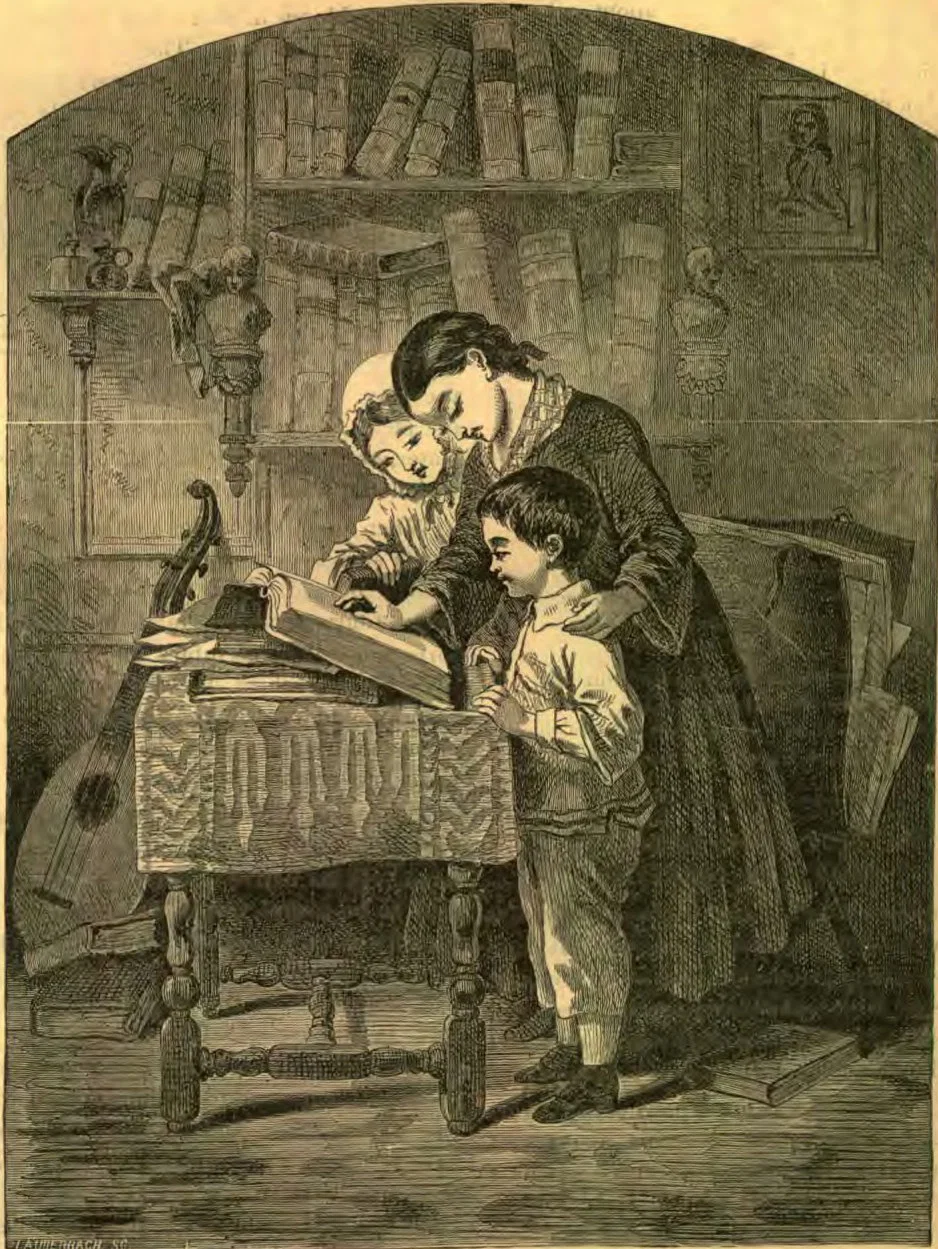
How many of the readers of the INSTRUCTOR are like the children whose faces we see in this pleasing picture? That is, earnest and interested readers of the Bible? We hope that the whole INSTRUCTOR family are of this kind; for the Bible has claims upon us which no other book has.
Do you want to know which is the best book in all the world? It is the Bible. Which is the most interesting book? The Bible. Which is the oldest book? The Bible. Which contains the most ancient history? The Bible. Which contains the prettiest and most charming stories for children? The Bible. Which contains the purest precepts, and the plainest rules how to be good and holy? The Bible. What book alone explains about sin, and life, and death, and Heaven, and hell? The Bible.
But it is not all this alone which makes the Bible the most important of all books. It is because it is God’s book, and tells us what God wants us to do. When we come to feel that this book contains the will of our Maker, then it has charms for us which no other book possesses. It tells us how sin has come into the world, and how we have become defiled with it, and how we may get rid of it, and be saved and happy in his kingdom forever.
The Bible is, in many other respects, the most wonderful volume that was ever written. Many of the writers whose books compose the Bible never saw each other. They lived in different ages, separated by hundreds of years. They lived in different countries, separated by hundreds of miles. They wrote under all kinds of circumstances; in riches, in poverty; at home, in exile; in kings’ palaces, and in dungeons; yet they all agree in what they write. It was more than fifteen hundred years after the first book of the Bible was written before the last was completed, the truth being brought out from age to age just as men needed it, and were prepared to receive it. But all this while its testimony is uniform, and one object is kept steadily in view; namely, to make men better, to lead them from sin to holiness, and show them how to gain Heaven at last.
All this could not have been the case if the Bible was the work of men. We can account for this harmony and uniform tendency only on the ground that it is the work of God, who saw the end from the beginning, and who is the same in all ages.
The world owes all its progress, refinement, and civilization, to the Bible. For in those countries where the Bible is not found, the people are low and degraded, half-civilized or savage; and wherever the Bible is introduced in these heathen lands, civilization and progress at once begin.
Then ought we not to love the Bible, and study it, till we know all about what it teaches? Yes, just as they are doing in the picture. Let our music stand one side, and let other books remain unopened, till we have first learned a good lesson from the precious Bible. Youth is just the time to acquire a love for this good book. Three chapters read on every week day, and five every Sabbath, will take you through the entire Bible in a year. U. S.

THE BIBLE.

Thy word is like a garden, Lord, With flowers bright and fair; And every one who seeks may pluck A lovely nosegay there.
Thy word is like a deep, deep mine; And jewels rich and rare Are hidden in its mighty depths, For every searcher there.
Thy word is like the starry host: A thousand rays of light Are seen, to guide the traveler, And make his pathway bright.
Thy word is like a glorious choir, And loud its anthems ring; Though many tongues and parts unite, It is one song they sing.
Thy word is like an armory, Where soldiers may repair, And find, for life's long battle-day, All needful weapons there.
Oh, may I love thy precious word, May I explore the mine, May I its fragrant flowers glean, May light upon me shine!
—Edwin Hodder.

THE VICTORIA REGIA IN GOLDEN GATE PARK, SAN FRANCISCO.

Golden Gate Park is about five miles from the heart of San Francisco. It comprises a large, mountainous tract of country, covered with native and foreign trees and shrubs. Excellent carriage-roads and walks wind around the hills in every direction.
My attention was principally attracted by a large conservatory, covering an area of about an acre. This building contains a variety of tropical plants and flowers. Among other curiosities I saw a cactus twelve feet high and eighteen inches in diameter; also the ginger plant from the Sandwich Islands. The blue lily of the Nile, called the rose of Egypt, with many other plants mentioned in the Bible, interested me very much. Visitors are strictly forbidden to touch the plants, but through the courtesy of Mr. Monroe, the superintendent, I received several choice flowers, with much interesting information concerning them.
At the time of my visit, on the evening of Sept. 11, the conservatory was lighted by forty Chinese lanterns, and three headlights, such as are seen on locomotives, making it nearly as light as day. A public announcement had been made that at 8 P. M. the Victoria Regia would be in full bloom. It is said that there are but three of these plants in the country, and I gladly availed myself of the opportunity to see so rare and beautiful a specimen of the vegetable creation.
On account of its size, beauty, and rich fragrance, the Victoria Regia is called the queen of lilies, and also of all aquatic flowers. It was first discovered about seventy years ago, in Central America, and was afterward found in different parts of South America. In 1849 it was carried to England and placed in the royal gardens.
The habits of this plant are somewhat singular. It will grow from the seed, and begin to bloom in about four months from the time of planting. The seed should be planted in April, and the flowers appear in August and September. A single plant bears, the first year, from twenty-five to thirty blossoms, on separate stalks; it has fewer the second year, and ceases to bloom after the third year, although it has been known to live on for twenty years. The flower is in full bloom in forty-eight hours after it begins to unfold. It opens in the night, and partially closes during the day. When in bloom, it rises on its stem about nine inches above the water, as if to say, Behold the beauty with which the wisdom of God has clothed me!
When examined under a microscope, this flower surpasses in richness all others which I ever beheld. The full-blown flower is about fourteen inches in diameter, and in form and color resembles the white water-lily. On the third day the petals change to pink, and on the fourth day the flower closes, and sinks below the surface of the water, nevermore to rise.
The leaves of the plant are round, tough, very large, and flat, with a rim around the edge. In its native country the leaves are said to be twelve feet in diameter, and are sometimes used instead of boats for a short ride on the water. The plant which I saw had seven leaves, the largest about seven feet in diameter. They supported the weight of a person weighing one hundred and ten pounds. The upper side of the leaf is green and smooth; the under side is dark crimson, and covered, along the veins, with strong prickles. From the time the leaf makes its first appearance it is fourteen days in reaching its full size.
As I looked upon this magnificent plant I could but think, if this earth, which for six thousand years has groaned under the curse, can now produce flowers of such beauty, what will the new earth bring forth, after having received the finishing touch of the Divine Architect!
S. N. HASKELL.

IRON SHOD.

The safety of a mountain-climber depends upon being well shod. Therefore the Swiss guides wear heavy shoes with sharp spikes in the soles.
On a bright July morning, a famous scientist of England started with two gentlemen to ascend the Piz Morteratsch, a steep and lofty snow mountain in Switzerland.
Though experienced mountaineers they took with them Jenni, the boldest guide in that district. After reaching the summit of the Morteratsch, they started back, and soon arrived at a steep slope covered with thin snow. They were lashed together with a strong rope, which was tied to each man’s waist.
“Keep carefully in my steps, gentlemen,” said Jenni; “for a false step might start the snow and send us down in an avalanche.”
He had scarcely spoken when the whole field of snow began to slide down the icy mountain-side, carrying the unfortunate climbers with it at a terrible pace. A steeper slope was before them, and at the end of it a precipice! The three foremost men were almost buried in the whirling snow. Below them were the jaws of death. Everything depended on getting a foot-hold.
Jenni shouted loudly, “Halt, halt!” and with desperate energy drove his iron-nailed boots into the firm ice beneath the moving snow.
Within a few rods of the precipice, Jenni got a hold with his feet, and was able to bring the party up all standing, when two seconds more would have swept them into the chasm.
This hair-breadth escape shows the value of being well shod when in dangerous places. Life is full of dangerous places, especially for the young. No boy is prepared for perilous climbing unless he is well shod with Christian principles. Sometimes temptation ices the track under him, and then he must plant his foot down with an iron heel or he is gone.
A poor boy of my acquaintance signed a pledge never to taste liquor. One day his rich employer invited him to dinner. There was wine on the table, but the lad was not ashamed to say,
“No, I thank you, sir. I never touch it.”
Then came on a rich pudding, which the boy tasted, and finding that there was brandy in it he quietly laid the tasted morsel back on his plate. The employer discovered that the boy had “pluck” enough to stand by his convictions, and he will never be afraid to trust him. He is a sure-footed boy.
God knows what steep places lie before us. He has provided the “shoes of iron and brass” for us to put on. They are truth, and honesty, and faith, and courage, and prayer.
A clear conscience will keep the head cool. And up along the hard road there is a sign-board, on which is written in large letters, “He that walketh uprightly, walketh surely.”—T. L. Cuyler.

TRUST

I know not what the future hath Of marvel or surprise, Assured alone that life and death God’s mercy underlies.
And so beside the silent sea I wait the muffled oar; No harm from Him can come to me On ocean or on shore.
I know not where His islands lift Their fronded palms in air; I only know I cannot drift Beyond His love and care.—Whittier.

LESSONS FOR CHILDREN.

LESSON XLII.—DAVID'S SIN AND ITS PUNISHMENT.

David did one thing that displeased the Lord greatly. Uriah was a faithful soldier in David's army, and David told Joab, the captain of the host, to put him in the front of the battle, that he might be slain. This he did because he wanted Uriah's wife, who was a very beautiful woman.
“And the Lord sent Nathan unto David. And he came unto him, and said unto him, There were two men in one city; the one rich, and the other poor. The rich man had exceeding many flocks and herds; but the poor man had nothing, save one little ewe lamb, which he had bought and nourished up; and it grew up together with him, and with his children; it did eat of his own meat, and drank of his own cup, and lay in his bosom, and was unto him as a daughter. And there came a traveler unto the rich man; and he spared to take of his own flock, and of his own herd, to dress for the way-faring man that was come unto him; but took the poor man's lamb, and dressed it for the man that was come to him. And David's anger was greatly kindled against the man; and he said to Nathan, As the Lord liveth, the man that hath done this thing shall surely die; and he shall restore the lamb fourfold, because he did this thing, and because he had no pity. And Nathan said to David, Thou art the man. Thus saith the Lord God of Israel, I anointed thee king over Israel, and I delivered thee out of the hand of Saul; and I gave thee thy master's house, and thy master's wives into thy bosom, and gave thee the house of Israel and of Judah; and if that had been too little, I would moreover have given unto thee such and such things. Wherefore hast thou despised the commandment of the Lord, to do evil in his sight? Thou hast killed Uriah the Hittite with the sword, and hast taken his wife to be thy wife, and hast slain him with the sword of the children of Ammon. Now, therefore, the sword shall never depart from thine house; because thou hast despised me, and hast taken the wife of Uriah the Hittite to be thy wife.”
“And David said unto Nathan, I have sinned against the Lord.” And Nathan told David that the Lord would forgive him, and permit him to live. This shows that David must have truly repented of his great sin, or the Lord would not have forgiven him. The bad influence of it, however, could not be prevented. Nathan refers to this when he says, “Howbeit, by this deed thou hast given great occasion to the enemies of the Lord to blaspheme.”
The trouble which David afterward had with his son Absalom must have led him to think of his own sins, and to see how great they had been.

QUESTIONS.

  1. What great sin did David commit? 2 Sam. 12:9.
  2. What way did the Lord take to reprove him? Verses 1-14.
  3. Relate the parable which Nathan put forth to David.
  4. How did David feel toward the rich man who had taken the poor man's lamb?
  5. What did he say should be the fate of the man who had done this thing?
  6. What did Nathan then say to David?
  7. What did he say the Lord had done for him?
  8. How had David shown that he despised the commandment of the Lord?
  9. How did he say David should be punished? Verse 10.
  1. What did David say to Nathan? Verse 13.
  2. What did Nathan say the Lord would do?
  3. What does this show?
  4. Could the bad influence of David's wrongdoing be prevented?
  5. How does Nathan refer to this?
  6. Who afterward made David much trouble?
  7. What would such trouble be likely to bring to his mind?

BIBLE LESSONS FOR YOUTH.

LESSON LXVIII.—DAVID'S DESIRE TO BUILD THE TEMPLE.

  1. Who had taken the ark of God from the Israelites? 1 Sam. 4:1–11.
  2. Tell how it was taken.
  3. Why were the Philistines unable to keep the ark? Chap. 5.
  4. What did they do with it? Chap. 6:1–12.
  5. What happened to the men of Beth-shemesh? Verses 13–21.
  6. Where was the ark next taken? 1 Sam. 7:1.
  7. In whose house was it kept?
  8. How far from Kirjath-jearim is Jerusalem?
  9. After the ark had remained many years in the house of Abinadab, what preparations did David make for removing it? 2 Sam. 6.
  10. Who had been appointed by the Lord to carry the ark? Num. 4:4–19.
  11. How were they to bear it? Chap. 7:9.
  12. What had they been forbidden to do?
  13. Did David obey these instructions?
  14. In what way did he attempt to remove the ark?
  15. What was the consequence?
  16. What effect did this have upon David?
  17. Where did he leave the ark?
  18. How long did it remain there?
  19. Describe the removal of the ark from the house of Obed-edom to Jerusalem.
  20. After David had built himself a house, what did he wish to do? 2 Sam. 7.
  21. What did he say to Nathan the prophet?
  22. What reply did Nathan make?
  23. What did the Lord say to Nathan that same night? 1 Chron. 17:4.
  24. Why did not the Lord wish David to build him a house? Chap. 22:8.
  25. Whom did the Lord say should build it? Verses 9, 10.
  26. What nations did David afterward subdue? 2 Sam. 8.
  27. What did he take from them?
  28. How did he dispose of these rich treasures? Verses 10, 11.
  29. In speaking to Solomon, what did David say of the preparations he had made? 1 Chron. 22:14.
  30. What is the estimated value of the gold and silver that David had laid up?

SYNOPSIS.

Although the Philistines had taken the ark of God, as before noticed, they could not keep it; for wherever it was taken, the people were grievously afflicted. So they returned it to Beth-shemesh, where many of the Israelites were smitten for looking into it.
From Beth-shemesh, the ark was taken to Kirjath-jearim, a small town about nine miles west by north from Jerusalem. There it remained in the house of Abinadab many years. Finally, David, gathering the priests and Levites, the officers of the army, and all the chief men of Israel, went to Kirjath-jearim to bring the ark of the Lord up to Jerusalem.
Now the Lord had appointed the Kohathites to bear the ark upon their shoulders. But even they were not allowed to touch the ark itself, or even to look upon it, under pain of death. David, not heeding the instructions which the Lord had given him, had the ark put upon a cart drawn by oxen; and when the oxen stumbled, Uzzah, who was driving them, took hold of the ark to steady it. For this rash act he was smitten of the Lord, and died upon the spot. This made David afraid; and, turning aside, he left the ark in the house of Obed-edom, where it remained three months. At the end of this time, David, accompanied by the priests and Levites, took the ark from the house of Obed-edom, and conveyed it in a proper manner to Jerusalem. There he kept it in a tent which he had made for that purpose.
Having built himself a palace, and being at peace with all his enemies, David had a desire to build a house for the Lord. He said to Nathan the prophet, “See now, I dwell in a house of cedar, but the ark of God dwelleth within curtains. And Nathan said to the king, Go, do all that is in thine heart; for the Lord is with thee.” But that same night the word of God came to Nathan, saying, “Go and tell David my servant, Thus saith the Lord, Thou shalt not build me a house to dwell in.”
David had been a man of war, and the Lord thought it improper for one who had shed so much blood to build the temple; yet promised that his son Solomon should build it.
After this, David had many wars, and was very successful in them all. He subdued the Philistines, the Moabites, and the Syrians, as well as Hadadezer, the king of Zobah. From these nations he took very much gold, and silver, and brass, all of which he dedicated to the Lord to be used in building a house for him.
In his charge to Solomon, he says, “Now, behold, in my trouble I have prepared for the house of the Lord a hundred thousand talents of gold, and a thousand thousand talents of silver; and of brass and iron without weight; for it is in abundance: timber also and stone have I prepared; and thou mayest add thereto.” The value of the gold and silver alone would be not less than four billion two hundred million dollars, and some estimate it much higher than this.
Note.—It might be interesting to calculate the time it would take a person to count such a sum, counting one dollar every second for ten hours each day.
G. H. BELL.

THE TEACHER'S EYE.

It is with the eye that the teacher will most readily and accurately keep himself informed as to the degree of attention which his pupils are paying to the exercises in which they are engaged. You will see at a glance whether they are following you, or whether, through inability to understand your meaning, or through distraction, their minds are wandering. Your eye, then, is your sentinel. But it is capable of much more than informing your mind of what is going on in your class. It will convey and emphasize your commands. Look what you mean when you give a command, and your words will be obeyed. Very often it will be needless to employ words at all. A look will suffice to express your wish and the intensity of the will that lies behind it. It will compel attention silently and promptly, without interruption to the exercise in hand, and without needless expenditure of physical energy. It will encourage and stimulate, admonish and rebuke, with a delicacy far beyond the power of language. Perhaps the most affecting of the reproofs given by the Divine Teacher was that referred to in the words, “The Lord turned and looked upon Peter.”—School Guardian.

Estimated Need for Bibles Worldwide

It is said that a careful estimate respecting the circulation of the Bible during the past century, places it at the enormous number of nearly 150,000,000 copies. Yet large as that number is, ten times as many would be necessary to supply every soul with the word of God, requiring 1,402,295,000 copies of the Bible, distributed as follows: For Europe, 306,800,000; for Asia, 804,000,000; for Africa, 200,000,000; for Australia and Polynesia, 4,865,000; for America, 86,630,000.

A WONDERFUL CLOCK.

The great clock at Strasburg, so long considered one of the wonders of the world, has recently been quite eclipsed by the work of a Detroit artisan. The American National and Astronomical Clock, as it is called, is now on exhibition in Chicago, and is the admiration of all who have seen it,—a marvelous triumph of skill, ingenuity, and patient labor.
Felix Meier, the inventor, is a Bavarian by birth. He came to this country about thirteen years ago, and for nearly ten years he has been employed on his great work.
This clock tells not only the hours and minutes of the day, but the days, weeks, months, and seasons of the year, the correct movements of the sun and moon, the earth and other planets, for 200 years, including leap-years, and shows many things besides.
It is 18 feet in height, and of handsome proportions; the framework is of black walnut, elegantly carved.
In the place usually occupied by the dial is a huge “basin,” or circular recess, with a blue back-ground studded with silver stars; a large brazen ball in the center represents the sun, around which all the planets revolve. Arranged around this circle, on the frame-work of the clock, are thirteen small dials, which tell the time of day at all the great cities of the world.
On a marble dome above the circle sits Gen. Washington in his chair of state, protected by a canopy. On each side of the main body of the clock are carved niches containing human figures emblematic of the march of life. These figures have bells and hammers in their hands.
At the end of every quarter-hour an infant in his niche strikes with a tiny hammer on the bell which he holds in his hand; at the end of each half-hour a youth strikes; at the end of three-quarters, a man; at the end of each hour, a graybeard. A grinning skeleton representing Father Time then follows with a measured stroke to toll the hour, a carved angel on each side of him flaps his wings to show that “time flies,” and a large music box begins to play.
Washington then rises from his chair, and a door on the left is opened by a negro servant to admit a long line of presidents, including President Hayes, each dressed in the costume of his time. They pass in file before Washington, bow, and disappear through an opposite door, which is closed behind them by a second servant. Washington then sinks back into his chair, and all is quiet save the tick of the huge pendulum and the ringing of the quarter-hours, until another hour has passed.
You will all agree that this clock is worthy of the praise which it has received. But all its beautiful carving and nicely adjusted machinery cannot be compared with the wonderful mechanism of the human body. This masterpiece of the Creator’s skill should receive our most careful study; for a knowledge of its laws will enable us to live happier and more useful lives here, and will be an important aid in securing immortal life hereafter.
M. A. D.

HOW STRONG IS GOD?

“How strong is God, papa?” asked Willie Dale,—“strong as a giant?”
“Who made giants?” said his father.
“Why, God, of course,” answered Willie.
“Then will not God be stronger than the men he makes?” asked papa.
“Yes, sir. But, then, how strong is God?”
“Stronger than all men put together,” said Mr. Dale; “stronger than all angels and devils; strong enough to dash all the worlds and every living thing to pieces in a moment.”
“I’m afraid of him,” said Willie, nestling to his father’s side.
“You need not be, dear. He is strong enough to keep you safe.”
“But I am a naughty boy sometimes,” said Willie;
“Well, God loves you, and he is strong enough to make you a good boy. Ask him to take you for his own. Let him help you to be good; and then God will be on your side.”—Little Folks.

LETTER BUDGET.

More than forty dear boys and girls will no doubt be disappointed that their names do not appear in print; but, as we have said before, we must have more variety in the INSTRUCTOR than to fill a column with letters which, with the exception of name and P. O. address, read almost exactly alike. We need your letters, little friends, to enliven the “Letter Budget.” Try again, and let us have other items of interest in your home lives to add to what you have already written.
ARBORVILLE, NEB.
DEAR EDITORS: Cousin Nellie received the September number of the INSTRUCTOR, but for some reason, I have not. I have taken the paper since last October, but I don’t know how I can take it another year, for the hail came the fourth day of July and destroyed our crops. My pa is now forty miles from home, earning something to live on. He is coming home in time to take us to camp-meeting. Ma sends all of my papers to friends who do not take the paper.
ANNIE B. HAYDEN.
We will send Annie the weekly INSTRUCTOR the coming year. This afflicted family will receive the sympathies, and we trust the prayers, of the 10,000 members of the INSTRUCTOR family. We hope their temporal wants will be supplied, and that their affliction will lead them very near to God. We are living in a time of great destruction of life by accident, by pestilence, and by commotions in the physical world. May we all learn the lesson designed for us,—not to put our trust in perishable things, but in the living God.
BRISTOL, ILL.
DEAR EDITORS: I have thought for some time that I would write a letter for the INSTRUCTOR, and will now do so. I took the monthly last year, and liked it very much. This year my little brother takes the weekly, and we are both much pleased with it. I am 14, and my brother 10, years of age. We keep the Sabbath with our parents, and we hope to be able to keep all of God’s commandments, and to meet all the INSTRUCTOR family in the new earth.
WILLIAM W. ROBINSON.
Since writing his letter, Willie Robinson has moved from Illinois to Battle Creek, and has become a member of our Sabbath-school. Dear boy, we hope your influence will ever be on the side of right, and that you will be an ornament to the society into which you are now thrown.
M. J. C.

AN AUTUMN SONG.

There's a song, little boy, for the autumn time, When the forest is growing red, And the acorns drop through the smoky air From the brown old oak-tree's head; When the hazel branches are bending low Beneath the burden they bear, And the squirrel is leaping from bough to bough Where the ripening beech-nuts are!
Here's a race, little boy, with the autumn leaves, As they frolic and flutter away; There, through the clustering forest-trees, Here, where the brooklets play! Up on the hill-side, down in the dell, How they rustle wherever we tread! How they race before, how they chase behind! How they dance in the air o'erhead!
Here's a shout, little boy, with the autumn wind, Oh! a wonderful voice hath he; And a strong, strong arm, as he wrestles and tugs At the top of yon old pine-tree! Now sighing, now shouting, now singing he goes, So changeful, so musical still; Oh, a merry hurrah for the wind that blows So blithely o'er valley and hill!
Here's a hymn, little boy, for the autumn time,— A hymn to the Giver of all; Of the sun that shines in the soft southwest, Of the many-hued leaves that fall, Of the fruits that hang on the bending trees, Or drop in our hands below,— To the loving Father who gives us these, Let our glad hymns overflow!
—Selected.

You have reached the end of this edition.

The Youth’s Instructor · Oct 22, 1879