The American Sentinel, Vol. 8, No. 29.

Where are the Christians in the United States?
Earlier text: Where are the Christians in the United States?

“Jeroboam Has Followers Yet.”

THE above quotation is the closing sentence in an article entitled, “Seventh-Day Adventism,” and signed “Truth,” published in the Kent News, of Chestertown, Md., July 1, 1893. In order that all may see the “truth” in that statement we will look at the history of Jeroboam and compare it with his “followers.” Yet Jeroboam was chosen to reign over ten tribes of Israel. After a period of prosperity he began to fear the people under his charge would revolt, “Whereupon the king took counsel and made two calves of gold and said unto them, It is too much for you to go up to Jerusalem; behold thy gods, O Israel, which brought thee up out of the land of Egypt.” Having substituted false gods in place of the true the king next appointed a feast day in their honor and for their worship. “And Jeroboam ordained a feast in the eighth month, on the fifteenth day of the month, like unto the feast that is in Judah. . . . So he offered upon the altar which he had made in Bethel the fifteenth day of the eighth month, even in the month which he had devised of his own heart.” 1 Kings 12:28, 33.
It will be observed that the Lord had appointed a feast on the fifteenth day of the seventh month, but the king Jeroboam, had appointed his feast day on the fifteenth of the eighth month. No doubt he “devised of his own heart” that the particular day God had commanded was not so worthy of regard as the one ordained by himself to commemorate the deliverance of the people from Jewish customs into the fuller liberty he had inaugurated. One thing however troubled him; there were men that would not join in this idolatry, for we read: “And behold there came a man of God out of Judah by the word of the Lord unto Bethel; and Jeroboam stood by the altar to burn incense. And he cried against the altar in the word of the Lord, and said, O altar, altar, thus saith the Lord; behold, a child shall be born unto the house of David, Josiah by name; and upon thee shall he offer the priests of the high places that burn incense upon thee, and men’s bones shall be burnt upon thee.”
This was more than the king could endure. Here was a man preaching against the religious laws of the land and refusing to obey the king and magistrates in that respect. The peace and dignity of the nation demanded prompt action, so, “It came to pass, when king Jeroboam heard the saying of the man of God, which had cried against the altar in Bethel, that he put forth his hand from the altar, saying, Lay hold on him.” Jeroboam had the law on his side, and he did not propose to have his holy days denounced, so he gave orders for the prophet to be arrested. Perhaps he reasoned that this was not persecution, it was only enforcing the law.
Now let us apply these principles in the career of Jeroboam, to the two classes mentioned by “Truth” and see where “Jeroboam’s followers” are found. Evidently the writer of the article mentioned, intended the sentence to apply to Seventh-day Adventists, whom he accuses of doing a “nefarious work.” Is it the case that Seventh-day Adventists have gained control of the civil power and are now using it for the arrest of those who differ with them in religious faith and practice? Such a thing has never been known, and they repudiate any desire for such authority. They are not followers of Jeroboam in that respect. How is it in reference to the holy-days commanded by the Lord, have they substituted some other days? Their very name signifies that they observe for the Sabbath the very day of the week commanded by the law of God. In fact “Truth” acknowledges that therein lies their chief offense; he says:—
Their mischief comes of their teaching in reference to the Sabbath day. They seek to show the unwary that unless we keep the seventh day instead of the first, they violate the law, and in so doing they are an unpardoned sinner before God, no matter how strictly they may keep the other provisions of the sacred Scriptures.”
Certainly then they are not the followers of Jeroboam in this particular. We are compelled, therefore, to see if the application will fit any better when used to describe “Truth” and his fellow-men. The first thing that meets our view is that “Truth” desires the first day of the week to be kept holy instead of the seventh—“devised of his own heart”—that this day is more fitting for Christians than the one sanctified by the Lord. It certainly looks as though Jeroboam had many followers, and “Truth” may be hit by his own boomerang. Again it will be noticed that “Truth” and his followers have secured the aid of civil laws to enforce their so-called holy-day, thus proving their kinship with Jeroboam. Another feature of resemblance is that they are greatly disturbed because some prophet of the Lord speaks against their man-made institutions. Then “Truth” after severe censure for such “nefarious work,” says:—
And if such teachings are not stopped matters will grow worse. How long our rulers mean to endure all this, and how long our tax-payers are willing to pay the constantly increasing cost of court expenses these men are imposing on the people, remain to be seen.”
And then the next sentence is “Jeroboam has followers yet.” Whatever he meant, the only correct idea to be drawn from his words and its illustration is, that just as Jeroboam stretched out his hand and said, “Lay hold on him,” so “our rulers” are to say, Lay hold on the men that speak against our Sunday laws; and “Truth” wants to know how much longer they will wait before measures to stop such teaching shall be made.
Verily Jeroboam has many followers, and “Truth” is one of them. It may, therefore, be well for us to see the result of the king’s effort. “And his hand, which he put against him dried up, so that he could not pull it in again to him.” So our modern Jeroboams by invoking the sword are quite likely to perish with the same weapon. When they have stretched out their hand against Adventists they may not be able at pleasure to pull it in again. Then the king asked the man of God to entreat for him that his hand might be restored and it was done. But, alas! when his followers shall find themselves overtaken by the righteous judgments of God, and shall wander from sea to sea seeking some man of God to give them the word of the Lord, it will then be too late. Oh! that the followers of Jeroboam might now listen to those who plead for Jehovah and his word.
H. E. ROBINSON.

Church and State in North Carolina.

THERE is no question of deeper interest to the provinces of the Canadian Dominion or to any country which at present lies outside the boundaries of the United States, than the inquiry, What would be the rights of such province or country with respect to provisions concerning religion within its territory? So far as the Federal Government is concerned, that, as we know, is debarred from touching the matter, by the First Amendment to the Constitution, which declares that Congress shall make no law respecting an establishment of religion or prohibiting the free exercise thereof. That limitation on the powers of Congress is largely due to the course taken by North Carolina, which, as is well known, refused to adopt the Constitution, unless supplemented by amendments of which this was the chief. The fact shows that North Carolina was determined to reserve to itself as a State, the exclusive right of regulating religion; and, for that reason, the record of the relations of Church and State in that commonwealth is peculiarly instructive. The subject has recently been discussed at length and with singular lucidity by Prof. Stephen B. Weeks in a contribution to the series of the Johns Hopkins studies in historical and political science.
In North Carolina, as in Virginia, the Church of England was by law established up to the outbreak of the Revolution, and the abolition of it was one of the first steps taken in each State by the Convention called to frame a Constitution. That a majority of the inhabitants of North Carolina were Dissenters through the greater part of the colonial epoch is proved by the extreme difficulty, not to say impossibility, of levying tithes and providing other resources for the maintenance of the Anglican clergy. Nevertheless, although the payment of tithes could be evaded, there were other hardships and disabilities which Dissenters, including Presbyterians, as well as Baptists, Methodists, Quakers, Moravians, Mennonites, Dunkards, Unitarians and Catholics could not avoid. All these nonconformists suffered from the muster law, by which a distinction was made in favor of the clergymen of the Church of England and against dissenting ministers. Then, again, although Scotland was supposed to enjoy equal rights with England in the colonies, even Presbyterian ministers were not allowed to perform the marriage ceremony till 1766; and, when they did perform it, the fee went to the local minister of the Church of England. To other dissenters, Quakers excepted, this right was not conceded before 1776. Worst of all was the enforcement in North Carolina of the Schism act, repealed in England in 1718, which prohibited any one from keeping a school in the provinces unless he had obtained a certificate from the Anglican authorities. There is not a doubt that the enforcement of this act up to the period of the revolutionary war, through the widespread ignorance which it engendered, is directly responsible for the large percentage of illiteracy, and for the backwardness of intellectual activity characteristic of the State to-day.
If the Revolution really began in North Carolina, as the natives of that State contend, it was because the people were even more inflamed by a desire for religious freedom than by the wish for political independence. The Bill of Rights and State Constitution, adopted by the Provincial Congress at Halifax in December, 1776, asserted the natural and inalienable right of men to worship Almighty God according to the dictates of their own consciences. It was further laid down that there should be no establishment of any one religious church or denomination in the State of North Carolina in preference to any other. Neither should any person, on any pretense, be compelled to attend any place of worship contrary to his own faith or judgment, or be obliged to pay for the purchase of any glebe or the building of any house of worship, or the maintenance of any minister, contrary to what he believed right, or had voluntarily and personally engaged to perform. On the contrary, all persons should be at liberty to exercise their own mode of worship. These declarations involved the downfall of the Established Church. It only remained for the laws of the new State to be brought into conformity with the new Constitution. Marriage was put on a proper footing in 1778, by a law giving the privilege of performing the ceremony to all ministers alike. Next, the terms of the affirmation for Quakers, Moravians, Mennonites, and Dunkards were fixed. The restriction of school teaching to men fortified with the certificate of the Anglican authorities, of course, disappeared, and the law respecting the care of the orphan children of Quakers was repealed.
It is evident that North Carolina, from the moment that it declared itself an independent State, asserted an exclusive and unchallenged authority over religious matters. It could, had it so chosen, have retained the establishment and endowment of the Anglican or Episcopal Church. It might have established the Presbyterian Church, as it was then, and is still, established in Scotland. It might have given Calvinists of the Congregational type the same privileges which they enjoyed at the time in the Colony of Massachusetts. It might, had a majority of the colonists been Catholics, have made Catholicism the religion of the State. It did none of these things; but, in its fundamental organic law, it made, as we have seen, a close approach to universal toleration. Nevertheless, there was one provision, which, in process of time seemed to require amendment. The thirty-second section of the State Constitution of 1776 read as follows: “No person who shall deny the being of God or the truth of the Protestant religion or the divine authority either of the Old or New Testament, or shall hold religious principles incompatible with the freedom and safety of the State, shall be capable of holding any office or place of trust or profit in the civil department within the State.” As time went on, there were various interpretations of this section. One theory held that it clearly excluded atheists and such deists as made a parade of their infidelity by proclaiming the Scriptures to be false. Others thought that it disqualified Jews also, on the ground that the latter must necessarily deny the divine authority of the New Testament. Still others maintained that Quakers, Mennonites, and Dunkards were disqualified, because their belief that arms cannot lawfully be used in defense of one’s native country is subversive of its freedom and repugnant to its safety. Many lawyers declared, and their views seem to have been followed in practice, that the clause in question excluded nobody; that for want of a specified tribunal to expound and enforce it, the provision was a dead letter.
There is no doubt that the clause had been aimed at Roman Catholics. But it had never been interpreted against them. Thomas Burke, who publicly professed the Catholic faith, was a member of the Continental Congress from South Carolina, and, in 1781, was elected Governor of the State. There was no State office, from that of Governor down to that of constable, which had not, at one time or another, been filled by a Catholic. Perhaps the most distinguished of these was William Gaston, who had been successively a member of the State Senate, a representative in Congress, and a Justice of the State Supreme Court. No complaint was made when Judge Gaston assumed his seat upon the bench; nevertheless, it was thought best to amend the section in question when the matter came up in the Constitutional Convention of 1835. In the Constitution of North Carolina, framed and adopted then, the word “Christian” was substituted for “Protestant”; and thus, in the words uttered by Judge Gaston at the time, was the carcass of the last remnant of religious persecution interred, lest its pestilential effluvia should poison the atmosphere of freedom.—N. Y. Sun, June 16.

Religious Power Should Not Rely on the State

WHEN a religious organization resorts to the law to compel recognition of its tenets or customs, it proves its spiritual power to be at a low ebb. When it must have the aid of the State in the way of laws exempting its property from taxation, soldiers and police to enforce its Sabbath regulations, grants of public money to support its institutions, and the like, there certainly is a screw loose in its spirituality somewhere. Some religious leaders are too eager to throw aside the sword of the Lord and of Gideon and seize upon the weapons which man hath fashioned by his own cunning.—Independent Herald, Bertrand, Nebr.

Is It Selfishness?

THERE are many selfish people in the world, but they can never see themselves that they are selfish. They think that everyone else is selfish and is trying to deprive them of their rights, but they cannot see that by their actions they are continually depriving others of their inalienable rights.
How is it with the Sunday-law advocate? He complains that because the World’s Fair is open on Sunday the rights of the “Christian people” of the country are infringed. He virtually says: “We, the Christian people of the land, have asked that the Fair be closed on Sunday, and our request should be granted; not only so, but every person should be compelled to keep the day we regard as sacred.” It matters not to him how much his fellow-man’s rights are infringed so long as his are not. There are thousands who do not believe in the sacredness of Sunday, but that makes no difference to the Sunday-law advocate. In his eyes the “insignificant minority” have no rights that should be respected. Is there any selfishness in this? Is there any Christianity?
Christians should be freest of all people, for the Author of Christianity says: “Whom the Son makes free is free indeed;” but is a man free when his conscience is tied by a certain set calling themselves Christians? He is not; he is a slave, and that of the worst kind; for if he persists in being loyal to God, then he must suffer the penalty. He is called a law-breaker; he is put into prison; and if he still persists in being free in matters of religion, then stronger measures must be taken. The Sunday-law advocate has gone even so far as to threaten the use of the sword and the bullet if he does not have his way. But Christ said, “All they that take the sword shall perish with the sword.” But to them that are persecuted for His sake He says: “Blessed are ye when men shall revile you, and persecute you, and shall say all manner of evil against you falsely, for my sake. Rejoice, and be exceeding glad: for great is your reward in heaven.”

EAGLE BRAND THE BEST ROOFING

Is unequaled for House, Barn, Factory, or Out-Buildings, and costs half the price of shingles, tin or iron. It is ready for use, and easily applied by any one. Send stamp for samples, and state size of roof. Address,
EXCELSIOR PAINT AND ROOFING CO., DEPT., 9, 155 DUANE STREET, NEW YORK, N. Y.

“EVERYBODY’S LAW BOOK”

Is the title of the new 768 page work prepared by J. Alexander Koones, L.L.B., member of the New York Bar.

It Enables Every Man and Woman to be Their Own Lawyer.

It teaches what are your rights and how to maintain them. When to begin a law suit and when to shun one. It contains the useful information every business man needs in every State in the Union. It contains business forms of every variety useful to the lawyer as well as to all who have legal business to transact. Enclose two dollars for a copy, or inclose two cent postage stamp for a table of contents and terms to agents. Address,
Benj. W. Hitchcock, Publisher, 385 Sixth Avenue, New York.

DUST-PROOF GOLD-PLATED CASE

AMERICAN WATCH AND CHAIN. PRICE, $1.50.

DUST-PROOF GOLD-PLATED CASE.
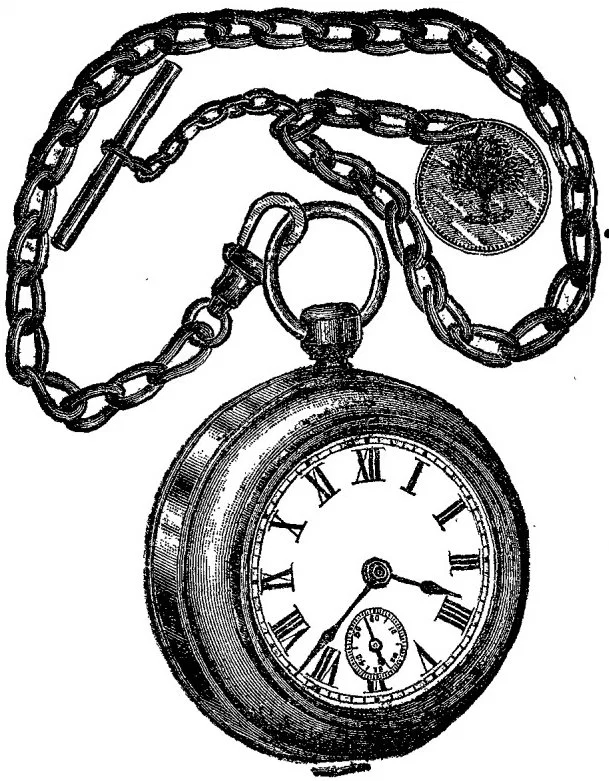
American Lever Movement, Patent Escapement and Regulator, Patent Winding and Setting Attachment Requiring no Key, 240 Beats to Minute; Hour, Minute, and Second Hands.
THE CHEAPEST GENUINE AMERICAN WATCH EVER SOLD.
Timed, Tested, and Regulated. EVERY WATCH GUARANTEED.
The case is strong and tight, of solid composition metal used the world over as a substitute for gold, with an Elegant Gold-plated Chain and Charm. Packed in a neat box and mailed to any address for $1.50 each; 3 for $4.00 by express; one dozen for $15.00 by express.

FULLY GUARANTEED TO KEEP ACCURATE TIME.

It is fully as durable as the most expensive watch, and with fair usage will keep good time for TEN YEARS. This watch is being manufactured in lots of 100,000 at the rate of 1,000 PER DAY by the largest watch manufacturing concern in the world. This constitutes the sole reason for its low price. It is a practical illustration of what may be done in this country by machinery and skilled operators when an article can be sold in large quantities. Its parts are not made by hand by “Pauper European labor” as are most of the cheap watches now sold, which never run long and can never be repaired. Automatic machinery does everything in this watch, and every part is as true as a die can make it. The movement is the same as in all American watches, and is readily understood and repaired by any jeweler. Every Watch Timed, Tested, and Regulated before leaving our hands, and carefully packed with chain.

A Few Testimonials for You to Read. We Have Them From Every State.

WEBB CITY, MO., Jan. 9, 1893. GENTLEMEN: I am much pleased with the Watch you sent me, and I will say it keeps right up on time. It has not varied any as yet. Most truly yours, DR. ANDERSON.
CARO, MASS., Jan. 6, 1893. GENTLEMEN: I take pleasure in saying the Watch you sent me gave perfect satisfaction. It is a good timekeeper and all you recommend it to be. You will be favored with an order from me soon. Yours truly, W. G. DONNELL.
CALDWELL, KANS., Jan. 3, 1893. SIRS: I received your Watch and found it to be as represented in the Twentieth-Century advertisement. It would be hard to improve on its time-keeping qualities. Yours truly, MOSES HINCHCLIFFE.
FORTE WAYNE, IND. R. H. Ingersoll & Bro., Room 44, 65 Cortlandt St., New York—Kind Sirs: It is a standing rule of mine when I see an admirable trait in any character, or a marked excellence in anything, to express appreciation either in public or in private. Taffy is better than epitaphy. Post-mortem praises do the dead no good. The corpse smells no flowers on its casket. Hence I want to say that I am delighted with your Watch—a little gem. I keep it on my typewriter desk during week-days, right before my eyes, and it keeps splendid time; I then use it on my pulpit Lord's days. Faithfully yours, REV. STEPHEN A. NEWMARK.
R. H. INGERSOLL & BRO., Sole Mfrs., Room 44, 65 Cortlandt St., New York.

THE BATTLE CREEK SANITARIUM HEALTH FOODS.

For more than sixteen years the Battle Creek Sanitarium has maintained a Health Food Department, at first for the benefit of its patients and patrons, later, and for more than a dozen years, with increased facilities, to supply the general public. Within the last year More than 150 Tons of the following named foods have been manufactured and sold:—
Oatmeal Biscuit, Rye Wafers, Medium Oatmeal Crackers, Fruit Crackers, Carbon Crackers, Plain Oatmeal Crackers, No. 1 Graham Crackers, Avenola, No. 2 Graham Crackers, Granola, Plain Graham Crackers (Dyspeptic), Wheat Granola, White Crackers, Whole Wheat Wafers, Gluten Biscuit, No. 1, Gluten Wafers, Gluten Biscuit, No. 2, Infants' Food.

Granola, The Gem of Health Foods.

Our Granola, which has now been manufactured by us for nearly seventeen years, is unquestionably the finest health food ever devised, and is greatly superior to any of the numerous imitations to which its success has given rise.
TO THE PUBLIC: This certifies that the Battle Creek Sanitarium Health Foods, manufactured by the Sanitarium under the name of the Sanitarium Food Company, are made under my direction and supervision, and that Granola and the other special foods manufactured by this company, are not made or sold by any other firm or person except their duly authorized agents. J. H. KELLOG, M. D.
Our goods are shipped to every part of the world—to Australia, New Zealand, India, Persia, and other foreign countries, as well as to all parts of the United States; and in every instance they have demonstrated their wonderful keeping properties. The following are a few of the hundreds of testimonials received from persons who have for years made use of our foods.
MICHIGAN.
I have for three years used the “Health Foods” in my family, and can heartily recommend them, both for purity and health-giving properties. C. F. PORTER, D. D. S.
INDIANA.
Your “Health Foods” are the wonder of the nineteenth century. I have used Granola but a short time, but have already experienced relief from indigestion and acid, or flatulent dyspepsia. I also find the Zwiebach nourishing and toothsome. D. M. KAUFFMAN.
I have personally tested your excellent food known as Granola. It is highly pleasing to the taste, easy of digestion, and the most nutritive cereal production with which I am acquainted. DR. R. W. BULA.
NEW YORK.
Your Granola is the best selling invalid food I have ever handled. I have already sold nearly two thousand pounds. A. J. BROUGHTON.
CONNECTICUT.
We have used your “Health Foods” in our family for three years, and can not get along without them. Having been troubled with dyspepsia and chronic inflammation of the stomach, I find that your Granola, Avenola, Wheatena, and Gluten are the only foods that I can eat with safety. WM. M. MERWIN.
OHIO.
Our baby is a testimonial to Sanitarium food. She is ten months old, weighs twenty-eight pounds, and is as ruddy and healthy a specimen as can be seen. She has actually gained flesh while cutting her last two teeth. Her flesh is firm and sound, and she is very strong. FRED. L. ROSEMOND.
MINNESOTA.
We have twins, and the little fellows are thriving nicely. The food agrees with them perfectly, and I have recommended it to many who are bringing up babies “by hand.” D. W. McCOURT.
We are constantly improving our foods, and adding to our list as the result of experimental researches conducted in the Sanitarium Laboratory of Hygiene and our Experimental Kitchen. For the latest descriptive circular and price list, address,
SANITARIUM HEALTH FOOD CO., Battle Creek, Mich.

A Word of Explanation.

WE are asked to explain the statement made two weeks ago in these columns to the effect that the Sunday closing proviso in the World's Fair bill “is in no sense law.” The phrase used did not express clearly the thought in the writer's mind. The act in question did not require the closing of the Fair on Sunday, but did propose to secure such closing by making it the condition of a gift. This was as far as Congress could go, for in no other way could Congress control the actions of a State corporation operating within the boundaries of a sovereign State. The act of Congress did however bind the Government, the legislative, judicial, and executive; and did just as fully commit the Government to the championship of Sunday as though in its terms it had been mandatory. The proviso is law, in just the sense that every other act appropriating money is law, when passed by both houses of Congress and signed by the President. This view of the matter is in perfect keeping both with all that the SENTINEL has ever said on the subject and with the legal decisions that have been had, excepting that of Judges Woods and Jenkins, which was overruled.
WE print on page 228 of this paper under the heading, “Persecuting Sabbath Keepers at Ford's Store, Md.,” an account of the trial of one Adventist before a Justice of the Peace at that place, and the postponement of another case, that of Mr. G. W. Marvell.
MR. MARVELL was arrested with only the pretense of a warrant. The paper which purported to be a warrant was not a warrant in any sense. Therefore, after taking the matter under advisement for one week, as related in the account given on page 228 by Mr. Ford, the justice issued a warrant and upon that Mr. Marvell was again taken into custody.
This case was tried on the morning of the 11th inst., and though there was no evidence to justify such a conclusion, Mr. Marvell was found guilty. The case was appealed. The fact is that it requires no evidence to convict an Adventist in Maryland of Sunday work. The charge is sufficient, and unless the accused can prove that he did not work, his conviction is a foregone conclusion.
In Mr. Marvell's case the constable who made the charge against him, and who arrested him, and who will get the fees, came to him the evening before the trial and said that he did not actually see him doing any work, and that if he would swear that he was not working that would settle it. This Mr. Marvell declined to do, and the next morning he was promptly convicted.
NOW the Mail and Express says that “Attorney-General Rosendale has sent a written opinion to President Huntington of the State Commissioners of Fisheries, to the effect that Sunday fishing does not come within the scope or meaning of the law for the protection and preservation of fish and game. He further declares that the provisions of the Penal Code, Section 265, as to fishing on the first day of the week, is an act for the observance of Sunday, but that the fish and game protectors have no statutory duty and possess no powers in respect thereto ‘more than any other citizen.’”
RHEA COUNTY, Tennessee, is about to proceed against those who do not square their lives by the established religion of the State, and keep the venerable day of the sun, the legal Sabbath of the State of Tennessee. In his charge to the Grand Jury at Dayton on the 3rd inst., Judge Traynor referred to the Seventh-day Adventists, ridiculed their observance of Saturday, and said that the Mormons might as well contend for the privilege of practicing polygamy. The Adventists have an academy at Graysville, in Rhea County, and as everywhere else their reputation for fair dealing, and exemplary lives is excellent. The only charge against them is concerning the law of their God. What the outcome of the judge's charge will be remains to be seen.
THE Sun, in some respects the best of the New York dailies, is very anxious for the annexation of Canada, or, as some prefer to call it, for political union of the Dominion with the United States. Three considerations are in Canada urged against political union with the States: (1) Loyalty to the British Crown; (2) Loss of national identity; (3) The provision of the Federal Constitution prohibiting any union of Church and State.
It is of course the Roman Catholics who object to political union with the United States on the ground last stated, namely because Congress is by the Constitution prohibited from making any law respecting an establishment of religion or prohibiting the free exercise thereof. And this objection the Sun undertakes to remove, not by showing the Romanists the iniquity of Church and State union, and the justice of religious liberty, but by assuring the papists of Quebec that their province could become a member of the American Union and still retain its ecclesiastical establishment. This is perhaps technically true, but it would not be true if the courts were to give to the First and Fourteenth Amendments the broad application of which they are capable. But whether true or not, it is a shame that a leading American newspaper should be willing to thus sell the American birth-right for a mess of popish pottage.
THE account which the Sun gives of the evolution of religious toleration in North Carolina is interesting; but it is a mistake to suppose that by substituting the word “Christian” for “Protestant” in the constitution of that State, “was the carcass of the last remnant of religious persecution interred,” even if Judge Gaston did say so. Jews and atheists are still under the same disability that Catholics were formerly, and the “pestilential effluvia” of persecution is just as likely to “poison the atmosphere of freedom” in that State to-day as it was before the constitution was amended by striking out the word “Protestant.” But the Sun's is the popish view of religious liberty, which Cardinal Gibbons has defined as “freedom to worship God according to the dictates of a right conscience,”—the Catholic Church, of course, to determine what is a “right” conscience.
THE Adventists are building a very nice little church at Ford's Store, Md., and some of the zealous Sunday keepers threaten to burn it down. One lady who makes a high profession in another church said she would furnish all the oil necessary to make sure work of it, or words to that effect. It is marvelous what some people will do in the interests of Christianity (?) and law (?).
SUNDAY closing seems about to be realized owing to lack of patronage of the Fair on that day. Closed buildings, covered exhibits, and the religious boycott, are strong arguments. Doubtless the churches will know how to use such weapons in the future even more effectively that in the case of the Fair.
APROPOS of the advertisement on another page is the following note, which speaks for itself:— “Box 107, Willow Lake, S. D., May 22nd, 1893. “Editors AMERICAN SENTINEL: I sent for one of those cheap watches on the strength of your advertisement, and it is ‘O. K.’ Thanks for advertising it. It is not a fraud. ‘evident’ nor otherwise. Those ‘unfriendly’ critics were too fast. ‘Slow to speak’ is a safe motto. “Yours for the right, “WM. JOHNSTON.”

You have reached the end of this edition.

The American Sentinel · Jul 20, 1893