Your ShelfYour Projects

Review and Herald, Vol. 81, No. 19.

Publishers' Page
Earlier text: Sanitarium Interests at Washington

Unconscious Teaching

MRS. D. A. FITCH
“MAMA wants to go over to Mrs. Smith’s a minute. Be good children, and I’ll be right back.” The mother left the house, not thinking of the promise she had just made, and like many another careless one, was totally unconscious of the lesson she was about to teach, which was one more added to scores of others of like character.
Five minutes pass, and the little ones wonder how long a minute really is. If it takes sixty such periods to make an hour, it is sincerely hoped mama will not ever say she is going away for that length of time. They have been taught never to meddle with the stove, but the wood has burned low, and the room is getting cold. Could the little children read the clock, they would find they had been alone nearly an hour. Some minutes more elapse, and the mother returns with never so much as an explanation of her long absence; so the children take it for granted she was gone only a minute.
It is nearing supper time, so Tom and Jennie are told to pick up and arrange their playthings, making ready for the evening meal with papa. “In a minute,” is the prompt reply; but measuring duration by mama’s scale, they think they yet have time sufficient for a long play.
The children have grown older by several years since the occurrence of the incident above mentioned, and find some of their amusements away from home with playmates no better versed in time observance than they are themselves. Having been taught to regard carelessly the passing of time, they are not to be depended upon to obey promptly or to keep promises with any degree of accuracy. These and kindred habits strengthen with their years, and go with them through life only to be reproduced in their children, unless the converting power of God’s grace shall eradicate false ideas and wrong habits from the mind and life.
Parents, be careful what kind of legacy you are preparing to leave your children; for every evil trait woven into their character must be eradicated therefrom, if they are finally saved with you in the kingdom of heaven. Upon your knees confess to them and to God your mistakes, asking for help that these wrongs and their dire results may be eliminated, and a pure record be written for you and your children in the heavenly books.

Some Causes of Typhoid Fever

L. A. S.
TYPHOID fever is commonly caused by the drinking of impure water, but certain other causes of this grave malady are being pointed out, to which it is well to call attention.

Whisky Drinking

That whisky drinking is a frequent cause of typhoid is asserted by Dr. George W. Webster, president of the Illinois State board of health. In a recent address before the Chicago Young Men’s Christian Association Dr. Webster said:—
“Do not drink whisky if you wish to avoid typhoid fever. It lowers the vitality and prevents perfect digestion, and there is nothing more conducive to stomach troubles than whisky. A low vitality and imperfect digestive organs invite typhoid fever.”

Oysters

Evidence of the connection of this popular edible with outbreaks of typhoid is now ample and well established. Attention has been recently called to this fact in New York City, in the neighborhood of which many oyster beds have been found to be contaminated with sewage, and drainage from cemeteries. Dr. Cyrus W. Field, assistant bacteriologist of the city health department, in a recent talk before the county medical society told of some experiments with typhoid-infected oysters at the aquarium. It was proved, he said, that oysters carry the typhoid bacilli alive for nine days. It was found also that many oysters die in transit from salt water to fresh, and in dead and dying oysters the bacilli increase rapidly.
The New York Times, in a recent editorial calling attention to this matter, said:—
“It is well established that the oyster may be, and frequently is, the agent in transmitting this disease [typhoid]; that when taken from polluted water, it holds the infection with considerable tenacity, and that in the presence of ice as usually employed in cooling oysters and clams for the table, the malignant energy of the bacillus typhosus seems to be at its maximum.
“To determine whether the oysters which supply the New York market are exposed to contamination an investigation was undertaken by Walter Bensel, M. D., assistant sanitary superintendent of the health department. What has already been learned is that many of the fattening and bleaching beds are covered with sewage-polluted water, and that to oysters from such beds a number of typhoid epidemics in this and other countries have been traced unmistakably. In several cases the presence of the bacillus coli communis in great quantities in the waters of the creeks and inlets used for bleaching beds was discovered.
“The investigations of Dr. Bensel were conducted along the shores of Long Island, on the west side of Staten Island, along the New Jersey coast, and up the Sound as far as New Haven and its neighborhood. Sanitary surveys were made and photographs taken, the latter showing that in a great many instances the brackish waters in which the ‘drinking’ beds are established are heavily polluted with sewage and filth, and that nothing which comes out of them is safe for food until sterilized by cooking. This is as far as the investigation has gone.”
Prevention is always better than cure, but how very much better when it is a case of typhoid fever caused by drinking whisky or eating a sewage-polluted oyster.

A Wise Mother

“I HAVE taught my children,” said a mother I know, “to come to me immediately for even a pin scratch. I do not mean to exaggerate little pains, but my father, who was a physician, taught me how easy was precaution beside cure. I always keep on hand two good antiseptics, listerine and boracic acid in solution. Every fresh wound or scratch is bathed cleanly and wrapped in sterilized cheese-cloth before a particle of dirt can enter it. One so often finds children with stubborn sores on their hands or feet, which take forever to heal. They were probably caused by a rusty nail, by the dirty sort of knife one finds in a boy’s pocket, or by a broken bottle which may have held anything. The ugliest wound of this sort, if cared for immediately, will heal immediately. In nearly every city during the winter a course is given on nursing and simple surgical work, which a mother may find both interesting and profitable. If this is not available, I would advise every mother to go to her physician and pay him a fee if necessary for a lesson on cleaning a wound and bandaging it, as well as what to do for the bruises and contusions which are of daily occurrence in the growing family.—Good Housekeeping.

A New-Found Sense

If the eyes of one who had never seen were suddenly opened, the world would be a strange sight. We see not only by means of the physical powers of the eye, but by experience. A blind man whose sight is restored can not recognize his own wife until he touches her face or hears her voice. A man who had never seen until he was thirty years old has sent to the Problem, a magazine for the blind, a remarkable account of his experience when the bandage was drawn from his eyes in the hospital, and he was, as it were, born again into the world:—
What I saw frightened me, it was so big, and made such strange motions. I called out in terror, and put out my hand. My fingers touched my nurse’s face. I knew she was there; for she had just taken the bandage from my eyes, and I knew what I was touching; but I did not know what it was I saw.
The nurse answered me soothingly, taking my fingers in her hand and moving them from her mouth to her eyes, to her nose, chin, and forehead.
“It is my face that you see. Look! You know this is my mouth, my chin, and these are my eyes.”
So I knew that I was seeing what was familiar to the touch of my fingers,—a human face. But the sensation was still one of terror. I seemed so small beside that expanse of human features which was so familiar to my fingers, so unnatural to my new sense.
When the nurse moved away from my cot, I felt a new sensation, which was so agreeable that I laughed aloud. The nurse came back, but not so close as before.
“What is that?” I asked.
“You are looking at the blanket which lies across your feet,” she said.
“Blankets must be very beautiful things,” I said.
“It is a red blanket,” she explained.
Then I thought I knew why people spoke of the beauty of the red rose. This was my first knowledge of colors.
I saw, and yet did not know that I saw. How could I know at first that those new and wonderful sensations meant the birth of a sense of which I knew nothing except in theory? Of course I was expecting to see; but was this sight—this jumble of extraordinary sensations?. The dazzling light first convinced me, for I had always been able to distinguish between night and day. But I could not recognize objects with my new-found sense until I had translated into its speech the language of the other senses.
The one lesson of the blanket was sufficient to teach me the color, red.
Yellow was a different matter. The nurse brought me a cool drink. I could recognize her by sight now. The thing I saw in her hands I knew to be a tray after I had felt of it. Suddenly I felt a thrill of disgust.
“What is that thing on the tray?” I asked. “It makes me sick.”
“It is a lemon. You said you liked lemonade.”
“Then it is yellow. It is the color that nauseates me.”
Any object close to me looked tremendously large. I had often romped with children, yet when I first set eyes on a baby, it looked gigantic.
The first day I sat by the window, I put my hand out to feel the pavement.
“That must be the pavement,” I said. “I’m going to feel of it to make sure.”
“O!” laughed the nurse, “the pavement is two stories below.”
The first meal I ate was an odd experience. When I saw that great hand with a huge fork approaching my mouth, the inclination to dodge was almost irresistible.—Youth’s Companion.

The Pruning Season

THERE are two principal seasons of pruning with us. The first of these we would call the dormant pruning, because it is undertaken at some time while the trees are dormant. The second we would call the summer pruning. That which most persons have in mind, and which is commonly practised on all fruit-trees, as well as shade and ornamental trees, comes in the first category. Probably ninety-five per cent of all the pruning done by the most successful fruit-men of the country, is done during the late fall, during open periods of the winter, or in the spring before growth starts. In our judgment, it is largely a matter of convenience. The fall season and warm weather during the winter furnish favorable opportunity, because during that time the other farm work is less pressing. However, in cold climates particularly we have seen some damage result from fall pruning. This is because the pruned portion dries out, and because it also freezes all cracks more or less. Late spring pruning is sometimes equally objectionable, because the wound is apt to bleed. Unless the pruning is done at exactly the wrong time, however,—that is to say, just at the season when growth is fairly started,—this bleeding will not be excessive, and will cause no injury to the tree.
We might summarize this discussion by saying that the common pruning which is given to fruit-trees can be carried out at any time during open weather in the winter or early in the spring, the earlier in the spring the better. We have practised pruning in June, and have found it highly satisfactory. The pruning which we do in summer, usually in June, is of another character altogether. At that period we cut only the growing shoots, not removing any of the old wood, except in very special cases. This summer pruning is intended to stop overvigorous growth, to let in light for the coloring of the fruit, and to promote the ripening of the fruit-buds.—Country Gentleman.

The Popularity of Dahlias

THE old-time popularity of dahlias is being revived. The showy and fancy dahlias were formerly the most popular types, but at present the cactus varieties are leading. They are of the easiest culture, and yield a profusion of flowers, which are very useful for decorative purposes. Some of the newest varieties are Countess of Lonsdale, with dark blossom; Beatrice, white, with shaded center; Britannia; General French; Gloriosa, very dark; and Mrs. Frances Fell. Dahlia bulbs give better results when planted late than when set early in the spring. It will do to set them as late as the middle or last of June in the latitude of New York and Boston. Failure often comes from planting too early in May. The plants make a quick start, and in midsummer seem to be attacked by a blight, which gives them a setback, from which they often do not recover. The late-set bulbs seem to escape this, and usually give as early flowers, and of larger size and of better texture. They bloom profusely until frost kills the tops, when the stalks should be cut off and roots lifted, and after drying a few hours, stored in the cellar, either in boxes or in barrels, or on the cellar bottom. Care should be taken that they do not mildew and rot.—American Agriculturist.

An Anti-Alcohol Congress

AT the International Anti-Alcohol Congress that recently held its ninth session in Bremen, the teachings of science concerning a moderate use of alcohol and the effect of its use on every phase of human progress were discussed. Two schools of thought were represented—the moderates, who called themselves the “Temperate School,” and the total abstainers, who called themselves the “Abstinence School.” By common consent the congress passed no resolutions, but the applause for the testimony of science and experience on behalf of total abstinence showed the moderates to be in the minority. The statement of Dr. August Forel, one of the foremost authorities in the world on brain and nerve diseases, that neither science nor experience furnishes evidence to justify calling alcohol a food, called out prolonged acclamations. In a paper on “Alcohol and Art,” Professor Berens, director of the German School of Art at Düsseldorf, says that alcohol, by dulling the spiritual aspirations essential to the greatest work, is an enemy of the highest attainment in art.
A paper on “Scientific Temperance Education in the Public Schools in the United States,” by Mrs. Mary H. Hunt, led in a discussion in which twenty speakers took part, and nearly every one of them commended the extension of the American method for the prevention of intemperance.—Sabbath Recorder.

The Agitation in Favor of Sunday Legislation in Rome
CHAS. T. EVERSON
FOR a year or more there has been a strong movement in Italy favoring Sunday legislation. But in the last few weeks the agitation of the question has been receiving special attention, and has been prosecuted with great vigor.
In Rome large placards were posted conspicuously in every part of the city, advertising a mass-meeting to be held in a leading theater. The subject considered at this meeting was a law favoring Sunday closing. And although the weather was disagreeable, the theater was filled to overflowing by an enthusiastic audience. Several prominent statesmen, legislators, and senators spoke on this occasion, showing the necessity of a Sunday law, and the good results to be derived from legislation of this character.
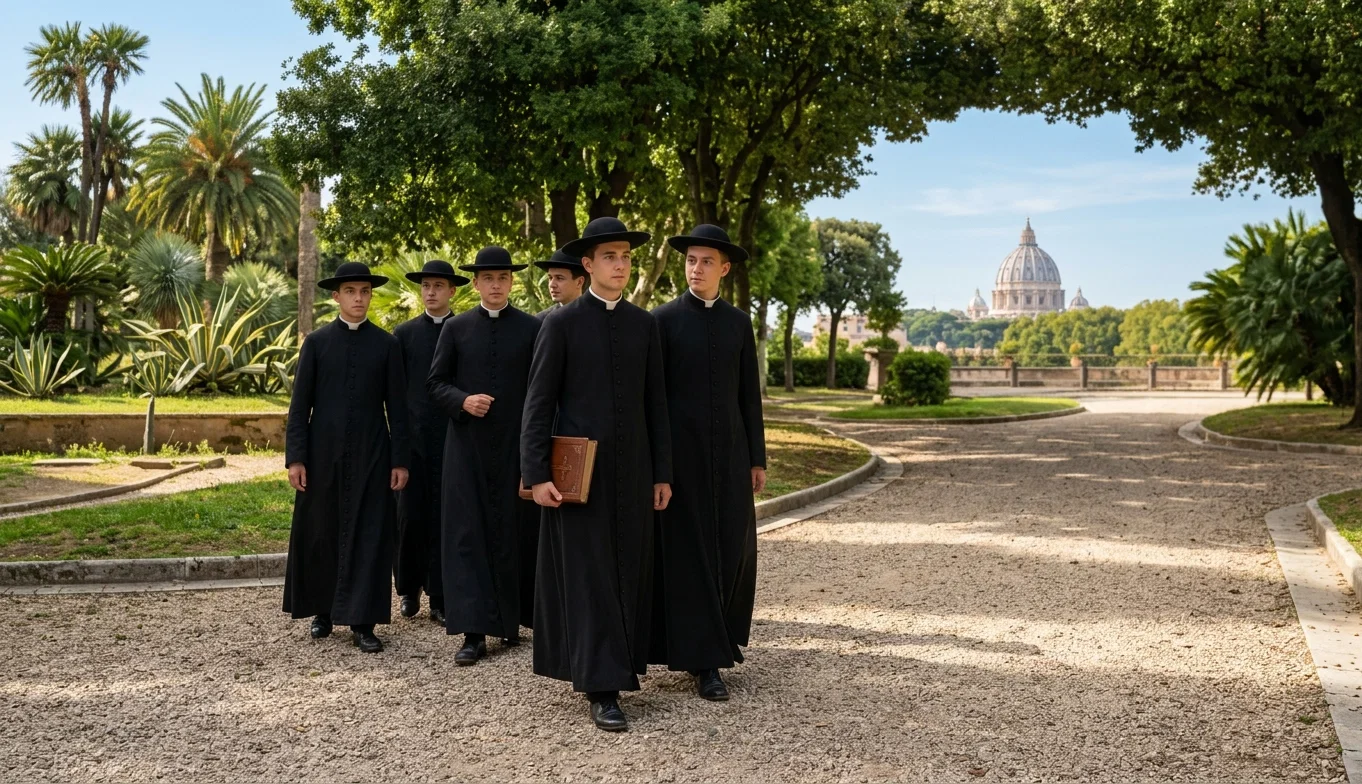
A COMPANY OF STUDENTS FOR THE PRIESTHOOD
Besides meetings held in favor of Sunday legislation, the daily press has given much space to the discussion, and thereby it has been extensively placed before the public. After the question had been agitated in this manner for some time, a law was introduced into the Italian Parliament, having as its object the strict enforcement of Sunday closing. This law was vigorously debated in several sessions of the legislature. But, of course, the same plea was used here as is urged everywhere by the exponents of Sunday legislation, that this legislation is purely civil, and has no religious significance. But the discussion of the question brought out the fact that there is a religious phase connected with it. One legislator who gave a speech on the law, which was greatly applauded, showed plainly that there is a religious significance to the question. He stated clearly that the law in its application must penetrate the consciences of the working men. He then reminded the legislators of the strong respect for religion that exists in the German and Anglo-Saxon countries, and the good results seen from it in these countries. Then as a climax to what he had said in this strain, he read a decree that was issued by Mr. McKinley, ex-president of the United States, in which the people were asked to pray to God for the prosperity of their native country. Loud applause and comments of approbation followed the reading of this decree. This legislator concluded his remarks by stating that there should be religious teaching in the public schools that would serve to re-enforce the conception of "sanctifying the Sabbath day." We also notice that in these remarks the fourth commandment itself was quoted in support of this Sunday legislation.
And another thought that should not escape our attention is the fact that right in the very halls of the Italian legislature the example of the United States is referred to when that body is promulgating a Sunday law. And in this connection we recall the words of the prophecy, which say that “he exerciseth all the power of the first beast before him, and causeth the earth and them which dwell therein to worship the first beast, whose deadly wound was healed.” We know that the United States is here referred to as that power which will influence the earth to render obedience to the papal beast.
In obeying Sunday laws we render obedience to the papal power; for Sunday is a child of the papacy. And not only will the United States, according to this prophecy, enact laws in favor of Sunday in its own territory, but it will also influence the other nations to do the same. Has the United States, which has been such a potent factor in leading the nations away from Rome and from the mingling of civil and religious matters, begun to lead back to Rome? It would seem impossible, but nevertheless it is true that the example of the United States is tending toward Rome. In fact, the example of the United States is quoted in the legislative halls of Rome itself, when Sunday legislation is under consideration. Who can say that the United States is not causing the earth to worship the papal beast? Yes, and in fact it is causing the very seat of the beast, Rome, to render greater obedience to the beast.
The Sunday law has not been passed yet, owing to some disagreement concerning certain parts of the law, but it is sure to be passed before long. And the Catholic Church itself is one of the potent forces behind this Sunday-closing movement in Rome. For over a year the Catholic Church has been waging a vigorous warfare in favor of Sunday closing. The head priests in the different parishes have instructed their members that no Catholic should buy from any firm that refuses to close its place of business on Sunday. As the Catholic trade is such a strong factor in the business of Rome, many close their doors on Sunday for fear of losing this source of revenue; but this Sunday closing is quite characteristic of the Catholic Church where religion is a matter of external forms. For while many close their places of business, yet they continue their work behind the closed doors.
When we came to Rome, we were informed that the people made no distinction between Sunday and the other Catholic holidays; but we see that the conditions have changed rapidly even during our short stay; for it seems that the prophecy must be fulfilled, and Sunday must be accorded the place that the Word has assigned to it. And it is certain that in the near future the "day of the sun" will be exalted again in the place of its birth.
Rome, Italy.

A Trip to the Fort of Fautaua, Tahiti, Society Islands

L. A. ROTH
Much has been said about the Society Islands, and much more might be said. Each one coming to this part of the world sees the country differently. One who loves nature will be bound to talk about the beauties of nature, and of the wonderful works of our Creator, while another will have very little to say about this, but will see other things that interest him. I have recently made a visit to the Fautaua Fort and its vicinity, a spot that is more or less visited, which I will describe.
Starting from Papeete, we follow the main island road up to what is called the Fautaua River, one of the largest streams or rivers on Tahiti; turning here toward the center of the island, we follow a valley that bears the same name as the stream. This valley is quite wide at first, but soon gets very narrow as it reaches the center of the island; three miles will take us to a place where there is just enough room for the river and the road, and a little farther on, the road stops entirely, as there is only room for the river, the mountains standing on both sides as straight and faithful sentinels. The great Fautaua Fall is about a mile farther up, so that if any one desires to reach the foot of it, he will have to do so by following the river, jumping from stone to stone, and very often will have to swim.
Where the road stops, there is a bridge that takes us on the other side of the river and also of the mountain, and this one starts right up on the other side of the river. By following a trail made by the soldiers that live near the fort, we shall soon be up in the mountains, where we shall have a grand panorama of nature all around us. On our right, and near our path, is a precipice of about one thousand feet, in the bottom of which the river is running. In front of us we see the great six-hundred-foot fall of Fautaua, and the wall of the fort, made to blockade the trail. In this wall there are about fifteen or twenty holes where the noses of guns can be put in to defend the fort. When this fort is guarded, it is impossible for any one to go farther up, as on the left stands the almost perpendicular mountain, on the right the precipice, and the fort and the fall in front. Behind this fort is a little valley where the French people have built a home for the governor's family, and a home for the soldiers that guard the fort. In this valley grows everything that grows anywhere else in this island. The soldiers have a nice vegetable garden, containing a large bed of strawberries. This place is cooler than Papeete, and would make a nice place for a cool resort. Here are kept provisions for the French people who would take refuge here in time of war. The valley in which the fort is located is closed up on three sides by higher mountains, one of them being about seven thousand feet high, more than twice as high as the place where the fort is, and the ascent impossible on either side. By walking to the top of a hill situated on the back of the fort home, one gets a view of the surrounding country that in some respects surpasses even the sceneries of Switzerland, the rocks and mountains being nearly all covered with bushes, shrubbery, ferns, banana trees, plantains, cocoanut trees, orange trees, etc. This is a wonderful island. One can indeed say, How great are the works of God! how wonderful is his creation!
This walk to the fort is as far as one wants to walk in one day; with the return trip it is eighteen kilometers. One can not do so much walking here, on account of the heat, and such a walk as this will be enough for any white man. The natives do not mind long walks, as they are use to the climate, but even they will not be willing to take this walk very often.
The mountain is so steep at some places that it is difficult to keep from running when on the way down, and those who can, do run to the bottom of it. After half an hour's walk, we arrive at the bathing pool. The water is very cold here, much colder than we get at Papeete; and a good cold bath acts as a tonic to our vitality. Coming out of it, we all feel refreshed, and soon arrive at our home, thankful to the Lord for his guiding hand over us, and glad to know that we are serving such a loving Saviour.
Papeete, Tahiti.

Jamaica

KINGSTON.—Our work is onward. Twelve were baptized here last Sabbath. Five others are preparing to receive this rite soon. I have received word that twelve or fourteen are awaiting my coming to the West End, for baptism. Many of our lay members are at work. God is blessing their efforts.
Last month was our hardest month since the storm. We do not look for much improvement before August. We are not now expecting to start our school work before fall. As yet we have no arrangements in regard to treatment rooms. We are all of good courage.
J. B. BECKNER.

Nevada

RENO.—The special meetings held in the church during the winter have resulted in nine adults accepting the Sabbath, eight uniting with the church,—seven by baptism, and one who had been immersed, on profession of faith. Others who attended the meetings are still interested, and Mrs. Leland and I are holding readings and cottage meetings with them. The Young People’s Society is doing a good work with the Signs and other periodicals. Our church-school, which is in good condition, is being taught by Sister Lysinger.
An item of interest and encouragement to our canvassers may be found in the case of a lady whose husband came to Reno seeking employment, and while here attended the meetings, and accepted the truth. He was unable to secure a position, and decided to return to their home in Colorado; but the lady did not wish to return without being baptized, and uniting with the church; she said she wanted to return a full-fledged Adventist and teach the truth to her relatives.
Her mother said that she would as soon have a Mormon teaching in the home as for her to come to them with Adventism, and tried to overthrow her faith. A sister said, “I was happy till you came home with this doctrine, but now I am very unhappy.” The sister who had accepted the truth hardly knew how to meet their objections, but in looking over their library she found a book entitled “Bible Readings for the Home Circle,” which an agent had sold her mother years before, but which she had never read. This she began to study, and found plenty of Bible proof for every position she held, and an answer for all their objections. That book, although unread for years, is now preaching the message. Paul may plant, and Apollos water, but God gives the increase.
C. E. LELAND.

Queensland

WARWICK.—After binding off the work in Maryborough, we came to Warwick, the largest town in southern Queensland. We pitched our tent, and began meetings on the twenty-first of January. The attendance was not large at first, but gradually came up to a fair hearing. The people seemed much interested, and we had been holding meetings three weeks when Mr. Hugh Paton, an evangelist who is just now drawing large crowds in Queensland, came to Warwick by invitation of the churches here. They pitched a large tent, and by the combined efforts of popular preaching, professional singing, and a big band and choir, succeeded in drawing away most of those who had formerly attended our meetings.
Mr. Paton’s meetings lasted a month. At his farewell service he spoke against the Sabbath, thus warning the people against our work. We at once billed the town, and began over again, giving those who came the complete message. At present ten adults have taken their stand for the truth, among whom is a local preacher and his wife, also the wife of another minister. Others are interested, and we are continuing meetings each evening.
The third angel’s message is going forth with power. There is no such thing as failure with God. Sometimes it seems as if the enemy is about to swallow us up, and the way looks dark. But in such experiences it is comforting to know that our God never changes; for with him is no variableness, neither shadow of turning. So in these hours of trial, if by careful self-examination we find that we have not changed, we may be well assured that he has not changed, and the vital union between our soul and heaven is not changed. Consequently there is no room for discouragement, murmuring, or unbelief. Simply stand by faith, and let the hurricane roar. Faith is the victory, and though it should take three full weeks, as with Daniel, for God to bring about the desired end for which you are praying, know for a certainty that if need be every angel in heaven will be sent to the aid of that worker whose life is sanctified by obedience to the truth.
R. D. QUINN.

Gospel Progress in Korea

THE progress of the gospel in Korea has been most remarkable. One missionary who had labored there twelve years says: “Twelve years ago three Koreans and I began work on this very spot. There was not a Christian church in this whole region. Now we have in this district between sixty-five and seventy independent congregations of between 2,500 and 3,500 Christians.”

Arkansas

LONDON.—Since my return to this field another sister has stepped out upon the promises of God, and has begun to keep the Sabbath of the Lord. A brother who began the observance of the Sabbath about the first of February last, laid aside his tobacco after having used it for more than fifty-two years. His neighbors look upon it as a miracle, but he tells them that the Lord is able to keep him from evil. There are several others in the valley of decision; they are convinced that they should obey the commandments of God, but the tobacco habit has such a hold upon them that they think they can not give it up. This habit is one of the worst obstacles we have to contend with in the South, as men and women use it alike, with few exceptions.
Brother W. Bender and I expect to pitch a tent at this place next week, and begin the battle for the Lord. We would be pleased to have a goodly number of our English tracts and papers sent, prepaid, for free distribution. We shall probably be in London until the latter part of June. Pray for us and the work here. H. CLAY GRIFFIN.

Arrival in East Africa

OUR party of five landed here safely, Sunday, March 27, one day earlier than we expected. Our missionaries, Brethren Ehlers and Enns, met us on the steamer. They both are in good health, and have made good progress in learning the Swahili and also Wapare. They report favorably as to the progress made on the farm. They have now a good road down to Kihuin, a distance of twelve miles, where there is the great caravan road. They have also turned their creek direct to their house, and have tilled considerable land. Their property is a valley three fourths of a mile long, and from two to three hundred feet wide. They secured some chickens, a few head of cattle, and here we were able to secure two Indian horses, young and small, but it is very difficult to find anything suitable.
Our boat is still discharging its cargo, and if our freight is not unloaded by tomorrow forenoon, it will have to follow the next train. The train leaves three times a week. Ours leaves on the thirtieth, and takes us fifty miles. Then we have still one hundred miles to march till we reach our station. Most of the distance is through the prairie, and the third day's trip is the worst, as there is no resting-place for forty-five miles. We shall need about one hundred carriers to transport our provisions, tools, goods, etc., to the station.
The early rain has failed this year, and not until March 26 was there any sign of the latter rain. But now it has rained one whole night, and there is prospect that we shall enjoy the benefit of the tropical latter rain. The country here presents the nicest landscape I have seen anywhere in Africa. There is quite a range of mountains in full view, all wooded and covered with plantations. Here are fine palm groves, mango trees, etc. The town is well laid out, has nice government buildings, and a number of well-stocked stores and warehouses.
We have nice bananas, pineapples, mangos, etc.; but potatoes are dear and very scarce, also milk. By going with our brethren to the different business houses, one gets a better idea of prices and customs; and we have made different arrangements as to our money, supply of goods, etc.
MAIN STREET IN TANGA
Our brethren employ from sixty to eighty Wapares on their farm. They pay ten resas, or five cents, for grown persons, and half as much for boys; they board themselves, and are glad to have a way to earn something, and secure clothing for it.
Our mission is already well known all around here. The German Lutherans from Leipzig demanded that we leave the field or cede it to them, but they are now ready to divide. The Wapare is a special dialect, and so far but very little appears in print.
Brother Enns found it at first difficult to enter their homes, but as they became better acquainted, they began to call for him, and request medical help. Many are troubled with the sand-fleas, and he finds plenty to do. There are about two thousand persons within a circuit of three miles around their present station.
Thus far we are all well and of good cheer, and I am glad to make the trip and gain an experience in heathen mission work. In the coast towns, the missions do not seem to have much success. The Mohammedans are the leading ones here, and many Germans complain that the Christian boys are often worse than the pagan and Mohammedan. They need instruction in industrial work.
L. R. CONRADI.

South Africa

STELLENBOSCH.—We hope soon to open a mission station in the Colony, not very far from Lovedale. Kama, a local chief in that vicinity, has offered us a farm, and is anxious for us to come. We are now negotiating in the matter. It may be that the Lord is opening the way for us to do what we ought to have done years ago—establish a mission among natives for whom the preliminary work has been done by others, and to whom we may give the message direct, and then send them on to the interior to teach others. Brethren Shone and Tarr each have a burden for native work, and can both speak Kaffir well.
At present Brethren Tarr and Moko are conducting open-air meetings in the native location at East London. Some of the colored people have begun to keep the Sabbath, but I do not know that any of the natives have. The natives are pretty well stirred up, however, and a petition has been sent to the town coun cil, asking them to remove Brother Moko. The native ministers are afraid of his influence and work. I do not know how it will terminate, but we are hoping for the best.
There are about ten thousand natives in this one locality. Some of them are well educated, and hold good positions as interpreters of the court, magistrates, clerks, etc.
If we do not hold a tent-meeting here in Stellenbosch, I expect soon to return to East London, and conduct tent-meetings there. I am anxious to see some of those intelligent natives accept the truth, and then go as missionaries to their people. It is difficult in the towns for them to keep the Sabbath, as they work largely for the government, or for large firms.
We are very glad to know that Dr. Thomason is coming so soon. There is an open door for him into a large and fruitful field. We are of good courage, for the work is the Lord's.
I. J. HANKINS.
Continue reading: Oregon