LEAVING the Tsungwesi Mission, I had planned to meet Sisters E. Edie and Mary Long at Beira, and accompany them to the mission station. On reaching Beira, I learned that their steamer would not arrive until ten days later. I therefore took passage on the German steamer that was leaving Beira for Chinde the day of my arrival. Reaching Chinde the next morning, I was fortunate in making close connections with the river steamer "Princess."
There was nothing of special interest en route up the Zambesi and Shire Rivers, save two crocodiles, some hippopotamuses, and a sugar plantation. At the plantation our steamer made a short halt. The sugar plant was running steadily day and night, turning out three hundred tons of refined sugar a week. Nearly all the work is done by the natives under white supervision. The pulp and stalks are used for fuel, thus furnishing heat, gas, and steam sufficient to operate the plant.
We passed the old Chipange Mission, which we were told had been operated on the industrial training plan for over one hundred years. Here Mr. Livingstone's wife lies buried. On the gravestone is represented a native bearing to her flowers in token of native respect for her labors of love for them in the pioneer days of mission work in Africa.
On account of the drought the water of the rivers was low, and I was obliged to ride twelve hours in a house-boat propelled by natives with spike poles before reaching Port Herald. On the Shire River only were we troubled with mosquitoes. The house in which I slept the night I stayed at Port Herald was undergoing repairs, and in consequence I caught a slight cold.
The next day I was met at Luchenza by Brother G. A. Ellingworth and some native carriers with two riding donkeys. It was late in the afternoon when we left for the mission station, and we traveled the twenty-three miles to the mission by nine o'clock that evening. When we started, it was so hot that we removed our coats. At sunset it grew much cooler. In climbing the hills we perspired freely, and in crossing a river on a native's back I got my feet wet. By the time we reached the mission, I was having the worst chill I had ever experienced. The next day my temperature was one hundred two, and later I was informed that I was having a slight run of fever. I was up and about part of every day, and did not know that I was having the fever until well on the road to recovery. Had I known it, I might have kept my bed and imagined myself more ill. It was wise strategy not to inform me till I was well over it. I had a theory that I should escape the fever on this trip as I did13before, as I was taking, apparently, all necessary precautions; but, like many others, I learned that a little exposure to either heat or cold spoils many a theory in this country.
I was thoroughly impressed with the need of a road out from the mission farm to the main road, and also the need of a bridge over the river, so that our workers can come and go without so much exposure. When one looks upon the surroundings from the mission farm, which overlooks Mt. Cholo to the northwest, Mt. Milanji forty miles to the northeast, and a beautiful range of hills and valleys, interspersed on every side with rippling rills and sparkling streams, with no stagnant pools anywhere, one has great difficulty in believing that there is any possibility of malaria lurking beneath such scenes. Still from time to time the reality of the deadly malady demands recognition. With all this beauty and grandeur, and the apparent healthful atmosphere, the deadly germ is there.
During the last year the tsetse fly made its appearance among our dairy herd at Malamulo Mission. Dairying is our chief industry, and fifteen head of our best cattle died within five months. These were nearly all cows, and some among them were very valuable, being thoroughbred and high-grade milkers. By removing the cattle kraal to higher ground, changing the feeding-grounds from the river to the highlands, and clearing the jungle brush along the streams, it is hoped that the present difficulty with the tsetse is overcome. This will not be determined before another rainy season, for it is at this season that its work is largely fatal.
The mission still has forty-two cows and heifers, twenty small heifers, thirty-four calves, one bull, nineteen oxen, and twenty-three small oxen. This leaves the total number of cattle now in the herd one hundred thirty-nine. They have four good donkeys, twenty-eight native sheep, and fifty good fowls. Mantandane station also has a good start in stock.
Our Annual Council in Fiji
By A. G. Stewart
A. G. STEWART
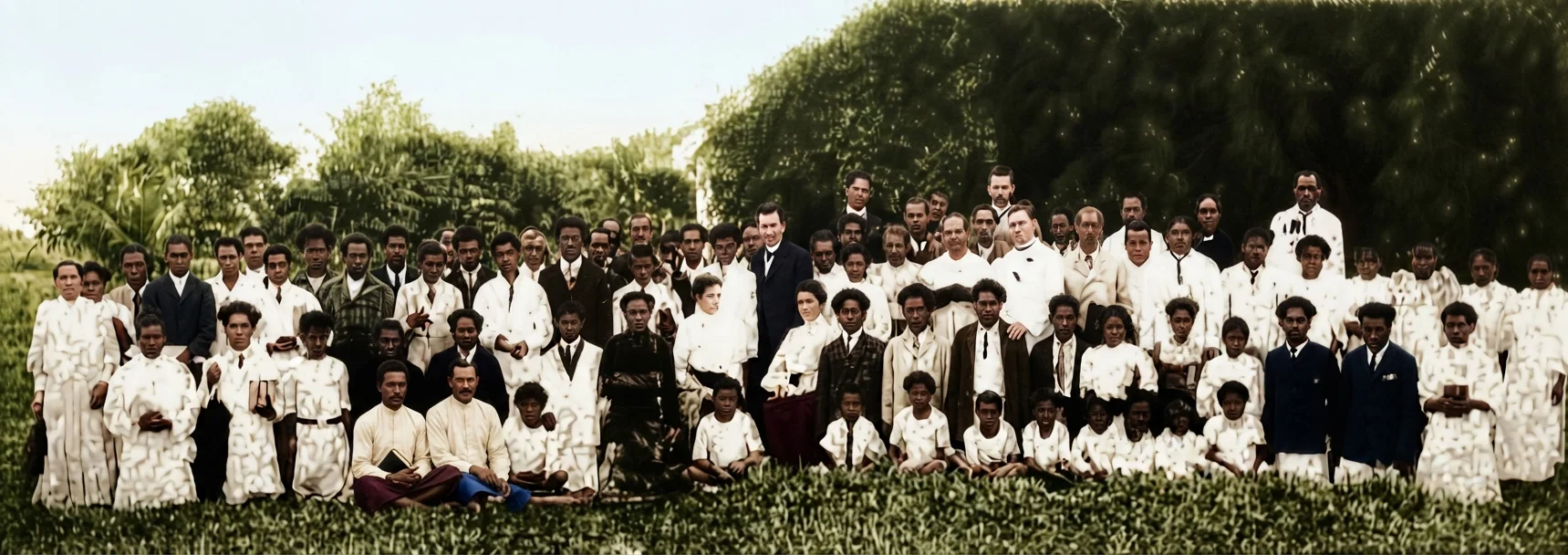
SEVERAL weeks ago we held our annual council of the Fiji Mission. As our people live on different islands, thus making it hard for them all to meet together, it was decided to hold two meetings. The first one was conducted at Lau, the most easterly part of the group, where we have about forty believers who availed themselves of the privilege of attending this meeting. The second division of the council was held at Suva Vou. This is still the headquarters of our mission. The Fijians naturally like large gatherings, and will travel long distances to attend them. Some of the brethren who came to this meeting walked about one hundred miles over hilly country, taking three days to make the journey, as they brought their little children with them.
Elder J. M. Cole, president of the New Zealand Conference, attended both these meetings, and gave timely and helpful instruction. It was no doubt a great joy to him to spend a short time in this field, and see the progress the message has made since he landed here over seventeen years ago, and sowed the first seeds of present truth. During these meetings he baptized seven believers, thus making a total of thirty to embrace the truth the past year. We now have two hundred fifty baptized members here, who are striving to live up to all the principles of the message.
While there is much more that we should like to see accomplished in the way of aggressive work and in the attainment of a higher spiritual standard, still we feel encouraged by what the Lord has done and is doing for his people in Fiji. It makes one's heart glad to hear their earnest prayers and free testimonies.
We are sorry to have to report that through illness our force of European laborers has been somewhat reduced during the last year, Brother G. E. Marriott and I, with our wives, being the only ones left. However, we are thankful for a good staff of native workers, who are earnestly laboring for the advancement of the truth among their own people. One of our faithful workers, Alipati Rainima, was taken from us by death a short time before our council. We missed him from his accustomed place in our annual gatherings, but he is missed more in the field where for so many years he has labored faithfully for the sake of the truth he loved so dearly. We hope that at the union conference council soon to be held more help will be forthcoming from the home fields should our former fellow workers not return.
GROUP OF BELIEVERS ATTENDING THE FIJI COUNCIL
The work for the forty-five thousand Indians in these islands still stands untouched. Time is fast hastening on, and their numbers are yearly increasing. How long must they wait before we give to them this last message of mercy?
Suva Vou.
A New Union in Central Europe
By L. R. Conradi
L. R. CONRADI
FROM July 19 to 28, 1912, the West German Union had its regular session at Friedensau. In view of the fact that the fields are being divided more and more, and inasmuch as we had an especially large meeting last year, it was supposed that this year's meeting would not be nearly so large. But some time before the meeting, all the tents and all the rooms available had been filled; and when our people crowded into the large tent which we had last year, but without the addition, it was more than full. A goodly number from the East German Union attended the meeting. Many came before the meeting began, and on the eighteenth a special evening service was held.
As at this time a new union was to be separated from the West German Union, we had a number of union conference presidents present.—Elder J. T. Boettcher from Russia, Elder L. P. Tieche from the Latin Union, Elder H. F. Schuberth from the East German Union, and Brother J. G. Oblaender. There was also a full quorum of the European Division of the General Conference Committee. By the time the new union was organized, we had no less than seven members of the committee on the ground, and we held quite a number of important committee meetings.
Elder J. Erzberger preached the opening sermon Friday night, and the writer spoke on the Sabbath. Hundreds came forward to seek the Lord, and about fifty offered themselves for baptism.
All the fields were fully represented by delegates, and several new conferences and mission fields were received. The Upper Rhenish, the Hessian, the Wurtemberg, and also the Central German Conference, which the East German Union had ceded over, were received by the West German Union, and also the Bohemian and Moravian-Silesian mission fields.
Elder Oblaender's report was very interesting, showing a net gain in membership of 1,400 for the two years, the membership at the time of the meeting being 7,302. All the delegates felt that the time had indeed come for a division.
As the new field takes in the southern portion of Germany, German Switzerland, and Austria, the name Central European Union was unanimously adopted. The following conferences and fields were then separated from the West German Union: The South German, Wurtemberg, Bavarian, and German-Swiss Conferences, and the Austrian, Moravian-Silesian, and Bohemian mission fields.
The membership of the new union was 2,632. Its staff of workers includes twenty ordained ministers, thirteen licentiates, and about sixty Bible workers. A good force of canvassers is also in the field. After careful consideration, Elder O. E. Reinke was unanimously chosen for the union president. Elder Reinke will also continue to act as president of the German-Swiss Conference for the present. Basel will be the headquarters of the new union.
The West German Union will finance the field until Jan. 1, 1913, when the new organization will go fully into force. Both the West German and the Central European Union will send their second tithe to the European Division of the General Conference from January 1. As the East German Union has decided to do likewise, the General Conference will have over $20,000 second tithe to use in its mission work. According to their estimate, the Central European Union will probably need an appropriation of $4,000, and the Danube field about $10,000, so that there will be a net surplus of about $6,000 for other fields.
The sessions of the West German Union were marked throughout with a spirit of unity, and Elder Oblaender was unanimously reelected union president. The key-note of the meeting was the missionary spirit, and when the question was put as to how many of the workers were ready to accept calls to foreign fields, about sixty-five offered themselves, and later a number of the young people volunteered.
The second Sabbath was also a good day. Quite a number sought special help. In the afternoon Brethren R. Rall and O. Gassmann were ordained to the gospel ministry.
Elder H. Steiner, who with his wife has a good knowledge of the French, as well as of the German, and also knows some English, accepted the call to the Abyssinian field. They and Brother and Sister Seiler and Brother Palm, who are going to German East Africa, were presented before the Lord, special prayer being offered in their behalf.
There were numerous discussions dealing with the needs of the fields, and a number of resolutions were passed. Much of the time was spent in giving instruction to the people, gospel workers, canvassers, presidents, and union presidents. All appreciated the advice given.
The offerings for missions were very good, and we were pleased to know that the German-Swiss Conference during the last twelve months had given an average of ten cents a week a member to missions. Besides the men already mentioned, Elders G. Dail, O. Luepke, L. Voigt, and Boex, and Dr. E. Meyer, as well as the local men, helped in the meetings.
The Hamburg Seventh-day Adventist Society and the German Health Association had their annual meetings at the same time, and elected their officers. The creation of the two new unions left the institutional arrangement untouched, except that the board of trustees was increased by the addition of Brethren Reinke and Huenergardt.
Our institutions had had the best year they had ever enjoyed. Several hundred canvassers had been added in these unions, and the sales had increased by $40,000. Both Hungary and Austria were supplied with good general agents from Germany, and we believe that as a result, the work will advance in these more difficult countries. The sales of our health food store in Hamburg had doubled within two years, and with the sales at Friedensau, had almost reached the sum of $100,000.
A number of outsiders attended the services on Sunday. The Magdeburg and Burg newspapers gave reports of our meeting. Friedensau will ever be a sacred spot to our people on account of the many blessings they have received there from year to year.
As the Central European Union, with its 35,000,000 persons, has quite a Catholic population, and as there are many grave obstacles to be overcome in the presentation of the third angel's message, we should surely remember it in our prayers, that all the parts that are not entered may soon hear the glad tidings of the message.
The Brave Soul Can Mend Even Disaster
"The brave soul can mend even disaster."
Night
By Mrs. M. L. Brock
MRS. M. L. BROCK
"The sun knoweth his going down. Thou makest darkness, and it is night, Wherein all the beasts of the forest creep forth. The young lions roar after their prey, And seek their food from God. The sun ariseth, they get them away, And lay them down in their dens. Man goeth forth unto his work And to his labor until the evening. O Jehovah, how manifold are thy works! In wisdom hast thou made them all: The earth is full of thy creatures."
Psalm 104, A. R. V.
Time to Rest and Sleep
"This dead of night, this silent hour of darkness,
Nature for rest ordained and soft repose."
When night spreads her sable curtains, the din of business is hushed; the fowls and cattle, obedient to the signal, retire to their resting-places. A refreshing coolness pervades the air, and a dreamy stillness rests upon the earth, all inviting to repose. How strange, then, that human beings should be deaf to this divine and eloquent language! How strange that they should pervert the order of nature by converting day into night and night into day!
With multitudes, night is not a season of rest for the invigoration of the mental and physical powers, but a time for body- and soul-destroying dissipation. This is the time used for fashionable parties, where in addition to lack of rest, the system is poisoned by impure air, and oppressed by excessive and improper food and drinks, while the mind and all the moral feelings are worked into a feverish state of excitement, which acts with terrible effect on the abused and overburdened physical frame. Can any one for a moment believe that the laws of nature may be thus violated with impunity? As surely as God has a care for the works of his hands, so surely will every violation of the physical laws be visited with its legitimate punishment. These laws are written in our frame by the hand of the Creator himself; and they are as fixed and immutable in their nature and consequences as is the author of them. One of these laws is that night was ordained for physical rest in quiet sleep.
With many the idea prevails that the Sabbath was given to man merely for physical rest. The Sabbath could not give all the physical rest needed for the daily repair of the daily waste. It does not require a holy day to give the needed rest from labor. The Sabbath was ordained to be used for holy and divine purposes. The law, Christ says, that governs the Sabbath, commands us to do good on that day. The night comes at the close of each day's labor, and is just what the laboring class needs. The Sabbath is just what the child of God needs to afford him an opportunity to do good. God could have had one long day reaching from one Sabbath to another, and then have given the Sabbath to man as a physical rest day; but he knew just what the daily life of toil would require, so he placed darkness between the days, and called it night.
During the shades of night we are to receive physical rest from our daily labor. During the hours of the seventh-day Sabbath, in addition to physical rest, we should experience a holy rest of faith. As this calmness of faith passes over our Sabbath rest, we receive a spiritual rest in our hearts. To receive this Sabbath rest we must lay by every worldly care on the seventh day, and keep in harmony with its true purpose and spirit.
Kissimmee, Fla.
Love's Tribute
By Worthie Harris Holden
No eulogy or eloquent appeal
Can echo and reecho in the heart,
As when some trusting child your hand will steal,
And softly say, "I love you," then depart.
It thrills your soul to be accounted dear,
To know your labor was not spent in vain,
And breathes an incense and a holy cheer
Like morning's sunshine after summer rain.
So can my Saviour's love be glorified,
E'en when my feeble, stammering tongue may say
With heart sincere, "I love my Christ who died,
And seek his hand to guide me through the day."
O Love divine, so infinite and strong,
My heart delights thy wondrous gift to praise!
I would my life could utter all day long
A nobler tribute to thy matchless ways.
Portland, Oregon.
The Cooking of Vegetables
By MRS. E. E. KELLOGG
MRS. E. E. KELLOGG
THE preparation of vegetables for the table is generally thought to be a very simple process, one which the most inexperienced cook need not hesitate to undertake. "Anybody can cook vegetables" is a common expression. It is not difficult so to apply heat and the solvent property of water as to soften vegetable tissues enough for mastication, and by the addition of condiments and seasonings to make them taste well; but to cook them so as to preserve their natural flavors, and change their constituent elements into the most digestible form, requires no little care and skill.
Vegetables admit of much variety in preparation for the table. They may be wholesomely cooked by baking, roasting, steaming, boiling, and stewing. Water enters so largely into their composition that but little additional liquid is needed for cooking, and a general rule, applicable to all tubers to be cooked by boiling or stewing, is to cook them in as small an amount of water as possible without burning. The salts and the nutrient juices are largely dissolved in the water, and if this is drained off, much of the little nutriment these foods possess is wasted.
The potato is the most commonly used of all the tubers, and in nutritive value it exceeds all others. In a mealy state the potato is easily digested, but when waxy or water-soaked, it is exceedingly trying to the digestive powers.
To obtain the desired result, when the potato is to be cooked by boiling, it should be introduced into water that is actively bubbling, and cooked continuously until it can be easily pierced, then thoroughly drained. Cover the kettle, with the exception of a small aperture for the steam to escape, and set it on the back of the range or in some other warm place for a few minutes, to allow the moisture on the outside of the vegetables to evaporate, and serve at once.
Whether or not to cook the potatoes with skins on is a matter to be settled by individual consumers. The chemists have demonstrated that when boiled in their skins, the waste of nutritive elements is only three per cent; when boiled without skins, fourteen per cent, or two ounces to every pound. Because so much of the nutriment is lost in water, the potato, as well as most other tubers, is better when cooked by steaming, roasting, or baking.
To cook a potato by baking, first thoroughly clean and dry it. For cleaning tubers nothing is better than a vegetable brush. Put into the oven, the temperature of which should not at any time during the cooking exceed four hundred degrees. A common test is a temperature in which the hand can be held long enough to count twenty. Do not pierce to try. When done, the tuber will feel soft or mellow when pressed with the fingers. On taking from the oven, burst the distended skins by a quick pressure of the fingers, just enough to allow the steam to escape, and serve at once.
A principle to be observed in the cooking of tubers is to remove them from the water or oven just as soon as tender. The cooking will continue some minutes after their removal, owing to the heat stored within. By overcooking, vegetables become less digestible.—Good Health.
"Abide With Me"
By Lora Clement
ON the eastern coast of Devonshire, England, is the ancient little seaport town of Brixham. This parish, composed for the most part of hardy fisherfolk, was under the care of Rev. Henry Francis Lyte for twenty-five years, who labored faithfully for his beloved people, though all the while suffering from that dread disease, consumption. While still in the prime of life, the time came when he realized that his work would soon be over, and he earnestly prayed that he might be permitted to do something that would point humanity to the risen Saviour after he had gone to his rest.
In the autumn of 1847 the physicians informed Mr. Lyte that he must give up his work, and spend the winter in Italy. On the last Sabbath of his stay in England, September 5, he preached for the last time to his little flock, and celebrated with them the Lord's Supper. "In words of melting tenderness he pleaded with his people to live holy lives; and when he took his leave of them, there was scarcely a dry eye in the church. The day had been well-nigh perfect, and in the late afternoon, recovering somewhat from the strain of the service, the pastor walked slowly and feebly down the terraced walk to the water he loved so well, and which he was about to leave forever. The benediction of autumn rested upon land and sea, and God's smile was over all." As the bright sunset colors faded into twilight, he made his way home in prayerful silence, and immediately retired to his room. "It was in that hour that the great hymn 'Abide With Me,' doubtless conceived in the walk by the sea, had its birth." When he joined his family a little later, he bore in his hand the words that were destined to be a blessing to humanity so long as the heart turns to the Father above for help in time of need. His prayer for the privilege of service had been answered.
The actual use of this hymn in church services dates from 1861, when it was published with the now-familiar tune in "Hymns Ancient and Modern." "After one of the meetings of the committee which compiled that book, it was suddenly remembered that there was no tune for hymn No. 27, 'Abide With Me;' whereupon Dr. Monk, the musical editor, sat down, and composed in ten minutes the tune that has carried 'Abide With Me' to the ends of the earth."
The Noon-Hour Prayer
By Editor
"Evening, and morning, and at noon, will I pray, and cry aloud: and he shall hear my voice." "And the Lord turned the captivity of Job, when he prayed for his friends."
We are sure that if all our brethren and sisters could have the privilege of reading some of the letters containing requests for prayer which we receive, their interest would be greatly drawn out in behalf of these burdened ones. We have quite a number of requests for publication in this number, so it is necessary for us to make them as short and concise as possible. The following desire to be remembered:—
55. A sister in Wisconsin who wrote some time ago requesting prayer for her little boy suffering with Bright's disease, and for her husband, reports that God is hearing prayer in their behalf, and that marked improvement is witnessed in the case of her little son. She requests prayer further for her brother who is addicted to intoxicating liquor, that God may show him his danger.
56. An afflicted sister in Ann Arbor, Mich., who has suffered for six years.
57. A sister in Duluth, Minn., expresses great thankfulness to God for leading her out of the darkness of Catholicism, and she now desires prayers for her sister, that God may lead her in the same way.
58. An aged sister in San Jose, Cal., who has been a member of the church for sixteen years, earnestly desires healing from a large tumor.
59. A mother in Wisconsin writes of the burden of heart she feels regarding her daughter who is about to marry out of the truth. Pray that the mother may be strengthened and given wisdom for her need, and that the daughter may clearly understand what God would have her to do, and act in harmony with his will.
60. From San Diego, Cal., comes a letter from a father and mother desiring prayers for their son and his wife, "that their hearts may be turned to the Lord and to each other, and that all strife and malice may be put out of their lives."
61. From Hickory, N. C., a mother writes desiring prayers for her son who is out in the world, and from whom she has not heard for a number of months, that God may draw him back to himself.
62. From Orangeburg, S. C., comes a letter from a brother desiring prayers in behalf of his wife, who is very sick and beyond medical help. Her ten-months-old babe needs a mother's care.
63. A mother writes from Colorado with great burden of heart regarding her daughter who, though a member of the church, is engaged to a young man who is not a Christian. She fears for her future, and desires that prayer may be offered that God will hold her and direct her.
64. From East Gloucester, Mass., a sister writes asking prayers in behalf of her daughter who has long been sick.
65. In the Napa asylum is one of our sisters who has become mentally unbalanced. Her mother, at Modesto, Cal., feels greatly burdened, and believes that God is willing to hear prayer in her behalf. Pray that health of mind and body may be restored to this afflicted woman.
66. A sister in Willow, Cal., presents a request for prayer from one of her neighbors who is suffering from a serious throat difficulty. She believes in prayer, and that God is with this people. Pray for her recovery, and that God may guide her into all truth.
67. A sister writes from Oregon, asking for the prayers of God's people, that, if it be according to his will, she may be healed of an affliction from which she has been suffering for some time. She also requests prayer for the restoration of her sister who is very ill.
68. From an aged and lonely brother in Kansas comes a request for prayer that the Lord may give him health and strength.
We have received several requests with no signature or address. We hardly feel like publishing requests of this character. We do not require the name and address for publication, but must have them as an evidence of good faith. We hope that16all our readers, as far as consistent, will take part in this noon-hour prayer service. It will bring to them rich blessings. The requests which are published from week to week are worthy of our interest.
That Letter
SHE hastens to the house. "A letter, father; it must be from some of the children, and I will light the lamp."
Father holds the letter until the lamp is lighted, then looks at it closely.
"Yes, mother, it is from Tom, and in his own handwriting." A little choked sob tells better than words how the dear old father and mother feel, and mother takes the letter, opens it, and reads it with tears of gratitude and love. How glad are these parents that their first-born son holds a responsible position in the dear Lord's work! They gladly excuse him. They read his reports in the papers; they watch with much interest the progress of the work in his State. They hear from his good wife of his travels among the churches and of the welfare of the family; but all this can not bring the joy and gratitude of the letter written with his own hand, expressing his love for them, and his hope which reaches beyond this life.
The Fog in the Valley
By Edward J. Urquhart
EDWARD J. URQUHART
I STOOD on a Western mountain
One day in early spring,
And saw in the distant valley
A truly wondrous thing.
A fog from the broad Pacific,
Leaving its home behind,
Was rolling up through the valley,
Driven before the wind.
I looked again at the valley,
Or where it used to be,
And there, spread before my vision,
It seemed an inland sea.
And standing there on the mountain,
Bathed in the sun-rays bright,
I knew that they in the valley
Were groping without light.
And so when we keep to the highlands,
As taught by the Word of God,
And know by blessed experience
The path the Saviour trod,
We may see the fog in the valley
Where once our feet have trod,
While 'round us like sunshine falleth
The light — the truth of God.
That path is above earth's shadows
And fogs by tempests driven;
And lit by the precious Scriptures,
It leads to God and heaven.
Camino, Cal.
The Work in the City of Chicago
By D. H. Kress, M. D.
AN important council, composed of Elders A. G. Daniells, W. T. Knox, O. A. Olsen, Allen Moon, G. E. Langdon, and representatives of the city work, was held in Elder K. C. Russell's tent and the West Side Mission building August 19 and 20, to consider the needs of the city of Chicago and how they may be met. The city work is still an unsolved problem. Something has been done, it is true; but greater efforts must be made, and more extensive plans evolved, if we would meet the needs of the hour.
The council approved the efforts that have been made in the past to educate, enlighten, and help the people. Dr. David Paulson and his associates were encouraged to continue their good work in educating city workers at the South Side Mission. It was felt that in addition to this a medical mission should be opened on the West Side, the work of which would differ somewhat from the work done in the South Side Mission.
The burden of those conducting the South Side Mission will be to take men and women who have a burden to learn how to become a blessing to their neighbors, and give them a course of six months' training in treating simple diseases, in the preparation of foods, etc. With this will be combined Bible instruction on how to lead men and women to Christ, and how to present the truth to them in the most attractive manner. Practical work will be one of the chief features of the training. This will include ministering to the sick poor, distributing literature, conducting cottage meetings, etc. It was voted that the General Conference be requested to furnish a Bible instructor.
The West Side Mission is for the purpose of giving advanced work to graduate nurses and experienced Bible workers in carrying forward schools of health, giving lectures on health, temperance, and other Bible topics, and conducting Bible readings with the better classes. It is hoped in this way to carry on a ministry to all classes.
In addition to this, these workers will assist in carrying forward training schools in our churches for the benefit of the members who are desirous of being a help in the community in which they live. Physicians and ministers will unite in carrying forward meetings in halls.
We trust that we shall see accomplished a good work in the city of Chicago during this fall and winter, when people are most accessible, and that this wave of reform may extend to all the large cities, and that the time will come when every Seventh-day Adventist Church will be a training-school for Christian workers, and every Seventh-day Adventist an intelligent and efficient worker somewhere in the Lord's vineyard.
We are living in the eleventh hour. There are many honest souls who are anxious to do something, but are afraid to venture, or do not know how to begin. Many of these are to be encouraged to go to work in the communities where God has placed them, not as conference employees, but as self-supporting missionaries. There are those who have home duties that will not permit them to canvass for our literature, or to do other self-supporting work. These should learn how to be neighborly, or how to be a neighbor, in the community in which they live.
Christians are needed to-day, not merely in our large cities, but everywhere. Men and women living the Christ-life, going about doing good, helping the people where help is most needed, — this is the manifestation of the sons of God that this world needs and is longing for.
D. H. KRESS, M. D.
The Camp-Meeting for Colored Believers in Virginia
By W. H. Green
IN connection with the Virginia Conference and camp-meeting held in the city of Richmond from August 22 to September 1, there was held in another part of the city a conference and camp-meeting for the colored believers, which the writer attended throughout. The meeting was in charge of Elders J. B. Mallory and L. Muntz, with the writer assisting.
The camp was on Baker Street, near Brock Avenue, where Brother Mallory has been and is conducting tent-meetings. There were about fifty of our people present from various parts of the State, including sixteen delegates. No one camped on the grounds, as good accommodations were obtained at low rates in private homes.
Our evening services were well attended by interested listeners. There were between four hundred and five hundred present Sunday evenings, and about half that number attended on other evenings.
While we could not fully conform to camp-meeting regulations, we were able to hold four meetings every day, with four conference meetings during the time,—morning worship from 9 to 10 A. M.; at 11, study of the Testimonies and various phases of the message; at 3 P. M., preaching, or study of the truth; and in the evening evangelical preaching for the public.
Along with our feeble efforts there was able and instructive help rendered by the following brethren: W. J. Stone, president of the Virginia Conference, and R. D. Hottel, A. M. Neff, and J. H. Tindall of the same conference; J. E. Shultz, of Mt. Vernon College; J. L. McElhany, president District of Columbia Conference; F. M. Wilcox, editor of the REVIEW AND HERALD; H. R. Salisbury, educational secretary of the General17Conference; N. S. Ashton, educational secretary of the Columbia Union; and B. G. Wilkinson, president of the Columbia Union Conference.
The meetings were full of life from beginning to end. All present renewed their hope in the truth, and took a firmer stand in the message for the finishing of the work, pledging their service, prayers, and God's money lent them, to the cause.
One hundred forty dollars was pledged to the conference expense fund. There was $11.32 taken up for missions in the Sabbath-school. Other collections were taken during the conference.
Several took their stand for the truth, and others asked for further instructions. Meetings will be continued two weeks longer by Brother Mallory, three nights in the week.
Twelve were baptized by Elder Muntz the last Sunday of the meeting, six of whom united with the Richmond church.
Indeed, the meetings were a gospel feast for those who attended, and all returned home with renewed zeal for the finishing of the conflict in this generation.
W. H. GREEN.
Cats Are Dangerous
THERE is little difference in cats, and that difference is only that of degrees of badness. Take them in their social grades, the back-yard sloper, the spinster's “tabby,” and the long-haired blue-ribbon wearer, who feasts on sirloin and sleeps on a silk cushion. The first is worst, the second worse, and the third bad. There is no health in them. As a race they are extremely dangerous to humanity. As disease disseminators they are as great a menace as the rat, and we are exterminating the rat because it spreads the bubonic plague.—E. R. Pritchard, Secretary Chicago Health Department.
Hold-Ons
Hold on to your hands when you are about to do an unkind act.
Hold on to your tongue when you are just ready to speak harshly.
Hold on to your heart when evil persons invite you to join their ranks.
Hold on to your virtue; it is above all price to you in all times and in all places.
Hold on to your feet when you are on the point of forsaking the path of right.
Hold on to the truth, for it will serve you well and do you good throughout eternity.
Hold on to your temper when you are excited or angry, or others are angry with you.—Selected.
Contentment
"Give me neither poverty nor riches," said Agar; and this ever will be the prayer of the wise. Our income should be like our shoes; if too small, they will gall and pinch us; but if too large, they will cause us to stumble and trip. But wealth, after all, is a relative thing, since he that has little and wants less, is richer than he that has much but wants more. True contentment depends not upon what we have, but upon what we would have; a tub was large enough for Diogenes, but a world was too small for Alexander.—The Lutheran.
Just Saying It
By Dr. Whyte
An old Scotch woman lay dying. The sorrowing husband sat holding her worn hand in his, and seeing she was soon to leave him, broke through his lifelong Scotch reserve by saying earnestly, "Janet, if ever a woman was loved, I love you." The weary eyelids were raised, and a radiant smile overspread the pale face as Janet replied: "I ay kenned it, John, but O, to hear ye say it!" Jesus knew that Peter loved him, but repeated his question that he might hear it from his own lips. How much we often lose by not saying it! — Dr. Whyte.