The Youth’s Instructor, Vol. 48, No. 24.

THE HAWAIIANS

The Youth’s Instructor

Jun 14, 1900

Review and Herald Publishing Company · Battle Creek, Mich. · Jun 14, 1900

THE HAWAIIANS

Manners and Customs
The native Hawaiians are mild, pleasant, indolent, and very fond of music and flowers. Most of them are large, finely formed, and approach more nearly the original standard than the majority of white persons of the present generation. The pure Hawaiian is very dark, has black or dark-brown eyes, and an abundance of either straight or curly black hair.
I will relate, as it was told to me, an instance illustrating the Hawaiians’ simple manner of life and love of ease. Years ago, before the white man’s influence was so widely felt, about a dozen Kanakas (native men) united their interests, and went to live at one house. One man obtained work, and for a whole month labored industriously, as indeed he must; for the burden of supporting the whole family rested upon him. It is true their wants were few and simple, an abundance of poi and raw fish being enough to satisfy even the most fastidious; but even these necessaries could not be obtained for nothing, and so Number One toiled cheerfully on, looking forward to the good time coming.
At the end of a month his work was done for a year; and Number Two took his place, followed by each of the others in turn.
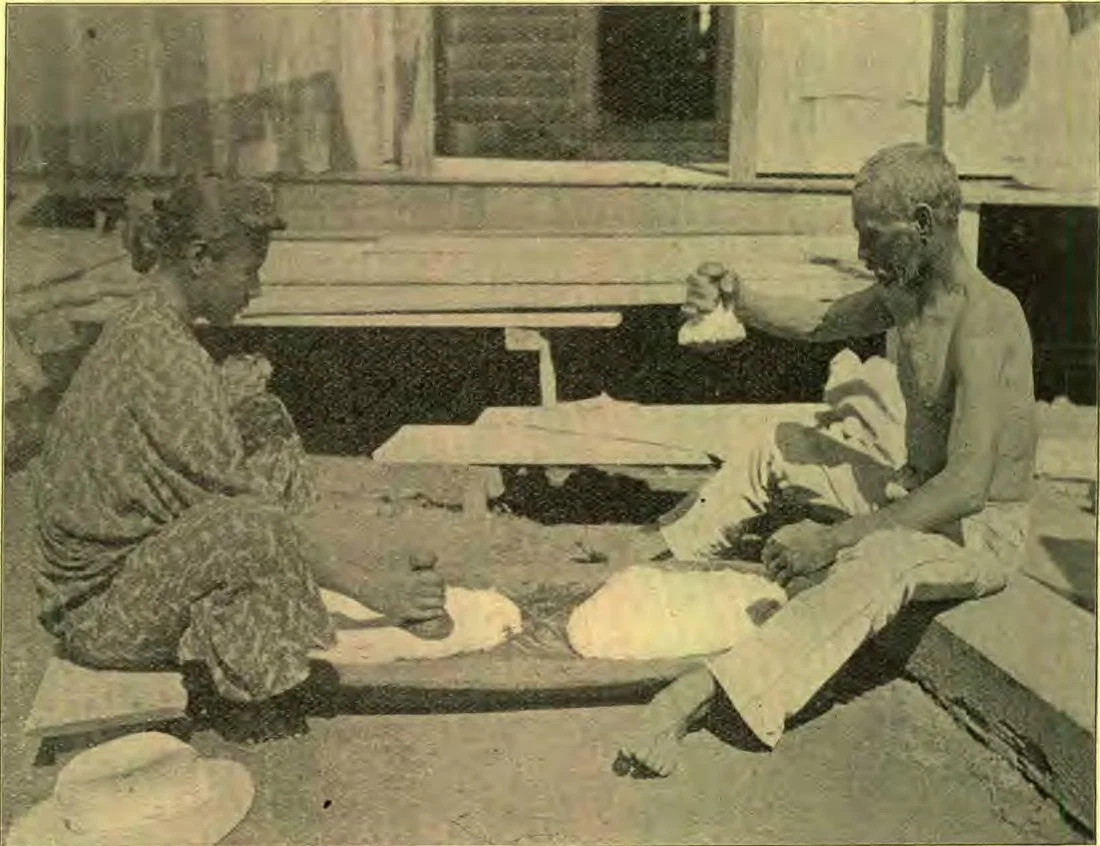
And so they lived, happy and contented, lounging in the sunshine, singing, playing the beloved guitar, sleeping, and — resting. Sometimes, feeling especially energetic, they made poi. This is a paste, or pudding, and was formerly made by baking taro, sweet potatoes, or breadfruit in underground ovens, and afterward peeling and pounding them up with more or less water. The mass was then left to ferment, after which it was again worked over with more water, until it attained the consistency of thick paste. This was known as “one-finger poi,” from the manner of conveying it to the mouth, which is not with spoon or fork, but with the forefinger of the right hand. There are also two- and three-finger poi, according to the consistency of the dish.
MAKING POT
MAKING POT
At the present time most of the poi is made by Chinamen. The taro is first boiled, and then ground, mixed with water, and allowed to ferment, after which it is ready for use. It is carried around in kegs or pails fastened to the ends of long poles borne on the shoulders of the little yellow men from the Orient.
The curiosity of the fastidious American or Englishman is generally satisfied with one look at the cloth that covers the bucket, its ancient appearance being sufficient to dissipate all previous desire to investigate the mysteries of this favorite dish of the Hawaiians.
During the recent epidemic of plague, many barrels of poi were taken in wagons to the quarantine lines, and there dealt out to the natives, in bowls, pitchers, pails, and all kinds of dishes. The Chinese and Japanese seem to like it as well as do the Hawaiians; and it was a curious sight to see men, women, and children of all sizes and colors, from black to light yellow, each awaiting his turn to be served, and then walking quietly away with his treasure.
Ordinarily nearly all the natives and the Chinese, as well as Japanese and Portuguese, go barefoot; but since the breaking out of the plague, one rarely sees bare feet upon the street. Stockings, however, are deemed superfluous, and are generally omitted.
The Hawaiian luaus, or feasts, are generally objects of interest to foreigners as well as to the natives themselves.
The food for these is usually prepared in the following manner: First a deep hole of the required size is dug. In this a wood fire is built. Rocks are next added; and when these are sufficiently heated, they are covered with ti leaves, and the articles to be cooked are placed upon them. Roast pig is generally a very prominent, and often the principal, dish at these luaus, and it is generally roasted whole. Besides this, there are fish, beef, taro, and sweet potatoes. These are placed beside the pig, and all are covered with ti leaves, banana leaves, a clean white cloth, and, last of all, with earth. After several hours the coverings are removed, and the feast is ready to be spread.
One has only to recall his childhood days, when he roasted potatoes and apples in the ashes, and green corn before the glowing coals of the kitchen fire, to realize the superior excellence of the food thus prepared.
We are informed upon good authority that a certain kind of dog, raised and fattened upon poi, is also considered a great delicacy.
LENA E. HOWE.

Speaking Obligingly When We Cannot Oblige

“We can not always oblige, but we can always speak obligingly.”

THE CHILDREN OF GALILEE

We read of much that men of old were doing, In ages long ago, in Galilee. With nets drawn up to dry, the tired fishers Floated at sunset on the rosy sea; Strong arms bound up the sheaves, or in the springtime Scattered the yellow grain afar and wide; The priests prayed in the temple, and the shepherds Kept the white flocks upon the mountain-side. The deeds of master, servant, soldier, tradesman, Upon the printed page we often see; But none have thought to tell us the sweet story Of what the children did in Galilee.
The busy women gaily laughed and chatted, While on their ears the sounds of spinning fell; Then, in the twilight of the summer evening, Fetched the fresh water from the village well. They spread the meals, and served their guests, like Martha; Or, Mary-like, conversed in language sweet: They ministered unto the sick and dying, Arrayed the bride, or draped the winding-sheet. The past has told of many a fair mother, Whose happy babe sat laughing on her knee; But, though they loved their voices, none have told us Of what the children said in Galilee.
MINNIE ROSILLA STEVENS.

JUNE STUDY OF THE FIELD

PART IV: “TRIP THROUGH FIJI!” “A JAMAICAN DEDICATION!” “A MISSIONARY TOUR IN URUGUAY”
  • (June 17–22) *
1. Entering Fiji.— Our work in these islands dates back five years, when Elder J. M. Cole and family reached this group from the Norfolk Islands, where they had been waiting several weeks for passage. They arrived in July, 1895. The “Pitcairn” visited them the same year; and in July, 1896, Elder J. E. Fulton and his wife, who had been laboring in Australia, joined them. The brethren began immediately to study the language. They were soon provided with a boat, first named the “Loughborough,” and later overhauled and painted, and launched under the name of “Cina” (lamp). The necessity for a boat was imperative, as there are eighty inhabited islands in this group, and all travel is by water. In no field has the work grown in a more encouraging manner. Literature has been translated, and recently about forty hymns were translated for use in the services. Every letter from our workers in Fiji breathes faith and courage, and almost all report some interested or having already been baptized and united with the church.
2. Teaching the Truth while Studying the Language.— While our laborers were studying the language, a native missionary became very much interested in their work, and in many ways showed his kind regard for them. He came often with questions on Bible subjects, and several times asked Brother Cole to preach for him. This, of course, Brother Cole could not do, as he had not sufficiently mastered the language. However, he prepared a sermon on repentance, in the form of a Bible-reading, and after having it corrected, gave it to the missionary, who had never seen anything like it before, and who was so delighted with it that he asked for a copy, in order to preach it to his people. Brother Cole gave it to him, and about two weeks later the missionary returned to tell him that he had preached that sermon, and the people thought it was excellent. He then sent two young missionaries to see our brethren, telling them that they could answer any questions the young men might ask. They had been thinking on the change of the Sabbath, and asked many questions about it, saying, before they left, that it looked very plain, and they desired to talk about it again. They were also anxious for some books on these subjects. These experiences, with many others, led to the translation of some literature into the native language, but much should yet be done.
3. Relief during a Famine for Water.— Mrs. J. M. Cole, in writing from Fiji, April 6, 1897, relates an experience illustrating the care of our Heavenly Father for his children. The source of their water-supply was so low that in one more week the natives expected that it would be entirely exhausted. There were no wells, and the tide coming up the creeks made the water brackish, and a famine seemed inevitable. Brother Cole’s family were compelled to get water from their neighbors’ tanks, their own being empty; and the supply of their neighbors was rapidly giving out. Of this time Mrs. Cole wrote: “The situation began to look serious, I assure you. Our cows were giving very little milk, as the water was so poor, and the grass so dry. One day Mr. Cole was down near the river, and thought he would follow up the draw that came up just a little below our house, and see if he could not find some place in the rocks where there was water standing that would do for the cows. For a long distance it was perfectly dry, when suddenly he detected a trickling sound, and a little farther on discovered a living stream of water about as large as a man’s arm. It came through from among the rocks, ran a short distance, and then was lost under the rocks again. In this way it formed a large pool, where we could wash our clothes, which we had been unable to do for two weeks, for lack of water. How thankful we were for that clear, cold water! Even the cows seemed thankful. No one seemed to know anything of the whereabouts of this stream, but all feel that the Lord knew of our need, and placed the water there just for us.”
4. Churches in Jamaica.— Some phases of our work in Jamaica are very different from those in the States. One is the importance of church buildings. In the home field, churches or halls, and in country places, schoolhouses, may be secured for public services, or they may be held in private houses; but for every company that is developed in Jamaica, a church ought to be erected. The schoolhouses in the island are owned by the various denominations, and there are no public halls to be secured for our work. Outside the towns the houses are only large enough for shelter, so that Sabbath services could not be held in them, and churches are a necessity. Several have been erected, and as many more could be used, were the means at hand to supply them. The native brethren do all they can to secure the material that can be obtained from the timber, but they have no money to buy that which they can not make. A small sum was recently given to this work by the Foreign Mission Board.
5. A Glimpse of Uruguay.— The little republic of Uruguay is about twice the size of the State of New York, with an extremely healthful climate, receiving, as it does, the invigorating breezes of the Atlantic Ocean. “The Uruguayan is generous to the extreme, very obliging, and hospitable. Poor though he may be, the traveler is always gladly welcomed by the dueño of the house; and, like the widow of old, these people joyfully share their rations with those who seek shelter in their homes. Uruguay is a liberal country, speaking from a religious point of view. Every religion is guaranteed perfect freedom. We ourselves have preached in the principal squares of the large cities, having a large bodyguard of police at our disposition, especially sent by the magistrate, even against our wishes, to protect us. In small villages the people are better Catholics than in the large cities. They have less to call their attention from the superstition. . . . We already have three or four companies in this republic, and are longing for the day when the great threefold message of Revelation 14 will be preached in its every city, town, and village. The door is open; the Lord would have us go in and possess the land. May he help us to do so without further delay.” —Juan Mc Carthy, in Signs of the Times.

THE PRICE OF OUR REDEMPTION

III

After condemning Jesus, the council of the Sanhedrin brought him to Pilate’s judgment-hall, to have their sentence confirmed and executed. And there, though declaring, “I find no fault in him,” Pilate gave the Saviour up to his accusers. He desired to deliver Jesus; but when he saw that he could not do this and retain his position, he chose, rather than lose worldly power, to sacrifice an innocent life. The priests “were instant with loud voices, requiring that he might be crucified.” And “when Pilate saw that he could prevail nothing, but that rather a tumult was made, he took water, and washed his hands before the multitude, saying, I am innocent of the blood of this just person: see ye to it. . . . And when he had scourged Jesus, he delivered him to be crucified.”
Christ was betrayed by Judas, and forsaken and denied by his disciples. He was scorned as a deceiver, and hunted down as one unfit for human sympathy. He was condemned by Pilate, and crowned with thorns. His hands and his feet were pierced with nails as he hung on the cross. Every step onward in the shameful scene was one of intense suffering.
Behold the Son of God suffering on the cross for three terrible hours of agony, enduring the penalty of transgression, in order that repentant, believing ones might have eternal life. And in the darkest hour, when the Saviour was enduring the greatest suffering that Satan could bring to torture his humanity, the Father hid from his Son his face of pity, comfort, and love. Twice, at the baptism and at the transfiguration, the voice of God had been heard proclaiming Christ as his Son. The third time, just before the betrayal, the Father had spoken, witnessing to his Son. But now the voice from heaven was silent. No testimony in the Saviour’s favor was heard. Alone he suffered abuse and mockery.
In this trial Christ’s heart broke. “My God, my God, why hast thou forsaken me?” he cried.
As the divine Sufferer hung upon the cross, angels gathered about him, and as they looked upon him, and heard his cry, they asked, with intense emotion, “Will not the Lord Jehovah save him? Will not that soul-piercing cry of God’s only begotten Son prevail?” Then were the words spoken: “The Lord hath sworn, and he will not repent. Father and Son are pledged to fulfill the terms of the everlasting covenant. God so loved the world, that he gave his only begotten Son, that whosoever believeth in him should not perish, but have everlasting life.”
Christ was not alone in making his great sacrifice. It was the fulfillment of the covenant made between him and his Father before the foundation of the world was laid. With clasped hands they had entered into the solemn pledge that Christ would become the surety for the human race if they were overcome by Satan’s sophistry.
After Adam fell, Jesus entered upon the work of redeeming man. In every part his sacrifice was perfect; for he could make a complete atonement for sin. Though he was one with God, yet he made himself of no reputation. He took upon him our nature. “Lo, I come,” was his cheerful announcement of the clothing of his divinity with humanity, “to do thy will, O God!” He loved his church, and gave himself for it. “Therefore doth my Father love me,” he said to the Pharisees, “because I lay down my life, that I might take it again.”
“He saved others; himself he can not save,” was the mocking taunt hurled at Christ during the agony of his death on the cross. At any moment he could have saved himself, and come down from the cross; but had he done this, the world would have been given over to the control of the great apostate. It was a marvel to the angels that Christ did not seal with death the lips of the scoffers. It was a marvel to them that he did not flash forth his righteous indignation upon the hardened, corrupt soldiers, as they mocked him, and fixed a crown of thorns on his head. But the Son of God knew that the greatest guilt belonged to the priests and rulers, the representatives of sacred trusts, which they were basely betraying. Pilate, Herod, the Roman soldiers, were ignorant of Jesus. They knew not that he was the sent of God. They thought by abusing him to please the priests and rulers. They had not the light so abundantly given to the Jewish nation. They were unacquainted with Old-Testament history. Had they known what the Jews knew, they would not have treated Jesus as cruelly as they did.
MRS. E. G. WHITE.

WHAT MAKES MEN STRONG?

THE apostle wrote unto young men, because, as he said, they are strong. But when is a young man strong? Is he strong when he is held and shaken like a reed in the clutch of some base appetite? Is he strong when he is scourged and driven at the hand of some lust like a slave, and, like a slave, submits without shame or resistance? Is he strong when a low-bred sneer, a stinging taunt, or a silly banter can sheer him from a noble purpose? Is he strong when the breath of a woman, expressed in an invitation to taste the wine-cup, can blow his resolution and pledge into the air, and whirl them, as the wind whirls a feather, out of sight and thought? It was not to such that John wrote.
The thing that makes young men strong is moral courage,—high, undaunted courage,—or, to put it in a single, sinewy Saxon word, grit. In public and business life this quality enables a young man to say “No,” not as if he wanted to say “Yes,” but a negative that everybody, the devil included, will understand the meaning of.—Youth’s Friend.

WHEN I HAVE TIME

When I have time, so many things I'll do To make life happier and more fair For those whose lives are crowded now with care. I'll help to lift them from their low despair, When I have time.
When I have time, the friend I love so well Shall know no more these weary, toiling days; I'll lead her feet in pleasant paths always, And cheer her heart with words of sweetest praise, When I have time.
When you have time, the friend you hold so dear May be beyond the reach of all your sweet intent— May never know that you so kindly meant To fill her saddened life with sweet content, When you had time.
Now is the time! Ah, friend! no longer wait To scatter loving smiles and words of cheer To those around whose lives are now so dear; They may not need you in the coming year— Now is the time!
—London Christian Endeavor.

12—SOLOMON'S SEAL

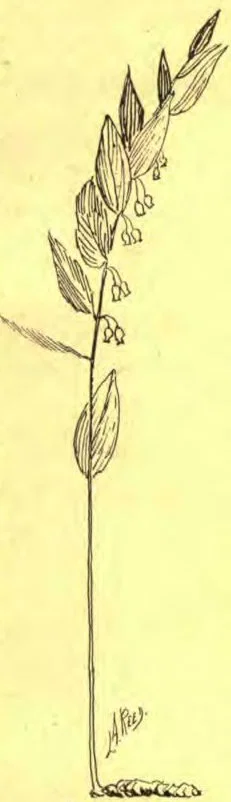
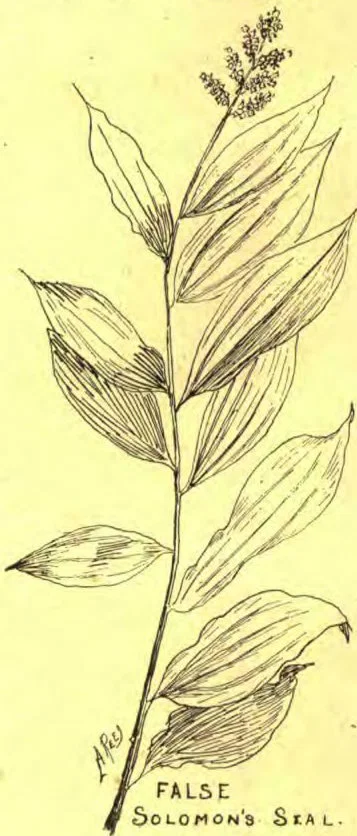
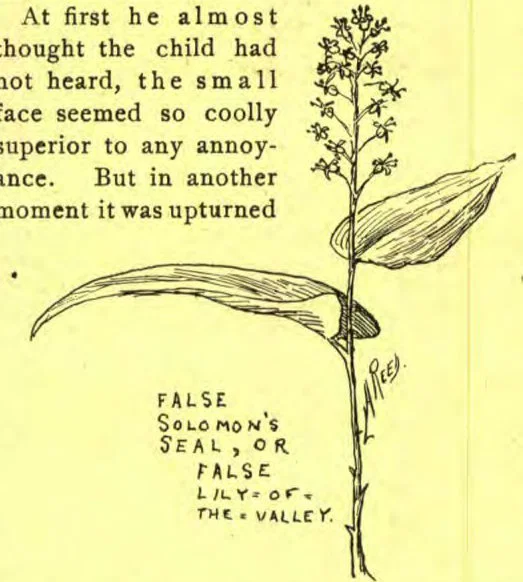
Among the larger wild flowers of the spring, Solomon's Seal is conspicuous. Both it and the larger False Solomon's Seal may be found growing near each other in the cool, moist woods. There is also a smaller False Solomon's Seal, which closely resembles the larger plant. It grows from three to five inches high. The drawings will easily show you the characteristic marks by which you may know these plants. If you carefully dig up the roots, you will see that there is no resemblance between the two False Solomon's Seals and the real Solomon's Seal. The last-named has a peculiar, thick root, with numerous round scars, where the leaf-stalks of former years once grew. These scars are what give the plant its name, as they look somewhat as if a signet, or seal, had been pressed upon the root, thus giving it these impressions.
The False Solomon's Seals have roots quite different from this; but their leaves give them a look somewhat similar. Solomon's Seal has two flowers at each axil of the leaves; the others bear their flowers at the terminus of the stem.
FALSE SOLOMON'S SEAL.
One of these, the smaller, is also called False Lily-of-the-Valley, because its two leaves resemble the leaves of the Lily-of-the-Valley. L. A. R.

Duty Whispers Low: Thou Must, I Can

So nigh is grandeur to our dust, So near is God to man, When duty whispers low, Thou must The youth replies, I can —R. W. Emerson

Behold a Bird's Nest: Verse on Avian Craftsmanship

“BEHOLD a bird's nest! Mark it well, within, without! No tool had he that wrought, no knife to cut; No nail to fix, no bodkin to insert, No glue to join: his little beak was all! And yet how neatly finished! What nice hand With every implement and means of art Could compass such another?”

A REAL LITTLE BOY

He was one of the dearest, quaintest little boys ever found outside of a book—the six-year-old son of a college professor, spending the summer at a Quaker farm-house in Virginia. He looked like a tiny professor himself, the other boarders thought, when he sat for long minutes on the veranda steps, with his wise little head resting on his hand, and his dark eyes looking off into space.
Horace was quite a naturalist; and among his possessions was a collection of creeping things, including two huge green tomato-worms, which he kept on the veranda in a wooden box covered with mosquito-netting. Once one of them escaped, and great was the grief of their small owner, and high the excitement of the summer boarders. It was a relief to the whole household when the runaway was captured, and Horace, clasping it tenderly between his tiny, threadlike fingers, restored it to its home. He pored over entomologies by the hour, and based great hopes upon some of the cocoons and chrysalides in his collection.
“What is that?” I asked him one morning, pointing to a large oval cocoon wrapped in a dry leaf.
“That?” he said, turning his wise, big eyes upon me, and speaking in his peculiarly ringing, deliberate little voice. “If ‘Tenants of an Old Farm’ is correct, that is the cocoon of a Polyphemus moth.”
It will be a long time before Horace’s friends forget the dignity that he displayed on another occasion. He had driven with the Quaker minister to the post-office and village “store.” There was the usual number of idle youths sitting about on cracker boxes in front of the shop, and the precocious-looking little stranger came in for his prompt share of attention. “Look at the kid,” jeered one, “with his legs the same size all the way up.”
They were thin little legs, it can not be denied; and the remark was so much more creditable to the youth’s powers of observation than to his good breeding that the Quaker minister awaited with sympathetic interest the effect on Horace.
At first he almost thought the child had not heard, the small face seemed so coolly superior to any annoyance. But in another moment it was upturned to his, and the deliberate little voice spoke, pitched just high enough to reach the boys on the cracker boxes.
“That is what I consider a rather personal remark,” he said, “but perhaps those little boys haven’t any fathers and mothers.”
And the Quaker minister patted his head, and smiled, and felt that, after all, Horace had the best of it.—Young People’s Weekly.

Through the Dark

A True Story
THE sun had gone down in a bank of clouds. As night fell, these clouds spread. Rough winds lifted themselves up, tossing branches and treetops about, and roaring around the parsonage like a wild beast trying to get in. The country parson stirred the logs into a cheerful blaze, and his wife lighted an extra lamp.
“Some traveler may be on the road tonight,” she said, looping the curtains back from the front windows with thoughtful care; for the parsonage was but a little way from the country road.
Hardly had these good folks seated themselves at the tea-table when a pressing “rat-tat-too” sounded on the door, as if some one was eager for entrance.
As a matter of fact there were two such—two boys of fourteen or fifteen, with wheels tilted against their legs. They begged for a night’s shelter, explaining that they had expected to reach Dallas before dark, but had lost their way, and been overtaken by storm and darkness.
“We’ll sleep anywhere,” Hugh said; “a barn will do, if there’s straw enough to keep warm in.”
But the preacher made the boys welcome, and set them down to share his supper.
“My, but this light was a blessing!” exclaimed Guy, blinking his still bewildered eyes at the good wife’s lamps. “I am sure nobody ever was so thankful before to see a light as Hugh and I were when this kind lamp came shining out through the dark to meet us.”
“Don’t be too sure,” said the preacher. “I think I can tell a story of the dark worth two of yours.”
“Now, husband, don’t!” remonstrated the preacher’s wife.
“Why not, my dear? Perhaps my cave story would interest the boys. And if it doesn’t turn out a ‘sang,’ as Burns says, there may be a bit of a ‘sermon’ in it. Go on with your supper, lads; you can listen and eat at the same time.”
“When I was young, I had a great fancy for caves. I have been in a good many, in Virginia, Kentucky, and elsewhere. But once I got so much of a visit to a cave that I have never been underground since. It was out in Tennessee, long before either of you boys was born, that I reached the little village of L——, late one evening, and put up at its one hotel. My purpose was to visit a cave near by, of which I had heard interesting accounts. At the supper table I met several friendly young business men who were proud of their cave, and anxious to show it to me.
“But you’ll have to lie by a day,” one of them said to me; “to-morrow is election day, and every mother’s son of us must go to the polls.”
“I told them how sorry I was to lose their friendly services, but that having only one day to spare, I must explore the cave without them. ‘There is a guide on the spot, I suppose.’”
“‘Yes,’ they said; ‘the guide lives in a cabin only a stone’s throw from the cave’s mouth.’ But they were evidently disappointed.”},{
“When I came down to breakfast next morning, there was not a man in sight over twenty-one. I set out on foot for the cave, and soon reached Jim Hagood’s cabin. Alas! Jim had gone to the polls, too. None of us had foreseen this.”},{
“I asked Jim’s wife if she could not act as my guide. By no means; her six-weeks’-old baby could neither be taken into that cold place nor left alone in the cabin.”},{
“But I was determined to see the cave, although the woman warned me earnestly against going in alone. Lives had been lost in there before now, she said; there were precipices and holes without number in those dark recesses. I believed her in part, but partly I took this for the ‘shop talk’ of a guide’s wife. At any rate, go I would.”},{
“I got from Mrs. Jim a candle, a box of matches, and some rice to mark a trail; also a long, stout stick, like an alpenstock. With these I plunged into the cave’s mouth, promising myself that I would venture only so far as half my candle would hold out.”},{
“But, being a geological crank, I lost my head as soon as I got to work on the unexpected formations I found in the cave. I sprang from boulder to boulder, using my hammer, sitting down to study and examine my ‘finds,’ without realizing how time was passing, and how my candle was wasting. Suddenly I began to feel hungry. I came to my senses and looked at my candle. There was only an inch left! Not that I had been in the cave as long as an unmolested candle would burn on your table, but I had idiotically flared it above my head, swinging it here, there, and everywhere, to get good views. And this was the result.”},{
“A cold perspiration broke out on me. I dropped my bag of treasures, my hammer as well, and began to retrace my steps as rapidly as possible. But I had neglected the rice-sowing; and even if I had not, the candle gave out long before I could hope that I was near the entrance. Its last ruddy flare showed me a yawning crevasse some steps ahead, and then I was in total darkness.”},{
“Perhaps you think, boys, that you know what darkness is. You do not. Not until you find yourself alone, deep below the surface of the earth, with darkness folded around you like a thick blanket, can you know the meaning of the word. By means of lighted matches I managed to cross this first chasm, over a narrow ledge of rock; but it wasted my supply so alarmingly that I had to desist. Then I tried to go forward in the dark, but a single experience of putting forward my stick, and having it go down (I had almost toppled after it) into an uncanny void, so unnerved me that I gave up the hope of getting out of the cave by myself.”
“What did you do next, sir?” demanded Hugh, eagerly.
“Ah, this is the part of my story that I want you to remember, boys. I realized now, as you can well imagine, my utter helplessness. And then, although I had been a Christian for many years, I realized for the first time what it was to have an Almighty God for my Father and Friend. I kneeled down in the darkness, and committed myself to his care, asking him to save my life if that was according to his holy will; and if not, to be with me in the dark hour of death.”
“Having done this, I quit trembling, my head no longer swam, my eyes ceased starting from their sockets. I began again to draw free, regular breaths. And now I beguiled the time by repeating all the things I had ever committed to memory, especially psalms and hymns; and when I had been at this business for at least two hours, as I thought, or maybe three, I lighted one of my precious matches, and looked at my watch. Exactly twenty minutes had passed.”
“Then, boys, I began to know how long eternity might be; and my heart overflowed with gratitude to my Redeemer, who had provided for me an eternity of light. I lifted up my voice, and sang his praises in the dark, and felt my cheeks wet with tears,—happy tears, boys,—for his wonderful goodness in giving me a bright, eternal hope.”
“Well, you see me here, so you know the end. I sat there, sometimes lying down, for thirty-six hours. The guide’s wife thought she saw me pass her cabin on my way back to the village, and gave the matter no more thought. But the young men whom I had met at the hotel, finding that I did not come back for my traps, felt alarmed for my safety, and a searching party set out to find me.”},{
“Can you imagine my feelings when I roused from a half stupor of sleep, and saw a light glimmer through the darkness?—No, you can not possibly picture it to yourself. I can never have such an emotion again until I leave the darkness of earth, and see the light of heaven.”
When the old preacher took down the Bible for the evening worship before sending the boys to bed, he read the beautiful psalm which says, “The darkness and the light are both alike to thee.”—Elizabeth Preston Allan.

Speech as a Window to Character

SPEECH is gold when the soul has gold to put into it, and sounding brass when there is but brass back of it. There is, of course, great difference in the transparency of speech. Some men shut the windows; some have stained glass, to let in the light, and hide what is within. And yet what is there will out. If genuine character is within, it will manifest itself. If angels are within, they will show themselves, as will also imps of darkness.— Emerson E. White.
Continue reading: CONTENTMENT