The Youth’s Instructor, Vol. 48, No. 24.

THE HAWAIIANS
Earlier text: CONTENTMENT

To Reach BATTLE CREEK

FROM CHICAGO, BUFFALO, DETROIT, OR TOLEDO,
Purchase Tickets Reading over the MICHIGAN CENTRAL “The Niagara Falls Route.”
A First-class Line for First-class Travel between Chicago and New York and Boston. Elegantly equipped through trains pass Battle Creek in each direction daily.
R. N. R. WHEELER, Ticket Agent, Battle Creek.
O. W. RUGGLES, Gen'l P. and T. Agt., Chicago, Ill.

TAKE THE Canadian Pacific Railway

for . . . CHATHAM, OTTAWA, MONTREAL, LONDON, GALT, QUEBEC, WOODSTOCK, TORONTO, BOSTON, PORTLAND, and
All points in New England, the Maritime Provinces, Great Britain, and the Continent.
Illustrated literature, time-tables, and full particulars, upon application to—
J. FRANCIS LEE, GEN. AGENT, Passenger Dep't. 228 SOUTH CLARK ST., CHICAGO.
Branch Offices: 76 Ottawa St., Grand Rapids, Mich. Room D, Chamber of Commerce, Cincinnati, Ohio. 315 Chestnut St., St. Louis, Mo.

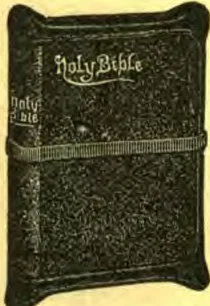
Self-Pronouncing S. S. Teachers’ Reference Bible.

CONTAINS the celebrated Teachers’ Helps, comprising nearly 400 pages. Also a complete series of fifteen new maps.
Description. — Imperial Seal Binding, Tuck Edges, known as “Divinity Circuit,” Rounded Corners, Full Red under Gilt Edges.
We offer this Bible, post-paid, for only SIX NEW YEARLY SUBSCRIPTIONS at 75 cents; or TWELVE NEW SIX MONTHS’ SUBSCRIPTIONS at 40 cents.
We will also send it, post-paid, with the INSTRUCTOR one year for $2.25. For 20 cents extra we will stamp your name in gold upon the cover.

NOTES AND COMMENTS

A Shoe-Shining Machine.—At last a machine has been invented that will automatically clean shoes. The process is as follows: “The foot is inserted into a properly arranged opening, and the railing of the machine is firmly grasped. A small motor actuates rotary brushes that remove the mud. The foot is next placed in the blacking arrangement proper, which acts as the dauber, and the third set of brushes is devoted to polishing.” The various stages in the operation are indicated by a needle on the machine. In using, the only caution needed is to turn up the bottom of the trousers sufficiently so they will not be caught in the rapidly rotating brushes.
A New Use for the Phonograph.—It is now proposed to use the phonograph as an aid in learning foreign languages. It is a fact that “in learning a language it is necessary first of all to have the ear trained to catch and recognize the sounds, and the only way to accomplish this is to listen to the continual repetition of the sounds until the ear becomes familiar with them.” Also, as many persons desire to learn a foreign language who can not have the aid of a teacher who can speak that language correctly, it is proposed to have phonographic records of foreign language lessons. By this means the student may have at his command a speaking-machine that will repeat the lesson to him over and over and over again, until he becomes perfectly familiar with it.
A Great Accumulation of Newspapers.—In the British Museum the files of the daily newspapers are encroaching very largely upon the space allotted to them. The shelves occupied by London newspapers alone exceed one thousand yards in length, while “those devoted to the provincial and foreign numbers measure more than three thousand yards,” making a total of nearly three miles. It is stated that in a single year the British newspapers filled one hundred and eleven yards of shelving, which is at the rate of one mile in sixteen years. In consequence of this, a bill is now before Parliament authorizing the trustees of the British Museum to “deposit with local authorities any local newspapers which have been received by them at Bloomsbury since the year 1837, or which may be hereafter received, and also to make rules respecting the disposal, by destruction or otherwise, of printed matter deposited in the museum, which is not of sufficient value to justify its preservation.” Any one who has ever visited the British Museum will surely agree that its present quota of relics, literary and otherwise, is quite large enough for all practical purposes. A. J. BOURDEAU.

A FORTUNE IN MANNERS

“His manner is worth a hundred thousand dollars to him,” said one of the chief men of the nation not long ago, speaking of a young man, who, by his cheery, thoughtful, friendly ways, was winning friends on every hand. “It would not be worth so much to one who meant to be a farmer, or who had no opportunities; but to a young college student with ambition, it is worth at least a hundred thousand.”
Is the estimate too high, do you think? And do you agree with the idea that a courteous manner is worth more to the ambitious young collegian than to the young man in the smaller school, in the shop, on the farm?
No; the estimate is not too high: the courtesy that springs from an unselfish wish to make others comfortable and happy, the manner that is the natural outgrowth of a real desire to be like the One who said, “I am among you as he that serveth,” is not to be estimated by any worldly standard of value. And this accomplishment is within the reach of the humblest. There is nothing to hinder the farmer lad, the blacksmith’s apprentice, the grocer’s boy, from possessing the unselfish heart that will make them affable and helpful to all whom they meet, considerate of others’ foibles, and friendly and courteous at all times. And if such a manner is worth a hundred thousand dollars to the college youth, who has the advantages of education and culture to help him in life’s battle, what will it not be worth to the young man who is handicapped by the lack of these, and who yet hopes also to win,— to rise to an honored and useful place in the world, in spite of the obstacles in his way? Surely, from the view-point of worldly wisdom alone, he will do well to cultivate the civility that “costs nothing, and gains everything.”
But aside from this phase of the question, there is another thing to consider: We are won or repulsed by the manner of those who speak to us; we win or repulse others by our manner in speaking to them. How important, then, that those who have the privilege of telling to others the truth for these days shall possess a manner that will win them to acknowledge and accept it! “He that winneth souls is wise.”

FOR EVERY DAY OF THE WEEK

Sunday:

God's glory lies not out of reach; The moss we crush beneath our feet, The pebbles on the wet sea beach, Have solemn meanings, strange and sweet. — Owen Meredith.

Monday:

If you would not be known to do a thing, never do it.—Emerson.

Tuesday:

“A germ is hidden in every deed, And every word we say, I know; And be it a flower or a thistle seed, It will sometime, somewhere, surely grow. And on and on in the world we go, And on and on, and we never know The fruit that comes from the seed we sow.”

Wednesday:

Blessed is he who has the gift of making friends; for it is one of God's best gifts. It involves many things, but above all the power of going out of one's self, and seeing and appreciating whatever is noble and loving in others.—Thomas Hughes.

Thursday:

“If none were sick, and none were sad, What service could we render? I think if we were always glad, We scarcely could be tender.”

Friday:

The true calling of the Christian is not to do extraordinary things, but to do ordinary things in an extraordinary way.—Arthur Penrhyn Stanley.

Sabbath:

“They that wait upon the Lord shall renew their strength; they shall mount up with wings as eagles; they shall run, and not be weary; and they shall walk, and not faint.” Isa. 40:31.

SPECIAL NOTICE!

After July 1 the price of the Missionary Magazine will be fifty cents a year; to foreign countries, seventy-five cents. This decision was reached at the recent meeting of the Foreign Mission Board, after carefully considering the question in all its phases.
The Missionary Magazine has been published at a loss from its first issue, this heritage having been received from the Home Missionary, out of which it grew. The subscription list has more than doubled, and yet the cost of the paper has been about twice the subscription price, and it will be impossible ever to secure a list sufficiently large to make it self-supporting at twenty-five cents. Because of this, the price was raised to fifty cents, which will practically pay the cost of publication.
The Magazine has been before our people more than two years, so that they can judge of its value. It has been printed on better paper than the Home Missionary, and bound in good paper covers. Besides this, it has been materially enlarged, and made more valuable by the addition of illustrations and in other ways. It is the aim of the publishers to endeavor to increase, rather than diminish, its value.
We are now offering our people, for fifty cents a year, a good, forty-eight-page monthly, equal in value and size to many missionary journals ranging in price from seventy-five cents to one dollar and fifty cents.
The Missionary Magazine and the Sentinel of Liberty—formerly the American Sentinel—will be clubbed together for one dollar and twenty-five cents. Let all orders be sent as heretofore—either through the State tract society or direct to the Foreign Mission Board of Seventh-day Adventists, Room 1906, 150 Nassau St., New York, N. Y.
FOREIGN MISSION BOARD OF SEVENTH-DAY ADVENTISTS.

MISSIONARY MAP OF THE WORLD

WE are pleased to announce that a missionary map of the world, representing our work in organized Conferences and mission fields throughout the world, is now in course of preparation. It will be printed on substantial cloth, in black and two colors. Price, seventy-five cents. It will be ready for delivery about July 1. Address all orders to the Foreign Mission Board of Seventh-day Adventists, 150 Nassau Street, New York, N. Y.

You have reached the end of this edition.

The Youth’s Instructor · Jun 14, 1900