LEA came slowly out of the house and sat down in a chair on the piazza. She chose the farthest chair a little round the corner and hidden by the vines. Lea’s heart ached, and hearts ache best in solitude.
“I’m the only un-show-off-able Quimby there is,” she sighed, rocking ashamedly. “Or ever, ever was,” she added, as memories and tales of little Quimby aunts and uncles, cousins and even far-back grand-Quimbys recurred to her.
In the parlor back of the vines some one was playing a stirring march on the piano. It was Barbara—Barby could play beautiful music. Pretty soon somebody would say, “Won’t you sing for us, Sylvy?” and Sylvy would sing. Then if she sat there in the veranda rocker long enough, Lea knew she should hear Luther declaim with splendid, big inflections “Horatio at the Bridge,” or, “The Black Horse and His Rider.” He would do it so beautifully,—everybody did things, sing-things and play-things and speak-things, so beautifully.
“Except me,” sighed Lea.
She stopped rocking suddenly, and gazed despairingly about her. In her gentle, sore little soul rankled a dreadful feeling. Lea did not know its name was Envy. She thought it was a shame because she was a Quimby, and could do nothing to help entertain her friends.
Over the piazza floor were strewn blocks and odd-shaped bits of dissected pictures. Lea got up and went stooping painfully about picking them up. Jeffy and Mig were so scattery—and so dear! How many, many times a day folks had to clear them up!
Lea did not remember that it was almost always she who did it. To her order-loving little mind things lying about out of their places were an offense; she had a way of stooping to pick them up as she went by. It was a beautiful habit, Lea’s mother thought. Every Quimby—and in the family there were nine—liked to have Lea clear them up. But, oddly, it never occurred to them to praise her for it. No one ever said, “Won’t you clear up for us now, Lea?”
The march came to an end with several mighty, inspiring thumps on the lower keys. The sad little fingers gathering up blocks outside the window heard a soft clapping. Then, after a few moments, a clear, sweet little voice began to sing. Sylvy’s voice—Lea listened admiringly. It sang something beautiful about birds and flowers and brooks. The soft clapping began as soon as it stopped.
“Now, Luther, ‘Won’t you speak the “Black Horse” for us, Luther?’” murmured Lea outside.
But Luther chose another “piece.” His big oratorical voice came out through the window impressively:—
“Girt round by rugged mountains
The fair Lake Constance lies.”
He had chosen the “Legend of Bregenz” instead of “Horatio” or “Black Horse.” Lea knew it by heart, and followed him anxiously. Suppose he forgot! For the honor of the Quimby name he musn’t! At a dreadful little pause she crept to the window to prompt him through the blinds, but he picked himself up and went on without assistance. Luther spoke pieces splendidly. Lea was proud of Luther—of Barbara, of Sylvia. But she was not proud of herself.
“I can’t do a single thing!” she mourned, and went on sorrowfully clearing up.
When the company by and by came out on the piazza to go away, the delighted eyes of the Quimby mother saw that it had been set in order, and she need not blush for the little disorderly litter as she had a while ago. “Lea,” thought lovingly the Quimby mother. But no Lea was in sight.
In the parlor, after the impromptu little exhibition, confusion reigned. The chairs were moved about tipsily, sheets of music were scattered over the piano and floor, empty cups stood about.
They had been the “company” and that was the explanation of the exhibition. The Quimby mother did not believe in showing off to persons out of the family; but she always yielded to Miss Getty and Miss Ann Mary, because they were lone, little, old sisters from the Old Ladies’ Home, and asked in such dear, eager old voices. They deserved to be entertained, reasoned the Quimby mother.
Lea went in through the rear door, through the library into the empty parlor. Empty! It looked running over full to Lea! She began at once to set it in order, and by the time the two little old women had succeeded in tearing themselves away, and the procession of Quimbys came back into the house, the room was spic-and-span again. But no Lea—she was hurrying out to the kitchen with the empty cups and the sugar bowl. She could not know that the tired Quimby mother said, “Bless her,” and meant her.
That night, after the different “stages” of little Quimbys had all gone to bed—Jeffy and Mig at seven, Luther and Sylvy at eight, and Barby and Lea at half-past—the Quimby father and the Quimby mother and the baby, who refused to go to bed at all, sat under the nursery lamp and softly talked. Lea could hear them through her half-opened door—the Quimby baby loudest of all. He was showing off, thought Lea, laughing to herself in the dark. The little beloved, singing and speaking his little foreign pieces!
Thinking of the baby made her for a minute forget the sore place in her heart. But she felt it again presently.
“Sylvy’s voice grows sweeter and stronger, William.” The Quimby father was William.
“That so?” he said. “Good! I must get her to sing for me.”
“And Barby to play for you—and Luther Boy to declaim!” laughed the Quimby mother with a tender little undernote. “They all performed for Miss Getty and Miss Ann Mary this afternoon. I couldn’t refuse the little old ladies, William. The children did beautifully; but, William—”
Lea’s wet face, burrowed deep in the pillow, came up quickly at the next thing the Quimby mother said. It was so very unexpected and so good sounding! Lea could hardly believe her ears.
“But, William, our little Lea has the most beautiful talent of them all, did you know it?”
No, the Quimby father did not know it, and while he waited for the rest, Lea waited too. She sat up perfectly straight and held her breath. What could it be the Quimby mother was going to say? “The most beautiful talent of them all”—not the most beautiful one! She must have heard wrong, Lea thought. Still, her ears were such good hearers—
“She has the talent of helping people—mothers,” the tender voice explained out there to the Quimby father. The tenderness was a new kind that sent a little sob upward into Lea’s throat, and made her feel like getting up into the Quimby mother’s lap and hiding her happy face. It was different from the other kind that had been a pride-tenderness. This was the—the love-kind.
“She is all the time doing beautiful little things to help me. You can’t think, William! She picks up the babies’ play-things, and clears up the rooms. If that isn’t a beautiful talent——”
“It is,” the Quimby father nodded. Lea could hear him nod. “It’s the best13kind of talent, Mary. I’ve a good mind to go in and kiss the child!”
“I’ll go with you!”
They were coming. Lea sank down in a little heap and waited. She shut her eyes because she thought they wanted to find her asleep. Very quietly she lay in the darkness. There was no sore place now in her heart. She had a talent, too! It was a beautiful one! She was a good clear-up-er and they were coming in to kiss her for it. Why, that would be like clapping. People clapped when Barby and Sylvy had talents—and Luther.
Lea held her breath and waited in a little transport of happiness. Her small, expectant face was uplifted and ready.
“Bless her,” the Quimby father said, and kissed it softly in the dark.
“Bless her!” whispered the Quimby mother, and kissed it again and again. Mothers are not satisfied with once. Lea felt her smooth cheek against her own and the happiness grew bigger and bigger. In her heart was a great desire to get up and go downstairs and clear somebody up right now for this dear Quimby mother. But wait till to-morrow—O, wait till to-morrow!—Annie Hamilton Donnell.
Costa Rica
By H. C. GOODRICH
H. C. GOODRICH
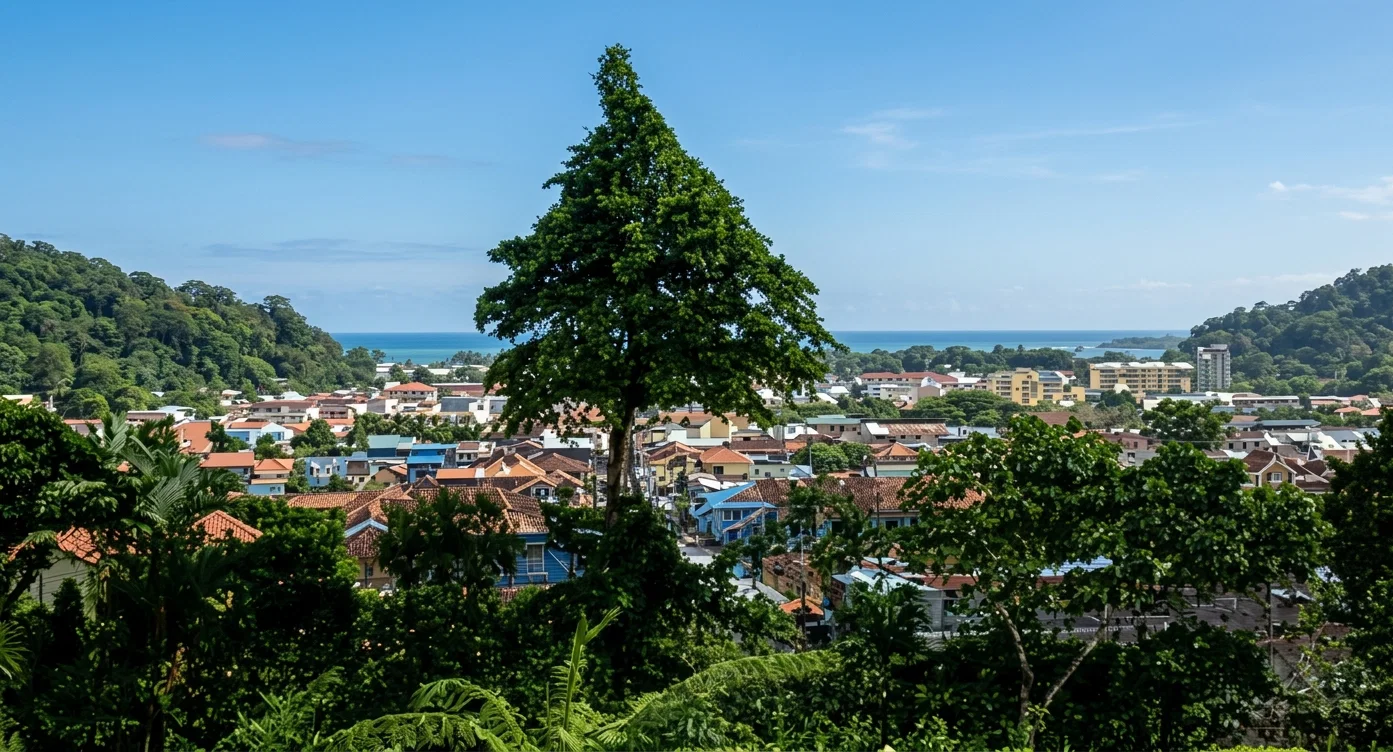
WE are glad to note progress in the present truth in Costa Rica. With my daughter Mildred I landed at Port Limon, March 25, and the next day started for San Jose, the capital of Costa Rica, one hundred two miles distant by rail. The scenery along this road is very beautiful. The road winds around the mountains, which rise in places hundreds of feet on the one side, while on the other are precipices just as high. The valleys are thickly settled, and the growing crops and tile-roofed houses as we looked down upon them from the passing train, made a beautiful sight. It made me think of the great message that is given to us to give to every nation, kindred, tongue, and people, even to the people of these valleys, before our work is done.
PORT LIMON, COSTA RICA
Leaving the coast, we leave also the English-speaking people; the laborer here must have the Spanish language. The people, too, are more industrious, the land is better tilled, and the common people seem more prosperous; as we approach Cartago, about ninety miles from Port Limon, and at one time the capital of Costa Rica, we notice a change in the climate. The air is delightfully cool, and toward night is almost cold. We reached San Jose about five o'clock, after a ride of seven hours. Here our pioneer worker, Brother T. M. Brown, has been working for two years, sometimes encouraged with success, then almost disheartened by the turning away of those who have received the word. His work has been from house to house, and during the past year ten adults have accepted the faith. Five of these were baptized at this visit, among them the first fruits of the Spanish people in Costa Rica. Brother J. B. Stuyvesant, who has been in these countries for several years as a self-supporting missionary, has joined Brother Brown in the Spanish work of Costa Rica, and is giving his whole time to the work of the ministry.
Leaving San Jose, I came to Pacuarito. The principal crops raised here are bananas and cacao. At San Jose nearly all the fruits and vegetables of the Temperate Zone are raised, and because of its beautiful climate is fast becoming noted as a health resort. At Pacuarito we have a church of seventy members, which has been organized and built up by Elder H. Louie Mignott. They have a very neat church building, which is furnished with a good organ and a bell; and scarcely a quarterly meeting passes that some have not been added to their number. I found Elder Mignott holding meetings in a sawmill at Siquirres, which is given to him free of charge. Several have already begun the observance of the Sabbath at this place, and there is a good interest to hear the truth. I noticed with much pleasure that the church at Pacuarito, which is only three miles from Siquirres, have done what they could to help in these meetings. This has been a great encouragement to Elder Mignott, and has helped a good deal in his success.
During our stay in San Jose we witnessed the ceremonies of "holy week," including the celebration of Good Friday and Easter Sunday. Thursday night in one of the large churches was a garden filled with ferns, palms, and other plants, in the farther corner of which was a life-sized image of Jesus, appearing as if bowed down with grief.
Two women sat within the enclosure of the garden, selling bits of ribbon which had been blessed by the priest. Hundreds of people were coming and going to see the garden, and buy the bits of ribbon. A little way off in the garden was a life-size image of Peter, while a rooster, tied by a string, was occasionally crowing.
Friday morning the image of Christ, mounted on a float, and carried on men's shoulders, himself bearing a large cross, was led forth to be crucified. Good Friday is the great day of the year. The stores are all closed, and all business is stopped; not a railway train, nor a street-car, not even a carriage, is allowed to run in all the country; everything stops. The procession left the Carmon church, led by a band of more than sixty pieces, playing a funeral dirge. At twelve o'clock they arrived at the cathedral, and after a short delay a curtain was raised, and there was the Christ hanging on the cross. Flowers and sprigs of green hid the wood of the frame in which the cross was set; many candles were burning before him, and standing on either side were the disciple John, and Mary the mother of Jesus. At three o'clock there was a sermon in Spanish, on the evidence from14Scripture that Christ would come and die; then at four o'clock the image was laid in a gilded casket, with glass sides and top; this was followed by the images of John and Mary; and these in turn by a score or more of beautiful girls, five or six years old, with wings of feathers fastened to their shoulders to represent angels, all carried on floats on the shoulders of men. Again the procession was led by the band. The casket was followed by the bishop and by all the priests of the city. The crowd was so great that the police had to clear the way for the procession, which went to another church, called the Solidad, where the gilded casket with the image will remain till the holy week of another year.
On Sabbath, business was resumed again in some measure. Sunday morning at daybreak there was another procession, which filled the street from side to side for several blocks. The images of Mary and John were again carried in the procession, and the same band played a lively air. Above the heads of all the people was a great framework of irregular shape, covered with what looked like loose cotton; this I understood to represent the cloud which received Jesus out of their sight. This ended the ceremonies for holy week. Only the dead past was before the people. The power of the living Christ Jesus, who saves us from our sins, who sits with his Father in judgment, who will come again in power and great glory, was not known by the people, nor did it seem to come into their minds. Only the glory of the ceremonies was before them.
A gloom of sadness hung over the whole city, and every flag, both government and private, hung at half-mast. The people came in crowds to the churches, prostrating themselves before the images of the saints, some of the more devout visiting all the churches, bowing low before every image and every picture, reading prayers before each, in their efforts to find peace with God. And yet the people were not all at the churches. A great many had left the town to escape these ceremonies. They have lost confidence in the only religion they ever knew. Many have gone into spiritualism, and more into infidelity. While a great many of those who remain in the church wonder at its corruption, they feel afraid to leave the fold. Surely the harvest is great, but the laborers are few.
Cristobal, Canal Zone.
Be Simple in Hospitality
By Ralph Waldo Emerson
I PRAY you, O excellent wife, not to cumber yourself and me to get a rich dinner for this man or this woman who has alighted at our gate, or a bed-chamber made ready at too great a cost. These things they can get for a dollar at any village. But let this stranger, if he will, see in your looks, in your accent, and behavior and will, that which he can not buy at any price in any village or city, and which he may well travel fifty miles and dine sparsely and sleep hard in order to behold.
Certainly, let the board be spread, and let the bed be dressed for the traveler; but let not the emphasis of hospitality lie in these things. Honor to the house where they are simple to the verge of hardship, so that there the intellect is awake, and reads the laws of the universe.—Ralph Waldo Emerson.
Rattling Windows
By The Commoner
ON stormy or windy nights, such as we have frequently in cold, wintry weather, the rattling of a loose sash will occasion much loss of sleep, and in order to prevent the noise, it is only necessary to insert a bit of wood at the side of the sash. This wooden “stop” may be made slightly wedge-shaped, and lightly driven in the opening as far as required to keep the sash steady. The head of the wedge may be tied with a bit of twine and fastened to the side of the window, so it will always be in place. All loose boards, and shutters should be tightened up wherever located, as this will prevent one of the most troublesome annoyances of the stormy, winter night.—The Commoner.
Notes of Travel in Turkey
By Claude D. AcMoody
—No 1
CLAUDE D. AC MOODY
SHAKSHAK, MARCH 11.—This afternoon of ideal weather finds me in a little Armenian village of one hundred houses, all of which are made of sun-dried bricks of mud and straw. The village is situated at the top of a high hill. We will not look into the village itself; for all that we see are its filthy, and narrow streets and rickety old houses; but we will look off to the Sea of Marmora on one side, with the Princes Islands in the distance, and off to the south to the range of mountains lining the south coast of the “marble sea.” With the glasses, Constantinople can be seen, commanding the exit of the Bosphorus into the Marmora. From the point where I am penning these lines I can see the ruins of what is said to be the birthplace of the mother of Constantine the Great. It is close to the sea. Near this old ruin is seen what appears to be the remains of an old stone road, built out into the sea. How far it might have extended is not at all certain; but it is thought by some to have one time reached across to the Princes Islands, which are a considerable distance from the shore. The line of hills stretching back at an angle from the sea to the southwest presents a beautiful sight from the more elevated position of the village. In the evening, as the sun sinks behind the mountains, the valleys between the ridges, filled to the lip of each hill with a smoky haze, have the appearance of vast depths of violet.
We reached this village by twelve hours’ travel on horseback from Bagtchedjik (little garden), where I have conducted an institute for two months this winter, which closed last week. Ten students were in attendance. Though we have labored under some trying disadvantages, not having a good interpreter part of the time, still the Lord has blessed the effort, and the students, many of whom are quite young, have been of good courage. One young man who was in the institute will do some Bible and tract work this summer. We do need ways and means for educating our youth so as to prepare them for the field. This institute has been a start in the right direction; and we are glad to have been able to conduct it. Of course we have no rights from the government to conduct a school, and but for very friendly relations with the civil heads of the church communities and Turkish officials in Bagtchedjik, we could not even have conducted the institute without being interfered with by the authorities. We hope and pray that the institute plan may develop into a permanent school, with a permit from the government to conduct it.
I have just passed a Sabbath and several days with the brethren here, enjoying some good meetings with them. Their membership is twenty-three, all of whom are rejoicing in the message of Christ’s soon coming. This is one of the places where I live strictly Turkish fashion. For one week I have sat Turk fashion to meals by a table about ten inches high, and dipped from the large dish in the center of the table.
LALEDERS, MARCH 12.—The season is opening especially early even for this country. Constantinople is on the same parallel of latitude as New York City, but the spring comes much earlier. Since the middle of February the weather has been delightful. It is therefore very15pleasant traveling on horseback. Yesterday afternoon a breeze came from the sea, and blowing gently across the Bythinian hills, dotted here and there with flocks of sheep with their shepherds, it had an exhilarating influence upon the traveler. One could dream himself in the years gone by, when our Lord and Master drew forth those sublime lessons of the kingdom of heaven from the flocks and herds and hillside scenes of Judea. A few days ago I saw a shepherd in the midst of his flock, with a little lamb under each arm. Jesus could not have drawn a more significant picture of his care over his people from any source than from the life of these Oriental shepherds. They spend the nights in all seasons with their flocks, so that they are “wet with the dew of heaven.” Likewise our great Shepherd cares for his sheep, bearing the weak ones in his strong arms. He has endured the ravages of sin that we might be gathered at last safe from all the storms of this cursed earth.
We have only one brother and one sister in the faith in this village. They are numbered with the Shakshak company,—the place from which I wrote yesterday. These were very anxious that I should visit their place, and speak to some of the village people. It is my first visit here. Last evening between sixty and seventy people gathered to talk, ask questions, and hear a lesson from the American who had come to their village. Through my faithful interpreter the Lord blessed as I opened to them the simple and practical truths of the gospel. Buried in the dark superstitions of the old Gregorian Church, many unable to read, only the simplest lessons can be grasped by them. My congregation last evening would certainly have been a strange sight for our American brethren who have not traveled in Oriental countries. My interpreter and myself were seated each on a “minder” (the cushion placed on the floor of a Turkish house, which serves in the place of a chair) at one end of a room, with a little low table about eighteen inches high before us, upon which was a lamp and a large ancient Armenian Bible. At each side of the room, and across the center, “minders” were laid, and occupied by the simple Armenian villagers. After I had spoken for about an hour, we passed through what is a usual ordeal in such a place as this,—listening to and answering all manner of questions, religious and secular. I would remark here that, though this village is but about forty-five miles from Constantinople,—in fact I saw Constantinople this morning early by the aid of strong field-glasses,—the people, in common with many other villagers within short radius from Constantinople, seem nearly as far removed from the world of affairs as they would be if the Sahara desert intervened. Villages of one, two, and three thousand inhabitants have no postal service. To all who could read Armenian, we gave some of our Armenian tracts. There are hundreds16of these places, which have never been entered by the Protestants, to whom we long to send workers to enter the open doors. Of course progressive work in any place lays us liable to interference from the government, but with care one can go ahead even under difficulties.
This morning we have just come from a walk to an ancient Greek cemetery. Unfortunately there were no inscriptions to be found. I was told by those attending me that there were some inscriptions, but that they had been destroyed or carried away. This whole country is covered with the relics and ruins of ancient civilizations. Alexander passed not far from this part of the country after the battle of Granicus. Later it was the scene of campaigns by the Philips of Macedonia.
Constantinople.
Canton (China) Workers’ Meeting
By Mrs. J. N. Anderson
MRS. J. N. ANDERSON
The workers of the Quangtung province, both native and foreign, met in a general workers’ meeting at Canton, March 12-18. Elder Keh Nga Pit from Amoy was present, and his long experience in the gospel ministry and in educational work, combined with an unflagging enthusiasm for the cause, makes him especially valuable help in a meeting where, as in Quangtung, most of the workers are young men of short experience. All of the workers except the teacher of the Kongmoon girls’ school were present,—some thirteen regular native workers in all, including the teachers. These, together with the older pupils from the two girls’ schools and the boys’ school, made up an altogether inspiring congregation.
The meeting began with a prayer service at seven o’clock, on Thursday. The topics assigned for that day were as follows: forenoon, ten to twelve o’clock, “Our Message;” afternoon, two to four o’clock, “The Selection and Training of Workers.” Elder Keh led in the first topic with an address, a model synopsis of which will appear later. Real earnestness and enthusiasm were manifested from the first, and the discussion by other workers, which followed, leads to the expectation that God is laying upon these young people the burden of this message to their own race. Other topics considered were, “Means and Methods of Advancing the Message;” “Our Schools, Their Aim and Management;” “Narcotics and Stimulants, Our Attitude Toward the Use of These;” “The Sabbath-school;” “Street Chapel Work;” “Country Work;” etc. A question-box offered opportunities for the discussion of miscellaneous topics, and was made very helpful. There was general Bible study each morning.
The subject of narcotics and stimulants is a vitally interesting one here in South China, where men and women alike smoke everywhere and all the time to the full limit of their means, and where only the very poor do not afford at least a few cash worth of wine with the family meal. Dr. Law Keem dealt with the subject very pointedly both from a physical and spiritual point of view. To receive callers without pipes, and to entertain guests without wine at meals, is, in Canton, niggardly and discourteous,—a breach of custom, which to most people is worse than sin against God. To refuse these courtesies from others is quite as bad, or even worse, and calls for no little moral stamina on the part of church-members. Heathenism appears to be a very fat-stalk for the grafts of all foreign vices; and while the stung and poisoned nation of China is stirring herself to be freed from the curse of opium, Western enterprise is literally walling her streets with cigarette and tobacco posters, and filling her shops with bottled wines and liquors vastly more dangerous than those of home manufacture.
HOUSE BOATS, CANTON RIVER
One speaker, in pointing out our duty in the face of this situation, said, “Why should virtue be so overmodest? Why should we fear to offend these menacing twin evils? Vice is not so modest. She flaunts her ugly fame through our street everywhere. Vice is boastful, vaunting, TRIUMPHANT. Let us not cower before vice because it is custom, but in God’s strength carry the standard high as he has placed it.”
So many good things were said that I have decided to give a few of them in other articles as an encouragement to our brethren at home to “have faith in God,” and in his work in heathen lands. His Word prospers here as elsewhere, and in darkened China will ultimately bear the same fruits, though development on heathen soil may take place more slowly.
On Sabbath our rented chapel was more than filled by our own people, pupils from our schools, and their invited friends, though the street doors were not opened to allow a promiscuous attendance.
One very significant feature of this meeting was the circle of inquirers which gathered to it. First there was Hung Hei Ying, the pastor of an independent congregation of Christians, some two hundred miles from Canton, in the vicinity of Swatow. Once a mandarin (government official), he left that work because, as is usually the case, the salary was insufficient to support him in proper style without “squeeze” (“graft” it is called in America). Later he became a Christian worker, and being a man of some means has supported himself for some years past. He began to keep the Sabbath about one year ago, with his wife and a family of five children. A greater part of his congregation, who are mostly farmers, now stand intelligently with him, keeping the commandments of God. This interest, I believe, was awakened through the Sabbath tract written by Elder Keh, and which he himself distributed at Swatow in calling at that port on his way to Canton. He related how, in the days when the Sabbath truth first dawned upon him, and his conscience was moved to obedience, he at first wavered under the persuasive arguments of friends, but his wife staunchly persisted that since it was God’s command, they could do nothing else but obey. There has been caution both on the part of Brother Hung and on the part of the mission. He, as a thorough Bible student, has tested carefully every point of truth. It is possible, too, there have been some misgivings about connecting with a mission under a foreign board. On the part of the mission there has been a fear to encourage connection with a work so far distant from close supervision until its character was thoroughly known. Brother Hung’s presence at this workers’ meeting brought perfect confidence to both parties, and since his return home he writes a splendid letter in which he says his wife is very much pleased with what he has to say about his visit, and counseling together they wish to convey to the church here their desire to become members of the Seventh-day Adventist16Church forever. This will open the way for the organization of a church at his place in the north of this province.
Two relatives by name of Chan were present from the village of Ngoi Hoi, not far from Kongmoon, where Brother E. H. Wilbur is located with his family. They are representatives of a band of some twenty odd, as they report it, who have become interested, and are keeping the Sabbath according to their idea, as the fruit of literature sold in that section. They offer to support a chapel, and ask for leadership and further instruction.
From a village ten miles out from Canton came another man, Ho Kei Yam by name, whose interest is very recent. So far we have had no opportunity to investigate the matter. He represented himself as educated for the ministry in a mission school, and that the people in this village are ready to furnish a site, erect a chapel, and do all they can to help if a work can be started there. This man was present at almost every meeting, sometimes walking the ten miles before breakfast to be at the early morning prayer-meeting.
Another call was presented by a man from Hoi Fung about half way between Canton and Swatow. Some years ago a few men in this district accepted Christianity and appealed to a mission for help. At the time that mission was unable to undertake the work, but a young preacher accepted the call on his own responsibility, and went there to work under the support of these Christian believers. They now have two chapels with a good company of believers at each. The work has far outgrown one man’s capacity, and some time ago they appealed to one of the German missions for help. This mission could not undertake the work, but, after looking into the matter, wrote a letter to whatever mission these Christians should see fit to present it, seconding their plea for help. Through the influence of young men in our Bible school this man, Yim Tak Ming, had his attention called to present truth, and now brings a call from six hundred families for this message to be preached among them.
They are perfectly independent of any relation to any mission body, and want a chance to know the truths for these days. Brother J. P. Anderson went home with the man to stay a week. As he was leaving, they gathered around him, and pleaded like men begging for bread that he would promise them help. What answer will the brethren in the home land return to them?
Altogether this meeting was one of blessing and great benefit. On every side are evidences of fields white to the harvest while at this time we saw indications never so apparent before, that God is preparing witnesses for himself from among this people. We feel to do as Paul did when the brethren from Rome heard of his coming, and came to him at the Three Taverns,—thank God, and take courage.
Canton, China.
The Foreign Mission Seminary
By H. R. SALISBURY
The first year's work of the Foreign Mission Seminary is just finished, and we have great reason to thank God for his guidance, and for the prosperity granted us during the session. Our enrolment was seventy-seven for the year. The actual attendance remained almost unchanged, but three students leaving the seminary after December to the close of the year, aside from those who were sent to fill definite appointments in home and foreign fields.
While the work has been new, it could not be called experimental; for though we had no school among us to follow as a pattern, yet the great and positive need that brought the seminary into existence was of itself a guide to definite lines of study. With this need before us, we had but to arrange our courses to satisfy the demands. Briefly put, these requirements were as follows: (1) an advanced and thorough presentation, by recitation and lecture, of the great Biblical themes that make us a peculiar people, and give us a present-truth message; (2) practical and experimental knowledge in the treatment of simple diseases, and also of special diseases which are met with in the different countries to which the foreign missionary is preparing to go: the courses in tropical hygiene and diseases, hydrotherapy, sanitation, advanced physiology and anatomy were taught by physicians from foreign fields; (3) studies in modern languages, as, French, German, Spanish, Chinese, Hindi, etc., taken by students who were planning definitely for the fields in which those languages are used; and work in Latin, Greek, and Hebrew for those who were preparing as ministers, teachers, and translators.
It is almost unnecessary to say that the missionary spirit was excellent, and all the studies, lectures, and meetings had as their objective point the preparation of the foreign missionary. During the first part of the year we were crowded for class room, but several weeks before the session closed, we were able to come into the new seminary building, where we now greatly enjoy those conveniences which make it possible for us to carry on our work with the most favorable surroundings.
Besides the regular lines of work carried on by the instructors the past session, our location at headquarters has made it possible for us to receive special lines of instruction in organization, religious liberty, missionary qualifications, etc. The officers of the Mission Board visited the seminary very frequently, and became personally acquainted with all the students.
All the students this year have been planning for the regions beyond, or have been taking a thorough training in a course which would give them special fitting for the gospel ministry. The seminary has made special plans to have a strong ministerial course, covering every possible subject necessary for preparing young men to be efficient in that line of work. That this course of study is necessary, need not be argued here; for it is apparent to all that one of the crying needs of this denomination is a stronger ministry, composed of those who have had special fitting for this line of work. The coming year we are planning to strengthen that course, as well as our course in foreign mission study.
The young men and women who have not already gone to foreign fields, but who are planning to return the coming year to continue their studies, are definitely engaged in the work of this denomination. One third of the students are out working for scholarships. The others are working in the ministry, or in the Bible work, or are connected with our institutions.
Already numerous applications have come in from those who will attend the coming session. Many of them have already been assigned to definite fields by the Mission Board, and will be here to spend one year on their way to their fields. The new building and facilities provided by the Mission Board, the strengthening of our faculty, the commendation and co-operation of our leading men throughout America, gives promise of a most successful session, and encourages us to believe that a large number will go out at the end of the next school year to grapple intelligently and understandingly with the conditions which they must meet in the regions beyond. H. R. SALISBURY.