Here is a little letter from Chautauqua Co., N. Y., written by ALDA F. DOBBIN, who says: “I have often thought I would write a letter to the Budget. I am ten years old, and keep the Sabbath with my parents and brother. We live about two miles from the new chapel that has just been fitted up. I think the Lord is good to help us to such a nice place to hold our meetings. I want to be a good girl and live in the earth made new.”
The next letter is from Ada Co., Idaho, written by BERTHA CARTER, who says: “We have a very nice Sabbath-school, which was organized by Eld. Fero in Jan., 1886. I have been absent but once, and have had perfect lessons every time. I keep the Sabbath with my parents and two sisters. My elder brother does not keep the Sabbath. We are praying that he may sometime. We are keeping my little cousin, whose mamma died not long ago. She is two months old. Her name is Pearl. I have a brother younger than I. I want to be good, and set good examples before them both, that we may at last be saved.”
MINTA CARPENTER, of Blue Earth Co., Minn., says: “I am twelve years old. My mother died when I was five years old. I was baptized at the Waseca camp-meeting, in the fall of 1887. I have two sisters and two brothers. We have a good Sabbath-school, which I attend regularly. I take great interest in reading the INSTRUCTOR. I am trying to be a good girl.”
ESSIE LUTHULTZ sends a letter in the same envelope with Minta’s, saying: “I am eleven years old, and was baptized at the same time Minta was. We live two miles and a half from town, where our Sabbath-school is held, but I attend as often as I can. I am trying to live a Christian, and want a home in the new earth.”
GERTIE M. HATCH, of Tuscola Co., Mich., writes: “I am nine years old. I go with papa and mamma to Sabbath-school. Mamma is my teacher yet. We have a number of house-plants, three birds, and a nice white kitty almost fourteen years old. His name is Snowball. We have a pair of white ducks. I am trying to be a good girl, and hope to be saved.”
HARVEY ANSON WOODS, a little boy ten years old, writes from Miami Co., Ind., saying: “I keep the Sabbath with my parents and little sister. I go to Sabbath-school every Sabbath. I like to go, and I like my teacher. I learn my lessons well. I am trying to be good, and hope to meet the INSTRUCTOR family in the kingdom of heaven.”
HENRY CHASE, of Isabella Co., Mich., writes: “I am a boy ten years of age. I am all alone in my Sabbath-school class. Mamma teaches it. I am trying to be a good boy, so as to meet you all in God’s beautiful kingdom.”
NETTIE CHAPMAN writes from Redwood Co., Minn. She says: “I keep the Sabbath with my parents, and am trying to be a good girl. I am eleven years old. We have no church building, so we have meetings and Sabbath-school in our house. I send my love to all.”
JESSE, IRA, and RUTH JARED sent letters from Edwards Co., Kan. Their ages are thirteen, eleven, and nine years. They had been keeping the Sabbath about three months, when they wrote. They go to Sabbath-school, although they live three miles from the place in which it is held. They wish to be remembered by the letter-writers.
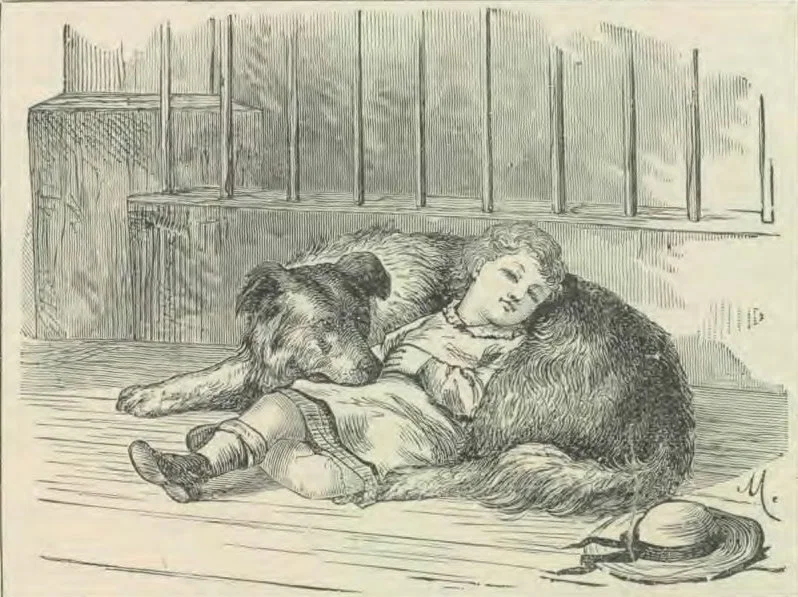
MARY AND DOG CARLO.
LITTLE Mary and her great black Newfoundland dog, Carlo, were a very familiar picture to me. I often stopped to look at them as they ran about the yard. If it was a warm afternoon, they lay asleep under the large evergreen trees. Mary’s light curls made a lovely contrast to Carlo’s shaggy black sides. His loving gentleness made him seem as good as he was handsome.
Little Mary had a naughty habit of running away from home. Carlo would not leave her for a moment. He seemed to try to get her home again. He ran before her, keeping her from getting off the walks, and trying to coax her to turn about. Sometimes he would succeed, and then I heard his joyful bark, when he saw her once more safely in the yard. If he could not get her home, he would never desert her. When she was tired out, she laid her curly head against his neck, ready to go wherever he led. Then you may be sure he led her home just as straight as he could go.
One day, when I came out of the gate, Carlo met me, barking and jumping about in the most anxious manner. He ran a little way, and then came back to me, as if coaxing me to follow him. I thought him too wise a dog to be mistaken; so I followed him, though a little slowly. He seemed to notice this, and to beg me to hasten. In a moment more I saw dear little Mary toddling along the railroad track.
I felt sure that the dog’s quick ears must have heard the train, which was coming around the curve. I hurried fast enough, I can tell you. Carlo had never before allowed me to pick her up, even for a moment. Now he seemed fairly wild with joy, when I caught her in my arms. He led me home in a perfect dance of delight.
After that, I was a privileged friend; for Carlo never forgot that morning. To the day of his death he thanked me, in his mute, loving way, every time he saw me.—Our Little Ones.
ONE THING WE SAW.
By M. J. C.
At the Cincinnati Centennial Exposition, which we visited last September, where every sort of industry was being shown, at one time our attention was attracted by a group of small boys, seated about a table, seemingly waiting for the machinery to start up to give them something to do.
At the first signal for work, they began hastily to spread out printed labels and small sheets of tin-foil, and to smear them with paste ready to be stuck to something that as yet was nowhere to be seen; so we looked on, and on, to learn the beginning as well as the ending of the matter, which was this:—
A man stood at a machine for cleaning bottles. This had a revolving shaft, at the outer end of which were several arms. Upon each of these, the man would slip a bottle partly filled with soapsuds and shot. Here the bottles would turn rapidly around a number of times, when everything that was sticking to them would be loosened. He would then pour their contents into other bottles that needed cleansing, rinse the first and place them bottom side up to drain, into a box that would hold about a dozen.
He did his work so fast that clean bottles were always ready for the next machine, which was for filling them with some liquid.
It was the business of the man at the second machine to fill and cork the bottles, and to place them into another box to be passed to a table where one man wired the corks into them to keep them from bursting.
And now the bottles have reached the table where were seated the company of boys spoken of at the beginning of this article. There were four of them. The first boy caught up a bottle and clapped a piece of tin-foil over the cork. Boy No. 2 stuck a label around the neck of the bottle. Boy No. 3 a label lower down on the bottle, and No. 4 one on the opposite side of the bottle from No. 3's label.
It was quite interesting to follow the work from the start; for it was done with such nicety and precision, and a box of bottles would be taken from the first machine, through the whole round, ready for shipment, in nearly the time it takes to tell you about it.
We were sorry to learn, however, that it was with lager beer that the bottles were filled, and that in the great German population of that great city there are thousands of children who use it as a beverage more freely than good temperance boys and girls use water.
Just think of it! In that one city alone there were, in 1886, twenty-four brewing and seven bottling establishments, employing over 1,100 hands, and manufacturing nearly 27,000,000 gallons of beer. Since that time, the business has much increased, the bottling business having grown so fast that it enables them to ship much more largely.
An industry of this kind for bottling useful articles is a fine thing; but don't we all wish there was no use for such conveniences for preserving that which too often ruins the body and soul of those who use it? There is need of temperance missionaries, and among the boys and girls, too. M. J. C.
THE SURGEON BIRD.
Two birds were building a nest under a study window. A gentleman sat in that study every day. He watched the birds. They were building the nest of clay. They brought round bits of wet clay in their bills. They stuck these bits upon the wall.
After they had worked busily for awhile, they would perch on a tree near by. There they would sit and look at the nest. Sometimes they would fly down and tear away all they had built. Sometimes a part of the nest would fall down. Then the birds would sit and think how to build it better.
Right in the middle of their work an accident happened. One of the birds stepped on a piece of broken glass. It cut her foot very badly.
But Mrs. Bird was a brave little body. She wished to keep on with her work. She did keep on until she was faint and sick, and could not fly up from the ground. Then she lay down. She closed her eyes. She looked very sick.
The other bird looked at her anxiously. Then he turned around, and gave three loud, strange cries. Soon, several birds came flying about, to see what was the matter.
A little surgeon bird came with them. He looked like the others, but he soon showed that he was a surgeon. He brought a bit of wet clay in his bill. He ground it fine with his own little beak. Then he spread it on the bird’s sore, stiff foot, just as a surgeon spreads a plaster.
Next, he took in his bill a long, green cornstalk which lay near. He flew up on a tin water-pipe under the window. One end of the cornstalk was near the lame bird. She understood what to do. She took hold of it with her bill, and helped herself up on the water-pipe, too. Then the surgeon bird helped her into the half-built nest.
Poor Mrs. Bird! It was very hard to be sick, and to move into a half-built house.
What do you suppose the little surgeon bird did next? He went to work and helped Mr. Bird finish the nest; then he flew off home.
Could the gentleman in the study have been kinder or wiser than that little bird?—Interstate Primary Meeting.
WORK AND SING.
One may work, another sing
That's the way the birdies do;
See the workers on the wing:
See the idle singers too.
Yet not wholly idle these,
They the toilers do not wrong.
For the weary heart they ease
With the rapture of their song.
If our busy life to cheer
We no music had, no flowers,
Life would hardly seem so dear;
Longer then would drag the hours.
Like the birdies let us be:
Let us not the singers chide;
There's a use in all we see;
Work and sing! The world is wide.
—Selected.