IN these peculiar and highly prophetic days, when observant minds throughout the world are profoundly impressed by alarming conditions existing in nature; by the perplexing political state and the threatening military attitude of several of the great nations; by the intense, wide-spread struggle for wealth, power, influence; and, saddest of all, by the rapid rejection—by leading teachers of the day—of candid belief in the creative work of God and in the sacrifice of His Son for the sins of the world, it is highly opportune to cite attention to a fearful but widely unheeded statement of Christ in His Sermon on the Mount.
In Matt. 7: 13, 14 occur its extremely solemn words. There Christ Himself, man's Creator, advises, urges, yes, commands those who heard Him—and all who have followed, down through the centuries—thus: “Enter ye in at the strait [limited, restricted] gate.” Why?—“Because strait is the gate, and narrow is the way, which leadeth unto LIFE,” and—saddest of all utterances—“FEW there be that find it.”
But He prefaces this electrifying assertion with an announcement even more startling, more warmful, if that be possible. We give His words: “For WIDE is the gate, and BROAD is the way, that leadeth to destruction, and many there be which go in thereat.”
Notice: The Author of human life does not say that the wide gate and the broad way lead to punishment in endless suffering and torment, but to “destruction,” a finished, completed act, with no continuance of life thereafter.
And herein beam forth the kindness, compassion, and mercy of the divine Father. Men and women who sin impenitently, forfeit LIFE. They do not spend eternity in misery. God's words to Ezekiel were, “The soul that sinneth, it shall die.” Eze. 18: 4, 20.
But the death of a sinful being affords the Father no pleasure. With great fervor He exclaimed, on one occasion, “As I live, I have no pleasure in the death of the wicked; but that the wicked turn from his way and live.”
By these words God does not mean that a man by turning from sinful ways, and walking in paths of righteousness, can escape physical death, or can shun residence in the grave. That blessedness will be experienced by those only, who pass triumphantly the superlative testing of the last days—now at the door. They will then undergo an instantaneous change, equivalent to dying, and succeeded quickly by fulness of life forevermore.
Reader, harken: Paul wrote to his beloved Corinthians: “Behold, I show you a mystery; We shall not all sleep, but we shall all be changed, in a moment, in the twinkling of an eye, at the last trump: . . . and we shall be changed.” Why? Because “flesh and blood can not inherit the kingdom of God. Neither doth corruption inherit incorruption. . . . This corruptible must [first] put on”—assume—“incorruption, and this mortal must [first] put on immortality.”
Further, Paul writes to the faithful Thessalonians, whom he styles the “children of light, and the children of the day”: “Then”—after the righteous dead are resurrected—“we which are alive and remain shall be caught up together with them in the clouds, to meet the Lord in the air; and so shall we ever be with the Lord.”
But we have strayed from our text. Let us return to it, greeting Christ's own impressive commentary thereon, uttered on an occasion near His death, and recorded in Luke 13:24. “STRIVE to enter in at the strait gate.” WHY?—Because “many . . . will seek to enter in, and shall not be able!”
These are momentous words. Their full significance reaches far into eternity. They are the words of Christ Himself. Their vast meaning should ring into the very soul. They should arouse men instantly from their inexplicable lethargy in reference to spiritual interests. They should make men spring to their feet mentally, morally, spiritually, and begin to “STRIVE to enter in.”9
Two tremendous facts are couched in these living words of the Redeemer. First, there stands—for every human being—the inspiring possibility of entering into eternal life at the strait gate. Second, there exists the saddening, awfully solemn fact that many shall seek—not STRIVE—to enter that supremely inviting gate, and—“SHALL NOT BE ABLE!”
The difference in effort, of the two classes, arrests our attention. What thought had Christ in mind when He spoke these words of vast import? What is the difference between striving and seeking, that the one is attended with joyful success, and the other is linked with dire failure? There must be an element in the one case which is lacking in the other.
Is it not FAITH—strong, active, persevering faith, which achieves the glorious reward at the strait gate, while its lack, its absence, assures eternal defeat? On many occasions Christ referred to faith as the mightiest instrumentality at the service of man here on the earth.
Just after the wonderful scene on the Mount of Transfiguration, He said to His disciples, “If ye have faith as a grain of mustard-seed, ye shall say unto this mountain, Remove hence; . . . and it shall remove.”
But even that was not the limit. Stepping to the very summit of possibility to faith, He declared, “NOTHING shall be impossible unto you.”
Many statements from the life of Christ, Paul, and other Bible writers, might be cited to show that without faith there is no possibility of life for man beyond the grave; but we have not space for them in this article.
Compared with the mass of mankind, few people, even in Gospel lands, act, work, and live by faith in God's Word. Large companies of men and women are looking, in an indefinite way, for a future life; but with their expectations there mingles no element of faith in the efficacy of Christ's death to save from wrong doing. They form this great body of seekers for the narrow way and the strait gate, but they are not striving to enter in.
The prize which awaits the victor at the strait gate is the greatest, the most worthy of effort to obtain, that can be offered in the universe of God. This prize is LIFE, life eternal. Of its blessedness, its inherent value, its marvelous inclusion of joy, peace, comfort, opportunity for expansion of spiritual being, and for accomplishing great commissions under God, we can form but faint estimate. “Eye hath not seen, nor ear heard, neither have entered into the heart of man, the things which God hath prepared for them that love Him.”
Now if all these supreme results and fruits await man's striving to enter the strait gate, what height of folly, what summit of unthinking is it, to make no effort to enter therein? And what depth of apathy, of unconcern, of self-robbery is it, to accept in their stead the deluding, fleeting, cheating things of earth, and especially as a sufficient reward for the unceasing struggle the multitudes are putting forth. CHANGE—to striving for the strait.
Christian Attributes
By Mary C. Miller
Seeking some lost soul to save,
Onward, upward, ever pressing,
Trusting in the Saviour’s love,
Ever trusting and confessing;
Ours to comfort, help, and cheer,
As we still are onward going;
We can feel Christ’s presence near,
As on others gifts bestowing.
Following God’s most precious Word,
Still His covenant renewing;
“Blest are they”—“thus saith the Lord”—
They whom I shall find so doing,
Looking for the coming Lord,
Loving, hoping His appearing;
“Even so”—thus saith the Word—
Blessed promises and cheering.
Mary C. Miller.
Magnets in Christ’s Hand
GOD has no “Johnny Don’t” among His children. When He sends you a real cross, bear it in the spirit of submission and heroism, but do not make crosses for yourself out of every blessing He gives you.
The gloomy, fearful, distressed Christian repels every one he meets; but the one who enjoys this life fully, as well as his religion, is a natural attraction toward righteousness. He is a magnet in the hand of Jesus Christ to draw men to himself.—New York Observer.
Arise, and Go to Thy Father
By Delwin Rees Buckner
O WANDERER, arise! Why such delay?
Thy Father in His mansion waits for thee;
His anxious, fervent wish it is to see
Thee, boy, ahungered, homeless, far away.
What does it matter if thy cloak be soiled?
The spotless, gorgeous robe the Father wears
Will cover over the unseemly tears
Within thy garment, tattered—O, so spoiled!
Thy Father—never was there one so kind—
Will not assign thee to a servant’s place;
But rather He will share with thee His store.
He will not bring the former things to mind;
His only wish is to behold thy face
And call thee son, His son, once more.
DELWIN REES BUCKNER.
Ambato, Ecuador.
Harkening to God
God is love. All that He says to man is spoken in love. Why not, then, listen to His voice, and harken to what He says, no matter in what way He says it? When the Lord came down upon Mount Sinai and spoke His law to Israel, it was not merely to condemn, it was to save; it was not merely that the law might be remembered as a law, but be received by faith as a life; it was not merely that the forth-shining of God’s glory might reveal sin and terrify the sinner, but that that glory might shine into the heart and shine away the darkness and sin.
All this the law did to and for Moses. He not only saw the blinding glory without, but he received it within; and the sin and the condemnation passed away. Israel said, “Let not God speak to us any more.” Moses said, “I beseech Thee, show me Thy glory.” To the one came condemnation and only condemnation; to the other came condemnation and the passing away of condemnation in the light of God’s righteousness. God’s speaking meant condemnation to those who wished to hear God no more. It meant righteousness and life to him who received it into his heart. God is love. He speaks that we may live. How do you receive His Word?
The Love of God and the World's Attraction
THE love of God must master the world's attraction, or, if not, then the soul is “like the troubled sea when it can not rest.”— F. W. Robertson.
Answering Our Unanswered Prayers
“A CERTAIN pastor on hearing that his daughter had decided to volunteer, asked in astonishment, ‘How came you to think of going abroad as a missionary?’ She replied, ‘Why, father, I do not count it strange. All my life I have heard you pray for foreign missions, and now I am going to answer your prayers.’ Is it not time for us to begin to answer our unanswered prayers?”
The Ten Commandments
THIS is what one soul writes to the editor of a paper which conducts a Bible study:
“I have for the past fifteen years taught a Sunday-school that salvation is by grace through faith, and have shown that 2 Cor. 3:7-11 teaches that the Ten Commandments were done away, and that God so loved the world that He gave His only-begotten Son that whosoever believeth on Him should not11perish, but have eternal life. Yet I find from the Sunday School Times the statement that the Ten Commandments will be in force until the end of the world. Now these things confuse and ought not to be. M. M. I.”
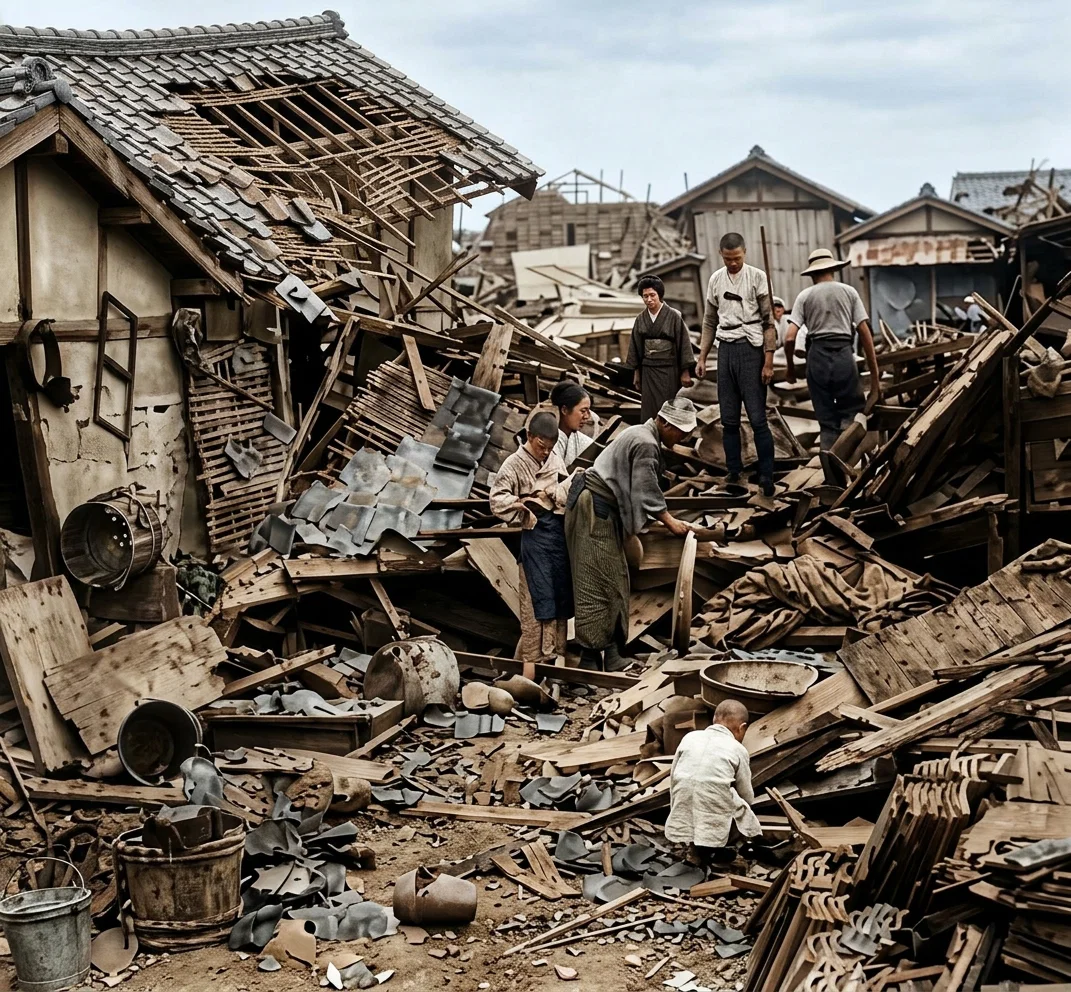
A Temporary Shelter after the Earthquake
And the editor replies:
“This raises a question as old as the Christian church, and one that will excite discussion to the end of the age.”
Why did not that editor show that inquirer that God’s Decalogue, like Himself, is eternal; that it is easier for heaven and earth to pass than for one tittle of the law to fail; that the object of the Gospel is to place that law within our hearts; that only the carnal heart is opposed to the law of God? 2 Cor. 3:7-11 confirms the Ten Commandments.
Calamities in Japan
By F. W. Field
The Ruins of a Temple Caused by the Earthquake
A Complete Wreck by Earthquake
JAPAN is well known as a land of earthquakes. Slight shocks are of frequent occurrence in certain parts of the country, including the vicinity of Tokyo. But these shocks cause little or no damage, and destructive earthquakes are no more common in Japan than in many other parts of the world.
In 1891 a very destructive earthquake occurred in Central Japan, the center being a little to the north of Lake Biwa. The shocks were felt over a wide area; Gifu, Osaka, Kyoto, Nagoya, and many smaller places were seriously affected. Nearly ten thousand persons were killed, and twice as many injured.
Since that time no serious earthquake has affected Japan until the 14th of last August. At 3:30 P.M. on that day occurred an earthquake that will go down in history because of its severity and destructiveness. The center and area of this earthquake were almost identical with that of 1891. But it was not nearly so severe, nor was the loss of life so great.
This recent earthquake occurred at the time of the Buddhist obon festival, or feast of all souls; and many of the people of the country villages were assembled at the various temples. When the first shocks occurred, the people rushed out of doors. The strongest shocks, which did most of the damage, came several minutes later, after the people had escaped into the open air. Consequently the loss of life was much less than it otherwise would have been. The vibrations accompanying these first shocks continued for nearly an hour. There were frequent shocks felt during the following night and day.
The losses to life and property reported up to the close of the day following the earthquake, were as follows: 31 persons killed, and 168 injured; 20 temples and shrines totally wrecked, and 59 partially destroyed; 470 dwellings wholly destroyed, 1,367 partially so; 636 other buildings wholly wrecked, and 992 partially destroyed. Later reports raised the number of killed to 40.
The center of the disturbance seems to have been Ibuki-yama, a mountain to the northeast of Lake Biwa. It is said that at the time of the earthquake, terrible rumbling noises were heard issuing from this mountain. About one hundred farmers were working near by at the time, and a number of them were quite seriously injured by falling stones. Extensive landslides were reported in the neighborhood of the mountain. At one place a piece of the hillside 5 miles long and 600 feet wide had slipped down like an avalanche. At another place there was a similar landslide 3 miles long and 1,800 feet wide; and still another, on the south side, 5 miles long and over 400 feet wide.
Thousands had their homes either wholly or partially destroyed, and thousands more deserted their houses for the time for fear of further shocks. But as the weather was warm, and no rain fell, there was little suffering from exposure. The people were very watchful lest fires should break out, and no loss from fires was reported. The authorities furnished prompt aid to those in immediate need; and the nurses of the Red Cross Society did good service in caring for the injured.
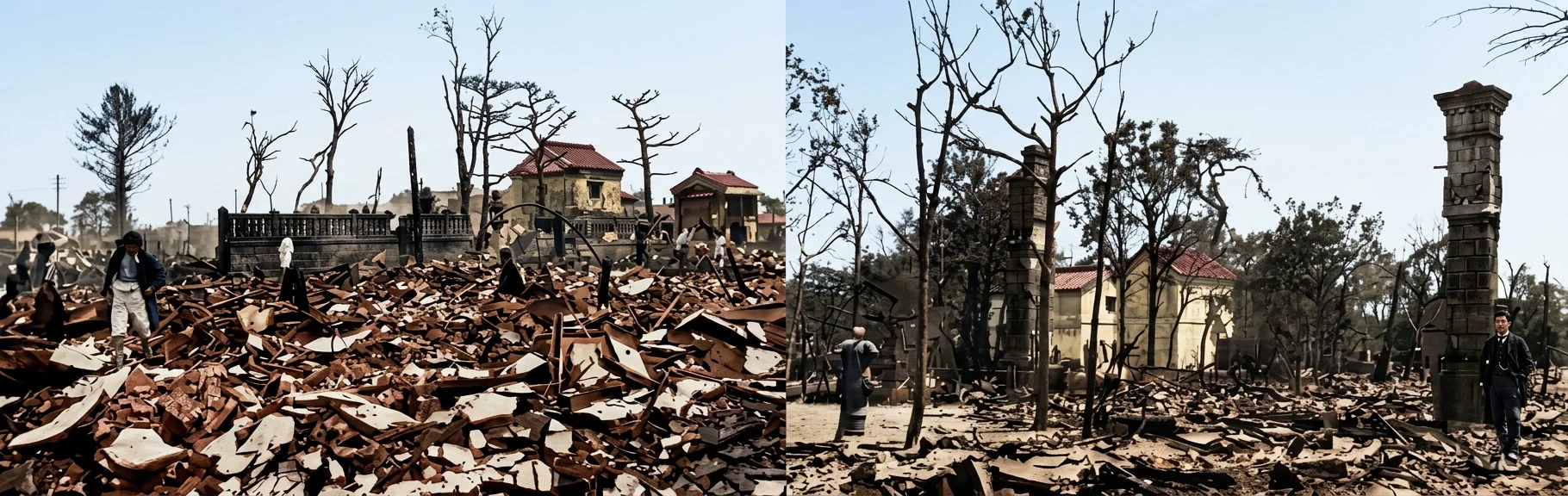
An earthquake is a terrifying, awe-inspiring thing. But a calamity worse in some respects than the one just described, was the great Osaka fire, which occurred only about a fortnight before the earthquake. An overturned lamp, a hurricane wind, and a sad lack of facilities for fighting fire, made a combination of circumstances that resulted in one of the most destructive conflagrations ever known in Japan.
The fire started early in the morning of the 31st of July, and raged all that day and the following night, and was not checked till the forenoon of August 1. About one third of the area of the city was burned over; 12,000 buildings were destroyed, and 60,000 persons rendered homeless. The property loss was variously estimated at from twelve and a half to twenty millions of dollars. The larger structures destroyed included school buildings, temples and shrines, banks, bridges, the court-house, and the rice exchange. The path of the fire extended for 3 miles, and the burned portion covered an area of 305 acres. For a time the wind blew at the rate of 40 to 60 miles an hour. Those who visited the ruins afterward, remarked upon the complete destruction wrought by the fire. Even where buildings of brick and stone had stood, there remained little but ashes.
Accounts of earthquakes, floods, fires, and other calamities are becoming so common as to attract but the passing notice of many, and are soon forgotten. These two great calamities in Japan are only a few months in the past; yet already they are seldom mentioned. But thoughtful people are inquiring the meaning of the frequent calamities that are afflicting mankind. The judgments of God are falling upon a guilty world. Nothing short of such catastrophes will arrest the attention of many in their mad rush after worldly gain and pleasure. Happy is he who learns from the Word of God the meaning of these events, and prepares for that great event of which these are but feeble premonitions. Is it not wise to take warning, and prepare for the coming of Him before whose presence the whole earth shall shake, and whose glory is a consuming fire? There is still time in which to prepare to meet Him in peace.
F. W. FIELD.
Tokyo.
The Alleged Passion Play
One of the most remarkable travesties perpetrated on any community is the alleged Passion Play by a gang of degenerates who take delight in cruelty. They are not only weak but coarse and in a very real sense vulgar. We can think of but few things more sacrilegious, more humiliating, than the puerile attempt to “play the crucifixion.” The saddest thing about it is that those afflicted with this dreadful mania have lost all moral, not to say Christian perspective, and in the name of the church crucify not only Christ but Christianity itself. We can not imagine on what ground such coarse, brutal ideals can be justified. We would think that common decency would shame them into silence. We do not believe that the Spanish bull-fight is one half so demoralizing as this alleged Passion Play. It reveals a condition of barbarism and general degeneracy which we did not know existed in the bounds of intelligent, civilized society.—California Christian Advocate.
The Average Family
REFERRING to the coming census, an exchange says: “The most striking single fact which would be shown by a comparison of the figures of the censuses of 1790 and 1910 (as the latter will present themselves when assembled) would be the disappearance of the children. One hundred years ago one half of the population of the United States consisted of boys and girls under sixteen years of age. Now the proportion is only one third. If the average family in this country to-day were as large as in 1800, there would be 16,000,000 more children in the United States than are actually living. In 1790 there were 780 persons over twenty years of age for every 1,000 girls and boys under sixteen. To-day there are 1,600 such adults for every 1,000 children.”
Mexico’s Misfortunes
By G. W. Reaser
A Scene of Complete Destruction after the Osaka Fire. After the Osaka Fire. The Scenes on this page recall San Francisco
It would seem that the people of the Mexican republic are having their full share of misfortunes during the present year. Added to the calamity of the destructive earthquake which came on the 30th of July, and the unprecedented floods in Monterey and vicinity, at the end of August, accompanied by terrible cyclonic disturbances, there followed on the 27th of September, the scourge of a blighting frost which spread its mantle over a considerable area of the tableland district, largely destroying the unmatured corn, barley, and bean crops, which constitute the food material of the common people. It is estimated that in the single valley adjacent to Mexico City, the financial loss occasioned by the frost amounted to $2,000,000, while this valley is only a limited portion of the area affected. It is said that but ten per cent of the bean crop will be harvested.
The masses of the people, desperately poor, are in dismay over the situation. All of these calamities have come within a little less than two months.
Millions of the people of Mexico are taught, and devotedly believe, that Mary, the mother of Jesus, the chiefest saint in glory, is the special protector of the land of Mexico, having withdrawn her benign influence from all other countries.
Is the Lord using these calamities, which come in such rapid succession, to break their confidence in their false religion, and turn their darkened hearts toward the light of truth? If so, we who are favored with the full light of the Gospel, are debtors to the people of Mexico.
G. W. REASER.
The Lords and Commons.—
A mighty struggle is on in England. The finance budget originates in the House of Commons, and for about 300 years the House of Lords has assented to the budget and tax proposals connected with it. But now for the first time during that long period it has dissented. November 16 Lord Lansdowne gave notice in the House of Lords that on the motion for the second reading of the finance bill, he would move that “this House is not justified in giving its consent to the bill until it has been submitted to the judgment of the country.” Issue was thus squarely joined. Many thought that the Lords would yield, but they have not done so. So, November 30 the budget was rejected. It is therefore illegal for the king’s agents to collect taxes with which to carry on the government. This action of the peers was taken contrary to the advice of such men as Rosebury, Morley, Lord James of Hereford, Cromer, Balfour of Berley, Courtney, the Earl of Litton, and the archbishops of Canterbury and York. The matter will now go before the country for its approval or rejection. In other words, the crown through the ministry will dissolve the House of Commons, order a general election, and it will be seen whether the present liberal House and ministry will be sustained in insisting on the budget. The vote was announced just before midnight, and stood 350 for Lansdowne’s motion, to 75 against. All the peers were present, many of whom never appear unless especially called for some crisis like the present. Chancellor of the Exchequer, Lord George, had a prodigious task before him in providing the means necessary to support the government, and meet the tremendous and constantly increasing expenses of the navy. And in his plan for raising taxes, he aimed to get back to the land; to increase the income tax especially derived from ground leases and rented lands, and to levy on the wealthy land owners’ non-productive sporting reserves and untilled moors.
Reviving Witchcraft
By Editor
Last August at Reading, Pa., in investigating the cases of six infants who had died in that neighborhood, the coroner found in every case that the children were “verhexed,” that is, bewitched, and had called in a witch doctor to drive away the evil. A few months before that a woman was charged in court at Butler, Pa., by a neighbor with being a witch and casting a spell over a cow, thus preventing it from giving milk. Cases are also mentioned in Cornwall, England, and in Cuba. Not long ago a party of Navajo Indians in Mexico stoned to death a squaw of their own tribe for casting a spell over other squaws.
These are what would be considered cases among the more ignorant people, we suppose; but we would like to know what different are the recent revelations in Christian Science circles. Mrs. Stetson is accused of “malicious animal magnetism;” which is, we suppose, casting a spell over some other persons. The logic seems to be fairly good that if a few sitting together and concentrating their minds upon a person can bring benefits, a similar circle could bring evil through “malicious animal magnetism” directed against the person. And yet we are asked to accept this sort of thing in lieu of Bible Christianity, of which the apostle declares that those who accept it have received from its Author “not a spirit of fear; but of power, and of love, and of a sound mind.”
The Power of Money
Just recently, in a New York court, where divorce proceedings for the poor linger long and with more or less publicity, Col. John Jacob Astor and his wife secured a divorce through their lawyers, neither of them being present, in fifteen minutes. She left for Europe with her daughter; he with his son on a tour to12the West Indies in his private yacht. A fearful storm having swept over the West Indies, people became alarmed for his safety. Three nations are searching for his yacht. One of the vessels of the United States was fitted out with a complete wireless telegraphy plant in order to find the lost yacht; and England and Germany were also enlisted in the same quest. From the divorce proceedings to the searching for the yacht, we are shown what men will do for one who has no more brains, no more worth, no better standing morally, than thousands of other men who are not thought of, simply and solely because he has the one thing—money.
A Nice Way of Getting Around the Sunday Law.
The Regina, Saskatchewan Leader of November 23, 1909, tells us that in a decision rendered by the Junior County Judge (Morson) in Toronto, November 22, tobacco was considered to be a drug. A magistrate had decided that selling cigars on Sunday was a breach of the Lord’s Day Act, and the druggist was fined $5.00. Lee, the defendant, appealed to Judge Morson, who decided on the evidence presented that a cigar is clearly a drug. “It was perfectly clear on this evidence that tobacco is, under the statute, a drug. It must be sold as a drug on Sunday, only, however, for some known ill. If sold simply to smoke for pleasure, it constitutes a breach of the Lord’s Day Act.” But it will be a mighty easy thing to find druggists who will prescribe tobacco as a drug, a remedy for stomach or nerves, just as this druggist declared they they were in the habit of prescribing cigars and tobacco as cures for various troubles. It will be just as easy for the purveyor of liquor to sell whisky on similar prescriptions; while the man who sells useful things, things that are legitimate, things that are beneficial to life in every way, will be considered the criminal. This is characteristic of Sunday-law legislation. It is utterly inconsistent, incongruous, inequitable, un-American, unchristian, iniquitous; and a half dozen more similar adjectives could be applied to it as well. If one would lay aside his prejudice and preconceived notions long enough to fairly consider it, he would never support a Sunday law again while he lived.
The Standard Oil Company Dissolved
THE decision of the United States Circuit Court of Appeals dissolving the Standard Oil Company is considered by Attorney-general Wickersham to be “one of the most important decisions ever rendered in this country.” The four judges were unanimous. The opinion written by Justice Cook declares that “the modern doctrine is but a recognition of the obvious truth that what a government should not grant, because injurious to public welfare, the individual should not be allowed to secure and hold by wrongful means. The baneful effect is the same whether the monopoly comes as a gift from a government or is the result of individual wrong-doing. Nor can arguments of reduced prices of product, economy in operation, and the like, have weight.”
On these principles the decision was rendered. It was felt that the company was a form of trust or combination prohibited by section 1 of the Sherman anti-trust act. What will be the result of the decision remains to be seen. Will the Standard Oil Company still continue doing business? Will it appeal to the United States Supreme Court? Or will it take some other of the protean forms which combinations assume in these days, and still gather its enormous riches from the people? Some thinkers regard the decision as a great blow at Socialism.
How Tom Won a Soul
Tom said, “It won’t do to keep all this blessed news to myself,” so he thought how he could bless others with it. His bed stood close by the window-sill, which was low; and somehow he got a pencil and paper and wrote out different texts, which he would fold and pray over and drop into the noisy street below, directed, “To the passer-by—please read.”
He hoped that by this means some might hear of Jesus and His salvation. This service of love faithfully rendered, went on for some weeks, when one evening he heard a strange footstep, and immediately afterward a tall, well-dressed gentleman entered the room and took his seat by the lad’s bedside.
“So you are the lad who drops texts from the window, are you?” he asked kindly.
“Yes,” said Tom, brightening up. “Have yer heard as some one has got hold of one?”
“Plenty, lad, plenty. Would you believe it if I told you that I picked up one last evening, and God blessed it to my soul?”
“I can believe in God’s Word doing anything, sir,” said the lad humbly.
“And I am come,” said the gentleman, “to thank you personally.”
“Not me, sir. I only does the writin’; He does the blessin’.”
“And you are happy in this work for Christ?” said the visitor.
“Couldn’t be happier, sir. I don’t think nothin’ of the pain in my back, for shan’t I be glad when I see Him, to tell Him that as soon as I know’d about Him I did all as I could to serve Him? I suppose yer gets lots of chances, don’t yer, sir?”
“Ah, lad, but I have neglected them; but, God helping me, I mean to begin afresh! At home in the country I have a sick lad dying. I had come to town on pressing business. When I kissed him good-by, he said, ‘Father, I wish I had done some work for Jesus; I can not bear to meet Him empty-handed;’ and the words stuck to me all day long, and the next day, too, until the evening, when I was passing down the street, your little paper fell on my hat. I opened it and read, ‘I must work the works of Him that sent me, while it is day: the night cometh, when no man can work.’ John 9:4. It seemed like a command from heaven. “I have professed to be a Christian for twenty-five years, my lad; and when I made inquiries, and found out who dropped these tracts into the street, and why it was done, it so shamed and humbled me that I determined to go home and work for the same Master that you are serving so faithfully.”
Tears of joy were rolling down the lad’s face. “It’s too much, sir,” he said, “altogether too much!”
“Tell me how you managed to get the paper to start it, my lad.”
“That warn’t hard, sir. I jest had a talk with granny, and offered to give up my ha’porth o’ milk she gives me most days, if she would buy me paper instead. You know, sir, I can’t last long. The parish doctor says a few months of cold weather may finish me off, and a drop of milk ain’t much to give up for my blessed Jesus. Are people happy as has lots to give Him, sir?”
The visitor sighed a deep sigh. “Ah, lad, you are a great deal happier in this wretched room, making sacrifices for Jesus, than thousands who profess to belong to Him, and who have time, talents, and money, and do little or nothing for Him!”
“They don’t know Him, sir. Knowin’ is lovin’, and lovin’ is doin’. It ain’t love without.”—Selected.