[All questions to this department will be answered which to the editors will seem to minister to the good of the readers and to the mission of the paper. The same question can not be answered repeatedly in the same volume. The name and address must accompany question, not for publication, but as an evidence of good faith, and that answer may be made by letter if deemed advisable. It is well always to enclose a stamp for reply.]
Will you please explain 1 Cor. 3: 15, "If any man's work shall be burned, he shall suffer loss: but he himself shall be saved; yet so as by fire."
If you will note the context, the apostle is speaking of the ministry. He tells in verse 11 that there is only one Foundation, Christ Jesus. He wanted to build surely. Some would build upon that Foundation gold, silver, precious stones; others would build wood, hay, stubble. So it is in the work of some ministers of the Gospel. The converts gotten by some are steadfast, stable, well-grounded in the truth; other ministers, equally honest, tho not so well fitted for the building up of character in the church, fail in these respects. Their work, so to speak, ravels out; their converts do not stand the test. They are like the seed that is sown on stony ground, which springs up quickly, but in time of drought burns away. And the apostle tells us that while this may be the case with earnest, honest laborers, they themselves may be saved, tho their work will prove of little worth. It does not have reference to individual character. For the character which is built of wood, hay, and stubble, will be devoured in the fires of the last day.
2653.—Trust and Insurance.
Please harmonize Mal. 3: 10, 11 with the custom of those Christians who pay tithes in getting their buildings and crops insured. Does not the Lord say, "I will destroy the devourer," etc.? They profess to believe this is true, but in taking out insurance policies, do they not virtually say that in case the Lord does not do as He agreed, they want some resource for loss?
The matter of insurance is one which must be settled by conscience. If one feels that it is impossible to insure in the light of Mal. 3: 10, 11, by all means he should not do it. Follow conscience in the matter. There are some who use the principle that "a prudent man foreseeth the evil and hideth himself." Such a one thinks it duty to insure. Sometimes he thinks it duty to insure for the reason that not only is he in danger because of carelessness on his part or the part of some of his family, but on account of the carelessness of his neighbors. Sometimes his property is mortgaged, and insurance is demanded. These and other facts enter into the solution of the problem.
Among God's children, all in the ranks are pledged by virtue of their relationship to God to help those in affliction. The ideal insurance society among Christians would be the insurance of the church; so that whenever need, or want, or death came to a family, it would find the people of God all willing and anxious to help the one who is afflicted. That ideal condition can not be realized in this world. The only way to do is to leave all in the hands of the great Father; that is the better way; "according to thy faith, be it unto thee, as thou wilt." If one has not the faith, he is still in the Lord's hands. Let the Lord teach him.
2654.—The Bread and Wine.
What should be done with the bread and wine left over after the Lord's Supper? Have we any definite instruction regarding it?
We know of no definite instruction. What was left over of certain sacrifices was to be burned. Why not follow this practise regarding the consecrated elements? If they were used at all, we would say give them to the poor. After they have been consecrated to God, ought they to be made common?
2655.—Israel in Egypt.
Please tell (1) how many children went into the land of Egypt; (2) how long they were there; (3) how many of them were God's children who kept His covenant after they came out of Egypt; (4) why God put them there.
In reply: (1) Acts 7: 14. (2) About 215 years. (3) We do not know, nor does God tell us. Many fell in the wilderness, yet over 600,000 of the children under twenty years of age when they started entered Canaan. (4) First, to carry the Gospel to Egypt; secondly, to teach Israel the right way, the humble way, the true and trusting way. Read Psalms 78 and 105.
As we come to the shorter books of the Bible, we have a variety of reading each week, rendering also necessary much briefer notes to each book. The closing chapters of 2 Corinthians speak for themselves. From the 20th verse of chapter 5 to the first verse of chapter 7 inclusive ought to be learned by every Christian. They are packed full of the most blessed instruction and experiences in Christian life. Chapter 7 refers to the person reproved by the apostle in the first epistle, showing how that reproof worked repentance. Chapter 11 contains the summary of some of the apostle Paul's sufferings, yet in it all he triumphed.
The date of the book of Nahum was probably during the reign of Josiah, about 630 or 640 years B.C. His name means "Rich in Comfort." He was born at Elkosh, which may be the Old Testament term for Capernaum, inasmuch as Capernaum means "Nahum's village." His prophecy is largely against Nineveh, the bloody city; and Nineveh is a type of latter-day conditions.
★
Habakkuk prophesied not far from the same time, probably a little later. Some place him as late as the middle of Jeremiah's prophecy. The word Habakkuk means "to embrace." The prophecy is largely against the Chaldeans, who should sweep over the land on account of its wickedness. Various woes are presented against those who are covetous, cruel, intemperate. How clearly last-day conditions are depicted in chapters 1 and 2. The last chapter is a beautiful lyric poem expressing much of the glory of God, and the prophet's trust in His power.
★
Zephaniah means "Jehovah hides." How fitting it is that a prophet with such a name should be used to describe the great wrath which should be poured out upon a world by a God who in the midst of it all would be the hiding-place of His people. The burden of the entire prophecy is, The great day of the Lord is near, and hasteth; that the only hope of His children was to repent. It closes with precious assurances to the children of Zion. It was probably written between the books of Nahum and Habakkuk.
★
The meaning of the word Haggai is "Festal." He was a Jewish prophet, who came forward in about the year 520 to urge Zerubbabel to rebuild the temple. The work was begun in the very autumn of that year. It is a plain, simple declaration of the duty of God's children, with occasional prophecies of the glory of Christ who was to come.
★
With this same week also begins the epistle to the Galatians, written by the apostle Paul to the Gauls, or Celts, who had accepted the Gospel. The entire book is a setting forth of the principles of the Gospel with the one view of meeting the heresies by which false teachers were endeavoring to lead astray the Galatians.
Righteousness and Sin.
1. In whom does all righteousness find its source? “Their righteousness is of Me, saith the Lord.” Isa. 54:17.
2. In what is God’s righteousness expressed? “Harken unto Me, ye that know righteousness, the people in whose heart is My law.” Isa. 51:7.
3. How enduring and unchangeable is this righteousness? “My righteousness shall not be abolished.” Isa. 51:6. “All His commandments are sure. They stand fast forever and ever.” Ps. 111:7, 8. “It is easier for heaven and earth to pass, than one tittle of the law to fail.” Luke 16:17.
4. What is the transgression of this law called? “Sin is the transgression of the law.” 1 John 3:4.
5. Is there sin apart from transgression of God’s law? “All unrighteousness is sin.” 1 John 5:17.
6. What is the inevitable harvest of sin? “Sin when it is finished, bringeth forth death.” James 1:15.
7. How may we become rid of sin? “If we confess our sins, He is faithful and just to forgive us our sins, and to cleanse us from all unrighteousness.” 1 John 1:9.
Unselfishness.
1. What was a prominent characteristic in the life of our Lord?
"For even Christ pleased not Himself." Rom. 15: 3. "Who being originally in the form of God, counted it not a prize to be on equality with God, but emptied Himself, taking the form of a servant." Phil. 2: 5, R.V.
2. To what extent did He go in His self-denial?
"He humbled Himself, becoming obedient unto death, yea, the death of the cross." Verse 8.
3. For whom did He do all this? and for what purpose?
"Who gave Himself for us, that He might redeem us from all iniquity, and purify unto Himself a peculiar people, zealous of good works." Titus 2: 14. "Tho He was rich, yet for your sakes He became poor, that ye through His poverty might be rich." 2 Cor. 8: 9. "Rich toward God." Luke 12: 21. "Rich in faith, and heirs of the kingdom." James 2: 5. "Rich in good works." 1 Tim. 6: 18.
4. By what spirit should we be actuated?
"Let this mind be in you, which was also in Christ Jesus." Phil. 2: 5. "Let every one of us please his neighbor for his good." Rom. 15: 2. "If any man will come after Me, let him deny himself." Luke 9: 23.
Ecuador.
By Thos. H. Davis
By Thos. H. Davis.
ECUADOR, like all other South American republics, has been under Catholic rule since Spain raised her flag in the Western Hemisphere.
It is said that President Garcia Moreno, the president before the setting up of the liberal party in 1895, sent 50,000 sueres a year to the pope of Rome.
General Eloy Alfaro, the present president, and his party, after many years of fighting, gained in the revolution of 1895. Since then the country has been open to Protestant denominations for propaganda work.
Altho the conservative party has been very bitter against his work, the country has been steadily advancing, especially in liberal ideas.
The inauguration of the Guayaquil and Quito Railroad, at Quito, the 25th of June, has silenced as it were the enemies of progress. The head ones of course are always the priests who scheme to keep the people in ignorance.
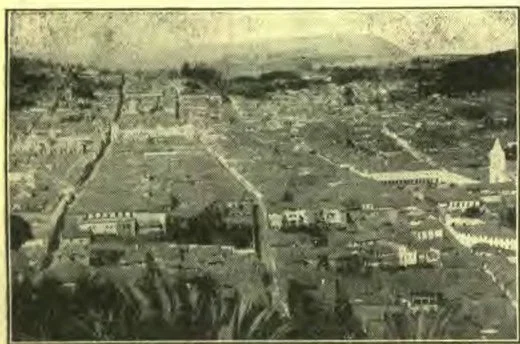
The writer was privileged to see Quito for the first time at the inauguration of the train. Quito is 289 miles from Guayaquil. Being elevated 9,400 feet above sea-level, it has a very agreeable climate. The population is about eighty thousand. I was surprised to find it much cleaner than other smaller interior towns. Being situated on the mountainside, it is very easily drained. The water for the city is piped from a waterfall up in the snow belt, so no ice is needed to cool the water.
Panorama of Quito, Ecuador.
It is said that there are forty Catholic churches and convents in the city, but with all this number of temples there are many who think Protestantism is the best religion. Some evangelical work has been done there, but at present there are no Protestant workers, so now would be just the time for us to enter this great city. It seems to me a school (English) could be started very easily there now on a self-supporting plan as Mr. Buckner is doing of late here in Ambato, and at the same time he is teaching the third angel's message to his students in a quiet way. Any one coming as a teacher should know the Spanish language before coming, or stay at least six months in the country before attempting to teach. Any one interested in this line of work could write to William Steele, the director of our mission of Ecuador, Ambato, Apartado 3.
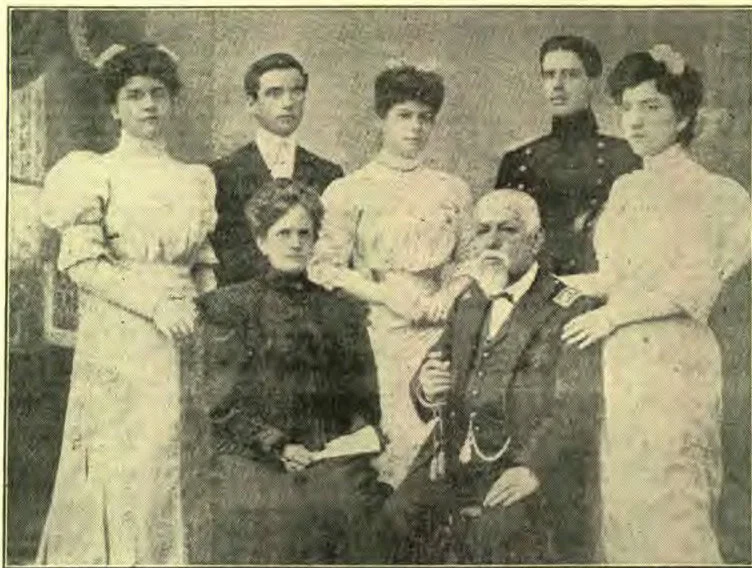
Gen. Eloy Alfaro, the President of Ecuador, with his family.
Our Work and Workers.
FIVE were baptized at Foosland, Ill., recently by Brother Chaney Wood.
BROTHER C. J. BUHALTS reports the baptism of nine persons at Monon, Ind., the fruits of the labors of himself and Brother J. M. Ellis.
A CHURCH of seventeen members was organized at Alva, Okla., October 10, the results of tent-meetings conducted by Brother J. R. Bagby.
BROTHER R. C. PORTER, writing from Australia, states that in that field progress is being made in all lines of the work, the Avondale school, the Wahoonga Sanitarium, the publishing and other lines all being prosperous. Elder J. N. Loughborough's labors are much appreciated in all the different centers of the work. Brother and Sister Porter left Australia for Africa September 30, to take up labors in that needy field.
Interior of Morey Convent, Quito.
Papers for Jail Work.—Mrs. C. Willeford, Chattanooga, Tenn., just writes that she is going to take up jail work again. She says, "The prisoners have time for reflection and time to read, and I know of no better help than the SIGNS OF THE TIMES."
Sister Willeford's health will not permit of her going into the paper work sufficiently to make her work self-supporting, but she will carefully use a club of twenty-five copies of the SIGNS each week if sent to her. Would you like to donate toward sending such a club through the Cooperation Corner? Twenty-five copies will cost fifty cents a week. Send donations to Cooperation Corner, SIGNS OF THE TIMES, Mountain View, Cal.
Wanted for Missionary Work.
ANY of our denominational papers and tracts for use in city work. James Harvey, 1055 Brush St., Oakland, Cal.
SIGNS OF THE TIMES. Mrs. F. F. Hibbard, Colton, Cal.
SIGNS OF THE TIMES. Elder T. Godfrey, Creston, Iowa.
Little Friend and Instructor. Mrs. J. M. Guilliams, 630 Eleventh St., Bowling Green, Ky.
If any of our brethren having relatives in this city will send me their names and addresses, I will call on them. R. E. Burke, 129 Arlington St., Dubuque, Iowa.
RELIGIOUS LIBERTY literature and Icelandic books and papers. Mrs. A. J. H. Bingham, "The Anchorage," Union, N. J.
To the Volcano Cotopaxi.
By Delwin Rees Buckner
By Delwin Rees Buckner.
THE snow is reddened by the flames at night;
Like vapor-clouds thy smoke ascends by day,
Fresh from the furnace God hath stored away
Within earth’s center, hidden from our sight.
Thou Cotopaxi, but a chimney art,
Yet on thy slopes the Inca feels the heat,
Knows that an oven burns beneath his feet
And feels the throbs grow quicker in his heart.
And who is he that can not comprehend
That God, as just, must have a Day of Doom?
Now He reserves His fiery arsenal,
Which, like a flood, will issue at the end.
Then, Cotopaxi, too, thou wilt consume
When God ariseth and consumeth all.
Ambato, Ecuador.
GIPSY SMITH SPECIAL EDITION OF
Hallowed Hymns
NEW AND OLD
BY I. ALLAN SANKEY, SON OF IRA D. SANKEY
298 PAGES JUST PUBLISHED NEARLY 125
RESPONSES NEW SONGS
$25 per hundred, 35 cents each by mail
RETURNABLE SAMPLES MAILED TO "EARNEST INQUIRERS."
THE BIGLOW & MAIN CO., NEW YORK OR CHICAGO
FOOT-HILLS OF CALIFORNIA
The Most Beautiful Home Sites in the World
Why not live where the gold of the hills, the gold of the trees, and the gold of the sunshine combine to make life worth living?
COME WEST
For particulars writeC. S. Fee, Passenger Traffic Manager, San Francisco, Cal.SOUTHERN PACIFIC RAILROAD COMPANY
Holman Bibles
HOLMAN BIBLESIF YOU ARE PARTICULAR
about the fine points of a Bible, get a Holman Edition.
ASK YOUR BOOKSELLER.
The Word Made Flesh
The December number of the monthly SIGNS OF THE TIMES has for its general subject, most fitting to the Christmas season, "The Word Made Flesh;" God in Christ Jesus reconciling the world to Himself, and that word triumphant, not only in this life over sin, but over all that has come in consequence of sin.
It is a number of great encouragement to the Christian, and yes, more than this, to him who is not a Christian, because it shows him the way in which he may become a partaker of all the benefits which God has given in Christ Jesus our Lord.
Among the principal articles are: "The Coming of Christ;" "Meaning of the Nativity;" "The Love of God Expressed in Christ;" "Christ in You the Hope of Glory;" "The Enmity Existing in the Heart of Man Against Sin;" "The Rest of Christ in the Fourth Commandment;" "The Two Comings of Christ Compared;" "The Triumphant Word Through the Ages."
A special article for this number, copiously illustrated, is entitled: "Rome's Challenge to England," by our own correspondent, being a report of the great Eucharistic Congress held in London, and the lessons to be drawn from it. There is another striking article on "More Battle-Ships," especially dealing with England's plan for her navy of the future.
The departments are themselves well sustained; in fact, the December issue is an excellent number, and one which ought to have a large circulation. Added to all this is an illustrated cover, with Plockhorst's great picture of "The Nativity" for the center.
The price of the number is ten cents. It ought to have a large sale.
Submarine Torpedo-Boat Maneuvers
The Success of the Submarine Torpedo-Boat.—In the naval maneuvers this summer, the submarine torpedo-boat has received considerable attention. The feats accomplished by these little vessels make their promoters very jubilant. In the United States navy, five submarines made a sham attack on the cruiser “Yankee.” They steamed away from the “Yankee” in broad daylight, closely observed through glasses by the officers on board the cruiser until they were out of sight. Returning to the attack, at twenty miles distant they were submerged and proceeded under water, making observations at intervals by means of the periscope until they came within striking distance, when each boat discharged a blank torpedo which found its mark in every case. Altho the “Yankee” kept up a close watch for surface indications of their approach, and altho she knew they were coming, yet no signs of them were seen till the torpedoes struck.
Italy in her maneuvers sent a flotilla of submarines from Venice to Spezia, a distance of 1,300 miles, under their own power and without any assistance from auxiliary vessels. And England sent four submarines for 300 miles under war conditions, and during that journey they stayed forty consecutive hours under water.
The ambition among naval men now is to make the submarine much larger so as to have it as an adjunct of the navy on the high seas instead of being confined as at present to the vicinity of harbors.
*
Last year it was reported that a peak called Mt. McCulloch had been pushed up from the bottom of the sea at Bogaslov, one of the Aleutian Islands. Measurements were taken at that time by Capt. Geo. M. Daniels of the revenue cutter “McCulloch.” Captain Daniels arrived in his vessel from the north November 5. He has another chart of the island, but now where the volcano stood there is nothing but water, a bay in fact. There is this difference, however, that before the mountain was pushed up this part of the island consisted of flat, wave-swept reefs. Now there is a beautiful bay surrounded by a rim of high land. It is stated that when the mountain first came up, geologists told us that the peak was of the solidest rock, and born to live many a year; but the poor, little geological infant died when less than twelve months old.
*
According to “The Independent” of October 22, the meeting of the American Board, the oldest of our missionary organizations, and the largest, with the exception of the Presbyterian, declares that their missions in the East have grown so fast that the proper support can not be obtained. Hence louder appeals than usual for money, but “an even more serious matter than this is the failure of candidates for the mission field, whether ordained men, physicians, or unmarried women as teachers; yet religious liberty in Turkey opens a new opportunity,” with less opposition than has ever been met before. Why is it that the missionary spirit is falling off? We wish to raise the question; we will let our readers answer it. May we not find one of the causes of this, the turning from simple evangelical methods, and the seeking of the support of the State in the home land? If the true Gospel spirit were prevalent at home, would that not arouse many to extend it abroad? If, for instance, the federation of the churches were a true Gospel movement, would it not stir men and women to give their lives to Christ and the work of missions?
*
The Rev. W. C. Martin, in an article in The Homiletic Review of November, justly observes that the “attempt to reform and elevate by satire and pasquinade and witty flings and hits at common vices, may make men angry or amuse them, but to elevate practical life, they are a failure. Men who make this their forte miss the only thing which can give success. To reform the practical life of men, you must give them an ideal. ‘Be ye perfect, as God is perfect.’”
*
“Life and Health” for November treats two themes in a pleasing, instructive manner. These are health and joy and peace for the adult and proper play for the child. In addition to these leading themes are pointed, practical articles dealing with the questions of food, exercise, and temperance, timely things tersely told. Price ten cents. Address “Life and Health,” Takoma Park Station, Washington, D. C.
*
The Western Normal Institute, at Lodi, Cal., is primarily a training-school for teachers. Full courses of instruction are given in both theory and practise. A training-school, a normal academy, and a training college are combined, with industrial, commercial, and normal departments. Prof. C. D. Sharpe, the president of the institution, invites correspondence.
DATE OF EXPIRATION.
The SIGNS' wrapper bears date of last issue due on your subscription. Unless renewed in advance, paper stops with expiration date.
If herewith is an order-blank, you will know you have overlooked sending renewal. You will not wish to miss a single issue. Back numbers often can not be furnished.
CHANGE OF ADDRESS.—When a change of address is ordered, both the new and the old address must be given. The notice should be sent one month before the change is to take effect.
HOW TO REMIT.—Remittances should be sent by Draft on San Francisco or New York Express-order, or Money-order, payable to order of SIGNS OF THE TIMES. Cash should be sent in Registered Letter.
Next Week’s Signs of the Times
By Editor
Special announcement concerning the Signs of the Times next week. All our friends will be glad to see it.
The Vatican and the Nations.
WHAT to many is significant, and to more ought to be, is the relationship which is manifest between the Vatican and the various powers of earth. He who understands history at all, knows something of the part which the relationship between the Papacy and the various European powers has played in the world's history. He who understands the Roman Catholic Church knows that it is a vital part of her doctrine that church and state ought to be united, or the state should be subservient to the church.
The relationship noted is coming home to us much closer than in the European states. In the recent election of a very eminent citizen to the post of Chief magistrate, one of the first to offer his congratulations is the pope. A despatch from Rome, dated November 4, declares:
"The pope has cabled his congratulations to Mr. Taft, whose election to the presidency is thought to guarantee the acceptance of the pope's proposals in the matter of compensation to the religious congregations of Porto Rico."
The next day a statement even more striking appears in the daily press, sent from Rome on November 5. It reads:
"The Tribuna, in an article on Wm. H. Taft, recalls his visit to Rome in 1902, and the excellent impression he made on Pope Leo XIII. To Mr. Taft Pope Leo expressed the hope that he [Pope Leo] would one day realize his dream of having an American diplomatic representative accredited to the holy See." The Tribuna concludes by saying: "Now that Mr. Taft is President, can Leo's successor entertain the same hope which is against the spirit of the American Constitution?"
We note this and suggest to our readers that it is worthy of remembrance in the rapidly developing events of modern-day history.