1. WHAT did man lose in the fall?—He lost his life. “Thou shalt surely die.” Gen. 2:17.
2. How did Adam’s transgression affect you and me?—“Death passed upon all men.” Rom. 5:12.
3. For what purpose did the Saviour come into the world?—“To save that which was lost” (Luke 19:10); “Christ Jesus came into the world to save sinners.” 1 Tim. 1:15.
4. How many have sinned?—“All have sinned.” Rom. 3:23. Christ came to save sinners. All have sinned, therefore Christ came to save all, even me; for he “loved me, and gave himself for me.” Gal. 2:20. He “gave himself for our sins.” Gal. 1:4. The Lord never consulted us when he purchased our salvation. He saw our necessity,—our helpless, hopeless, and lost condition,—and without any desire expressed on our part, he paid the penalty of our transgression of God’s law, by dying on the cross. Therefore the penalty for the whole world has been paid.
5. Then can every person in the world be saved?—“Whosoever will, let him take the water of life freely.” Rev. 22:17. “Ho, every one that thirsteth, come ye to the waters, and he that hath no money; come ye, buy, and eat; yea, come, buy wine and milk without money and without price.” Isa. 55:1.
6. Why does God extend this gracious invitation?—“Ye have sold yourselves for nought.” Isa. 52:3. Having sold ourselves for nought, we have nothing with which to purchase ourselves back again; and so in his great love and mercy he says, “Ye shall be redeemed without money.”
7. What was our condition when Christ died for us?—We were ungodly, and without strength to make ourselves any better. The doctrine of Roman Catholicism is that the Lord requires men to help themselves. The doctrine of the Bible is that the Lord helps those who cannot help themselves. “For when we were yet without strength, in due time Christ died for the ungodly.” Rom. 5:6.
8. In the death of Christ, what was manifested?—The wonderful love of God. John 3:16; Rom. 5:8. He saw our lost condition, and then paid the price for our salvation, without consulting us at all.
9. What should such love lead us to do?—To repent heartily, and forsake all our sins. Rom. 2:4.
11. How many are cleansed from sin?—“Let the wicked forsake his way, and the unrighteous man his thoughts; and let him return unto the Lord, and he will have mercy upon him; . . . for he will abundantly pardon.” Isa. 55:7. “If we confess our sins, he is faithful and just to forgive us our sins, and to cleanse us from all unrighteousness.” 1 John 1:9. In asking for the forgiveness of sin, we are asking for a condition of freedom from sin. The Lord says he will cleanse from all unrighteousness. His righteousness takes the place of our unrighteousness; “not by works of righteousness which we have done, but according to his mercy he saved us.”
12. Could we accept Christ, and not live the life of Christ?—“If a man love me, he will keep my words.” John 14:23.
13. If we love the life he lived, what kind of lives will we live?—We will be governed by all the principles which governed the Saviour in all his life.
14. What kind of life did he live?—A life of obedience to his Father’s law. He said, “I have kept my Father’s commandments.”
15. In what practical way will our love for God be manifested?—“This is the love of God, that we keep his commandments.” 1 John 5:3. To keep the commandments of God is practical religion.
16. When there is genuine love in our hearts, for others, is it a hard, irksome task to be true and loyal to them?—To be denied the privilege of doing for those we love is always attended by sadness of heart.
17. When the “love of God” is in our hearts will it be a hard, irksome task to keep his commandments?—“O how love I thy law! it is my meditation all the day.” “How sweet are thy words unto my taste! yea, sweeter than honey to my mouth.” “Therefore I love thy commandments above gold.” Ps. 119:97, 103, 127. If I love the Saviour, who first loved me (1 John 4:19), and “gave himself for me” (Gal. 2:20), the greatest pleasure of my life will be to go forth and show how much I love him, by living a life of perfect obedience to his Father’s law. Let us study more diligently and prayerfully to know our relationship to Christ, and his relationship to us.
PASSING EVENTS AND COMMENTS.
Psychology and Religion.— A friend has sent us a clipping from a Kansas paper giving account of some remarkable “revival” meetings that were in progress in a Free Methodist church in one of the towns of that State. People in the audience were seized with a mesmeric or trance condition which they could not resist, even by fleeing from the house. Under this condition they would go into a variety of fantastic performances, none of which were voluntary, but which were attributed by them to the power of the Spirit of God.
Every good thing is sure to have its counterfeit. Since the days of Moses and Aaron, when Jannes and Jambres withstood the truth by presenting spurious imitations of the signs produced by the power of God, the same work has been going on. In the last days especial efforts to duplicate the work of God and deceive his people will be made by the enemy of all good. Enough has been developed in the line of mesmerism and hypnotism to show that there are laws of the mind of which mortals in general have no knowledge, but which, if known, would be used by wicked men for very evil purposes. In fact, they can hardly be used for any other than wicked purposes. A man may unconsciously put those laws into operation, and others be affected in a mysterious way. Where people congregate and their sympathies are very closely thrown together, a strong man is in the lead, and all yield their individuality to him, there is no accounting for the results.
But such demonstrations are to be distinguished from the working of the Spirit of God. They are no more alike than light and darkness. One is from beneath; the other is from above.
Is it Baptist? or What is it?— “It” refers to the great Chicago University, with its celebrated president, Prof. William R. Harper. This institution has been the favorite of fortune from the start, having received in gifts the munificent sum of eleven and a half million dollars before it is out of its infantile days, if indeed it can be said to have had any infancy. Doctor Harper is reputed to be a Baptist, but his learning and energy have been more prominently displayed than his denominational tendencies. John D. Rockefeller, whose income is more than a thousand dollars an hour, day and night, is reputed to be a Baptist, as are other children of fortune whose millions have contributed to this colossal house of learning.
Now their country cousins begin to open their eyes with astonishment. Is this really ours? Is President Harper a real, genuine, out-and-out Baptist? Do these halls of learning, this magnificent endowment, belong to us? The Texas Baptist Standard has been investigating as to whether it is really Baptist or not. Like the patriarch of old, he thinks that the neck and hands are those of Esau right enough, but the voice is that of Jacob. The buildings are there; the students, almost two thousand of them, are there; the endowment is there; and they are Baptist; and so is the board of directors; but the theology—that is something else.
The editor of the Standard is shocked and pained (and no wonder) at the equivocal manner in which the Scriptures are held. Doctor Harper told him that he thought that—
“The Bible was not given us to teach the origin of man, but to teach religion. Genesis is neither fiction nor history. Its early stories contain the world’s earliest ideas of the origin of man. These early ideas may or may not be correct. I don’t know whether Adam’s body was made from the dust of the earth, or whether Eve was taken from his side. My opinion is that all the facts of modern science point to the evolution of man’s body.”
The editor of the Standard says:—
“The fear that we have is that the new species that is at present being evolved there is a species of irreverent critics, who will soon come to regard the Bible as a football to be kicked about and ‘fumbled’ at will, but to be believed or not, according to the state of the critic’s liver, or his advancement in the science of unmaking the divine record. . . . We greatly fear that its destiny is to do great hurt to our cherished faith, and sow seeds of distrust in the minds of our young Baptists who are brought under its influence, that will honeycomb our denomination with irremediable skepticism. Doctor Harper does not, as the interview clearly demonstrates, believe the whole Bible, and there is every reason to fear that his students, unable to make all the nice distinctions of which his massive and keen intellect is capable, will believe less of it than he does. In the end, if we are to follow such leadership, we will have no Bible, and every man will be his own standard of faith.”
The New Constitution.
The South Carolina Constitutional Convention has completed and ratified its work. The finished Constitution of the State is signed, sealed, and delivered to the proper custodian, by whom it has been consigned to the archives of safe-keeping. Those clauses which have caused such vigorous comment, as being intended to disfranchise the Negro, read as follows:—
“Up to Jan. 1, 1898, all male persons of voting age applying for registration, who can read any section in this Constitution submitted to them by the registration officer, or understand and explain it when read to them by the registration officer, shall be entitled to register, and become electors, . . . and such persons shall remain during life qualified electors, unless disqualified by the other provisions of this article.”
“Any person who shall apply for registration after Jan. 1, 1898, if otherwise qualified, shall be registered, provided that he can both read and write any section of this Constitution submitted to him by the registration officer, or can show that he owns and has paid all taxes collectable during the previous year on property in this State assessed at $300 or more.”
The ability to read is not always a reliable standard of intelligence, and intelligence is, we suppose, the object which it is desired to secure. There is, however, no outspoken discrimination against color in this, unless it be that illiteracy is peculiar to the colored race, which is not entirely true in the Southern States. Still, it is doubtless true that a larger proportion of colored people are illiterate than of the whites. The clause which provides that those who cannot read may be registered if they be able to explain any section, is liable to be much abused.
We have all realized the evils which threaten a community whose government is dominated by those of the densest ignorance, therefore we naturally sympathize with people who desire to escape such peril. The provisions of this Constitution will doubtless stimulate education among whites and blacks, and therefore will be a blessing in that direction, at least. Whether an educational test will be permitted under the national Constitution is a question upon which the federal courts may be called to pass. But the opportunity to assist the poor and ignorant classes of the South is even better than before.
Other Clauses
Other noteworthy clauses read as follows:—
“The privileges and immunities of citizens of this State and of the United States under this Constitution shall not be abridged, nor shall any person be deprived of life, liberty, or property without due process of law, nor shall any person be denied the equal protection of the laws.”
“All elections shall be free and open, and every inhabitant of this State possessing the qualifications provided for in this Constitution, shall have an equal right to elect officers and be elected to fill public office.”
“The marriage of a white person with a Negro, or mulatto, or person who shall have one eighth or more Negro blood, shall be unlawful and void.”
“Divorces from the bonds of matrimony shall not be allowed in this State.”
“No person who denies the existence of a Supreme Being shall hold any office under this Constitution.”
INCREASE OF GOLD PRODUCTION.
By M. B. C.
The demonetization of silver in this country has had at least one other result than giving Eastern and Western politicians something to quarrel over: it has quickened the search for gold, and the discovery of new fields has increased the production till the question has been asked, “Shall gold be demonetized?” This question has been asked before. In the fifties, when the Californian and Australian gold mines were at their greatest productiveness, monometalists feared the effect of the enormous yield of gold; yet the whole world’s gold product during the twenty years beginning with 1840 was but $1,696,000,000, while the ten years from 1890 to 1900 will probably yield $2,000,000,000. The decade ending with 1890 threw out of the mines and into circulation $1,000,000,000. During the past year the world’s output of gold was $180,000,000, or thereabout, and the United States furnished $82,000,000 of it.
Since silver fared so badly at the hands of our legislators, Colorado, the banner silver State, has turned over a new leaf—a gold leaf! And now it is predicted by some that in time Colorado alone will produce as much gold as all South Africa, since her ores are on an average much richer than in the African mines. In 1893 Colorado gave the world $7,500,000 in gold; in 1895 her mines threw out $15,000,000. There has also been a great increase in the output from the gold mines of Arizona, Idaho, Montana, and Oregon, and the outlook is fair for an increased production in the Southern States.
While the output of gold has had such an enormous increase, the silver output for the world has remained about the same; in the United States production has decreased from $82,000,000 a year to $64,000,000. Commenting upon this change in the production of the two metals, the Minneapolis Tribune predicts that, as the relative output of gold is likely greatly to increase during the next generation, “the old ratio of 15½ to 1 will be restored by the operation of natural laws, without any effort to hasten it by legislation.”
What will be the effect of the continued increase of gold? The Indianapolis State Journal says: “If the capacity of the world to absorb gold for money and manufactures is limited, as is its capacity for much more perishable merchandise, then there is a fair ground to assume that in a few years gold will be so plentiful that, if it has a decided effect upon prices, it will be to advance rather than contract.” But the world’s uses for gold are on the increase, as well as is its gold. From 1493 to 1850 the world produced only about two thirds as much as five years will produce now; yet of course when gold gets to be as plentiful as iron, it will be worth no more than iron, and then silver may have a chance for retaliation.
M. B. C.
THE OLD-FASHIONED MILL.
By T.
AMONG the early recollections of childhood and boyhood are those of many hours spent at the droning mill by the noisy brook, while waiting for our “grist” to be ground. In those days each man who raised any grain took it to the mill in bags in such quantities as suited his convenience. Every man’s name was on his bags, and his grist was kept standing by itself until its turn came to be ground. By starting very early in the morning, we could generally get our turn so as to get back home before night. Sometimes we went so early as to call the miller out of bed.
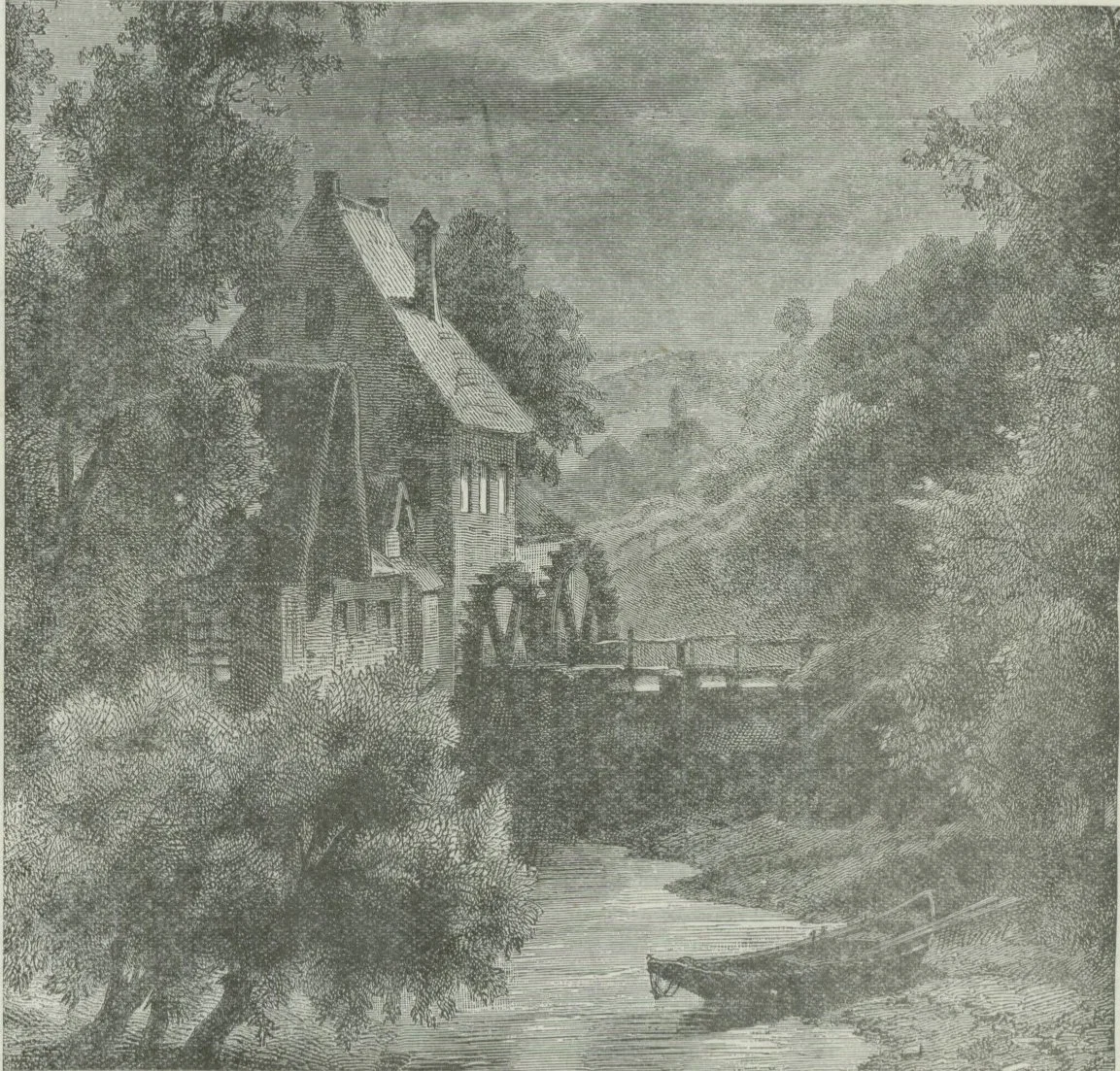
With what wonder I used, as a child, to look on those ponderous wheels revolving so slowly, while the water splashed and foamed in a vain attempt to make them go faster. How actively I sympathized with the water, as I watched the little stream of grain pouring so slowly into the mill, and looked at the numerous bags that must be ground before ours, and then thought how hungry I would be. We used to tell the miller, over and over, the story about the tall, hungry boy who declared that he could eat the meal faster than the mill was grinding it. The miller asked him how long he thought he could keep it up, and the hungry boy said he could do it till he starved to death. But nothing we could say seemed to hurry matters. There was an old boat in the stream below the mill in which I paddled and rocked and watched the minnows. But the mill is forsaken now, and the water no longer dashes over the ponderous wheel, which is falling to decay.
These old mills were simply the older fashioned hand-stone mills, of which we spoke last week, greatly enlarged, and run by artificial power. The stones were a hard flint quarried in but few localities. The surfaces were kept perfectly true, and were creased with furrows radiating from the center. Every few days the stones must be taken apart and the grinding surfaces “dressed,” or sharpened, with steel “picks.” This was a nice work, and must be carefully done. The surfaces of the stones, though running very near together, must not be allowed to come into actual contact, or the little corrugations caused by dressing would be quickly ground off.
The first step of any particular importance in improving milling, was the introduction of mechanical bolting, or sifting of the ground meal. The texture employed for this purpose is silk of a very superior quality, woven principally in Switzerland, and of different degrees of fineness of texture. This cloth, stretched over a six-sided reel about three feet in diameter, and perhaps twenty-five feet long, was so fine at the end where the meal was introduced as to admit of only the finest flour being sifted out. The meshes of the cloth increased in size toward the other end, and a slight inclination of the bolt caused the meal to gravitate that way. Up to a certain point the product was flour. After that it was middlings, or canaille, or pollard, or shorts, whichever one pleased to call it. At last it was bran, which consisted of the husk with some middlings and flour adhering to it. The middlings were fine bran and coarse flour, and contained some of the most valuable portion of the wheat. These two last products were then fed to cows, and splendid cows they made, too. But there was always much dissatisfaction and grumbling connected with this system. Grists were apt to be short; flour was mixed; bags were lost, etc. The country miller, like the country school-teacher, had more than his share of the ills of life, though he was usually fat and smiling in his dusty garb. T.
TABLE TALK.
By Myrta B. Castle
BY MYRTA B. CASTLE.
(Battle Creek, Mich.)
Talk when you are at the table; for it is only the glutton, who hasn’t time, or the dyspeptic, who is melancholy, that keeps still at meal-time. Among well-brought-up people the dinner is a social function, where people come for the pleasure of meeting one another as well as for the main reason — the desire to satisfy their hunger. Perhaps the dinner is the only chance in the day for all the family to be together; so, unless they are ill-natured, they come to the table to enjoy one another as well as the food, to have a happy time over the day’s occurrences, or to discuss a new magazine or book, — in short, they come to be entertaining, to give pleasure while they are receiving it.
Moreover, there is little need to fear that dyspepsia will invade a family where the food is prepared healthfully, and where cheerful table talk is on the daily program; for the digestive juices are exceedingly sensitive to emotions, and pleasant feelings excite these juices to their best work. It is also true that cross and ungenerous or sad and melancholy feelings are poisonous to the system.
But no doubt it seems impossible to take time for table talk in families where an hour is the limit of time allowed for getting home from work, eating, and getting back again. Under such conditions, if one is to feel merry and conversationally inclined, the dinner must not be like the diners — hurried. The food, however simple, must be good, and then must be put on the table right. There is as much chance for artistic ability in the setting of a table as in the making of a hat or a gown or in the painting of a picture. Indeed, a dainty table is a picture; and whoever sits down to it, will be likely to arise refreshed mentally and spiritually, as well as physically.
Moreover, it does not take long to see that the table-cloth is clean, or that a fresh doily is placed over any soiled spot the children’s carelessness may have caused. It takes no longer to put the knife at the right with its back toward the plate, and the fork on the left with its tines up, than to put them both on one side. Then the spoon at the inside of the plate, with its handle toward the knife and its bowl toward the fork, completes the furnishings of the plate. In the season when flowers grace our meadows and our lawns, keep a rose jar in the middle of the table, and fill it each morning with a fresh posy. Its fragrance and beauty will add to the pleasure of the diners and the agreeableness of the table talk, and thus to the digestion of the food.
These seem like little things; but whatever gives any one pleasure is not a little thing. Even the hungry workmen on a farm will be likely to appreciate the quieting, soothing effect of a dainty table with fewer kinds of food, and grow to like it better than a disorderly table71loaded down with cookery. The tired house-wife will be sure to like it better. But the main benefit will be to the children; for clean and lovely surroundings have a tendency to breed clean and lovely thoughts, while the reverse is most certainly true,—that unlovely surroundings breed unlovely lives. It is only the grace of God, in abundant measure, that can keep one sweet and gentle in the midst of disorder and in the absence of all attempts toward beauty; and no one has any right to tempt others to unloveliness by making no effort to teach them loveliness.
A THOUGHT.
By M. Gracie Fisher
BY M. GRACIE FISHER.
(Poy Sippi, Wis.)
THE sweetest thing that I ever saw
Was a tender, kindly look;
It came to a poor, sad, sinking soul;
The burden of grief it took
From that saddened heart was wonderful.
The Christ-love shone in that heavenly smile,
That bade the sad one sing;
“I’ll help to bear thy burden of care,
And thy load to Christ we’ll bring.
I’ll not pass by on the other side.”
Those words of cheer from a heart so true
Were like sunshine after storm,—
A waft of heavenly peace divine,
A rose without the thorn,—
And Christ our Saviour was glorified.
And down the long ages comes the thought:
“E’en as ye have done to one
Of my humblest, erring children dear,
Unto me also ye’ve done!”
WHAT SHALL WE PUT ON BREAD?
By Mrs. D. A. Fitch
BY MRS. D. A. FITCH.
(Sanitarium Cooking-School.)
To the question, What shall we eat on our bread? generally the answer will be, “Butter.” Butter may be eaten, and many do eat it; but that is not proving that it is necessary or even expedient that people should eat it. Some people who do not countenance the use of butter eat cream, sirup, gravy, or other dressing with their bread, while others very properly take fruit with their “staff of life.” In Gen. 1:29 we have the bill of fare God gave to Adam and Eve in Eden. Thoroughly understood, this means that God designed man to live on grains and fruits. (Do not think the grains must always be in soft form. Our breads are made of grains.) In this text is included the nuts. They are the fruit of a tree—shell fruit. They are also seeds—oleaginous seeds. Vegetables and flesh were given for food later in the history of our race, after sin had entered.
As far back as the memory of this generation goes, nuts formed no part of the regular bill of fare. They have been eaten as titbits between meals, perhaps as a part of the dessert, and at evening repasts; thus, by being eaten usually at untimely hours, nuts have come into disrepute, and have been called indigestible. It is strange, indeed, that some of our best friends should be so maligned; for nuts, properly eaten, are easily digested, and go to serve important offices in the system. From the food-table (page 485, “Science in the Kitchen”) I make up the following statements in regard to nuts: They average nearly three times the total nutrition there is in meats. They contain rather more nitrogenous, or tissue-building material, and almost five times as much carbonaceous material, or that which goes to the making of energy. This carbonaceous element is largely fat.
When we consider Eccl. 7:29, we usually apply the “many inventions” to evil things; but may not the expression mean some good thing, sometimes? The Health Food Company of Battle Creek, Mich., is now manufacturing nut butter. The company began on a small scale, but the demand is so great that the facilities for its manufacture are being greatly enlarged from time to time. Its price, as it comes from the factory, is thirty cents a pound. When prepared in the home, according to directions, its expense is only half that. This is what hundreds are now using on their bread, and the pleasure derived therefrom is great, compared with that found in the use of the dairy product, to say nothing of the fact that it is thoroughly hygienic, while the dangers of the latter are manifold.
In former articles I have helped you make bread; now you have bread and butter. In addition to this, I am going to give you a recipe for a bread which is so palatable you will not think of wanting anything on it. Notice that there is neither yeast, baking powder, nor soda in it.
Brown Bread.—Make three cupfuls of strong coffee from caramel-cereal. Add to it one cupful of cream, one-half cupful of sugar, and a pinch of salt. Heat this to the boiling point, and then, without lumping, stir into it one third of a cupful each of corn-meal, fine rye flour, and good white flour, the three kinds of flour having been previously mixed together. Cool a little, and stir in three cupfuls of crystal wheat. Pour the batter into a basin, cover, and steam three hours. Dry out a few minutes in the oven before serving.
The caramel-cereal and crystal wheat are manufactured by the Health Food Company.
In the article on white bread, it should have been stated that after the last turning, the bread should be allowed to rise again before being made into loaves.
MRS. D. A. FITCH, instructor in the Sanitarium Cooking-school, who so acceptably contributes to our Home department, informs us that there is a call from many for a small book on hygienic cooking. She aptly suggests that the REVIEWS be preserved, or at least that scraps be saved for future reference, and thus in a short time one will have quite a fund of practical information. The book “Science in the Kitchen,” by Mrs. E. E. Kellogg, though larger and somewhat more expensive than ordinary cook-books, is of a character not to be compared with them. The saving of a few dimes in the purchase of a book by which the essential and underlying principles of cookery are lost, does not pay. What one would save in purchasing a smaller book would be but an insignificant matter compared with what he would gain by getting the larger one. We have no hesitancy in advising people not to obtain the cheaper cook-books. In “Science in the Kitchen” knowledge, experience, good taste, and conscience are combined to produce that which will not merely gratify the depraved appetite, but that which will tend to health, pure living, and an economy that is not mean or niggardly. It is poor economy to go without a book of this kind. T.
PHYSICAL REST.
By E. R. Caro
BY E. R. CARO, M. D.
(Medical Missionary College.)
Apart from the continual presence of Christ and his angels, nothing is so essential to the happiness of a home, as good physical health. Satan employs sickness and death to cast gloom and sorrow over our families, and too often we assist him by unknowingly doing those very things which produce disease.
Our bodies require rest, and rest they must have. Each tissue is made up of thousands of minute living cells, which, throughout our waking hours, work hard to perform their allotted task. In so doing they become surrounded with waste products, resulting from their own activity. The organ,—brain, liver, or kidney, as the case may be,—is clogged, and must cease from work. While resting, the blood washes away the accumulated waste material, carrying it to those organs which can expel it from the body. We wake in the morning with our living machine clean and ready for a new day’s work. On the other hand, we are very tired, but do not rest. Waste material accumulates, and hinders the cells in their work, until finally they are compelled to stop, and we drop exhausted.
Fatigue is nature’s method of warning us that it is time to rest; and her warnings cannot be neglected without subjecting our bodies to a strain from which they are very slow to recover. By introducing thorough system into the home, our daily work can be performed in much less time than we are accustomed to devote to it. A regular rising hour, a regular time for meals, and a division of work proportionate to the strength of the different members of the family, will enable them to spend their evenings in one another’s society, and to obtain the necessary amount of sleep.
Hours spent in rest are hours well spent. A strong and vigorous body will accomplish far more than one weakened by overwork.
RECIPES
We are indebted to Mrs. May R. Reed, Seymour, Wis., for the following useful recipes:—
Yeast.—One ounce of hops, two quarts of water, one tablespoonful of salt, a half cupful of sugar, one pint of sifted wheat flour, one and a half pounds of potato. Boil the hops for one half hour; strain, and cool till lukewarm. Add salt and sugar. Mix the flour to a smooth paste with some of the hop-water, and then mix all together. Keep this batter in a warm place for three days, and stir it occasionally while working. Then boil and mash the potatoes, and add to the sponge; let it stand another day. Strain through a colander, and it is ready for use. No yeast is required to start this, and unlike other soft yeasts, it will keep sweet for two or three months, even in summer, if kept in the cellar. One cupful of this yeast is sufficient for five loaves of bread.
Hulled Corn.—Corn, either whole or cracked, when properly prepared, is a valuable addition to the winter bill of fare. To hull four quarts of shelled corn, use one heaping tablespoonful of saleratus, and water enough to keep it covered. Boil for four hours, or until the hull is removed. Wash in clear water thoroughly, and rinse several times, until the hulls have all been turned off. Then soak in clear water over-night, to remove all trace of soda, and cook all day in clear water in a double boiler, or on top of the stove. Season with a little salt, and pack in a jar in a cool place. It may be warmed in small quantities when desired, and served with a dressing of cream and sugar, canned fruit, or maple sirup. This process of hulling is much easier and more satisfactory than by the use of lye.
Beet Salad.—Take young, tender beets, and bake or boil tender; cut into fancy shapes, slice, or chop quite fine. Pour over them while hot a sauce made by diluting the juice of one lemon with two cupfuls of water, one dessert-spoonful of corn starch, a little salt, and one tablespoonful of sugar.
CAREFUL IN LITTLE THINGS.
“Hester, please straighten that rug,” said Aunt Grey. “Some one will stumble over it, and fall against the stove.”
“O Aunt Grey,” laughed Hester, “what will you think of next? I call you a pessimist. You are always looking for something bad to happen!”
But Hester’s married sister, Mrs. Hills, who had just come in, did not laugh. She said, after a moment, “I haven’t told you what I did the other night. I went to the kitchen the last thing, laid the kindling in the stove ready for morning, and replaced the cover, leaving the lifter in it projecting from the stove.
“It is dark, at this time of year, when Will rises; and the next morning, as usual, he went into the kitchen to start the fire, and in another moment I heard him cry out in pain. It flashed instantly upon me what had happened. He had stooped in the dark, and had struck his eye against the projecting lifter. I felt sick with terror. I thought,—
“‘What if I have made Will blind for life!’ “It really did hit his eye, though not to blind him, and the bruise and swelling are not yet gone. I am convinced, now, that we ought to be careful in little things.”—Household.
An Irishman, a Doctor, and an Undertaker
— The Irishman and the doctor come in for more than their share of the jokes; but here is a little one that concerns them both. A son of Erin called on an undertaker to attend Patrick Connell. “Is poor Pat dead?” exclaimed the undertaker. “No, he’s not dead yet,” answered the man, “but he’ll die to-night. The docther says he can’t live till mornin’, an’ he knows what he give him.”
WHAT OF THE NIGHT?
By G. C. T
On a stormy, perilous night at sea there is in the hearts of all passengers a feverish anxiety to know just how matters are going. Is the ship safe? Is she showing any signs of weakness? Is there water in the hold? Are the engines all right? How is the weather? What o’clock is it? Where are we? Is the captain on the bridge? Are the men calm and courageous? Every few minutes the passenger lies perfectly still to listen for the regular pulsation of the engines. And as he hears them beating away like a well-regulated heart, he is assured. If the captain or one of the leading officers passes through the saloon, how anxiously his replies are listened for—“Captain, what of the night?” “Is all well, Captain?” Then the answer comes, “The ship is all right. There is no water in the hold. The engines are stanch.” “But where are we, Captain?”—“The land is near. We shall soon pass around the cape into smooth water, and then we shall reach the port.”
With what relief those words are heard. Fears are cast aside; courage and joy spring up in every heart. What of the dashing waves, the roaring winds? The harbor is at hand!
But while the thoughtless passenger may thus cast away care, the more wise and thoughtful captain knows that in approaching land, dangers are greatly increased. How many vessels, after passing through stormy seas, and safely meeting all the terrible tests of tide and tempest, strand upon the beach or dash upon the rocks, almost within sight of the harbor! Great care must be exercised now. All hands are on duty. Every eye and ear is strained to perceive the right path and to avoid the dangers. A few moments’ faithful vigilance, and the anchor will be dropped in the peaceful bay. One moment of heedlessness, one false word of command, one mistaken turn of the helm, and all is lost! The addition of one syllable the other day caused the great steamer “St. Paul” to imbed herself deeply on the beach at the entrance of New York harbor. The lead showed seven fathoms, and the man who was sounding by mistake cried “seventeen.” That seemed safe, but the next moment there was a catastrophe.
We are nearing land on the voyage of earthly probation. In reply to the anxious inquiry, “Watchman, what of the night?” comes back the ready answer: “The morning cometh, and also the night.” There are signs of land; it is almost in sight; there are dangers also. Now, as never before, the times demand vigilance and faithfulness. Over the dashing billows gleams the steady light of God’s unfailing word. But on every hand flash the false lights of human kindling. Just beyond those lights are the breakers! We will follow carefully the unerring guide of ages past, and we are safe. It is too late in probation’s day. We are too near the port to make shipwreck now. That word which has been the hope and guide of the good of all past ages is still our guide. Its Author is our pilot; we hear his voice in warning and encouragement, and we will obey. G. C. T