The Youth’s Instructor, Vol. 38, No. 43.

PURE RELIGION

The Youth’s Instructor

Oct 22, 1890

S. D. A. Publishing Association · Battle Creek, Mich. · Oct 22, 1890

PURE RELIGION.
“I wonder why Mrs. Peters doesn’t come,” said Ethel Brown, looking out of the window. “Here it is eight o’clock, and the clothes are soaking. She never disappointed us before. But if she don’t come, I expect I would better go at the washing myself.”
“I think you will have to, if you expect to get the clothes out,” said Ethel’s sister Mary; “for Willie told me that Johnnie Peters had broken his arm, and of course Mrs. Peters will have to stay at home to nurse him.”
“I wonder if that is the case,” said Ethel. “Willie, come here. Are you sure that Johnnie Peters has broken his arm?”
“Yes, ma’am,” said Willie; “I was over on the common yesterday, and the boys were playing round the livery stable, and Johnnie got knocked down from a high fence, and he fainted away, and the livery man carried him home in his buggy.”
“Poor little boy!” said Ethel, “and poor Mrs. Peters! How much trouble there is in this world! Well, we must hurry and get the washing out, and then, Willie, if you will show me the way, we’ll go over and see Mrs. Peters. Perhaps we can do something to help or comfort her.”
“Dear me,” said Ethel’s aunt, who was visiting them from New York, “why don’t you give up your whole time to looking after washer-women and ragamuffins? No doubt the woman has plenty of friends of her own kind who will do everything for her that she needs. I would not make myself so common, if I were you, Ethel Brown. For my part, I think it very much to her discredit that she didn’t send you word that she couldn’t come, or supply somebody to fill her place. I want you to go with me this afternoon to call on my wealthy friend on the south side. I can tell you friendship with her will be a great advantage to you, Ethel, for she can introduce you to the very best society; so of course you will have to put off visiting your washer-woman to-day.”
Ethel’s aunt swept out of the room with an air that seemed to say, “There, that is settled,” and Ethel gazed after her with a look of pain and surprise. Strange thoughts went through her mind, something like this:—
“Is that my dear dead mother’s sister? How differently she feels and talks from my mother.”
It had only been a few months since Ethel’s mother had been laid in the grave. She was the oldest of the family, and had been nurse and housekeeper, and her young heart had learned to bear sorrow and care. Her face, though young and sweet, wore a shadow that told of those long days of watching and weariness. But Ethel would not have taken anything for her experience, and though it had been. What precious words she had heard her mother speak! What a loving, unselfish spirit she had seen her manifest! What patience in suffering! what faith in trial! what triumph in death! It was in her sick-room she had read the precious words about Jesus and his love for all men,—how there was no difference in his eyes; how he was no respecter of persons, but identified himself with the low and the weak and the sorrowing; and as Ethel had often carried out her mother’s wishes in giving to the poor, in sending messages of comfort to the mourning, she, too, had learned to delight in doing good to all who came within her reach.
Still Ethel thought of her aunt’s words, and wondered if she could put off her visit to Mrs. Peters, and visit the rich friend on the south side.
“I don’t care much about going,” said Ethel, “but I would like to please aunt. Mary can go, though, just as well as I. That friend on the south side does not need me half as much as poor Mrs. Peters, and I have no doubts about her having so many friends. Poor people don’t usually have any too many. Besides I would feel very strange to go over to that rich lady’s simply to have her get me into fashionable society, and I won’t do it. I hate toadyism,” she concluded, giving the towel a vigorous rub.
“What are you grumbling about?” asked Mary, coming into the kitchen.
“O, I was just saying I hated toadyism, and I was thinking about what pure religion is.”
“Ethel, you are always putting the strangest things together. Well, what is pure religion?”
“I’m sure it isn’t visiting a rich woman for the sake of having her influence to help you into society, and for me to-day I think it is to visit the widow and the fatherless in their affliction, and to keep myself unspotted from the world.”
“O you cranky thing! and you won’t go with aunt to the south side? Well, I’ll go; for I want to see her velvet carpets and gorgeous things, and I haven’t any conscience about the widow and the fatherless when you have such a burden for them.”
At noon the washing was out. Ethel was tired, but Mary got dinner ready, and Willie and auntie came in from the store with appreciative appetites, and the question of the afternoon’s doing was decided.
“Whoever goes with me to the south side this afternoon will have no cause for sorrow. I saw a handsome piece of goods this morning that somebody is going to get for a present.”
Auntie looked at Ethel smilingly, but it did not seem to influence her; so at about half-past one auntie and Mary took the hack for the south side, while Ethel and Willie trudged away on foot toward the tenement houses of the poor.
All along the way Ethel saw much that was sad. Saloons were open, drunken men were reeling on the streets, dirty children playing in the alleys, and forlorn-looking women walking along, some carrying heavy burdens, and some wearing cheap finery, and smiling with a smile that made Ethel feel sad.
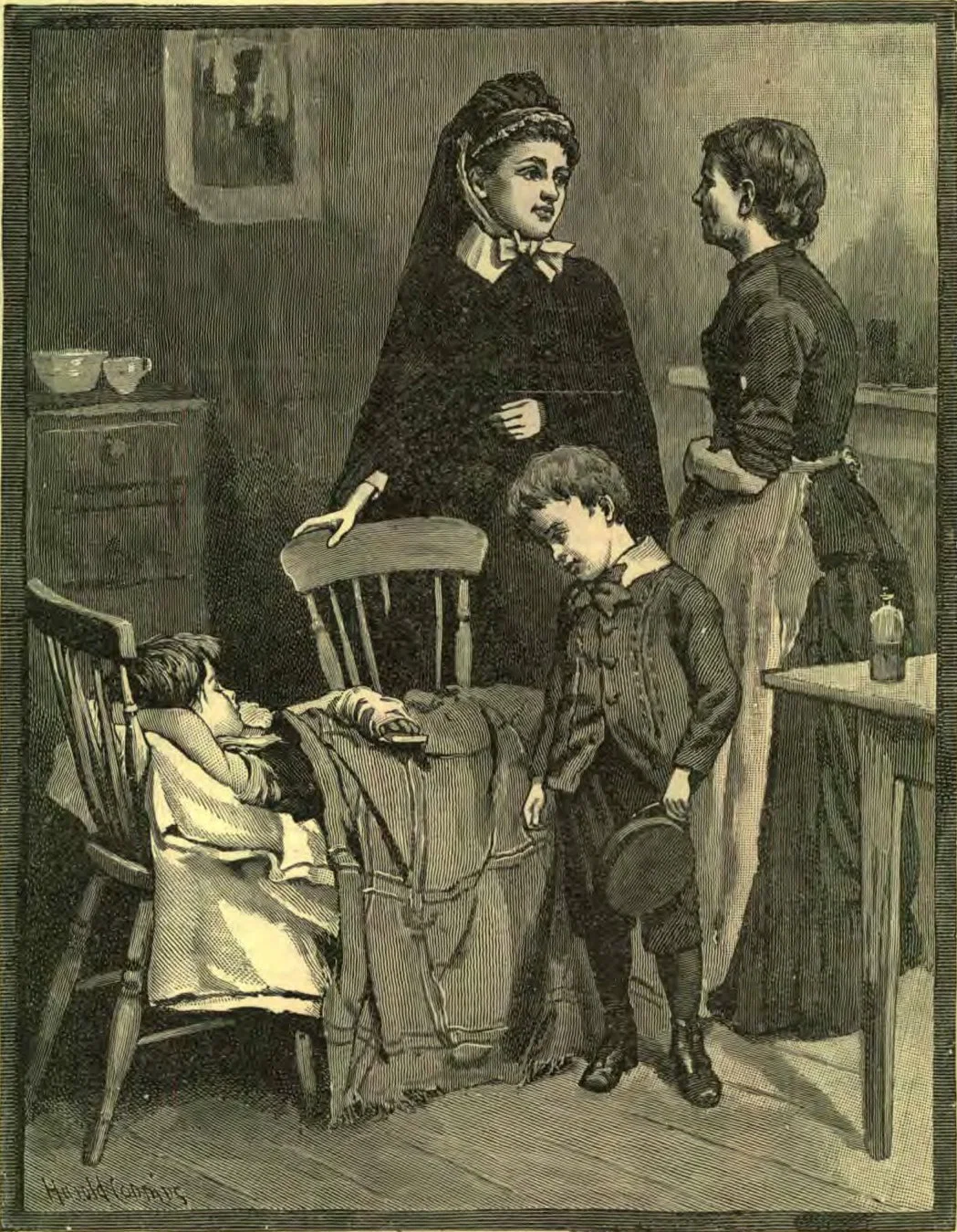
By and by they reached Mrs. Peters’s house. They had to climb up some rickety, dark stairs, and feel around for the door, and when they got in, they saw that Mrs. Peters was very poor. Her little room looked cheerless indeed. In the middle of the room lay Johnnie, on a couple of chairs with a board across them, and some pillows under him, and his poor, broken arm lay on an old shawl that was spread over him.
As Ethel clasped Mrs. Peters’s hand, and said, “I am so sorry for you!” the tears filled Mrs. Peters’s eyes, and rolled down her cheeks. She didn’t have another chair to offer to Ethel and Willie, but Ethel said she would just as soon stand up, and would not mind it.
Mrs. Peters told her all about the accident to Johnnie, and then said, “And now, Miss Ethel, the Lord only knows what will become of us. It’s taken every cent I had raked and scraped together to pay the doctor. I’ve got nothing but my two hands to support me. My husband is dead, and he’d better be dead than living as long as the saloon stares us in the face. If it wasn’t for Johnnie, I would have given up heart long ago, but I want to see him reared up a decent man. Indeed, Miss Ethel, do you think there is a God? And if there is, does he care a bit for us poor creatures that have to live in tenement houses?”
Mrs. Peters’s face looked hard and sad, until Ethel put her arm around her, and began to weep.
Ethel prayed in her heart for words to speak to this poor heart that was weary, and the words came.
They were so full of faith and tenderness that Mrs. Peters’s heart was melted, and the women seemed like two sisters as they wept together.
“Don’t doubt God, dear heart,” said Ethel. “I have had sorrow, too, but it has only worked my good. God wants to save us, and sometimes he has to take just this way. Don’t you know, ‘whom the Lord loveth, he chasteneth’? God does love you. He gave his only begotten Son to die for you, and our great High-priest in heaven is touched with the feeling of our infirmities. He says that not a sparrow falls to the ground without his notice, and that you are of more value than many sparrows. Be brave. It won’t be long, any way, till Jesus will come; for he is coming soon, and then we’ll reach that land where there’ll be no more sorrow.”
“O how sweet that is, Miss Ethel! It sounds just like your dear mother. And I do believe God sent you to-day; for it seemed as if my heart would break.”
Ethel put some money into her friend’s hand as she started away.
“It’s only the wash money for to-day, and I earned it for you. I only wish it were a hundred times more. I am coming back before night.” Ethel kissed Johnnie, and Willie gave him a handful of marbles as he went away.
How glad Ethel’s heart felt as she tripped along the alley, smiling at the children, and speaking to the dogs.
“It seems as though I love everybody in the world,” said Ethel. “I don’t feel a bit tired, but I am just as fresh as a daisy. Now, Willie, what can we get together to make that house more homelike, and Johnnie and Mrs. Peters more comfortable?”
Ethel and Willie thought of a number of things they could spare, and you would have thought them very happy if you could have heard them singing and laughing as they took down a few pictures from their bed-room walls, and packed up some dishes, mats, bedding, and household furniture. Willie got a drayman, and Ethel found strength to go back to the tenement house to see that everything was made cosy for her friends.
Mrs. Peters and Johnnie looked so happy, and thanked her again and again; but Ethel said it was God’s dear love, and no praise belonged to her, but to him.
Ethel went home again in time to get supper for her father, and when she told him all about Mrs. Peters, he gave her a five-dollar bill for her.
When auntie and Mary came home, Ethel was singing and playing.
“You seem happy,” said Mary, “but I guess you’ll get over it when you see my beautiful new dress, and hear that I’m invited to the Atherton’s next party.”
Mary displayed her dress, and Ethel said it certainly was a beauty, but that she knew she was happier than Mary could be; for she had read in the Book of God that it is “more blessed to give than to receive.” FANNIE BOLTON.

CONTENT

ALL lands are fair to him who knows content, All skies are sunny, and all fields are green; In dreamy mists with softest azure blent Lie distant cloud-lands tipped with silver sheen The wayside violet sheds her fragrance sweet, For him the wild rose's blushes are all spent; Life's fullest gifts are poured about the feet Of him within whose heart is found content.
—Selected.

ROUND THE WORLD.—32.

SOMETHING ABOUT BOMBAY.
UNTIL late years, Calcutta has been the most important city in Asiatic countries; but now Bombay has the largest trade, and the inhabitants intend to make a strong effort to have the residence of the viceroy transferred to their domain. As the nearest Indian port of any size to England, it has an unquestionable advantage; for all communication with the mother-country is by sea. But should the British engineers and capitalists carry out their scheme of bridging the English Channel, running a railroad across the continent of Europe to Gibraltar, placing the cars on pontoons, and in this manner conveying them across the straits to Northern Africa, and then on by rail again to the Suez, across it, and through Persia to Kurrachee, in India, Bombay will lose a good deal of trade.
Bombay is called by the natives, “Mumbai” (the capital of the West). It is built on an island of the same name, having only one connection with the main-land, namely, a railroad bridge. The land is mostly flat, with the exception of the rising ground called Malabar Hill, a point to the west of the island, Chinchpoogly to the east, and Parell Hill on the north.
TOWER OF SILENCE.
TOWER OF SILENCE.
Formerly the island of Bombay belonged to the Portuguese; but by the marriage of Charles II., of England, with the Infanta of Portugal, in June, 1661, it was ceded as her dowry to the British monarch, and an expedition under the Earl of Marlborough was sent in March, 1662, to take possession of it. This was unsuccessful, inasmuch as an excess of territory, over that named in the concession, was demanded; and while the Earl returned to England, the troops, under Sir Abraham Shipman, were encamped on the island Anjedva, the climate of which proved fatal to many soldiers and to their commanders. But Bombay was eventually taken possession of in 1664, and transferred to the East Indian Company in 1688, with all the powers of local government. The fortifications were then enlarged and strengthened, and the population soon rapidly increased, the admirable situation of the fort and harbor, the strength of the place, attracting persons of all nations, Asiatic and European.
The transactions of the period are, however, singularly deficient in incidents of history; and although the French, the Dutch, the Portuguese, and the Danes, as well as the English, held factories in India, it does not appear that local rivalry led to any bad consequences. The struggles between Sivajee and the Seedee of Jinjewra created considerable uneasiness in Bombay in 1674. The harbor was the scene of several engagements by sea, and the neighborhood of Salsette by land. In this contest the English interfered on one occasion only, when the Maharatta fleet was dislodged from their position near the island of Kenny, at the entrance of Bombay harbor; in other respects a perfect neutrality was observed. It would seem that almost all the towns and cities of note in India have at one time or another been the scene of strife and bloodshed. But now all is peace and harmony, and the natives seem happy and contented under British rule. How long this state of affairs will last, none can tell. Russia longs to pounce upon this bright gem of Victoria’s crown, and the British are prepared to fight for it to the last. Statesmen say that the storm-clouds of war are brewing, and that it will not be long until they burst again.
What shall I say of the city? Countries and cities grow monotonous to travelers after the excitement and novelty of a nomadic life have worn off. Places lose their interest. Countries appear to be but an illy distributed mass of mountains and plains, forests and deserts, and cities but immense groups of buildings blackened by smoke from tall chimneys of factories, or suburbs containing the usual villa surrounded by a flower garden.
Were it not for the sea-breeze, summer at Bombay would be almost unbearable. May is the hottest time of year, and we were there in an exceptionally hot April. It is absolutely dangerous to walk out during the day, and even should one change his clothes every half hour, he could wring water out of them at the end of that time.
The cathedral, the town hall, the new secretariat, and the post-office are magnificent structures, and the residents are justly proud of them. Once a week the mail steamer, bearing letters from England and America arrives. This is always an event of interest, as home ties are dear to those far from their native land. I watched the huge red vans, drawn by splendid draught horses, bringing the mail-bags from the bunder (landing-place) to the office. It seemed as if it would take days to sort it; but in two hours the clerks were busy serving it out.
One important feature at the time of our visit was the fair and illuminations in honor of Prince Albert Victor, the grandson of the present Empress. On the military parade ground was a miniature city of brown canvas tents and pavilions trimmed with valances of scarlet. An open fence of white St. George’s and Oriental crosses about ten feet high encircled the ground, in the center of which a tower was constructed on the same principle as those used in the United States for wind-wheels. From the top of this, a panoramic view of the cotton city could be obtained. Some of the stalls were very prettily arranged as cafes, where ice-cream, lemonade, and other unhygienic delicacies were served out to the heated visitors. Cross-legged on the raised dias of their stalls sat the Babu merchants, ever ready to bargain and sell for one-fourth their original price. Frequently, when one asks the cost of an article, they will say, “Sahib, one price or two?” If you say “two,” they start an extraordinary figure, and you may have the privilege of discounting them as much as you can. If you answer “one,” it is supposed that they will come down but very little, though as a rule they will decrease it just as much as when the other method is adopted. These venders look very picturesque in their flowing white Oriental dresses, with gold-braided caps and colored sashes. The Oriental loves display.
Almost all the curiosities of the East were exhibited, from the tortoise-shell jewelry of Ceylon to the embroideries of Delhi and the shawls of Cashmere. A “maze” was a great feature of attraction; into it there was but one entrance, and out of it but one, while inside were scores of paths fenced off from each other, and intricately arranged with turns and windings innumerable. One wrong turn to right or left, too early or too late, and the traveler finds himself debarred from further progress, with no redress but to start afresh and strive to thread the magic paths aright. Some got through in a few minutes, while others worked for hours before they unraveled the secret windings of the labyrinths. Into the “Hall of Mystery” we did not venture, and therefore cannot say what it contained.
In one street hung out the sign, “Edison’s Phonograph,” and it only proved true the ancient adage, that in order to know the wonders there are in your native land, you must go to distant shores. We have been in New York, the birthplace of this wonderful instrument, which is to supersede the poor traveling correspondent of the press; but we had never heard its history from its own lips till in Bombay. It reproduced a cornet solo which had been rendered in London some months before, and then delivered a little speech on a political crisis in India. The former was distinctly audible over a large room, but the latter only through the acoustic tubes.
But the best time to visit the fair was at night. The stalls were open till two and three o’clock in the morning, and up to midnight the concourse of people was great. Immediately after sunset the lights are set burning; all the crosses forming the fence, the gateways with their Gothic arches, the tower, and the stalls were emblazoned with myriads of lamps. These were little square glass boxes of various colors, red, blue, green, and yellow, about four and one half by three inches in size, and filled with cocoanut oil, with a wick in the center. They glittered and sparkled everywhere, and the ever-moving, singing throng of white-robed Hindoos lent enchantment to the scene, making it almost like a fairyland dream.
There was only one feature in connection with this “Tamasha” (which means, anything out of the common), that reminded us of any past period of our lives, and that was the odor of the cocoanut oil from the lamps. It indeed called up remembrances of a sanitarium we were once acquainted with, where the above-named ingredient was an important item in the treatment of the sick.
One evening not only the fair-ground, but the whole city, was illuminated in honor of the prince. All public buildings, monuments, and stores were ablaze with lights of many colors. They were hung around the lintels of the doors, and from the casements of the windows on the architraves, and from parapet and buttress. Everywhere they glistened, those near the ground casting a soft light across streets and squares, while those on the cornices and heights of the towers had, as they flickered in the wind, more the appearance of twinkling stars. In the harbor I suppose there were as many as a thousand ships, and from the masts and rigging of nearly all of them gleamed these fairy scintillations, the light streaming over the water, and producing a resplendent effect. We thought of the honors that men bestow on their fellow-beings, and remembered what a cold reception was accorded to the world’s Redeemer when he came to earth to die for humanity. But so it has been ever, and will ever be, until He shall come whose right it is to reign, and shall claim his own. And then celestial rays, far brighter than anything ever conceived in the mind of man, will flood the heavens and bathe the earth in glory.
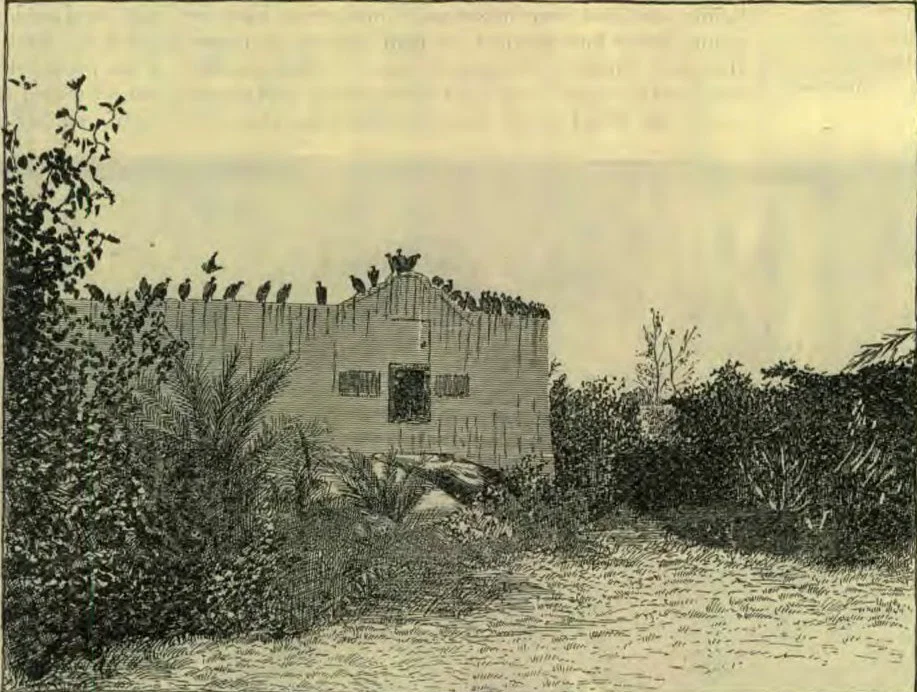
The accompanying cut should by right appear with the next article. It represents one of the famous “Towers of Silence,” the curious burying-place of a curious people. In our next we will give their story, with characteristics of the heroes and heroines.
P. T. M.

RIPE FRUIT.

“Come, little ones, we will go across the fields to the orchard.”
“Are our apples ripe, mamma?”
“We will see.”
“O mamma, I cannot stand it if they should not be ripe. You know they were quite, quite green last time we went to gather them.”
“Yes, dear one, the fruit in the orchard was not ripe. What else?”
“I don’t know what else, mamma,” and Margaret dropped her head. “Yes—I do know, but—I don’t like to tell.”
“I know, mamma; shall I tell?”
“No, John; let Margaret speak.”
“Mamma, the sweet fruit of patience was not ripe in my heart, and I fretted and worried all the way home, because I wanted some nice red apples, and I could not get them.”
“Poor little girl! That was hard—hard to do without the apples, but it was harder to be cross and unhappy, was it not?”
“Yes,” said John, “and I was cross too; and so was little Tot, because Margaret and I scolded her.”
“Has little daughter been working hard since then? Has she been trying to make the fruit grow?”
“Yes, mamma; I have been trying part of the time, and part of the time I have forgotten. But I will try harder and harder after this.”
“And mother will help her dear girl,” and Margaret was held close to her mother’s heart for a good warm hug.
The children were soon ready for their walk.
“Mamma,” said John, “I think you had a real hard time that other day, when we went to the orchard.”
“Do you dear? Why?”
“O, because I guess you were looking for two kinds of fruit, and you did not find either of them.”
“Were you, mamma?” said Margaret, running back to her mother, and throwing her arms about her knees. “O mamma, did you care? I never thought you cared.”
“About the apples, Madge? Yes, I did want the apples very much that day, because, you know, we were going to send some of them to grandmamma. I had promised to send them, and I did hate to disappoint her.”
“And that wasn’t all, was it, mamma?” urged little John.
“No, John, that wasn’t all.”
“You were looking for sweet ‘patience fruit’ in our hearts, I guess.”
“Yes, and all you found was little, green, sour, bitter fruit. Did you feel dreadfully about it, mamma?”
“Indeed I did. I could hardly bear to be disappointed about that; I wanted so very much to find sweet, lovely, precious ‘patience fruit’ in every little heart.”
“There goes little Tot on her nose,” shouted John, and both children dropped mother’s hands and ran to pick up little sister, who had trotted ahead, and now lay on her face in the dust, across a big stick.
“Never mind, little Tot; don’t cry.”
“I won’t cry. I don’t cry any more, ’cause I’ve got a nice, rosy ’ickle apple in my ’ickle heart.”
“In your ’ickle heart!” laughed Margaret and John; “what do you mean?”
“I dess you do know, too. When you’re cross, ’oo don’t have no nice, sweet ’ickle apple in ’oor heart, does ’oo?”
“O, she means a ‘patience fruit.’ Mamma, dear mamma, little Tot is trying too.”
“Precious girl,” said mamma; “that will make us all try harder, will it not?”
“Why, mamma, do you have to try, too? Isn’t your ‘patience fruit’ all ripe and sweet long ago?”
“Not all. Mamma has to try very hard sometimes, but it grows easier all the time.”
“Oh, see! Oh, see!” shouted all the children together. “The apples must be ripe. How big and rosy they are. Here is one on the ground, and, oh, how mellow it is! May we eat some?”
“Yes, we will each have one before we begin to fill our baskets.”
As they munched the sweet, juicy apples, John said, “What makes the fruit grow ripe?”
“Our Father gives the sunshine and the pure air and the ground to grow in, and the tree stretches out its root-mouths for food, and it opens its leaf-mouths for the air and sunshine, and then the fruit grows ripe.”
“And what does Our Father give us to make our fruit grow?”
“Can’t you guess?”
“I know what our ‘ground’ is. It’s where he puts us. That’s our own dear home; but what is the ‘air,’ mamma?”
“I think, John, we might call the ‘air’ the teachings he gives you through papa and mamma, and the sunshine—”
“O mamma, don’t tell! don’t tell! I know. The sunshine is Our Father’s love, and yours and papa’s love.”
“An’ ’ickle Tot’s love; that’s sunshine, too,” interrupted the baby, between big mouthfuls of apple.
“Yes, indeed, we count that in, don’t we, dear children?”
The hugs and kisses which Tot caught just then gave answer.
“If we hold our heads up to the sunshine as this good tree does, we will get plenty of it, and oh, how much faster our ‘patience fruit’ will ripen,” added mamma. “You know it couldn’t ripen in the dark.”
“Mamma,” said Margaret, “isn’t that God’s house under the trees?”
“Yes, dear.”
“Wouldn’t it be nice for us to go in and thank Our Father for our ‘ground and air and sunshine’?”
“Yes, it would; and I want to thank him that I can see the sweet ‘patience fruit’ growing and ripening in my children’s hearts.”
“Can you really, mamma? I am so glad.”
“Yes, I can, really.”
“Well, I want to thank Him that the ‘patience fruit’ is all nice and ripe and sweet and big in our mamma’s heart,” said John.
“An’ ’ickle Tot fank Him too for ‘patience apple,’” interrupted dear Totty.
“I think our mamma’s heart is just full of all kinds of lovely fruit, and I’m just as thankful as I can be; for I’m sure if she were not so dear and sweet, I would never try.”
“Little Margaret, remember that mamma has to look to Our Father for the sunshine of his love, or she, too, would give up trying.”—Emily A. Kellogg.

“GOOD-BY TO SUMMER.”

GOOD-BY, good-by to summer, For summer's nearly done; The garden smiling faintly, Cool breezes in the sun; Our thrushes now are silent, Our swallows flown away. But robin's here, in coat of brown And scarlet breast-knot gay. Robin, robin redbreast, O robin dear! Robin sings so sweetly In the falling of the year.
Bright yellow, red, and orange, The leaves come down in hosts; The trees are Indian princes, But soon they'll turn to ghosts! The leathery pears and apples Hang russet on the bough; It's autumn, autumn, autumn late; 'Twill soon be winter now. Robin, robin redbreast, O robin dear! And what will this poor robin do? For pinching days are near.
The fireside for the cricket, The wheat-stack for the mouse, When trembling night-winds whistle And moan all round the house. The frosty ways like iron, The branches plumed with snow— Alas! in winter dead and dark, Where can poor robin go? Robin, robin redbreast, O robin dear! And a crumb of bread for robin, His little heart to cheer.
—Selected.

A FABLE.

“I’ll master it,” said the ax, and his blows fell heavily on the iron; but every blow made his edge more blunt, till he ceased to strike.
“Leave it to me,” said the saw, and with his relentless teeth he worked backward and forward on its surface till they were all worn down or broken; then he fell aside.
“Ha! ha!” said the hammer, “I knew you wouldn’t succeed; I’ll show you the way.” But at his first fierce stroke off flew his head, and the iron remained as before.
“Shall I try?” asked the soft, small flame. But they all despised the flame; but he curled gently round the iron and embraced it, and never left it till it melted under his irresistible influence.
There are hearts hard enough to resist the force of wrath, the malice of persecution, and the fury of pride, so as to make their acts recoil on their adversaries; but there is a power stronger than any of these, and hard indeed is that heart that can resist love.—Mrs. Prosser.

THE COST OF A BIBLE.

The first English translation of the Bible, as our young people are aware, was made by Wycliffe, A. D. 1380. Before that, the price of a Bible in Latin was equal to fifteen hundred dollars of our money. Even after Wycliffe’s copy was finished, the value of a New Testament was one hundred and fifty dollars of our money.
Tyndale was the first who had a Bible printed in English. The first edition was bought up and burned; but he soon got out a second. He was betrayed into the hands of the enemies of truth, and strangled at the stake. His body was burned to ashes, “but the Word of God is not bound.”
At what cost has the precious Book been handed down to us; and for what a small sum we may now procure it! Yet, let us remember we can never understand it rightly unless the Holy Spirit brings it home to our hearts. The “things of God” are “spiritually discerned;” of ourselves we cannot find them out. What need then to pray, “Open thou mine eyes, that I may behold wondrous things out of thy law!” “Wisdom is better than rubies; and all the things that may be desired are not to be compared to it.”
Continue reading: GOOBERS