You have all heard of Egypt, that country over in the north-eastern part of Africa. You have read about it in your Bibles, if nowhere else, and have learned how Joseph was sold to a mighty captain who lived there; and how, for many long years, the Israelites worked very hard for the Egyptian king. You read about the River Nile, and how its waters were once all turned to blood, because Pharaoh would not let the Israelites go out from Egypt up to the promised land.
At that time, Egypt was a fine country, with busy towns and beautiful cities. Now all is in ruins. If you were to visit the places where these old towns stood, you could hardly tell what had been there; in most places, only heaps of rubbish mark the spot. But some of these ruins are the most wonderful in all the world, because they are the oldest.
If you will look on a map of Egypt, you will see, near the northern part of the Nile, a city marked Cairo. Just below this city, on the west side of the river, stand these wonderful ruins. They are nothing more than great hills of stone, built ages and ages ago, before Christ was born,—before the Israelites came down to Egypt; such a long while ago, that nobody can tell who built them, or when. There are seventy of these pointed, four-sided stone hills, or pyramids, at this place. They are made of great stones, so large that nobody can invent any machinery that can hoist such heavy stones so high, and hundreds of men could not pull them up. How these Egyptians got them up there is a wonder indeed. But they did their work well, else it could not have stood so many thousands of years. If the workmen had been careless, we might not have known anything about the pyramids.
What were they built for? I suppose the old kings meant them for tombs,—sepulchers where the royal families might be buried. The Egyptians had some queer notions about death. They thought that at death the thinking part of man went into some animal, and that after three thousand years it would come back to live in the old body. They took great pains to keep the body in some safe place and to preserve it with spices, so that at the end of this time, it could live again as before. But it was of no use, for we can read in our Bibles that dead people do not know anything, and never will till Jesus comes and raises them to life; and if these Egyptians had only had the Bible to read, they would have known better too.
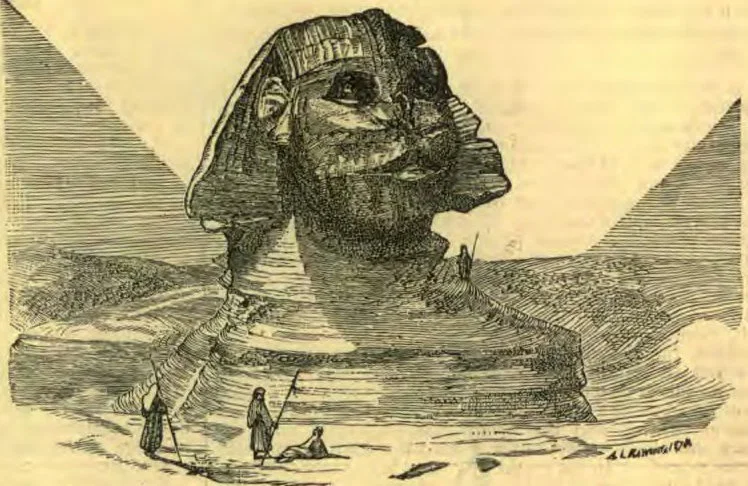
By the side of one pyramid is another monument, and nobody can quite make out what that was made for. You can see in the picture what it looks like. It is called the sphinx. It is a massive great image of solid stone. What a long time it must have taken to hew it out!
It is broken in a good many places now. Its head was like a man's. Once it had a cap on, but the top part of that is gone; and it has lost its long beard and its nose.
For many years it was buried up in the sands that the wind had blown upon it, and only its head could be seen, so that people thought that was all there was to it. At last somebody dug the sand away; then the great head was found to have a body like a lion's. Between its outstretched paws were the ruins of a large temple. No doubt the Egyptians once came here to worship, and the sphinx is an image of one of their gods. This picture of the sphinx must have been taken before the sand was dug away.
It is sad to think that the busy people who once lived in this country are all dead, and their cities in ruins, so that nothing but rubbish tells of what has once been.
W. E. L.
EMPTY ROOMS.
“Boys,” said Miss Proctor to her class one Sabbath, “tell me some of a boy’s enemies.”
“Evil companions,” said the largest boy in the class.
“Bad habits,” said Willie Thorn.
“Teasing your sister,” shouted little Tommy Crane.
“Wicked thoughts,” whispered a sober-looking boy in ragged clothes, at the end of the class.
Just then the superintendent’s bell rang, and there was no more said.
After Sabbath-school, as Miss Proctor was walking home, she saw before her a small, ragged figure pressed closely up against a stone wall. “Well, Joe,” she said kindly, “are you waiting for me?”
“Yes’m,” Joe answered rather faintly, and walked silently along by her side for some minutes.
He was a new boy, and Miss Proctor had not yet been able to get interested in him. What was there in the pale, rather dull face, with its hopeless eyes? She could get no clue to the boy.
“Did you like the lesson to-day, Joe?” she began.
“Yes’m, what you said about a feller’s enemies, an’—an’ you know you told us last Sabbath that enemies was something we must fight. Do you s’pose, if a feller fights real hard now, he can take their heads off?”
“What do you mean, Joe? What is your particular enemy?”
“Bad thoughts, Miss Proctor,” and the boy looked earnestly up in her face. “I get thinkin’ of all kinds of things that I know an’t right, and then seems as if I never could get rid of ’em.”
“Joe, what kind of books do you like to read?”
“Oh, I don’t know; ‘The Bride of the Prairie’ ’s a good one, an’ ‘The Haunted Dagger,’ an’ ‘Low-down Dicksy’ ’s another.”
“Now, Joe, do you think you would like to be such a man as those you have been reading about?” Joe looked thoughtful a moment.
“No, ma’am, I don’t really b’lieve I would.”
“Well, don’t you believe the more you read and think about them, the more you will grow to be like them? Now if you come home with me, I will give you a story to read about a man who fought many a battle, who went through many an exciting scene, but who was brave and pure and true. If you will promise to read only the books I give you for some time, I can promise you that the bad thoughts will be likely to go away.”
Boys and girls, fill your minds with pure, good thoughts, and there will be no room for evil ones. Your minds are like empty rooms, waiting to be occupied. Which will you have dwell there, good angels or bad ones?—Child’s Paper.
LITTLE BOY BLUE.
By Abby Sage Richardson
Under the hay stack little Boy Blue
Sleeps with his head on his arm,
While voices of men and voices of maids
Are calling him over the farm.
Sheep in the meadows are running wild,
Where poisonous herbage grows;
Leaving white tufts of downy fleece
On the thorns of the sweet wild-rose.
Out in the fields where the silken corn
Its plumed head nods and bows,
Where golden pumpkins ripen below,
Trample the white-faced cows.
But no loud blast on the shining horn
Calls back the straying sheep;
And the cows may wander in hay or corn,
While their keeper lies asleep.
His roguish eyes are tightly shut,
His dimples are all at rest;
The chubby hand, tucked under his head,
By one rosy cheek is pressed.
Waken him? No. Let down the bars,
And gather the truant sheep;
Open the barnyard and drive in the cows,
But let the little boy sleep.
For year after year we can shear the fleece,
And corn can always be sown;
But the sleep that visits little Boy Blue
Will not come when the years have flown.
—Abby Sage Richardson.
A PRETTY INCIDENT.
A BALTIMORE policeman found a little boy wandering about one of the wharves of the city at ten o’clock at night, and took him to the station-house. The little fellow was fair-haired and rosy-cheeked, and could speak German only. A comfortable bed was made for him on one of the settees. He lay down, but remembering himself, he said, in his native tongue: “I have not prayed yet.” Then, while three reporters and two policemen reverently bowed their heads, the little hands were clasped, and in childish accents the prayer ascended to Him who hears and answers. When he concluded, a reporter tucked a policeman’s coat around the child, who, in angelic charge, dropped to sleep.—Selected.
The Little Girl Who Helped the Preacher
“One thing helped me very much while I was preaching to-day,” said a clergyman. “What was that?” inquired a friend. “It was the attention of a little girl, who kept her eyes fixed on me, and seemed to try to understand every word I said. She was a great help to me.” Think of that, and when you go to church, fix your eyes on the minister, and try to understand what he says, for he is speaking to you as well as to the grown-up people.
Letter Budget.
Elias A. Johnson, of Macon Co., Mo., writes: “I have earned two dollars this spring, by dropping seed corn. I wish to use the money for some good purpose, and so send it for the Australian Mission. I have a missionary garden this year, and a strawberry bed of my own. I think I will sell some of my berries. I am working very hard to keep the weeds out of my garden. We have a good Sabbath-school, and I like my teacher, but I wish we had a missionary box in our Sabbath-school, so that the children could drop their money into it when they had it to spare, before they spent it for needless things.”
It is quite common for children, and for older persons too, to dispose of their small change without much thought, and too many times for things that one is just as well off without. These little sums, if saved for useful purposes, would accomplish a great amount of good. Each person might have a missionary box of his own, into which he could drop his spare bits of money. Some persons always do so, and with very satisfactory results.
Alice M. C. Mark writes from Wood Co., Wis. She says: “I am a little girl eleven years old. We live far from any Sunday-school. My mother, and brother nineteen years old, cannot see to read any more. I have been going to day school, and can read quite well, so I would like the dear, good INSTRUCTOR to come and tell me about the Saviour, and help me to be a good girl. We had a copy that was given to me, but by mistake Ma tore it up, so I don't hardly know how to direct a letter to you. If you get this letter, please send me the INSTRUCTOR, and I will send the money as soon as I see the terms. I hope the little friends who write letters in the paper will remember such lonely ones as we, who cannot hear the gospel preached at all.”
Some papers were sent to Alice as soon as her letter was received. We hope she may find the INSTRUCTOR a comfort, and a help in forming a good character.
Ruby A. Weeks, of McComb Co., Mich., writes: “I am a little girl eleven years old. I would like to tell the readers of the INSTRUCTOR about our children's meetings. We have had them all winter. For two months we have held Bible Readings. We make our own readings, each member making one. The one who makes the reading, is the reader that week. I will mention some of the subjects. First was ‘Duties of Children to their Parents,’ ‘Love,’ ‘Second Advent,’ ‘Faith,’ ‘Truth,’ ‘Patience,’ ‘Our Words,’ ‘Repentance,’ ‘Sin,’ and ‘Pride.’ After the reading, our leader reads something from the ‘Testimonies.’ We have a secretary, who reads the report of each meeting. We held a temperance meeting of our own. I send my love to all.”
With proper help in conducting the exercises, Ruby, which probably you have, we think your meetings might be made very profitable, as well as interesting.
The writer of the following letter from Pike Co., Ohio, forgot to sign his name. The letter reads: “I am a little boy nine years old. I go to Sabbath-school and meeting at the Yellow Springs church. Our Sabbath-school numbers about twenty-five members. My father is superintendent. I like the reading in the INSTRUCTOR very much, and the pictures are pretty. It is very pleasant living in this part of the country. The yellow spring, from which the place is named, is a living fountain of yellow water, on high land, from which its waters ever flow.”
We trust the one who wrote the nameless letter will recognize it, although we did not print it entire. We cannot use long letters very often, so we print that part of them which will be most entertaining.
Gilbert L. Browning writes from Myrtle Creek, Oregon. He says: “I have not seen a letter from Oregon in the INSTRUCTOR, and so I write one. I am eleven years old. I keep the Sabbath with my mother, brother, and sister; and we are the only Sabbath-keepers here. We take the INSTRUCTOR and like it much. We have eleven sheep, three cows, and two calves, but we do not keep hogs. I am trying to be a good boy, and wish to meet the INSTRUCTOR family in heaven.”
We have not received many letters from Oregon, although there are a number of our readers even in that far-away State. Cannot some of them tell us about the country? Perhaps Gilbert's letter will put it in the mind of others to write.
Mamie Bell Rockwell writes from McCook Co., Dakota. She says: “I live in the southern part of Dakota, a very beautiful country, one mile and a half from the church. We built a new church last fall, 24x44 feet. I attend Sabbath-school every Sabbath, and study in Book No. 5. We have a church of fifty-two members, and seven classes. Eld. Whitney's family live near the church, and we have preaching very often. I expect to go to the camp-meeting at Sioux Falls this summer. I like the INSTRUCTOR, especially the Budget. I send the paper to my cousins in Minnesota. I send love to all.”
Mamie is one of the favored ones,—she can attend Sabbath-school, meeting, and camp-meeting. If only the benefit she receives goes out in her influence and labors for others, so that it can be said of her, “She hath done what she could,” she will not have to account for wasted privileges.