HERE is peace now on the Balkan Peninsula. When spring comes and the mountains become passable, the Bulgarian and Grecian bands of highwaymen leave their hidden corners and begin their so-called war for liberty and justice. But it is often only robbing and stealing and in general only fighting in the interest of the superiority of rude power.
The Turkish Parliament voted last year that these excesses should be stopped at all hazards. It was strictly forbidden to bear arms. This proved a good step in the direction of peace and order. New efforts were exercised with regard to the gendarmerie, the military outposts were strengthened, and as much as possible was done to protect the peaceful countrymen in the districts of Macedonia.
These Komitadjis, as the members of those bands were called, had always been a reason for trouble between Turkey and its neighbors. It is said that even the Bulgarian court played a suspicious part in the interest of these brigands.
But Turkey is feared now. None of the Balkan States would risk entering into trouble with Turkey. It is a factor with which all its neighbors have to count. Even Russia is stirred up, seeing how the naval forces of Turkey grow from month to month. It is true that the relations for instance between Bulgaria and Turkey are kept in order only with many difficulties. There was fear of a tariff war between them. But when the Servians as well as the Bulgarians, and the Greeks as well as the Montenegrins, know that there is no help at all from the European powers, they themselves will keep quiet.
In the European concert Turkey plays now also an instrument, but it is not yet clear which. Europe is divided into the triple alliance and the dreibund. Both hope to get the preponderance, when Turkey would enter into the one or the other. But the Turks are not in a hurry to make a decision. They think that they have the best profit by being friend with both constellations. They try with all their power to settle their inner difficulties, and have sent therefore their troops against Albanians and Druses, and now against the Arabs. In doing so they take away from Europe the right to mingle with their inner affairs. And it is true, the more the present government gains ground in the hearts of the people, and the more it fosters its position in the distant provinces, the more it is honored by the powers, which formerly had the idea that it was left to them forever to settle the affairs of Turkey.
We have to state a change in the sentiments of the Turks regarding Germany. Kaiser Wilhelm II had been friend with Abd-ul-Hamid; and when the Young Turks took possession of the government, they regarded Germany and its Emperor as an enemy of true liberty. But the Germans did not tire in stating again and again that they had been friends with the former Sultan only as a representative of Turkey.
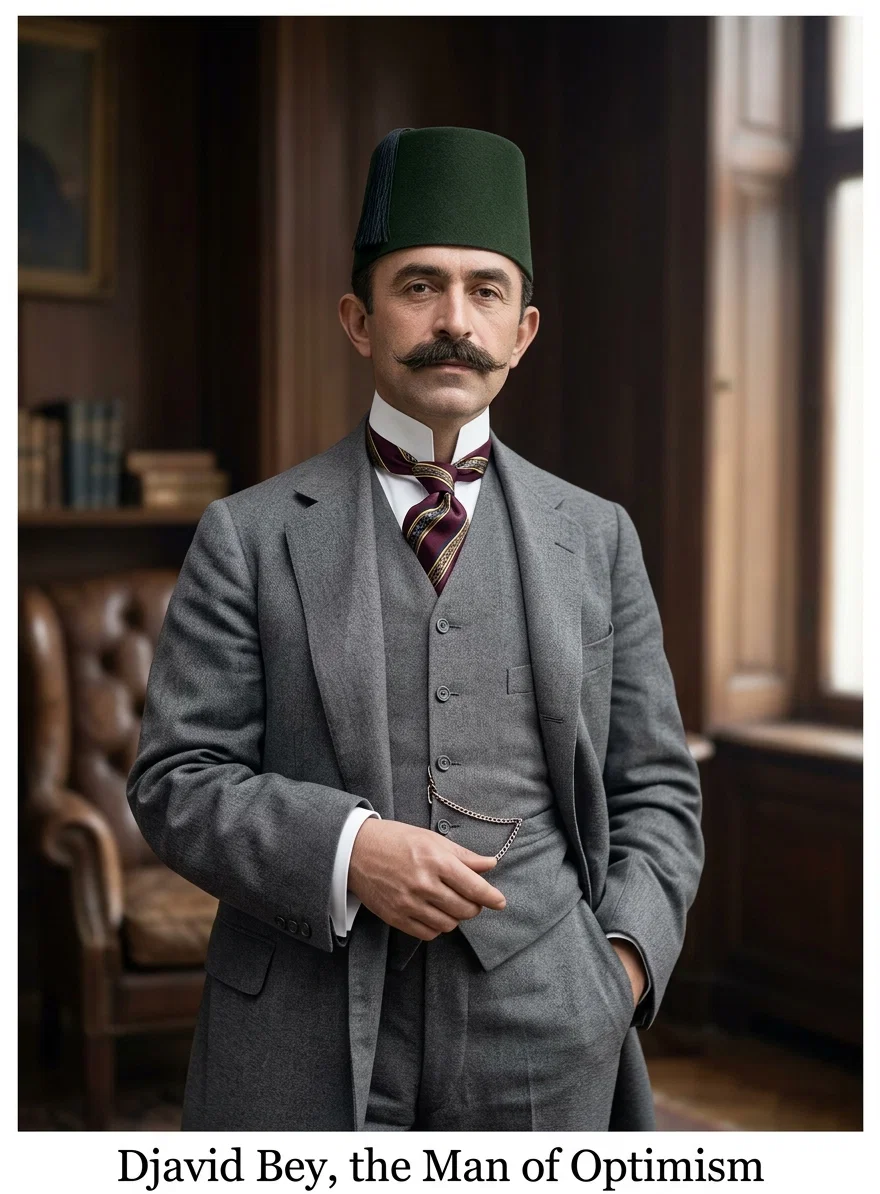
Djavid Bey, the Man of Optimism
And the last year gave one opportunity after the other, to show that this was true. When France wanted to grant a loan to the Turkish government under the condition of controlling the finances of Turkey — a condition which the Turks could not accept — the Germans were ready to give the money on better terms. Turkey was in need of war-ships, and Germany gave some ships, with which the Turks are satisfied. But a late and strong sign of Germany's friendship can be seen in these days, when the Bagdad Railway Company, a German corporation, agreed that the last part of this most important line — Bagdad-Persian Gulf — could be built by an Ottoman company.
The Sublime Porte in Constantinople, which almost wholly burned down March 5, 1911 The Fountain which Kaiser Wilhelm erected in remembrance of his visit to Constantinople
This was done to avoid England's protest against the raising of the custom rate from eleven per cent to fifteen per cent, as England thought that the additional receipts would be used to build that German line from Adana to the Persian Gulf, and because England thinks to have a right to control those districts around that gulf. Furthermore the same company withdrew its rights to use the surplus of the customs, and will build the railway with other means, thus leaving a considerable surplus of income to the use of the Turkish government.
And they need it. Indeed, all the optimism of a man like Djavid Bey, the minister of finances, is necessary to believe that Turkey will not become in the very near future bankrupted. He had begun his introduction to the budget with the words that the deficit of the budget contains an educational element for the nation; but the chairman of the budget commission answered, when bringing it before the chamber, that with each deficit the nation loses a part of its independence. This is true, as it is the money of the foreigners with which the budget is balanced.
Again, more than one third of all payments of the present fiscal year are destined for the interests of navy and army, an amount of about 1,100,000,000 piasters. For public instruction the figures are about 100,000,000. Some 20,000,000 more than that will be paid for public works. It is true that the receipts every month are higher than were anticipated. But the big deficit of about 8,500,000 liras, or about $40,000,000, has to be paid in foreign money. And when we remember that nearly all the railways which run already, and all those which are to be started in the very near future — and these will furnish Turkey with a good railway system — are in the hands of foreign companies, then we see that Turkey's splendor and power are not founded on a basis which promises long continuousness. C. VOIGHT.
Constantinople, March 26, 1911.
The Epidemic of Graft
By T.
THERE seems to be so much “grafting” throughout the country, that one is inclined to think it is epidemic. But is it? Have we not reached a condition that should be denominated “chronic”?
In talking with leading business men in various cities, they seem to be settled in the conviction that in order to do business nowadays you have to do a certain amount of grafting and bribing. At least if you do not directly engage in any of the execrable business yourself you have to submit to it in others in order to keep the currents of trade flowing smoothly.
For instance, at the present time the daily papers on the Pacific Coast are reciting each morning the progress in the prosecution of leading officials in San Francisco, Oakland, San Jose, and San Mateo. Three of the foregoing named cities are leading centers of population situated around the southern end of San Francisco Bay. The fourth one lies so close to San Francisco as to be almost a suburb to that city.
Grafting in San Francisco has been odiously held before the public, not merely here on the Pacific Coast, but the matter has been of nation-wide discussion, for the last five years. And instead of the malady’s being cured it has spread to the adjoining cities of the great Western metropolis.
And this coast is by no means peculiar and alone in this unsavory business of grafting. The Eastern despatches and also the Eastern papers as they come to us day by day all unite in showing that the evil thing is altogether too general. We often laugh at the Socialist when he propounds his stereotyped question of “what shall be done for the ills of society;” but laugh as we may, the “ills” are nevertheless here, and the question is a disquieting one to every thoughtful individual.
When we inquire for the cause of all this lack of moral backbone; when we seek for the reasons why men will submit to the “hold-up” of the “grafter” and the “briber,” we should have no difficulty. This is the century of the “higher critic,” who has thrown his popular form of skepticism against the Bible; it is the century that is so grasping and intent in its pursuits for wealth, that it has no time to consider the old-fashioned and sturdy morals of the Ten Commandments; it is, furthermore, the century that has witnessed the wide-spread teaching that the Ten Commandments were abolished at the death of Christ.
The teaching that the Ten Commandments have been abolished has been largely inspired by the desire to get rid of the clear evidence from the Bible that the seventh day of the week is the Sabbath, and that the law concerning it is just as moral and just as obligatory as when it was spoken in divinely sublime majesty from Mt. Sinai. As the result of this teaching that God’s law is abolished, there has been a growing disregard for Sabbath observance, and folly and hilarity have taken the place of worship. And men who have been taught to disregard God’s law, have come to disrespect human law as a consequence of breaking away from the higher law of Jehovah.
When the general teaching is such that it leads the rank and file of the people to have respect for the Bible and the moral law of that divine Book, you may be assured that men will have too much respect for their manhood to allow themselves to descend to grafting and bribing. Their minds have been elevated by the precepts of Him who has said, “All things whatsoever ye would that men should do to you, do ye even so to them.”
Long-Distance Telephone and Political Corruption
By Editor
Direct telephone communication has been opened between New York and Denver, a distance of 2,011 miles. This is the longest distance the human voice has ever been carried. The line from New York to Philadelphia was opened in 1885, and communication between Chicago and New York was established in 1892, and Omaha was reached at a later date, and remained, until this latest triumph, as the long distance telephone point “furthest west” from New York. In talking with Denver from New York, the Pupin induction coils are used to re-enforce the current, and this in connection with the “phantom” circuit enables them to transmit simultaneously telegrams over the wire that is used for speaking.
Concerning the scandal in connection with the election of Mr. Lorimer to the United States Senate the National Prohibitionist says, “The Lorimer incident is a revelation of the almost fathomless wide-spread rottenness in American politics, a rottenness that reaches so high and spreads so far as to be well-nigh irrefutable testimony to the impossibility of a regeneration without a complete overturning of the present dominating political organizations.” And yet in the same issue of the paper the Prohibitionist charges their own national chairman with “bossism” and other uncomplimentary things. If the people of this world would only look honestly at the indisputable facts that stare us in the face on every side, they would be compelled to admit that we are confronted with a condition that no human power can successfully grapple with. Nothing short of the power of Him who drove the money-changers and other tricksters from the temple of old can save the situation to-day. Devout and true men ought to be able to see this, and appeal to Him who is the all-wise One to quicken the powers of mind and heart that will enable them truly to see and meet the demands of this hour.
The Prohibitionists would be glad to show that their work is causing a decrease in the use of strong drink, but they are compelled to publish from time to time the facts to the contrary. For instance, in a recent issue of the National Prohibitionist it is stated that the arrests for drunkenness in 1902 were 366,853, while in 1907 they were 482,371, or an increase in six years of almost twenty-three per cent. And in making this statement the Prohibitionist avers that the percentage of arrests for drunkenness is probably lower to-day than in the past. In 1902 the people drank 17.18 gallons of beer per capita; in 1907 they drank 20.56 gallons per capita — an increase of almost twenty per cent. During the same time the consumption of whisky increased seventeen per cent per capita. These are facts that are gathered from reliable statistical sources; and yet in the face of numerous evidences like these, men will vehemently tell us that the world is getting better and better all the time. And who will say how much worse it would have been were it not for the continued and faithful efforts of our devoted army of temperance workers?
On Monday, May 8, the new Anglo-Chinese agreement for the extinction of the opium traffic was signed. It is an interesting though singular fact, that Chinese statesmen have long realized that the opium traffic was debauching their people, and have been working to suppress it; and English statesmen, through the influence of the British East India Company, have insisted on perpetuating the evil, so that they might realize on invested capital. England’s perpetuating of the opium trade in the face of “heathen China’s” protest, and a similar perpetuating of the liquor traffic for like reasons, and equally as glaring governmental inconsistencies in this country, make a person feel a kind of queer sensation when listening to some of the high-sounding utterances that these are “Christian nations.” “Christian” England withstood the entreaties of “heathen” China for almost a century before she yielded to her “heathen” request to be relieved from the curse of the opium traffic. We would not in the least disparage the high ideals and the great civilization of both England and our own country. And we would ardently affirm the strong influence that Christianity has had in building up this civilization. But they have many heights yet to reach before either nation will be justly entitled to the appellation “Christian.”
More than $336,000,000 is sent and carried abroad from this country each year. Of this sum, it is estimated that about $150,000,000 is sent by citizens and residents to their friends and dependent relatives in the Old World. A large part of the remainder is spent by our navy while cruising in foreign waters, and the rest is spent by tourists. These figures make it apparent, as was suggested by Governor Dix in a recent speech at Glens Falls, New York, that there must of necessity be a trade balance in favor of this country of over $300,000,000 a year in order to keep pace with this immense expenditure.
Prof. W. T. Foster of the Washington, D. C., Weather Bureau predicted an earthquake for May 4, and the seismograph of Santa Clara College, California, recorded it as having occurred in the Pacific Ocean. The shock continued for fifty-six minutes.
Endurance Test of Great Battle-Ship
THE Delaware is one of America’s first battleships of the “Dreadnought” type. Last December she was sent on a voyage to Chile to convey thither the body of the late Chilean minister, Señor Cruz. She passed through the Straits of Magellan, reaching Valparaiso on schedule time. When she was nearing her home port of Boston, on April 25, having churned off 25,000 miles since she started, she received a wireless message to prepare immediately for a full speed test. Her commander, Captain Gove, considered that all the preparation she needed was a fresh supply of coal, which was given to her as quickly as possible, and right on the heels of this long voyage she immediately put off to see what she could do in maintaining her builders’ guarantee for speed.
She was designed for a speed of twenty-one knots; and on her builders’ trial, with clean bottom and picked coal, she made an average for the first four hours of 21.55 knots, and a trifle over 20 knots for the remaining twenty hours of her test. But on this last test, made at the end of the longest continuous voyage on record for any battle-ship, the Delaware made 21.86 knots the first four hours, and an average of 21.30 knots throughout the remaining twenty hours.
When the news of this triumph was flashed to Washington by wireless, the vessel was ordered to the New York port to be fitted out as the flagship of Rear-Admiral Vreeland, the flag officer who has been selected for the coronation ceremonies of Britain’s King.
Letters to a Daughter
By Mother
By a Mother
Economy — Self-Denial — System — Method — Accuracy
My dear Daughter,—
Your letter, so full of interesting news, is just at hand, and I hasten to write, that I may relieve your mind of what I can see is a burden to you. I can not tell you, dear one, how much we appreciate your attitude in this matter of the expense of your course. While it is true that the rest of the family must deny themselves some little luxuries, perhaps even comforts, that you may have the advantage of this opportunity, we deem it a pleasure to do so.
You remember the promise, "Cast thy bread upon the waters: for thou shalt find it after many days." You are simply receiving your own. You have made every possible sacrifice that your brothers might get a good start along the lines of their chosen life-work; and now, my dear, it is your turn, and the pleasure is ours. You know all too well that the most we can do for you in the matter of money will be very little. That little, I trust, during the years before you, will prove a factor in your training which will help you to develop right principles in the use of money.
Through this training you will doubtless get many a lesson in self-denial — an experience not least desirable, let me assure you, for by its practise the sinews of your character shall become strengthened, and your love broadened. You will find ample opportunity for it.
As I look forward along the line of your life-work, it seems to me there awaits you one long self-denial. Your time will never be your own; daily you will find it necessary to change your plans, give up cherished hopes, and in many ways deny yourself for the comfort and pleasure of others, those for whom you live and work. YOU will find this irksome indeed, except as you grow up to it in daily sacrifice in small things. In this, as in every other experience of life, we find our Father's loving plan for the happiness of His children. The law of compensation in the spiritual realm comes to our rescue, and humble self-denial is sweet. The peace, the sense of satisfaction in seeking not our own but another's good or comfort, far outweighs our pain.
Emerson says: "A man must expect no other good than the just fruit of his own labor. Let him see that as much wisdom can be expended on a private economy as upon an empire, and as much wisdom can be drawn from it."
Fortunately for us, the loving Father has not seen fit to trust us with overmuch means. Fortunately, I say. You may wonder that I say it. Money might bring us much good which we have not, but I truly feel that the constant care we must exercise in the matter of ways and means is a blessing rather than a misfortune, a good far greater than any that could be bought with money.
It is not a matter of chance that the world's best work has been done by those who have had more or less financial struggles in their youth. I want you to read the life of that remarkable woman who stood so long at the head of Wellesley College, Alice Freeman Palmer. Her influence will live on through the ages.
Your monthly allowance must be small, as you know; but even so, my dear, the way it is apportioned by you will mean very much to you in the future.
I send to you this little clipping from the pen of one who from a very humble beginning has made a great success in life. Read it carefully and ponder it well:
"Whether it be dimes, dollars, or thousands in your hands, and whether the same be earned or inherited, character is made or marred, and success largely shaped, by the way you spend it. If you are a clerk or factory hand starting on five dollars a week, it is vastly more consequence to you how you apportion that sum than it is to Mr. Rockefeller how he divides his millions of monthly income. If you are, on the other hand, a fortunate son of wealthy or of well-to-do parents and have ample funds at your disposal, the issue is the same, tho the risk is greater; for it is said that in America the distance between shirt-sleeves and shirt-sleeves is only three generations. The whole scheme of life can be centered in five dollars a week. If it is a sound and wise scheme it will not be altered much when it is ten, a hundred, or a thousand dollars a week.
"Here, again, as in the right use of time, system and method are necessary. And first in the system must be accurate records. Whether the accounting is to parents or to one's self matters little. The point is the fixing into permanent habit of principles essential to sound business. A little vest pocket blank book, a lead-pencil, and the habit of putting the two together every time there is a financial transaction, is all there is of it — except the copying of these items into a larger book for permanent record. One who, like the writer, has followed this simple practise for a lifetime, can go back over the record of boyhood, of school, of college, of small earnings in the early years, and of larger ones in the later years of business life, and trace the development of taste and habits and even of character, in a way which no formal diary can do. The forcing of balances in such a record is not essential, and if attempted often defeats the whole scheme. It is a financial diary, and not the keeping of a set of books. At the end of the year a classification of the expenses under a few general heads, will serve to show whether resolutions at the beginning of the year are working into results.
"It would be idle to lay down laws as to personal expense where the taste and surroundings of individuals differ so greatly. But two or three rules should never be lost sight of. First, expenditure within income by a margin to be fixed at the beginning, not at the end of the year. This will fail, be it observed, unless each month be treated as a unit and made to account for itself. Second, twice as much money put into articles of permanent value, such as books, pictures, and the like, as into needless indulgence. No better way can be contrived of proving how formidable are the totals of the nickels and dimes that get away for trifles. A man whose books and paintings cost $15,000, recently figured that it was only the equivalent of $1.40 a week invested and compounded for the thirty-five years in which the treasures were gathered. A friend who loved books and pictures, but had to get along without them, admitted that cigars alone had averaged him $1.40 a week during the same thirty-five years. Third, a fixed percentage of income, however small, for well-directed benevolence — not impulsive generosity. The men who pursue this rule in their humble beginnings are those who can be looked to, in their affluent years, for larger giving to the great charitable and benevolent works that lift America, in her higher life, above all the nations of the world.
"The abuse of money is the reckless, haphazard use — not necessarily a wrong use. The man who sits down on the last day of the year and wonders where his money has all gone, need not be feared much in the race of life. His feeble resolve to make a better record next year will fade out before January ends, for the habit-of-spending impulse, once fixed, is seldom broken."
Do not feel that you must treat others. I can not too strongly protest against this practise, altho I know how it will hurt. You will no doubt be thrown with many in your class who have money and spend it freely13on their friends. It will call for strong self-denial on your part not to return their favors, even with your last cent. To do this, my dear daughter, is not only not your duty, but a great weakness you are called upon to master. Could you look into the future, you would see some of these same girls wives of poor men, kept poor by their improvidence.
Your whole future success as a financier for yourself, the cause you serve, or the man for whom God may give you as a help meet, will depend upon the way you use your present small means. The less the amount you have, the more careful the thought required.
But it is not in the matter of money alone that you may practise economy. Economy of time is of great importance. So large is this subject, that I will not speak much of it in this already too lengthy letter. In a thousand ways you will be able to improvise and save, in the matter of laundry, food, and other avenues of expense, much that will add to your own exchequer, and prove most gratifying to those whose home you may be called upon to enter.
It is one of the grave charges made against trained nurses, that they are extravagant, and that besides the money they require as wages, they add heavy burdens in the way of household expenditures. I trust this will not be said of you.
There are many ways in which you can study to reduce expenses in the sick-room. Use the sunlight to cleanse and freshen the linen. Be careful of the left-overs, and materials of which you have already used a part. Do not call for the purchase of any articles you can possibly do without. Study to improvise with what you have at hand. Be careful of the furniture you have to use. All these things will be highly appreciated by your patrons, besides being of service to you in the way of recommendation. No more this time.
Your loving —
MOTHER.
Duty
By William Wordsworth
Stern daughter of the voice of God!
O Duty! if that name thou love,
Who art a light to guide, a rod
To check the erring, and reprove;
Thou who art victory and law
When empty terrors overawe,
From vain temptations dost set free,
And calm'st the weary strife of frail humanity.
Stern lawgiver! yet thou dost wear
The Godhead's most benignant grace;
Nor know we anything so fair
As is the smile upon thy face;
Flowers laugh before thee in their beds,
And fragrance in thy footing treads;
Thou dost preserve the stars from wrong,
And the most ancient heavens through
thee are fresh and strong.
To humbler functions, awful power,
I call thee; I myself commend
Unto thy guidance from this hour;
O let my weakness have an end!
Give unto me, made lowly wise,
The spirit of self-sacrifice;
The confidence of reason give;
And in the light of truth, thy bondman,
let me live!
—William Wordsworth.
Royal Canners
You can make a good living on a small piece of ground with one of our Royal Fruit and Vegetable Canners. Good money in canning for the market.
Easy to learn. We teach you how. Our methods retain all the delicate, natural flavors. A splendid Health Food Business all your own. Write to-day for our illustrated circulars.
Full equipments from $8.50 to $25.00. Also cans, labels, etc.
HOME SUPPLY & MFG. CO.
Chattanooga, Tenn.
News Building, Department D.
Mrs. Stuttle's
HOME
SERIES
These three books by Mrs. L. D. Avery-Stuttle furnish to the parent a much-needed help in the instruction and entertainment of their children
Making Home Happy
Pictures before the reader in interesting story form the relations that should exist and the lines of influence that should be guarded and cultivated in every home. (200 pp.)
Making Home Peaceful
Is the sequel to the above, and every one reading the first book will want to learn more about "Deacon Beardsley's" family, and how an unhappy home was made peaceful. (227 pp.)
Those Bible Readings
While especially suited to the needs of the young, there is an attractiveness in the arrangement and presentation of these readings that will hold the interest of all, old and young. (206 pp.)
These books are beautifully bound and may be obtained singly at 75 cents each, or the entire set of three for $2.00.
Pacific Press Publishing Assn.
Mountain View, California
Portland, Ore. Calgary, Alberta Kansas City, Mo.
A Boy's Reason for Total Abstinence
I ABSTAIN from alcoholic drinks because, if I would excel as a golfer, Gray says abstain; as a walker, Weston says abstain; as an oarsman, Hanlon says abstain; as a swimmer, Webb says abstain; as an orator, Bright says abstain; as a missionary, Livingstone says abstain; as a doctor, Richardson says abstain; as a preacher, Farrar says abstain; asylums, prisons, and workhouses repeat the cry, abstain.—Selected.
Glendale Sanitarium Training School for Missionary Nurses
WE desire at least twenty-five young people for our nurses' class beginning June 1, 1911. Applicants will be admitted to class any time during May and June, but it will be well for each one to enter as early as possible.
We are now able to offer a very strong course, one in which an exceptionally large amount of valuable practical experience can be obtained. Our proximity to Los Angeles enables us to give our nurses thoro training along all lines, each nurse spending some time in visiting nurses' work in this city. We desire to put at least twelve nurses into the city during the next few months to help do the work in Los Angeles that we are being called to do in all of our large cities. We can do this and more if our young people will respond to this call. The training that we can offer is one which many if not all of our young people should have to prepare them for active missionary service whether as nurses, canvassers, or Bible workers.
We are just about to open up a surgical ward in our sanitarium which will greatly increase our surgical and obstetrical work.
Those desiring to enter, apply as early as possible to Belle Wood-Comstock, Superintendent Training School, Glendale, California.
Hygienic Vegetable Cooking Oil
By Dr. O. C. Godsmark
No More Healthful Shortening Made
Like Olive-oil and keeps indefinitely. 5-gal. can, $4.50; two cans, $8.50; 8 1-gal. cans, $7.75; half barrel (about 32 gal.), 76c per gal. Cash with order. By freight from Louisville or New Orleans. Address Dr. O. C. Godsmark, Chattanooga, Tenn. Department D.
1,000 Samples Free
Washing Made Easy
I want 1,000 lady readers of the "Signs" to try E-Z Washing Tablets and will send 1,000 packages free. Washing is so easy when you use E-Z Washing Tablets. Just boil your clothes in a solution of water, soap, and Tablets for 20 minutes and they are clean without rubbing. Enclose two 2-cent stamps to pay postage. Address Alfred Mallett, 721 H St., Sacramento, Cal.
For Sale
160 acres, new improvements, near Adventist school and church, one mile to small country town and station. Personal property and household goods if desired. Immediate possession. Poor health compels reasonable price and terms. Address Box 55, Viola, Idaho.
Approximate Chronology
"Type and Antitype"—a booklet giving the Scriptural and historical facts, physical and climatic conditions, and astronomical calculations, that enable us to establish in our own modern calendar time the exact date of the Passover, Crucifixion, and Resurrection of Jesus. Price 25 cents. Address H. H. Perry, 67 19th St., San Diego, California, or your tract society secretary.
"HERALDS OF THE MORNING"
By Editor
The appalling loss of life by murder and suicide, political and social troubles, dissatisfaction between employer and employee, strikes and fires, wars and rumors of wars—all these are of daily occurrence. What do they mean? and is there any significance to these things at this particular time? To the close observer, all these are evidences that there is a nearing social vortex into which all unsettled factions, and the world at large, will be plunged. When and how this will be brought about is revealed in "Heralds of the Morning." By appealing to the "sure word of prophecy," the author clearly shows that these conditions were to exist just before the Lord's return, and points out many other signs that the Scriptures tell us are certain heralds of the glad morning when strife shall cease, and peace and happiness reign forever. That the reader may understand these events, and be prepared for the final outcome, is our reason for calling attention to this valuable work. More than 150 illustrations vividly portray that upon which the subject-matter treats. A live book upon a live subject.
Bound in cloth, with marbled edges, $2.00.
PACIFIC PRESS PUBLISHING ASSN.
Mountain View - - - California