The Youth’s Instructor, Vol. 34, No. 15.

WILLIAM PENN

The Youth’s Instructor

Apr 14, 1886

S. D. A. Publishing Association · Battle Creek, Mich. · Apr 14, 1886

WILLIAM PENN
THE IRON WOLF.
THE IRON WOLF.
In the court of Charles II. was a noted admiral named Sir William Penn, who had a son, also called William. The admiral was an ambitious man, seeking for advancement at court. He had many friends and high connections among the nobility. So he took all possible pains with his only son, sending him to the best college in the land, that he might be able to fill with honor the high position that would be his when his father was dead.
While young William was away to school, he fell in with a Quaker youth, who converted him to his religion. William was an ardent professor, and his zeal sometimes led him beyond bounds. It got him into trouble with the students and officers of the college, and he was expelled. You may imagine how Sir William felt to think that his son, on whom he had placed such high hopes, had been expelled; had left the Church of England, and joined the despised Quakers; had donned the drab, long-skirted coat of the sect, said “thee” and “thou” instead of “you,” hated war, and said, “If a man smite thee on one cheek, turn to him the other also,” and would not doff his broad-brimmed hat even in the presence of the king.
Old Sir William stormed and raved. Finally he sent his son off to the Continent, to get this nonsense taken out of him. Young William traveled much in France, and learned to be gayer in his manners and dress, was well-informed and well bred, and came back a polished gentleman, but still a Quaker.
Then his father sent him to Ireland to look after two large estates. Here he fell in with the youth who had converted him at college, and all his old zeal returned. He attended the Quaker meetings, and with several others was arrested and thrown into prison for attending “unlawful assemblies.” On returning to England, all the old disputes between himself and his father revived. Sir William at last offered to tolerate every other peculiarity, if his son would not say “thee” and “thou” in the presence of the king, the duke of York, and himself, and would remove his hat in their presence.
But young William steadfastly refused to make any compromise, saying that “as to this same hat-worship upon which you do insist, I may not, in conscience, remove my hat to any man, lest by so doing I do perjure myself, seeming thus to proffer to a human creature the same honor I would give to my Creator.”
Then the bottled wrath of the admiral burst forth. “Get you gone! get you gone!” he cried. “From henceforth you are no son of mine; and though you do rot in jail, I will not lift hand to help or save you.”
But even this did not move young Penn, who replied: “My prison shall become my grave before I will budge a jot. For I do owe my conscience to no mortal man.”
Then the admiral, boiling with rage, whipped out his sword, and, as the record says, “fell upon him, and beat him sorely, and drove him from the house.” It was a long time before the hot-tempered old man could be prevailed upon by his loving-hearted wife to forgive their son. He never quite forgot their troubles, though he left him his property when he died.
Penn now traveled throughout the kingdom and in Germany, preaching the Quaker doctrines. Often he was cast into prison; yet he was not idle while there, but wrote pamphlets and tracts explaining his doctrines. At one time he wrote: “I abhor two principles in religion, and pity them that own them; the first is obedience upon authority without conviction; and the other, destroying them that differ from me for God’s sake. Such a religion is without judgment, though not without teeth.”
The “teeth” of this intolerant spirit soon made England a very uncomfortable place for the Quakers, and they, together with the Puritans, turned their faces to the New World as the only place of refuge. The king was deeply in debt to the admiral, and when William proposed to call the matter settled if he would give him a grant of land in the New World, he no doubt thought it an excellent bargain.
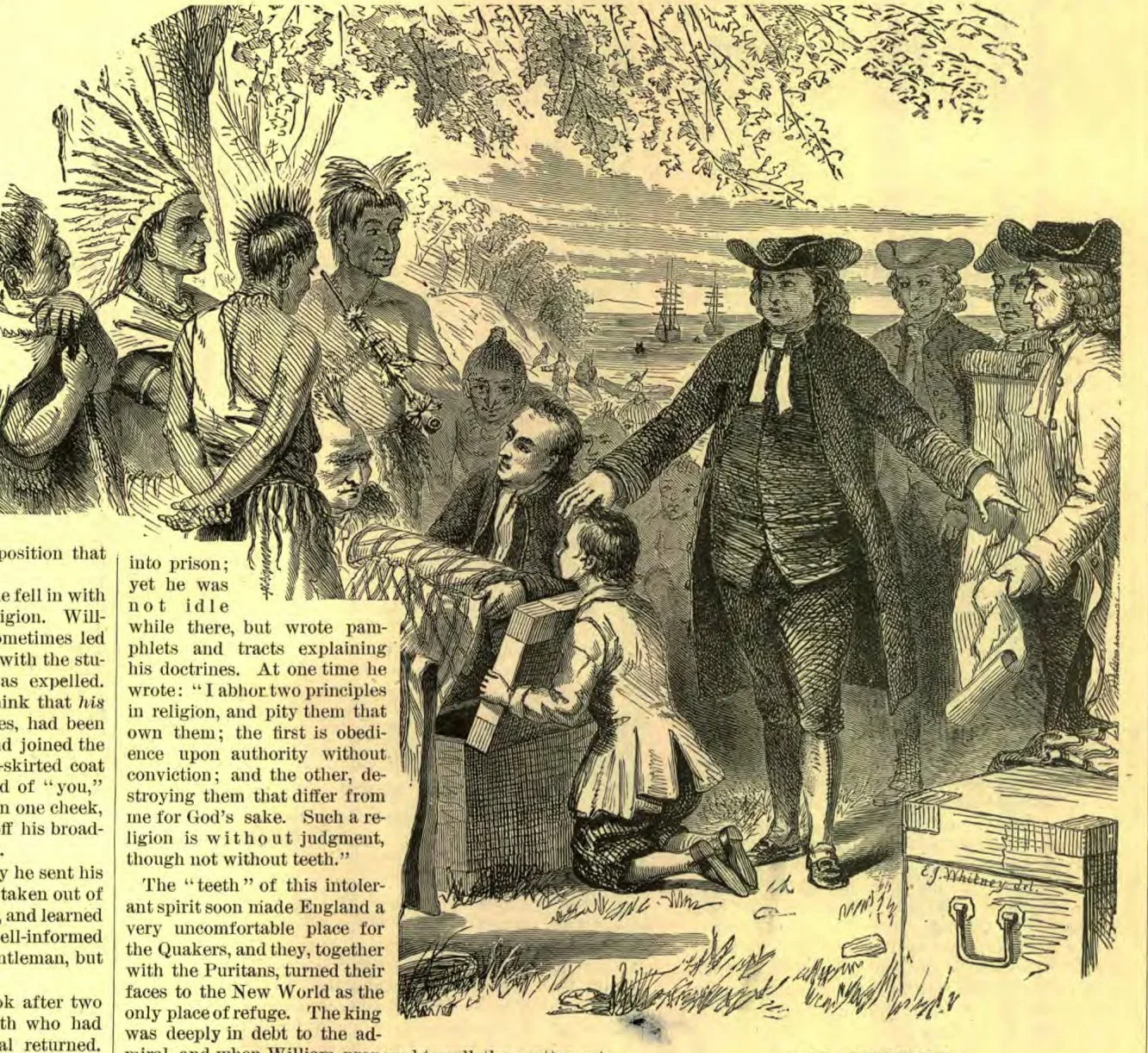
In company with a good many Quakers, Penn set sail for America, going up the Delaware River, and landing at Philadelphia. Under a broad-spreading oak, he called the Indians together to purchase of them the land that the king had given him. There met the Quakers, in their broad-brimmed hats and drab clothes, and there the Indians, gorgeous in war paint and gay feathers, strings of wampum, and pelts of fur, to make a treaty of peace, “the only one never sworn to and never broken.” This old oak flourished for many years, and now a monument marks the spot where it grew. Here he built a city, and called it Philadelphia, or “the city of brotherly love,” for in it he hoped all men would dwell in peace.
At length troubles in England called Penn to his native land, and he never returned to America. Toward the close of his life he suffered repeated shocks of paralysis, at length depriving him of memory and the power of motion. When he died, he was buried near the village of Chalfont St. Giles, in Buckinghamshire.
Penn governed his territory wisely and well. The Quakers had learned good lessons from their persecutions, and made wise and tolerant laws. To the end of his life, Penn retained the intense affection of the Indians; and when he died, “they sent to his widow a message of sorrow for the loss of their ‘brother Onas,’ with some choice skins to form a cloak which might protect her ‘while passing through the thorny wilderness without her guide.’”
W. E. L.

THE DAFFODILS.

I wandered lonely as a cloud That floats on high o’er vales and hills, When all at once I saw a crowd, A host of golden daffodils, Beside the lake, beside the trees, Fluttering and dancing in the breeze.
Continuous as the stars that shine And twinkle on the milky way, They stretched in never-ending line Along the margin of a bay; Ten thousand saw I at a glance, Tossing their heads in sprightly dance.
The waves beside them danced, but they Outdid the sparkling waves in glee;— A poet could not but be gay, In such a jocund company; I gazed and gazed, but little thought What wealth that show to me had brought.
For oft when on my couch I lie, In vacant or in pensive mood, They flash upon that inward eye Which is the bliss of solitude; And then my heart with pleasure fills, And dances with the daffodils.
— Wordsworth.

THE IRON WOLF.

“I CONDUCTED the services two months ago,” said a clergyman, “at the funeral of one of my parishioners. He had been a farmer. Forty years ago, as a young man, he commenced work for himself and his young wife with one hundred acres of land, and he ended with one hundred. He was a skilled, industrious workingman, but he laid by no money in bank. I understood the reason, as I listened to the comments of his neighbors and friends.
“‘It was always a warm, hospitable house,’ said one. ‘The poor man was never turned away from that door.’
“‘His sons and daughters all received the best education which his means could command. One is a clergyman, one a civil engineer, two are teachers; all lead useful, happy, and full lives.’
“Said another neighbor, ‘Those children sitting there and weeping are the orphans of a friend. He gave them a home. That crippled girl is his wife’s niece. She lived with them for years. That young fellow who is also weeping so bitterly was a waif that he rescued from the slums of the city.’
“And so the story went on, not of a miser who had heaped dollar on dollar, but of a servant of God, who had helped many lives, and had lifted many of them out of misery and ignorance into life and joy.
“On my way home from the funeral, I stopped at the farm of another parishioner, who said to me, in a shrill, rasping tone,—
“‘So poor Gould is dead? He left a poor account. Not a penny more than he got from his father. Now I started with nothing, and look there!’ pointing to his broad fields. ‘I own down to the creek! D’ye know why? When I started to keep house, I brought this into it the first thing,’ taking an iron savings-bank in the shape of a wolf out of the closet. ‘Every penny I could save went into its jaws.
“‘It’s surprising how many pennies you can save when you’ve a purpose. My purpose was to die worth a hundred thousand dollars. Other folks ate meat; we ate molasses. Other men dressed their wives in merinoes; mine wore calico. Other men wasted money on schooling; my boys and girls learned to work early and keep it up late. I wasted no money on churches, or sick people, or paupers, or books, and’—he concluded, triumphantly,—‘and now I own to the creek, and that land with the fields yonder and the stock in my barns are worth one hundred thousand dollars. Do you see?’ and on the thin, hard lips was a wretched attempt to laugh.
“The house was bare and comfortless; his wife, worn out by work, had long ago crept into her grave; of his children, taught only to make money a god, one daughter, starved in body and mind, was still drudging in his kitchen; one son had taken to drink, having no other resource, and died in prison; the other, a harder miser than his father, remained at home to fight with him over every penny wrung out of their fertile fields.
“Yesterday I buried this man,” continued the clergyman. “Neither neighbor nor friend, son nor daughter, shed a tear over him. His children were eager to begin the quarrel for the ground he had sacrificed his life to earn. Of it all, he had now only earth enough to cover his decaying body.
“‘Economy for a noble purpose,’ added the good old clergyman, ‘is a virtue; but in the houses of some of our farmers it is avarice, and like a wolf, devours intelligence, religion, hope, and life itself.’—Selected.

THE HOME LIFE.

“THE fear of the Lord is the beginning of wisdom.” This, then, is the first step that the youth are to take in progress. Let all who shall read these lines in the INSTRUCTOR inquire whether they are indeed fearing the Lord, fearing to offend him by indulgence in any wrong practice. Are they seeking to do their duty at home? Have they company manners only? Do they put on their best appearance when away from the home circle?
If children and youth seek to be kind and courteous at home, thoughtfulness will become an abiding habit. Every-day politeness will cause them to be always polite. Home is the very place in which to practice self-denial and thoughtfulness to each member of the family; thus it is with the family in heaven, thus it will be when the scattered families of earth are reunited in the heavenly home.
We want children and youth to be happy in this life, and to bring all that makes heaven desirable—a place of peace and bliss—into the home-life. Train yourselves to behave at home, having the fear of the Lord before you, and it will become habit to behave well when away from home. Habits, often repeated, make character. Children who allow themselves to speak rudely to one another, and to be impolite at home, are forming habits that will cling to them in after life, and that will be most difficult to overcome. They do not show that they fear the Lord. They do not manifest refinement of character; their disposition becomes coarse, lacking in civility and that which constitutes refinement of manners; and all this casts a reflection upon the home training. In the behavior of children away from home, strangers can read, as in an open book, the history of the home life. They read there of duties left undone, of want of thoughtfulness, of lack of self-forgetfulness, of a disposition toward strife, fretfulness, impatience; while those who show that they have the fear of the Lord before them will, in character and in words, testify of a home where love is cherished, where there is peace, where patience is cultivated, where attention is given to the little proprieties of life, each mindful of his duty to make others happy.
Children and youth, are you all preparing to become members of the heavenly family? Are you seeking in the home-life to be fitted to become members of the Lord’s family? If so, make the home life happy by mutual self-sacrifice. If we want Jesus in our home, let kind words only be spoken there. The angels of God will not abide in a home where there is strife and contention. Let love be cherished, and peace, and Christian politeness, and angels will be your guests.
The enemy of God and the enemy of man is constantly seeking to keep active in children and youth those objectional features of character which will make not only themselves unhappy but also those who are associated with them. The apostle exhorts you to resist the devil and he will flee from you; and to draw nigh to the Lord. When we draw nigh to the Lord, we will keep him in mind, seeking to do those things which he will approve, and letting the heart be uplifted to him in prayer, for the guidance of his Holy Spirit, for wisdom to ever choose to do those things which he will approve, seeking for strength and grace every hour from him. Then when the enemy comes in unexpectedly, or clothes his temptations with garments of righteousness, the Spirit of the Lord will lift up a standard for you against the enemy, and he will be repulsed. The Lord will hear the prayers offered to him in faith from a sincere heart. Then pray much, and you will receive much.
MRS. E. G. WHITE.

MAPLE-SUGAR MAKING IN VERMONT

Written for the INSTRUCTOR.

MAPLE-SUGAR MAKING IN VERMONT.

As the season for sugar-making has returned, it may interest many of the young readers of the INSTRUCTOR to learn how it is made, especially as the rude, old-fashioned way so often described is almost wholly abandoned. When compared with the present improved method, the process employed only a few years ago seems quite imperfect.
When the country was new, men made an incision in the tree near the ground, and then drove in a splint of wood, over which the sap flowed, and dropped from the end into wooden troughs. For a long time the usual practice has been to tap, or bore, the tree about four feet from the ground, with a small bit, or augur, and then drive in a small sumac spout, from which a bucket was suspended. The sap from these buckets was gathered in a large tub, and hauled on a sled to the “boiling place,” which was out-of-doors. Here two large iron kettles, in which to boil down the sap, are hung upon the ends of long, heavy poles resting upon posts, and thus enabling the sugar-maker to turn his kettles away from the fire when the syrup is done. But this method necessitated much exposure to cold and rain and snow, and besides, there was a great waste of fuel.
With comparatively few exceptions all this is now changed. The sugar-maker takes his team and sleds, and distributes the light wooden or tin buckets around the orchard; while others, provided with a half-inch bit, hammer, and a basket of light cast-iron spouts with a wire hook attached upon which to hang the bucket, do the tapping, which consists of boring in the tree a hole from one and a half to two inches deep, driving in a spout, and hanging thereon a bucket. In a large sugar orchard the bright tin pails and gaily painted wooden buckets produce a pleasing effect.
In good “sugar weather” the sap flows quite fast, giving the men employed all they can do to secure it. It is hauled to the sugar-house, where it is allowed to flow from the gathering tub into huge storage tubs. From thence it passes through a strainer into a tube leading to a patent evaporator set over a brick arch. Here it is fast reduced to clean, thick syrup, and is drawn off at the opposite end of the evaporator from which it entered as sap. It is then allowed to settle, is strained, and made into sugar by boiling again in large sheet-iron pans. It soon grains, and is poured into tin cans made for the purpose and holding twenty-five or fifty pounds. Nearly all the sugar now made is put up for market in this way. Some of it is made into bricks, and is harder.
The sugar-season rarely lasts over four weeks, beginning the latter part of March. At its close the buckets are gathered to the sugar-house, washed, and nicely packed away, and all utensils are cleaned up. Much of the sugar is sent West, even to the remote Territories; and there is an increasing demand for it in the large cities. Syrup is put up in gallon cans, and is becoming fashionable in cities and towns to accompany morning griddle cakes. Maple sugar is never adulterated by the manufacturers, as the loss of its peculiar “maple” flavor is easily detected, and would in no wise pay; but I fear that after it gets to market, it does not always come to the consumer as “pure Vermont maple sugar.” Though maple-sugar making is hard work, it has some pleasant social features. For those who love “warm sugar,” sugaring off is an occasion of marked interest. When the thick, warm syrup is poured upon snow or ice, it becomes brittle, is easily broken in pieces, and makes a nice confection. A sugar orchard may contain from three hundred to three thousand or more trees, but perhaps five hundred to twelve hundred would comprise the average number. Of the maple-sugar product, Vermont produces more than any other State, in proportion to its area.
A. W. BARTON.

SOON

Soon the catkin’s velvet tassels will be blowing, Soon the brimming brooks will call and shout, And the green grass will be growing, growing, And the crocus buds will all look out.
Soon the birds will come with trill and whistle, Little wings a-whirring through the air, Fetching wisp of hay, or down of thistle, Such as last year’s harvest had to spare.
Soon anemones will show their startled faces, Violets will be pushing toward the light; Soon the leaves will steal into their places, And the fairy frost will take its flight.
—Companion.

DANIEL WEBSTER AND THE BIBLE.

Though Daniel Webster's fame rests chiefly upon his oratorical powers, he was remarkable, too, for his familiarity with the Bible. In fact, his colleagues once nicknamed him the Biblical Concordance of the United States Senate. How he earned this title, and how the Bible influenced his literary style, is told by the Youth's Companion:—
While a mere lad he read with such power and expression that the passing teamsters, who stopped to water their horses, used to get “Webster's boy” to come out beneath the shade of the trees and read the Bible to them.
Those who heard Mr. Webster, in latter life, recite passages from the Hebrew prophets and the Psalms, say that he held them spell-bound, while each passage, even the most familiar, came home to them in a new meaning. One gentleman says that he never received such ideas of the majesty of God and the dignity of man as he did one clear night when Mr. Webster, standing in the open air, recited the eighth psalm.
Webster's mother observed another old fashion of New England in training her son. She encouraged him to memorize such Scriptural passages as impressed him. The boy's retentive memory, and his sensitiveness to Bible metaphors and to the rhythm of the English version, stored his mind with Scripture.
On one occasion the teacher of the district school offered a jack-knife to the boy who would recite the greatest number of verses from the Bible. When Webster's turn came, he arose and reeled off so many verses that the master was forced to cry, “Enough!” It was the mother's training, and the boy's delight in the idioms and music of King James's version, that made him the “Biblical Concordance of the Senate.”
But these two factors made him more than a “concordance.” The Hebrew prophets inspired him to eloquent utterances. He listened to them, until their vocabulary and idioms, as expressed in King James's translations, became his mother-tongue. Of his lofty utterance it may be said, as Wordsworth said of Milton's poetry, they are “Hebrew in soul.” Therefore they project themselves into the future.

MARTIN THE ERRAND BOY.

LITTLE Martin was a poor boy, who earned his bread by doing errands. One day he was returning from a village, which was quite distant from his home, and feeling tired, he sat down under a large tree, near an inn, to rest. While he sat there, eating a piece of bread which he had taken for his dinner, he saw a handsome carriage driving up, in which sat a young gentleman and his teacher.
Martin looked at them very attentively, and then looked at his crust of bread and at his ragged clothes and old cap; and he could not help sighing as he said, half aloud, “Oh, dear! if I were but that young gentleman, instead of being poor Martin the errand boy! How I wish I could change places with him!”
The teacher chanced to overhear what Martin said, and he told it to his pupil, who, leaning out of the coach window, beckoned Martin to come near.
“So, little boy,” said he, “you would like to change places with me, would you?”
“I beg pardon, sir,” replied Martin; “I meant no harm by what I said.”
“I am not angry with you,” said the young gentleman; “on the contrary, I am quite willing to change places with you.”
“Oh, now you are joking!” cried Martin; “no one would wish to change places with me, and least of all, a gentleman like yourself. I am obliged to walk many miles every day, and seldom have anything but dry bread or potatoes to eat, while you may ride in your nice carriage, and have whatever you desire.”
“Well,” said the young gentleman, “if you will give me all you have that I have not, I will in turn give you everything that belongs to me.”
Martin started, for he did not know what to say; but the teacher desired him to answer.
“Do you agree to change?” said he.
“Oh, yes,” said Martin, “I do indeed, if you are in earnest. How the people in the village will wonder to see me coming back in this grand coach!” And Martin laughed at the idea.
The young gentleman then called his servants, and they opened the coach door, and helped him to get out. But what was Martin’s surprise on seeing that both his legs were quite crooked, and of no use to him!
He was obliged to lean upon crutches for support; and on looking at him more closely, Martin saw that his face was pale and thin, like that of a person who is often ill. The young gentleman smiled kindly on Martin, and said, “Well, my lad, do you still wish to change situations with me? Would you, if you could, give up your rosy cheeks for the sake of driving in a carriage, and wearing a handsome coat?”
“Oh, no, not for the world!” said Martin.
“And I,” said the young gentleman, “would gladly be poor, if I only had the use of my limbs; but as it is God’s will that I should be lame and sickly, I try to be patient and cheerful, and to be thankful for the blessings he has left me.”
“And you, my young friend, must do the same, and remember that if you have poor clothes and hard fare, you have health and strength, which are far better than a coach and horses, and what money can buy.”—Selected.

IMPORTANT BIBLE SUBJECTS.

LESSON 2.—THE TEN COMMANDMENTS DELIVERED TO THE PEOPLE.

[NOTE TO THE STUDENT.—Do not consider the lesson learned until you can give at least the substance of every text, with the correct reference for each. The references in black letters indicate those texts that should be committed to memory. A little diligent application each day will enable you to learn them, although this need not be considered a test of scholarship.]
1. What preparations were required to be made before the Lord came down on Mount Sinai?
2. Describe the appearance of the mount when the Lord descended upon it.
3. By whom was the Lord accompanied?
4. For what purpose did he come?
5. How did the Lord make known this law to the people? Ex. 20:1; Deut. 4:12.
6. When the people begged that they might not hear the voice of God any more, how did they afterward receive instruction?
7. Soon afterward, what did the Lord say to Moses? Ex. 24:12.
8. How long was Moses in the mount? Ex. 24:18.
9. When the Lord had finished the instructions which he gave to the people through Moses, what did he give to Moses? Ex. 31:18.
10. Whose workmanship were the tables? Ex. 32:15, 16.
11. How and by whom was the law written on these tables? Ex. 32:16.
12. When Moses saw the people dancing around a golden calf, what did he do with the tables of stone? Ex. 32:19.
13. After the people had been punished for their wickedness, what command did the Lord give to Moses? Deut. 10:1.
14. What did the Lord say he would write on these two new tables? Deut. 10:2.
15. Did Moses do as he was commanded? Deut. 10:3.
16. What did the Lord then do? Deut. 10:4.
17. What does Moses call that which the Lord wrote on these tables? Deut. 10:4.
18. Then what was it that the Lord spoke from out of the midst of the fire on the mount?
19. After Moses had rehearsed the ten commandments to the people (Deut. 5:7–21), what did he say to them? Deut. 5:22.
20. If the Lord “added no more,” then could anything else than what was on the tables be any part of the ten commandments?
21. Repeat the ten commandments. Repeat the fifth; the second; the eighth; the third; the sixth; the ninth; the fourth.

NOTE.

WHEN Moses was in the mount, God gave him two tables of stone made by himself, on which he had graven the “testimony” (Ex. 31:18; 32:15, 16); after these two tables had been broken, Moses, at the command of God, went up into the mount, having in his hand two tables like the first (Deut. 10:1–3); on these two tables the Lord wrote the same matter that was on the first two tables, and that was “the ten commandments.” Deut. 10:4. These words, says Moses, the Lord spoke in the mount out of the midst of the fire in the day of the assembly; therefore that which was spoken from Mt. Sinai, and written on the two tables of stone, was the ten commandments. Further: Moses, after rehearsing the substance (Deut. 5:7–21) of that which is given in full in Ex. 20:3–17, said: “These words the Lord spake unto all your assembly in the mount out of the midst of the fire, of the cloud, and of the thick darkness; and he added no more; and he wrote them on two tables of stone, and delivered them to me.” Deut. 5:22. Therefore we must conclude that nothing that was not written on the tables of stone can form any part of the ten commandments. In other words, the law of God, or ten commandments, is limited to that which God spoke with his own voice and wrote with his own finger, and which is found, as spoken and written, in Ex. 20:3–17.

HONORING THE HOLY SPIRIT.

It is related that at the close of an evening service, conducted by Mr. Moody, in the early part of his evangelistic career, he was met by an aged Christian, who, with fatherly tenderness, said: “My dear young brother, always honor the Holy Spirit in all your work.”
There is reason to think that the office and work of the Holy Spirit does not hold the place that it ought in the heart and faith of professed believers.
In honoring the Holy Spirit by the full surrender of our souls in personal faith, and humble, trustful reliance in his work and power, we shall so voice the truth that it will be made savingly efficient. We ought not to rest satisfied until we see the truth leading to repentance and faith in the Lord Jesus Christ; for then alone is witnessed on the human side a change of which regeneration is the divine side. The more we come into vital contact and sympathy with the work of the Holy Spirit, the more we shall be faithful and direct in presenting the truth, of lesson and sermon, in ways that shall reach, by the divine blessing, the citadel of the will. Our duty is to bring ourselves and others face to face with the Holy Spirit. Let us not shrink from dwelling upon his office and power because the work wrought is mysterious. In this very fact we discover an assurance that the gospel is life eternal, and not simply a code of morality.
To be filled with the Holy Ghost! Is there any secret of power, in guiding and saving souls, to be compared with this? We need, as teachers of the word, that is made effectual by the Holy Spirit, not only to believe in the baptism of fire, but earnestly to seek for this enduement with power from on high.—Selected.

The Boy of Hoorn.

There are some queer places in Holland, made so by the odd ways of the people who live there. One quaint place goes by the name of Hoorn. It is situated on that narrow peninsula of North Holland which juts out into the water between the Zuyder Zee and the North Sea. Its location is given on a large map of Holland. A gentleman who has visited this place, writing in the Christian Weekly “for the small boys of America,” says:—
“Hoorn is the quaintest, queerest, tidiest old-fashioned place in the world. The houses lean to every point of the compass. Some stand so straight that they lean backward; others seem to be trying to lean over lovingly to rest against their neighbors across the street, while almost all of them slant sidewise as far as they can until they come to the next house in the block and can go no farther. The streets look like rows of children’s play-houses just after they have received the first push at the end and before they have collapsed.
“Through all the streets run beautiful canals lined with great shade trees, and the boy of Hoorn is as likely to live in a canal-boat as in a house; and the clean, polished canal-boats, with their cozy, white-curtained cabins, make very attractive houses for the boy.
“To go fishing, he has simply to open his bedroom window and drop a hook and line. Nine chances out of ten, if his hook is well baited, he will pull in a fish pretty soon. If he lives in a canal-boat, he can go fishing from the roof of his house any time of day.
“His mother dresses him just as her husband is dressed, so that he looks like a little old man cut down to a boy’s size. He wears baggy pants, a grown-up sort of coat, and such great, heavy, clumping wooden shoes that it would make you laugh to see him come shuffling down the street on a fast trot. How he can keep his shoes on is a wonder, for he can jump into them at one spring, and there are no ties, buttons, or elastics to bother him. A baby’s shoe is seven inches long and four inches wide, so you can imagine what large shoes the boys and men must wear.
“The Hoorn boy’s principal bad habit is rolled up in a cheap cigar, and he imitates his father and uncles by always puffing at it. I have seen him when he was not more than six or eight years old, holding his mother’s hand and smoking with all his might. He seems to smoke as a matter of course, just as he eats his breakfast and goes to school.
“Don’t imitate the boy of Hoorn in this particular, but only in his good habits. One of these is unfailing politeness. Whenever a stranger passes him on the street, he invariably touches his hat to him. If he is sitting on a seat in a public park, and a gentleman passes, he rises and salutes him. If he is whistling a merry tune, he stops the tune until he has passed his elders; and in a hundred little ways he shows his good training and aptness to learn. With the exception of his tobacco habit, one cannot help loving this boy, he is so neat and clean. His clothes are not always very nice, but they are always whole and tidy, and his face usually shines like the cheek of a rosy apple, or like his mother’s kitchen door-step.”
Mr. Clark said other interesting things about the city and boy of Hoorn, and altogether, what he writes, makes one feel an attachment for the place and boy. He mentions the fact that one of the ancient poets writes of the place as the “Blessed Hoorn,” and he thinks it deserves the name, and that “the small boy is one of its most delightful characters.”

THE GIANT IN THE COAL-BIN.

It is Thomas A. Edison, the famous electrician and inventor, who says in substance that there is a “giant in the coal-bin.” Do you wonder how he knows? A few facts in Mr. Edison’s past history will tell you how. He began his life in 1847, a poor boy, receiving such instruction in his earlier years as his mother could give him with several other children. At the age of twelve years he was selling pea-nuts and papers on the Grand Trunk Railroad, experimenting with chemicals and studying during all his spare moments. He used an old baggage car as laboratory, labeling all his chemicals “Poison,” to prevent their being meddled with. In this same car he set in type and printed a paper.
When Mr. Edison was sixteen years old, he snatched the child of a station-master from the track before a swiftly moving train; and the child’s father, in gratitude for this act of bravery, taught him telegraphy. Edison acquired great skill in his profession, and it was he who invented the system of telegraphy whereby four or six messages can be sent over the same wire. His inventions in electric science were so numerous that in 1883 he had taken out 235 patents. The United States Patent Commissioner described him as “the young man who kept the pathway to the Patent Office hot with his footsteps.” Some of our young readers have heard of his phonograph, telephone, and various other ’phones; of his electric pen and electric light. He has continued to improve the details of the electric-light system, and he is hard at work, expecting the study of electricity will reveal still more marvelous things in the near future. In his experiments he is so dependent upon the use of carbon, you may understand what a writer in Treasure-Trove means when he says:—
“The giant is there; Mr. Thos. A. Edison says he is. But nobody can find the key that will unlock his prison door. Wise men are searching for it every day, for it would be a great blessing to have the giant let out. He would propel all our cars and boats, swiftly and silently; he would turn the wheels of all the machinery in our great factories. There would be no steam-engines to hiss, and roar, and scream; to fill the air with smoke, and gas, and cinders; to explode, and crush, and scald people.
“There would be no enormous gas bills to pay; the giant would furnish all the light needed. There would be no fires to be built in the morning, no coal scuttles for boys to lug, no ashes for girls to sweep up, the giant would furnish all the heat needed to warm our houses and cook our food. Instead of calling Bridget to put on more coal, we would simply turn on a little more electricity.
“If the giant were out, car-fares would be reduced, and so would the whole cost of living. There would be no danger of our coal mines giving out some day and our supply of fuel being cut off.
“Who will let the giant out? Perhaps the boy that is going to do it is now poring over his philosophy lesson. Study hard, boys, especially the chapter on electricity, and perhaps you will find the key that will open the giant’s prison door.”

THE MISSING SOVEREIGNS.

As the story goes, the electric telegraph, on the start, proved itself an invaluable institution with a certain business house in Great Britain. It is related that when the “invention was new and a mystery to the masses, there came trouble one Saturday night in the Bank of England. The business of the day had been closed, and the balance was not right. There was a deficit of just £100. This is a fearful thing in that establishment. Had it been a hundred thousand or a million, there could not have been greater commotion. It was not the money, but the error that must be found. For some of those clerks there could be no sleep until the loss should be taken up.
“All that night, and all day Sunday, a squad of clerks were busy. That £100 was surely gone from the vaults, but no penmark told where.
“Meantime, a young clerk, on Sunday evening, wending his way homeward from one of the gardens, fell to thinking of his busy companions at the bank; and suddenly a suspicion of the truth flashed across his mind. On the following morning, he hurried to his post of duty, and told the chief what he suspected. The mistake might have occurred in packing some boxes of specie for the West Indies, which had been sent to Southampton for shipment.
“The chief acted upon the suggestion. Here was an opportunity to test the powers of the telegraph. Lightning against steam, and steam with eight-and-forty hours the start. Very soon, the telegraph asked a man in Southampton, ‘Has the ship “Mercator” sailed?’ The answer came back, ‘Just weighing anchor.’ ‘Stop her, in the Queen’s name!’ flashed back the lightning. ‘She is stopped,’ was returned. ‘Have on deck certain boxes [marks given], and weigh them carefully, and let me know the result,’ telegraphed the chief.
“The thing was done; and one box was found to be somewhere about one pound and ten ounces avoirdupois heavier than its mates,—just the weight of a hundred golden sovereigns!
“All right! Let the ship go!”
“And the West India House was debited with the £100.”
Continue reading: MYSTERIOUS PERSIAN WELLS