In the neighborhood of Shiraz, on a hill an hour’s ride to the northeast, the traveler comes upon some very, very ancient wells. Near the top of this very steep hill, with no trace of masonry to mark the site of fort or palace, there yawns an opening about eight yards long by six wide, which is the mouth of a well going straight down into the bowels of the mountain. The shaft is cut in the rock, the sides are as perpendicular as the plumb line could make them, and the depth, as ascertained by the time of a falling stone, must be something under four hundred feet, the bottom at present being dry. Within a distance of fifty yards, on the same hill, are two other smaller wells; and it is said that there is an underground communication among the three. This theory finds support in the fact that when a pistol is fired at the mouth of one of these wells, to disturb the pigeons that flock thither at noon, the noise of their wings, at first very loud, gets gradually fainter, as though the birds were escaping through some lateral galleries. They certainly betake themselves in some manner away from the perpendicular shaft without coming out at the upper mouth, though where they go to doesn’t appear.
The labor expended on the boring of these wells must have been enormous; and it is a puzzle whether they were indeed wells, or intended as passages for the sudden exit of troops from some fortress built on the hill to hold the plain in awe! In the latter case, some sort of spiral staircase would necessarily have been attached to the walls of the shaft, of which at the present day no trace remains. No traveler has yet visited Shiraz sufficiently enterprising to go down the four hundred feet of perpendicular side with rope or ladder. Curious relics of bygone times might certainly be found at the bottom, but without a proper windlass and better ropes than those now made in Fars, the risk of a broken neck would cool the ardor of the most venturesome antiquary; and so, up to the present, the pigeons alone enjoy the sight of the secret treasures which possibly lie at the bottom of these mysterious and most astounding shafts.
FLOWERS AND PERFUMES.
The chief places of their growth are in the south of France and Piedmont, namely, Montpellier, Grasse, Nimes, Cannes, and Nice. These last two especially are the paradise of violets, and furnish a yearly product of about 13,000 pounds of violet blossoms. Nice produces a harvest of 100,000 pounds of orange blossoms, and Cannes as much again and of a finer color; 500 pounds of orange blossoms yield about two pounds of pure Neroli oil. At Cannes the acacia thrives well and produces yearly about 9,000 pounds of acacia blossoms. One great perfumery distillery at Cannes uses yearly 140,000 pounds of rose leaves, 32,000 pounds of jasmine blossoms, 20,000 pounds of violets, and 8,000 pounds of tuberoses, together with a great many other herbs. The extraction of the ethereal oils, the small quantities of which are mixed with such large quantities of other vegetable juices that it requires about 600 pounds of rose leaves to win one ounce of otto of roses, demands a very careful treatment.
DO GOOD.
“Do good as you have opportunity, Ruby, dear,” said old Aunt Marcia, as she placed her hand on little Ruby’s golden head. Ruby was only five years old, and “opportunity” was a long word for her to understand, and she spoke it over and over to herself after Aunt Marcia had passed out of the door. Op-por-tu-ni-ty? What a long word it was, and what did it mean? “I’ll go and ask mamma right off,” she said as she ran upstairs, but mamma was not in her room. She had gone out somewhere. Ruby knew it, because the empty bonnet-box stood on the bed. So she went downstairs again, and found Bridget in the dining-room.
“Bridget, what does opportunity mean?” she asked.
“Indade, Ruby, ye are very old for your age. Where did ye get that big word?”
“Aunt Marcia said it to me when she went away. She said, ‘Do good as you have opportunity.’”
“Arrah, indade, your Aunt Marcia is always putting strange advices into your head. Children as young as yourself couldn’t be doing much that’s good in the world.”
“You don’t know what it means, or else you would tell me,” said Ruby, in a discouraged tone of voice.
“Indade then, and I does know what it means. It means occasions, shure. As you have occasions; but what occasions can a bit of a child like yourself be afther having?”
“You don’t ’splain things one bit, Bridget. Here comes grandpa; I’ll ask him.”
As Ruby ran out into the hall, she saw grandpa was quite out of breath, for he had been walking against the wind. She was very fond of grandpa, and she took his hat and cane and put them in their places; and when he sat down in the big chair, she sat down on the floor and pulled off his overshoes.
“How much good you have done me, Ruby,” grandpa said, as he began to get rested. “I don’t know what I should do without you. There is a strong, cold north wind outside, and it blew in my face and against my chest, and I really didn’t know but it would knock me down before I got home.”
“I’m glad it didn’t, dear grandpa,” the little girl said as she climbed into his lap. “But I want to ask you something. Aunt Marcia said I must do good as I have opportunity. What does that mean? Bridget said ‘occasions,’ but she doesn’t know, I guess.”
“Opportunity to do good, my child, means any time there is any good to be done. What you did for grandpa just now was an opportunity. You know I have such a lame back that it hurts me to stoop over and take off my overshoes. You did it for me, and that saved me some sharp pains; and you put my hat and cane away for me when I was very tired, and that gave me an opportunity, or chance, to rest myself sooner than I otherwise would.”
“I understand,” said Ruby, “and I’ll tell Bridget.”
So she went into the kitchen, where Bridget was beating up waffles for supper, and she said very indignantly, “I’ll tell you now, Bridget, what opportunity means. It means putting up grandpa’s hat and cane when he comes home tired with the cold wind beating against him, and taking off his overshoes when his back is so lame that it hurts him to stoop over.” And Ruby showed by her watchfulness and willingness that she really did understand what Aunt Marcia said, and meant to do it.
BETTER TO WHISTLE.
As I was taking a walk early in September, I noticed two little boys on their way to school. The small one stumbled and fell; and though he was not much hurt, he began to whine in a babyish way—not a regular roaring boy cry, as though he were half killed, but a little cross whine.
The older boy took his hand in a kind, fatherly way, and said:—
“Oh, never mind, Jimmy, don’t whine; it is a great deal better to whistle.”
And he began in the merriest way a cheerful boy whistle.
Jimmy tried to join in the whistle.
“I can’t whistle as nice as you, Charlie,” said he, “my lips won’t pucker up good.”
“Oh, that’s because you haven’t got all the whine out yet,” said Charlie; “but you try a minute and the whistle will speedily drive the whine away.”
So he did; and the last I saw or heard of the little fellows, they were whistling away as earnestly as though that was the chief end of life.
Letter Budget.
By Editor
HERE is the very finest chance in the world for little boys and girls to learn a lesson in patience. Do you ask what it is? Well, you say, “I wrote a letter to the Budget months ago, and it is not printed yet.” This is the lesson, then,—to wait quietly until it is printed. We shall give all the space we can spare each week for letters, and hope, sometimes, to furnish a good many at one time. If we do this, they should be very interesting; for none of us want a dull Budget. So, little people, when you write for your paper, write something that all will be eager to read. We have some excellent letters, and a great many that contain things good of themselves, but they all say about the same thing, and one tires of reading a Budget full of them. Just as you get to a place which is ever so nice to tell us something about your home, your school, your missionary plans, or some of the many other things we all want to know, some of you chop your letters right off, so that we may not be able to use them at all. There is a marked improvement in many of the letters, but we want all to use care in what they write.
CHARLIE WALKER writes from Saginaw Co., Mich. He says: “I am a little boy eight years old. I have a brother Frank and a sister Nellie. Last fourth of July papa gave us some money to spend, and we sent it for the INSTRUCTOR. We are real glad that we did, for we all like the paper, and mamma can get the lessons out of it too. We go to Sabbath-school every Sabbath. I get my lessons in Book No. 1. I have had perfect lessons almost every time for seven months. I love to get my lesson. I help papa do his chores, feed my calf and the puppies, help chop and bring in wood, and then study. I read in the third reader. I am trying to be a good boy, so that when Jesus comes, he will take me to the new earth. Good-by.”
RACHEL P. EVRARD, of Menominee Co., Mich., writes. She says: “I love to read the letters in the INSTRUCTOR, so I will write one. Mamma reads some of the pieces to us, and explains what they mean. We always look for Eld. Canright’s pieces. I am the oldest of six children; was ten years old last November. My mamma has taught me to read and write. We have Sabbath-school in our house. My grandpa is superintendent. I have two grandmas and two grandpas, and they all keep the Sabbath. One grandpa is elder of the church, and the other is deacon. We live on the side of a big hill, one mile from town; but we can see the town. Papa left us a nice little grove on the hill. My sister Tamer is eight years old. She loves to take care of the younger children. They call her mamma, and they love her better than papa or mamma. I help mamma knit and sew and do housework, and I make bread for her when she is sick. When papa is away, I help do his chores. I have a little brown cow; her name is Lady. She is very gentle, and lets us children try to milk. Mamma says when I am older she will let me milk. I have a big black hen that comes and lays in the house sometimes. I have much more to write, and if this letter gets printed, I will write again.”
MARY EDWARDS wrote a letter from Gratiot Co., Mich., where she and her mamma were on a visit when she wrote; but her home is in Wexford Co., Mich. She says: “I like the INSTRUCTOR, and after I read it, I give it to my friends who do not have it. I go to Sabbath-school, and learn lessons in Book No. 2. I am going to send for a canvasser’s outfit for the INSTRUCTOR, for I want to do much good. I want to be one of God’s commandment keepers, and finally be saved with them. I send my love to all.”
WINNIE PRICE, of Whitman Co., Wash. Ter., says: “As I have seen no letter from this place, I will say that we have a Sabbath-school of about fifteen members. I go every Sabbath, and study in Book No. 3. I also go to day school. I like to read the INSTRUCTOR very much. We have taken it three years. I have tried to get subscribers for it, but have not been successful. I am eleven years old. I have two sisters and three brothers. I send love to all.”
ROSA S. JOHNSON, of Brown Co., Minn., wrote a letter to a friend at Battle Creek, who sent us the following portion of it to put in the Budget. Rosa says: “Papa has been at home this Christmas for the first time in six years. This year we had our first Christmas tree; and as papa had only one night to spend at home, without meetings, we had it on the 23d. Mamma had sent Ella, Mary, and myself over to a neighbor’s; and when it was evening, she sent word for us to come home, and bring our neighbors with us. When we came into the kitchen, mamma met us, and washed us and combed our hair. Papa was in the other room, and had shut the door, and wouldn’t open it till we were all ready.”
“We didn’t know what it meant; but when we opened the door, we saw that funny tree. There were many lights of different colors on it, and apples, nuts, cakes, raisins, and pop-corn for all of us, with our names written on each bunch. Papa told us all about the Christmas tree, and what it was to remind us of; and then we were permitted to examine the tree as much as we liked. He cut the things off from the tree as fast as he could, and had some one give them to us. Then we girls blew out the candles.”
“In the morning, papa told us how good the Lord was, and that Jesus came like a little baby to this world, and lived here over thirty years, and showed us how to be good, and finally died for us. He then asked us if we wouldn’t like to give him something; and Ella, who is only four, said she would, but she didn’t see how she should get up to him. Mary said she wished she had a big dollar to give him, and then he gave her one right off, and one to Ella, and Della, and me.”
“Christmas day we had a meeting at Mr. Mortenson’s, and at the close, papa said that while we sang a hymn, all could come and leave their Christmas gifts for the Lord on the table. Ella was the first to come, and she hurried back to mamma, because she didn’t like to have them look at her. When papa counted up the money, there was $30.80.”
MYRTIE A. BUXTON, a little girl ten years old, writes from Shawnee Co., Kan. She says: “I have taken the INSTRUCTOR ever since I can remember. I would not know how to get along without it. I have never written any letters for it before. I go to Sabbath-school every Sabbath and study Book No. 3. Tent meetings were held here last summer, when quite a number united with us to keep all of God’s commandments. I go to day school and like my teacher very well. We held meetings on Christmas, and donated $60 to the different missions. I want to be good, and be saved when Jesus comes to make up his jewels.”
CARRIE STILSON, of Richland Co., Wis., says: “I am nine years of age. I have one sister and two brothers, and they are all younger than I am. We do not go to Sabbath-school, because there is none near here. We all go to day-school in warm weather, except my little baby brother. I have been going this winter, until this week, but I have two miles and a quarter to go, and it is too cold for me to go that distance. We have been keeping the Sabbath about four years. We have no Sabbath meetings to attend, as we are the only Sabbath-keepers here; but ma went to camp-meeting at Tomah last June. I am trying to be a good girl, so that I can meet the INSTRUCTOR family in heaven.”
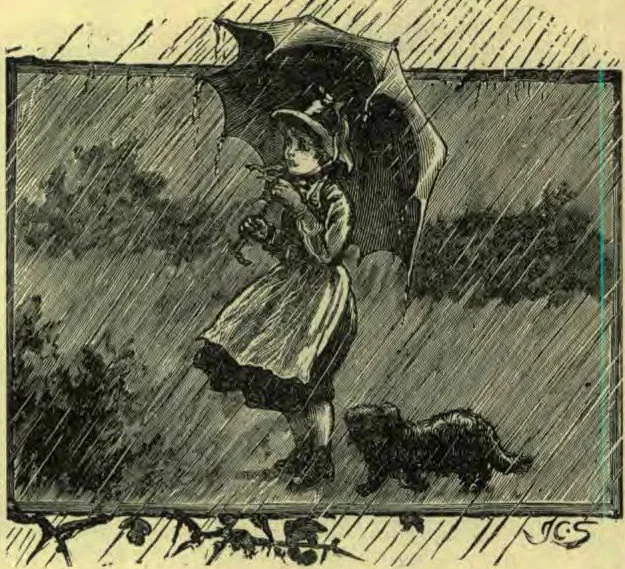
ETHEL IN THE RAIN.
By S. Isadore Miner
“April showers bring May flowers,”
Sings Ethel in the rain.
She cares naught when storm-clouds gather;
In the fickle April weather
Soon the sun will shine again.
Well she knows the rain drops falling,
To the sleeping buds are calling,
And a robe of verdure o'er the earth will fling;
Flowers will bloom the sweeter,
May will dawn completer;
So she hears in each soft patter
Footsteps of returning spring.
Learn a lesson from the shower,
Ethel in the rain;
Life has much of April weather.
Many a day when dark clouds gather,
Much of sorrow, much of pain;
But each sorrow brings its treasure—
Brings a blessing without measure,
And the pain to joy will blossom, if we bear it day by day.
Trusting in our Father's kindness,
Till, at last, released from blindness,
We can trace in each affliction
Angel foot-prints all the way.
S. ISADORE MINER.
HOW MOLLIE HELPED.
There was once a bright, spirited little girl, whose hard-working father was taken suddenly away from his little family, leaving the whole burden of their support on the mother. A kind lady questioned this child, but six years old, as to how they got along.
“Oh,” said little Mollie, “mother and I do all the work now, and we do it first-rate.”
“But what can you do to help, with such little hands as those?” asked the lady.
Mollie held up her plump little hands, and turning them over and over again, said,—
“Oh, I can do lots and lots! I set the table, wash the dishes, and shake up the cradle pillow, and blow the whistle for the baby. Sometimes mamma gets tired washing, and she cries. Then I go and lift baby out of the cradle—he’s awful heavy—and hold him right up before mamma. Then she always laughs and takes him, and that rests her, you see.”
THE LITTLE GLEANER.
Little things are often neatest;
Little words are always sweetest;
Little lakes the stillest lie;
Little blessings farthest fly;
Little seeds produce our trees;
Little drops of rain our seas;
Little words of kindness often
Will a heart of anger soften.