LAST week we noted some of the scriptures which speak of the war spirit that will arise in the last days, and also other scriptures which speak of the sentiments that will prevail in favor of peace. We further noted the fact that these scriptures taken together call for very strongly contradictory conditions.
One set of these texts say that the world will be filled with the spirit of war. Another class of these texts say that the great mass of the people will be making a strong demand for universal peace. In other words, great popular demonstrations for peace will be mingled with an equally popular clamor for war.
Human beings would not make such prophecies as these, because they would seem too contradictory; but the Author of the Bible has made just such prophecies, because His infinite foreknowledge enables Him to predict the actual facts rather than what people might think would occur.
The reading public is familiar with the multiplicity of organizations, state, national, and international, that have denominated themselves "peace societies." One of these international organizations, at which practically the whole world was represented, has just concluded a meeting in Geneva, Switzerland. They are seeking to educate the world away from war. They claim that they are doing it, and enthusiastically state that they will meet with complete success.
But there can be no question but that the prophecies predict the great Armageddon, the worst war of all the ages, and it is to occur at the very close of time. They also tell of what the people will be saying in favor of peace, and we see these conditions in marked contrast in the world at the present time. Tremendously influential peace organizations are forming, and yet there never was a time when there was such a disposition working in the direction of universal war.
Wreckage and distortion at the back of an 11½-inch armor-plate, made by a bursting shell that has passed through it
In thinking of this subject, consider this text from 2 Timothy: "But know this, that in the last days grievous times shall come. For men shall be lovers of self, lovers of money." 2 Tim. 3: 1, 2.
Self-love and money-love, says this text, will make the last days perilous. Money-love indicates a great commercial spirit that will be working. Men will be possessed with an uncontrollable passion for commerce and money-making. This is the very thing that the apostle, writing under divine inspiration, predicted. And what do we see in the world at the present time? Commerce is the great mania, not merely of individuals, but of nations. In order to protect their merchant princes, the great progressive commercial nations are eager to gain and hold every advantage that looks toward the building up of trade. Germany is determined on colonization in order to build up her commerce. France, Russia, and even Japan are working in the same direction; and it is not necessary to mention the United States as one of the stalwart, progressive commercial powers. This country is building the Panama Canal to aid commerce — a very desirable and a very commendable undertaking. But other nations are jealous for fear we will get some peculiar advantage out of this. They are watching every move that this country makes in the direction of either Mexico or South America, fearing that she may thereby gain some great business advantage. There can be very little question but that this country would have intervened in Mexican affairs long ago, had she not feared that in so doing she would involve herself with other powers who are anxiously watching, not for the peace of the world, but to hold the business of the world.
The news of the day indicates that there can be very little question but that England and Russia have reached an agreement in regard to Persia, that practically leaves Persia in the hands of the "great northern bear." Russia wants Persia in order that she may gain the commercial and military advantages that are there; and England is willing to make this alliance in order to hold the friendship of Russia, so that she may be able to meet Germany, with whom she is constantly in dread of coming in conflict.
The Turkish territory all through Western Asia and Europe is a seething caldron of revolutionary and war sentiment, with war actually in progress in some places. The nations are watching the movements there, and each one is standing ready to step in to see that its commercial advantages are secure, in the event of dividing up the territory among the powers. The six nations that are a party to the negotiation for the six-power loan in China, are seeking to hold themselves together, so that they may unitedly reap the commercial advantages that may be gathered there.
And while all this material that furnishes causes for war may be seen throughout the world, there is progressing right along a fiendish development in the implements of destruction that are to be used upon the battle-field. Fleets that sail the seas, fleets that navigate under the waters, fleets that sail in the air, are built by all the great powers with feverish activity. Ponderous guns are constructed, great armies are organized. Very much more is spent by the nations in preparations for war than is spent for the advancement of husbandry. These preparations for war will go on more11and more madly until the time is finally reached when the infinite Jehovah will permit the clash of Armageddon to come. For let it be understood that one of the sublimest prophecies in all the Bible represents the angels of God as holding these winds of strife until His work in the earth is finished.
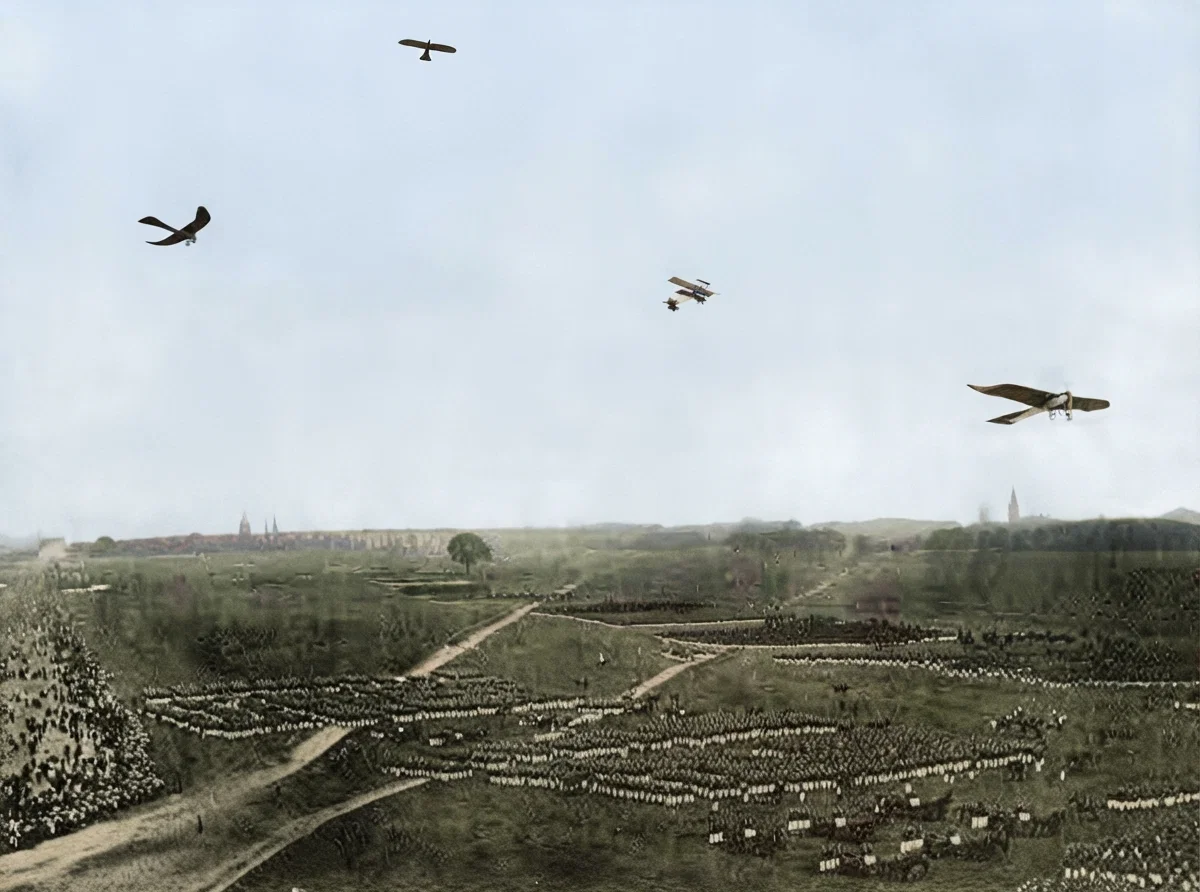
Military maneuvers of the German army, with air-ships on scout duty
These are times when men should carefully think for themselves, because the momentous issues of eternity are even now confronting the world. T.
— ★★ —
The Nine Richest Men.—A despatch from Boston gives the nine richest men in America, with the estimated fortune of each, as follows: John D. Rockefeller $1,000,000,000 Andrew Carnegie 500,000,000 J. P. Morgan 300,000,000 William Rockefeller 250,000,000 George F. Baer 250,000,000 James B. Duke 200,000,000 James Stillman 200,000,000 Henry C. Frick 150,000,000 W. K. Vanderbilt 150,000,000
While the foregoing figures give Mr. Morgan a fortune of only about $300,000,000, yet they do not take into account the billions of money over which he has control through his bankers' association. There is not much question but that we have at least one billionaire, and the millionaires who are getting well along toward the half billion mark are coming to be quite numerous. This little group of men is a controlling power in the financial world. The problems that cluster around these mighty holdings of wealth form one of the greatest menaces to the world that has ever confronted it.
Drugs and Crime.—The prison riots in Michigan, according to the Springfield Republican, have brought to light the fact that drugs have been extensively smuggled in to the prisoners, and prison guards in many state prisons secretly make a handsome revenue from this practise. This would indicate that many of the criminals are drug fiends, and the drug fiend is an individual who is taking a post-graduate course from the school of alcoholism.
When one considers how the drug habit and the alcohol habit are increasing, and places side by side with these facts the increase of crime, he ought to be able to know the history of the future quite well. Habits that are strongly formed in individuals are very rarely broken. Only the few, as a general rule, who actually get hold of the power of God, are able to break away from the chains of habit that bind men to drugs and alcohol. And following drugs and alcohol is crime; and criminality itself becomes a habit. In looking out upon the future of this world, it is well to look the actual facts of alcoholism, the use of drugs, and criminality, squarely in the face. These are problems that will have to be dealt with, and they show us plainly the direction in which the world is going.
But we do not need to go in that way. The Lord has provided salvation in this life from all of these things, for every individual who will accept Him; and the prophecies clearly show that His coming will be in a very near day, and at that time He will deliver His people, not only from the habits, but from the world in which such habits prevail. This is the one hope that is before the world at the present time. It is a hope that is filled with joy and gladness to the one who possesses it; and men who are not so intoxicated by some fad or theory or pursuit that they are unable to weigh facts, will sooner or later see and accept this great truth. It is written large in God's Word, and it is written all over the pages of the doings of the world of to-day.
A hole made through an 18-inch Krupp armor-plate and its timber backing, by a shell from a 12-inch gun
Race-Track Gambling in California.—Those interested in gambling are making a subtle effort to have a law passed in California, through the initiative, that will again open the gates wide for gambling in this state. The anti-gambling law passed by the legislature has practically closed some of the most popular race-tracks in the state, because with the gambling feature eliminated, the races can not be made popular and profitable; but now it is proposed to enact a law, through the initiative, that will permit certain forms of gambling. And if gambling in certain forms is permitted, it will open the doors wide for everything that goes with it. Those who are working for this measure in the interests of gambling, are seeking to do what is to them a very wise thing. The title under which the bill goes on the ballot, declares the measure to be an act to prohibit pool-selling and book-making. On the face of it, it would appear that this is in reality a law against gambling, but the proposed bill itself permits the race-track gambling to be revived in this state. It is highly important that the people of California be sure, when they cast their ballot in November, that they are not voting in favor of a gambling law, while thinking that they are voting to the contrary. Incidentally this proposed law in favor of gambling shows that the initiative can be worked in both directions, and by all classes of people. It can not be said to be an unmitigated good. But however that may be, the good people of California want to keep their eyes open, and use their best endeavors to see that a law is not passed in this state which will permit all of the debancheries that go with the gambling at the race-track.
A despatch from New York City under date of September 23 states that there is to be another rise of three cents a pound in the price of beef. There is better food for the human race than beef, or any other kind of meat. Thousands of men have lived without meat, and demonstrated that in so doing they were not only free from many of the ills of meat eaters, but were in every way stronger and better. If the price of meat could continue to rise, until more people would learn this great lesson, it would be one of the greatest benefits that could come to the human race.
Dr. Paul Walden, of Riga, Russia, president-elect of the ninth International Congress of Applied Chemistry, while with 150 other world famous chemists at Chicago, predicted that "not only eggs, but a variety of nitrogenous foods, will be made from the air some day." The scientific achievements that are possible would be one of the grandest things of the age, were it not for the fact that so many of the foremost men of the world are making a god of science, and this is blinding them to the real substantial benefits that otherwise might accrue. However, we think that so long as the hen continues to produce eggs, scientific men might better find a more useful field for their operations.
J. P. Morgan & Company have just purchased the property at 29-33 Wall Street, New York. They had previously purchased a lot adjoining. The two purchases have a total of 16,000 square feet at the corner of Wall and Broad streets. The assessed valuation is $4,320,000. The assessed valuation, of course, would not be nearly so great as the actual value of the property. This shows something of the value of land in that great financial center. The Morgan company is going to erect office buildings on the corner, for its exclusive use.
In conducting her grand army drill maneuvers during the month of September, England chose for her plan to have one section of her military force come as an invading army from the direction of Germany, and another section was to repel the attack. It is quite unaccountable how both Germany and England should continue to act as they do toward each other. They are continually discussing the dangers of a clash between the two nations, and conditions seem to grow no better as the days go by.
On September 23 the police reserves of New York City were called out to quell a riot of 1,500 public school boys who were protesting against certain transfers of their principals. The pupils of two schools were involved, and for a short time they smashed windows, routed the janitors with showers of vegetables, and terrorized the neighborhood. The youngsters paraded the streets in real adult fashion, to prevent the children who did not join them from entering the school buildings.
The hotel men in some of the Eastern cities find that they have a problem on their hands in the way of furnishing increased accommodations for the rapidly growing number of women who are addicted to the cigaret habit. The women as well as the men now desire their after-dinner smoke, and must have a place provided for it.
The Panama Commission sends out a despatch from Washington that it expects to open the Panama Canal on October 15, 1913. That is the date fixed when the first vessel will pass through the new waterway; and by December 1, 1914, the canal will be ready for unrestricted use by commercial vessels.
Every country of the world except Italy was represented in the ninth meeting of the International Peace Congress, which was convened in Geneva, Switzerland, September 23.
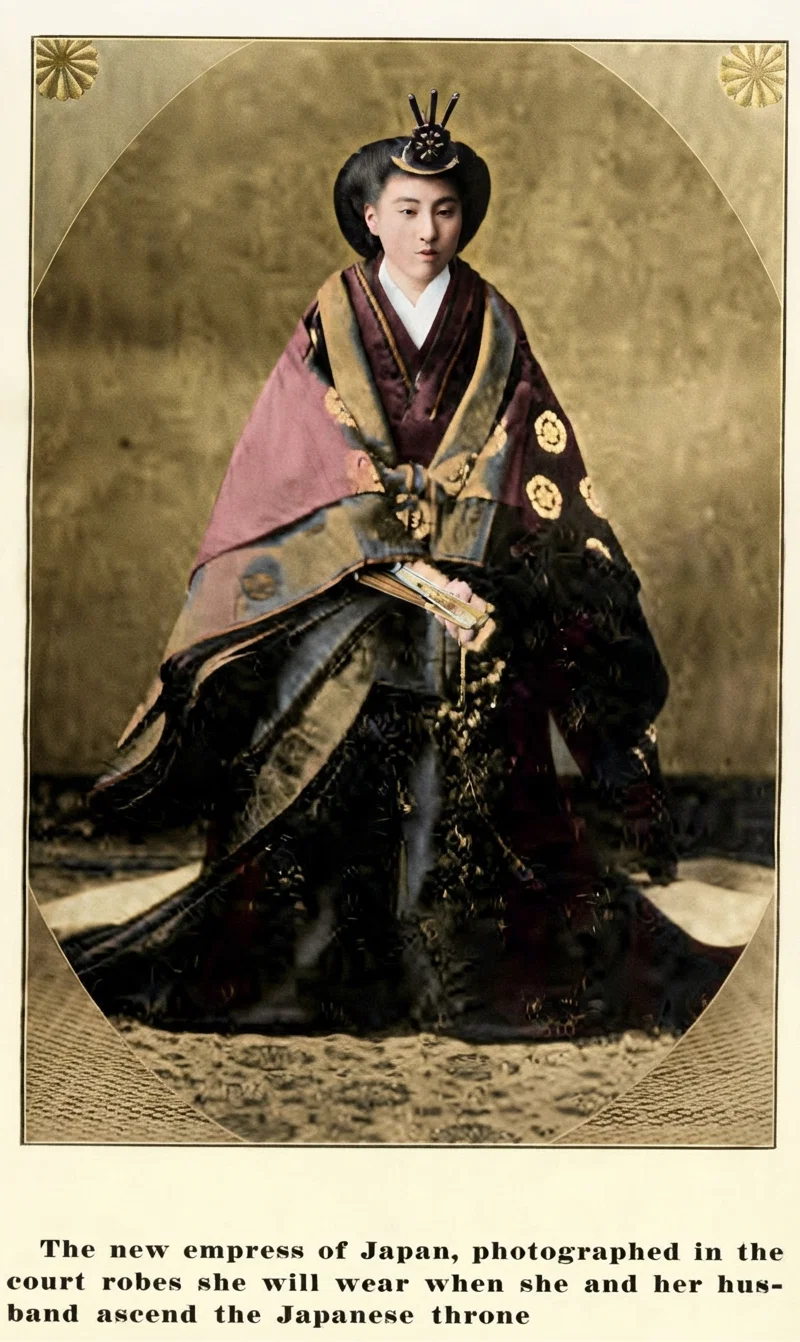
The new empress of Japan, photographed in the court robes she will wear when she and her husband ascend the Japanese throne
Photo by Paul Thompson, New York
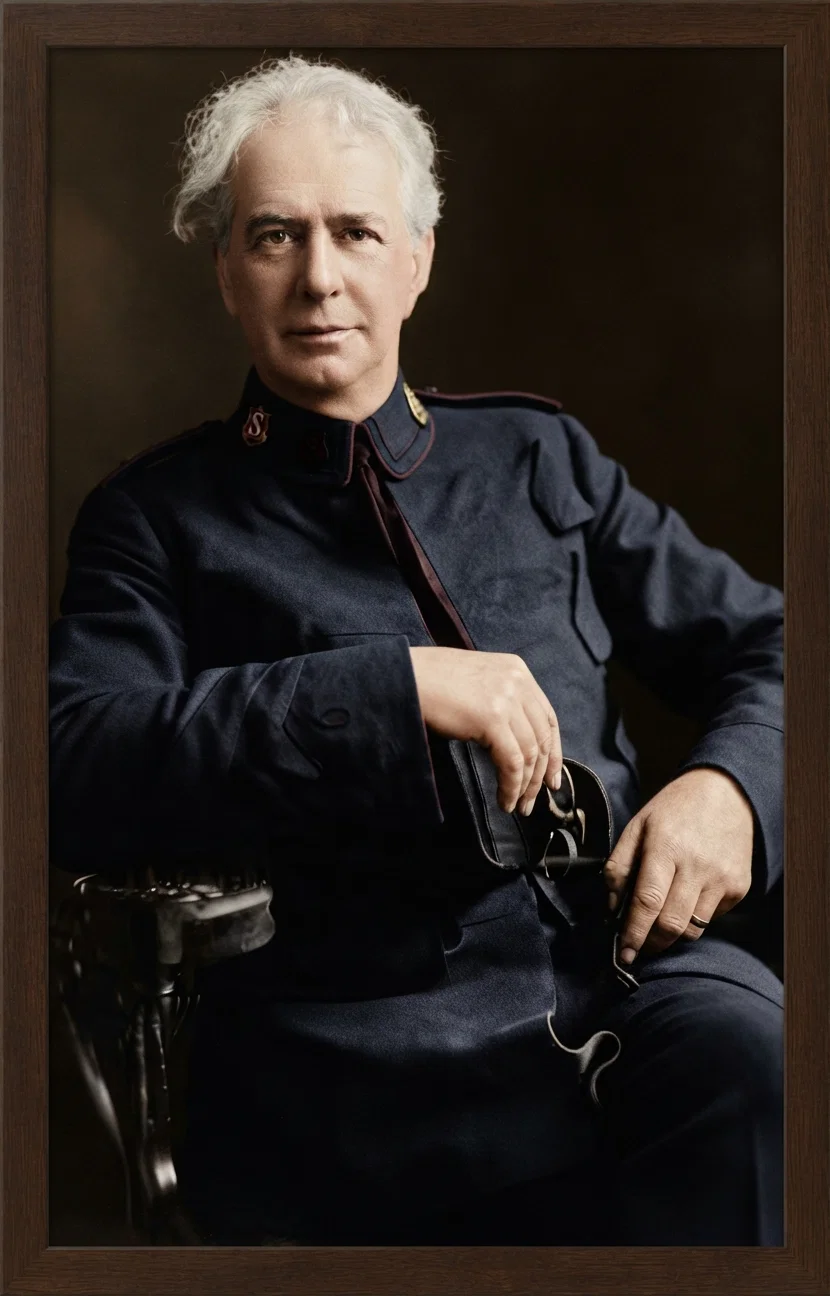
General Bramwell Booth, who succeeds his father, the late William Booth, as head of the Salvation Army
To the "Left-Out" Little Sister
By Adelaide B. Evans
By Adelaide B. Evans
DEAR little plain-faced sister, why are the corners of your mouth drawn down, and why is that worried wrinkle between your eyes? And your eyes themselves—soul windows, little sister, should always be clear and bright, and their curtains should never be swollen and red.
You are "discouraged," you say; you wish—O, how you wish—that you were pretty and graceful, like Jeanne; or bright and winsome, like Lelia; or gifted and accomplished, like Katherine, who plays so well, who has a voice that all love to hear, and who can move a whole roomful to smiles or tears by her recitations. Then there is Marian, who is the pet and pride of the beautiful home where her friends love to go for the "good times" that do not come your way. And sometimes it seems as if life were very hard indeed; as if you were shut out from all that makes it pleasant and bright and happy and desirable, and shut in to much that is unlovely and disagreeable. Your own home is very plain, your clothes are perhaps poor and coarse, and the education you long for more than anything else is denied you.
You look at these other girls whom you regard as more fortunate, in possessing good looks, dainty garments, beautiful homes, accomplishments, leisure, opportunity, "good times;" and because you can not read their hearts, and have not yet learned that every human soul must sooner or later be disciplined by pain, you allow yourself to become envious and bitter. "It is not fair!" you cry, again and again; and you permit the thought so large a place in your mind that it hinders your own soul growth, and makes you miserable and unhappy.
And in a world where one is so surrounded and pressed about with opportunities for bringing sunshine into darkened lives, unhappiness may become a positive sin.
"If Satan can not make you wicked, he will make you miserable," was the word of a dear, wise-hearted friend, in whose busy life being selfishly "miserable" found no place. So long had her thoughts been high and sweet, for so many years had her strength been given to unselfish service for others, that her naturally plain face had become really beautiful in its expression of serenity and trust—a face one could not look upon without longing to possess the secret of its peace.
And let me tell you that it is not worth while to fret for greater gifts and larger opportunities while your own precious talent is folded so closely in a napkin of selfish desire, and buried deep in the soil of discontent.
O, you "haven't any talent"? Ah, but you surely have one. Perhaps—who knows?—you may have two, or three, or even more, all hidden away and lost sight of in your longing for the good gifts of others. But you surely have one. Bring it out, then, and cultivate it. That is the first step on the road to happiness and the pleasant land of content—willingness to bring ourselves into harmony with our environment, and to do the work at hand.
Your talent, indeed, may be a very homely one—a gift for making a sweet, light loaf of bread, for setting neat stitches, for soothing a fretful child, for giving a homelike touch to a room—perhaps a large, many-sided talent of every-day usefulness that may make your value above rubies in the humble surroundings of your own home.
But you "don't like that kind of talents"? You would rather sing, or play, or paint? Well, if you wish to sing, why not make your life a song—"a grand, sweet song"? You can if you will. Some one has expressed the thought that God writes the words of our lives, and leaves us to set them to music. We can make the song sad or sweet,—a wailing dirge or a hymn of joy,—according as we will. And, too, there is music in human hearts—music as exquisite, as filled with divine harmony, as any that ever swelled into beauty under the hand of a master musician—music that perhaps waits for the skilful, sympathetic touch that you alone can give. And what more beautiful pictures than happy smiles, the sunshine of happy hearts, on faces that were, but for your ministry, mournful and sad—pictures as much more precious than the most wonderful creation of an artist's brain as a human soul is of more worth than canvas and pigments! Play and sing and paint, then, by all means; but do not fret because your opportunities for expression in these arts are not precisely those of your neighbor.
In cultivating your own special gift, do not neglect the distasteful duties that fall to your share. Bring to them a spirit of resolute, cheerful determination, and perhaps you will soon have two talents where now you have but one. There need be no limit to the increase, remember, if you will only become a "worker together," for His power is limited only by our willingness to let Him work through us.
Amiability, good sense, cheerfulness, sympathy, sincerity,—there is no surplus of these beautiful graces in the markets of the world—nor likely to be. Yet they are all within your reach—your reach, little sister; and if you will seek for them, open your heart to them, they will bring joy to your soul, and to your face a beauty above and beyond mere feature symmetry. Strive for them, no matter if you fail a hundred times; and some day they will crown your life with a diadem more precious than any that is locked and double-locked in the Old World treasure vaults. No princess of the royal line need be more rich than you in these priceless jewels.
As for the education that you must give up for a term, a year, perhaps even longer, why be in despair over that? There is an education of the heart, little sister, beyond that of books; but that need not suffice. Every day opportunities knock at our door; and she who keeps her eyes open, her ambition and courage high, and her heart receptive, need not pass through life ignorant. The self-educated girl, no less than the self-made man, is likely to be more of a success than one who has received her education as she has her food—with no thought of its cost or of its adaptability to her needs. Read good books, improve your memory, and determine that, no matter how little you know, you will know that little just as well as it can possibly be known, and you will find your place waiting for you when the time comes. Not without shrewd business sense are the words of the great apostle, "This one thing I do." She who can do one thing well, often takes precedence over her more showy sisters, who can do many things indifferently.
And the "good times" that you are shut away from or left out of by reason of your environment, your taxing duties, your slow tongue and plain face and poor clothes—do not grieve for them. It is hard for you to understand, now, why God does not give these things to you. It may seem as if, with so many good things in the world, there might be some for you.
There are some for you, and sometime, never fear, yours will come to you. No sweet white clover blossom, common tho it be, can be so hidden that it will not be found by some thirsty, weary bee; no tiny stream, no matter how choked, and thwarted, and turned out of its chosen way, but makes a little strip of earth fairer, and offers its perpetual cup of cold water to bird and insect and shy woodland creatures innumerable.
Wait patiently, then, little sister, for the unfolding of God's perfect plan for you, remembering that—
"God's plans, like lilies pure and white, unfold;
We must not tear the close-shut leaves apart;
Time will reveal the calyxes of gold."
And be sure that in that plan there are "good times" for you—perhaps not just the kind you long for now, but those so much better that when they do come you will wonder that you ever sighed for the other.
But there are "good times" that you need13not wait for — good times that you can enjoy even now. There are the other shut-outs, you know — the girls who long with aching, envious hearts for the few good things that you enjoy — and despise. Share your pleasures, the they are never so rare and poor, with these girls, and you will find your joy growing deeper and fuller with every experience. Enter into their lives, and pass on to them the determination and hope and high resolve that have inspired your own; and you will find, by and by, that life — your life, with its thwarted plans and blighted ambitions — is sweeter than you had thought.
Then, as the years pass, and the graces that are the fruit of a love-filled, unselfish heart crown your character, friends will come to you, and deepen and broaden your life, and make it rich, and sweet, and complete beyond the power of words to tell,—friends whose companionship and sympathy and love will give you a faint glimpse of what the associations of heaven must be, since they are among the good gifts of the Father of that country. Then the wonder to you will be, not that you have so few friends, but that you have so many. With humility you will strive to meet their high ideal of you, and to be worthy of their confidence and love.
So begin now, little sister, with the unpleasant duty that calls you this moment; improve your one talent; neglect no opportunity, however poor, for self-culture; shed on others the light of sympathy and love — and heaven's best and most precious gifts shall be yours.
"The Key"
By Lilla Warren
By Lilla Warren
"Prayer is the key in the hand of faith to unlock Heaven's storehouse, where are treasured the boundless resources of Omnipotence."—"Steps to Christ."
Prayer is the key, in hand of faith,
That will unlock for me
The storehouse which in heaven is,—
A boundless treasury.
Omnipotence has treasured there,
Beyond our finite mind,
Resources which so boundless are,
No end to them we'll find.
To-day I do not see the way;
I'm pressed on every side.
But there is One whose resources
Will for my need provide.
And so I stretch the hands of faith,
Which hold the needed key,
And know God will not fail me now,
For He has promised me.
And O, by faith I see Him work!
I can not see just how;
But this I know beyond a doubt,—
That He is helping now.
Out of Hell and Purgatory
By Editor
"Out of Hell and Purgatory," by Ex-Priest P. A. Seguin. Published by The Home of Rest, Stevens Point, Wis. Cloth.
The "hell and purgatory" from which Mr. Seguin has been delivered, as would be inferred from the title of his book and from the fact that he signs himself "ex-priest," is the Catholic Church. We can do no better, in giving an idea of the volume, than to quote a few sentences from the preface: "The primary object of this book is to arouse Protestant Christians in America from the lethargy into which they have apparently fallen in regard to the spiritual welfare of their popish neighbors, in the hope that they themselves, if truly converted, saved, and sanctified, may become interested in the conversion of said deluded neighbors, from a religion of empty formalities, false doctrines, and lies, having their conscience seared with a hot iron; forbidding to marry, and commanding to abstain from meats,' as Paul has it in 1 Tim. 4:1-3." "As it can be seen readily, the secondary object of this 'red pepper book,' which the author kept constantly in view, is to show that popery has its origin and seat in the corrupt principles of our depraved nature. The very essence of Romanism is alienation from God in His revealed character; and it operates, like all other idolatry, in the way of loving and serving the creature in preference to the Creator."
The foregoing sentences tell the author's own purpose in writing. Having been a priest himself, he can certainly speak from the standpoint of experience. But we wish that he spoke in a more kindly strain, not having quite so much of the "red pepper" in what he says. It is true that the Bible itself speaks very plainly in talking of the great apostasy at the head of which the Church of Rome is standing. But we must take into account that most of those who are in that church have been filled from their infancy with prejudices concerning the church, and we will have to use the greatest skill in getting them to open their minds to receive the truth of God's Word. More can be done to help them by showing them what Jesus Christ actually is than by trying to show them what the Church of Rome really is. But nevertheless the book is written in great earnestness and from the depth of a deep and strong conviction, and the sentences quoted from the preface show that the author holds correct views of the matter.
BOOK NOTICES
"History of the Sabbath and First Day of the Week," by J. N. Andrews and L. R. Conradi. Review and Herald Publishing Association, Washington, D. C. Cloth. Price $1.50.
The late J. N. Andrews made exhaustive study of the history of the Sabbath question, consulting many of the best libraries in both the Old World and the New. He was also one of the most profound Bible students, it being said of him that he could from memory recite verse about with any one of practically the entire Old and New Testaments. Hence he brought into his work not only much careful historical research, but a depth of Bible knowledge as well. His valuable volume has long since been out of print, and Pastor L. R. Conradi, of Germany, undertook the task of verifying all the historical facts that Pastor Andrews had woven into his work, and has gathered out much valuable new matter as well. The book traces the Sabbath from its institution at the close of creation week, all through the old dispensation, giving the Bible facts concerning it. In addition to the facts gathered from the Bible covering this period, there are also many other interesting and helpful quotations made from leading Bible expositors and historians.
But in the time of the old dispensation there is not much controversy over the Sabbath question, and hence the greater part of the book is devoted to the time of Christ and after. The history of Sabbath observance in the new dispensation is carefully traced, and alongside this history is given the origin and history of the Sunday institution. In concluding chapters the restoration of the Sabbath and its conflict with the rival Sunday institution are carefully treated.
An appendix gives "brief biographies of the authorities quoted" in the work. There are three indexes: an index "to authorities quoted;" a "Scripture index;" and a "general index."
—★—
Taken as a whole, it is one of the most valuable books that has come from the press in many a day.
A GIFT
By Editor
When you present "Advance Guard" to a young friend, you practically insure his acquaintance with the lives and purposes of more than fifty of as noble men and women as the world ever knew. These were those who under God went out to foreign fields to open the way for modern missions. The most interesting facts are given, and put in such a thrilling way as to be eagerly read and thoroly enjoyed.
Chapter 8, for example, tells of the Wesley family. John was the fifteenth of nineteen children, and reared in poverty. But his godly mother held devotional exercises with the children, and had her quiet hour each day. The real secrets of John's success, and many experiences in his career, are told in a way to thrill and fire with enthusiasm all who read it.
Morrison's systematic Bible study, mentioned in chapter 12, is full of suggestion. His struggle for an education, his decision to go to China, his study there, and the publication of his first literature, all in the face of the most trying difficulties, is an inspiration.
"Advance Guard" tells of Whitman, Eliot, the Mayhews, David Brainerd, Ziegenbalg, Schwartz, Carey, Martyn, the Judsons, Gordon Hall, Scudder, Duff, Moffat, Livingstone, Taylor, Williams, Paton, Gardiner, and others.
Young people are delighted with it. It is bound to influence them to deeper consecration for God's service. It has 347 pages. Plain cloth edition, $1.00; marbled edges, $1.50. Prices 10% higher in Canada. Order of your tract society or
Pacific Press Publishing Association
Mountain View, California
Portland, Oregon
Calgary, Alberta, Canada
Kansas City, Mo.
Ceremonial and Moral Law Distinguished
By Editor
Many confuse the ceremonial and moral laws. A brief explanation is entitled "Ceremonial and Moral Law Distinguished." You will find it very helpful in your studies pertaining to the law. Copy, postpaid, 2 cents; a hundred, $1.00.
The Story of the Ages from Creation to Redemption
By Editor
"The Story of the Ages from Creation to Redemption," by J. Elwin Woodward. Historic and Prophetic Pub. Co., 741 E. 44th St., Chicago, Ill.
The volume has a large "historic and prophetic diagram" folded and appropriately fastened to the back cover. The book itself is a key to this diagram. It follows the history of the world, and places beside the history the prophecies that had foretold what the history would be. The outline is sufficiently brief to keep it from being wearisome, the book containing only 222 pages. But still it is sufficiently full to give the reader quite a comprehensive view. The volume is supplied with a good general index. The advertising pages in the back, as well as copious quotations in the text itself, show that the leading denominational works, such as "Desire of Ages," "Daniel and the Revelation," etc., have been quite closely followed, altho the author is not directly connected with one of our publishing institutions. We would suggest that many children and young people might be interested in figuring out the chart, and thus be led to acquire a good taste for the solid studies of history and the Bible.
A Tariff Study from Its Rudiments Up
"A Tariff Study from Its Rudiments Up," by Nelson A. Dunning, author of "Philosophy of Price," "History of United States Dollar," "Tariff Troubles," etc. Grafton Publishing Co., Los Angeles, Cal. Paper cover. Price 25 cents.
The author starts out by giving in very simple form the definitions of the various terms used in the tariff question. He brings the whole subject right down to the easy study and understanding of the common people. In this respect his book is very commendable. His own conviction seems to be that a protective tariff is the best thing. But however that may be, he tells the whole story in such a plain, easy way that it is not hard for the reader to make a choice.