Your ShelfYour Projects

Review and Herald, Vol. 66, No. 40.

THE NEED OF ADVANCEMENT
Earlier text: IS GOD PARTICULAR?

THE GREATNESS OF LONDON.

Its Vast Population, and How They Live.

Few persons stop to form any conception of the wonderful features and transactions pertaining to a great city. Under the heading given above, a late London paper presents the following interesting statements relative to that metropolis of the world:—
Every four minutes marks a birth. In the next two hours after you read this, thirty babies will have been born, and twenty deaths will have taken place. Think of it! the evening paper that records the births and deaths of the preceding four and twenty hours, must give 300 separate items. Verily, its joys and sorrows are a multitude. London has 7,000 miles of streets, and if you walked them at the rate of twenty miles a day, you would have to walk almost a year, and more than a year by nearly fifty days, if you should rest on Sundays. And if you were a thirsty sort of a traveler, and couldn’t pass a public house, don’t be alarmed—the 7,000 miles have five and seventy miles of public houses; so you need not think of thirst. In a year London folks swallow down 500,000 oxen, 2,000,000 sheep, 200,000 calves, 300,000 swine, 8,000,000 head of fowls, 500,000,000 pounds of fish, 500,000,000 oysters, 200,000,000 lobsters—is that enough to figure on? If not, there are some million tons of canned provisions; no end of fruit and vegetables, and 50,000,000 bushels of wheat. But how they wash all this food down you might feel glad to know. It takes 200,000,000 quarts of beer. But more than this, they drink 10,000,000 quarts of rum and 50,000,000 quarts of wine—the wine, the rum, the beer, 260,000,000 quarts.

Chicago Free Kindergarten Association Enrollment Report

—The Chicago Free Kindergarten Association enrolled last year 2,232 children.

TIME ON A ROUND WORLD.

(Continued.)
It now remains to be considered how the definite days can be traced one after the other, around this spherical, revolving world. To do this we have recourse to another diagram, herewith presented.
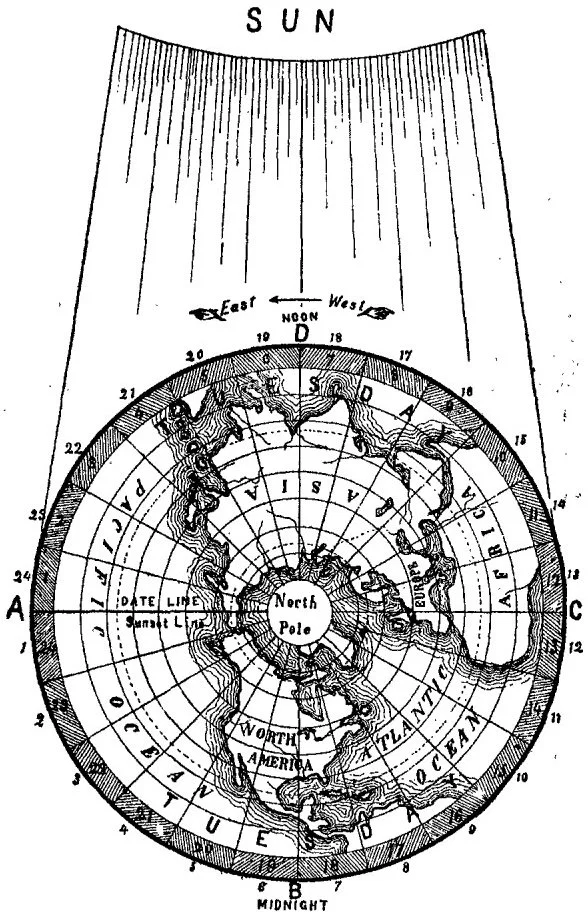
This is a map of the Northern Hemisphere, on a polar projection. Imagine yourself looking down upon the earth from the north, in a line with its axis. On one side is seen North America, and on the other Europe and Asia with a portion of Africa, with the Atlantic and Pacific oceans occupying their respective positions between them. Imagine this disk revolving from west to east in the direction of the arrow, causing the sun shining down upon it, to appear to an inhabitant of the earth to be moving from east to west. Remember that it is the motion of the earth, not that of the sun, which causes a succession of day and night. In the stationary light of the sun the earth revolves, causing every part of its surface to pass through the light and the darkness. From the stand-point of the sun, sunset is always at “A,” and sunrise at “C”; while “B” is midnight, and “D” is noon. But all portions of the earth pass all these points with each revolution.
Twenty-four meridians are shown upon the map, dividing it into twenty-four equal parts, representing the twenty-four hours of the day. But there are two kinds of day on the earth at the same time, as will appear upon a further study of the diagram. One of these may be called for convenience’s sake, the fixed or absolute day, the other the sunset or local day; the first goes around with the earth; the second goes around the earth. In the diagram these two days are designated by two sets of figures; the outer circle numbers the hours of the sunset day; and these figures remain ever in the same position; the inner circle numbers the hours of the fixed or absolute day; and these are constantly changing. Of the sunset days, there is always one day on the globe, and that complete; of the absolute days, there are always two on the globe at the same time in ever varying proportions (the instant when one day just encircles the globe being so brief before another day begins to come on, that it cannot be measured). The sunset days complete themselves in twenty-four hours, in endless succession; the absolute days occupy forty-eight hours each, before their circuit is entirely completed. The sunset day always has all its twenty-four hours on the globe at once; the absolute day constantly varies in the portion that is on the globe from the least fraction of a second to the whole twenty-four hours.
These statements may at first sight appear to some extent paradoxical; but a further examination of the diagram will, we think, make all plain. We have already found that the dividing line between days lies on the meridian that runs through the mid-Pacific. The map represents the earth in such a position that this line is seen running from the center, or North pole, to the right, and terminating at “C.” That line, as we have also shown, is the dividing line between two days; and the date on the west side of it is twenty-four hours in advance of the date on the east side of it.
But the sunset line at “A” is also a dividing line between days; there is, however, this difference between them: the day line, or as we may better call it, the date line, is permanently fixed to one meridian, and goes around with the globe, while the sunset line is caused by the revolution of the earth, to sweep over every part of the earth’s surface every twenty-four hours.
The sunset line is permanent with respect to the sun; the date line is permanent with respect to the earth. The sunset line, while not changing with respect to the sun, is constantly changing with respect to the earth; the date line, while not changing with respect to the earth, is constantly changing with respect to the sun.
It is on the sunset line that all days have their birth. And it is evident that once in every twenty-four hours, the date line and the sunset line must come together. And it is when these two lines thus coincide, or when the date line passes the sunset line, that the absolute day, marked by the inner circle of figures, has its beginning. The hour marked “1” under the date line, when it first came on occupied the space marked “12,” under “A.” It was then the first hour of the absolute day, and then corresponded to the first hour of the sunset day. When another hour had elapsed, the “1” of this day was opposite the outer “2,” and hour “2” of this day was opposite the outer “1.” As the earth continued its revolution, the “1” of this new day passed the 3, 4, 5, 6, and so on, till it reached the point opposite 12, where it is represented in the diagram. Abstractly considered, that hour is still the first hour of the absolute day, although it has now reached the 12th hour of the sunset day; for it was twelve hours before, that that locality passed the sunset line at “A.” The day that began to come on when the date line passed the sunset line, is, at the time represented in the diagram, twelve hours on. Let us suppose this day to be Tuesday. Then the day just east of that line, and which passes off at the sunset line at “A” as fast as Tuesday comes on, is Monday.
As represented, there are twelve hours each of the two days on the globe—twelve hours of Tuesday from “A” by way of “B” to “C,” and twelve hours of Monday from “C” by way of “D,” around to “A.” But the earth is constantly in motion from west to east in the direction of the arrow, and as fast as the hours of Monday reach the sunset line, they pass off, and Tuesday comes on.
Meanwhile, the date line, as the vanguard of Tuesday, is moving onward with the motion of the earth. When it reaches the noon point at “D,” there will remain but six hours of Monday, from “D” to “A,” on the earth, while Tuesday will show eighteen hours, from “A” by way of “B” and “C” to “D.” Six hours more elapse, and all the hours of Monday have passed off, and the date line has reached the sunset line.
Consider now for a moment what the situation, in this case, would be. The hours of Tuesday would occupy the whole circumference of the world as shown in Fig. 4.
Fig. 4.
Fig. 4.
The hour of Tuesday marked “1,” (inner circle) has now reached the sunset line at “A.” But the same hour set out from the same point twenty-four hours before. It has consequently taken that hour twenty-four hours to make the circuit with the earth from “A” around to “A” again. But while this hour has reached that point, and is ready to pass off, the twenty-fourth, or last hour of Tuesday, has but just come on and set out upon its journey; and it will take another revolution of the earth, or twenty-four hours more, to bring that hour around to the same point again. This explains how we can say that it takes a day (the absolute day) really forty-eight hours to complete its circuit of the earth; that is, it is forty-eight hours from the time the first hour of the day begins to come on, till its last hour passes entirely off.
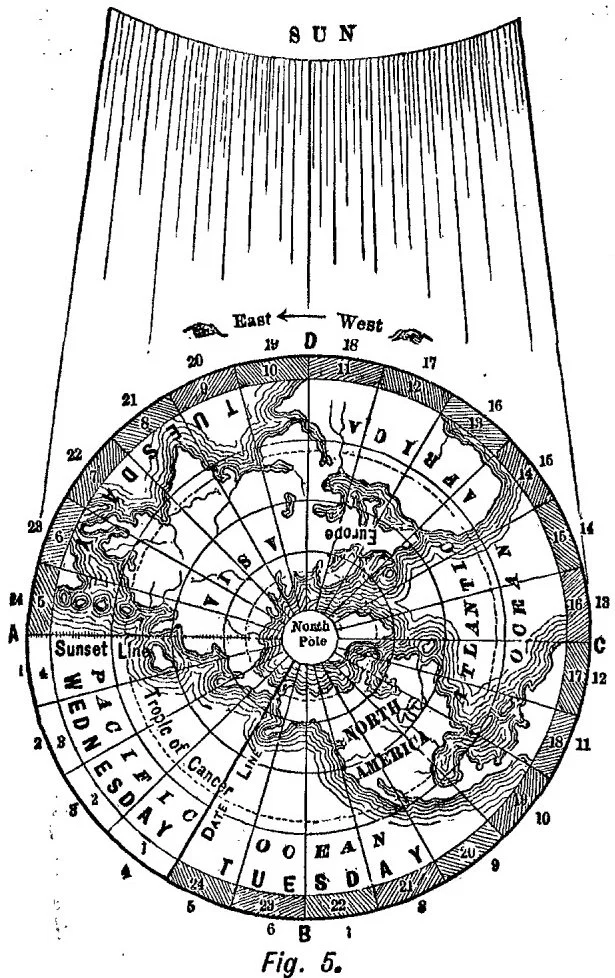
The diagram shows the position when Tuesday just encompasses the globe—when its first hour has just reached its starting-point, and its last hour has just come on. But it occupies this position only during the inappreciable instant while the date line is passing the sunset line; for hour “1” of Tuesday cannot pass on over the sunset line and still remain Tuesday; for that would make Tuesday more than twenty-four hours long, which would be impossible; and besides the sunset line always marks the introduction of a new day. So, immediately, as the date line passes the sunset line, another day begins to come on; and that day, of course, is the one that follows Tuesday; that is, Wednesday. And the date line is now seen to mark the division between Tuesday and Wednesday, as before it marked the division between Monday and Tuesday. Another diagram (Fig. 5) will further illustrate this point.
When the earth has moved on, we will say, sixty degrees, from the position shown in Fig. 4, we have the position shown in Fig. 5. Here we see that the date line has passed on four hours from the sunset line, bringing on four hours of Wednesday; and four hours of Tuesday have passed off, leaving but twenty hours more of that day to disappear, one by one, as they are borne around to the sunset line, as Wednesday, hour by hour, comes on.
Fig. 5.
Fig. 5.
By bearing in mind that the sunset line is permanent with respect to the sun, and is always at “A,” while the earth in its revolution is continually passing that point, and when the date line passes it, a new day is introduced, it will be easy to understand the philosophy of the succession of days on the earth. In the foregoing map, Fig. 5, the white spaces represent the hours of Wednesday. As already stated, four of them are represented as having come on. They are continually entering at the sunset line, as the date line, leading the first hour of that day, moves on. And when all the hours of Tuesday are gone, then Wednesday will, just for an instant, encircle the world, to be succeeded by Thursday, and that by Friday, and so on through week after week, and year after year in unbroken succession.
(Concluded next week.)

A SURE FOUNDATION.

THE principles of present truth constitute a firm and sure foundation of Christian faith. Supported by the authority of God’s word, and evolved in his appointed time by the patient, prayerful, and conscientious study of his chosen servants, they have stood for more than forty years unshaken, against all the assaults of the champions of dogmatic errors. No one can point to-day to one of these principles which has been overthrown in the fierce conflicts which have been waged against them, or which its advocates have been compelled by any circumstances to abandon. The light of succeeding years, which so often proves fatal to new forms of religious belief, only reveals more clearly the soundness and integrity of the doctrines which have been proclaimed by Seventh-day Adventists since the middle of the present century. This could not have been the case were these doctrines not as old as the word of God itself.
In every genuine work of reform, this characteristic has been present. In the messages sent from God in past times, he has never called his people to take their stand upon a platform unilluminated either by the light of reason or revelation. He has presented to men the clear, plain truths of his word, calling upon them to accept the message or suffer the consequences. If at such a time some part of the message had proved untrue, no one could have been held to account for doubting its origin or refusing to accept it. But God has never left men any excuse for failing to accept his word, weighty with its awful consequences of good or evil. All the record of his dealings with mankind attests this truth.
Can we suppose, then, that with such fearful consequences attending the rejection of the third angel’s message, as brought to view in Revelation 14, God will allow any person an excuse for failing to heed its warning? Will any part of the message proclaimed with such earnestness to the world be found so erroneous and unscriptural as to cast a shadow of doubt upon the whole? Such a thing is manifestly impossible.
The doctrines of this message have stood every test which the fierce opposition of years has brought to bear upon them, and in this they fully meet the expectation that such a message should be to those who accept it a firm and sure foundation, upon which they can stand with all confidence through the perils of the last days. L. A. S.

REASON, INSPIRATION, AND TRUE RELIGION.

The province of reason and inspiration in the work of genuine religion is well worth considering. The importance of the former is not always realized. When the prophet Isaiah was reproving the children of Israel for their sins and lack of religion, he said, “Come now, and let us reason together.” Isa. 1:18. It is the province of reason to weigh; to consider; to examine closely with the understanding; to draw conclusions from premises; to ascertain the value of proofs offered; to give the proper weight to facts and arguments presented, in order that conclusions consistent with truth may be attained, and error detected. The possession of the faculty of reason is one of the main features which distinguish a man from a brute. We would never for a moment think of addressing religious considerations to the animal creation. There have been some trained horses, dogs, and other animals which exhibited marked intelligence. But never was one heard of which could appreciate religious knowledge. They could not weigh such considerations. Appeals to them of this character would be utterly unavailing. But mankind can, by use of their reason when so disposed, understandingly consider such intelligence, and survey with interest eternal and spiritual themes. The prophet recognizes this fact, and appeals to the people to use their reason in viewing the considerations involved in their course of life. Man has an intellectual and spiritual nature. They should ever be mutually and closely interwoven, blended, and united in all religious experience. We are furnished with abundance of evidence that the intellect alone is insufficient to guide a man safely in obtaining the highest good. The moral and spiritual nature must be enlisted. When these are enlightened by the truths of inspiration and the Spirit of God, then a man can go safely and surely.
There are many men of intellect who are great rascals. The most selfish, unprincipled men are often shrewd, bright, and keen, intellectually. Satan himself is, doubtless, a being of vast intellect. But, on the other hand, we cannot ignore the intellect,—the reasoning power,—and rely upon the spiritual nature alone. It would be difficult to tell which course would result most deplorably, to ignore the reason or the spiritual nature. Both would result disastrously in the end. They are designed ever to be united, blended in their work. The skeptic, however, sees little use for the one; the fanatic, for the other. The vain reasonings of the one, and the lack of good sense of the other, only demonstrate the truthfulness of our position. Paul speaks on the one hand of the insufficiency of “worldly wisdom.” It is but “foolishness” with God, and wholly unable to find him out, grasp or comprehend his plans. On the other hand, he presents the folly of a “zeal of God, but not according to knowledge.” Neither will answer.
The religious nature of men has been terribly abused and outraged. We cannot question that every false religion has made use of the religious faculty as certainly as true religion has. Man uses his veneration as really when worshiping Jove or Baal as when worshiping Jehovah; when bowing before the virgin as when bowing before Christ. The faculty of religious belief or faith may be as truly called into requisition in behalf of Buddha as in behalf of Jesus; and the hope of attaining nirvana, i. e., absorption into the body of Deity, or extinction of being, may be as real as our blessed hope of everlasting bliss in the presence of God. And who can doubt that the conscience is greatly troubled at one’s sins when such acts of self-abnegation are performed as the Hindoos and others do, involving the greatest pain and the loss of life itself? When mothers give their children to the destructive embraces of Moloch or cast them into the Ganges, we cannot question the sincerity of their acts. Benevolence has been as fully exercised in behalf of idol shrines and grand cathedrals for popery as ever it has been for Christ. These faculties—reverence, faith, veneration, conscientiousness, and benevolence—are those we use in the service of God, and a mere glance convinces any one that their perverted use has been oftener displayed than their legitimate use. And an intensity of devotion has as often been shown in wrong directions as in right ones. The millions of lives of Mohammedans and Catholics sacrificed in the crusades over the possession of the holy sepulcher; the countless lives given in behalf of wars of persecution and to sustain slavery and other terrible evils; the sacrifices of ascetics, recluses, hermits, and monks, of all that we would call of value in life, to carry out their perverted views of religion; the compassing of sea and land by Jesuit priests and others, to sustain false systems of religion,—all are illustrations of an intense false devotion, and a misuse of the religious faculties.
Mohammedanism presents as many strange excesses in the name of religion and prostitutions of everything sensible, as any system of so-called Christianity. Its dervishes correspond in a measure to monkery in Catholicism. They have an immense influence with the masses, so great that even the Sultan himself can scarcely control them. The dancing and howling dervishes compose their greatest number. Persons perform the most menial and unpleasant offices for a period of years, in order to gain a membership among them. Their worship is an exhibition of the most astonishing fanaticism. In it is a mixture of dancing, whirling, shouting, and howling till they become frenzied and often insensible. Well-authenticated facts, stated by reliable travelers, seem too much for credence. One traveler says: “By looking at a stop-watch, I ascertained that they turned [around] sixty-four times a minute. After spinning around for about five minutes, at a signal from the high-priest both music and dancers suddenly stopped, but recommenced in a few seconds. The third time they kept it up for nine minutes and three-quarters. My brain was swimming, too, so much so that I could hardly count their evolutions. The fourth and last time they whirled for five minutes and three-quarters, thus making in all 1504 turns in twenty-three and one-half minutes.” (See McClintock and Strong, Art. “Dervishes.”)
The perversion of the religious faculties has been seen associated with Protestantism as truly as with other forms of religion; but not to the same degree, owing to the fact that it seeks to conform to reason and inspiration. In just the degree that it does this, is it saved from fanaticism. But there has been no lack of exhibitions of wild excitement, foolish zeal, and fanatical extremes manifested here and there, even in connection with movements mostly reasonable and genuine. In times of great religious interest, weak minds lose their balance, unless guarded by wise instruction, and a healthful, sensible influence is kept uppermost. In “revivals,” as they are called, where strong appeals are made to the feeling, there have been numerous instances of persons losing their minds, and even becoming permanently insane. Even in connection with the great advent movement a movement founded on Scripture, and taught by appeals to the understanding and judgment, some became unbalanced. Especially after the passing of the time, before the third angel’s message was preached, did persons become affected, more or less, with false ideas of the nature of true religion. Some taught that no work must be done. Some advocated that the sisters’ hair should be worn flowing down the back; others, that it should be cut off; and various silly and extravagant ideas were circulated. But the present truth concerning the last message corrected largely, at least, these follies, wherever it was received. It ever appeals to the Scriptures and the understanding. Hence fanaticism, which largely grows from feeling and excitement, has found little congenial soil in it.
What a strange scene the history of past ages has presented when we view the realm of religious thought!—what vagaries, what extremes, what follies, what crimes, what perversions of all true religion! Verily, an enemy hath done this. Satan has stepped into this field, and made terrible havoc. But God has ever had a truth in the world,—pure, lovely, reasonable, elevating, benevolent, sensible, in harmony with the highest reason. The inspired word presents the light of truth, to invigorate the understanding and correct its waywardness. Yet even in this realm the reason must have place. An idiot cannot be benefited even by inspiration, and a fanatic will claim to be taking the word for his guide, and deceive other enthusiasts by his cranky notions of the Scripture itself. We must use common sense in religious things as well as in other things, or we are liable to go astray. When the Lord says, “Come now, and let us reason together,” he would have us use our reason in religious things most certainly. Reason and inspiration must be interdependent. When true prophets spoke, there must have been a difference between their appearance, their sentiments, their course of action, etc., and the statements and actions of false prophets. Our Saviour says: “Beware of false prophets. . . . Ye shall know them by their fruits.” Here the reason must be called into play, to weigh and thoroughly consider the nature and character of those fruits and the evidence of genuineness, in order to arrive at just conclusions. But when the evidence is convincing, that God is speaking through the prophet, then the reason must accept the light imparted as a guidance to duty.
The Scriptures have been thoroughly proved for past ages as well as by present experience, to be genuine revelations from God. When we can be certain that we have their true meaning, they must be regarded as authoritative. But reason is constantly necessary in their study and investigation, in order to arrive at their real meaning, lest we take foolish and false views of their teachings. The instruction they give, and the blessing of the Holy Spirit which inspired them, also resting upon us, enlarges, purifies, strengthens, and spiritualizes the understanding, and thus prepares us to drink deeper and deeper draughts of true spiritual experience; to know more and more of God, and be more and more conformable to Christ. May we all thus grow in grace and in the knowledge of the truth.
G. I. B.

Australia and the Heart of the Work

From Australia.

While it is true that Australia lies at one of the extremities of the work of God, and farthest from its heart, still each pulsation of the heart is distinctly felt even in its remotest parts. And when there is a strong, healthy action at head-quarters, and the pulsations seem to come stronger and faster, it thrills every part of the body with new life. It is true that it is a good thing for a vigorous circulation to keep the feet warm, but the feet will be far more likely to be warm if the heart is warm. And while it is hardly possible for the feet to warm the head or heart, a well warmed heart will send warmth and life to the extremities. This is not designed as an essay on physical thermotics, but it may illustrate what I wish to emphasize, that the condition of the work in all foreign fields is greatly affected by its condition at home. Vitality and vigor must be preserved there, and their impulses will be realized throughout the system.
The United States have evidently been chosen as the place where the principal scenes in the closing drama will be enacted. It is here that the light for the last days first arose, and we see the wisdom of God in ordaining it thus,—a land of light and freedom, of active habits and quick perceptions; a gathering-point for all nations; a land of vast varieties and features which attract all classes, and thus open up avenues through which every part of the earth may be reached. Such a land in miniature was Palestine, where the gospel of salvation had its early planting.
How appropriate, then, that here should be seen the most remarkable signs of the times, and that from here should proceed the light of present truth. But it is a noticeable fact, and one which is a source of great comfort to us who are far away, that distance from the heart of the work does not modify its character or the spirit which it bears. How often I have said to myself in the past year, “And have all been baptized into one spirit.” It makes every country home-like when we can meet with kindred spirits, where we can see the same battles fought and victories won, and the same impress is given to those who come under the influence of the truth. There is “no north, no south, no east, no west,” to the third angel’s message, and when its work is done in one place, it will be finished everywhere.
While our brethren in America watch with interest the progress of the work in the foreign fields, let them always remember that those in distant parts watch with far greater interest the progress and development of the work at the center. The very impulse which is given to it there, is felt in every part of the earth where the work has been established. And the rapid steps which are being taken in the fulfilment of prophecy, cause us to feel renewed courage and faith in the cause.
We, here in Australia, feel a particular interest in the experience of our people in the United States, because we think that they are but preceding us a little way on the road over which we must soon pass. Those who oppose our work already talk of the force of law which could very readily be invoked in this country. There is at present a very active discussion being carried on in Victoria, over the question of religious education in the public schools. Some years ago the educational act was so amended as to exclude all such teaching. But the churches and religious press are not at all satisfied with this, and an amendment was introduced at the present session of Parliament, but was defeated. Its friends, however, declare that they will renew the contest, and keep it up until their objects shall be gained. It is clearly a conflict on the same line as that introduced by the Blair bills in Congress; and it is fought on the same line of argument to a great extent. We stand on the side of religious freedom, and endeavor to let it be known. In order to bring our work more prominently before the country, we are supplying our members of Parliament with the Bible Echo for several weeks. This Parliament corresponds very closely with our Congress, or more closely with our State legislatures. The Lower House, or Legislative Assembly, is elected from and by the common people, and the Upper House, or Legislative Council, is composed of men who are worth at least a sufficient sum of money to give them an independent income; and no one can vote for these gentlemen except he is a householder, and owns property to the extent of fifty pounds.
There is considerable talk in some circles about Australian confederation, and many people are looking to the United States as possessing a form of government especially adapted to the wants of these colonies. While we feel no special interest in these issues, still the present state of affairs in many ways interferes with business and the development of the country. Our readers will appreciate this better by supposing that each State of the Union ran an independent government on protective principles. At every crossing of the lines an officer overhauls the luggage. Nearly all articles of intercolonial trade must pay duty into Victoria. And these duties have been materially increased this year. Each colony has its own stamps, so these convenient articles cannot be used as currency outside of their own colony. Matters of postage under the colonial laws are not well regulated. Letter postage is two-pence (four cents). Our papers cost one half-penny, whether sent by publisher or other persons, and in the case of magazines, it is double, and quadruple if they exceed four ounces. So that it costs us four cents to post each copy of Good Health. In the neighboring colony of New South Wales, however, papers are mailed free, and may be sent from that colony to this without any postage. This, of course, places us at a disadvantage, but with others, we are doing what we can to produce a change which will be for the benefit of periodical printed matter.
While writing on this subject, I beg the privilege to speak in behalf of our Bible Echo. We are expected to produce a sixteen-page paper twice each month, and so far have done so; but it has been hitherto like making bricks without straw. Not that the bricks were made without straw, but the slaves were required to gather their own straw, and make the same number of bricks as before. Now we do not have to gather stubble, exactly, but at the same time we have but little straw furnished us. I am informed, and I think correctly, that with the exception of Bro. Haskell’s articles which are written for our paper, not more than three or four articles have ever come from the United States written for the Bible Echo. We are glad for the moral effect of a respectable corps of corresponding editors to place at the head of our columns. But we look for something more tangible than that kind of charity which says, “Depart in peace, be ye warmed and filled.” Cannot our good correspondents remember us occasionally? Anything sent to the Pacific Press, addressed to the Bible Echo, will be sent on without further postage.
We are glad to be able still to say that God is blessing his work in Australia, and our publications are beginning to exert quite a perceptible influence. The papers are generally well received, and find many interested readers. G. O. T.

A WONDERFUL BATTLE.

THE most murderous battle ever fought on this earth was one which had an important bearing on the fulfillment of prophecy. It was when Charles Martel inflicted upon the Saracens a crushing defeat on the plains of Tours, France, in A. D. 732, in which battle it is said that between 350,000 and 375,000 men were killed. The Saracens were determined on subduing Christendom; and being foiled in the East by the then existing Eastern Empire, they crossed over from Africa into Spain, overran that country, scaled the Pyrenees, and descended like a swarm of locusts upon the plains of France. But after the overwhelming disaster above mentioned, they never again essayed to enter Europe from that direction. This obliged them to confine their operations to the East, and led ultimately to the overthrow of Constantinople, the fall of the Eastern Empire, and the fulfillment of the last part of Revelation 9. Next to the battle of Tours in frightful mortality, was one between Attila and the Romans in A. D. 451, in which 250,000 men are said to have been killed. “The most murderous battle of modern times,” says a London paper, “was that of Borodino, a Russian village, where Napoleon fought the Russians on September 7, 1812. This battle was one of the most obstinately disputed in history, and resulted in nearly 80,000 men being placed hors-de-combat.”

MICHIGAN

CHIPPEWA AND MORLEY.

We closed our meetings at Chippewa July 30, leaving seven adults keeping the Sabbath, and, as we trust, converted to God, as the result of our tent-meeting in that place. A class was organized, also a Sabbath-school of twenty members, and books and papers were secured for the purpose of carrying on their Sabbath-school work.
We pitched our tent in Morley, and began meetings Aug. 2. We have had a fair attendance and a very good interest, considering the fact that this is the third tent-meeting held in this place by our people. This meeting, however, was designed more for the special benefit of our people living near here, there being a class of our people both east and west of this village, and not so far removed but that they can attend meetings here. It was thought best to pitch the tent and awaken an interest, and induce them to build a church. Accordingly, measures have been taken to secure means for the erection of such a building, and about $200 have been pledged, besides some material. We expect to see the house raised before cold weather.
Our brethren here have been very faithful in attendance and in supplying our temporal wants. We have devoted one-half hour each evening, before preaching, in giving instruction to our brethren and others on the spiritual bearing of the commandments of God, justification by faith, Christian perfection, and practical Christianity, which has resulted in much good. Many of those not of our faith have attended this class exercise, and claim to have received great light from it. Some have given their hearts to God, and are keeping his commandments, while others are deeply interested. We feel that the power of God has been manifested in a marked degree in our meetings in this place, and we are all of good courage in the Lord.
R. C. HORTON. L. N. LANE. O. SOULE.
Continue reading: LOUISIANA