The Youth’s Instructor, Vol. 34, No. 17.

THREE HINDRANCES

The Youth’s Instructor

Apr 28, 1886

S. D. A. Publishing Association · Battle Creek, Mich. · Apr 28, 1886

THREE HINDRANCES.

There are three hindrances that are quite apt to get into children’s lives, and impede their progress. The first to be mentioned is fretfulness. It is a terrible stumbling-block; it destroys the peace of the child’s life and of the loved ones in the household. It robs childhood of much of the happiness which ought to belong to it. It puts puckers in the child’s forehead, makes the face look as if everything in the heart was always awry.
It takes away the pleasure of companionship with one’s friends; in fact, it mars the whole outlook of child-life.
With such a child, nothing is right; the weather is too hot or too cold; the clothes are too tight or too loose; friends all have something about their ways that is undesirable; some other school but the one the parents select is always preferable. If there are certain duties to be performed each day, the child who is encumbered with the habit of fretfulness will worry and talk over the acts to be performed long enough to have done them three times over. Work done in moments of fretfulness is much harder than if taken up in a cheerful spirit.
Remember, children, that fretting over our duties wears us out more quickly than the doing of them. Indeed, it is healthful for each child to have certain duties at home to do every day, and when such work is done with “the heart put into it,” it is accomplished much more easily. Don’t let this habit of fretting, which begins in cobwebs, end in iron chains which you cannot break away from after you become men and women.
The second hindrance is procrastination—putting off the duties that you know should and must be done. This is a very great hindrance, because the minutes and hours of each day pass away from us so quickly, and we can never go back and pick them up again. Putting off the duty of the hour to another hour later in the day, crowds the work of one portion of the day into that of another. It puts everybody out, and leads to a great many unpleasant words, and sometimes much unhappiness. Promptness is one of the most important characteristics, and we should be determined to cultivate it. There are many men and women in the world who are never on time. It is because, when they were children, they were always putting off everything until the last moment. Often very serious consequences grow out of this habit of not being punctual.
If the tardy one hindered only his own progress in life, it would be bad enough; but when he hinders others by his late comings and goings, it really becomes a very serious matter.
This leads to the third hindrance,—unreliability. These three hindrances I have spoken of take hold of hands, and stay together. A reliable child will make a reliable man or woman. “I can always depend on that boy; I never knew him to fail,” a gentleman said of a boy who was in his employ. “I am just as certain of his doing his work as if I did it myself. I feel confidence in him; and if I go away, when I come back, I find things just as they would have been had I been there.” Such a boy is invaluable. But a boy or girl who is interested with some important matter, but who forgets it or neglects it because it requires self-sacrifice, time, and labor, loses one of the most necessary characteristics of manhood and womanhood. People soon learn to pass unreliable persons by when they have important trusts to give, and hand them over to those who will prove worthy of the trusts reposed in them.—Susan T. Perry.

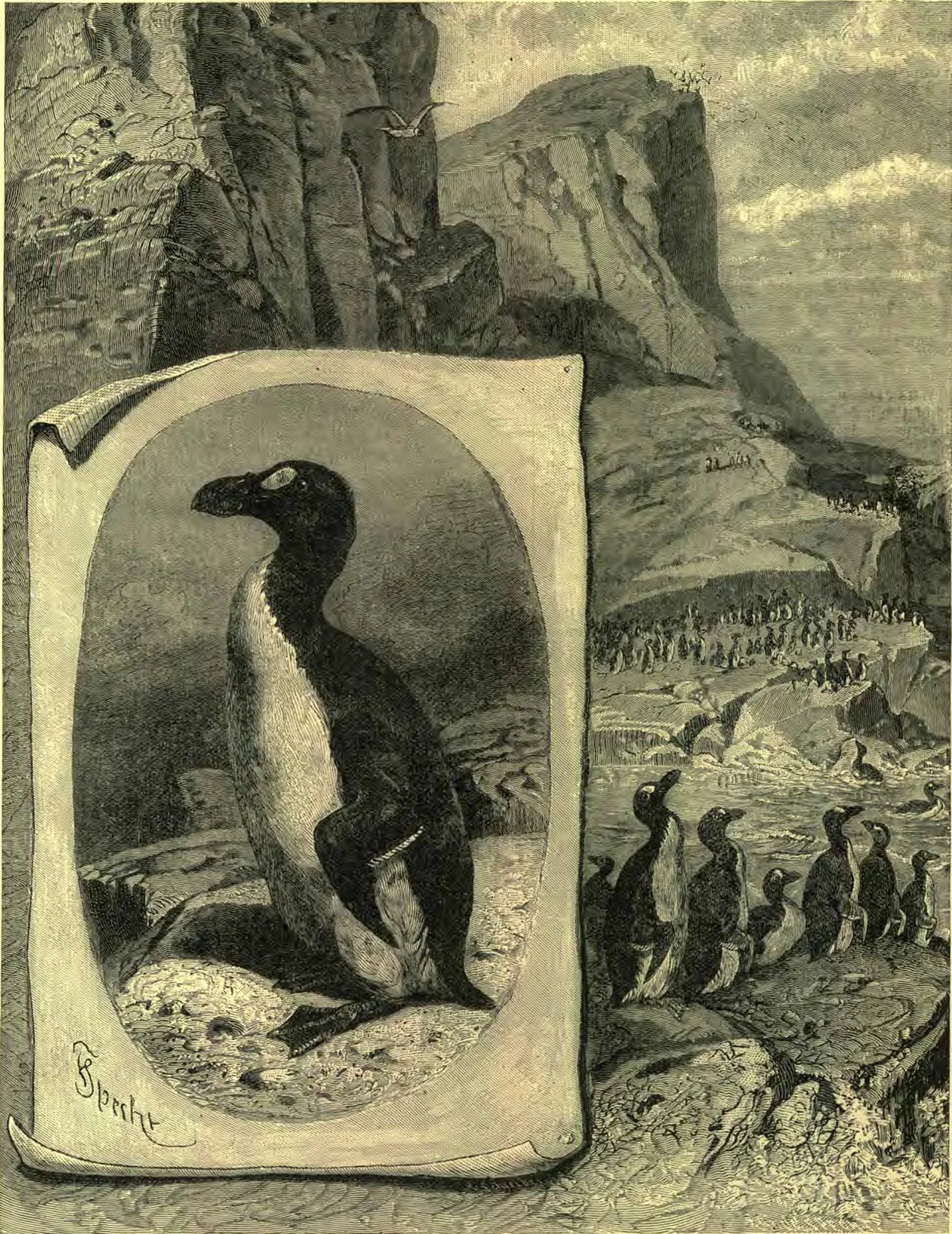
THE GREAT AUK.

AMONG the large family of swimmers may be found the great auk, shown in the picture on this page. These auks have their dreary homes on the frozen coasts and islands of the Northern Ocean, from which they wander hundreds of miles out to sea. They are strictly ocean birds and scarcely ever leave the water, except to build their nests and breed in immense flocks in caverns and crannies of rocks, laying one disproportionately large egg.
The great auk is remarkable for the imperfect development of its wings, which are totally unfit for flying. They are set very far back on the body, and are not much more than rudimental; but they are used by the bird as oars, and in conjunction with its feet it plies them with such power and swiftness that it has been known to escape from a six-oared barge pulled by vigorous oarsmen. It rarely leaves the Arctic circle and the waters adjoining.
In summer all the upper parts of this bird’s plumage are a deep sooty black, which is changed in winter to white on the cheeks, the sides, the neck, and the throat. It lays one large yellowish egg, as big as a swan’s, irregularly dashed with black marks, which have been compared to Chinese characters. Its feet being situated at the extremity of its body, it stands or sits erect, propped up by its short, stiff tail after the manner of penguins, which it not a little resembles.—Selected.

THE PRINCESS'S CASKET.

A ROYAL young Araby's daughter, A princess both gentle and fair, Received from the wise one who taught her A casket of ivory rare—
A casket of carving most clever, A dainty delight to the eye, But, “Open it not,” said the giver, “Until a whole year has passed by.”
How oft, with the casket before her, The princess would touch the closed lid, And wonder, like little Pandora, What treasures beneath it lay hid.
But time still moves on, though it lingers; The long year of waiting is past; With trembling of fair, slender fingers The casket is opened at last.
Alas! for the treasure long cherished Behold, but a small shroud of rust, A something whose beauty has perished As flowers go back to the dust.
Beneath, on the smooth satin lining, A small slip of parchment appears; The princess, perplexed and repining, Unfolds it and reads through her tears.
“This trinket, when herein I placed it, Bore one little rust-spot alone; But time and neglect have defaced it, Till now all its beauty is gone.
“Learn, princess, how one fault or failing May injure a character fair, And virtue be all unavailing, If one little ‘rust-spot’ be there.
“Place here in your casket a treasure, A jewel of untarnished gold; Your eyes may behold it with pleasure Still beautiful when you are old.
“And you—with my heart's prayer I ask it— Oh, keep yourself spotless from sin, Your body the beautiful casket, Your soul the pure treasure within.”
—The Child's Paper.

The Fear of the Lord

THE fear of man will make us hide sin, but the fear of the Lord will make us hate it.

LOST SHEEP.

“What man of you, having a hundred sheep, if he lose one of them, doth not leave the ninety and nine in the wilderness, and go after that which is lost, until he find it? And when he hath found it, he layeth it on his shoulders, rejoicing. And when he cometh home, he calleth his friends and neighbors, saying unto them, Rejoice with me; for I have found my sheep which was lost. I say unto you, that likewise joy shall be in heaven over one sinner that repenteth, more than over ninety and nine just persons that need no repentance.” Luke 15:4-7.
When Jesus spoke these words, he was talking to a company, many of whom knew by experience what a shepherd’s life is in Palestine. There the flocks are not kept in level, inclosed pastures, but on the hill-sides, among crags and precipices. The climate of Palestine is warm, and the shepherds watched their flocks day and night, sleeping in temporary booths or on the ground in the open air. Sometimes several flocks of sheep were herded together. This made it more pleasant for the shepherd; for then, while one slept, two could keep watch, and thus in turn relieve one another.
There was always the danger from robbers and wolves to be guarded against. Sometimes a sheep would stray away from the flock; so they were frequently numbered to see that none were lost, for the shepherd must give a strict account of all the sheep under his care. If the owner of the flock found one sheep missing through any neglect on the shepherd’s part, the keeper was discharged, and compelled to pay for the sheep that was lost.
At one time Christ was reproving the Pharisees because they were not true shepherds, but closed their eyes to the plainest truths which he presented in his lessons. He called them blind guides, because they were false teachers. He then presented the parable of the true and the false shepherds, telling them that he was the good shepherd who laid down his life for his sheep: while the hireling, whose own the sheep are not, would flee and betray the flock in time of peril. The Pharisees were of that number who were holy in their own estimation. They took no notice of the lost sheep. They were, they thought, just and righteous, and felt no need of repentance or of a Saviour. This parable of the lost sheep was for their benefit; and if they had not been filled with pride and self-conceit, they would have been instructed by these precious lessons given by Christ, and would have seen that they had a work to do for those who had not so great a knowledge of the truth as they possessed. The Pharisees, on account of their learning and advantages, felt above being instructed; but this made it all the worse, because they should have known Jesus and accepted his teachings, and then they would have had divine wisdom given them.
The shepherd’s life is one full of peril. If he is a trustworthy shepherd, he will not be careless and study his own ease, but he will search for the straying sheep amid storm and tempest. Perhaps he will find the lost sheep slipped into some crevice of the rock, where he cannot find his way out. He is beset with fears on every hand. The good shepherd does not come with a harsh voice, scolding the poor frightened sheep, but he speaks in pitiful, soothing, winning tones, so that when the sheep hears his voice, he will follow, unless he is imprisoned in the rocks or tangled in the brambles. Then the only means by which the shepherd can find the sheep is by following up the bleat of distress that the wanderer sends in answer to his call. And when the good shepherd finds the lost one, he puts the weary wanderer upon his shoulder, and brings him back to the fold, rejoicing at every step.
This is the way the true Shepherd treats the lost sinner. He goes after him; he does not hesitate at peril, self-denial, and self-sacrifice. He is intent upon bringing the sin-burdened soul to repentance, to salvation, to peace, rest, and happiness in his Saviour’s love. And it is the privilege of every one who has experienced the love of Jesus in his own heart, to think if there is not some one whom he can by personal effort, by studied tact and kindness, bring to Jesus, who is ready and willing to accept all who will come to him. We can all do much through personal effort. We can be laborers with Jesus Christ. Will the INSTRUCTOR family see what they can do to seek and to save the lost sheep?
MRS. E. G. WHITE.

HOW IT BEGINS.

“Give me a half-penny, and you may pitch one of these rings, and if it catches over a nail, I’ll give you threepence.”
That seemed fair enough; so the boy handed him a half-penny and took the ring. He stepped back to the stake, tossed the ring, and it caught on one of the nails.
“Will you take six rings to pitch again, or threepence?”
“Threepence,” was the answer; and the money was put into his hand.
He stepped off, well satisfied with what he had done, and probably not having an idea that he had done wrong.
A gentleman standing near watched him, and now, before he had time to look about and rejoin his companions, laid his hand on his shoulder.
“My lad, this is your first lesson in gambling.”
“Gambling, sir?”
“You staked your half-penny, and won six half-pence, did you not?”
“Yes, I did.”
“You did not earn them, and they were not given to you; you won them just as gamblers win money. You have taken the first step in the path; that man has gone through it, and you can see the end. Now, I advise you to go and give his threepence back, and ask him for your half-penny, and then stand square with the world—an honest boy.”
He had hung his head, but raised it very quickly, and with a bright, open look, said, “I’ll do it.” He ran back, and soon emerged from the ring, looking happier than ever. He touched his cap and bowed pleasantly as he ran away to join his companions. This was an honest boy, and doubtless made an honorable man.—Morning Star.

EASTER

Sunday, April 25th, was Easter. Do the young readers of the INSTRUCTOR know what Easter is, and how it originated? A long while ago, hundreds of years in the past, the Gauls and Saxons, and others who were heathens, worshiped a female deity whose name was Ostera. This goddess was thought to have much to do with spring-time and flowers. Every year, at the time when the spring moon was full, the people held a grand feast to this goddess.
When the Romans conquered these wild tribes, they adopted the custom of holding a festival in the spring of the year, and, as I suppose, got what good they could out of it by joining it to their own religious rites.
The Sacred Year of the Jews began in the spring, with the full moon of the vernal equinox, which is about March 21. This is when, as we say, the “sun crosses the line” in the spring. The Passover came on the fourteenth day of this moon. The resurrection of Jesus took place on the next first-day of the week, or Sunday. Back quite early in the history of the Church, it was seen that the resurrection came at about the same time as the feast of Ostera or Eostre, and the name Easter was given to the day. So a heathen name became united to an event dear to the Christian church. Many Christian doctrines have indeed been perverted and lost sight of by association with heathen practices. Let us all, dear little readers, keep clear of all evil by abiding by the word of God—the Bible.
Easter comes on different Sundays year by year, and some wonder how this can be, as the resurrection of Jesus was of course on one particular day of a particular month. “The World’s Cyclopedia,” shall tell how it is. It says: “This feast was fixed by the Council of Nice in the year 325 to be held on the Sunday which falls upon or immediately after the full moon, which happens next after the twenty-first of March.”
This is why Easter varies. It is certain the day of the resurrection of our Lord cannot vary, but Easter, which celebrates the event, does, according to the above rule.
Before the Council of Nice, some of the churches did not always observe it on Sunday. The Council settled the matter in favor of uniformly keeping it on this day.
We are not bound to observe Easter as a religious duty. The Bible does not command it. If it was necessary, the word of God would make it known. Some churches are very careful to observe this festival. There is great display. Fine music and beautiful flowers help in the grand services in many places. It is a sad truth that the plain commandments of God are passed as of little importance, and service is rendered to him that he does not require. The best way to honor Jesus our divine Saviour, and to please him in all our ways, is to honor his Father, our Creator, in keeping his holy commandments as his son Jesus did. By this means we may abide in his love. Will we all do it? N. J. Bowers.

CHILDREN, DON'T QUARREL.

Who likes a quarrelsome child; who cares for a man who is cross and easily provoked, or wishes for his company? Doesn't everybody want to be respected and loved? Then why do children and others act in such a way that no one can love them? That is strange, is it not?
See how anxious that little boy is that everybody shall think well of him. He is much displeased if everybody does not like him and choose his company. But now see how petulant and cross he is. If everything does not go to please him, there is a fuss immediately. No one must touch his things without his permission; no one must have his book when he wants it; no one must get into his chair or look at his paper. And yet he expects all to love him and want to play with him. Strange, is it not?
Now that is what I call a quarrelsome child. To quarrel, Mr. Webster says, is “to dispute violently; to wrangle; to fall out; to find fault.” Hear Tom finding fault with Jane; he is quarreling. Henry and George have fallen out about the sled; they are quarreling.
I have been in families where there was one continual quarrel from morning till night, right among brothers and sisters too. Isn't that a shame? What must the Lord think of such children? And yet, if I should tell those children that they were quarrelsome, they would be greatly offended. They have become so used to quarreling that they do not realize how much they do of it, nor how bad it is. Henry, let me ask you, Are you a quarrelsome boy? You say you are not? But what did you say about your sister's letting your slate alone? Didn't you have a sharp dispute with your brother about building the fire? Didn't you scold because your mother was late with dinner? And, let me see, what was that talk I heard at the dinner table about Frank Jones, “such a mean boy, such an ugly boy, wants his own way,” etc.? I should call that a bad boy who would scold his sister, dispute with his brother, find fault with his mother, and have a fuss with his school-mates all in the same day.
Now, I don't suppose that any of you are as bad as that. I wish I could believe that none of you ever do so. What is the use of it? The more you scold and find fault, the more you will feel like doing it. And, if you keep on that way, you will get so into the habit of it that you may never get over it. You will go all through life, speaking harsh words and complaining of everybody and everything. And that will not be the worst of it. Your quarrelsome spirit will influence others around you, and they will become cross and quarrelsome too. Just notice, the next time you are cross to your brothers and sisters, and see how quickly they will answer back in just the same manner. The Bible says, “Grievous words stir up anger.”
Another scripture says, “A soft answer turneth away wrath.” There are two good things we do by using soft, or kind, words. The first is, we make ourselves feel better, make our own spirits more tender and kind, and that is worth a good deal; and the next good thing we do is to make others around us feel better and more tender.
We never gain anything by being crabbed and fault-finding. Do you like to do anything for others when they are cross about it? Certainly not. And don't you suppose others feel just as you do?
But what does God say about this? “Blessed are the peace-makers, for they shall be called the children of God.” So, then, if you want to be one of the Lord's children, you must make peace. But how can you do that? Would you really like to know? Will you try to practice it? It is very simple. Speak kindly to your brothers and sisters at home; be pleasant at school; put up with a good deal without showing any anger; be easily suited; don't find fault with your clothes nor with food nor with your books. If others are cross and unkind to you, don't notice it, but return them good for evil. That is what it is to be a peace-maker. God loves such children.
Notice how much the Lord has said about this. Jesus says: “Love your enemies, bless them that curse you.” The good apostle Paul thus admonishes his children: “Let all bitterness, and wrath, and anger, and clamor, and evil speaking, be put away from you, with all malice; and be ye kind one to another, tender-hearted, forgiving one another.” Eph. 4:31, 32. What good advice that is, isn't it? What a good boy he will be who does that way! God will love him, his mother will love him, his father will be proud of him, his teacher will like him, and he will be happy himself. D. M. CANRIGHT.

Flowers as a Sign of Generous Hospitality

An American traveler, who had made the tour of Europe on foot, was asked what guided him in selecting a resting-place at night; he replied, “The presence of flowers. Whenever I find flowers in the yard, or garden, well cultivated, I am sure of meeting people with generous hearts. They may be ignorant of books and of the world, but I always find them hospitable and kind to a stranger. Flowers to me,” he said, “are the sign and indication of an elevated humanity.”

IMPORTANT BIBLE SUBJECTS.

LESSON 4.—BREADTH OF THE LAW.

[Note to the Student.—Do not consider the lesson learned until you can give at least the substance of every text, with the correct reference for each. The references in black letters indicate those texts that should be committed to memory. A little diligent application each day will enable you to learn them, although this need not be considered a test of scholarship.]
1. WHAT can you say of the perfection of the ten commandments?
2. Of whose character are they a likeness? Give proof.
3. How much of our duty is comprised in the ten commandments?
4. If we do the commandments, what sort of characters will we have? Deut. 6:25.
5. Of whose righteousness will we be partakers? 1 John 3:7; compare Isa. 51:6, 7.
6. If to do the commandments is righteousness, what must it be to fail to do them?
7. And what is all unrighteousness? 1 John 5:17.
8. Then what is sin? 1 John 3:4.
9. How may we know that any action is sinful? Rom. 7:7.
10. To what law does Paul here refer as pointing out sin? —To the law which contains the commandment “Thou shalt not covet.”
11. Then of what law is it that John speaks when he says that “Sin is the transgression of the law”?—Of the law of ten commandments.
12. Can there be any sin committed that is not covered by the law? Rom. 4:15; 5:13.
13. What did David say of the law? Ps. 119:96.
14. How broad is it? Heb. 4:12.
15. How did Jesus illustrate this in the case of the sixth commandment? Matt. 5:21, 22.
16. Do the commandments forbid evil thoughts and desires as well as open sins? Matt. 5:27, 28.
17. What is the whole duty of man? Eccl. 12:13.
18. What reason is given why we should do our duty by keeping the commandments? Verse 14.
19. What does this statement indicate? (See note.)

NOTE.

“Fear God, and keep his commandments, for this is the whole duty of man. For God will bring every work into judgment, with every secret thing, whether it be good, or whether it be evil.” Eccl. 12:13, 14. Keeping the commandments is declared to be the whole duty of man. The reason given why we should thus do our whole duty, is that “God will bring every work into judgment, with every secret thing.” This statement, coming in the connection that it does, can indicate nothing else than that the commandments of God cover every work, with every secret thing. Whosoever therefore keeps the commandments will be perfect, even in his secret thoughts.

HOW THE INDIANS WRITE.

In nearly every part of the earth are persons who do not know how to write. Some are needlessly ignorant, but there is a large class whose ancestors or kinsfolk in any line have never been instructed in a written language. They may have signs or marks by which they convey their ideas to others; but they have no system of writing, no alphabet like yours, by which they can communicate thought. The wild savages in our own country, with the exception of some tribes that have had the advantages of schools, are specimens of this class. When they wish to send a message to another, they express what they have to say by pictures, their picture-writing being something like the rebuses you sometimes puzzle over in newspapers and magazines. Henry Eckford, in the St. Nicholas, gives a pleasing illustration of their picture-writing, which we give you in a condensed form. It is something as follows:—
“Supposing a party from the great clan, or tribe, known as Turtles, have made a raid on a village of huts and wigwams owned by enemies belonging to the wide-spread clan called the Bear clan. After robbing their neighbors of their cattle and plundering and burning their homes, they wish to let other Indians know what fine robbers they are; so the Turtle chief chooses a piece of smooth, cream-colored birch bark, chews up a little tobacco to serve as ink, and with a twig of soft wood for a pen, draws upon the bark,—first, a turtle, a very big turtle, because he thinks he and his clan are very great personages; then he draws as many curving lines, to represent bows, as there are Indians in his party, and perhaps as many Indians with top-knots; his lines bend forward, to show in what direction the trail went. Following these, a rising sun stands for day-break, and three horizontal lines under it mean that three days went by in going to the Bears. Next he makes as many funny little pyramids as there were Bear wigwams, and draws them upside down, to show that they were destroyed. After that he draws a wee, wee bear, very small, in order to show his contempt for the Bears. Finally, he draws with the greatest care as many oxen and ponies as he has captured, because he is chiefly proud of this part of the exploit, and wishes all to know what a successful robber he is.”
“If the Bear braves were away when he surprised the camp, he does not care to tell that. This may be understood, however, by the absence of any sign for scalps. If there is resistance, and men are slain on either side, the exact number of dead are noted by drawing just as many human figures without heads.”
“To call the attention of every one who passes through the woods, the war chief next fixes the piece of bark to the top of a long pole, and plants it on the path so that the most careless person cannot fail to see it.”
Our method of sending messages on paper by means of a written alphabet, is very mysterious to a real wild Indian. He calls it a “talking leaf,” and thinks the writer and the receiver of the message are both wizards.

WAMPUM

It may be the readers of the INSTRUCTOR already know this is the name which was given to the shell beads the North American Indians used as money; but we feel certain you will like to know something of its manufacture and use. The Indians made it themselves, by hand, from the inner part of certain shells,—the conch, or periwinkle, and the hard-shell clam. What they formed from the conch-shell was white, while that made from the dark portion of the inside of the clam-shell was purple, or nearly black. “Black wampum” was so scarce it was worth twice as much as the white.
Besides being of two colors, they made the beads in two forms. The kind earliest in use varied in size from that of an English sixpence to an English shilling, and was about one-eighth of an inch in thickness; while that made later was in size and shape more like a clay pipe-stem, and in length from one-half to one-third of an inch.
It was a slow, tedious process to make it, and this gave it considerable value with them. They first broke from the shell the part which was suitable for a bead, and rubbed it on a stone until it was of the right size and nicely polished, when they cut it into the right lengths, pierced holes in the center of all, and strung them on some sort of a string.
You would feel strange, no doubt, to be passing beads for money; but the boys and girls did that in the early history of this country. In the 17th century the laws of the white colonists made wampum a legal tender for certain sums, and it was rated at four white beads or two blue ones for a penny. At one time for nearly half a century, “silver money was so scarce in New York that wampum was almost the only currency in use.”
Of its name, a writer in a late magazine says: “A string of white beads, the most common currency, was called by the Indians, wampum-peak, or ‘white string-beads,’ wampum meaning white, and peage or peake, shell-beads at least when strung. The settlers caught the first part of the compound word, and hence all money beads became known among them as ‘wampum.’”
This same writer says, “By their custom, handed down from time immemorial, it was necessary that all great acts of state policy should be accompanied by the exhibition of wampum in some form.” It is said by another, “Wampum was used in all treaties, on all public occasions, a string or belt being given to bind each article of a treaty, and a treaty belt being delivered as a solemn ratification.
“The belts were composed of short strings of wampum containing from six to twenty-four beads each, laid side by side, and knotted closely together. The length of the string made the width of the belt, which varied from two to nine or ten inches, while its length varied from two to eight feet. The wider and longer the belt, the greater, of course, was its value, and the higher its significance as a pledge or memorial. Each belt usually had its special device, which was wrought sometimes in white beads on a dark ground, sometimes in purple beads on a white ground, according to a recognized system, so as to form the record of an event, that could be read.”
“The Indians who lived along the sea-coast were the principal manufacturers of wampum, and they drove a brisk trade with the tribes of the interior. Long Island in particular was a noted seat of this industry. It was the Potosi or California of the Northern Indians, and bore among them the name of Sewanhake, or ‘Land of Wampum.’”

BUILDERS

WE shape ourselves the joy or fear Of which the coming life is made, And fill our future’s atmosphere With sunshine or with shade.
The tissue of the life to be We weave with colors all our own, And in the field of destiny We reap as we have sown.

OLD EGYPTIAN SKILL.

THE ancient Egyptians excelled in nice mechanical work, and it might puzzle some of our masons and stone-workers to equal them at the present day. Mr. Kendrick, in speaking of the casing of the great pyramids, says: “The joints are scarcely perceptible, and not wider than the thickness of silver paper, and the cement so tenacious that fragments of the casing stones still remain in their original position, notwithstanding the lapse of so many centuries and the violence by which they were detached. All the fine work of the interior passages, where granite is not expressly mentioned, is of the same stone, and finished with the same beautiful exactness. But the skill in quarrying was displayed more in the extracting of the huge blocks out of which obelisks and colossal statues were hewn. Obelisks ninety and statues forty feet high, each fashioned out of one stone, were not uncommon things; and the blocks selected for these monuments were not chance splinters from barbarous efforts of splitting and smashing, but clean slices separated secundum artem from the native rock, after being selected and accurately defined. And how was this done—by driving in huge iron wedges? No, indeed; that would probably have split the stone. By infinite labor, then, in chiseling and sawing? The old Egyptians knew a trick somewhat cleverer than that; they cut a small groove along the whole length of, say, one hundred feet, and in this inserted a number of dry wooden wedges; they then poured water into the groove, and the wedges expanding simultaneously and with great force, broke away the large fragments as neatly as a strip of glass is taken off by a diamond.”—Classmate.

BOILING WATER BY SUNLIGHT.

PROF. S. P. LANGLEY, a distinguished American astronomer, has been carrying on some experiments at Mount Whitney, South California, with a view to determine the amount of heat the sun sends to the earth. Into these we need not enter here, but it was incidentally found that, on the summit of Mount Whitney, the temperature in a blackened copper vessel, covered by two sheets of ordinary window-glass, rose above the boiling-point. Thus, in such a vessel, water could be boiled among the eternal snow of Mount Whitney by the direct solar rays.—Sel.

SPIDER-SHOWERS

GILBERT WHITE records in his “History of Selborne,” that in 1741 he saw a shower of spiders, which continued for nearly a whole day. Mr. Darwin saw one in 1832, while at sea, and each spider was supported by a tiny parachute, composed of a few threads of almost invisible gossamer. A writer in Chamber’s Journal describes as follows a spider-shower he saw in September, 1875:—
“On the morning of the shower there had been some electrical disturbance. There had been one loud peal of thunder, but no rain.
“About ten A. M., I noticed small spiders running over my coat-sleeves, and had to brush off several trails of gossamer-web.
“Looking round, I found that brick-walls, houses, branches of trees, etc., had these webs dangling from them, and that other gossamer-webs were continually falling from above, and adding to the accumulation.
“By midday, a long fence was festooned from point to point of its triangular rail-tops with a ribbon-like ladder of gossamer; and this was growing broader and broader as the tiny creatures kept running along this ladder, each increasing the breadth by adding its own contribution of another silken thread.
“All along this ladder the little strangers were running in an excited and hurried manner, as if they had lost their way, and had got into a strange country.
“Some, in travelling over their improvised road, made mistakes, and got into bordering webs of the garden spiders, where they were speedily devoured.
“About one P. M., the clouds cleared off, the sun shone out, and I noticed that some of the spiders had begun to re-ascend into the atmosphere.
“Fixing my eyes upon one of them, I observed that as it left the gossamer pathway, it selected a clean spot on the iron railing, and gathering its limbs closely together, it projected from its spinnerets several threads which expanded outwards, and stretched upwards from nine to twelve inches.
“Then this parachute seemed to show a buoyant tendency, and suddenly the tiny creature left hold of the iron rail, or was lifted off it, and quickly ‘vanished into thin air.’
“Possibly the real home of gossamer spiders may be in the blue ether, where, in the wonderful economy of nature, they may have their appointed work to do. Or, it may be that these Lilliputian roamers through space, like the migratory birds, have their appointed periods for going in one direction and returning in another.
“Who knows?—He only who made them and us, and whose ordained ministers are, humanly speaking, infinite in their number and variety.”—Selected.

LOCAL ENGLISH.

A RECENT writer upon English manners and customs calls attention to some of the different names of employments and callings in England and in this country. He mentions among these that what we call a lumber-dealer is there known as a timber-merchant. It may be remarked that the word dealer is in frequent use only in America.
The other word, timber, suggests a great variety of usage. Timber, in New England, is applied to trees large enough to cut logs for the mill, to the logs entire, and to the large single sticks into which they are hewn, or sawn.
When the logs are cut into boards, planks, joists, and so on, they form lumber. In the West, timber is generally standing trees; and it includes all trees, large and small, without reference to their fitness for the mill.
The cutting and hauling this timber is lumbering there; but in a large part of New England it is logging. What we call joist is known elsewhere as scantling, and what we call boards or planks, the English call deals.
In this country a person who splits out shingles is called a shingle-weaver. In England shingles are not made in this way; but lath are regularly riven, and a maker of them is called a lath-render.—Exchange.

THE PILOT KNOB.

A CORRESPONDENT writes to the Star, of Washington, that in North Carolina there is a mountain formation very closely resembling the Sphinx. It is called the “Pilot Knob,” and is in Surry County, in the north-western part of the State, just east of the Blue Ridge, its position, prone on the Piedmont plain like a gigantic lion, its body at right angles to the precipitous ridge, and with head reared aloft, as if in the act of rising. The head is of solid rock, several hundred feet in height. The shoulders and breast are finely proportioned, and at the distance of a few miles it looks like a thing of life and intelligence. It rises about fifteen hundred feet above the plain. It is seen at the distance of fifty miles, but as yet no railroad approaches it nearer than twenty miles.

A BIG BOOK.

In the library of the late Dr Williams, at Redcross-street, London, there is a curious manuscript, containing the whole book of Psalms, and all the New Testament, in fifteen volumes folio. The whole is written in characters an inch long, with a white composition, on black paper, manufactured on purpose. This perfectly unique copy was written in 1745, at the cost of Mr. Harris, a tradesman of London, whose sight having decayed with age, so as to prevent his reading the Scriptures, though printed on the largest type, incurred the expense of this transcription, that he might enjoy those sources of comfort which are “more to be desired than gold—yea, than much fine gold.”
Continue reading: ESTHER'S VICTORY