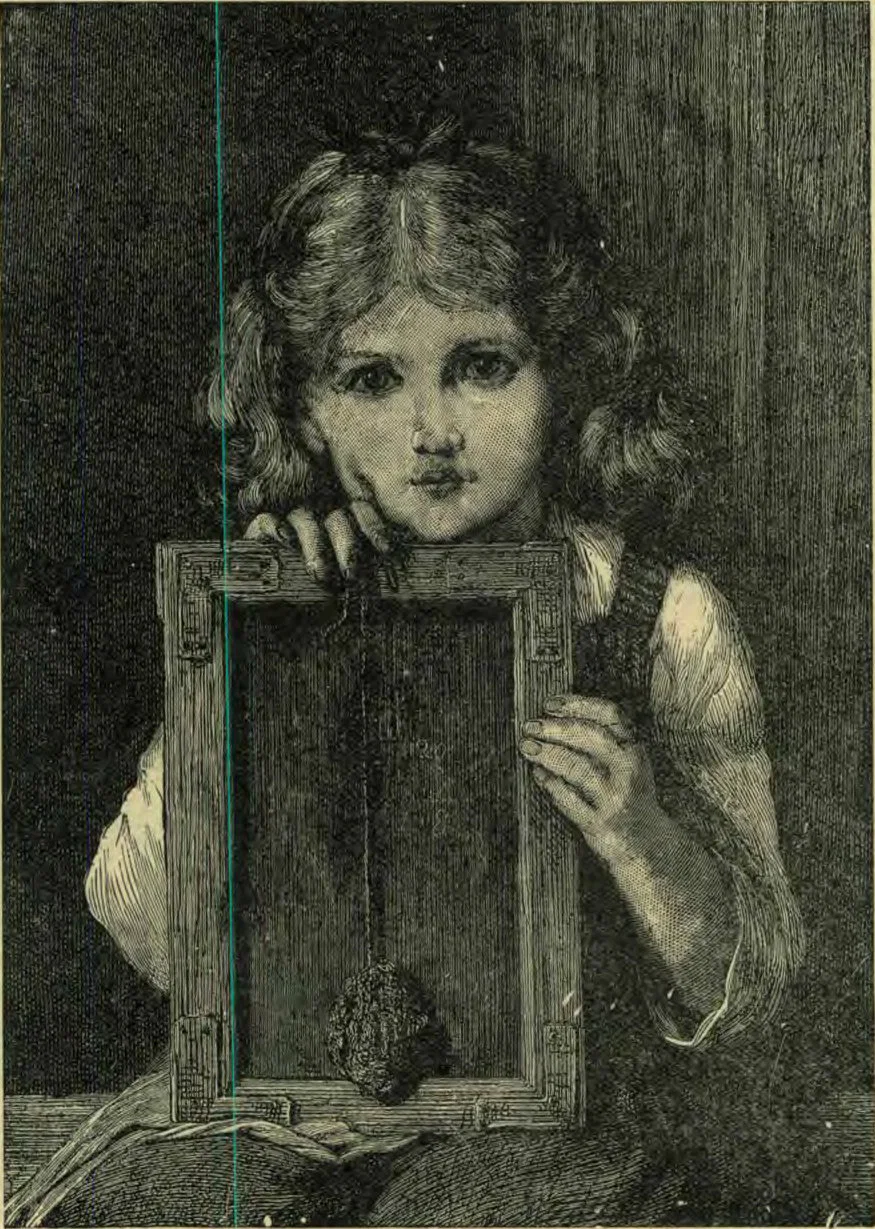
“O DEAR!” and Esther sighed wearily as she bent over the tiresome figures on her slate. The long afternoon sun shot slanting in at the window of the little red school-house, where thirty restless children were thumbing the leaves of their well-worn books. The last class in spelling was on the floor, and Esther had not finished her problem. It wasn’t such a very hard example, but Esther was a little girl, and didn’t like arithmetic. Yet she kept at it; for there was to be a prize given at the end of the term to the one who had the most perfect lessons. The prize was a copy of “Robinson Crusoe,” handsomely bound in blue and gold, and full of pictures. Books were scarce in Esther’s home, and she wanted this one so much.
But now the spelling class was dismissed, and all the scholars were putting away their books for the night. Esther looked ruefully at the long columns of figures on her slate and the answer that, try as hard as she pleased, she couldn’t prove to be right, and something very much like tears shone in a pair of great hazel eyes as she straightened up her desk.
After the supper dishes were washed that evening, Esther sat down again to the puzzling example. The arithmetic class came the first thing in the morning, and she must get her answer ready to-night. But it was as bad as ever, and she couldn’t get it right. By and by mamma called her to go to bed, and the problem had to rest.
There was no time in the morning, for in this busy household, every one had his appointed tasks, which he was expected to do. So Esther took her lesson and went to sweep and straighten up brother Jack’s room. When she was whisking her duster around the books on the corner shelf, a little one on the end fell off to the floor.
Esther stooped to pick it up, and paused. What chance had placed that book in her way? She did not know Jack had such a book. It was an arithmetic just like hers, and beside each problem was plainly written in black ink the correct answer.
Esther turned over the leaves till she came to the place where her lesson was. Her answer was nearly the same; there was only one figure in the tens that was wrong. What hurt would it do if she should copy the answer and hand it in for hers? She was sure she had worked long enough on it to have it right, and nobody would know. It was but the work of an instant, and the book was put back in its place.
With a smiling face, Esther went to school, and when the arithmetic class recited, was marked perfect in her lesson; but her conscience was not quite at ease. Everything said that day seemed to have something in it about honesty. The reading lesson was about an honest boy that would not tell a lie to save himself from punishment; and Miss Lewis said she hoped they would all strive to be strictly honest in their lessons, for that would be better than any prize they might win.
Esther knew she had not done right, and that she ought to tell Miss Lewis about it; but she put it off that day, and on the morrow, the warning voice of conscience grew more faint, till it ceased to trouble Esther. “It will not matter much,” she said, “if I don’t do it again.”
At length the last day came. There was to be speaking and singing at the school-house, and the children’s parents and friends were to be present, and the prizes presented. The little room had been gaily decked for the occasion with wreaths and flowers, and through the open door and windows came sweet scents of lilies and clover and blossoming orchard trees.
When the exercises were over, Miss Lewis rose to give the prizes. “There are two scholars,” she said, “who stand so nearly equal in their studies that it has been a difficult matter to decide which one to award with the prize. These are Jennie Feverel and Esther Hallern. However, as Esther has had one more perfect mark than Jennie, she may come forward and receive the prize.”
With beating heart and triumphant face, Esther felt the coveted book in her hands, and heard Miss Lewis’s kind words as she handed it to her. But as she turned to go to her seat, she saw over in the corner her dear friend Jennie sobbing as if her heart would break over the disappointment.
With a sudden twinge of conscience, Esther remembered how unfairly the prize had been won, and paused half way down the aisle.
“What is the matter, Esther?” said Miss Lewis kindly, as she saw her stand there, her face flushing and paling by turns, as every moment her action looked meaner.
“O Miss Lewis,” said Esther, her voice growing so husky she could hardly speak above a whisper, and her eyes filling with tears of shame. “The prize is no more mine than Jennie’s. I copied one lesson out of Jack’s arithmetic; and the book belongs to her because she didn’t cheat,” and with a new sense of honor, Esther laid the beautiful book on Jennie’s desk.
Miss Lewis said a few words in reply, though what they were Esther could not have told, for her shame and disappointment crowded out everything else. Then school was dismissed.
Esther took her books and hurried home alone, not waiting even for her mother to come with her, and flung herself down in the grass under a full-blown pear tree, where the soft wind sent down showers of petals over a very miserable little girl. Here her mamma found her. Then there followed a quiet talk that Esther will never forget. Jennie kindly came over most every afternoon with her book, and by the last of vacation they had finished the story together.
When Esther gathered up her books, on the morning school began again, she was very much delighted to find a new history and a book-slate laid beside them—presents from her mamma for her generosity and truthfulness about the prize.
W. E. L.
Letter Budget.
Some of the letters in this paper have waited long, and many others are waiting still, but while they wait we hope the writers of them are not idle, but are busy in good works, busy with their study, and at times with their play. But what about missionary gardens, flowers, and chickens? Be sure to have a few flowers to cheer the sick and sorrowing ones. We hope by and by to hear the best report of your work that has ever appeared in the Budget. Our first letter is from a little boy away almost to the Pacific Ocean. You see he lives on the water a part of the year. What little boy or girl can answer his queries about the tides, and the sea in the new earth? Perhaps some who have lived on the water longer than he would like to explain about the tides.
HARRY HAINES, a little boy eleven years old, writes an interesting letter from Chehalis Co., Wash. Ter., where he lives with his parents. He says: “We live just at the head of Gray's Harbor, twenty miles from the Pacific Ocean. This is a new place, and there are no roads; for the village is built on tide land, and people have to go about in boats. Of course we don't have any horses. They could not be used if they were here, and they could not be brought here only in a boat. Every time there is a full moon in the winter months the tide covers the ground from one to two and a half feet deep, and sometimes we get a high tide when it isn't full moon. Last night the wind blew hard all night from the south-west, and when the tide came in next day, it was the highest we had ever seen it. The houses and sidewalks are all built on posts two and a half and three feet high; but the water came into some of the houses that day, and the walks were afloat. Some days when school is out they have to come after us in boats, and in a few hours the water is all gone. We have only lived here since last spring, and it seems strange to us, for we had always lived in Michigan, away from the ocean. In the winter the tide is always higher at the full of the moon, and the highest tide is in the daytime; but in the summer, it is highest at the new moon and in the night. I would like to have it explained in the INSTRUCTOR. I enjoy going to the ocean. I think I wouldn't like to live again where I could never see it. I wonder if Rev. 21:1 means there will be no ocean in the new earth? I hope not. I am eleven years old, and keep the Sabbath with my mother, two sisters, and two brothers. We know of no Sabbath-keeper within three days' journey of this place, so we have no meeting or Sabbath-school to attend; but we learn the lessons in the INSTRUCTOR every week. We have had the paper in our family since I can remember, but this year I paid for it myself, and it comes in my name. I am glad I belong to the INSTRUCTOR family now; and when the time comes that God's kingdom will fill the whole earth, as we have been studying about in our Sabbath-school lesson, I want to be a member of it. There are many strange and wonderful things here, and if you print this, when I can write better, I will write again.”
MAY SMITH, aged ten years, writes from Allegan Co., Mich. She says: “I have one brother, eighteen months old, but I have no sister. We live on Seminary Hill. I go to day school, and to Sabbath-school with mamma. Papa does not keep the Sabbath. Last fall I earned twenty-five cents by hand-picking over beans for papa, and I am going to pay it for the INSTRUCTOR. I hope to see this, my first letter, in print. I want to be a good girl and be saved in the new earth.”
BERTIE R. CRAWFORD writes from Juneau Co., Wis. He says: “I live on the south side of a big hill, and we have fine sport sliding down it. The cars pass near our house very often. We had a new church built last year. We have a Sabbath-school of about sixty-four members. I have never seen a letter in the Budget from this place. I hope you will print this. I am ten years old. I have one sister and six brothers,—one a baby brother. We all keep the Sabbath. I want to be a good boy.”
ARTHUR DUNN, of Linn Co., Iowa, writes: “I have never seen a letter from here, and I thought I would write and tell you we had a Christmas tree, and our church put forty-two dollars on it. I went to camp-meeting last August, at Des Moines, and I attended the children's meetings, which were very interesting. If I can, I shall go next year. I am thirteen years old. I have one brother and one sister, and we all keep the Sabbath. I want all my sins blotted out.”
Bad Habits Gather by Unseen Degrees
Bad habits gather by unseen degrees,
As brooks make rivers, rivers run to seas.
NO! NO! NO!
WHEN by others urged to tread
A path you should not go,
Let them blame you, if they will,
But firmly answer, No!
Do the right with all your might,
A good example show,
Nor fear to speak that little word—
No! No! No!
With a frank and honest face
The wary tempter meet!
Never try to screen yourself
By falsehood's vain deceit.
Tell the truth, whate'er you do—
The truth where'er you go;
Nor fear to speak that little word—
No! No! No!
When you feel a course is wrong,
And conscience tells you so,
Though a friend should bid you err,
Be firm, and answer, No!
Thus in every step of life
A good example show,
Nor fear to speak that little word—
No! No! No!