Copyright, 1910, by
Milton C. Wilcox. "Let the Revelation speak and tell what is truth. . . . . Uplift Jesus as the center of all hope."
VII. The Church in Thyatira
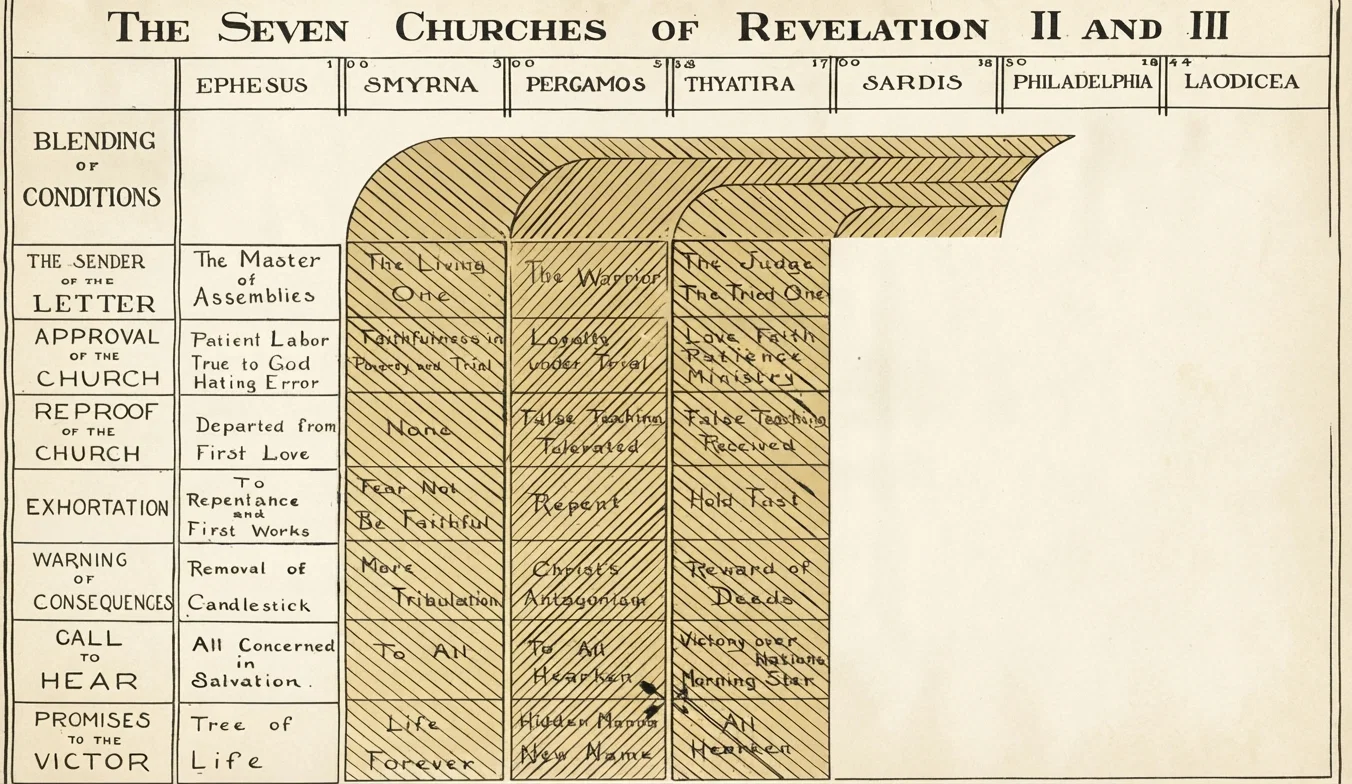
THE Thyatiran church is symbolical of the condition of God's people during the Dark Ages, when truth was trampled under foot, when false teaching tolerated in previous centuries was now bearing full fruitage. Church and state, that ever evil union, was consummated in a fuller degree than past ages had known, and many were yielding their faith and many dying for their faith.
The student will note that it is not the apostate church that God addresses in this symbolism, however holy her profession, however exalted her pretensions, however mighty and wide-spread her influence. Apostasy may call itself a "church" or "the church;" it may even call itself "the Catholic Church;" but God never so designates. She is a synagogue, a gathering, is likened to a corrupt woman holding alliance with the kings of the world; while the true church is symbolized by a pure woman. The false is not called by inspiration a church, an ekklesia, a regularly, lawfully called-out body of believers. God's church in Thyatira, therefore, are a comparatively "little flock," persecuted, hunted, scattered, torn; many of them imbibing false teaching, but still His people, because the heart is to do His will; many of them backslidden, but not apostate.
The Answer of the Text
[The answers to the questions are from the American Revised Version. Omitting questions, and disregarding sometimes the capital at the beginning and the period at the close of an answer, the text may be read continuously. In notes and comments both versions are used without designation.]
1. How does our Lord represent Himself to the church in Thyatira?
"And to the angel of the church in Thyatira write: These things saith the Son of God, who hath His eyes like a flame of fire, and His feet are like unto burnished brass."
2. For what did He commend them?
"I know thy works, and thy love and faith and ministry and patience [steadfastness], and that thy last works are more than the first."
3. For what did He reprove them?
"But I have this against thee, that thou sufferest the woman Jezebel, who calleth herself a prophetess; and she teacheth and seduceth My servants to commit fornication, and to eat things sacrificed to idols."
4. What had God done for her, and how did she respond?
"And I gave her time that she should repent; and she willeth not to repent of her fornication."
5. What punishment will come in consequence?
"Behold, I cast her into a bed, and them that commit adultery with her into great tribulation, except they repent of her works. And I will kill her children with death."
6. What would all these consequences teach?
"And all the churches shall know that I am He that searcheth the reins and hearts: and I will give unto each one of you according to your works."
7. Of what did He assure the faithful?
"But to you I say, to the rest that are in Thyatira, as many as have not this teaching, who know not the deep things of Satan, as they are wont to say; I cast upon you none other burden."
8. What earnest exhortation does He give?
"Nevertheless that which ye have, hold fast till I come."
9. What is the appropriate promise to the overcomer in Thyatira?
"And he that overcometh, and he that keepeth My works unto the end, to him will I give authority over the nations: and He shall rule them with a rod of iron, as the vessels of the potter are broken to shivers; as I also have received of My Father: and I will give him the morning star."
10. What is still pressed home upon the heart of the individual?
"He that hath an ear, let HIM hear what the Spirit saith to the churches."
Note and Comment
1. "Thyatira" was an important town of Asia Minor, on the Luces River, having a large Greek population, and noted for purple dyeing and weaving. Lydia, Paul's first convert at Philippi, was from Thyatira. Its name is from two Greek words meaning "to bruise," and "incense, or sacrificial rites," a fitting emblem of the true church during the Dark Ages. "The Son of God."-The Divine One. In chapter 1:13 we have the "Son of Man" glorified; here, the Son of God supervising and superintending His church. The eyes of Deity pierce to the inner secrets and motives of the heart; and His feet like burnished brass are to remind us that He has passed through the sevenfold heated furnace. No depth of iniquity can be hidden from Him; no pathway through suffering but what He has traveled.
2. "Thy works."-How the fierce persecutions and manifold trials of the Dark Ages - about A.D. 500 to 1600 - developed the approved graces of love and faith and ministry and patience, or patient endurance,-love for God, which held them despite the many voices calling; faith to walk for God in the darkest spiritual period of earth; ministry, loving service to those in like affliction; and endurance, patience, steadfastness, even unto death. Of that period we read elsewhere, "Here is the patience and the faith of the saints." Rev. 13:10. "They shall fall by the sword and by flame, by captivity and by spoil, many days." Dan. 11:33. That "many days" was the long period of the papal persecutions - 538 to 1798 - shortened at end and beginning in sharpness of persecution for the elect's sake. See Dan. 7:25; Matt. 24:21, 22, 29. In the latter part of this period came the Reformation, when the hopes, the zeal, the earnestness of God's true people were revived. The "last works" were more than "the first."
3. "Jezebel."-The meaning is "unhusbanded," not lawfully married. She, like many of the symbols of the Revelation, is an Old Testament character. Balaam, Jezebel, Babylon, Jerusalem, the beast, the dragon, the candlesticks, the stars, the manna, the scroll, the plagues, the song of Moses,7the symbolic description of Christ's person, the Tree of Life, in fact the whole book is filled with Old Testament imagery and symbolism, familiarity with which will better enable us to understand the Revelation. Jezebel was the daughter of Ethbaal, the sun-worshipping king of Sidon. He was formerly a priest of Astarte, the Phenician Venus, and made his way to the throne by murdering his predecessor Pheles. Ahab, the king of Israel, departing from the command of God, married the corrupt, iron-willed princess Jezebel, herself a devoted sun-worshipper of Baal and Astarte, or Ashtoreth, and herself seemingly a priestess and devotee of the licentious rites. Four hundred priests of Astarte ate at her table, and at Baal's sanctuary there were 450 priests or prophets, with a temple large enough to contain thousands. Into this horrible, cruel, licentious idolatry Ahab and Israel were led. Under the symbols of Jeroboam's calves Israel in a way still worshipped Jehovah and acknowledged His law; but under the influence of Jezebel there was utter separation from Jehovah. Israel turned from their union with God to union with the sinful world. The fornication of their abominable worship was the fitting outward emblem of their deeper spiritual fornication in turning from God to Baal. It was the mightiest step in Israel's ruin. Ahab was not wholly bad, but he could not resist his far stronger paramour.
4. "Who calleth herself."-Jezebel fitly represents the apostasy under the Papacy. She exalts herself as the mouthpiece of God. Like Jezebel, she brooks no oppositions, tolerates no dissenting opinions, persecutes to the death those who lift faithful voices against her. By her teaching she leads astray. By honors she seduces. The word planan, rendered "seduce," as Vincent remarks, "never means mere error, as such, but fundamental departure from the truth." This the Papacy has taught by assuming to change the royal law of God, and by putting man in the place of Christ in the Gospel. But of this more later, when the prophecy is more explicit. All these teachings and seductions the true church should have resisted to the death; but they tolerated them, and were weakened thereby.
5. "Time . . . repent."-God is not willing that any should perish. Not a soul ever sinned in God's universe - angel or man - that God did not give space, time, and opportunity to repent. So He did those in the great antichristian apostasy. There were centuries of exhortation and entreaty and protest before the Reformation, voices within and without the Roman fold, but they were unheeded.
6. "Great tribulation."-Nearly all the wars and strifes and sufferings of the Dark Ages came because of the union between church and state. Plots, conspiracies, rebellions, cabals, cliques, wars, and all the horrible work of the Inquisition came because of the self-assumed authority of the antitypical Jezebel. Century after century dragged on till relief to overburdened men and nations came in the revolutions from the sixteenth century on. Some of these were socialistic and infidel, some of them scholastic and infidel, some of them political, and some of them, thank God, truly spiritual, a return to first principles of salvation through Christ alone and to the Bible as the standard of faith - at least professedly so. The strife of centuries and the loss of millions of lives would have been prevented if the church had kept out of politics, and the civil governments had been left free from her domination, intrigue, and seduction. All that came was the result of the unlawful union of religion with the state, the fornication of the apostasy, who, espoused to God, left her rightful Lord, and united with the world. Yet there was time for "repentance out of her works" and into Christ's works within till the Reformation broke. The warning is as good to-day.
7. "Shall know."-God's Word and fulfilled history make plain, and every true child of God ought to read, the lesson that is taught by the Dark Ages; namely, that no church is good enough to dominate the faith of a single soul. All the spiritual slavery and ignorance and debasement and decadence of the Latin nations have come in consequence of the spiritual fornication of that period. It is one of the saddest things that Roman Catholics are aspiring after, the very things which well-nigh wrecked the world, and that Protestants and civil governments are tolerating, being seduced by the same teaching.
18. And unto the angel of the church in Thyatira write; These things saith the Son of God, who hath His eyes like unto a flame of fire, and His feet are like fine brass;
19. I know thy works, and charity, and service, and faith, and thy patience, and thy works; and the last to be more than the first.
20. Notwithstanding I have a few things against thee, because thou sufferest that woman Jezebel, which calleth herself a prophetess, to teach and to seduce My servants to commit fornication, and to eat things sacrificed unto idols.
21. And I gave her space to repent of her fornication; and she repented not.
22. Behold, I will cast her into a bed, and them that commit adultery with her into great tribulation, except they repent of their deeds.
23. And I will kill her children with death; and all the churches shall know that I am He which searcheth the reins and hearts: and I will give unto every one of you according to your works.
24. But unto you I say, and unto the rest in Thyatira, as many as have not this doctrine, and which have not known the depths of Satan, as they speak; I will put upon you none other burden.
25. But that which ye have already hold fast till I come.
26. And he that overcometh, and keepeth My works unto the end, to him will I give power over the nations:
27. And he shall rule them with a rod of iron; as the vessels of a potter shall they be broken to shivers: even as I received of My Father.
28. And I will give him the morning star.
29. He that hath an ear, let him hear what the Spirit saith unto the churches.
Lessons from the Thyatiran Church
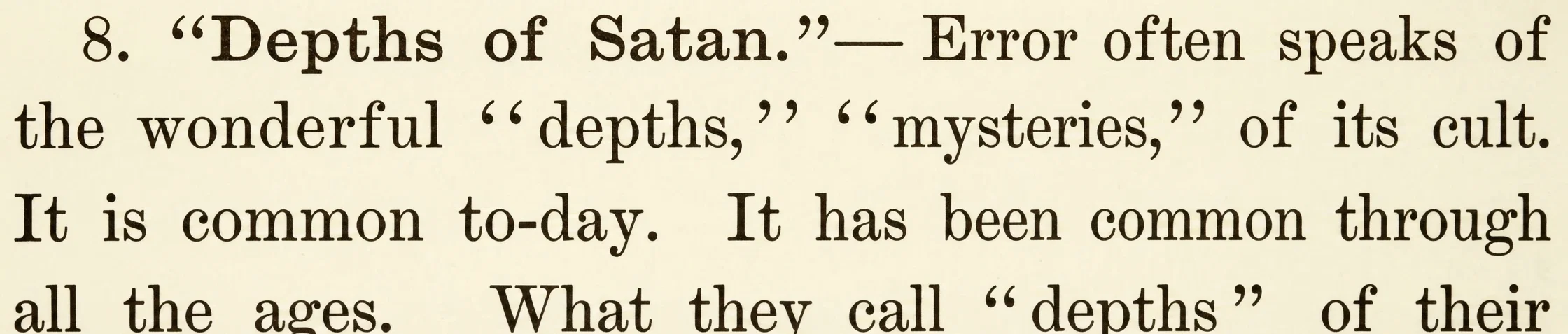
teachings, Christ calls “depths of Satan.” The rest have not accepted these revamped mysteries of heathenism, originated by Satan; God will not place upon them heavier burden to bear; they will see no greater affliction. The days of tribulation were shortened for the elect’s sake; the light of the Reformation eased the church’s burden of the Dark Ages.
8. "Depths of Satan."— Error often speaks of the wonderful "depths," "mysteries," of its cult. It is common to-day. It has been common through all the ages. What they call "depths" of their
9. “Hold fast” whatever may come. Some in the Thyatiran condition in some countries may exist to the end. “Hold fast till I come,” is the Lord’s blessed entreaty.
10. “Authority over the nations.”—How appropriate, how fitting the promise to the persecuted church of the centuries. The nations, misled and misguided, have had authority over God’s children, have persecuted, tormented, slain them. In God’s plan there will be a reversal. The Master was identified with them in the sacrifice, the suffering, the tribulation; when infinite justice demands that He shall come and destroy sin and oppression, and as sin will be reckoned all who are then identified with it, His saints will share with Him that eternal triumph. See Psalm 149.
11. “Hear” what the Spirit says. The same principles which made Balaam and his followers, which made the Nicolaitans, which made Jezebel and those associated in her wickedness, are still operative, and will make similar characters now if men yield to them. Our safety is to let the eyes of the Son of God shine away the sin, and Himself live in us.
How God’s Character Is Received
By R. S. Owen
God’s character is revealed to man in the person of Jesus Christ. To have Christ in us is to be one with God, as Jesus said, “I in them, and Thou in Me, that they may be made perfect in one.” But any man who is in Christ Jesus is a new creature, or creation. 2 Cor. 5:17. In him is manifest creative power. In this new creation is revealed the name or character of God, for His works declare His name; and the sign or memorial of this name, the Sabbath (Ex. 20:8-10), ought to be seen upon this new creature. O, my dear reader, if God has made you a new creature in Christ Jesus you ought to carry to the world His Sabbath, which is the sign, or seal, of His creative power. Do not deny your Father’s name by being ashamed of the sign and by failing to keep it. See Rev. 3:8-11.
When God finished the creation of the world in six days, He entered on the seventh day into His rest and was refreshed. Ex. 31:17. Not, however, by physical rest, for the Creator “fainteth not, neither is weary.”8But He rested. He viewed His new creation, and saw that it was good, and He rejoiced and took delight in it. And this was His rest, while the morning stars sang together, and all the sons of God shouted for joy. So, my dear reader, if you have looked to Him, and find in Him for you a new creation, and are rejoicing in it, you have entered into God's rest, "for we which have believed do enter into rest." It is therefore your privilege to shout for joy, and to join in the song of the angels who are rejoicing in the presence of God over one sinner who has repented. Such "call the Sabbath a delight, the holy of the Lord, honorable." Such do not do their own ways, nor find their own pleasure, nor speak their own words (Isa. 58:13); but they delight in the law of the Lord, and in His law do they meditate day and night (Ps. 1:2).
R. S. OWEN.
Our Bible Reading
The Sabbath in Israel
1. What charge did Pharaoh bring against Moses and Aaron after these men of God taught the Israelites?
"And Pharaoh said, Behold, the people of the land now are many, and ye make them REST from their burdens." Ex. 5: 5.
NOTE.—The word here rendered "rest" comes from the same root as "Sabbath," so that making them rest from their burdens was equivalent to saying that they were instructed to keep the Sabbath day and so did.
2. Upon what did the Lord test the Israelites as He brought them out of Egypt?
"Then said the Lord unto Moses, Behold, I will rain bread from heaven for you; and the people shall go out and gather a certain rate every day, that I may PROVE THEM, whether they will WALK IN MY LAW, or no."
"And it came to pass, that there went out some of the people on the SEVENTH DAY FOR TO GATHER, and they found none. And the Lord said unto Moses, How long refuse ye to KEEP MY COMMANDMENTS AND MY LAWS?" Ex. 16: 4, 27, 28.
3. By what great constant miracle did God point out the specific day to that people?
By the manna's falling constantly six days in the week, by the double portion which fell on the sixth day, by the preserving power which would keep that over the seventh day, by the withholding of the manna on the seventh day, and this continuing for forty years. See Ex. 16: 22-29, 35.
4. In the idolatry of Israel what transgression is specially marked?
"But the house of Israel rebelled against Me in the wilderness: they walked not in My statutes, and they despised My judgments, which if a man do, he shall even live in them; and MY SABBATHS THEY GREATLY POLLUTED: then I said, I would pour out My fury upon them in the wilderness, to consume them." Eze. 20: 13.
5. What did the Lord forewarn them that their departing from the Sabbath would bring?
"But if ye will not harken unto Me to hallow the Sabbath day, and not to bear a burden, even entering in at the gates of Jerusalem on the Sabbath day; then will I kindle a fire in the gates thereof, and it shall devour the palaces of Jerusalem, and it shall not be quenched." Jer. 17: 27.
6. What did He declare that the keeping of the Sabbath would mean to their kingdom and city?
"And it shall come to pass, if ye diligently harken unto Me, saith the Lord, to bring in no burden through the gates of this city on the Sabbath day, but hallow the Sabbath day, to do no work therein; then shall there enter into the gates of this city kings and princes sitting upon the throne of David, riding in chariots and on horses, they, and their princes, the men of Judah, and the inhabitants of Jerusalem: and THIS CITY SHALL REMAIN FOREVER." Jer. 17: 24, 25.
7. What reformation does He demand regarding His Sabbath?
"If thou turn away thy foot from the Sabbath, from doing thy pleasure on My holy day; and call the Sabbath a delight, the holy of the Lord, honorable; and shalt honor Him, not doing thine own ways, nor finding thine own pleasure, nor speaking thine own words." Isa. 58: 13.
8. What encouraging promise does He give to the Gentiles who would take hold of His Sabbath?
"Blessed is the man that doeth this, and the son of man that layeth hold on it; that keepeth the Sabbath from polluting it, and keepeth his hand from doing any evil. . . ."
"Also the SONS OF THE STRANGER, that join themselves to the Lord, to serve Him, and to love the name of the Lord, to be His servants, every one that KEEPETH THE SABBATH from polluting it, and taketh hold of My covenant; even them will I bring to My holy mountain, and make them joyful in My house of prayer." Isa. 56: 2-7.
9. What is the last reform recorded which was wrought in Israel before Christ came?
"Then I contended with the nobles of Judah, and said unto them, What evil thing is this that ye do, and PROFANE THE SABBATH DAY? Did not your fathers thus, and did not our God bring all this evil upon us, and upon this city? yet ye bring more wrath upon Israel by profaning the Sabbath. And it came to pass, that when the gates of Jerusalem began to be dark before the Sabbath, I commanded that the gates should be shut, and charged that they should not be opened till after the Sabbath: and some of my servants set I at the gates, that there should no burden be brought in on the Sabbath day." Neh. 13: 17-19.
10. What reform was taught by our Lord to lift the Sabbath from its burdensome traditions?
"How much then is a man better than a sheep? Wherefore it is LAWFUL TO DO WELL ON THE SABBATH DAYS. Then saith He to the man, Stretch forth thine hand. And he stretched it forth; and it was restored whole, like as the other." Matt. 12: 12, 13.
11. How long does God design that His Sabbath shall remain among His true Israel?
"It is a sign between Me and the children of Israel forever: for in six days the Lord made heaven and earth, and on the seventh day He rested, and was refreshed." Ex. 31: 17.
"For as the new heavens and the new earth, which I will make, shall remain before Me, saith the Lord, so shall your seed and your name remain. And it shall come to pass, that from one new moon to another, and from ONE SABBATH TO ANOTHER, shall all flesh come to worship before Me, saith the Lord." Isa. 66: 22, 23.
NOTE.—Israel, God's true Israel, shall be saved with an everlasting salvation. That new earth shall be eternal. Isa. 45: 17, 18. Even so long will God's children observe His Sabbath.
The Crisis of Luther's Life
By Arthur C. McGiffert
From Arthur C. McGiffert's "Martin Luther and His Work" in the December Century
LUTHER's life was full of startling and unexpected crises, and the first and most startling of them all came in the summer of 1505, after he had been a law student for less than six months. He had just been home for a brief visit. His progress in his work had been all that could be desired, and his parents' pride and hope were higher than ever, when suddenly, to the consternation of everybody and to the wrath of his father, who was already thinking of an honorable marriage for him which should still further improve his prospects, he threw it all up and went into a monastery. The immediate occasion of this extraordinary step was a terrific thunder-storm which overtook him just outside the town when he was returning from his visit home. In mortal dread of death, he threw himself on the ground, crying to the patron saint of the miners, to whom he had often turned in seasons of distress: "Help, dear Saint Anna! I will become a monk."
Frontier Fighting
WITH most temptations, to get to close quarters is to seek disaster. A temptation is dangerous in direct ratio to its nearness to us. And there are many temptations that we do not need to let get near to us; we can see them coming, and can have them disposed of at a safe long range.
Bishop Oldham, of India and the Philippines, has given to young Christians the wise counsel, "Fight temptation on the frontier." It is when a temptation gets well within our heart, and is argued with or struggled with there, in our life citadel, that it has a terrible advantage.
There are outposts of our life—in our mind, and sight, and feelings—who usually recognize the approach of a temptation, and whose duty it is to notify instantly the forces at our disposal for the fighting and defeating of the temptation before it comes any closer. That is frontier fighting.
The only way this can really be done is to turn it over to Jesus Christ. When the message is flashed to us that the enemy is coming, when any temptation shows itself on the far horizon of our life, let us instantly cry, "Lord Jesus, defeat it for me, now, before it gets any closer." And He will. He loves to do this for us. We can move on, day by day, in habitual victory over besetting sins, when we let Christ rout them in this way on the frontier of our lives. It is so much easier than desperate struggling, and so much safer.—Sunday School Times.
Will the Heathen Hear of Christ?
By C. O. Cushman
By C. O. Cushman
WILL the millions who have died without a knowledge of Christ or the Gospel, have an opportunity sometime of hearing the wonderful plan? Did Christ die for all? Wouldn't it be unjust to destroy those who could not hear, who had not a chance? Does not Christ desire that none shall perish, but that all should come to repentance?
These and other questions are often asked by those who do not study principles. They are important questions, and demand our careful consideration. They are important because God has revealed just how it is, and everything He has revealed it is our duty to search out.
Some who ask these questions, believe that God will give the heathen an opportunity of accepting Christ during the millennium, they say, while He reigns on the earth with His saints in their immortal state. But this would be compelling acceptance. Would it be just, under those circumstances, to compel the wicked to accept or reject Christ without faith? Such a step would be contrary to God's plan and man's free choice. Really, has God hidden the Gospel from any in this life, in order that He could bring them under more favorable conditions for knowing Him with the redeemed in their glorified state? Who would not accept Him then, that is, till the selfish heart demanded more?
We often hear men say, If I could see Him I would believe on Him. But many saw Him and did not believe. All the wicked will acknowledge Him in the day when He comes; but they will be lost, for there is no change to the Master's character. The facts of the case are these:
If, therefore, the heathen are saved, they, with the rest of the redeemed, will be caught up to meet the Lord when He comes; for nothing will take place on earth during the one thousand years in the way of salvation. At the expiration of that period the wicked who have long been dead, and those who perished in the brightness of Christ's coming, when He took His people to Himself (2 Thess. 2: 1-8), shall be destroyed (Rev. 20: 7-15). When Christ comes, those who are righteous will remain righteous, and those who are wicked will remain wicked. Rev. 22: 11, 12. The righteous will be saved by their faith and works, and the wicked will be lost because they have rejected Christ the Light.
3. To all God gives opportunity. All good gifts come from the Father of Lights. James 1: 17. To every one comes the Light "that lighteth every man that cometh into the world." John 1: 9. It may be faint or dim, but it is always sufficient for the soul to choose. For that measure of light and opportunity we are responsible, whether we believe it or not, and for it will we be held accountable. "If our Gospel be hid, it is hid to them that are lost." 2 Cor. 4: 3. The man who received the one talent, did not improve it, thus hiding it, and was cast out. We hide the Gospel by not yielding to its power. We turn from the true Light, and are left in darkness. We cherish the sins we know, and are lost. Many a heathen has followed the one ray of light till he has reached the Sun of Righteousness. Altho he knew nothing of the person of Jesus, he followed the best he saw of the plan of Christ. Observing the things visible, tho he can not know the invisible, he will be "without excuse" in the day of the Lord's reckoning. Rom. 1: 18-22. All will be held responsible for the amount of light they have. "For unto whomsoever much is given, of him shall be much required." Luke 12: 48. "For when the Gentiles, which have not the law, do by nature the things contained in the law, these, having not the law, are a law unto themselves." Rom. 2: 14. No paraphrase could make the text clearer than the next verse does: "Which show the work of the law written in their hearts, their conscience also bearing witness, and their thoughts the meanwhile accusing or else excusing one another."
We need not trouble ourselves about the prospects of the heathen. He will receive absolute justice with the rest of mankind. We are held responsible for the way we use the light which shines upon our pathway.