Because of the arrests of the McNamaras and others for the destruction of the Los Angeles Times building, the Socialists propose to make "California a battle-ground." "California for Socialism," says one of the leading Socialist organs, "is the answer the working class is making to the organized capitalist, more especially the steel trust and General Otis, their Western representative, in their cold-blooded attempt to murder McNamara." Whether these men under arrest are innocent or guilty we have no means of knowing. But we do know that there is a large class who believe strongly that they are innocent; there is another large class who believe just as strongly that they are guilty. And between these two classes there will be a strong fight made, not only in the courts, but also through the newspapers. Strifes of this kind are growing both in frequency and in bitterness. The foregoing quotation shows that the Socialists regard the arrest and trial of McNamara as a "cold-blooded attempt to murder." They do not admit the possibility (or at least such is the case with the author of the foregoing quotation) of his guilt. It must be seen that the final outcome of such discussions will be rioting and violence. With the discussions between these two classes we have no sides to take. There is a far greater problem before the world. What do these sure portents of an oncoming storm of violence and rioting signify? Reader, have you ever given attention to all these problems of modern society from the standpoint of plain Bible prophecy? There are many who would sneer at the idea of the Bible taking any of these things into account; but, just the same, this journal for more than a third of a century has been calling attention to how society would more and more come into a condition that would make for violence and strife, and we see how events are driving in that direction. Keep your eyes open to the situation. We have reached only the beginnings. The great storm lies on beyond.
An "arson trust" has just been disclosed in Chicago through the arrest of Leopold Dreyfus, a wholesale clothier. The trust has been operating in Chicago, New York, Cincinnati, and other cities. The trust employs persons to keep on the watchout for business men who are in a hard place for lack of ready cash, and when these are found who are in business distress they are "approached" with the suggestion that for a certain per cent of insurance money together with a certain advance fee, the trust will undertake to have their property "mysteriously" burned down. The owner has nothing to do with the matter except to pay the fee and the percentage. The trust attends to all the details of the burning through its secret agents. Men who can stoop to such base things have certainly reached a very low level.
The Mormons in Europe.
There is a tremendous sentiment stirring through Europe against the Mormons and their propaganda. They have been severely attacked in the Scandinavian countries and also in England. Strange to say, in this latter country they have found defenders. These defenders evidently do not understand the Mormon system. Germany, with her characteristic forthrightness, does not stop to mince matters at all. The Church of Latter-Day Saints is simply scheduled as "an illicit religion," unrecognized by the State. They are not given the privileges that other illegal religions have. Permission to reside in Germany is not refused them; but they are not permitted to proselytize, and public meetings of Mormons are subject to the provisions of the law, which compels the holders of any public meeting to give notice of the same to the police in advance. This is true of other religions, and permission is usually given; but the police always refuse permission for Mormon meetings; and in nearly all attempts to hold meetings by foreign Mormon missionaries, the missionaries are expelled from Germany as undesirable aliens. For instance, on July 22, 1910, twenty-one missionaries, mostly young American students, were given twenty-four hours to quit the country. There are about 3,000 Mormons, it is said, in Germany.
It is a strange thing, a startling inconsistency, what would be a traitorous act, if one saw it clearly, to teach that Christ Jesus, the Saviour of all who are saved, of Jews as well as of Gentiles, of antediluvians as well as of modern Christians, saves one class by one code of character and conduct and another by another code; that He is changeable, and therefore unwise, short-sighted; that the seventh-day Sabbath was all right for forty centuries, but not for twenty; that the Ten Commandments were loved and observed by Jesus our Lord, in the full freedom of love, but they are to us a "yoke of bondage." How such must lose the harmony, the beauty, of the Word! The next thing is higher criticism or Roman Catholicism.
A train wreck on the Santa Fe Railroad near Domingo, New Mexico, on June 9, killed one, fatally burned three others, while many more were more or less seriously injured.
"Questions and Answers"
By Editor
Would you appreciate a brief, practical, intelligent exposition of the "puzzling" or "hard" texts of the Bible? You should have a copy of "Questions and Answers," the new book given as a premium with this paper.
Over 250 pages
Topical and textual Indexes
Almost 300 questions and answers
Substantially bound in cloth
Contains the most important matter that has appeared in the Question Corner Department of the "Signs" for a number of years, very carefully selected and conveniently arranged
Not for sale
Given as a premium
For $2.00 we will send the paper 1 year and one copy of the book
For $3.50 we will send the paper 2 years and one copy of the book
For $3.50 we will send the paper 1 year to two addresses and one copy of the book
Papers and books may be sent to separate addresses
Example—
The paper 1 year . . . . $1.75
Value of the book . . . . 1.25
Total . . . . . $3.00
Special, paper and book, $2.00
Order through our nearest depository
or address
THIS PAPER
The House-Fly and Disease
BECAUSE the common house-fly is so potent an agent in spreading disease, many methods are suggested for its extermination. Dr. L. O. Howard, who stands at the head of the Department of Entomology in the United States Department of Agriculture, says: "The house-fly breeds only in fermenting organic matter. . . . The larvæ, moving in an excrementitious mass, accelerate putrefaction and help the spread of the putrefactive germs throughout the substance."
Dr. John B. Smith, entomologist in the New Jersey Agriculturist Experiment Station, says: "The campaign is not so much against the fly as it is against the conditions which require the presence of the fly as a natural scavenger. . . . The fly is man's good friend and a necessity so long as man is a filthy animal. When he becomes a clean pig the flies will naturally disappear."
Dr. C. Gordon Hewitt, dominion entomologist, Canada, puts it this way: "House-flies indicate the presence of refuse, garbage, and other insanitary conditions. The house-fly is useful therefore; it is of the greatest use as a danger-signal, as a 'red flag.' But we should not require danger-signals in such enormous quantities."
Prof. S. W. Williston, of the University of Chicago, expresses himself to the effect that the fly is of domestic origin, that it does not exist apart from the insanitary conditions created by man. He points out that it is not found far removed from man's habitations. There are many places in the unsettled regions of the Rocky Mountains where a house-fly could not be found by hours of search. The same authority avers that thirty years ago the fly was unknown on the plains where it now exists in swarms.
In summing up these facts Popular Mechanics says: "Thus it is not the fly which is primarily to blame for epidemics of typhoid fever and the like. It is man's segregation into cities and towns where he has not provided himself with the requisite sanitation. If the cause of the fly be removed, the fly will disappear, largely if not entirely, and the probability is that if in some miraculous way we could exterminate the fly without removing the cause, there would something worse speedily develop to take its place."
The moral of all this is that the sanitary laws of cleanliness proclaimed by Moses, if they were carefully enforced, would rid the world of house-flies, and much of its troubles in the way of infectious diseases.
LETTERS TO A DAUGHTER
By Mother
By a Mother
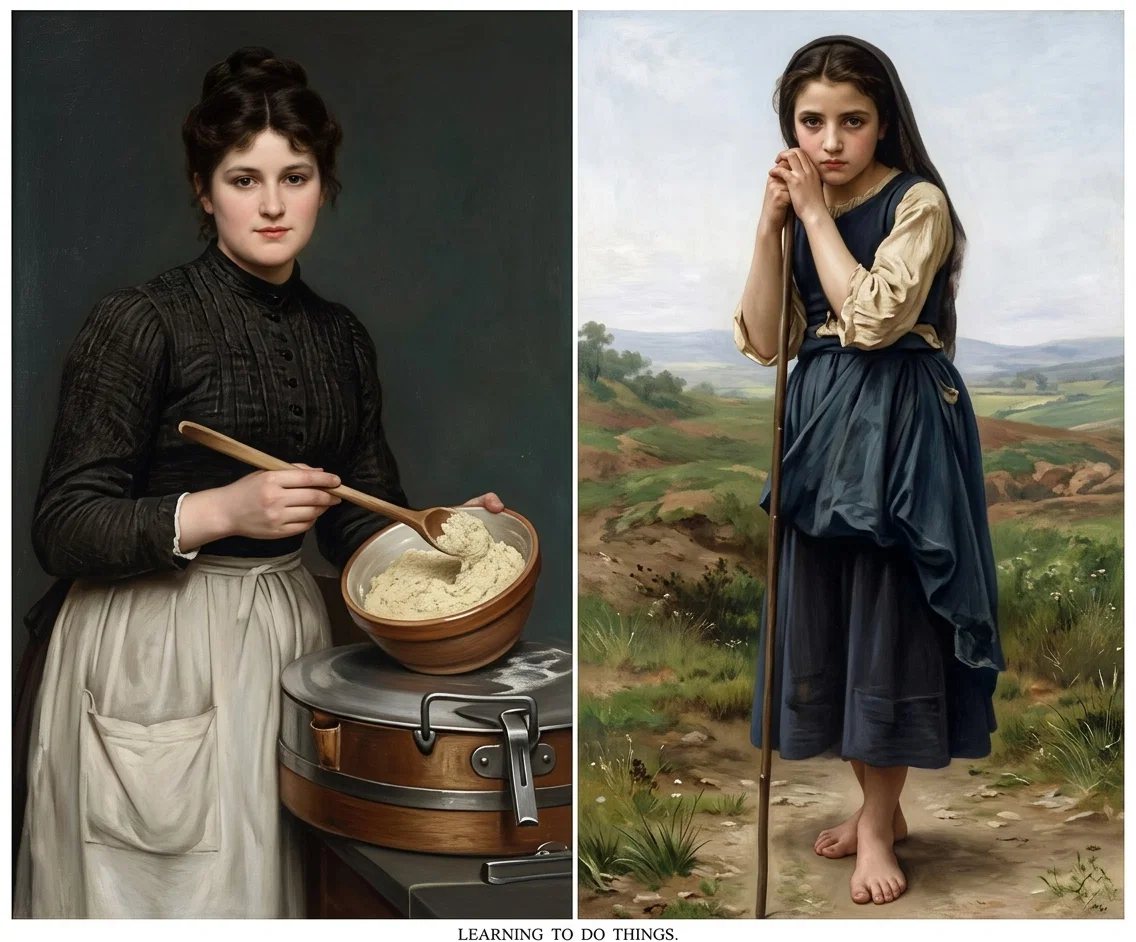
“Learning to Do Things”
MY DEAR DAUGHTER,—
Your letters are full of interest to us. We are more and more glad you are there. Do not be impatient to get at the work that seems to you to represent your purpose.
You know how I prize the spring-time of life, and I am as jealous of every passing day as you can possibly be. Yet I do not in the least regret these weeks and months you are spending in learning to do well this work, which is quite as necessary to the development of an all-round nurse as is the bathing of a sick person or the bandaging of a broken limb.
You say you are still engaged for the most part in washing pots and kettles. Do not despise this day of fundamentals, but strive each day to do your work better. Of course, darling, you will not spend your life at this; you may never do it again. But you will always have to do with this work in a way. You can never teach others to do with despatch and perfection that which you have not learned to do well with your own hands. Remember that life’s accomplishments, like character, blend to make a seamless robe. We can not strengthen a part without strengthening the whole. So while you are learning to wash a pot, leaving it, not once, but always, free from grease and soot, immaculate within and shining without, by the divine law of “the correlation and conservation of forces,” you are learning to assist, perhaps, to perform a delicate surgical operation.
In the Louvre at Paris is a painting by Murillo in which an old kitchen is represented. But doing the work therein are white-robed angels. One is putting the kettle on the fire, another is lifting a pail of water, another doing something else. All are busy, working with a will, refining the work in which they are engaged. “It is the angel aim and standard in an act that consecrates it.” There is no need of being great or doing great deeds in order to share the inspiration of God’s presence.
If we could but learn to measure by God’s standards, we should learn that real greatness lies in perfection in the least. So great is God’s estimate of character.
There is no such thing as chance. We each are in our allotted place, filling our own little niche. No one else can do our work. Would that every one of us could have the understanding of Stradivarius, whom George Eliot makes to say:
If my hand slackedI would rob God — since He is fullest good —He could not make Antonio Stradivarius’ violinsWithout Antonio.
Let this thought be your inspiration in all the work that is given you to do, day by day. Do each task the best it can be done. The reward is your own.
Already you are having the privilege of putting into practise some of the principles of scientific cooking. I am sure this will be a very enjoyable part of your training. You have the promise of being an accomplished cook before leaving this department. To be a practical as well as a scientific cook is no mean accomplishment. Indeed, such are hard to find. And your time will be well spent.
I see that your course of study and manual training takes you through a good course in domestic science. We have certainly chosen well in giving you the advantages of this school. That woman is fortunate who can turn her hand to all the arts that naturally grace the womanly woman.
I am glad to know you are making practical use of some of mother’s home training. I thought perhaps you could find time to make your own uniforms during your hours off duty. I am glad to know your effort has proved so satisfactory. I did not suppose you would dare undertake the making of the coat. You were wise to hire the assistance of an expert for a few hours. Her services were worth much more to you than the pleasure of having a well-fitting garment. It is worth twice the price you paid, to have had this little lesson in doing things right. I am glad you have the satisfaction of feeling the coat is more becoming than any you could get in the shops, and is better finished.
And so you have your fall hat already, and made it yourself! Are you not glad that I insisted upon your taking the course in millinery at the Y. W. C. A.? I am sorry you find it so hard to do up your white shirt-waists satisfactorily. I feel I did you an injustice in not insisting upon better instructions and more practise in the art, while you were at home. I have arranged for your sister two or three weeks with Madam Coin this coming vacation, learning how to wash, starch, and iron a shirt-waist in proper manner. You must struggle on and perfect a method of your own.
I was just looking over your letter. You must have saved at least forty dollars by the things you have been able to do for yourself. And it has been no hardship, I am sure, but rather a pleasure. Now you see you have that money for lectures, concerts, or anything else that will add to you pleasure and profit, while you are in the East. You will find many ways for it. Study to know that which will give you the best returns. This aptitude of yours for doing things will stand you in good stead at all times. In the homes of the well-to-do it will be appreciated. In the homes where much of your work will be, it will be most necessary to your success in giving comfort and relief.
Yes, dear, embrace every opportunity to learn any new accomplishment. First, it will add to the sum total of your worth. Second, you never know when or where you will need it.
The necessity of work — I should say the privilege of work — is man’s greatest blessing; and through it, whatever it is, be it honorable, we attain our highest culture.
My attention has just been called to a newspaper clipping under the heading of “Philosophy of Work,” in which are expressed the sentiments of men whose names are familiar to the world. I will send it to you:
“Nature is just toward men. It recompenses them for their suffering. It renders them laborious because to the greatest toil it attaches the greatest reward.” — Montesquieu.
“It is only by labor that thought can be made healthy, and only by thought that labor can be made happy, and the two can not be separated with impunity.
“If you want knowledge, you must toil for it; if food, you must toil for it. Toil is the law.
“It would be well if all of us were good handicraftsmen in some kind. Work first and then rest. You must do more than pray; you must work.” — Ruskin.
“Shun no work. Make yourself remarkable by some talent or other. Yet do not devote yourself to one branch exclusively. Strive to get clear notions about all.” — Seneca.
“Observe, without labor nothing prospers.” — Sophocles.
“Virtue’s guard is labor.” — Tasso.
“Labor rids us of three great evils, — irksomeness, vice, and poverty.” — Voltaire.
I would rather hear expressed in Voltaire’s language the positive side of this question. I think he would say, Labor gives us four great blessings, — happiness, usefulness, virtue, and prosperity.
Your loving —
MOTHER.
Duty
By Anonymous
I sought to do some mighty act of good,
That I might prove how well my soul
had striven.
I waited, while days and hours passed by,
Yet bore no incense of my deed to heaven.
Sad, without hope, I watched the falling rain;
One drop alone could not refresh the tree;
But drop on drop, till from its deepest root
The giant oak drank life and liberty.
Refreshed, like nature, I arose to try
And do the duty which should nearest lie;
And ere I knew my work was half begun,
The noble deed I sought in vain was done.
—Anonymous.
Fifth Head of the Beast
(Continued from page 2)
and satanic doctrine of the inherent immortality of the soul, and thus, before the day of judgment and awards, it has, contrary to the Bible, peopled heaven with intercessory saints, and purgatory and hell with suffering sinners. It is all but a continuance of the old Babylonian demon-worship and pagan tartarus translated into an apostate Christianity. It makes man's salvation depend on the good works of men instead of the free grace of Jesus Christ. It makes the saints to whom the intercessory prayers are offered omnipresent, like God, or, rather, deceives those who thus seek the aid of "saints" with the veriest mockery. In almost every imaginable way are the character of God, and Christ's priesthood in the sanctuary above, and the ministration of holy angels, perverted by the erroneous doctrines held by many sincere souls, but not the less soul-destroying.
4. WAR WITH THE SAINTS.—We need not recount the war of the Papacy against the people of God. It is estimated that during the 1,260 years over fifty million souls went to their deaths at the cruel and merciless hand of the papal phase of that beast-system. Of course the Papacy did not count them Christians; neither did the Jews count Christ a good man. "He is worthy of death," said they, because "He deceiveth the people" and "subverteth the nation." He is a Samaritan and hath a devil. They are worthy of death, said the Papacy. They are heretics, Jews, infidels, apostates, traitors against civil power. They ought to die. And then she turned them over to the often merciless power of papal governments to be tortured and executed by methods most ingeniously cruel, satanic, and inhuman. Even tho those put to death were very heretics, it is, according to the words of Jesus Christ, greater heresy to put even the HERETIC to death. (See John 12:47; Luke 9:53-56.)
5. POWER OVER ALL NATIONS.—This Spiritual Domination over the nations represented by the ten horns is to be considered in a general way, and not in its absolute sense. There never was a time during the 1,260 years when all the kingdoms of Western Rome were thoroly united in upholding and obeying the Roman see. But by promises, persuasion, craft, combinations, threats, and wars, these kingdoms were kept subject to the Papacy during the great part of this period. The completer fulfilment of that prediction is yet to be seen.
6. THE WORSHIP OF THE BEAST.—The highest worship is not in form or words, but in obedience. This is expressed in the following words of our Saviour: "Why call ye Me, Lord, Lord, and do not the things which I say?" Luke 6:46. "Thou shalt WORSHIP the Lord thy God, and Him only shalt thou SERVE." Matt. 4:10. True service, the doing of God's commandments, is the highest form of worship. As God alone is the only object of worship, it follows that the worship of the beast is a false worship opposed to that of God. And as the highest proof of worship is obedience, it likewise follows that the worship of the beast is obedience to the law of the beast instead of obedience to the law of God. The whole duty of man is summed up in obedience to God's commandments (Eccl. 12:13), His holy law of liberty (James 2:8-12), of which Jesus Christ was the exemplification (Ps. 40:7, 8; John 15:10), and the Decalogue is the summary. The law of the beast power is opposed to God's law. Its distinguishing feature is and must be the DIFFERENCE between the two laws. The prophet Daniel, speaking of the same power, said, "He shall think to change the times and the law." (Dan. 7:25, R.V.) And this the Papacy has sought to do; it has attempted to change the law of God in that particular which relates to time, not only as regards the day, but as regards the time of beginning of the day. The law of God declares, "Remember the Sabbath day, to keep it holy. . . . The seventh day is the Sabbath of the Lord thy God." (See Ex. 20:8-11.) But "Butler's Catechism," of the Roman Catholic Church, declares that what is commanded by the Sabbath law is "to sanctify the Sunday." And that church further declares, in numerous works of authority, in substance like the following, which we quote from one, the "Doctrinal Catechism," page 101:
Ques.—Have you any other way of proving that the church has power to institute festivals or precepts?
Ans.—Had she not such power, she could not have done that in which all modern religionists agree with her—she could not have substituted the observance of Sunday, the first day of the week, for the observance of Saturday, the seventh day, a change for which there is no Scriptural authority.
Another Catholic work, called "Abridgement of Christian Doctrine," has the following:
Ques.—How prove you that the church hath power to command feasts and holy days?
Ans.—By the very act of changing the Sabbath into Sunday, which Protestants allow of; and therefore they fondly contradict themselves by keeping Sunday strictly, and breaking most other feasts commanded by the same church.
Q.—How prove you that?
A.—Because by keeping Sunday they acknowledge the church's power to ordain feasts, and to command them under sin; and by not keeping the rest by her commanded, they again deny, in fact, the same power.
To worship is to obey; knowingly to obey the Papacy instead of God. This Rome, by deception and force, has caused all nations to do. And in the crisis now rapidly developing, all will, without excuse, be found on one side or the other. The question is, Shall it be God's Word or tradition, however hoary that tradition may be? Will we accept or continue to pass the well-worn counterfeit bill, which will be burned in the fire of just wrath? or will we accept the genuine gold of God's truth?
7. THE DEATH STROKE OF THE BEAST.—Verse 3 of Revelation 13 declares, "I saw one of its heads as it were wounded to death;" literally, "slain unto death." (See R.V., margin.) It was as truly killed or slain as was the Lamb of chapter 5:6. So also in chapter 13:10: "He that leadeth into captivity shall go into captivity: he that killeth with the sword MUST BE KILLED with the sword." The influence of the Reformation weakened the power of Rome in the German and British dominions; and those powers threw off the yoke of the Papacy, and prospered, notwithstanding the anathemas of popes. In the persecutions that waged in Catholic countries oftentimes, the rulers saw that the best citizens were either slain or forced to flee to Protestant countries or the open arms of the unknown America. In 1776 Maria Theresa of Austria issued her decree of toleration, and in 1798 the death stroke was given to that head—the papal—of that satanic system of earthly rule, by General Berthier, acting under the orders of the French Directory, and Pius VI was taken prisoner, dying in captivity August 29, 1799.
But it was not the mere captivity of a pope which dealt the death-blow. Such things had occurred before. It was the taking away of the Spiritual Domination, the undoing of the dignity conferred by Justinian, the taking away of the civil power. The Papacy was NO LONGER ACKNOWLEDGED the "Head of all the Churches." The decrees of the "True and Effective Corrector of Heretics" could not be enforced. Previous to that time no greater honor could be accorded a sovereign than to be crowned by the pope or his envoy, but after that none was so poor as to do him homage. Pope Pius VI at that time lost his civil power, but the Ecclesiastical Power of the Papacy was not destroyed; and even to the time of his death, at Valence, France, August 29, 1799, he was the head of the Roman Catholic Church, but not the recognized religious head and corrector of heretics BY THE GOVERNMENTS of Europe. The French Republicans would have been glad to overthrow the Papacy entire, but this they could not do. Within itself it possessed the power of perpetuating the ecclesiastical system independent of civil power. Says one historian:
However desirous the French Republicans might be that Rome should not have another pope when Pius VI expired, the great bulk of those who professed its religion felt very differently. Austria gave effect to their wishes. The Emperor procured a meeting of the dispersed cardinals at Venice, then an appendage to his monarchy, and they elected, on the 14th of March, 1800, Barnabas Chiaromonti to fill the papal see. He called himself Pius VII, and within a few weeks of his election he entered his capital as a sovereign prince; the French armies having sustained such reverses in the preceding autumn as left Southern Italy to its ancient masters.
Afterward negotiations were opened with France, Napoleon acting as first consul. But it is noticeable that the Spiritual Domination of the Papacy had gone, and the Pope was obliged to accept the conditions of Napoleon if he would retain any hold upon France at all. This was most manifest immediately after the restoration of the Temporal Power in the connection of the Papacy with France. Napoleon thought it best to re-establish religion, in order that the religious French might not be governed by foreign bishops. He divided his realms, marked out the bishops' sees, fixed their salaries, brought the Pope to his coronation, and then crowned himself, took the management of things into his own hands generally, limited the powers of the Papacy, and the Papacy was obliged to submit. The Spiritual Domination of the Vatican was gone. That phase of the persecuting system represented by the papal head, was slain. The Papacy, as a persecutor, was killed. All Europe felt the humiliation of the Papacy, and the abject attitude of the Pope toward infidel France drove away the last respect or fear that lingered in European governments.
8. THE HEALING OF THE DEADLY WOUND.—Note again that the head was wounded unto death. The R.V. margin reads, "slain unto death." The word rendered "slain" is the same as is rendered "slain" in Rev. 5:6, 9, 12; 13:8; 18:24. The prophecy declares that "his death stroke was healed." R.V. There must therefore be restored to him just what he lost. The deadly wound was given by taking away one of the essentials of a persecuting agency; control of civil power to enforce its decrees. To heal that wound, that control of civil power must be restored. The governments of earth must again acknowledge the pope of Rome Head over all Churches, and True and Effective Corrector of Heretics. Then will that phase of the beast again live, and all the world shall wonder and worship. This will be more fully considered in connection with Revelation 17.
THE HOUSE
WE LIVE IN
OR THE MAKING OF THE
HUMAN BODY
An Ideal Home
On corner, 100 x 150. New modern house of six large rooms; excellent water system, sewer, and electricity; model arrangements throughout; variety of bearing fruit-trees; excellent garden; barn. Five minutes' walk from S. P. station; frequent trains. Convenient to both school and church. Built for a home and not to sell. Price reasonable.
Address Box 261
Mountain View, California
Fills a Long-Felt Need
By Editor
"I have received the book 'Questions and Answers.' While I have several hundred books in my library, I think this is one of the very best. It is so arranged that a busy man can turn quickly to any point he may require, and is a mine of information on many questions. . . . All who study this little book must be impressed with its value."
"'Questions and Answers' came duly to hand, and I have given it a careful examination. I believe it should be in every home. It alone is really worth far more than, and rated according to present-day book ratings, would surely sell for at least three fourths as much as, the price you ask for both it and a single yearly subscription to the 'Signs.' . . . Be assured of my co-operation in the matter of its circulation."
"That good book of yours, 'Questions and Answers,' I have examined as far as time would permit since receiving it yesterday, and to say that I am greatly pleased with its contents is to express my appreciation only lightly. . . . I think that if our people generally knew the value of this book, they would all subscribe for the 'Signs of the Times' to pay the specified amount for the book and the paper. I hope that it will have a very wide circulation in this way."
"It is with pleasure that I acknowledge the receipt of 'Questions and Answers.' The book will fill a long-felt need with our people. It is especially helpful for those who are seeking to interest their neighbors and friends in the truths of the third angel's message; also Bible workers and those starting in the ministry. The ground covered by 'Questions and Answers' is such that it throws a flood of light upon the perplexing questions that come in connection with presenting the call of mercy, and I can only wish that it might be in the hands of our people."
Do you have a copy? Read about this book on another page.