It is well known to our readers that the church federationists are endeavoring to regulate denominations and religion and legislation, not only throughout the country, but in mission fields as well. It proposes to reach that stage of effectiveness where it can tell a small church to leave a certain field to the others. The Baptists protest against it. For instance, The Baptist Chronicle of January 13, published in Alexandria, La., under the heading, "The Baptist Program," declares:
"The time has come when Baptists are amply able to make out their own program. They have pandered long enough to the wishes of others. There is no place in the commission for them to make a division of territory in the world-wide work of evangelism. There is no place for a division of responsibility, and the work is so insistent that there is no time for quibbling. Baptists have received a commission to the whole world. They are responsible to Christ for the giving of the whole Gospel to every creature in the whole creation, and their Master's command is too imperative for them to while away the hours in inter-denominational love-feasts."
The Chronicle declares that to yield to this means "the loss of what was gained by the Reformation." Further it says:
"We want no entangling alliances with other denominations. So long as there is a field in the foreign world which we can not enter because of agreement with other denominations, just so long are we bartering our birthright for a mess of inter-denominational pottage."
And we wish to say that these are our sentiments too.
The contention of The Word and Way, another Baptist journal, of Kansas City, Mo., is that the Baptists who are in harmony with the federation idea are not representatives of Baptists, but "misrepresentatives."
Two Departures
Along the same line with an article in our last issue on "The Alarming Drift in Christendom," we note an editorial in the great Methodist paper, The Christian Advocate, of December 2. That editorial is headed, "Does This Surprise?" It cites the report of a superintendent, or presiding elder, whose district covers three thousand square miles, with one hundred thousand population, thirty-seven churches, thirty-eight additional preaching appointments, and he reports that "the class-meeting in that district is no longer any considerable factor in the life of the people; that of eighty-eight societies in the district, seventy are entirely without the class-meeting, and for the most part even the appointment of elders. He found that of the eighty-eight societies, forty-three have no prayer-meeting or other devotional meeting which corresponds to it. On the other hand he says that out of 279 churches or preaching places of all denominations sixty-three are without religious service, and most of them wholly abandoned. This is an an erage of one such abandoned church to every seven miles square of the district."
In the same vein take the following from The Delineator of the current month. A clergyman who has had many years' experience writes at length on the departure of the church, from which we quote:
"The fundamental doctrine of the kingdom of God and the spiritual life has lost its proper emphasis, and we are living under the belief that the spiritual life is spontaneously generated and develops along with the unfolding of the moral sense, and that the religious element is simply induced by Christian training, which may or may not be necessary, only as the case requires. We have demanded that the spiritual life shall give itself to the investigations of psychology, which has declared that Christian faith is simply a moral force operating in human life under the direction of the will. That spiritual crisis called conversion is becoming more and more infrequent, and men and women are knowing less and less of that experience in which our fathers claimed that they were 'born not of blood, nor of the will of the flesh, nor of the will of man, but of God.'"
All of which emphasizes—and a multitude more of testimonies might be cited—that Christianity is departing in two great things. It has substituted doubt for faith; it has substituted the philosophy of self-salvation for salvation through our Lord Jesus Christ; and by that very thing it has left itself open to every delusion and deception of the devil in these last days.
The Education of Our Girls
Some months ago we referred in this department to the teaching which is laddled out to our young men in the various universities as set forth by Mr. Harold Bolce. Mr. Bolce was ridiculed, but nevertheless his statements have been demonstrated. This is in evidence everywhere. In the February Cosmopolitan Mr. Bolce has an article entitled "The Crusade Invisible," the beginning of a series deal-ing with the most remarkable phase of the conflict between college teaching and orthodox authority, and the effect of such instruction upon the minds of the young women now attending our colleges in increasing thousands. The editor declares, "It will shock the conservative to learn that these educated young women are repudiating ancient and even sacred authority, while on the other hand they champion the doctrine that the human race is divine and destined to assert dominion." The editor further says: "The friends of higher education regard this crusade as the greatest force in the Christian centuries. They believe that it means a new civilization and indeed a new Christianity;" and yet they are told that this teaching declares that "it is absurd for humanity to stake its hope of salvation on much of what the Christian world has accepted as inspired writing." "Make your soul worth saving and it will be saved;" and again, to the scientific mind there is no "historic certainty that Jesus ever lived." "The Genesis of this earth is not explained by a single creative act, but implies a process extending over the immensity of geological ages;" that the "popular idea of the Exodus around which has clung not only romance but the record of the revelation of God to man, has no foundation in fact." They are told that all the Gospels have been worked over, Mark like the others. It is said to them, "We possess no real knowledge of Moses, who was not a man, but an idealized epitome thrown back by the latter age upon a superstitious, heroic past." Of the declaration that the New Jerusalem will descend out of heaven it is said that this would be "only a celestial show with no more spiritual significance than a splendid circus."
11But all this means of course the repudiation of Jesus Christ as well as the repudiating of Moses. In the words of Christ Himself, "For had ye believed Moses, ye would have believed Me: for He wrote of Me. But if ye believe not his writing, how shall ye believe My words?" There is but one source of divinity, and that is Jesus Christ. Through Him we may become "partakers of the divine nature." Apart from Him we are without God and Christ in the world.
BOOK NOTICES
The Best of the World's Classics. Editor-in-Chief, Henry Cabot Lodge, who also writes the introduction. Ten volumes. Price, cloth, $7.50; full Levant, $20.00. Funk & Wagnalls Company, New York.
Mr. Lodge is well known as the able, scholarly gentleman who has for many years represented Massachusetts in the United States Senate. He is also the author and editor of several valuable works. In his compilation of the world's best classics he has been assisted by Francis W. Halsey, the well-known editor, author, and lecturer. These volumes contain over 500 selections of what is considered the best of more that 200 of the world's greatest authors. The object is to give examples from all periods and languages of Western civilization of what is best in their prose literature. Poetry is excluded.
The work is chronologically arranged by countries, beginning with Greece, and so proceeding with Rome, Great Britain, Continental Europe, and America. Biographical sketches are given of each author.
Four rules have guided the editors in their selections: (1) examples of great writings which have influenced the world; (2) examples from writers historically important; (3) examples representative of various literatures and periods; (4) examples from the masters of English in Great Britain and America, showing what can be done in the matter of thought expression by our splendid Anglo-Saxon. One may not always find his favorite author of some particular period; it would be impossible in a work of this kind to give all that all would desire. But the editors have covered a remarkable field, and have done great service to the millions who would like to know somewhat of the literature of the world. Then, too, the volumes are convenient pocket size, easily carried, and permit the reader to obtain a general knowledge of the world's literature in what might otherwise be and often are idle moments. The work could well find a place in the literary curriculum of our schools as well as in private and public libraries.
"The Trial of Christ.—In Seven Stages." A Poem. By Brayshaw Kaye. Cloth, price, $1.00, net. Sherman, French and Co., Boston, Mass.
It is to be expected in a book of this kind that the author must to a large extent draw on his imagination, as well as the Scripture; and so Mr. Kaye has done, and in some of these conceptions he may be criticized for stepping outside of man's conception of truth, or overstraining the Bible thought itself; but all will agree who read the poem—written in blank verse—that we are given a strong, sympathetic, beautiful picture of the unjust trial and awful cruelty which our Lord suffered for the sins of men. The seven stages covered by the poem are: first, the Betrayal, Arrest, and Hearing before Annas. Judas in his sorrow is represented as telling us this part of the story. The second stage, Before Caiaphas; the third, Before the Sanhedrin; the fourth, Before Pilate; the fifth, Before Herod; the sixth, Before Pilate Again; the seventh, The Crucifixion. To quote at random from the scene of Jesus' arrest:
"But Christ turning to Peter calmly saith:
'Put up again thy sword into its place,
For all that take the sword shall thereby perish.'
Now doth He touch the ear of him so smitten,
Saying,
'Suffer thou thus far,'
and made him whole.
Thus doth He good still to His enemies."
Again, as brought before Herod:
"Unto the court of Herod Antipas,
Many of His accusers, small and great,
Following like hungry hounds to bay Him down
With the wild howls of the untired deriding.
Yet He spake not, but step by step bore up
The heavy burden of His mortal frame,
Staggering along in wearied consciousness,
His lips amove at times as tho in prayer
For strength, and for His ruthless enemies."
Every devout soul will read it again and again with sad pleasure and great profit.
"The Seven Essentials to Life and Health." By George D'Estin Ballon, Opt. D. Price $1.50. Modern Hygiene Publishing Co., Los Angeles, Cal.
This book, neatly bound and well printed, is the simplification of health principles, and is designed to be a practical and primary treatise on hygiene, told not in technical medical terms, but in ordinary English that the common layman can understand. The author has been for thirty years a student of hygiene, and lecturer on health and allied topics, and he has here set forth what he believes to be simple and practical principles and methods of retaining health or regaining it if lost. The seven essentials upon which the book is builded are, "sunlight, air, water, food, clothing, exercise, and rest." These seven things the author believes "include everything necessary to the regaining of one's health, except miracles."
"Artificialism, man's disposition to invent," he tells us, "has quite fully hidden from our eyes the great truth that they constitute the complete environment of life and health." The book consists of 15 chapters and an appendix, in which are considered, The Laws of Life; Drugs, Stimulants, Narcotics, and Patent Medicines; Gifts of Healing and Miracles; Disease and Its Causes; Mental Causes and Mental Remedies; Physical Remedies for Disease; Treatment of Diseases; Habits; Life and Labor; Transformations; Reforms and Extremes. It will help the reader to see the hollowness and shallowness of modern "mind" fads. There is a copious index which enhances the usefulness of the book. Address the publishing company, or the author, at Los Angeles.
"Modern Light on Immortality." By Henry Frank. Cloth, 8vo, $1.85; by mail, $2.00. Sherman, French & Co., 6 Beacon Street, Boston, Mass.
This work is declared to be an original excursion into historical research and scientific discovery pointing to a new solution of the problem of immortality. The author is not unknown. "The Kingdom of Love" and "The Mastery of Mind" are among the books of his pen. He declares that before he began this research he had freed himself from all traditional predilections. One is made to query not the honesty of the averment, but its fact. Yet in all his research the author "does not profess to have advanced an argument which finally proves the immortality of the human soul." Nor does he stand on the other side of the question.
The first half of the book carries with it a negative result; or in other words it presents nothing of value in favor of the soul's immortality, and the author himself feels this and frankly says so. Neither did he find it in his study of the Bible, in which he is not a believer. Yet it is true that the Bible does not teach the immortality of the soul; it does, however, teach the immortality of those who have been transformed in character through Christ; that immortality coming through the second coming of Christ and the resurrection. His next attempt is to learn what modern science and research reveal. But he is forced to admit, when he reaches his last chapter, that with all the light he can draw from the history of the doctrine and the hope of man through the ages, and from modern science and psychic research, the argument is still incomplete and not wholly convincing. We learn that the soul aspires after immortality, hungers for existence, shrinks from death, but the question is still left unsolved, and in the darkness of uncertainty; and every candid human research will result in the same. We wish that the author could have heartily pointed us to the only uncovering of the dark, dismal future, in the Gospel of Jesus Christ. In that we have life and immortality brought to light; but it comes not through the inherent immortality of man, but through the gift of God by Christ Jesus.
"Our Darlings' A B C Book." By Isabel C. Byrum. Gospel Trumpet Company, Anderson, Ind.
The aim is to make a little book of A B C's in color in which the letters are in bright red and very large, with rhymes of Bible facts on the one page of the opening, while on the other side is a little story concerning the person or thing brought out in the rhyme. For instance, "B" stands for bears, and on the other side is the story of Elisha and the children. "C" is for Cain, and on the other side is the story of how Cain slew his brother. Illustrations accompany these pictures. It seems to us it would have been worth more if the small form of the letters had been in colors as well as the capital letters.
There is somewhat of the usual exaggeration in the telling of the Bible stories. For instance, David the strong young man who slew the giant Goliath, is represented as "a little boy" who saw a giant trying to scare God's people. But on the whole it will be an interesting, helpful book to the children; one that the little ones will prize for its bright coloring as well as its Bible stories.
Proposal to Raise Postal Rates
THE North American, one of the strongest as well as the oldest daily newspaper in America, in its issue of January 13 has a tremendous editorial on the proposal of Postmaster-general Hitchcock to raise the price of postage on the weekly newspapers and monthly magazines of the country. It has been said by some that it would benefit the daily papers to raise the prices on the weeklies, but it would result doubtless in killing many of the weeklies. The North American repudiates this. It does not believe that the daily press of the country will sustain such a recommendation as the head of the Post-office Department has suggested. It believes that it would be an utterly wrong thing to do to crowd out some of our best publications, or to place upon them a greater burden in the way of postage. It believes that this could be more than met by the installation of a parcels post, by a little more careful economy in rural free delivery, by limiting to some extent the franking privilege, and by cutting out a class of magazines that are wholly for advertising purposes.
It is a tremendously vigorous article, and, aside from its strictures on Postmaster-general Hitchcock, states some truths which it seems to me the daily papers could well afford to ponder.
Right upon this matter of cheap postage we wish to refer to another stanch Philadelphian in addition to the editor of The North American, and that is Mr. Wilmer Atkinson, the editor of the Farm Journal. He has done yeoman service in behalf of reasonable postage. His articles are clear, incisive, instructive, and convincing. He recommends that those who are questioning over the matter would send to the Wilmer Atkinson Company, Farm Journal, Philadelphia, for the document which answers the question, "Does the Government Lose Sixty-three Million a Year on Second-class Matter? The Question Answered from Official Documents."
True Liberty Principles
The "Cumberland Presbyterian Banner," which is endeavoring to hold the church property and perquisites to the loyal in that denomination who refuse to enter the great Presbyterian fold, in its issue of January 14 utters some excellent religious liberty principles. It declares:
"The real affront—the most serious form of the sin—is not against man, but against God. It is that of assuming on the part of some of God's creatures to exercise the office of spiritual and governmental monitor over the judgments and consciences of others of God's creatures. No man with a true conception of his own dependence and limitation, would dare assume to exercise such an office over the conscience of another. To assume to speak for the Most High, or in any way or to any extent that robs the individual conscience of the right to speak as the Holy Spirit may speak, or as it alone is able to discern between that which is good and that which is evil, is one of the most blinding sins that the finite can commit. There is no other sin that so quickly and thoroly converts men into demons.
"Whatever may have been their previous standing or powers, all is lost when once the finite assumes to exercise the offices of light and government that belong to the Most High. There is neither limit nor accounting for what any man or set of men will do when once they set themselves up as lights to other men. It means war between them and those who acknowledge the sole supremacy of the Holy Spirit and the Word of God. Instead of becoming seers and prophets of wisdom, they become the victims of their own delusions. And resistance or defeat converts them into ecclesiastical hyenas."
Miscellaneous Notes
Brother D. F. Tarr reports from Buffelsfontein, South Africa, seventeen adults who had decided to obey the truth.
A church of twenty-one active members was organized at Paonia, Colorado, by Brother W. F. Kennedy recently.
The South African Missionary records the death of Elder William Haupt, a faithful, devoted laborer in that field.
There is a bill before the Senate in Peru to grant entire religious liberty. If it passes, this will be a great help to Protestants throughout the country, our own people included.
Brother Sutton, a canvasser in Iowa near Mount Pleasant, organized a Sabbath-school near his home not long ago, and recently six of the members took their stand for Christ. They will unite with the Mount Pleasant church.
A good old sister, Lydia M. Smith, of Loveland, Colorado, seventy-six years of age, writes that she has read the Bible through four times in less than three years. She reads four chapters daily, and feels that she would miss a great deal if she did not read every day.
- * -
The Methodist Episcopal Church sent during the year 1909 $300,000 to Africa for missions. This is good. Much more doubtless is needed — not only money but men.
- * -
The financial report of our Mountain View church was rendered at a recent meeting; from which we take the following items: Our entire list membership is 239, which includes many non-resident members. The resident membership does not exceed 200. From that 200 was received in tithe, $5,347.52. Many of these are non-wage-13earners, for there is a goodly membership of children and young people who are attending school. The average tithe for the resident membership is $26.75. In addition to this there were paid for missions — home and foreign — church school, and various needy enterprises, $5,000 more, making the whole amount over ten thousand dollars. There was paid directly to foreign missions over $683 in the three yearly offerings, $1,200 in all to foreign missions. The last annual offering to missions amounted to $294, as against $160 the year before.
Work To-day. — When Jesus calls men to His service, it is not to work next week, or to-morrow. It is, “Go work to-day in My vineyard.” “Behold, now is the acceptable time; behold, now is the day of salvation.” Then, brother, sister, go to work now. Leave the selfish pleasure, the selfish pursuit of gain, the selfish dignity, and work for souls to-day, now. Those needing help may be in your own household, may be your own neighbors, your own relatives. Help them to-day. Speak the helpful word, do the helpful deed, now.
Our Island Missions
By J. E. Fulton
Java
LETTERS of interest are coming in almost every day from the different islands of our great mission field. Our missionaries in Java are very much encouraged by the additional help given them. We have received some very good letters from them of late. One item of interest is the fact that our missionaries were invited to a conference of the Dutch missionaries in Java. The other day we received a picture of the group of missionaries attending this conference, and could clearly pick out four of our workers. Matters of interest relating to the progress of their work were considered. While our people were invited to the conference, before it was over they were made to understand that our people were invited to leave the colony, and work in other fields. But our work has entered Java to stay; and we believe that notwithstanding the opposition of these missionary bodies, progress will be made, and souls will be gathered out to follow the truths of this last great message and be saved in the kingdom.
While our missionaries were attending this conference, a little girl four years of age, a daughter of one of our missionaries who went to the conference, was left at home in the care of one of the young lady workers. This lady writes a very interesting letter about this little girl, Elva. She says:
"To-day at our Sabbath-school, she prayed in Malay a sweet, unconscious prayer; and the little Javanese, Yeen, knelt by her side. It was enough to touch one deeply. The sick Javanese come to be treated, as usual. Sister Thorpe told us the methods they have used. We have had several patients to treat each day. Some come miles and miles. The other day we washed a wound, and I asked little Elva (who speaks Malay well) to tell the man that I could wash and bind up the sore, but I could not heal it, only Jesus could do that. She did so freely, and added of her own accord: 'Jesus is soon coming. If we are good, we may go with Him; if we are not, we can not. We must be good.' 'And a little child shall lead them.' It is a sweet picture to see this little child sitting down between two brown natives, with 'Ministry of Healing' on her lap, telling them the meaning of the pictures."
This item shows what children can do in the mission field.
Literature for the Islands
We are planning to supply literature as fast as possible for our island fields, to sow these fields with tracts and papers. We have now planned to get out some somewhat pointed tracts in all the different languages spoken in the East Indian field, — in Javanese, Soedanese, Mandoerese, Battak, Dutch Malay, Singapore Malay, in Chinese, — so that when our workers are distributing tracts they will have one on each of the subjects of present truth for every man they meet. We have the manuscript for these tracts already, and are planning to get them translated as quickly as possible. Brother Munson, who has had a long experience in island work, has been for years engaged in translating some books and tracts for the East Indian field. He leaves with his family the last of the year to locate in Java. He will continue his work of translating.
An edition of Bible studies prepared some years ago for Fiji, has been exhausted, and the book is now being revised and enlarged. "Early Writings" also, in the Fijian, is now in manuscript, ready to go to the printer.
A book of Bible readings is about to be prepared in the Raratongan language. Our island papers are scattering the truths in different islands, and are well received. Letters come in frequently from interested readers.
Australia
Our work is onward throughout this island continent. The Lord's blessing has attended the preaching of the Word. During the last few months, a number of people have accepted the message.
The Strike
At the present time the circulation of literature in some parts of our field is greatly hampered by the coal strike. Twenty-five thousand men are out of employment as the result of this strike, and factories are closing almost daily, and shops are turning off their employees in large numbers. Business in many places has been almost paralyzed. At the time of writing, the conditions are very serious. The mine owners and the strikers all seem very firm in their decisions. It is hard to tell how long this may continue. It is feared that a general strike will take place. These things are prophetic; and we are reminded in God's Word that we are living in the last days, when there will be great conflicts between capital and labor. God calls upon His people at this time to be patient, knowing that the coming of the Lord draws nigh.
J. E. FULTON.
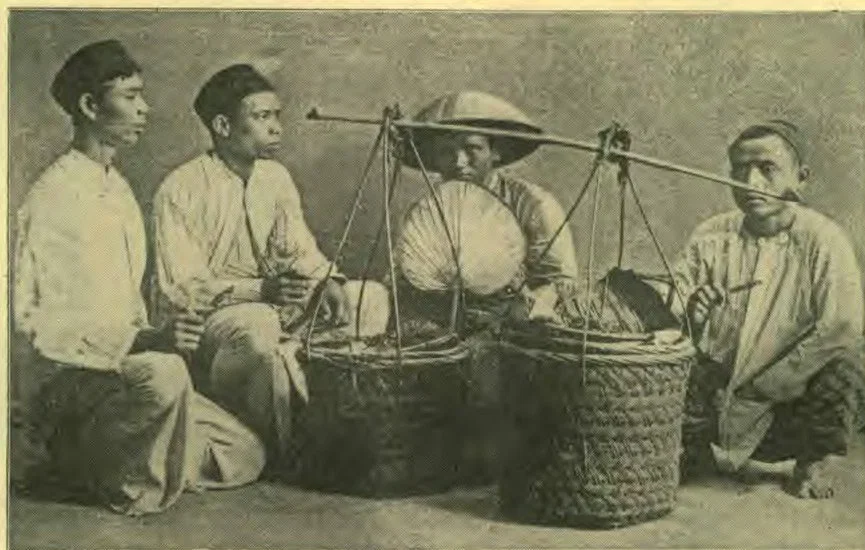
Javanese Meat Bellers
Looking Homeward
By Pauline Alderman
THE dawning of the great eternal day
That saints and sages have desired to see,
Is lighting up the world with glowing ray,
And faith tells us of greater joys to be.
O time! thy work of sin is nearly done;
The righteous reign of peace, biding its time,
Is almost here; I see the omens come
That tell we're nearing now a better clime.
O can it be that we are nearing home,
Beyond the reach of sin and all its train,
To a bright world where it can never come,
Our conquering Jesus ever more to reign?
I gaze with transport on the blessed scene,
And long to bid farewell to time and sin.
A few more days, perhaps, to come between,
And then I hope to hear the "Enter in."
MRS. PAULINE ALDERMAN.
THE HOUSE WE LIVE IN
By Vesta J. Farnsworth
OR THE MAKING OF THE HUMAN BODY
By VESTA J. FARNSWORTH
This is a book for home reading and it is a great help to mothers in teaching their children how to care for themselves physically.
The structure of the human body is set forth in a most interesting and instructive manner, and all its wonders, uses, functions, etc., are told in a most attractive way.
The style of the book is conversational — a mother talking with her children. It makes a splendid birthday gift.
Two hundred and eighteen pages, nearly 150 illustrations, attractive cloth cover.
Price, post-paid, $1.00.
Pacific Press Publishing Assn.
Mountain View, California
Portland, Ore. Regina, Sask., Can. Kansas City, Mo.
Do You Want an Easy Time?
That easy time may cost you your soul. William Hetherington, of England, uses this striking illustration of the necessity of effort on our part:
“A beekeeper told me the story of the hive,—how, when the little bee is in the first stage, it is put into a hexagonal cell, and honey enough is stored there for its use till it reaches maturity. The honey is sealed with a capsule of wax, and when the tiny bee has fed itself on the honey and exhausted the supply, the time has come for it to emerge into the open. But, O, the wrestle, the tussle, the straining to get through that wax! It is the strait gate for the bee, so strait that in the agony of exit the bee rubs off the membrane that hid its wings, and on the other side it is able to fly. Once a moth got into the hive and fed on the wax capsules, and the bees got out without any strain or struggle. But they could not fly, and the other bees stung them to death. Are you congratulating yourself on having an easy time, no hardship, no difficulties, no cross? Beware lest, like the bees, you lose your wing-power and perish miserably in the dust.”
Sabbath-School Birthday Card
The Sabbath-school Department of the General Conference has prepared a Sabbath-school birthday card which affords each teacher an easy and delightful way of remembering birthdays. This card is said to be appropriate for all ages, but will be especially appreciated by the youth and children. It has been prepared with Sabbath-school teachers and classes in mind. It is lithographed in seven colors, on a fine grade of bristol-board, with a decorative spray of autumn leaves. The price, post-paid, five cents each. Sabbath-school Department of the General Conference, Takoma Park Station, Washington, D. C.
Wanted
FOR missionary work, late, clean copies of SIGNS OF THE TIMES, Watchman, Life and Health, Review and Herald, Youth's Instructor, Little Friend, and tracts. Address Miss Sadie Wise, 34 South Pamelton St., Shelbyville, Ind.
The Great Second Advent Movement
By Editor
Second Advent Movement, The Great. By J. N. Loughborough. A late revision of the old book "Rise and Progress of Seventh-day Adventists."
This book forms a most interesting and instructive narrative on the subject indicated by its title. Commencing with the early experiences of the Advent movement of 1843 and 1844, the writer, who has been actively engaged in proclaiming the doctrine since 1849, here presents a graphic account of the struggles and difficulties through which the pioneers were safely carried by their unwavering faith in God and their unfaltering loyalty to the cause they had espoused. Due attention has been given to those agencies which, in the providence of God, have aided in building up and preserving the work represented by this people. Illustrated, 480 pages. Cloth, $1.25.
Address this office.
Address this office
By G. H. Heald
Colds.—By G. H. Heald, M.D. A treatise on the causes, prevention, and cure of colds. White leatherette binding. 58 pages, 25c.
Address this office
IN THREE DAYS
Overland Limited
TAKES YOU
To Chicago
ACROSS GREAT SALT LAKE
— AND —
HIGH SIERRA BY DAYLIGHT
Luxurious High-class Equipment
Electric Lighted Throughout
Pullman Drawing-room
Stateroom
Vestibuled Sleeping Cars
Careful and Attentive Dining Service
Parlor Observation Car with Library and Cafe
Ladies' Reading Room
Gentlemen's Smoking Room
Daily News Bulletins
Latest Papers and Magazines
Story of the Seer of Patmos
By S. N. Haskell
Story of the Seer of Patmos. By S. N. Haskell. The author's latest book is on the thrilling prophecies of the book of Revelation. It presents no vague, new theories, but in simple narrative style portrays the story of the prophet John's life, and traces his prophecies and their wonderful fulfilment.
Illustrated with original engravings made especially for this work. The text of the entire book of Revelation is printed in the margins, and accompanying it are thousands of Scripture references elucidating the text; and besides all this, the explanatory comment of the author on each chapter. It is a companion volume to "Story of Daniel the Prophet," by the same author, and is written in the same style.
The two books are uniform in size and style, and treat two of the most important and least understood books of the Bible. Fully illustrated. Contains 424 pages. Half cloth, $1.50.
Address this office.
Uncle Ben’s Cobblestones
Uncle Ben's Cobblestones. Familiar talks with boys and girls about the common articles of every-day use, such as air, water, sunshine, fire, smoke, glass, coal, salt, paper, matches, etc.
Uncle Ben has a very pleasing way of telling about the origin and use of these various things. There is a ray of sunshine streaming throuout the whole book, and yet it does not touch the ficklc so prevalent in books for children.
The purpose of the book, aside from the useful information given, seems to be soul-culture, for we observe on every page a moral fragrance that will impress young minds in the right way. Uncle Ben tells about more than one hundred different things in all, and intersperses with happy thoughts that bring good cheer to young and old. 221 pages, price, $1.00. Address this office.
Bibles
Bibles.—Remember that we are headquarters for anything in the Bible line. We shall be pleased to send you our catalog of Bible selections on application. Pacific Press, Mountain View, Cal.