At the close of the Calcutta conference, Professor Salisbury and I went to Burma to visit the different interests of our work there. Brother and Sister Ludington, who had come from Emmanuel Missionary College to take charge of the Meiktila Industrial School in Burma, reached Calcutta just in time to accompany us. We are glad to add these teachers to our staff of workers in Burma.
Rangoon is the headquarters of our work in Burma. Here, as in so many other places in the Indian Union, we met fellow workers whom we had known and helped to select for this field. Prof. R. B. Thurber lives here. It was in their family tent on the East Michigan camp ground five or six years ago that I made final arrangements with Brother and Sister Thurber to come to Burma. Although they have remained in this warm climate the most of the time since coming, they both are looking well and are bright and cheerful in their work. Brother Thurber is acting superintendent of the field and pastor of the Rangoon church. This church has a membership of seventy-five. The members are principally Europeans and Anglo-Indians, very few Burmese having as yet taken their stand for the truth. This church pays a good tithe, and supports the work liberally in every way. The members are quite active in home missionary work.
There seems to be a good interest in the city to hear our message. The hall they use for their regular meetings was well filled at each of the services conducted while I was with them. At the last meeting quite a number were unable to get seats; and listened from a side room.
The treatment rooms have recently been installed on the third floor of one of the best buildings in the city. They are nicely arranged and well equipped. They are under the management of Brother and Sister F. A. Wyman, who came to Burma a year and a half ago from the Foreign Mission Seminary. It has been but a few months since this medical work was started, so it is impossible to tell just what it will accomplish. However, the present prospects seem good for making the enterprise self-supporting. An influential barrister and a number of other prominent business men have begun to patronize them. Brother and Sister Wyman are earnest, warm-hearted missionaries, and they are praying that this work may prove a blessing to the cause throughout all Burma.
Our Meiktila school is three hundred and twenty miles north of Rangoon. We have a block of twenty-nine acres in a good location, two miles from the railway station. There are four principal buildings,—the bungalow, school hall, dormitory, and industrial hall. The bungalow is of good size, and substantially built. The first story is of brick, the upper, wood. The school and dormitory are built of teak frames filled in with split bamboo. Many buildings are constructed of this material in Burma. The industrial building is of corrugated iron with cement floors. It is so constructed that the sides can be swung out and up on hinges, which gives all the ventilation possible.
At the time of our visit very little industrial work was being done, the war having cut off their supplies of material; but they had succeeded in obtaining a good supply, which they were expecting to receive in a few days. The three principal lines are furniture, split bamboo chairs, and boots and shoes. The samples I saw showed that the boys do good work.
Just now there are only thirty-five students in the school. There are various reasons assigned for the decrease; but the brethren believe that the attendance can be increased, and that the school can be made a greater factor for our work than it has ever been. Eight or ten of the boys now in the school have united with the church by baptism. Some of them are earnest young men who give promise of making good workers. A good beginning has been made toward the establishment of an institution for educating and training native workers for Burma. This is a most important requirement for such fields.
We have living in Meiktila Brother Stevens and family, who are a great help to our work. He is the government prosecutor of the city, and holds a commanding influence among the best men in that part of the country. Sister Stevens seems like a superior woman, and they have a nice family, who do a large amount of missionary work. When I was there, they had just ordered ten thousand copies of the War number of the Watchman. They also contribute freely to the cause. This family, with the teachers and Christian students in the school, form the nucleus for a good11church. At present the membership is about fifteen.
Leaving Meiktila, we went to Mandalay, about fifty miles north. This was the old and last capital of Burma under the Burmese kings. Its present population is 139,000, only a little more than half its population when taken by the British in 1885. Brother and Sister R. A. Beckner have charge of the mission here. For a year or more he has been selling papers and tracts in the city and surrounding country. Several persons have embraced the truth. They have a church of ten or a dozen members. Hereafter Brother Beckner is to give more time to Bible reading and ministerial work. But he is very energetic, and will also distribute a large quantity of literature.
Mandalay is the natural center of our work in Upper Burma. In a radius of from ten to fifteen miles around the city, stretching west to the Irrawaddy River and east to the Shan Hills, we could see from Mandalay Hill some five hundred villages with a population of five hundred thousand. The country is level, and here, as perhaps nowhere else in Burma, there are good country roads. With a horse and trap Brother Beckner could easily reach many of these villages. I am glad to report that Brother and Sister Beckner are in excellent health, and are very happy in their work. He is getting a good command of the language. Their hearts are set on building up a good, strong work in Upper Burma, and they hope to be able to remain in that country until the Lord comes.
The Karens
As you know, the brethren in Burma have for a long time been urging that work be begun among the Karens. Brother Hamilton was sent out two and a half years ago in response to this call. Sister Gibbs, who was chosen for this work, has mastered the Karen language, having passed the first and second examinations with high marks. She has also completed a course in midwifery in the Calcutta hospital.
The Karens number about one million, or one tenth of the total population of Burma. The majority of them live in the eastern part along the great Salween River. They are scattered along a stretch of territory nearly five hundred miles in length. There are three divisions or branches of the Karens: the Pwo (Po) Karens, the Sgaw (Skaw) Karens, and the Karannee. The Pwos are the most numerous, and are settled in the lower part about Moulmein. The Sgaws are second in number. They live in the central and northern parts. The Karannees live in the extreme north, close to the borders of Siam and Tibet.
It was among the Karens that Judson and his associates did the most of their work. The Baptists now have a large following of both Pwo and Sgaw Karens. Their total baptized membership in Burma is about fifty thousand.
In company with Brethren Salisbury, Thurber, and Hamilton, I made a visit to this district. We first ran over to Moulmein, two hundred and eighteen miles by rail. There we took a small steamer up the Salween River sixty miles to a village called Shwegun. This is the terminus of the steamship line. The place our brethren had selected for our station is fourteen miles farther on, at a village called Kawkayet, on the Yunzalin River, which forms a junction with the Salween River about midway between Shwegun and Kawkayet. Beginning at this junction there is a stretch of country at least a hundred miles long occupied principally by the Sgaw Karens.
GROUP OF OUR WORKERS IN BURMA
When Brother Salisbury was in Burma last July he visited this region with the brethren, and agreed with them on the selection of a block of nineteen acres at Kawkayet for our mission station. As this land belonged to the government, Brethren Thurber and Hamilton went to see the district commissioner at Papun about securing it. They found him to be a very pleasant gentleman. After hearing them, he said he should go into the matter more fully, and if he found no objections, he should be glad to grant them the site for their mission. He also told them that he was authorized to give a certain allowance of timber for such purposes, and that he should give them all that he should be authorized to appropriate.
As we could not get a boat large enough to take us all up the river from Shwegun, where our steamer left us, to Kawkayet, it was decided that Brethren Thurber and Hamilton should go on in a small boat, and that Professor Salisbury and I should return. On arriving at Kawkayet, the brethren learned from the people that the commissioner had been down to inspect the block they had asked for. He had also posted the usual notice for thirty days, telling of our request, and giving opportunity for lodging objections. A man in the place told the brethren he had seen the written document containing the commissioner's decision to give us the land.
Although the brethren have not received final word direct from the commissioner regarding his decision, they have learned through another source that he has made the grant. We arranged for Brother Hamilton to go to Papun at once to have proper papers made out. If the commissioner makes the grant, we shall get a good block of ground in a healthful location, and, further, we shall get a supply of good timber for our buildings.
Now is the time to act. On account of the war, the timber business is dead. Millions of logs are tied up in rafts along the river banks. The mills are clogged with sawn timber, and are offering it for one third the usual price. Hundreds of men are wanting work, and can be secured at low wages by contractors. In view of the whole situation, I authorized the brethren to proceed at once with the enterprise. I have taken the responsibility of raising the two thousand five hundred dollars they have estimated it will require to put the mission in good shape. We cannot delay the opening of this mission without risking great loss.
Brother and Sister Hamilton and Sister Gibbs have been waiting a long time to get among the Karens, and they are happy beyond expression at the prospect of being at this new mission station in the near future. They have wonderful courage to go up that great river, and settle where tigers and other wild beasts are plentiful. Of course they will be safe, yet many would shrink from it. They believe the Lord has called them to that work, and that he will give them many Karens in return for faithful efforts. We shall watch the development and results of this new move with the deepest interest, not forgetting to pray earnestly for our dear workers and also the Karens.
A. G. DANIELLS.
A New School at Coimbatore
At the recent council meeting in Calcutta, India, it was decided to open another school in new territory, where advanced students in South India may continue their training. The school in Nazareth had become so crowded that another school was necessary. A favorable opening for this new mission school was found at Coimbatore, about two hundred miles northwest of Trichinopoli, where Brother and Sister Lowry expected to locate about March 1, to open the school in a very favorable location.
General Meetings in Europe
By L. R. CONRADI
L. R. CONRADI
THE most of our conferences on the Continent hold their annual meeting in the winter. During the last few years, I have generally spent the winter in Africa, and managed to come home only in time for the union conference committee meetings; but this winter, for the first time in some years, I arranged to visit every one of the eighteen meetings in Germany and two in Switzerland. In order to make this possible, we held as many as three meetings a week, while otherwise we generally had only one. In the larger fields we held a regular annual conference with a properly chosen delegation; in the smaller fields we had but general meetings, and did the main business of the conference through a large committee of representative brethren, who attended to the auditing, the issuing of credentials and licenses, and the election of conference officers, and also to the formulation of resolutions. The resolutions were then discussed in the public services. Short though the meetings were, they were a new experience to us, showing how much business can be attended to in a short time, and still make it possible to hold good, spiritual meetings. All these meetings were well attended, and our people appreciated them. Considerable expense was thus saved, also much time of the workers, and good results were obtained.
January 6-24 I attended the seven meetings in the East German Union. The first one was held in Chemnitz, Saxony. Saxony is one of the most thickly settled countries of Europe. It is about the size of Connecticut, and has a population of nearly five million. With seventeen gospel workers, 274 souls were gained last year, so that this conference now numbers 1,303 members. There are two churches in Dresden, with 220 members; two in Leipzig, with 203; in Chemnitz we have a church of 170 members. All the churches were well represented by delegates, who took a deep interest not only in the business of the conference, but also in the Bible studies and religious services. At the evening lectures the hall was packed. A good meeting was held Sabbath forenoon, and in the afternoon Brethren Hennig and Dwehus were ordained to the gospel ministry, after which the young people's society gave an interesting review of the origin and progress of our work throughout the world. The tithe and offerings amounted to 81,000 marks, against 93,000 the previous year. Our canvassers met with many obstacles the past year, and yet their work is onward.
After the close of the Sabbath we went as far as Dresden to attend to some affairs of the conference, and then on Sunday morning went to Goerlitz, in Silesia. Here we were to have only a general meeting, but to our great surprise the people had come in from all the different churches, and they all seemed hungry for the word of life. This province, with over five million people, has now 1,044 members. Last year 172 were added. In Breslau there are two churches, with 204 members; at Goerlitz we have a church of fifty-seven; the other churches range from this number downward. It had already been decided to divide the province into two conferences, and each conference would have been about the size of New Jersey and have had the same population; but in view of the war and the scarcity of workers, it was decided to wait another year for the division.
The next two days we spent in Guben, in the Warta Conference. God has blessed our efforts in this field, the seven workers gaining 117 souls. This conference now has 641 members. The tithe and offerings were over 43,000 marks, or a gain of more than 500 marks over last year.
The next Sabbath we spent in Stettin, Oder Conference. Here we also had merely a general meeting. There were twelve laborers at work, and 152 members were added. This field had 665 members at the close of the year. While the tithe went down about 8,000 marks, to 31,560, the offerings, which amounted to 7,856 marks, showed a slight increase. The strongest church in this conference is in Stettin, with 165 members. At Schwerin, the capital of Mecklenburg, we have a church of seventy members.
Sunday we went to Danzig, in the Weichsel Conference. Here we had only a general meeting. At Danzig we have a church of eighty-six members, and I was pleased to find a well-located hall, with every seat filled. We have in this field eight workers, who last year gained eighty-five souls, the present church membership being 565. The tithe increased 1,600 marks, while the offerings decreased about 486 marks.
On the eighteenth we reached Konigsberg, in the East Prussian Conference, at midnight. As Konigsberg is quite close to the border, we could see many evidences of the nearness of the great struggle. No other conference has suffered from the war so terribly as the East Prussian. Of the forty-nine churches in this conference, twenty-one are situated within the war zone. These churches have a membership of 478. A few of our members have been taken captive, many have had all their possessions destroyed, and others have had to leave everything behind and flee for their lives. But our nine workers who are left of the fourteen, have baptized 119 persons, bringing up the membership to 1,203. Here was the only place we could not have our full conference committee together—only three of its members being present. At Konigsberg we have a church of 120 members. One of our brethren who owns a house here has fitted up a good meeting hall, and it was well filled the evening I spoke.
The next three days we spent in Berlin, where we had a meeting of the East German Union District, and at its close a session of the union committee, and the audit of the union. In Greater Berlin we now have fifteen churches, with about 1,000 members. Several suitable halls have been rented, in which we conduct public lectures. Although the rents are quite high in a large city like this, yet there are many advantages over expensive chapels. By shifting our halls we can use them for public lectures, and at the same time for our regular Sabbath services. As the presidents of the various conferences were at the meeting, we managed to have evening lectures throughout the city. For the meetings of the union district we had secured a hall in the center of the city, which would seat about 1,000 by crowding considerably. On the Sabbath the hall was packed. Last year the district had 204 accessions, but its net gain was only twenty-four. The reason for this is that Friedensau belongs to the district, and instead of having 225 students in the school, who would be counted as members while here, we had only 100. The tithe decreased more than in any other field, from 134,000 marks to 86,000 marks; and the offerings from 38,850 to 24,000.
Since New Year's the union district has given back to the Middle German Conference, in the West German Union, the city of Magdeburg, where we have two churches, with 105 members.
The East German Union works Galicia as a mission field, and has divided it into two parts. While the West Galician Mission remains stationary, with only twelve members, thirty-four members were baptized in the East Galician Mission. Both fields had ninety members at the close of the year. They would undoubtedly have had more than one hundred members had it not been for the war. The director of the East Galician Mission is located at Czernowitz, the capital of Bukowina. He remained there during the Russian occupation, surrounded by many difficulties and dangers. Another of our workers is in the fortress of Przemysl, and we do not know the whereabouts of one of the workers. In Berlin Brother Hambrook was ordained to the ministry, and several church elders and deacons were also ordained.
With an average of ninety workers, the East German Union last year gained 1,158 members, or a net gain of 677, the membership at the end of the year being 7,177. The finances have decreased more in this field than in any other, from 500,000 marks to 400,000. In this union there were 181 canvassers during 1914, against13192 the previous year, and the sales were 185,800 marks, against 218,200. But in the union district we had 11,000 marks more in 1914 than in 1913. The East German Union is still the strongest union we have in Europe, and the Lord has blessed the labors of Elder H. F. Schuberth and his coworkers in the upbuilding of the cause. All the conferences were able to give their first tithe to the union, the five per cent and the second tithe to the division for missions, and to turn over a surplus for the regions beyond. We were pleased to notice the unity in our business transactions, and the confidence our brethren showed everywhere in our work and workers. I enjoyed the privilege of becoming once more acquainted with so many of our people, older and younger members, and with the workers. May the Lord continue to bless the East German Union in these troublous times, that it may keep abreast of all others, as it has done thus far, and become a still stronger factor in God's cause.
Progress in Porto Rico
By Clarence E. Moon
CLARENCE E. MOON
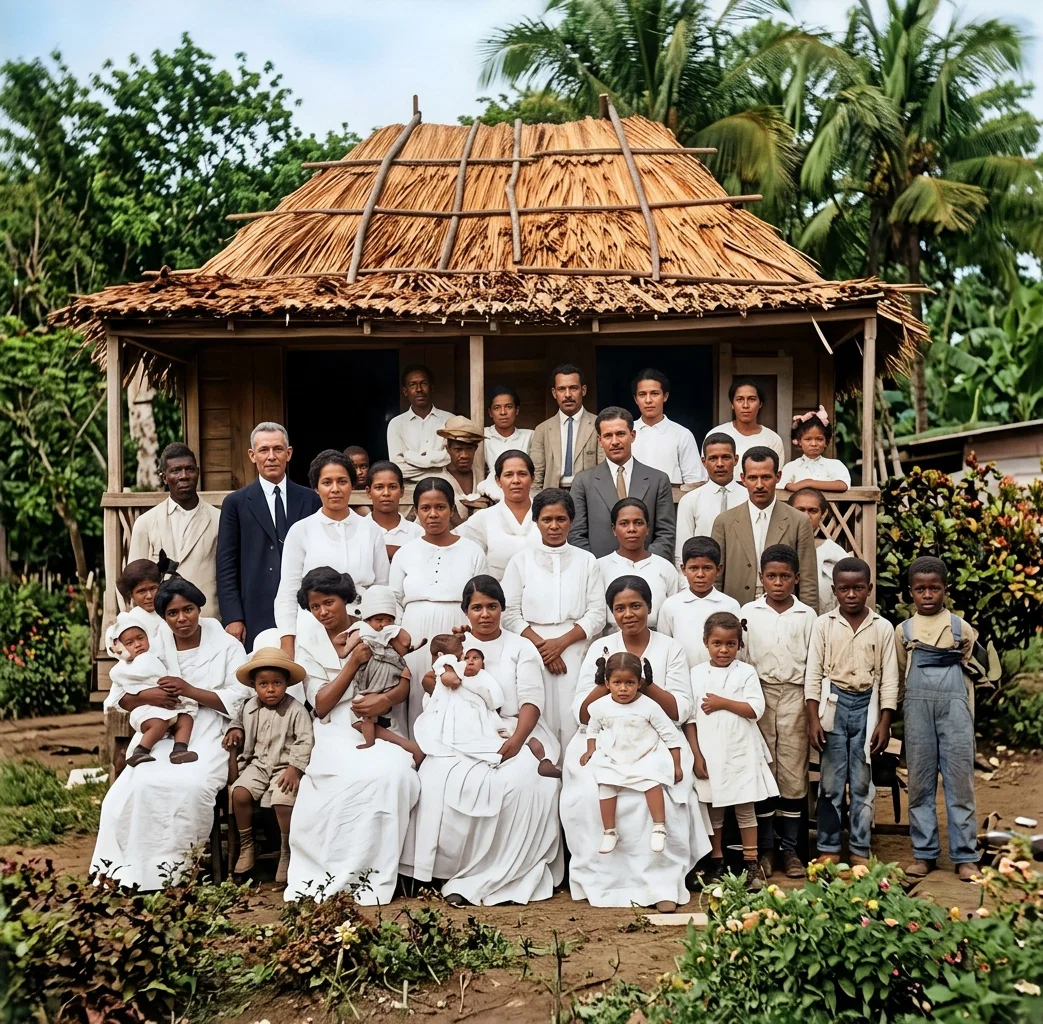
OUR hearts are full of praise and thanksgiving when we consider what God has wrought in the last few weeks here at Moca, Porto Rico.
It was in a little Wednesday evening prayer meeting, where some of our native brethren had assembled to seek the Lord, that we were blessed in a marked degree. We were studying some of the promises which the Lord has given us in his Word and by his servant, when we were impressed to begin asking great things of God. Reading Jer. 32:17, Acts 14:27, and similar texts, we were impressed that our greatest need was more faith in God, and a realization of his leading. Paul and Barnabas realized that it was the mighty hand of God working through them, and that there was nothing too hard for God.
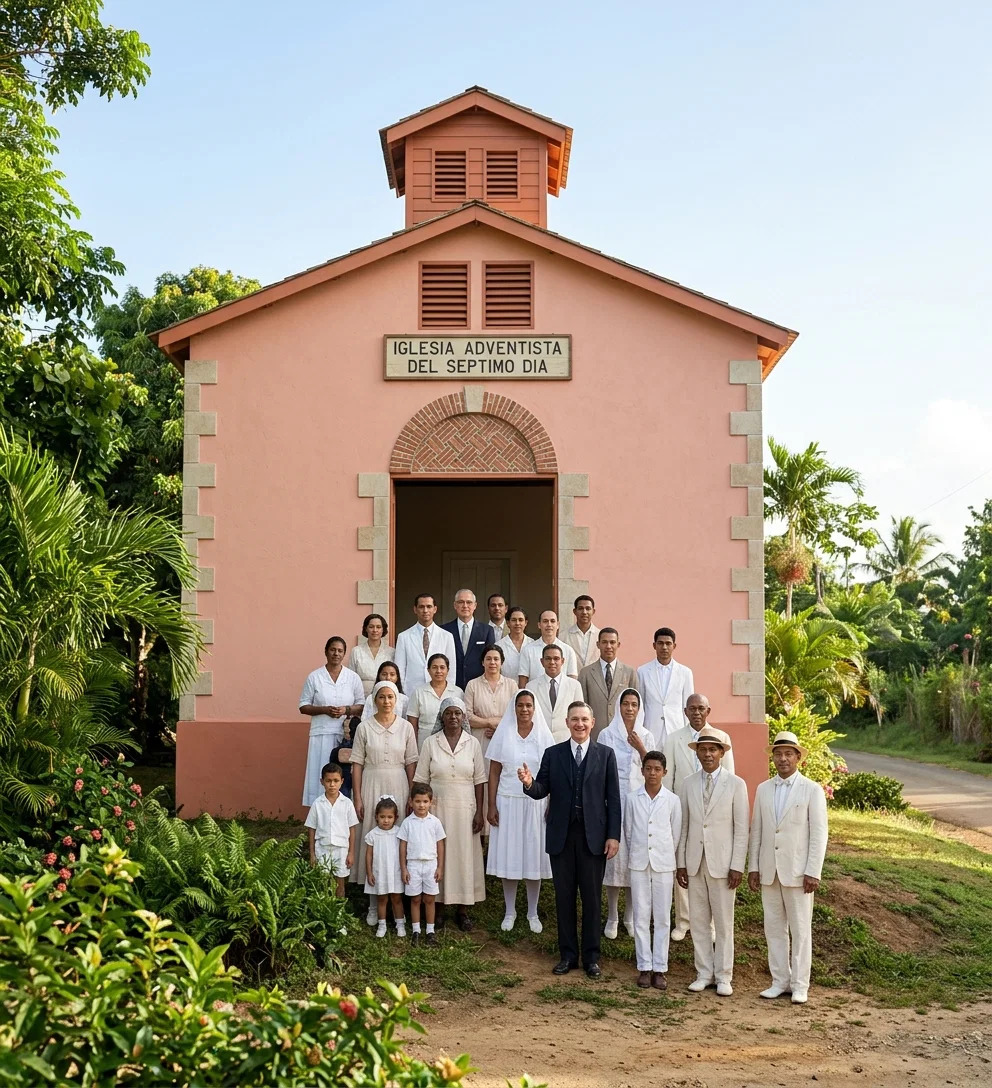
So we began to pray for the way to open to build a church here in Moca. It would make a long story to relate the wonderful manner in which the Lord reached forth his hand to answer these prayers. But suffice it to say, about a month later the house of the Lord was dedicated free from debt, with a church of twenty adult members organized.
The new church is located at the entrance to the town, on a corner lot given by the people, and a more beautiful situation we could not have asked for. It seemed a remarkable omen of the progress of the work of God in this island that the first Seventh-day Adventist church in Porto Rico should be built under such marked manifestations of God's providence.
It is even more wonderful how God has reclaimed living temples for the dwelling of his Spirit in the hearts of these people. Most of the Porto Ricans are cursed with the tobacco and liquor vices, and all are slaves to the coffee habit. The great change that has come in the lives of those not of our faith. I never shall forget how these dear souls took hold of the Lord, and how he has completely redeemed them from slavery to these habits.
PORTO RICAN HOME AT MOCA, WITH SOME OF THE BELIEVERS PRESENT
One aged sister told us that for a short time she used only a pinch of tobacco; but when we read that text, “What, could ye not watch with me one hour?” she took it very literally, and said she would try hour by hour, and that when the temptation came it would be a call to prayer. So she spent the night praying and struggling, as no one can understand but those who have used tobacco for a lifetime and have then undertaken to break the habit. But, thank God, she watched with Jesus, and is still watching, as this has now become a grand principle of her life. After the Lord gave her the victory over this habit, she asked him for her eyesight, having been blind for years, and now she reads her Bible and sings in our church.
MOCA (PORTO RICO) CHURCH BUILDING, WITH PORTION OF CHURCH MEMBERS
A young man with whom we studied apparently believed the truth, but would not accept it. We notified our workers, and began to pray for him. After about three months he came to us and said, “I am going to be a Seventh-day Adventist.” He said the change in him came about in this way: he was watching us settle a little business disagreement in which he knew the other person was wrong; and when he saw how calm we were, and that we paid the man his unjust demands, he determined to follow the same Jesus who made us such a people as that. He seemed to be in earnest, and trembled at the presence of God's Spirit. This young man with eleven others was baptized the following Sabbath.
Parana (Brazil) General Meeting
By F. W. SPIES
F. W. SPIES
The Parana general meeting for this year was held at Curityba, January 20-24. When the writer, accompanied by Elder J. H. Boehm and Brother August Pages, arrived at the place of meeting, we were very pleasantly surprised at seeing the new mission property, consisting of a spacious place for meetings and of two dwellings for missionaries, practically completed.
In order to construct this building the brethren of the Curityba church did some real sacrificing. The building, including the lot, cost about $5,000 United States gold. For a number of years the Curityba church had been gathering means for the building, but only about $3,000 had been provided. But in this time when materials were very cheap, and when the brethren themselves had but little work, they felt that they should go ahead with the building, and they did, they themselves providing what was still lacking. There being in the church membership men of different trades, they also did all the work on the large building. So it was with a pardonable feeling of satisfaction that they came up to the general meeting.
Unfortunately, on account of the hard times but very few of our brethren were present from the interior of the state. But the meeting was a season of special blessing to those who had the pleasure of attending it. Especially were the last days, Sabbath and Sunday, days of blessing, and with renewed strength and courage the brethren and sisters continue their journey toward the heavenly Canaan.
On the evening after the Sabbath the new building was dedicated. This time was chosen because many of the leading men of the state, such as the governor and members of his cabinet, the mayor of Curityba, and leading merchants who had made donations, were to be present, since the building was to serve as a school as well as for meeting purposes. It was thought that this time would be the most favorable for their attendance. Elder Suessmann, our minister in Parana, gave a fifteen-minute talk about our general work, Elder Boehm spoke of our educational work, and the writer gave the dedicatory address, and thanked the friends who had so kindly assisted us in the work.
The evening meetings were well attended, more than two hundred being present each evening, many of whom seemed really interested. May the Lord grant that many of these may yet cast their lot with God's people. The song services rendered by the choir of the Curityba church did much to increase the interest. We believe that the work in this city and state will now go with a new impetus.
Columbia Union Summer School
By C. L. STONE
At a meeting of the Columbia Union Conference Committee in February, it was voted to hold the summer school for 1915 at Washington Missionary College. Since that meeting, definite plans have been laid to make the work strong, and to this end a complete and experienced faculty has been employed.
The College has opened its dormitories, offering free rooms. Board will be furnished on the European plan. Teachers who have proper arrangements with their conference officials will have all expenses met, and can lay their plans at once to take advantage of this unusual opportunity.
This session will greatly strengthen and unify the educational work in this field, and will offer the privilege to every teacher and prospective teacher to increase his ability to meet the needs of the hour. It will be a time when all may seek earnestly and unitedly for a deeper work of grace and renewed wisdom from above.
Students will attend from the Atlantic and Eastern Canadian Unions, and no doubt there will be a number of students who wish to review or take regular studies in eighth, ninth, and tenth years. The outlook is good for a full attendance. If you are in need of the professional branches, if you wish to review, or if you desire to do advanced work in academic studies, make arrangements to attend.
This session will open about July 1. If you do not receive an announcement in the near future, make request for full information from the Columbia Union Educational Department.
C. L. STONE,
Educational Secretary.
Truth Stirs Michigan Editor
By W. L. Burgan
FOR more than two months Elder B. L. Post has been supplying articles to one of the newspapers in Lansing, Mich., on “The Hand of God in History,” and the editor has given him free rein to bring out the facts concerning the true and the false church. These articles, which average at least two columns, are being read in all parts of Michigan, and are arousing more than ordinary comment. It is also expected that some of the readers will accept the truth as the result of their publication.
In a letter recently received from Elder Post, he gives an account of one of the experiences he has had with the editor of the paper in which his articles have been appearing. He says:—
“The editor of the local socialist paper has been an avowed infidel, besides being considered the best criminal lawyer hereabouts. Day before yesterday I called on him, and found him sick; in fact, he does not expect to live long. A leading socialist was with him, and after a few remarks he turned to his friend, who is a Methodist, and said, ‘Do you know I think we have been all wrong? I have fought against and argued against the Bible and Seventh-day Adventists for years, but I am profoundly convinced that they are the people who have the truth. We have been fighting Rome, and at the same time have held to her sabbath in place of the Sabbath of Jehovah.’ Then turning to me, he said, ‘Tell them [the readers] in your articles that we believe the seventh day, known as Saturday, to be the Sabbath of Jehovah, and make that as strong as you can.’”
“I have been told that more than a score of men in the Reo Auto Works here are meeting every week to study my articles.
“This editor is being boycotted because of his attitude toward Rome. A few days ago he received from the chamber of commerce here a statement of a recent action by that body, to the effect that the membership of that organization cannot advertise in his paper as long as he permits articles to appear in its columns that in any way reflect on the Roman Church. He is losing financially because of my articles and on account of his own attitude of antagonism toward Rome’s political ambitions in this country. His paper weekly reaches about 5,000 readers from all over Michigan; therefore it seems to me that these articles cannot fail to accomplish some good for the Master. I look for definite results from this effort, and, besides, this is proving a valuable experience to me.”
Let others write a similar series of articles for their home papers, and thus help to hasten the message that wins souls to Christ.
W. L. BURGAN.
The West Virginia Colporteurs’ Institute
THE colporteurs’ institute for West Virginia was held in Parkersburg, April 9-19. This was the largest institute ever held in the State. The field agent and other conference officers had been doing very faithful and successful work, and an excellent company of consecrated men and women was in attendance to prepare for the Lord’s work. Among the number were two or three school-15meet them on every hand. Knowing this, how careful should we be to have them well armed to meet his assaults. Not only so, but we should teach them to be “temperate in all things.” This means not only temperate in eating and drinking and dressing, but also in reading; for through reading the enemy often approaches the citadel of the soul and breaks down its defenses. Mothers and fathers, guard your children’s reading.
Meeting of the Oakwood School Board
By C. B. STEPHENSON
According to appointment, the Oakwood School Board met in Huntsville, April 27. A joint meeting of the committees of the Southeastern and Southern Union Conferences was held at the same time. We were glad to have with us Elders I. H. Evans, W. T. Knox, and F. Griggs.
A number of items of important business were transacted, among which was the election of the faculty for next school year. Only a few changes were made in the present faculty.
The school grounds and the farm were in a splendid condition. Everything was clothed in the beauty of spring. Our farmer, Brother Swofford, has about one hundred and fifty acres in cultivation. There is every indication of a good fruit crop, which means much to the school.
The foundation of the new dormitory is laid, and the contract will soon be let for the work above the foundation. We hope to have the building ready for the opening of the school this fall. It will be steam-heated, and we hope lighted with electricity.
A very interesting canvassing class was begun by Brethren Dillon and Davis on April 29. About twenty students are studying to prepare themselves to sell the printed page. These students will spend the summer vacation selling books in the different conferences. Some will work for a scholarship. This plan offers a splendid opportunity to make one's way through school, while at the same time it gives a valuable training. “Those who reject the privilege of fellowship with Christ in service, reject the only training that imparts a fitness for participation with him in his glory.” “To every one who offers himself to the Lord for service, withholding nothing, is given power for the attainment of measureless results.” May the Lord bless the efforts of these young people.
C. B. STEPHENSON.
A Unique Missionary Meeting
By D. W. REAVIS.
LATE in the afternoon of April 27, Takoma Park, D. C., was visited by a severe electrical storm, which temporarily cut off the city electric current, leaving the place in darkness until about nine o'clock in the evening.
This was the regular evening for the missionary and prayer meetings of the church. Ordinarily the lack of lights would have been considered a reasonable excuse for not holding these meetings on this one special evening; but the missionary workers, whose meeting came first, felt they could not postpone the work of mailing their papers, writing their letters, and hearing the letters read which had come in since the last meeting. So one kerosene lamp was found in the neighborhood, and served for light in one large workroom, where about fifteen persons wrote missionary letters and wrapped papers for an hour. The Sabbath-school teachers drew upon their stock of fancy toy candles set in the kindergarten sand boxes.
The workrooms in the basement of the church, thus lighted, reminded some of the aged members of the days of their youth, when most churches had only candlelight, and it also brought to mind the time when the refuge of the remnant church will be in dens and caves—when it will not be possible to enjoy the freedom and the opportunity we now have to let the light of this glorious message shine in all the dark places of the earth. These thoughts which were freely discussed during the work hour, caused us to make vows of renewed consecration to earnest service at this time.
At the close of the work hour it was decided to assemble for prayer service in the large auditorium of the church, with only the one lamp. Familiar hymns were sung, and the members were requested to recite from memory as many of the promises of the Bible as they could. There was a remarkable response, and the presence and power of the Holy Spirit made this occasion one of the best feasts the church has ever had.