The Youth’s Instructor, Vol. 48, No. 27.

HAWAII AND THE HAWAIIANS

The Youth’s Instructor

Jul 5, 1900

Review and Herald Publishing Company · Battle Creek, Michigan · Jul 5, 1900

HAWAII AND THE HAWAIIANS

Ancient Dress
Mrs. Thurston, one of the first missionaries to Hawaii, thus describes the native dress in 1820, the time of her arrival:—
“Soon the islanders of both sexes came paddling out in their canoes, with their island fruit. The men wore girdles, and the women a slight piece of cloth wrapped around them, from the hips downward. To a civilized eye, their covering seemed to be revoltingly scanty. But we learned that it was a full dress for daily occupation.
“As we approached, Kawaihae Hopu (a native who had spent some time in America, and had become Christianized) went ashore to invite on board some of the highest chiefs of the nation. Kindly regarding the feelings of the ladies, he suggested that they put on garments; so they prepared for the occasion. Kalanimoku was the first person of distinction to come. In dress and manners he appeared with the dignity of a man of culture. He was first introduced to the gentlemen, with whom he shook hands in the most cordial manner. He then turned to the ladies, to whom, while yet at a distance, he respectfully bowed; coming nearer, and being introduced, he presented to each his hand.
“Kalakua (Kah-lah-koo-ah), with a sister queen, next welcomed us with similar civilities. Kalakua was the mother of three of the wives of the young king. Two wives of Kalanimoku followed. They were all attired in a similar dress, with the addition of the pau (pah-oo), which consisted of ten thicknesses of bark cloth three or four yards long, and one yard wide, wrapped several times around the body, and confined by tucking it in on one side. The two queens had loose dresses over these.
“Trammeled with clothes and seated on chairs, the queens were out of their element. They soon divested themselves of their outer dresses. Then one stretched herself full length upon a bench, and the other sat down upon the deck. Mattresses were then brought, that they might recline in their own way.
“After reaching the cabin, the common sitting-room for ladies and gentlemen, one of the queens divested herself of her only remaining dress, simply retaining her pau. While we were opening wide our eyes, she looked perfectly self-possessed and easy.
A NATIVE FEAST
A NATIVE FEAST
“From Kawaihae the chiefs and their large retinue all sailed with us to Kailua, where the king resided. They all slept on deck on their mats.
“Kalakua bought a web of white cambric, to have a dress made for herself in the fashion of those of our ladies, and was very particular in her wish to have it finished while sailing along the western side of the island, before reaching the king.
“Monday morning, April 13, the first sewing-circle was formed that the sun ever looked down upon in this Hawaiian realm. Kalakua, queen dowager, was directress. She requested all the seven white ladies to take seats with them on mats, on the deck of the ‘Thaddeus.’ Mrs. Holman and Mrs. Ruggles were executive officers, to ply the scissors and prepare the work. The four native women of distinction were furnished with calico patchwork to sew,—a new employment to them.
“The dress was made in the fashion of 1819. The length of the skirt accorded with Brigham Young’s rule to his Mormon damsels,—Have it come down to the tops of the shoes. But in the queen’s case, where the shoes were lacking, the bare feet showed very prominently.
“May 4, Tuesday, one hundred and sixty-three days from Boston, the ‘Thaddeus’ was anchored before Kailua. The queen dowager, Kalakua, assumed a new appearance. In addition to her newly made white dress, her person was decorated with a lace cap ornamented with a wreath of roses, and a lace half-necker-chief, in the corner of which was a most elegant embroidered sprig of various colors. These were presents we had brought her from some American friends. When she went ashore, she was received by hundreds with a shout.
“April 6 the king and his family dined with us by invitation. The king was introduced to the first white women, and they to the first king, that each had ever seen. His dress on the occasion was a girdle; a green silk scarf put on under the left arm, and brought up and knotted over the right shoulder; a chain of gold around his neck and over his chest; and a wreath of yellow feathers upon his head.”
In describing a feast to commemorate the death of Kamehameha I, Mrs. Thurston says: “The king departed from his usual custom, and spread a table for his family and ours. There were many thousands of persons present. The king appeared in a military dress, with quite an exhibition of royalty. Kamam Iu, his favorite queen, applied to me for one of my dresses to wear on the occasion; but as it was among the impossibilities for her to assume it, the request happily called for neither consent nor denial. She, however, according to court ceremony, so arranged a native cloth pau, a yard wide, with ten folds, as to be enveloped around the middle with seventy thicknesses. To array herself in this unwieldy attire, the long cloth was spread out upon the ground; then, beginning at one end, she laid her body across it, and rolled herself over and over till she had rolled the whole around her. Two attendants followed her, one bearing up the end of this cumbrous robe of state, and the other waving over her head an elegant nodding flybrush of beautiful plumes, its long handle completely covered with little tortoise-shell rings of various colors.
“Her head was ornamented with a graceful wreath of yellow feathers, of great value, from the fact that after a bird of the kind from which these feathers were obtained had been caught in a snare, only two small feathers of rare beauty, one under each wing, could be had from it. A mountain vine with green leaves, small and lustrous, was the only drapery which went to deck and cover her neck and the upper part of her person. Thus this noble daughter of nature, at least six feet tall and of comely proportion, presented herself before the king and the nation, greatly to their admiration. After this presentation was over, her majesty lay down again upon the ground, and unrolled the cloth by reversing the process of clothing.”
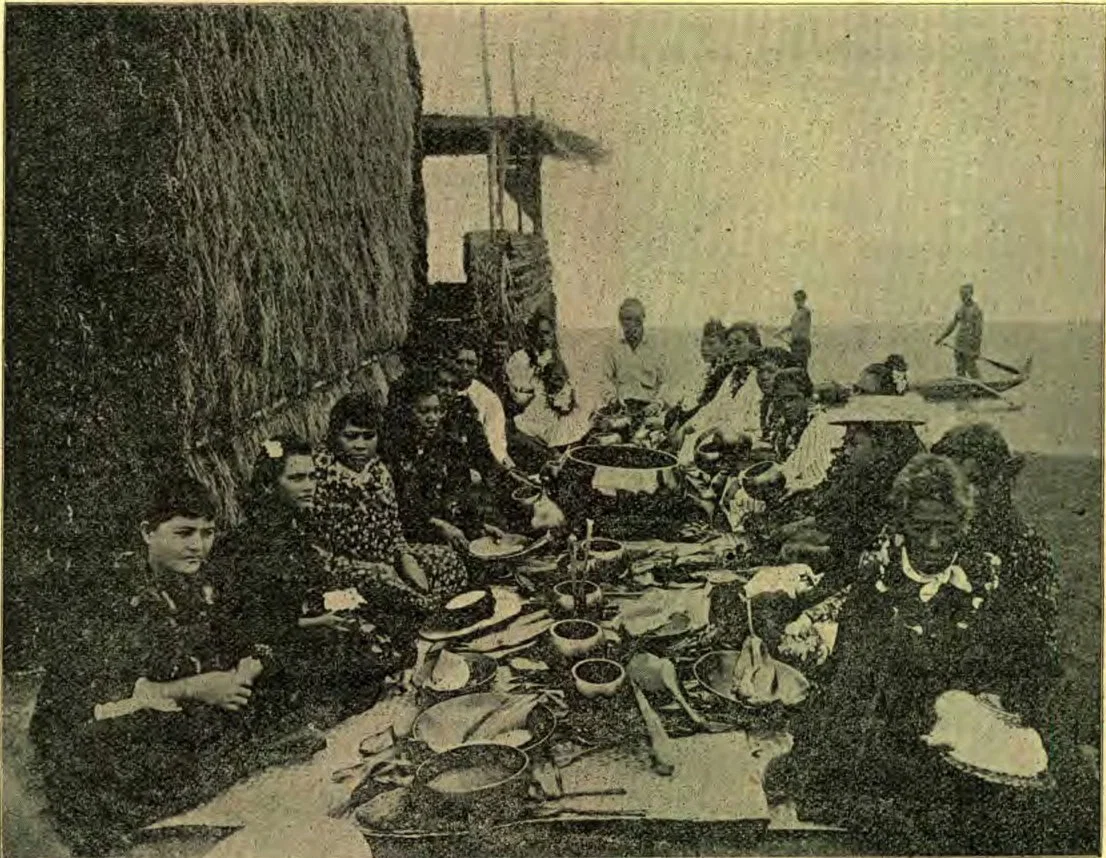
The accompanying illustration gives a correct idea of the serving of Hawaiian feasts, mentioned and described in the INSTRUCTOR of June 14. It also shows the dress and general appearance of the Hawaiians at the present time. LENA E. HOWE.

A VOICE FROM THE COUNTRY

Beneath a mystic veil of azure sky, In aisles of green the summer woods extend: Above a mossy carpet, lightly spread With shadows dark, the graceful branches bend.
Oh, go and rest beneath the cool, green boughs, And listen to God’s music all around; View nature’s varied beauties everywhere, And joy in harmony of sight and sound!
There is no purer prospect than the fields Spread out in rural beauty in the sun; There is no music like the lilt of birds, The wind’s soft whisper, or the wild bee’s hum.
The pine trees murmur songs of matchless tone To ears attuned to catch their gentle sigh; Exalted pleasure hides, and gently drifts With fleecy clouds across the summer sky.
What matter if of paintings we have none, Or harpstrings never charm our eager ears? We dwell mid scenes surpassing art’s best work, And listen to “the music of the spheres.”
MINNIE ROSILLA STEVENS.

HE BEGAN TOO LATE

A FEW evenings ago there sat in my office a young man, scarcely more than twenty years of age, who had just been released from a State reform school, to which he had been committed on a number of serious charges. I was anxious to know about his home influence, childhood, early experience, etc., and, with no little interest I asked, “My brother, were your parents Christians?” To my surprise he answered, “Yes, father and mother were both earnest Christians.”
I was silent for a moment. I thought: How can it be,—father and mother earnest Christians, and yet this lad had gravitated on down through sin and iniquity, tobacco-using and liquor-drinking, into vice and crime that carried him to prison!
I next ventured to ask, “Did you believe in Christ?”
He answered, “Yes, I believed in religion, but——”
“But what?” I asked; and with tears in his eyes he answered, “I began too late.”
Oh, yes, I thought to myself, I understand your story now. Yes, he was one of those young men who grew up with more or less gospel influence surrounding them. His parents were church-members; perhaps not so earnest as they might have been, but still they tried to raise their children right. He told me his father was sober and honest, and his mother a praying woman. But little by little he had neglected and rejected the light of heaven and the pleadings of the Spirit of God within his soul; step by step he had passed down the stairway that leads from the path of rectitude and purity to that of vice and immorality. Inch by inch he had given way to the advances of the enemy, and as a consequence, day by day he continued to drift farther and farther from principles that were pure and high and holy; while his mind became more and more poisoned with the thoughts and plans of the evil one. And thus a hundred little steps away from God and the right—a hundred little sins—had accomplished the work of searing the conscience, polluting the morals, and contaminating the soul.
I longed to give him an opportunity to redeem himself; and I purposed in my heart, if it were possible, to help him rise from the pit into which he had fallen; but I shall never forget those words that he spoke in answer to my question,—“I began too late.” I gave him an opportunity; but I, too, found that he had begun too late. One of his first acts, in return for the kindness shown him, was to steal his roommate’s purse, after which he fled, and I have not seen him since. But the memory of this young man lingers in my mind; and I would that I might cry aloud to every young man and every young woman who has grown up with the blessed privilege of knowing the truth, and tell them of the danger of remaining indifferent to the light they have received, or of neglecting the claims of God upon their souls.
My young friends, you and I are responsible for every ray of heavenly light and truth we have received: then shall we not, instead of day by day allowing thoughts of God and his love to slip out of our minds, lay fast hold of truth and righteousness; buy the truth and sell it not, but be willing to lay down our lives, if need be, for it; and no longer be indifferent to the claims of the special, distinctive truth that we profess? With a sense of the solemn times in which we live, and of our great responsibility as the younger soldiers of the Lord’s army, resting upon us, let us seize the banner of truth, fly it to the breeze, and go forward in the name of the Lord to garner sheaves for the soon-coming harvest. W. S. SADLER.

THY GOD WILL DELIVER THEE

The last message that King Darius gave Daniel as he went into the den of lions must have been encouraging to God’s tried servant. It was a remarkable statement to come from a heathen king. The king saw that he had been entrapped by the leading men in his government, and had unsuspectingly put his signature, as far as human foresight could see, to the death-warrant of the chief man in his kingdom. He reproached himself for not seeing the intent of the writing, and until the going down of the sun, he did all he could to save Daniel. But the purpose could not be changed concerning this servant of God, so the king commanded that he be brought. As Daniel stood before the king, innocent, his face beaming with intelligence and love, a man far above political strife, who stood firmly upon principle for the good of the poor and oppressed, the king’s heart yearned over him; and his parting words were, “Thy God whom thou servest continually, he will deliver thee.”
It was Daniel’s whole-hearted service of God that made him great. In his trouble Belshazzar said of him, “I have even heard of thee, that the spirit of the gods is in thee, and that light and understanding and excellent wisdom is found in thee.” This was all so, and all these gifts came because Daniel served God continually, and God was with him. Daniel gave God all the glory for the wisdom displayed through him. Listen to the noble words spoken before Nebuchadnezzar when his dream was explained by Daniel: “But as for me, this secret is not revealed to me for any wisdom that I have more than any living, but for their sakes that shall make known the interpretation to the king, and that thou mightest know the thoughts of thy heart.”
During the night that Daniel was in the den, God was testing the leading men of the Medes. Some rejoiced at what they supposed to be the fate of the chief man in the empire; but had they known how soon their turn would come to visit the den, they would not have been so exultant. The king passed the night fasting, and, as far as he knew how, resting hope in Daniel’s God. No doubt he broke the decree himself by praying for Daniel’s deliverance.
At the earliest possible moment he hastened to the den. The royal seal was broken, the stone was rolled back. Then with a “lamentable voice” he called to Daniel, “Daniel, O Daniel!” Why did he not listen to hear some word from him first? No, the king called to Daniel first. In this he manifested faith that, inexplainable as it seemed, Daniel was alive. Notice that Daniel’s God was on test. Darius continues: “Daniel, O Daniel, servant of the living God, is thy God, whom thou servest continually, able to deliver thee from the lions?” What a searching question! What awful consequences await the answer! Shall the king hear Daniel’s voice again? or is the mighty ruler no more among the living?
Then said Daniel: “O king, live forever. My God hath sent his angel, and hath shut the lions’ mouths, that they have not hurt me: forasmuch as before him [God first] innocency was found in me; and also before thee, O king, have I done no hurt.” Then the king was “exceeding glad.” Surely there is a God, and he is truly a living God, and one able to deliver his believing, faithful, innocent servants from peril and death!
Some thought the lions were not hungry. That delusion was soon dispelled when all those wicked men and their families were cast into the den. The record says: “The lions had the mastery of them, and brake all their bones in pieces or ever they came at the bottom of the den.”
Daniel’s God still lives. He is still able to do for us exceeding abundantly above all that we can ask or even think. Shall we walk so humbly and so constantly before him, as did Daniel, that through us he can magnify his own name, causing others to say, “He is the living God;” “he delivereth and rescueth, and he worketh signs and wonders in heaven and in earth”? T. E. BOWEN.

A CURE FOR CARELESSNESS

A SUCCESSFUL business man has said that he learned two things when he was eighteen, that were ever afterward of great use to him; namely, “never to lose anything, and never to forget anything.” An old lawyer sent him with an important paper, with certain instructions what to do with it.
“But,” inquired the young man, “suppose that I should lose it, what shall I do then?”
“You must not lose it,” said the lawyer.
“I don’t mean to,” said the young man; “but suppose I should happen to?”
“But I say you must not happen to. I shall make no provision for such an occurrence; you must not lose it.”
This put a new train of thought into the young man’s mind, and he found that if he was determined to do a thing, he could do it. He made such provision against every contingency that he never lost anything. He found this equally true about forgetting. If a certain matter of importance was to be remembered, he pinned it down on his mind, fastened it there, and made it stay. He used to say: “When a man tells me that he forgot to do something, I tell him he might as well have said, ‘I do not care enough about your business to take the trouble to think of it again.’ I once had an intelligent young man in my employ who deemed it sufficient excuse for neglecting an important task to say, ‘I forgot.’ I told him that would not answer; if he was sufficiently interested, he would be careful to remember. It was because he did not care enough that he forgot. I drilled him with this truth. He worked for me three years, and during the last of the three he was utterly changed in this respect. He did not forget a thing. His forgetting, he found, was a lazy and careless habit of the mind, which he cured.”—The Country Gentleman.

FIGHTING TEMPTATIONS

THE true way to conquer temptations is not to fight them in detail, but to go up into a loftier region, where they cease to be temptations. How is it that grown men do not long for the sweetmeats that used to tempt them when they were children?—They have outgrown them. Then outgrow the temptations of the world! How is it that there are no mosquitoes nor malaria on the mountain-tops?—They can not rise above the level of the swamps by the river. Go up to the mountain-top, and neither malaria nor mosquito will follow you—which, being interpreted, is, live near Jesus Christ, and keep your hearts and minds occupied with him, and you will dwell in a region high above the temptations that buzz and sting, infest and slay, on the lower levels.—Alexander Maclaren, D. D.

“SUFFICIENT UNTO THE DAY”

ONLY one day at a time, dear heart, Only one day at a time; One day's sorrows and cares and joys To weave into soulful rhyme. One day's journey along the way, Toilsome and rough and drear. Courage, dear heart! soon cometh the night; Then will come rest, don't fear.
Bright and cheery the sun may rise Over the morrow's way, Turning the rocks to nuggets of gold, Chasing the shadows away. Give thyself to its cheering power, Gather its shining gold; Store it away for a darker hour, When sunny skies grow cold.
One day's burden thy hands may bear, Nay, 'tis enough, dear heart! Borrow not aught of to-morrow's care, Cheerily bear thy part. Strength shall be given thee, hour by hour, With moments slow or fast; One by one they will glide away Into the shadowy past.
— The Housekeeper.

15—SORREL

The sorrels are so common and familiar that it may seem almost unnecessary to mention them; but I have found that some have no names of distinction, by which to separate the three most frequently met with.
YELLOW WOOD-SORREL.
YELLOW WOOD-SORREL.
The little yellow Wood-Sorrel, or Lady’s-Sorrel, is very common in June in meadows, woodlands, pastures, and even upon city lawns in moist, cool places. It snuggles down in the grass, and is to be found all through the summer months. The flower is a bright, rich yellow, which gives the plant the name of Yellow Wood-Sorrel. The leaf bears some resemblance to the clover leaf, and has the peculiar characteristic of doubling in upon itself at night, or whenever the sun is too hot for it.
The White Wood-Sorrel is easily distinguished by its white, crimson-veined blossom.
It has been used by artists for hundreds of years in floral designs and ornamentations. The flower is something like that of the anemone, but the leaves will easily lead one to a right notion of its place in the floral world. Unlike the Yellow Sorrel, the flower-stem of the White Sorrel bears but one blossom.
WHITE WOOD-SORREL.
WHITE WOOD-SORREL.
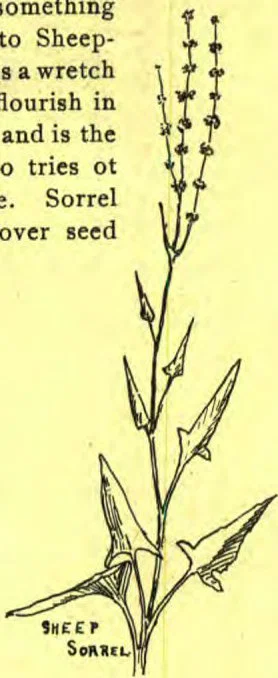
F. S. Matthews has something to say with reference to Sheep-Sorrel: “Sheep-Sorrel is a wretch of a weed, which will flourish in sandy or sterile ground, and is the bane of the farmer who tries ot raise clover for his cattle. Sorrel seed is so much like clover seed that the two get mixed up sometimes, to the utter discouragement of the farmer. I think the plant ought to be called ‘farmers’ bane.’ It belongs to the buckwheat family, and so can claim no relationship with Wood-Sorrel, which belongs to the Geranium family. I have seen a whole field as ruddy-looking as if it were filled with honest ripe buckwheat; yet the pretty terra-cotta color was produced by the flowering of this miserable Sheep-Sorrel.”
L. A. REED.

DON'T ANSWER IMPERTINENT QUESTIONS

IMPERTINENT questions are to be met with firm and dignified politeness. Any question about another’s personal affairs, about the price of one’s clothing, the amount of one’s earnings, the reasons one has for entirely private conduct, is impertinent. Would I answer such questions?—Not at all. Usually, by a little tact, one can settle such questioners. If there is no other way, I counsel a plain but courteous sincerity—a simple refusal to answer. One may just say, “Pardon me, I prefer not to give any information whatever on this matter.”—Margaret E. Sangster, in Ladies’ Home Journal.

Bird Mother-Love

Once while riding along a country byroad, I espied a small clump of rosebushes by the roadside. The flowers looked so inviting that I determined to pick a few of the choicest buds, but I had gathered only a few when my attention was attracted by the quick, sharp cries of a female meadow-lark.
Looking in that direction, I saw the bird fluttering and trembling along on the ground. It was apparently in the greatest distress, as if with a broken leg or wing. Determined to investigate, I crawled through the fence, and advanced slowly to the spot where the bird was. It moved slightly, but apparently with considerable difficulty. As fast as I approached, it receded, so that I was unable to get any nearer than within a few feet of it. After I had followed the bird about ten yards, it suddenly arose in the air, all unimpeded, with loud, sonorous notes of joy. The feathered hypocrite had been leading me from her nest.
I immediately retraced my steps, and resumed the picking of the roses. Again and again the bird tried the same tactics; but seeing that I did not heed her, she suddenly dropped all her strategy, and began drooping her head, and beating her wings on the ground. She uttered a few low, moaning tones, as if pleading with me not to disturb her nest. I could not withstand this last appeal, so I hastily climbed back into the carriage, without getting half the flowers I wished. No human being could have expressed more joy than did this mother bird then. Up into the air she rose, circling about, giving vent to her ecstasy in rapturous bursts of melody.
J. J. Thomas.

MIGNONETTE AND SWEET ALYSSUM

WHEN I fix my yard in spring, 'Fore the leaves hes started yet, I begin to plan, first thing, Fer my beds of mignonette. One down here beside the gate,— Kep' it there sence 'sixty-nine,— One up yonder, where the late Sunbeams likes to set an' shine. They're sech cozy, lovin' flowers! I could jest kneel down an' kiss 'em, Pet an' fuss with 'em fer hours— Mignonette an' sweet alyssum.
Yes, an' sweet alyssum, too; Most folks hes their preferences. Some likes hollyhocks, a few Growin' stately by the fences. Some likes lilies, straight an' white; Well, they're sweet enough, land knows! An' the good Lord puts a sight Of his comfort in a rose. Then the clovers, crowdin' clost— I should awf'lly hate to miss 'em! But there's two that I love most— Mignonette an' sweet alyssum.
Some folks says there's flowers above. Scriptur's silent there, I know; But I think the God of love Surely must hev fixed it so. Ef it really wasn't wrong, I could almost make a prayer— Thet I've loved 'em here so long, An' I want to find 'em there. They're old friends I've planned to meet, An' I don't expect to miss 'em, Growin' by the golden street— Mignonette an' sweet alyssum.
— Mabel Earle.

JULY STUDY OF THE FIELD

PART II: “THE MEXICAN PEOPLE AND CUSTOMS”

(July 8-14)
1. Homes of the Poor.— It is difficult to express in words, to those who have not had the opportunity of judging for themselves, the degraded condition of the mass of the laboring classes in Mexico. The idea of home life, as we know it, is wanting. The independent house in the city is unknown. A room, or rooms, on the ground floor, where there is little light and practically no ventilation, probably only a single opening,—that for entrance,—with dirt floors and no drainage, constitutes the home. In the suburbs and the country the dwellings in the cold regions are of adobe; but in the temperate or warm regions, they are mere huts of cane or of stakes, wattled with twigs, and roofed with cornstalks, plantain leaves, or brush. In such houses there is rarely anything answering to the civilized idea of a bed, the occupants sleeping on a mat, skin, or blanket on the dirt floor. There are no chairs, tables, fireplaces, or chimneys; few or no changes of raiment; no washing apparatus nor soap. In fact, there is no furniture whatever, except a flat stone with a stone roller, to grind the corn, and a variety of earthen vessels to hold food and drink, and for cooking. This last operation is generally performed over a small fire, within a circle of stones, outside, and in front, of the main entrance to the dwelling. These rooms, decidedly inferior in comfort and neatness to those of the negro of the South during the state of slavery, are as full of life as they are bare of furniture, the pet animals sleeping in the same room with the family. All huddle together at night on the mat or other improvised bed, with a roll of old rags for pillows, or with no pillows at all. Such living naturally invites disease; and the wonder is, not that so many die in infancy, but that any live, and grow to maturity.
2. The Maguey, or Mexican Aloe.— No plant of Mexican soil is more highly appreciated than the maguey, or hothouse century plant. It grows wild upon the mountains, springs up in uncultivated places as a weed, is cultivated as a domestic plant in little patches, and is also planted in fields of leagues in extent. The uses to which this plant is applied are more numerous than the methods of cultivation. When its immense leaf is pounded into pulp, it forms a substance from which both cloth and paper are made. The fiber of the leaf, when beaten and spun, forms a beautiful thread, resembling silk in its glossy texture, but which, when woven into a fabric, more nearly resembles linen than silk. This thread is the sewing-thread of the country. The leaf of the maguey, when crudely dressed, and spun into a coarse thread, is woven into sailcloth and sacking, and from it is made the bagging in common use. The ropes made from it are of that kind called Manila hemp. It is an excellent material for wrapping-paper. When cut into coarse straws, it forms the brooms and whitewash-brushes of the country; as a substitute for bristles it is made into scrub-brushes; and finally, it supplies the place of hair-combs among the common people.
3. The National Beverage is the fermented juice of the maguey, called “pulque;” and for this more than any other use made of it, the plant is valuable. Until the plant has reached its tenth year or thereabouts, there is no trace of bloom. The cultivator understands his plants so perfectly that he can detect just the time when the flower-spike is about to develop. He then makes an incision, extracting the whole heart, upon which the flower would eventually appear, leaving a natural basin often two feet deep and one and one-half feet in diameter. This rapidly fills with the juice of the plant, called agua miel, or honey water, which would have nourished the flower, had its development not been checked. This juice is gathered three times a day for two or three months, a single plant producing from sixty to one hundred and twenty gallons, after which it dies. The process of collecting the liquid is curious. A siphon is made of a long gourd, with a cow’s horn at one end. The collector sucks the juice up into the gourd, pouring it, as rapidly as it is filled, into sheep-skin bottles, conveyed upon the backs of patient donkeys to the barns where the pulque is made. Here it is emptied into vats; and some of the liquid, previously fermented, is placed in it, operating like yeast. In twenty-four hours the pulque is ready for sale. The liquor resembles koumiss in appearance; contains water, gluten, and alcohol; and has the odor of rancid meat. It is not only sold in shops, but is peddled throughout the country. The revenue to the government from this production is immense.
4. The Love of Gambling is one of the strongest traits of the Mexican character, and to it may be traced much of the moral and political degradation of the people. There is no distinct class in Mexico known as gamblers, but the vice is everywhere prevalent. It is said that at one time it was no uncommon sight to see the president of the republic and his chief officials gambling with priests and ragged leperos. When their simple wants are satisfied, money with them has little value, and quickly finds its way into the pockets of the almost omnipresent pulque or lottery-ticket vender, or the priest.
5. Child Life in Mexico.— A glimpse at the life of the children of the poor is sufficient to convince the most doubtful that a transformation in the character of a Mexican means a change beginning with childhood. Babies, cats, dogs, pigs, and chickens revel together in the filth of the little yard that is, perhaps, the outlet of several miserable homes. The baby looks as if it had not been washed for days—perhaps it never has had a bath. Its clothes are pieces of old cloth or calico,—a little skirt, a calico waist, and perhaps an old apron wrapped about its legs. It may lie for hours on the straw mat that serves as a bed. In some houses a hammock made of four boards fastened together at the corners, with a piece of strong cloth loosely tacked over them, serves as the baby’s bed. This is suspended from the rafters overhead. The children early learn to creep, and are taught to walk so soon that many become bow-legged, or even lame. Babies are allowed to eat everything; beans, tortillas dipped in chili sauce, fruit that is green or overripe, and even pulque, are given them. Small children are taught to work. Little ones scarcely able to toddle by the side of their mothers carry small bundles on their heads. When five or six years old, they carry babies so heavy that they can barely stand under the burden. The girls in the home have to grind the corn for tortillas (corn-cakes), carry water, and help in other ways. The boys also have their tasks, which, however, they shirk as often as possible, and waste their time in gambling. In many parts of the country there are no schools; and the children grow up without an education, learning, however, to lie and steal, beg and gamble, and drink pulque, which makes them drunk and stupid. Among these children of the poor there are some who are kind, patient, happy, loving little helpers, just such as we find in other lands; but in their present condition, their lives are hopeless. The gospel alone will uplift them, and we who know its blessedness are responsible for its reaching them. A broad field of usefulness is open to the teachers who will train these little ones for the Master.

HOME SUNBEAMS

“MILDRED is a perfect sunbeam in the house,” said a dear old lady, speaking of her granddaughter, some time ago; and ever since I have looked at that girl admiringly. For it was not spoken of one whose life is so surrounded with luxury that she has never known care or hardship, but of one who is bravely earning her own way. Nor was it the fond remark of a doting grandmother, who had Mildred only as an occasional visitor, and so saw her only in her happiest moods. It was the verdict of one who lived under the same roof, and who, in her declining health, needed much of care and tenderness; but her face lighted as she spoke the dear name, and in that brightening face was a wonderful tribute to a girl's beautiful character.
So many girls—girls with heart, conscience, and the best of intentions—are anything but sunbeams. Some of them are whirlwinds; they keep the house in a commotion with their comings and goings, their plans and projects, which sweep everything else out of the way. Some of them are like a fog, and settle down upon the household in a dull, depressing way whenever the sky is clouded. But the sunbeam girl—who is a genuine sunbeam in her own home—is rarer than we wish she were. May her tribe increase! — Well-Spring.

THEIR COST

How cheap are the things that are bought and sold, The beautiful things that the hands can hold,— Whatever is purchased with silver and gold!
The merchants are calling, and filling their rooms With jewels and laces and rarest perfumes, And wonderful webs from the Indian looms.
The price of the treasures is small, as they say; For dollars and cents are exchanged every day The furs of the North-land, the silks of Cathay.
But oh, the rare things that can never be brought From far-away countries, but still must be sought Through working and waiting and anguish of thought!
The patience that comes to the heart as it tries To hear, through all discord and turbulent cries, The songs of the armies that march to the skies;
The courage that fails not, nor loses its breath In stress of the battle, but smilingly saith, “I’ll measure my strength with disaster and death;”
The love that through doubting and pain will increase; The longing and restlessness calmed into peace, That is perfect and satisfied, never to cease—
These, these are the dear things. No king on his throne Can buy them away from the poor and unknown Who make them, through labor or anguish, their own.
— Selected.
Continue reading: THE PROGRESSIVE BEAN