TEDDY was eating his beans with a very enthusiastic appreciation of their merits.
“Teddy,” said his father, suddenly, “suppose you were to see a dry, white bean start suddenly to grow, sprouting first, then sending out two green leaves, then some roots, the stem growing longer all the while, and other little leaves coming out,—and all within two minutes’ time?”
“Why, papa!” cried Ted, “that is a regular ‘Jack and the Beanstalk’ story! Such things don’t happen, really and truly. You know they don’t, papa!”
“Well,” said papa, laughing, “I can show you something out in the garden that seems a good deal like that story. You come out with me after dinner, and I’ll show it to you.”
You may be sure Ted was ready when dinner was over. He had skipped away for his cap, and was back again in a twinkling.
A moment later the little boy and his father were walking through the bit of orchard behind the house toward the garden.
“Two weeks ago, Ted,” said his father, “I planted a dry, hard bean out here; and the second morning after that I planted another, and every other morning since then I have planted a bean. The last one I put in the ground this morning. See, here it is!” And Ted’s father began to draw the earth away from a bit of stick that was stuck in the ground.
“It is hard and dry, just as it was this morning. Now we’ll look at the one I put in the day before yesterday morning.”
In a moment that one was dug up.
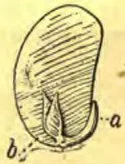
“See! it has swollen a little in the damp earth,” his father continued. “I’ll split it open down the middle, and you’ll see a tiny bit of stem at one end, lying curled up between the two halves of the bean.”
“Yes; there it is!” cried Ted, growing interested.
“Now we’ll look at the one planted two days before that,” said his father. “Ah, this is swollen still bigger; and I can open it with my fingers, the outside covering is so soft.”
“The little stem has grown bigger, and is trying to straighten out,” said Teddy.
“Here’s the one planted two days before that.”
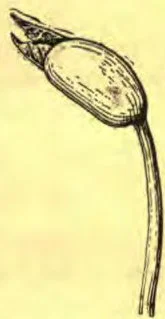
“Why!” cried the little boy, excitedly, “the little stem has come out through the outside covering, and the two halves of the bean have spread apart at the other end!”
“See this one that is two days older still,” said Ted’s papa, smiling to see how interested his little boy was getting.
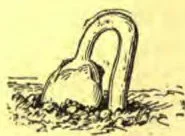
“That? Why, that’s a regular little plant! And, oh! how funny! The two halves of the bean stand up just like two leaves!” And Ted opened his eyes very wide indeed.
“Here’s the next member of this interesting family.”
“That has little roots starting down from the stem; and those two halves of the bean are turning green, just like real leaves,” cried Ted, looking closely at the little plant.
“We won’t have to dig up the next plant,” said papa. “It has poked its head up through the ground, and you can see a bit of stalk growing up between the two halves of the bean, that are still greener than the last ones.”
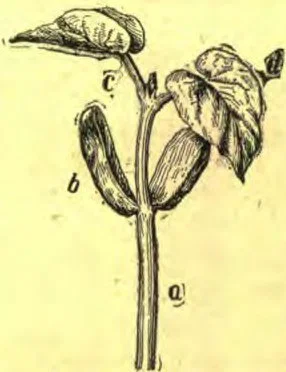
“And here, in the last one, the bit of a stalk has sent out two real little leaves,” said Ted, walking along to the spot where the first bean of all was planted, two weeks before. “It’s a regular little plant now,” he said. “But was the little plant in the bean all the time, papa?”
“It was curled up there in the bean all the time. If John will give you some peas, you may try the same experiment, and see how peas grow.”
But before papa had finished, two small legs were flying down the path to find John, the gardener.—Religious Herald.
COLOR-SCREENS AND RAY-FILTERS
By J. Edgar Ross
In photographing clouds, flowers, paintings, or anything that has several colors, the use of a color-screen and orthochromatic plates will wonderfully improve the picture. Without the screen, an ordinary plate will make green, yellow, orange, and red of almost the same degree of blackness; while the other colors are rendered almost equally white. The screen and orthochromatic plates tone down this contrast, and give to each plate nearly its true value. Instead of the color-screen a chemical ray-filter is often used for the same purpose.
Both color-screens and ray-filters may be bought at the stock-house; but either can be made with very little trouble. Here is the formula for a color-screen: Dissolve thirty grains of aurantia in one ounce of alcohol; then add one ounce of ether and twenty grains of pyroxaline. Take a thin glass plate (a lantern-slide, cover-glass, or even a spoiled negative that has been cleaned, will do), and pour a small quantity of the solution in the center of it. Tip it from side to side until the plate has been evenly coated over its entire surface. Set it away to dry, and then coat a second and a third plate in the same way. When the plates are dry, two of them should be given a second coat; and when these are dry, one of them may be coated the third time. This will give you screens of three different densities. The denser the screen, the more violet rays will be shut out, and the longer the plate will need to be exposed.
These screens may be used either in front or behind the lens, and may be suspended in any convenient way. They do not usually give as good orthochromatic results as the ray-filter.
A ray-filter consists of an appropriate glass tank filled with a solution of bichromate of potash. A bottle having thin, flat sides entirely free from air-bubbles would answer just as well as a tank made especially for that purpose. I have never been able to find such a bottle when I wanted one, though I have seen them at other times. If you succeed in getting one, all you will need to make a ray-filter will be five cents’ worth of bichromate of potash, and some simple contrivance to attach the bottle to the front of the lens. If you are unable to find a suitable bottle, you can make a tank with very little trouble and almost no expense.
Take four fruit-jar rubbers, and from two of them cut a segment about a quarter of an inch long. With some waterproof cement that will adhere to both rubber and glass, cement the rubbers together with the two uncut ones on the outside. This will give you a rubber ring about three eighths of an inch thick. Cement this ring between two thin glass plates, and your tank is complete. If the corners of the glass are cut so as to make them conform very nearly to the size and shape of the ring, there will be much less danger of breakage than if the plates are left square.
To attach this tank to the lens, take a board about three eighths of an inch thick, and just the size of the plates that make the sides of your tank. Cut a hole in the center large enough to fit snugly over the front of your lens. Do not get the hole too large. It should fit so tightly that there will be no danger of its being knocked off by an accidental jar of the camera. This board is cemented to214one of the glass sides of the tank, which is then filled with the filtering solution. When it has been filled, the opening left by the cut-out sections of the two rubbers may be stopped with a wooden plug.
Make a ten-per-cent solution of bichromate of potash (one ounce of bichromate to ten ounces of water); and when you fill the tank, dilute it to the required density. For dark cumuli clouds a two-per-cent solution is dense enough. Light sirrus clouds will require a five- or six-per-cent solution, with a consequently longer exposure. A bouquet of many-colored flowers should be photographed through an eight- or ten-per-cent solution.
In photographing moving clouds, too long an exposure is apt to cause blurring. Too short an exposure, though it may give sufficient detail, is likely to give the sky an unnatural blackness.
It is best to use orthochromatic, or isochromatic, plates with either the color-screen or the ray-filter. These plates are especially sensitive to yellow and orange light, and consequently they give the color values more nearly correct than do the ordinary plates.
Some manufacturers advertise that color-screens are not needed with their “ortho,” or “iso,” plates, but do not believe such a statement. A common plate, with a color-screen or a ray-filter, will give much truer monochromatic results than the best orthochromatic plates will give without one.
J. EDGAR ROSS.
A PROBLEM IN DIVISION
By Aunt Betty
WHILE Ted and baby were taking their midday nap, five-year-old Tom went into the garden for a walk with mama. It was the end of June, and the red raspberries were just beginning to turn color: yes, here was a ripe one; and there was another, and another. By the time they had gone the length of the two rows, they had found eight beautiful, bright berries.
“Take them in, Tom,” said mama, “and divide them among you. I must get some lettuce for dinner.”
When she came in, a few minutes later, there were two neat little groups of berries on the table,—three for Ted, three for baby. Tom had eaten his two berries and returned to his play. He was only a little fellow, and did not know much about arithmetic; but he could divide eight berries among three children, and have no remainder. Can you?
AUNT BETTY.
DROPPED STITCHES
By Margaret Vandegrift
GRANDMOTHER smiled as she sat there rocking,
And leisurely knitting a long black stocking.
The girls were telling what they would do
If their dreams of unlimited wealth came true.
And, “What would you do, dear grandma?” said
The girl whose visions came out ahead.
Said grandma: “If I’d unlimited riches,
I’d buy me some needles that wouldn’t drop
stitches!”
“But it wouldn’t matter,” said one of them. “Then
You never need pick them up again.”
Grandmother shook her pretty white curls.
“Listen to me,” she said, “my girls.
“No matter how high your wealth may mount,
Dropping stitches will always count!
Grandmother never sticks them in —
The morals — with a needle or pin;
She simply puts them up on the shelf,
And leaves them for you to help yourself.
— Margaret Vandegrift.
THE HEART AND THE BLOOD-VESSELS
By Mrs. M. D. McKee
The blood-circulating organs are the heart and the blood-vessels. These latter are of three kinds,—the arteries, which carry the blood from the heart to the tissues of the body; the veins, which return the blood from the tissues to the heart; and the capillaries, which are very fine vessels uniting the ends of veins and arteries. They end the arteries, and then gather into larger and larger trunks, thus forming veins. As the veins approach the heart, they form larger trunks, until at last two large veins are formed,—the “descending” and the “ascending” vena cava.
Arteries have firm, elastic walls, and retain their shape, full or empty. They have three layers of connective and muscular tissue. Veins have thinner, less rigid walls. They can hold double the quantity of blood that the arteries do. In the veins are valves, which allow the blood to flow but one way—toward the heart.
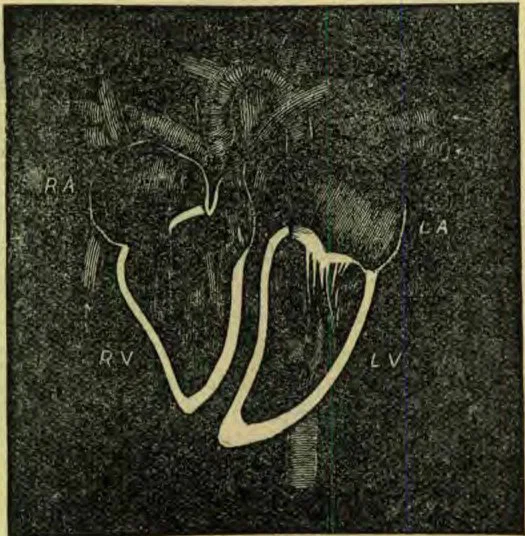
The heart is a hollow muscle about the size of one’s fist; conical in shape, placed between the fifth and sixth ribs and the lungs, which nearly cover it. The heart is inclosed in a sac, called the “pericardium.” In this is a fluid secretion, in which the heart moves easily, and by which it is protected from shock. The heart covering is attached to the central tendon of the diaphragm. The weight of the heart is from eight to twelve ounces. A perpendicular muscular partition divides the heart into two halves,—right and left,—and these are again divided into an upper and a lower portion,—four cavities in all. (See diagram.) These cavities are lined with a delicate membrane.
The upper cavities are called the right and left auricles, and the lower cavities are called the right and left ventricles. Each cavity holds about six ounces of blood. The walls of the ventricles are much thicker than those of the auricles; and the wall of the left ventricle is also much thicker than that of the right.
Each ventricle has two openings—one leading to the auricle on the same side, and the other to an artery. The right ventricle connects with the pulmonary artery, which leads to the lungs; and the left ventricle connects with the aorta, the largest artery in the body. The right auricle has two openings in its outer wall, through which the two largest veins in the body (vena cava, ascending and descending) empty the blood into the heart. The left auricle has four openings, which receive the blood from four pulmonary veins, two from each lung.
R A—Right Auricle. R V—Right Ventricle. L A—Left Auricle. L V—Left Ventricle.
The two openings of the ventricles are guarded by valves, which allow the blood to pass in but one direction. These valves are delicate curtains of membrane. The valve on the right side (between the right auricle and the right ventricle) has three curtains, and is called the “tricuspid valve;” that on the left side has two curtains, and is known as the “mitral valve.” There are also the aortic and pulmonary valves, which are called the “semilunar valves.” These allow blood to flow from the auricles to the ventricles and into the arteries, but not in the opposite direction.
In our next notice we will see how the blood flows through the body, and will study especially a diagram showing the action of the heart in reference to the circulation.
MRS. M. D. MCKEE.
THE DOCTOR'S PRESCRIPTION
Some years ago a lady, who tells the story herself, went to consult a famous New York physician about her health. She was a woman of nervous temperament, whose troubles—and she had had many—had worried and excited her to such a pitch that the strain threatened her physical strength, and even her reason. She gave the doctor a list of her symptoms, and answered his questions, only to be astounded at his brief prescription at the end: “Madam, what you need is to read your Bible more!”
“But, doctor—” began the bewildered patient.
“Go home, and read your Bible an hour a day,” the great man reiterated, with kindly authority. “Then come back to me a month from to-day;” and he bowed her out without a possibility of further protest.
At first his patient was inclined to be angry. Then she reflected that at least the prescription was not an expensive one. Besides, it certainly had been a long time since she had read the Bible regularly, she reflected, with a pang of conscience. Worldly cares had crowded out prayer and Bible study for years, and, though she would have resented being called an irreligious woman, she had undoubtedly become a most careless Christian. She went home, and set herself conscientiously to try the physician's remedy.
In one month she went back to his office. “Well,” he said, smiling, as he looked at her face, “I see you are an obedient patient, and have taken my prescription faithfully. Do you feel as if you needed any other medicine, now?”
“No, doctor, I don't,” she said, honestly. “I feel like a different person—I hope I am a different person! But how did you know that that was just what I needed?”
For answer the famous physician turned to his desk. There, worn and marked, lay an open Bible. “Madam,” he said, with deep earnestness, “if I were to omit my daily reading of this book, I should lose my greatest source of strength and skill. I never go to an operation without reading my Bible. I never attend a distressing case without finding help in its pages. Your case called not for medicine, but for sources of peace and strength outside your own mind, and I showed you where to find them unfailingly. I gave you my own prescription, and I knew it would cure.”
“Yet I confess, doctor,” said his patient, “that I came very near not taking it.”
“Very few are willing to try it, I find,” said the physician, smiling again. “But there are many, many cases in my practice where it would work wonders if they only would take it.”
This is a true story. The doctor died only a little while ago, but his prescription remains. It will do no one any harm to try it.—Well-Spring.
THE WOODCHUCK
The woodchuck is so often seen sitting alone on his earthen threshold that you are apt to think of him as a solitary old bachelor, and can almost imagine him grumbling that the clover doesn’t have the flavor it did in his youth. But you do occasionally see the whole family, and you may perhaps have the rare privilege of seeing the mother removing her young to a safer home than that in which they were born—carrying them just as a cat does her kittens. The young fellows sometimes betake themselves to solitary wandering when not more than one third grown, and are then apt to get into serious trouble if met by a dog or a no less terrible boy.
One day I came upon such a one, that was exploring the orchard at a foolhardy distance from the maternal burrow, toward which, on seeing me, he began to retreat. A barbarous instinct impelled me to give chase, and I soon overtook him. He threw himself upon his back, for defense, I presume; but he held up his paws in a manner so appealing that it would have softened even a boy’s heart.
In some parts of New England, woodchucks are so numerous as to be a pest, burrowing the ground, trampling the clover, ravaging the bean-fields, devouring the plants, leaf and pod, and sometimes invading the vegetable-garden. Then the farmer finds it necessary to wage a215war of extermination, or at least of decimation; for the last of them seems never to be killed. And indeed I, for one, should be sorry never again to see the upright, motionless, stump-like figure, and never again to hear that piercing whistle, which seems half a chuckle of derision.
Sometimes the woodchuck has a hankering for carnivorous diet, and raids the chicken-coop; sometimes he becomes a climber, and takes to the trees for leaves.
A friend of mine in Maine, who is a close observer of wild life, tells me that in his part of the State there are more black woodchucks than brown, and that the end of their hibernation has an unvarying date. Here in Vermont the brown are more numerous; and our skunk-trappers, who have a good opportunity for observation, tell me that the time when the woodchucks come out is regulated entirely by the weather.
One to whom it is allotted to spend the whole year in this northern land, and bear the stress of the vigorous winter, almost envies this fellow, who, after enjoying the months of flowers, birds, and green leaves, creeps, at the first hint of cold weather, closer to the warm heart of the earth, and falls into a sleep that neither nipping frosts nor howling wintry blasts disturb. While the lean fox shivers in his furs as he hunts the snowy fields for his meager fare of mice, and the hare forages among the undergrowth for scant rations of browse, the woodchuck sleeps with maw ungnawed by hunger.
When, in the lengthening days, the snow begins to melt a little about the door of his house, some warmer breath of air or moistening of the earthen floor awakens him, and he comes forth into the light to look upon the barren world. Then, they say, if he sees his own shadow, he takes warning of it of more biting cold to come, and retires for another sleep of forty days. But if the sky is clouded, you may henceforth see the imprint of his feet on the softened snow, linking his own to all his neighbor’s burrows; and then presently heigho, for the sprouting clover on the sunny southern slopes!— Youth’s Companion.
AUTOGRAPHS WRITTEN IN THE DUST
By Ernest Seton Thompson
Man and the birds are understood to possess the earth during the daylight, therefore the night has become the time for the four-footed ones to be about; and in order that I might set a sleepless watch on their movements, I was careful each night, before going to bed, to sweep smooth the dust about the shanty and along the two pathways, one to the spring and one to the corral by way of the former corn-patch, still called the garden.
Each morning I went out with all the feelings of a child meeting the Christmas postman, or of a fisherman hauling in his largest net, eager to know what there was for me.
Not a morning passed without a message from the beasts. Nearly every night a skunk or two would come and gather up table scraps, prying into all sorts of forbidden places in the search. Once or twice a bobcat came. And one morning the faithful dust reported in great detail how the bobcat and the skunk had differed. There was evidence, too, that the bobcat quickly said (in bobcat, of course), “I beg pardon; I mistook you for a rabbit, but will never again make such a mistake.”
More than once the sinister trail of the “hydrophoby cat” was recorded. And on one occasion the great, broad track of the king wolf of the region came right up the pathway, nearly to the door—the tracks getting closer together as he neared it. Then stopping, he had exactly retraced his steps, and gone elsewhere about his business. Jack rabbits, coyotes, and cottontails all passed, and wrote for me a few original lines, commemorative of their visit—and all were faithfully delivered on call next morning.—Ernest Seton Thompson.
In studying this lesson, read the chapter from the beginning, so as to get the connection. Read the lesson text many times, noting the meaning of every word, phrase, and sentence. Study it till you can answer the questions in the language of the text. By following this plan each week, you will have a definite understanding of the whole epistle at the close of the lessons. And don’t forget to pray for wisdom and understanding.
QUESTIONS
1. From whom were the Galatians removing? Into what had they been called? Gal. 1:6. Who is it that calls men? 1 Cor. 1:9. Then from whom were they departing?
2. Unto what were they removing? Gal. 1:6. Is there any other gospel? What was the cause of their departure from the gospel? What were these troubles really doing? V. 7. In view of this, with what must this epistle of Paul especially deal? Note 1.
3. What is the gospel declared to be? Rom. 1:16. On whom must we believe in order to be saved? Acts 16:31; 4:12. Then in what were the Galatians being led to trust for salvation? Note 2.
4. What solemn declaration does Paul make concerning the gospel he had preached? Would an angel from heaven be exempt from this curse? Gal. 1:8; note 3. In what words does he repeat and emphasize this curse? V. 9.
5. What have some of the angels done? 2 Peter 2:4. How do Satan and his followers often work to deceive? 2 Cor. 11:13-15. How can we distinguish these false teachers from the true? Isa. 8:20.
6. What questions does Paul ask in verse 10? What did he say in regard to pleasing men? Id.
7. Whom should the gospel minister always seek to please? 1 Thess. 2:4. How should we always seek to please God? Col. 1:10. When our ways please God, what will be our standing with men? Prov. 16:7.
NOTES
1. Since these false teachers were perverting the gospel, this epistle must deal especially with the gospel. And what Paul then wrote has been preserved for us, that we may know what the gospel is. There is only one way of salvation—the gospel of Jesus Christ. And the Lord has made this way very plain and simple. It is the work of the enemy to make God’s plan seem hard, or to lead people to add something to it that will spoil it all. Just as a little poison, mixed with good food, will cause death if eaten, so may a little error destroy all the power of the gospel in our lives. Then let us study these lessons carefully, that we may understand God’s plan of salvation.
2. The Galatians were not giving up the idea of being saved. On the contrary, they were doubtless very zealous in their efforts to secure salvation. But they were being led away from God’s plan; and since his way is the only way, and his power the only power, for salvation, they must have been led to trust in some way that had in it no power for salvation.
3. There are fallen angels, who sometimes appear as angels of light. But we need not be deceived. By carefully studying God’s word, we may know the truth so well that even an angel would not be able to deceive us. But if we neglect our Bibles, we shall be in great danger; for Satan will deceive all who do not know, love, and obey the truth.
To Reach BATTLE CREEK
FROM
CHICAGO, BUFFALO, DETROIT, OR TOLEDO,
Purchase Tickets Reading over the MICHIGAN CENTRAL “The Niagara Falls Route.”
A First-class Line for First-class Travel between Chicago and New York and Boston. Elegantly equipped through trains pass Battle Creek in each direction daily.
R. N. R. WHEELER, Ticket Agent, Battle Creek.
O. W. RUGGLES, Gen’l P. and T. Agt., Chicago, Ill.
TAKE THE Canadian Pacific Railway
For . . . CHATHAM, OTTAWA, MONTREAL, LONDON, GALT, QUEBEC, WOODSTOCK, TORONTO, BOSTON, PORTLAND, and
All points in New England, the Maritime Provinces, Great Britain, and the Continent.
Illustrated literature, time-tables, and full particulars, upon application to—
J. FRANCIS LEE, GEN. AGENT,
Passenger Dep’t. 228 SOUTH CLARK ST., CHICAGO
Branch Offices: 76 Ottawa St., Grand Rapids, Mich. Room D, Chamber of Commerce, Cincinnati, Ohio. 315 Chestnut St., St. Louis, Mo.
Cincinnati Northern Railroad Co.
TIME TABLE NO. 3.
IN EFFECT SEPT. 24, 1899.
Trains Pass Battle Creek, as follows:
WEST-BOUND.
No. 21, Mail and Express — 6.58 P. M.
No. 23, Accommodation — 2.07 P. M.
No. 27, Local Freight — 8.25 A. M.
EAST-BOUND.
No. 22, Mail and Express — 8.25 A. M.
No. 24, Accommodation — 1.45 P. M.
No. 28, Local Freight — 5.30 P. M.
Direct connections are made at Toledo with all roads diverging. Close connections for Detroit and Cincinnati.
J. L. READE, Ticket Agt., Battle Creek.
E. R. SMITH, City Pass. Agt., 6 West Main St.
E. W. Meddaugh and Henry B. Joy, Receivers.
CHICAGO & GRAND TRUNK R'Y.
By A. S. Parker
Trains arrive and leave Battle Creek.
WEST-BOUND FROM BATTLE CREEK.
No. 9, Mail and Express, to Chicago — 10.15 P. M.
No. 1, Chicago Express, to Chicago — 9.00 A. M.
No. 3, Lehigh Valley Express, to Chicago — 8.40 P. M.
No. 5, Pacific Express, to Chicago, with sleeper — 1.10 A. M.
No. 75, Mixed, to South Bend — 8.20 A. M.
Nos. 9 and 75, daily, except Sunday.
Nos. 1, 3, and 5, daily.
EAST-BOUND FROM BATTLE CREEK.
No. 8, Mail and Express, to Pt. Huron, East, and Detroit — 3.45 P. M.
No. 4, Lehigh Express, to Port Huron, and East — 8.27 P. M.
No. 6, Atlantic Express, to Port Huron, East, and Detroit — 2.25 A. M.
No. 2, Leh. Exp., to Saginaw, Bay City, Pt. Huron, and East — 6.50 A. M.
No. 74, Mixed, to Durand (starts at Nichols) — 7.15 A. M.
Nos. 8 and 74, daily, except Sunday.
Nos. 4, 6, and 2, daily.
A. S. PARKER, Ticket Agent,
Battle Creek.
Unemployed Men and Women, Attention!
THE Magic Pocket Vaporizer
It is the most effective means yet devised for applying healing remedies to the diseased mucous membrane found in Catarrhal Affections. It combines three instruments in one for treating the Nose, Throat, Lungs, and Ears.
Energetic agents can earn good wages by selling this invaluable little instrument, which may be carried in the vest pocket and used at any time without interfering with one's business.
It will be to your advantage to read every word of the following unsolicited letter from one of our salesmen:—
1101 LINCOLN AVE., SAGINAW, W. S., MICH., Feb. 6, 1900.
Modern Medicine Co., Battle Creek, Mich.
GENTLEMEN: I have canvassed the greater part of the time for more than thirty years, keeping my eyes open all the time for the best-selling books and other articles that might come upon the market, but do not hesitate to say your Magic Pocket Vaporizer is the best thing I have ever found to pick up money with. It is a real money catcher, as you will see by the following. On arriving in my territory, I went directly to work. At sundown that day I had sold four and taken five orders; the second day I put in about eight hours, and had fourteen in orders and sales. I can usually average eleven orders out of fifteen exhibitions, or a profit of from four to six dollars a day. I have succeeded in putting thirteen Vaporizers in one home, receiving $12.50 for them; eight Vaporizers in another family; five to a Baptist minister; three to another family. Yours truly, H. S. MERCHANT.
Write at once to the MODERN MEDICINE COMPANY, 105 Washington Ave., Battle Creek, Mich., for terms and territory.
Artesian Wells Bring Sahara Desert Under Cultivation
MORE than twelve million acres of the great Sahara desert, the larger part of whose three and one-half million square miles of territory has lain sterile for thousands of years, has lately been successfully brought under cultivation. Irrigation by means of artesian wells has apparently solved the problem of utilizing this great tract of waste land; and it is not beyond the range of possibilities that within a few years the geographies will be out of date that define the Sahara as a “region of deserts and oases,” since it may become as abundantly productive as our own Western “dry lands” in California and elsewhere.