The Youth’s Instructor, Vol. 48, No. 13.

Trees in Winter

The Youth’s Instructor

Mar 29, 1900

Review and Herald Publishing Company · Battle Creek, Mich. · Mar 29, 1900

Trees in Winter
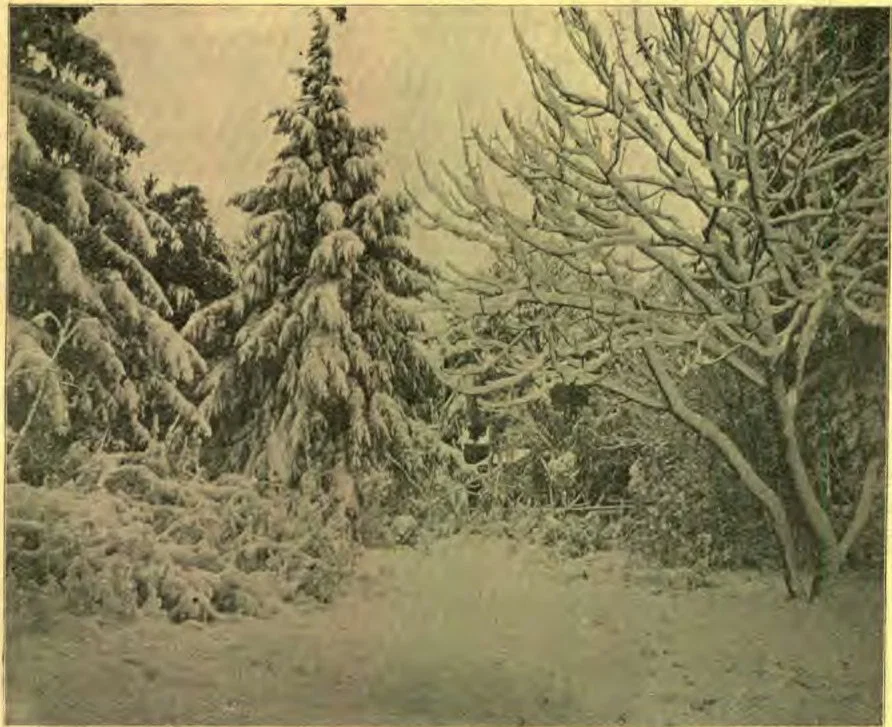
“WITH GLITTERING SNOWS O’ERLAID.”
Although, for instance, oaks and beeches are frozen when their cells are cooled down to forty-five degrees below the freezing-point, or thirteen degrees below zero, it does not necessarily follow that a temperature of thirteen degrees below zero will kill these trees. I have lived in countries where the temperature of the air was about forty degrees below zero for some days, but oaks and beeches were unaffected by it. This is explained by the fact that the excessive cold being of but short duration, the temperature of the soil does not fall to even the freezing-point, except perhaps at the surface. The warmth of the under strata of the soil furnishes the plant with the heat necessary to keep it alive.
By what means is the earth kept warm?—The sun shining upon the earth for a portion of nearly each day during the winter does much to keep up its temperature. It is a fact that the ground is warmed much more than the surrounding air. We have often seen ice and snow melting in exposed places, when the temperature was still somewhat below the freezing-point.
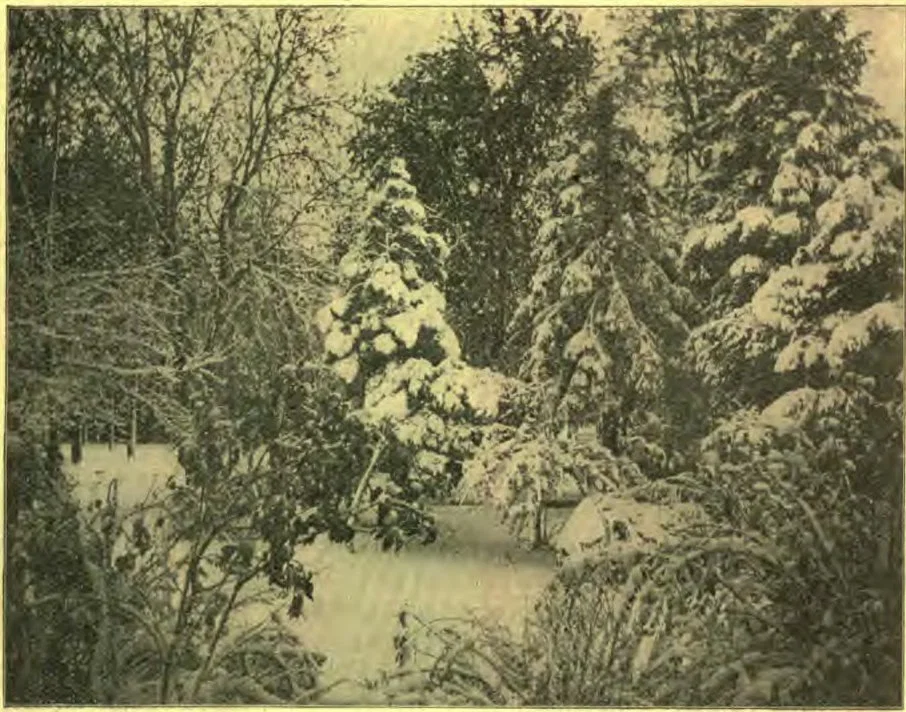
“ERMINE TOO DEAR FOR AN EARL.”
Snow also is generally supposed to be a great protection from loss of heat. In this climate, wheat often freezes when there is but a light fall of snow, or when the ground is bare; on the other hand, it endures much greater cold at times when there is a heavy layer of snow. Often, also, plants are protected from freezing by heaping up snow about them; gardeners often use snow effectively in protecting plants. Again, during very rigorous winters, trees and plants have been known to freeze down to a level with the snow, while the part that was protected survived, and subsequently sent up a new growth.
But really, snow, twigs, leaves, straw, earth, etc., serve as a protection only when the cold period is of comparatively short duration. They prolong the loss of heat, and so only protect against the first onset of cold. In long and continuous cold, the temperature of the coverings not only sinks gradually, but finally it becomes so low that even the thickest covering of snow, or straw, or leaves, or earth affords no protection to vegetation. All coverings that protect from freezing in temperate zones are therefore entirely useless in arctic regions.
In the temperate zone, when the sun shines on the snow, if only for a few hours of the day, the snow becomes warmed, and usually melted, at the surface. Where this occurs, the temperature of the snow does not fall so low as in the arctic regions, where for six months of the year there is no sun. In places in the Alps, the minimum thermometers show that the temperature a short distance beneath the surface does not fall much below the freezing-point, and often not even so far.
At the same time the temperature of the air may be many degrees below the freezing-point. The reason for this is that air is transparent to the larger portion of the sun’s heat, allowing heat to pass through it. The snow does not allow the heat to pass through, but instead, gathers it up, and is warmed thereby. Snow on the side of a roof in the shade will not melt, while that in the sunshine melts. The snow in the shaded place is as cold as the surrounding air; but that in the sun absorbs heat, and becomes warmer than the air.
It is a remarkable thing, and we may as well state it here, that solar rays hot enough to blister the skin, or, if concentrated, to burn the body to a cinder, may pass through the air, and still leave it at an icy temperature.
But resuming our topic: the sun, shining on cold, freezing days, though it may not seem to warm the air at all, and may seem unable to accomplish anything against the frost king’s power, is really doing much good, in that the earth and snow are thus kept warmed, and plant life is protected until the warm, bright days of April and May.
As we study the means by which God cares for the works of his creation, we are led to see something of the hidden meaning and beauty of the text that declares that “his tender mercies are over all his works,” and to take to our hearts the promise: “If God so clothe the grass of the field, . . . shall he not much more clothe you?” L. A. REED.

JOHN THE BELOVED

I

The name of the disciple John is one of the few whose memory clusters round the earthly life of the Son of God. As John studied the life of Christ, he beheld as in a glass the glory of the Lord, and he became changed from glory to glory, from character to character, until he was like him whom he adored. He imitated the life in which he delighted. He knew the Saviour by an experimental knowledge; his Master's lessons were graven on his soul. When he testified of the Saviour's grace, his simple language was eloquent with the love that pervaded his whole being.
As a witness for Christ, John entered into no controversy, no wearisome contention. He declared what he knew, what he had seen and heard. When insult was put upon Christ, John felt it to the very depths of his being. Christ had humbled himself; he had taken man's nature; but few could see him as John saw him. For John the darkness had passed away. On him the true Light was shining.
It was John's deep love for Christ that led him always to desire to be close by his side; and this place was always given him. Jesus loves those who represent the Father, and John could talk of God's love as none of the other disciples could. He revealed to his fellow men that which he felt it to be his duty to reveal, representing in his character the character of God. The glory of the Lord was expressed in his face. The beauty of holiness, which had transformed him, shone with a Christlike radiance from his countenance.
The life and character of Christ stood out before the world in sharp contrast with the life and character of the professedly religious rulers of the nation. His life of purity condemned their life of selfishness and iniquity. And their jealousy and hatred of him were intense. “The world is gone after him,” they declared, and they determined to rid themselves of him. At his trial they hired false witnesses to testify against him. When Barabbas was placed by the side of Christ, and Pilate asked, “Whom will ye that I release unto you, Barabbas? or Jesus, which is called Christ?” the mob, stirred to a pitch of frenzy by the priests and rulers, cried, “Not this man, but Barabbas.” “What shall I do then with Jesus?” Pilate asked. And they answered, “Let him be crucified.” The thief and murderer was released; while the Son of God, free from even the taint of sin, was condemned to die. Evil angels, under their leader, Satan, were the unseen agencies in this work. It was they who inspired the priests and rulers with the spirit of rebellion.
Christ was crucified; but he rose from the dead, appeared to his disciples, and ascended to heaven, escorted by myriads of heavenly beings. At the Father's throne he received the assurance that his sacrifice was accepted, and that the world that had been divorced from God by sin, was drawn across the gulf. Receiving Christ as a sin-pardoning Saviour, man might become an heir of God, and a joint heir with Christ; “for God so loved the world, that he gave his only begotten Son, that whosoever believeth in him should not perish, but have everlasting life.”
John's testimony in regard to the life, crucifixion, resurrection, and ascension of Christ was clear and forcible. Out of the abundance of a heart overflowing with love for the Saviour he spoke, and no power could stay his words. With power he bore witness that Christ was a risen Saviour. “That which was from the beginning,” he writes, “which we have heard, which we have seen with our eyes, which we have looked upon, and our hands have handled, of the Word of life: . . . that which we have seen and heard declare we unto you, that ye also may have fellowship with us: and truly our fellowship is with the Father, and with his Son Jesus Christ.”
If we study the epistles of John, we shall see why it was that this disciple could not be left in his old age to live in peace among his brethren. To please the Jews the Romans had crucified Christ, and they now sought still further to please them by placing John where his voice could not be heard by Jew or Gentile. Thinking to silence his voice, his enemies cast him into a caldron of boiling oil. But his testimony was not stayed. Like his Master, John patiently submitted to every attempt to put him to death; and the faithful servant was preserved as were the three worthies in the fiery furnace. As the words were spoken, “Thus perish all who believe in that deceiver, Jesus Christ of Nazareth,” John declared: “My Master patiently submitted to all that Satan and his angels could devise to humiliate and torture him. He gave his life to save the world. He died that we might live. I am honored in being permitted to suffer for his sake. I am a weak, sinful man; Christ was holy, harmless, undefiled, separate from sin and sinners. He did no sin, neither was guile found in his mouth.” These words of the disciple had an influence, and he was removed from the caldron by the very ones who had cast him in.
MRS. E. G. WHITE.

PLATES AND DEVELOPER

Now if you are supplied with the necessary tools, the next step will be the selection of materials. Perhaps it will be well to speak of these in the order in which they will be used.
First in the list come dry plates. There are very few manufacturers of dry plates who are recognized as leaders in their line. Plates made by them are called “standard” plates, and are sold at a “standard” price. In some places standard plates are the only ones obtainable. Dealers often allow a small discount on these plates, but at best the price is exorbitant. Plates other than standard are usually sold at from thirty to forty per cent discount, though they are quoted at the standard price. I have found, from a rather extensive experience, that the principal difference in these plates is in the price. Some plates may be, and for some kinds of work undoubtedly are, better than others; but they are all good, and if properly handled, will all yield excellent results. If economy is not a necessity with them, I hope my readers will look upon it as a duty, and choose some make of the cheaper plates if they can be obtained in their locality. Do not change about from one brand of plates to another. Even experienced photographers usually have trouble when they begin to use a new brand of plates. Each kind has peculiarities with which one must become familiar before he can expect the best results. Stick to one brand of plates until you become thoroughly familiar with them; by that time you will have no desire to change.
After the plates have been exposed, you will need chemicals with which to develop them. In all photographic stock houses, many kinds of developers that may be used by simply diluting with water, are kept in stock. In addition to these developing solutions there are an almost infinite variety of ready mixed developing “powders,” which require only to be dissolved in a given amount of water before they are used. All these developers are convenient, and some are excellent; but they are all expensive. That brings us back to our duty as stewards of the Lord’s goods.
With every box of plates the manufacturer incloses several different developing formulas that he recommends for use with his plates. Most of these give the preference to pyro.; and for professional photographers, who do a great deal of developing, and have no objection to stained fingers, pyro. is an excellent developer. But it is the one developer that I should advise beginners and amateurs generally not to use.
Second to pyro., eikonogen or hydrochinon, or a combination of the two, is recommended. If you decide to use any of these developing agents, you can mix them according to the formula of your plate-maker; or if you prefer to try it, you will find the following formula an excellent one for use with any kind of plates:—
Ingredient Amount
Hot water, 2 quarts
Sulphite soda, 6 ounces
Hydrochinon, ½ ounce
Eikonogen, 1 ounce
Dissolve these in the order named; and when cool, place in small bottles, and keep tightly corked. Most developers decompose rapidly when exposed to the air; but if the foregoing simple directions are followed, this one will keep indefinitely. Of course if you use a great deal of developer each day, it may be placed in one large bottle; but by keeping it in small bottles, the contents of one may be entirely used up before another is uncorked. These bottles should all be labeled “Developer A.”
For the other solution mix:—
Ingredient Amount
Hot water, 1 quart
Carbonate of soda (sal soda), 8 ounces
This may be kept in one large bottle, as it will not decompose by exposure to the air. It should be marked “Developer B.” For use, two parts of A and one part of B are mixed.
Every photographer has his favorite developer. I must confess that I have quite a number of favorites,—one for each kind of work. For portraits I prefer the one I have just recommended; for landscapes, another; for lantern slides, a third; and for bromide paper, a different one still. There are many developing agents, and each has some peculiarities that make it especially suitable for certain kinds of work.
A combination of metol and hydrochinon comes nearer being a “universal” developer than any other I have ever used. With slight variations it may be used for any of the developing processes that will be described in this series of articles. We will, therefore, call it our “standard” developer:—
Ingredient Amount
Water, 80 ounces
Metol, ⅛ ounce
Sulphite soda, 4 ounces
Hydrochinon, ½ ounce
Sal soda, 6 ounces
Keep this in small bottles filled to the neck, and tightly corked. It should be labeled “Metol-Hydro. Developer—2 to 3.” The “2 to 3” is the proportion of developer and water to use in developing a correctly exposed plate,—two parts of developer to three parts of water. The proportions to use for other classes of work will be given in due time.
When the plates have been developed, they must be “fixed,” or made permanent, by removing all the free silver. This is accomplished by immersing them in a solution of hyposulphite of soda (“hypo.”), two ounces to eight ounces of water. This solution will keep; but hypo. costs only five cents a pound, and it works so much better when fresh that I advise my readers to mix it only for immediate use.
J. EDGAR ROSS.

By Faith in Christ I Walk With God

By faith in Christ I walk with God, With heaven, my journey's end, in view; Supported by his staff and rod, My way is safe and pleasant too.
With him sweet converse I maintain, Great as he is, I dare be free; I tell him all my joy and pain, And he reveals his love to me. — Selected.

THE PEOPLE WHO ARE LOVED

THE people who win their way into the inmost recesses of others’ hearts are not usually the most brilliant and gifted, but those who have sympathy, patience, self-forgetfulness, and that indefinable faculty of eliciting the better nature of others. Most of us know of persons who have appealed to us in this way. We have many friends who are more beautiful and gifted, but there is not one of them whose companionship we enjoy better than that of the plain-faced man or woman who never makes a witty or profound remark, but whose simple quality of human goodness makes up for every other deficiency. And if it came to a time of stress, when we felt that we needed the support of real friendship, we should choose, above all, to go to this plain-faced man or woman, certain that we should find intelligent sympathy, a charitable construction of our position and difficulties, and a readiness to assist us beyond what we ought to take. If you could look into human hearts, you would be surprised at the faces they enshrine there; for beauty of spirit is more than beauty of face or form, and remarkable intellectual qualities are not to be compared with unaffected human goodness and sympathy.— Selected.

SIGNAL FIRES

I watch for springtime, not along the hill Where far-off pines are blue above the snow; I find her tokens where the woods are still, And where the willows grow.
Beneath them yet the snow is lying deep, Tracked by wee woodland footsteps, swift and shy; The long white ponds are silent in their sleep, While still the days go by.
What message, flashed from mountains far and white, Told them of days the nearing sun shall bring? What hope has stirred their hearts, and bid them light The signal-fires of spring?
For through the branches where the snowbirds flit Flames out the world's sweet hope in scarlet glow. Spring is at hand, and I am sure of it; The willows told me so.
— Mabel Earle.

DAGUERRE

IN connection with the articles on photography now passing through the INSTRUCTOR, it will be interesting to learn something more about the man who first conceived the idea of transferring an image of an object to a surface by employing light.
Louis Jaques Mande Daguerre was born at Cormeilles, France, in 1789, and died at Petit-Brie-sur-Marne, near Paris, in 1851. At first a revenue officer, he drifted into scene painting for French operas. In this he displayed marvelous ability, exceeding even his teacher in skill, and rapidly acquiring a wide celebrity. In his representations of light and shade he advanced the art of scene painting, and placed it upon a different basis than it had formerly occupied.
In company with M. Prevost, he painted panoramic views of Rome, Naples, London, etc., and in 1822 he opened, at Paris, the Diorama, in which moving pictures were affected by changes of light thrown upon them. This building was destroyed in 1839.
About this time Daguerre was making experiments with a view to obtaining permanent pictures through the action of light. Singularly, another man was working to accomplish the same result; and when Niépce learned of Daguerre’s efforts, he sent him full descriptions of his own experiments, with the camera lucida, an instrument invented by Dr. Wallasten for drawing in perspective, making use of metallic plates coated with a composition of asphalt and oil of lavender, afterward developing the image by the use of acids and chemical reagents. A warm friendship sprang up between the two men, and they experimented together until the death of Niépce, in 1833. Subsequently, Daguerre perfected the process known as the Daguerreotype process, which was afterward superseded by the ambrotype, or glass picture. This, in turn, gave way to the modern photograph.
Jan. 9, 1839, the French Academy of Science petitioned the government in Daguerre’s behalf, asking that he should be granted an annuity of six thousand francs, and the heirs of Niépce four thousand francs. The bills were passed in July, and the following August the government published the formulas in full. At that time Levi Chapman, a merchant of New York City, and father of the writer, heard of the action of the French government; and procuring the formulas and working models of the apparatus, he began the manufacture of the necessary materials, and introduced daguerreotyping into the United States. The business soon grew into vast proportions; and when daguerreotyping gave way to the ambrotype, scores of firms all over the world took up the manufacture of material, until pictures could be obtained at so moderate a price that in 1860, on Sixth Avenue, New York City, a large-size melanotype, or ambrotype taken on tin, could be procured for three cents. The INSTRUCTOR has already given you the history of the photograph.
W. S. CHAPMAN.

BEREAN LIBRARY STUDY

Dan. 11:28-31; “Thoughts on Daniel,” pages 250-262

NOTES ON LESSON 18

(April 1-7)
1. The Chosen People.—He who reads the history of the Jewish people with the loving, tender sympathy that is born of a union of spirit with Jesus of Nazareth, is affected more deeply and differently by the account of the sufferings of that people than by an account of the usual calamities and horrors of war. How the pitifulness of it surpasses all similar scenes when to us as well as to our Saviour these were the chosen people,—“my people, which are called by my name.” 2 Chron. 7:14.
2. And the Temple.—Although desecrated by unconsecrated priests and people, and profaned by the unholiest of practices, the temple at Jerusalem must in a certain sense be held in sacred remembrance in every heart that is in touch with divinity. We can not read of its ruthless destruction by the soldiers of Rome, with the impersonal interest with which we learn of the burning of other ancient buildings and cities; for we remember that Jesus wept over that doomed city, and that although he said to the Jewish people, “Behold, your house is left unto you desolate,” that saying, as well as all his denunciations of priests, people, and city, was but the mournful lamentation of a heart breaking for their sins, not a merciless judgment meted out to them. How the pitifulness of this also surpasses all similar scenes when we remember that the temple might have been preserved to this day as the center of the more glorious service of the gospel. Jer. 17:24-27.
3. A Latter-Day Lesson.—The Jews were never better satisfied with themselves and with their spiritual attainments than just before their destruction as a nation. They trusted wholly in themselves and their own righteousness. They failed utterly to understand the crisis in which they were living. The special mission, which was wholly theirs, of spreading a knowledge of the true God to the nations of the world, was never understood nor attempted; indeed, it was made impossible of accomplishment by the erection, by the Jews themselves, of insurmountable barriers, cutting them off from all other peoples, even from those of other nationalities living under the very shadow of the temple. And that same spirit will result in destruction anywhere and every time. It will destroy a denomination, a church, a family, a person.
4. Barbarian Invasions.—Our lesson covers the period of time made turbulent by the movements of restless barbarians. It was almost two centuries before the turmoil subsided, and the changes in nations and kingdoms became permanent enough to record. The “iron monarchy of Rome” had broken in pieces all kingdoms, but the time came when it was broken. It was “the warlike Germans who first resisted, then invaded, and at length overturned, the western monarchy of Rome.” “The most civilized nations of modern Europe issued from the woods of Germany.”
5. A Geography Lesson.—The general location of the tribes and nations of Germany and the East, at the close of the fourth century, was this: The right bank of the middle and upper Rhine was inhabited by the Franks and Alemanni. The Angles dwelt in what is now southern Denmark; and the Saxons upon the lower Elbe. Eastward of the Elbe, and on the Oder, dwelt the Lombards; on the coast of the Baltic, between the Oder and the Vistula, were the Vandals; south of the Vandals, on the Vistula, toward the Baltic, were the Suevi, and over the whole country east of the Suevi, and stretching away to the River Volga, were spread the Sarmatians. In the southern country below the Sarmatians, from the Danube through the valley of the Dniéper to the coasts of the Caspian Sea, was the dominion of the Huns.—“Great Empires of Prophecy,” page 598.
6. Three Great Barbaric Leaders.—Alaric the Goth, Attila the Hun, and Genseric the Vandal, were conspicuous in the movement which remodeled the map of Europe. The barbarians of the north poured south and west with irresistible fury, seeking new homes in the crumbling Roman Empire. City after city was spoiled and burned. The ships of Genseric cast anchor in the Tiber, and for days the pirates plundered Rome. “The colossal fabric planted of old time by the patrician fathers, strengthened and made great amid the bloody struggles of the republic, transformed by the genius of Julius Cæsar, and disgraced and degraded by the licentiousness of the later emperors, fell prostrate in the dust, and expired.”

WANTED—AT THE TOP

A WELL-KNOWN dentist in one of our large cities said the other day that for two years he had been trying in vain to get some one to assist him in his heavy practice. Are there not dentists enough?—It would seem so, certainly; he had had no lack of applications. The trouble was that among all he had tried, he had not found one who would do the work to suit him. “I had to do every bit of his work over again,” he said, speaking of the last “assistant.” “He would have spoiled my practice in six weeks.”
It is the old story that men of every business and every profession echo. There is not only “room enough”—there is an eager demand in every class of work—for men who are experts; it is the careless, the indifferent, the half-hearted, those who have never learned to do any one thing thoroughly and masterfully, who are pushed aside.—Well-Spring.

Drive Thy Business, Not Let It Drive Thee

“DRIVE thy business: let not that drive thee. Sloth makes things difficult; industry, all easy.”

APRIL STUDY OF THE FIELD

PART I: HISTORICAL AND POLITICAL CHINA

(April 1-7)
1. Basis of Study.—The first two lessons for April will be based upon “Historical and Political China” in the Missionary Magazine for that month.
2. Punishments; How Sometimes Avoided.—Fines may be imposed for small crimes, and sometimes for capital offenses. A man may avoid punishment by payment of a certain sum of money, the amount being regulated by the enormity of the crime and the wealth of the offender. A man under sentence of death may receive “an act of grace or pardon,” and thus escape the penalty. But there are cases in which the law forbids any interference with the infliction of the penalty. By surrendering himself, the offender may have his punishment reduced. A man may have his case submitted to the emperor for consideration, if he “shall have parents or grandparents who are sick, infirm, or aged above seventy years, and who have no other son or grandson above the age of sixteen to support them.” An offender under the age of fifteen or over seventy may redeem himself from any punishment other than for capital crime. And even in the latter case he may be recommended to the consideration of the emperor, if he is less than ten or over eighty years old. Treason is considered the most odious of all crimes; the one who commits this offense may suffer death by torture, while all his male relatives will be beheaded.
3. Examination Halls.—The man who wishes a government position must be the possessor of a literary degree. It is at the examination halls that the examinations for degrees are held. The candidate is placed in a cell about seven feet high, four feet wide, and three feet deep. A board placed crosswise, and pushed back against the wall, serves as a seat. One placed a little higher is to be used for his desk. These closets are entirely bare of furniture, and usually very dirty. From eight to ten thousand persons are crowded into them during the examinations.
4. The Examinations.—The candidate does not know upon what subject he is to write until all the candidates are seated, and have been assigned the themes. Certain rules for writing have to be observed; and when the essays are finished, they are first examined to see if any of these rules have been violated, in which case the paper of the writer who has not obeyed them all is posted in a public place, and the opportunity for passing that examination is lost. If all the rules have been complied with, one of the professional copyists transcribes the composition in red ink. The original and the copy are examined by two proof-readers, and then are sent to the twelve higher critics. Each of these, in his turn, examines it, and if he approves it, places his verdict upon it in a small red-ink circle; if he does not approve, the paper is laid aside. Those marked are passed to the prefect, and then to the examining commissioners. The names of the successful candidates are written in large characters and posted in a public place.
5. Peking.—Peking, the northern capital of the Chinese Empire, is situated in a sandy plain. The population is about one million. Peking is regarded by the Chinese as one of their ancient cities. The streets are not paved, but are hard-trodden earth, covered with a thick layer of dust in dry weather and with mud in wet weather. All the refuse from the native houses is thrown into the roadway. There is a raised cart-track in the center, with a ditch on each side, in which the liquid filth settles. Peking is divided into two parts—the Chinese, and the Manchu, or Tartar, cities. This division was made when the Manchus conquered the Chinese. For many years the people of the two cities would not associate freely. A wall, which has three gates and is four miles long, divides the city into these two parts. From the central gate runs a long, wide, straight, and dirty street, which is blocked with shops, hucksters’ stores, merchants, peddlers, jugglers, beggars, and idlers. Within the Tartar City is the Imperial City, and in the Imperial City is the “Forbidden City,” where the emperor has his residence. The greater part of the women of the Chinese City have bound feet. In the Tartar City the women have equal rights with the men, and never bind the feet.
6. Formosa.—Formosa is a Portuguese word, meaning “formly,” “beautiful,” so called from the beautiful scenery. The island lies off the southeast coast of China. It is nearly bisected by a chain of mountains running from north to south. The inhabitants consist of three classes,—the Chinese; the half-civilized aborigines, who have adopted Chinese dress and customs; and the savages of the eastern part, who refuse to recognize authority. The island was probably known to the Chinese from a very early date. In the sixteenth century the Portuguese made some attempts at settlements. The Dutch were the first to gain a foothold, but were driven out by the Chinese.

SMILES

How many smiles there could be If folks would only say: “Good morning, neighbor! let me give A helping hand to-day.” How many smiles there will be, My friend, when you and I Have learned to practice what we wish All other folks would try. — Selected.

PROGRESS

The following encouraging letter has been received concerning the Reading Circle at Morley, Mich. In a former letter, mention was made of an invalid mother and her daughter, who had become interested in “Thoughts on Daniel” through the efforts of some of the members of this circle. The writer says:—
“DEAR INSTRUCTOR: I will write once more to tell you how our Reading Circle is progressing. The persons I spoke of before are deeply interested. Already they have begun to pass the light on to others, by handing out reading-matter, and talking with them about the truth. The brethren have ordered the Review sent to them, and it is highly appreciated. In another family the children have become interested, and in our meetings have answered questions that seemed to puzzle their parents. One little girl often spends hours at a time with my wife studying the Bible, and working on a missionary quilt. Not long ago an old man said to me that if he could only have the assurance that his sins were forgiven, he would be the happiest person on earth. Bible studies were held with him, and he has acknowledged that there is comfort in the Scriptures. He has read ‘His Glorious Appearing,’ and to-day he bought another book on the subject of Christ’s second coming. Thus the good work is going here. Wm. S. HIPKINS.”

HOW MISSIONARIES TRAVEL IN JAPAN AND KOREA

The jinrikisha is the great vehicle of Japan. In coast city and in inland village,—everywhere,—the slight, easy, human carriage goes. It is a hard life for the “rikisha” man, and not even the strongest can endure it many years. He is out in rain and heat and cold; he runs for miles without rest; he drops at the end of a long run, soaking wet with perspiration, or dripping when he has no clothes to soak, and seems careless of a chill. He little knows how much he and his light two-wheeled affair have helped scatter the gospel over Japan.
The Korea missionaries, having a beautiful country to travel through, with forest and mountain and brook and river, have abundant opportunities in their journeyings to enjoy it. The bicycle has helped them greatly to move about in it quickly; but the bicycle becomes not only useless but a burden when the storms turn the roads into bogs. Many a weary missionary has plodded over Korean roads in pelting rain, carrying a mud-incrusted wheel on his back. The slower but safe course is to walk, with a stout little horse to carry the load, and, occasionally, the traveler. Each horse is accompanied by a mappoo, or hostler, its owner or its owner’s representative,—good-natured boys, and proof against the dangers of eating dozens of green melons as they tramp along. They buy an armful of melons at each wayside shop, and a new pair of shoes, two cents a pair, once or twice a day, to replace the pair of sandals made of green withes, and quickly worn-out on the stony road.—Well-Spring.

Happiness in God on Earth

MANY indeed think of being happy with God in heaven; but the being happy in God on earth never enters into their thoughts.—John Wesley.

TO THE LITTLE BUBBLE-BLOWER

O DEAR little lad with the clustering curls, And the light of the morn in your eye, You'll find that, enjoy them or dread, as you may, Like bubbles the years will go by.
The trials and sorrows that come by the way, Your strength and your patience to try, On the heart that is honest, and loving, and true, Like bubbles, oh, light may they lie!
And as with the length and the strength of the years, For the labor of earth you grow ripe, May suds be the worst ever found in your bowl, And bubbles the worst in your pipe!
ELIZABETH ROSSER.
Continue reading: KIT-KAT’S TALE