The Youth’s Instructor, Vol. 48, No. 13.

Trees in Winter
Earlier text: Trees in Winter

KIT-KAT’S TALE

Tommy Trot was tired. He had weeded and hoed for nearly an hour in the queer little garden where roses and radishes, beans and balsams, peas and pansies, elbowed one another good-naturedly. It was very hot, too; and his dear little face was as red as his roses when he came into the woodshed to put away his hoe. How cool and pleasant it was in there! And there were Kit-kat’s four little kittens in the box! He would sit down and look at them awhile, before going into the house.
He was scarcely settled in a comfortable position when Kit-kat herself came in, and jumped into the box beside the kittens, which set up a great mewing on seeing her.
She purred contentedly to her babies, and Tommy thought it a restful sound, as he laid his head on the side of the box and looked at them. In a little while he was surprised to notice that the purring sounded very much like talk. Then he jumped at hearing his own name spoken—Kit-kat was talking to her kittens!
“Tommy,” said she, “was in such a hurry to go to his garden that he forgot to give me my dinner. His mama gave me to him when I was no larger than one of you; he promised to take care of me always, and I really think he means to; but he often forgets, and I get very hungry. So I went into the kitchen to ask Dinah for something to eat; but she was cross because she had just burned a loaf of bread; and she drove me out of the house with the broom. Then I ran off to the barn to look for a mouse. There were plenty of mice in the barn when I first began to hunt, but for some reason they are scarce lately, and I have to watch a long time before I can catch one. ”
“I was sitting quietly in a dark corner by a hole where I thought I could smell a mouse, when Tommy’s papa came close to me. I could see him plainly, but I suppose he could not see me; for he stepped on my foot. Oh, how it hurt! I screamed as loudly as I could, and he jumped, and shouted, ‘Get out!’ I did n’t think that was fair, either; but I hurried out of the barn, and limped off to the meadow, where I hoped I might find something to eat. My foot ached, and I felt discouraged, and was about ready to give up and come home, when I heard a savage growl, and a great dog sprang at me.”
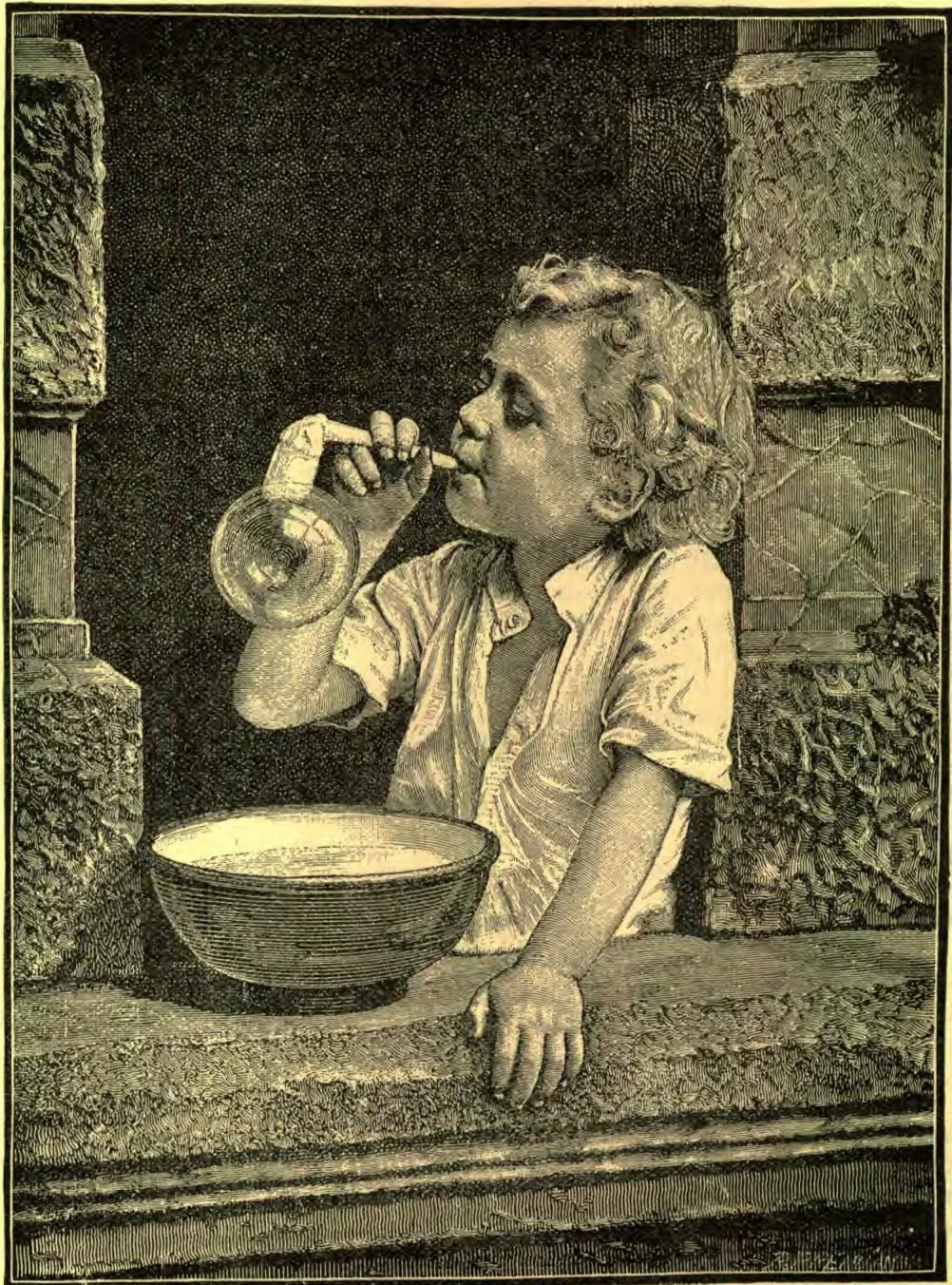
“DEAR LITTLE LAD, WITH THE CLUSTERING CURLS.”
“There was a tree near by; I ran toward it, and soon reached a safe place. There I stood, and watched my tormenter for a long time. How he jumped and barked and howled around that tree! I know my eyes glared terribly, and my tail was almost as big as my body. I was anxious about you, too; for I knew you must be hungry. At last I heard some one whistle, and the dog ran off, looking back, and barking at me as he went. As soon as he was out of sight, I hurried home to you. But I do wish Tommy—Tom—my—”
Tommy Trot tried to get up, but how heavy his feet were! There it was again—Tom—m—e—e!” and up he jumped. Kit-kat was still purring to her kittens, but mama was calling him to supper; and much she wondered at the thoughtfulness of her little boy, when he asked for “a saucer of milk for Kit-kat, first, please, mama.” Aunt Betty.

LITTLE MESSENGERS

VERY tired of the dull, cold weather, of the bare trees and the muddy paths, was little Rose. It seemed to her that the bright, beautiful summer would never come.
“Do not be impatient,” said mama. “Summer is already on the way, and she has sent little messengers out to say that she is coming.”
“Where are they?” asked Rose.
“Go up the hill a little way, and then turn into the field,” replied mama, “and I think you will find more than one herald all sweetly dressed in green. Perhaps there will be others in brown or black costumes. Wrap yourself up warmly; for March loves to nip a little girl’s nose and ears.”
“He will soon be gone, and I am glad of that,” said Rose.
“He is not as pleasant always as his brother and sister months,” answered mama; “but he is very useful to good Mother Earth, and I hardly see how she could get through her house-cleaning without him.”
As soon as Rose was in the open air, she felt better. The first tree that she passed held out an armful of baby catkins for her to see, and she could not help smiling at their soft, fuzzy bodies. Soon she was out of the disagreeable road and on the brown hillside. She glanced down as she set her feet upon the spongy turf; and there, looking straight up in her face, was little Clover in his new green dress.
“Why, you darling! I didn’t know you were here,” said Rose. “How glad I am to see you!”
“Glad! glad! glad!” sang a joyous voice close by.
Rose looked up. There was dear Song Sparrow atilt on the very topmost spray of a wild cherry tree. He was pouring out his happy heart in a bewitching carol to the spring.
“He is one of summer’s messengers,” said Rose. “‘The winter is over! the winter is over!’—that is what he says. ‘Be glad! be glad, little girl!’”
Rose looked about her for other little green folk. It was but a moment before she spied Baby Mullein in his new velvet frock. He was very young indeed, a mere infant; but he seemed to feel quite at home, and nestled close to the dear Earth as if quite sure that she would take care of him.
Then a clear voice sounded from a spruce near by. “Chickadee! chickadee!” it said.
“Oh, you are here, are you?” said Rose, whirling around in the direction of the voice. “But you have been here all winter. I know you very well, and I am very glad to see you.”
What a frolicsome place the outdoor world is, indeed. Rose turned from looking after Chickadee, and there on the fence-rail were two little brothers running a race. They were at the end of the rail in an instant, and then what a leap they made to the bough of a tree. How slim and trim and dainty they were in their red fur coats!
“I wonder if they live in that tree,” said Rose. “They must be glad that winter is over. But they look nice and plump. I suppose they are good, industrious little brothers, and always lay up all the nuts they need on their pantry shelves. I hope you weren’t afraid of me, you dear Squirrels.”
Our little girl’s discontented mood was gone entirely. She ran home, and told her mother about what she had seen.
“I am going out again to-morrow,” she said. “It is stupid to stay in the house and fret.”—Youth’s Companion.

OUR PLANET MERCURY

THE planet Mercury is often called “our modest younger brother,”—younger, because science, falsely so called, teaches us that this planet was the last of all the worlds to be thrown off from their common mother, the sun. Sometime we will study this teaching of heathen philosophy with the INSTRUCTOR family, and see how untrue this theory is.
If our readers would really like to become familiar with these different worlds that God has so beautifully made and hung as lights in our sky, to show to us his wisdom, power, and goodness, we shall be glad to spend many pleasant evenings with them this coming year, studying this branch of the handiwork of our Creator, and will try to tell the story in language so simple that all, both young and old, may become acquainted with the different phenomena constantly taking place in the heavens around us. The coming year will be especially favorable for amateur work, and a cordial invitation is extended to all the readers of the INSTRUCTOR to join our evening class in studying the mighty works of God as manifest in the heavens above.
We may truly call Mercury “modest;” for he peeps over the western hills at us for only a few evenings, then disappears again in the bright rays of the sun. When we next catch a glimpse of him, he is shyly looking down the eastern horizon, in the early flush of morn. Mercury moves in a path lying so near the sun that even trained astronomers, having good telescopes, do not get as satisfactory views of him as they might wish; the bright rays of the sun so completely dim the little light that he reflects to us that it makes it hard to see him as clearly as we would like.
At the present time of writing, March 1, Mercury has just reached a point far enough east of the sun to make him visible under the most favorable circumstances. To-morrow evening, March 2, the moon will pass just four degrees north of Mercury, and on the next evening it will pass within four degrees north of Venus, the bright star now hanging in the west, of which we wrote in our last study. From now until the eighth of this present month, when the evening is favorable, Mercury may be seen immediately after sunset, hanging low in the western horizon. His path lying between Venus and the sun, we shall find him somewhat nearer the sun than is Venus. His onward flight through the heavens is so rapid that we do not find him in the same place two nights in succession.
The planets, you know, shine with reflected light. For this reason they do not appear white, like the stars past which they seem to be constantly moving, but of a golden, ruddy luster; so that no one need have any difficulty in telling which are the planets, and which are the fixed stars. Just why their light, by being thus reflected, should reach us as yellow or orange instead of green, indigo, or violet, will be an interesting subject for some future evening’s work. To know that these things are so is indeed pleasant, but to know why they are so is much more satisfactory. God would have us study and know things for ourselves, and not depend upon the infidel teachings of heathen philosophers for all we know concerning the works of his hands.
Our next date with Mercury will be April 3, by which time he will have passed sufficiently to the west of the sun to rise a little before the sun in the early morning. Mars and Mercury will both be seen at that time just above the eastern horizon, near where the sun rises, and just before it makes its appearance. At that time Mercury will lie only two degrees to the north of Mars, and will gradually pass to the north and west of that planet, becoming plainest to the naked eye about April 21.
Having now learned where Mercury lives, and how to find him, let us bid him a warm good-night, wishing him a safe journey as he speeds on to the south and west, to the farther side of the sun, with the promise that, if all is well, we will be up bright and early to welcome him back to our circle when he appears in the east, as a morning star, during the early part of April.
In our next study we hope to learn many interesting facts about this new acquaintance, and we hope many will make a practical use of these subjects. We are beginning a study that will be instructive, and a constant source of profit and delight in this life, and something that we may carry on throughout all eternity.
O. C. GODSMARK, M. D.

THE RESURRECTION ANNOUNCED

  • (April 7, 1900)
Memory Verse.—1 Cor. 15:20.
Time: A. D. 31. Places: Joseph’s tomb, Jerusalem. Persons: Jesus, women of Galilee, disciples, Roman guard, priests and elders, gardener, angels.

QUESTIONS

1. When the keepers of Jesus’ tomb had recovered from the shock caused by the presence of the angels of God, what did they do? Matt. 28:11. What action did the priests at once take? V. 12. What instruction did they give the soldiers? Vs. 13, 14; How was their proposition received by the guard? V. 15.
2. Who was the first to reach the tomb on the morning of the resurrection? John 20:1. Noting only the fact that the stone was rolled away, with what thoughts did she return to the disciples? V. 2; While other of the women tarried, and thus learned of the angel’s presence, what was said to them? Luke 24:5-7.
3. What message were they then asked to carry to the eleven? Mark 16:7. As they carried the good news home, how was it received? Luke 24:9-11.
4. Which of the disciples were led by the reports received to go and investigate? John 20:3, 4. What did they discover? Vs. 5-7; What was the effect upon John? Vs. 8, 9. With what thoughts did Peter leave the tomb? Luke 24:12.
5. When Mary Magdalene again returned to the grave (she had followed Peter and John), what did she do? John 20:11. What was revealed to her as she viewed the empty sepulcher? V. 12. What did the angel say? What was her reply? V. 13.
6. As Mary turned from the angels to search still further for Jesus’ body, whom did she see? V. 14. What did Jesus say to her? What was her answer? Why? V. 15.
7. In what familiar manner did Jesus then address her? Recognizing the Saviour’s voice, what response did she make? V. 16. As she sprang toward him, what did Jesus say to her? V. 17. Returning in joy, what word did Mary take to the brethren? V. 18.

What She Learned

“I thought it was a pretty fair sort of telescope for one that wasn’t very big,” said Uncle Silas. “I’d rigged it up in the attic by the high north window, and had it fixed so it would swing round easy. I took a deal of satisfaction in looking through it,—the sky seemed so wide and full of wonders,—so when Hester was here, I thought I’d give her the pleasure, too. She stayed a long time upstairs, and seemed to be enjoying it. When she came down, I asked her if she’d discovered anything new.
“‘Yes,’ she says. ‘Why, it made everybody’s house seem so near that I seemed to be right beside ’em, and I found out what John Pritchard’s folks are doin’ in their out-kitchen. I’ve wondered what they had a light there for night after night; and I just turned the glass on their window, and found out. They are cuttin’ apples to dry—folks as rich as them cuttin’ apples!’
“And, actually, that’s all the woman had seen! With the whole heavens before her to study, she had spent her time prying into the affairs of her neighbors! And there are lots more like her—with and without telescopes.”—Selected.

Spain's Sunshine Compared With America

SPAIN is the most sunshiny country of Europe. The yearly average is three thousand hours. In America it is two thousand one hundred.

Making Home Peaceful

_By Mrs. L. D. Avery-Stuttle._

A Happy Sequel to Making Home Happy.

The purpose of the author has been to show the reader, by means of a happily conceived object-lesson, how the true Christ-love can be given tangible expression in every-day home life, and how the incoming of that love will transform a joyless abode into a happy home.
The book is well bound and illustrated. Price, bound in cloth, 50 cents; in paper covers, 25 cents.
The cloth-bound 50-cent book will be sent, post-paid, for three new yearly subscriptions to the YOUTH'S INSTRUCTOR; or with the INSTRUCTOR one year for only $1.00.

Life and Work of DWIGHT L. MOODY

Official and only authentic edition. Written by his son, WM. R. MOODY, and IRA D. SANKEY, his lifelong associate and friend.
100,000 AGENTS WANTED AT ONCE. Liberal terms. Freight paid. Credit given. A golden opportunity for you. Outfit free. Write to-day.
P. W. ZIEGLER & CO., 324 Dearborn St., Chicago.

Good Until April 15.

$11 for $7.
We will ship to any address for $7, cash, “Guide for Nut Cookery,” Perfect Ball-bearing Nut Butter Mill, Family Blanching Mill, and 50 lbs. extra No. 1 shelled Spanish peanuts. Without the Blanching Mill, 75 cents less.
The mill has been on the market for four years, and has been greatly improved. Nearly 3,000 in use. A child can operate it. It makes fine sterilized nut butter. “Guide for Nut Cookery” tells how. It is a complete recipe book, showing the most healthful ways to prepare nuts, grains, legumes, and all varieties of foods.
Write for descriptive circular, and prices on nuts and health foods.
JOSEPH LAMBERT,
Battle Creek, Mich.

To Reach BATTLE CREEK

FROM CHICAGO, BUFFALO, DETROIT, OR TOLEDO,
Purchase Tickets Reading over the MICHIGAN CENTRAL “The Niagara Falls Route.”
A First-class Line for First-class Travel between Chicago and New York and Boston. Elegantly equipped through trains pass Battle Creek in each direction daily.
R. N. R. WHEELER, Ticket Agent, Battle Creek. O. W. RUGGLES, Gen’l P. and T. Agt., Chicago, Ill.

TAKE THE Canadian Pacific Railway

for . . . CHATHAM, OTTAWA, MONTREAL, LONDON, GALT, QUEBEC, WOODSTOCK, TORONTO, BOSTON, PORTLAND, and
All points in New England, the Maritime Provinces, Great Britain, and the Continent.
Illustrated literature, time-tables, and full particulars, upon application to—
J. FRANCIS LEE, GEN. AGENT,
Passenger Dept. 228 SOUTH CLARK ST., CHICAGO
Branch Offices: 76 Ottawa St., Grand Rapids, Mich. Room D, Chamber of Commerce, Cincinnati, Ohio. 315 Chestnut St., St. Louis, Mo.

Cincinnati Northern Railroad Co.

TIME TABLE NO. 3.

IN EFFECT SEPT. 24, 1899.
Trains Pass Battle Creek, as follows:

WEST-BOUND.

No. 21, Mail and Express — 6.58 P. M.
No. 23, Accommodation — 2.07 P. M.
No. 27, Local Freight — 8.25 A. M.

EAST-BOUND.

No. 22, Mail and Express — 8.25 A. M.
No. 24, Accommodation — 1.45 P. M.
No. 28, Local Freight — 5.30 P. M.
Direct connections are made at Toledo with all roads diverging. Close connections for Detroit and Cincinnati.
J. L. READE,
Ticket Agt., Battle Creek.
E. R. SMITH, City Pass. Agt., 6 West Main St.
E. W. Meddaugh and Henry B. Joy, Receivers,

CHICAGO & GRAND TRUNK R'Y.

Trains arrive and leave Battle Creek.

WEST-BOUND FROM BATTLE CREEK.

No. 9, Mail and Express, to Chicago. 12.15 P. M.
No. 1, Chicago Express, to Chicago. 9.00 A. M.
No. 3, Lehigh Valley Express, to Chicago. 3.40 P. M.
No. 5, Pacific Express, to Chicago, with sleeper. 1.10 A. M.
No. 75, Mixed, to South Bend. 8.20 A. M.
Nos. 9 and 75, daily, except Sunday.
Nos. 1, 3, and 5, daily.

EAST-BOUND FROM BATTLE CREEK.

No. 8, Mail and Express, to Pt. Huron, East, and Detroit. 3.45 P. M.
No. 4, Lehigh Express, to Port Huron, and East. 8.27 P. M.
No. 6, Atlantic Express, to Port Huron, East, and Detroit. 2.25 A. M.
No. 2, Leh. Exp., to Saginaw, Bay City, Pt. Huron, and East. 6.50 A. M.
No. 74, Mixed, to Durand (starts at Nichols). 7.15 A. M.
Nos. 8 and 74, daily, except Sunday.
Nos. 4, 6, and 2, daily.
A. S. PARKER, Ticket Agent, Battle Creek.

“Beautiful Joe.”

An Autobiography
By
Marshall Saunders.
Beautiful Joe is a real dog, and “Beautiful Joe” is his real name. He belonged during the first part of his life to a cruel master, who mutilated him in the manner described in the story. He was rescued from him, and is now living in a happy home, with pleasant surroundings, and enjoys a wide local celebrity.—Author’s Preface.
This story awakens the interest of the reader in the first chapter, and sustains it to the end. It must make an impression for good, and in the interests of kindness and gentleness, upon all who read it.
The book is well bound in cloth, with gilt sidestamp; 304 pages; illustrated. Price, 60 cents. Smaller edition, cloth, without illustrations, 25 cents.
The 60-cent book will be sent, post-paid, for four new yearly subscriptions to the YOUTH’S INSTRUCTOR, at 75 cents each; or with the INSTRUCTOR one year for only $1.25. The 25-cent book will be sent with the INSTRUCTOR one year for $.90.

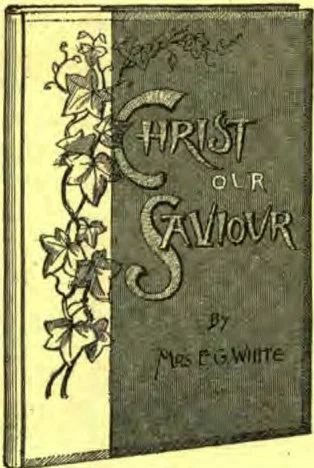
Christ Our Saviour...

Gives a graphic description of the birth, early training, baptism, ministry, death, resurrection, and ascension of Christ our Saviour. The book contains 160 pages, profusely illustrated, handsomely bound in three styles of binding.
Prices, $1.25, 75, and 50 cents.
We offer this book, post-paid, to INSTRUCTOR subscribers at the following rates:—
Cloth back, board cover, for three new yearly subscriptions, at 75 cents each; or with the INSTRUCTOR one year for $1.00.
Fine English cloth, for four new subscriptions, at 75 cents each; or with the INSTRUCTOR one year for $1.25.
Presentation edition, for five new yearly subscriptions at 75 cents each, or with the INSTRUCTOR one year for $1.50.

Making Home Happy.

By Mrs. L. D. Avery-Stuttle.
This subject is presented in an interesting story form, and every reader will feel inspired to strive to make his home cheerful. Happy homes are needed everywhere, and “Making Home Happy” is a good little book to help bring about this result.
The book contains 206 pages, with four full-page illustrations, besides smaller ones. Price, bound in cloth, 50 cents.
We will send it, post-paid, for three new yearly subscriptions to the INSTRUCTOR at 75 cents each; or with the INSTRUCTOR one year for $1.00

“Dickey Downy.”

By Virginia Sharpe Patterson.
This little volume is charmingly written, its object being to teach the children to love and protect the birds. That it is interesting, the following selected chapter-headings will abundantly show:—
The Orchard.
Dickey Downy’s Meditations.
Dickey’s Cousins.
A Winter in the South.
The Prison.
The Hunters.
Polly’s Farewell.
The book is bound in cloth, and contains 192 pages, with four beautiful colored plates. Price, post-paid, 60 cents.
We offer this book, post-paid, for three new yearly subscriptions to the YOUTH’S INSTRUCTOR, at 75 cents each, or with the INSTRUCTOR one year for only $1.15.
Continue reading: THE BETTER WAY