“Please do not forget that you have promised to tell us about the lion that lives in a pit, mamma,” said Ernest. “The ant-lion, I think you called him; and why is he called an ant-lion?”
“Because he preys upon ants,” answered Mrs. Heywood, “in the same way that real lions pray upon sheep and goats, and sometimes upon men and women. The ant-lion is only the grub or larva of a winged insect. In this state it is very slow and awkward in its movements, so that it could never catch the quick and active little creatures it requires for food, if God had not taught it to make up by cleverness what it wants in activity. The parent insect carefully deposits her eggs upon light, sandy soil, so that when the young ant-lion is hatched, he finds himself in a position exactly suited to his purposes of digging a pit, or trap, by which means he hopes to catch his little victims.”
“But how does he manage to dig, mamma?”
“His feet and mouth answer all the purposes of a spade,” said the mother; “no gardener or architect could hollow out a pit better. His body is of a dusty gray color, composed of rings, and tapers to a point at the tail. He has six legs. The head is provided with a most terrible pair of jaws, half round, like a reaping-hook, and toothed inside, that he may hold the prey firmly while sucking their blood. The ant-lion traces a circle in the sand, generally about three inches in diameter (that means three inches across from one side to the other). This done, he gets inside this circle or ring, and with one of his legs shovels up a load of sand on the flat part of his head; and then, with a sudden jerk, he throws the whole some inches away. It is a curious fact,” continued Mrs. Heywood, “that when the little fellow has gone once round the ring, he returns just the opposite way, so as to use the leg on the other side for shoveling, and rest the one on which he began. When he meets with no stones, the ant-lion gets through his business with very little difficulty; but sometimes there are stones mixed up with the sand, and these cost him a great deal of trouble. If they are quite small, he lifts them upon his head, and jerks them over the side of the pit, as he did the sand; but when they are too large for this, he tries another plan. Crawling backward to the place where the stone may be, he thrusts his tail underneath, and gradually pushes it upon his back. This done, he marches slowly and carefully up the sides of his pit, and rolls off the great stone at the top.”
“What a clever little creature! I am sure he deserves his dinners and and suppers, after taking so much pains.”
“When the pit is really done, the ant-lion reaps the fruit of his labors. He knows well that other insects are as much afraid of him as you and I would be of a real lion, so he completely hides himself under the sand at the bottom of his pit, and leaves nothing but the tips of his crooked jaws peeping out. Very soon an ant, who has been sent out on an exploring expedition, or some other little traveler, passes that way, and steps upon the edge of the pit, that he may see what there is to be seen below. He does not know that he will pay for this look with his life. The slippery sand slides from under his feet, he tries to save himself, but only falls the faster, down, down into the very jaws of the lion below. Sometimes, however, it may happen that the poor little victim is able to stop himself half way, and in haste he will try to scramble back to the top. But the lion from the bottom of his den, with his six sharp eyes, has spied him out; and quick as thought he shovels heaps of sand upon his head, and throws them up one after another upon the runaway. This destroys his last hope of escape; he cannot stand upon the slippery bank under the heavy sand-showers, and falls again, this time most likely within reach of the lion’s jaws. If so, it is all over with him; he is pounced upon in a moment, and the ant-lion holds him fast in his powerful jaws, while he sucks his blood at his leisure. When he has finished, he takes care to throw the dead body to some distance from his den, lest other insects, espying it, should guess there is a murderer below; and then he goes back to his hiding-place to watch for more prey. The fierce grub lives thus for nearly two years, until he is fully grown, when he wraps himself up in a round ball of sand, fastened together by very fine silk which he spins on purpose. Here he remains for about three weeks, when he bursts forth, a pretty little insect, something like a dragon-fly in appearance.”—Christian at Work.
WHAT NETTIE NEEDED.
By Pansy
NETTIE Raymond was usually a happy child, but to-day something caused the bright eyes to look very unhappy. The smile that her face usually wore was gone, and the red lips stuck out a great deal too far; altogether, she seemed very miserable.
She stood at the corner of her father's great white house, kicking up the grass with the toe of a chubby shoe, while one hand pulled the leaves from a great rosebush that stood near, covered with pretty buds. Nettie did not see the buds this morning. Naughty thoughts would not let her see anything beautiful.
Grandpa sat on the piazza reading a paper. The rosebush grew just at the end of the stoop, and when he heard the great shaking, he looked up and saw his little granddaughter tearing it to pieces in a way that surprised him. After thinking a moment, he said very gently, “My dear little Nettie, come here.”
Nettie looked up slowly from under her pink-and-white sun-bonnet, and saw grandpa’s kind gray eyes looking at her. She loved her grandpa dearly, and was always glad to sit with him whenever he wished her to, but to-day the little feet moved toward him very slowly. What do you think was the matter, children? I think a naughty spirit was creeping into her heart.
Grandpa thought so too. He waited until she came close to his side, when he gently drew her into his lap and said, “This does not look like Nettie; let us see if we can find out what has taken the smiles away from her face.”
The red lips trembled, and tears shone in her blue eyes. “Oh dear!” she said, “I just wish I wasn’t any girl at all, but a big, grown-up woman; then Ann could not send me out of the kitchen when I want to stay and help her make pies.”
“Well,” grandpa replied, “Ann is very busy this morning, and does not want to be bothered; besides, Nettie was a little cross, wasn’t she? If you had asked pleasantly for a piece of pie-crust, I think Ann would have given you some. There is something Nettie wants besides pies to make her happy. Shall I tell you what it is?”
Nettie nodded, and laid her curly head on grandpa’s shoulder. He took one little brown hand in his and stroked it while he said, “You need, more than anything else, a clean heart; your heart is stained with naughty thoughts, which make you feel cross. If they are not washed away, you will be a miserable little girl all day; but if you really want them to leave you, God can help you send them away, and will give you—oh, so gladly!—a clean heart.” Then he asked her if she would like to ask for a clean heart now.
“Yes,” she said.
So she repeated this little verse after grandpa very slowly: “Create in me a clean heart, O God.” They said it over and over, until the little blue eyes closed, and Nettie was fast asleep.
Grandpa saw a smile play around his darling’s mouth, and he thought Nettie had a clean heart now, or she would not have sweet dreams to make her smile. God had heard her little prayer, and had forgiven her for her cross temper and naughty thoughts, and now the ugly spirit had gone and she was happy once more—like herself.
My dear children, do you want clean hearts? If you do, ask your kind Heavenly Father to give them to you. Every morning, when you awake, say the verse in the Bible that Nettie did: “Create in me a clean heart, O God.”—Pansy.
OUR PUZZLE.
By Sel.
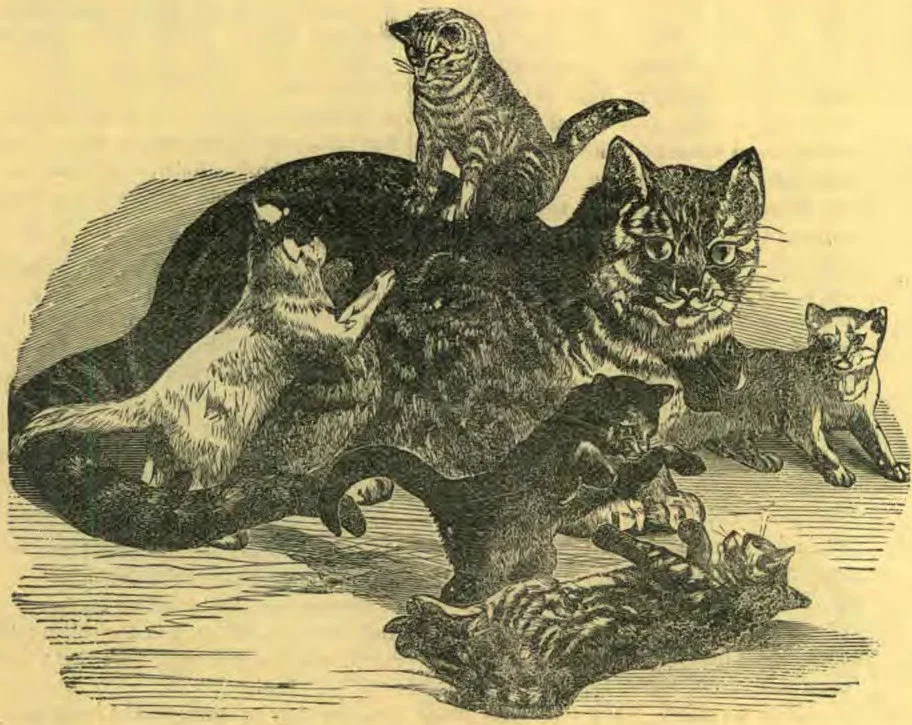
Between us two, we own a cat
(My sister Belle and I);
And she had five dear little kits,
This very last July.
And we are trying hard to think
How to divide them fair;
When Belle has two and I have two,
The fifth one's hard to share.—Sel.
WHERE THE CHILDREN PLAY.
Down by the hill in the meadow
The flowers are blooming gay;
Down by the hill in the meadow
The children are at play.
Where is the place that the children play?
Where is the place where the flowers are laid?
Down by the hill where the old mill stood,
Down by the hill at the end of the wood.
Kindness Increases by Sowing
KINDNESS, like grain, increases by sowing.
The Lasting Influence of an Upright Example
EVEN the humblest person, who sets before his fellows an example of industry, sobriety, and upright honesty of purpose in life, has a present as well as a future influence upon the well-being of his country; for his life and character pass unconsciously into the lives of others, and propagate good example for all time to come.