UNDER this title the Herald of Gospel Liberty quotes the Western Christian Advocate and makes a few comments that apply not only to ministers, but to all who pray and speak in public.
We would that some of our ministers might break themselves of the habit of unduly prolonging their syllables in prayer and preaching. Some of them have fallen into bad ways, "A-n-d, O-o-o-h L-o-r-d, w-e b-e-s-e-e-c-h T-h-e-e," etc. It is unnatural. It tires the worshiper by its strain and monotony. It suggests that the minister is desperately holding onto his word until he can summon some other thoughts. Simple but reverent language, spoken in natural, unaffected, unconventionalized tones will always be the most welcome to a worshiping congregation.—Western Christian Advocate.
Brethren of this class ought to have had a chance to take one lesson under the late Sam Jones on that point. He was merciless in scoring those long-drawn-out words in prayer. On one occasion he asked that the same be tried in the business and social spheres of life, and urged that the one trying it should notice carefully to see what effect this manner of speech would have upon the person addressed. He gave an example something like this: "A man wished to make a purchase of a suit of clothes, we will say, and as he entered the clothing house he began: 'O-h M-i-s-t-e-r C-l-o-t-h-i-n-g M-a-n, h-a-v-e y-o-u a-n-y p-a-n-t-a-l-o-o-n-s?'" And Brother Jones thought that would be enough to settle it that the man was beside himself, and yet we talk to the Lord with and for the people in public prayer in a similar fashion. The Advocate is right—let us be natural in our language in addressing the Father, just as simple and as plain as in every-day life. Long-drawn-out words are not needed, nor do they add to the profit of the service.
"It may be your burden seems heavy because your crown is in it."
A WOMAN OF MILLIONS.
By Anna Steese Richardson
One Hundred Clothes-Presses for One Woman.
[Anna Steese Richardson, in Woman's Home Companion for March.]
ONE clear, crisp autumn day I was sent in the capacity of a reporter to interview Mrs. Clarence H. Mackay at her magnificent country home, near Roslyn, Long Island. As I followed my guide through Mrs. Mackay's suite to the morning room, in which she does much of her literary work and plans her campaigns in the interest of education, we walked the length of a broad corridor—about sixty feet, I should imagine—walled with tapestry and inset with great mirrors.
When the interview was concluded, and I again walked through the corridor, the mirrors had opened on springs, to disclose clothes-press after clothes-press fitted with padded hangers and with myriad drawers for blouses, wraps, hats, lingerie, etc. Evidently the maids had taken advantage of the fine day to air furs and other heavy raiment in which moths might take lodgment.
One hundred and twenty feet of deep clothes-presses filled with exquisite raiment, and for one woman! Think of what that represented in expenditures, dear little homemaker, who must keep two small closets filled for yourself and daughter on a household and dress allowance of twenty-five a week! Yet Mrs. Mackay is not a notoriously extravagant dresser, but ranks among the women who are perfectly groomed, and gowned in admirable taste.
INDIVIDUAL COMMUNION CUPS
Send for FREE catalogue and list of over 4,000 churches using our cups.
Sanitary Communion Outfit Co. 64th Street, Rochester, N. Y.
Bank of Mountain View
By Editor
If you haven't already done so, why don't you drop us a postal asking us to send you a copy of our monthly paper, "The Bank of Mountain View Journal." It is very interesting. It is full of good ideas, and it is free to you for the asking. If you live in the East, send for a copy and see how we do it in California. We still hold ourselves ready to furnish you with information about Mountain View. Write us. Address—
Bank of Mountain View
Mountain View, Santa Clara County, California
Henton Fruit Truck Advertisement
By George E. Henton
Buy the celebrated HENTON FRUIT TRUCK when you intend purchasing wagons. For Carriages, or anything in the line of Farm Machinery, correspond with me. Can make it an object to you. Will lay goods down at your station at less than you pay local dealers. Satisfaction guaranteed. Geo. E. Henton, Mountain View, Cal.
A GOOD PROPOSITION.
to men and women. Send four ten-cent stamps for one dozen packages of E-Z Washing Tablets and instructions, post-paid. This may start you in a good, easy business as it has many others. E-Z Washing Tablets remove the dirt and stains without rubbing and positively without injury to clothes. Want agents in every State. Good profits. Address,
ALFRED MALLETT
Elkridge, - - - - - Baltimore, Md.
Cook Wanted
Wanted at once—woman to help cook. Family of four. Good home. Fair wages. Mrs. Libbie Edson, Hopland, Cal.
Scientific American
60 YEARS' EXPERIENCE PATENTS TRADE MARKS DESIGNS COPYRIGHTS &C.
COPYRIGHTS &C.
Anyone sending a sketch and description may quickly ascertain our opinion free whether an invention is probably patentable. Communications strictly confidential. HANDBOOK on Patents sent free. Oldest agency for securing patents.
Patents taken through Munn & Co. receive special notice, without charge, in the
Scientific American.
A handsomely illustrated weekly. Largest circulation of any scientific journal. Terms, $3 a year; four months, $1. Sold by all newsdealers.
MUNN & Co. 361 Broadway, New York
Branch Office, 625 F St., Washington, D. C.
MISSIONS
A PRAYER.
By Washington Gladden
O MASTER, let me walk with Thee
In lowly paths of service free;
Tell me Thy secret; help me bear
The strain of toil, the fret of care.
Help me the slow of heart to move
By some clear, winning word of love;
Teach me the wayward feet to stay,
And guide them in the homeward way.
Teach me Thy patience; still with Thee
In closer, dearer company,
In work that keeps faith sweet and strong,
In trust that triumphs over wrong.
—Washington Gladden.
CHINA
IV. CHINESE EDUCATION.
By J. N. Anderson
THE extraordinary addiction to letters, the general prevalence of literary habits among the middle and upper classes, and the very high preeminence which from the remotest period has universally been conceded to all persons of literary attainments, constitute a striking peculiarity of the Chinese.
Where but in China, indeed, could a person ever witness a literary examination in which grandfather, father, and son, all at the same time compete for the coveted prize, the degree, which in China corresponds to royalty in other lands? What nation, be it ever so advanced in science and art, can like China boast of scores of enthusiastic and vigorous students who have perseveringly and patiently traveled the scholastic road for sixty, seventy, and even eighty years? By actual count, the province of Anhui in the year 1889 reported thirty-five competitors over eighty years of age, and eighteen over ninety.
The bible of the Chinese race, the classics, which every schoolboy is required to learn by heart, is indeed
the Very Foundation
of the civilization of this race, and of the empire itself. Amid all the rebellions, social upheavals, and dynastic changes, this has kept them a nation. It is the magic web, which, running all thru China's social and political life, binds her millions, tho of different customs and speech, into one national unit, giving to this race a national life, not only unique, but in many respects stronger and more unified than either Europe or America can boast of. Politically China has repeatedly been subdued by invading hosts, but these foreign dynasties, once seated on the throne of Chinese power, never escaped being in turn conquered by China's educational life.
Like everything else in China, education is hoary with age, coming as it does from the golden age of Chinese history: according to the book of Rites (1200 B.C.), China's educational system was in full swing soon after the time of Moses. It seems quite clear that China easily led all the nations of remote antiquity in the matter of intellectual progress.
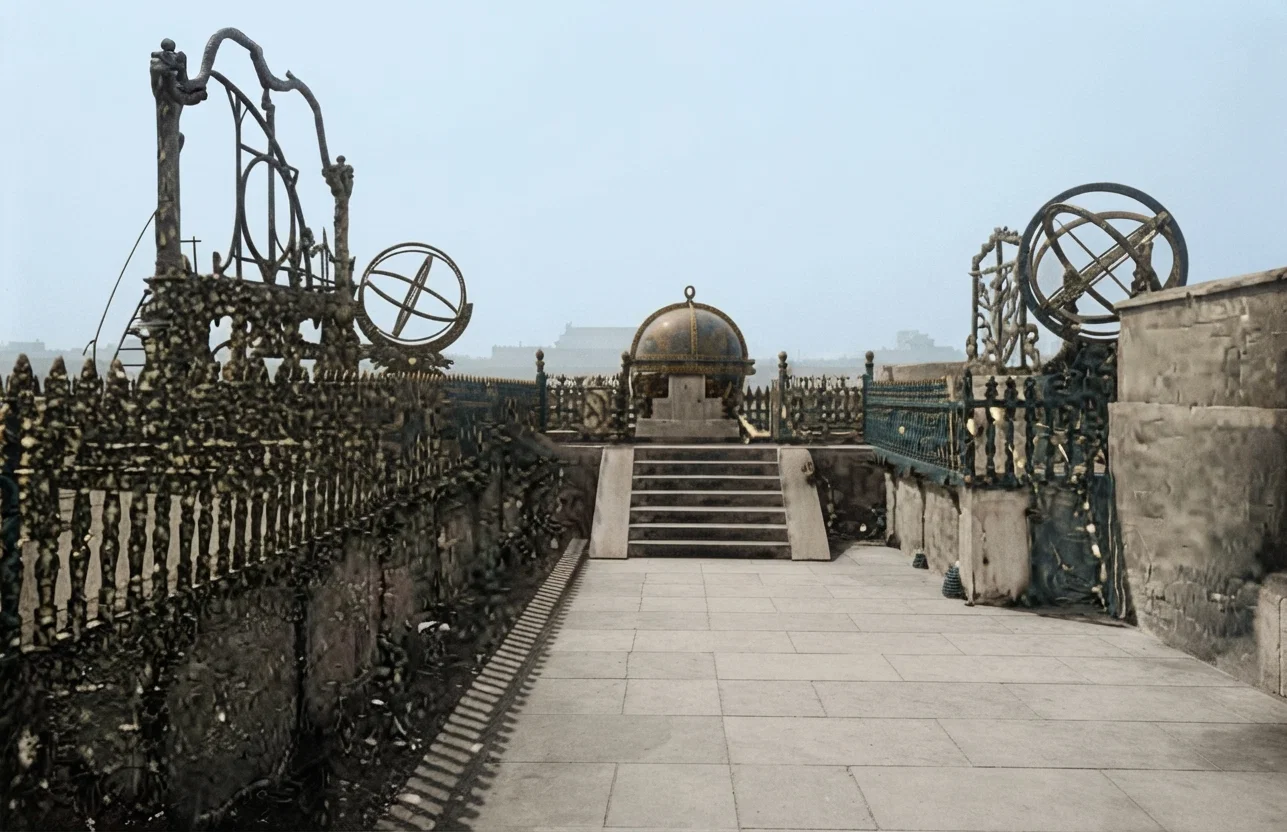
Chinese Observatory near Peking.
Ancient System Gone.
The reader should not fail to deal with these paragraphs as a bit of Chinese history, for the reason that China's system of literary examination, which dates from the Han Dynasty (about 180 A.D.), passed away by imperial authority in October, 1905. With one stroke of the vermilion pencil this elaborate and time-honored system, for so many centuries the pillar and stay of China, was swept aside, and that too, without any apparent remonstrance or protest. This sweeping away of the examination essay, the purpose and fulfilment of all Chinese education, has necessarily involved the entire educational fabric, so much so that within the last year the intellectual atmosphere of China has become heavy with new and modern educational ideas. Old examination halls are being leveled to the ground, and schools after the foreign model are rising to take their place. Temples once the abode of idols and imaginary spirits, are being made to serve the purpose of schoolhouses.
But our present concern is with what was. The new intellectual China of the past few months is beyond the scope of this article.
Method in Education.
First, then, as to method in Chinese education. Broadly speaking, the appeal is to one sole faculty of the mind, the memory. Reason and originality have no place at any point in this long and wearisome educational road. After the first three or four years the understanding is allowed to play a part, but until that time the little learner is held to his task of saying over and over a formidable array of baffling characters the meaning of which is quite unknown to him; not even are the sounds familiar to him, for the simple reason that he is now learning the classical language which is almost as different from the language of the fireside as Latin is from English. From daylight till dark, with sufficient intermission for meals only, the little Celestial, day after day and month after month, continues his monotonous task. There is neither recess nor variation in study—it is one continuous grind from one year's end to the other.
Later, as the scholar advances, a little light is allowed to break in upon his mind. By degrees the hitherto strange and bewildering characters are explained to the industrious and persevering boy. In this fact is found the otherwise inexplicable intellectual condition of the Chinese people; namely, that while a large percentage of Chinese men can read, only a small fraction of that number can understand what they read, for the reason that, owing to poverty, they were not able to pursue their studies beyond the initial stage. Of those who can read, or more properly, pronounce the characters, perhaps not more than one in twenty can really understand the meaning of the characters.
No Class System.
In a Chinese school there is no class system. Each boy constitutes a class all by himself, making as many classes as there are boys in the school, thus allowing free and full scope for individual diligence and aptitude. Each scholar studies aloud in his seat until he has learned his lesson, when he is required to "back it"—to come up to the teacher's desk and stand with his back turned while rehearsing it. All study is done13at school, as the home would be too distracting, and, too, the fireside, instead of being an aid to the work of the school, would rather have a tendency in the opposite direction. Unlike the American home, there is no newspaper, no helpful story books to act as a stimulus to the aspiring boy; for it need scarcely be said that in the matter of education the girl is not so much as thought of. The schoolroom is almost sure to be a gloomy, dark place with the most scanty furnishings possible—no maps, no charts, no globes, diagrams, or blackboards; but instead of these valuable aids to study, there is the constantly burning incense of the god of letters and Confucius. What may seem even more strange is the fact that in no case is there to be found a stove or any other convenience for heating the poorly ventilated room during the cold, wintry days of the higher latitudes.
What, then, is the subject-matter of the Chinese school? It is not what a Westerner would expect to find, such as arithmetic, geography, history, and the sciences. The Chinese school has nothing to do with such subjects. With truth it has been said, 'The vast majority of the educated men in China do not know to this day what is the meaning of the most common terms in our vocabulary, and much less do they know the use and value of the things designated, or how they are to be studied.' The Chinese scholar is indeed a student of antiquity, and all of his mental efforts have to do with the past, the remote past. The Chinese golden age is in the dim past, and all affairs are, or should be, dealt with in the light of that ideal and glorious past.
J. N. ANDERSON.
[This interesting article on Chinese Education will conclude next week, to be followed by another of equal interest.]
IMMANUEL.
By Max Hill
Tho King of the kingdom of heaven was He,
Enthroned by the Father's side,
Tho crowned with all honor and majesty,—
Yet He is the One who died.
Surrounded by all that was holy and pure,
Adored by the angel choir,
In all that was loving and lovely secure,
Obeyed in the least desire.
Yet He from the mansions of glory came down,
Came down at an awful cost,
A Babe in a manger of Bethlehem's town,
To seek and to save the lost.
To dwell on the earth, with the humble to live,
In hunger and pain and wo,
Tho the King of the universe, willing to give,
Give all tho it brought Him low.
Along the rough way of Golgotha He came,
To sink 'neath the awful cross,
To suffer the death of the tree with its shame,
To perish, nor count it loss.
Tho heaven may hail Him as Lord and as King,
'Twas my Saviour crucified;
Tho heaven may ring with the praises they sing,
For sinners—for me—He died.
No one of the angelic host can e'er know
The price that He paid for me,
And none but redeemed ones from sin here below
Can sing the glad song of the free.
Let angels adore Him, His name let them praise,
Throut the eternal years,
My song of redemption I joyfully raise,
And cast from my soul all fears.
Renouncing the cares and the burdens of life,
I rest in my Saviour's grace,
For soon, beyond worry and sickness and strife,
I know I shall see His face.
Max Hill.
OUR WORK AND WORKERS.
By Editor
At Lone Star, Texas, three recently united with the church.
THERE is a Seventh-day Adventist Church in Constantinople numbering about sixty.
BROTHER PAUL CURTIS reports ten new Sabbath-keepers at Yorkton, Saskatchewan, as fruits of meetings there.
AT Birmingham, Iowa, ten have united with the church, nine subject to baptism and one by letter, as a result of the labors of L. P. and Minnie Syp.
THE publishers of the SIGNS have issued a little folder entitled, "How to Get a Minister." Send for it, and see how easy it is to get a minister to help you in your missionary work.
THE brethren at Pueblo, Colo., have distributed 10,000 copies of "How Esther Read Her Bible," which awakened such an interest that meetings are called for. Our readers might do likewise. Send five cents to this office for copies of the little tract.
"THREE Germans have recently taken their stand with us on all points of our faith," writes Brother G. P. Gaede in The Welcome Visitor, of Ohio. He adds, "The calls for Bible-readings are coming in more rapidly than I can fill them." His work is in Cleveland.
BROTHER L. A. SPRING reports the baptism of seven at Canon City, Colo.
AT Oshkosh, Wis., two of Brother P. Wadkin's readers have accepted the truth.
THRU the work of the young people's society at Greeley, Colo., a lady has accepted the truth.
FOUR adult members have been added to the church at Lucky, Ark., thru the labors of Brother H. C. Griffin.
A SERIES of meetings and house-to-house Bible readings in Ava, Ohio, have resulted in three taking their stand for the truth. A Sabbath-school has also been organized by Brother W. C. Moffett.
MEETINGS held in Genoa, Nev., the oldest town in the State, by Brethren A. J. Osborne and B. E. Beddoe, have resulted in leading fourteen to the truth. The SIGNS is now going regularly into nearly half the homes in the town.
WHILE on his way to Ismidt, Asia Minor, where he is now located, Brother C. D. AcMoody had an interesting experience at Bucharest, Rumania. Not being able to speak the language, an effort was made to secure an interpreter. The one secured proved to know too little English, so the idea of speaking was given up. Next day, Sabbath, an Episcopal lady who spoke English sent for Brother AcMoody, and told him she would get him an interpreter, which she did, a lady not of our faith. An excellent meeting was held, and at the close the brethren joined in prayer for Brother AcMoody in his mission to Turkey, and thanked God also for sending the lady to interpret for them. At this the lady burst into tears. She said she deserved no thanks for her service, but was grateful for the meeting.
Address Wanted
Address Wanted.—The address of Mr. and Mrs. W. S. McCoy, who united with the Roswell, N. Mex., Seventh-day Adventist Church, July 1, 1903, is wanted by Mrs. S. E. Butler, church clerk.
WANTED FOR MISSIONARY WORK.
By Editor
(Always prepay postage.)
SIGNS OF THE TIMES, Watchman, Life and Health, Life Boat. Address, M. C. Ford, Grand Valley, Colo.
SIGNS OF THE TIMES. Address, Mrs. James F. Woods, 322 S. Detroit St., Warsaw, Ind.
LATE copies of the SIGNS and other denominational papers. Address, Chas. W. Grundy, Pansy, Mo.
SIGNS OF THE TIMES, Watchman, Life and Health, Life Boat, tracts on all subjects. Also Spanish papers and tracts. Address, J. L. McElhany, 15 Calle E, Ermita, Manila, P. I.
Chas. Kunz, Elida, N. Mex., can use to advantage copies of the SIGNS, Life and Health, and other denominational literature in missionary work. He will use carefully all sent to him in that new country.
CONTINUOUS supply of SIGNS and all other denominational papers, including Instructor and Little Friend, books and pamphlets, old and new, for use among the Indians. Address, S. B. Taft, Mechanical Instructor, Fort Defiance, Arizona.
Trusting God With Life’s Great Issues
“Shall we not perform our allotted tasks cheerfully, and trust our heavenly Father with the great issues of life? If the web of life looks intricate and hopeless to us, we need not despair; He is able to bring all patient effort to perfect fulness.”
The Voice of God in Silence
"WHEN every other voice is hushed, and in quietness we wait before Him, the silence of the soul makes more distinct the voice of God."
Uniting With Infinite Power
Only by uniting with Infinite Power do we become strong. Of ourselves we are nothing. By uniting our ciphers with the divine unit we become mighty. Our one zero (0) put on the right side of God's unit (1) makes ten (10).
A CANVASSERS' CLASS.
By Editor
A SPECIAL canvassers' class is to be held at Healdsburg, Cal., in connection with the Pacific Union College, under the direction of W. H. Covell, beginning April 1 and continuing two months. This will be a splendid opportunity for those near this school to get a training which will prepare them for this important branch of the work, and at the same time fit them to earn a scholarship in the school. The cost will be $30.00 for those entering the home. The cost to others will be $3.00. Write L. A. Reed, Healdsburg, Cal., for information.
San Francisco's Greater Calamity
By Editor
WAXING WORSE AND WORSE.
IT is a saying of Holy Writ that among those who profess Christianity in the "last days" "evil men and seducers shall wax worse and worse, deceiving and being deceived." Read from the first verse to the thirteenth in the third chapter of 2 Timothy. Compare the first five verses with the last part of the first chapter of Romans, where the apostle is giving us a picture of the heathen world. Note that the same sins which were prevalent in the heathen world in the days of the apostle will be manifest in the professed Christian world in the last days, among those that have the form of godliness but deny the power of it in their lives. Revelation after revelation has been given to the public for years of the awful wickedness and corruption which exist in our great municipalities.
These revelations began with that of the Tweed regime in New York City. There was moral strength enough then back of Samuel J. Tilden and those who prosecuted the evil-doers to have its effect. Of late the moral strength seems to be almost utterly lacking. Following New York have been exposures of corruption in Chicago, Minneapolis, St. Louis, Philadelphia, Pittsburg, and last of all and worst of all in poor, pitiful, stricken, earthquake-broken, and fire-devastated San Francisco. Of all cities it would seem that in the city by the Golden Gate every element of patriotism, sympathy, and strength of character on the part of its officials and leading men would have been given to lifting the city from its deplorable condition and helping in every way to establish its government, its commerce, its reputation; but if we are to believe what seems to be fact as it is told by the newspapers of all shades of politics, the whole city government, with a very few exceptions,—one journal tells us with but one exception; namely, the district attorney,—is utterly corrupt. Franchises were carried thru by wholesale bribery of the city boss and his underlings, the mayor and city council. One company, it is said, paid $500,000 for a franchise, $200,000 to the mayor, $200,000 to the boss, and the rest divided among the supervisors. And this is only one of a long list of lesser franchises, in which the individual bribes range from $500 up to $5,000. The district attorney and his assistants and some of the judges are doing the best they can to prosecute the evil-doers and punish them for the crime; and yet, there are, seemingly, judges who will bar the way to the execution of justice.
We are told that these men, when they knew that they were found out, came before the grand jury and unblushingly and unmoved told of the bribes which they have given or received, as tho it were an everyday commercial transaction. A few of the people are indignant, but the majority of them laugh it off. The saddest thing in the contemplation of it all is not so much the fact that such a crime as that could be conceived and carried thru, but there seems to be no conscience of crime, no shame on the part of the evil-doers, nor on the part of those who have supported their policy in the past. For instance, one of the supervisors is reported to have said that he had nothing to do with the giving or taking of bribes, but that if he had he would not go back on a friend, meaning that if he had known that the supervisors were guilty of just such things as have been revealed, he would not have brought them to justice, but would have concealed their crimes, notwithstanding his oath of office.
Surely, these things show that we are, in the words of Holy Writ, in "the last days," that the "perilous times" have come, and that these perilous times are not perilous because of the increasing violence, merely, that there is in the land, but perilous because these things can exist among those who profess better things, and constantly increase with so little effect upon the conscience of the public. Most of these men are professed Christians. They were honored by the suffrages of their constituents, because it was believed that they were honest men. The result is before us. The great question which even secular papers are asking is if there is conscience enough in the people who placed these men in office to select other men to take their places, who are not of the same order. All these things ought to stir thinking men and women. It ought to make them see and believe that God's word is preeminently true, and the thing which ought to be heeded above all things else is the "more sure word of prophecy," which throws the true light upon the dark places of the world at the present time.
Greater calamity than the earthquake and the fire is the corruption of San Francisco's officials.
IDAHO'S NEW SUNDAY LAW.
By Editor
WE wonder what the friends of religious liberty were doing up in Idaho, that such a law should have passed.
Sunday laws are demanded first of all by those who believe Sunday to be sacred (a perfect right which they have, of course), and who also believe that everybody else ought to be made to conform to their belief (a contention without a shadow of right).
Most of the politicians know nothing about it and care less. Some of them believe in Sunday and Sunday laws from religious prejudice. A very few see the dangers in this entering wedge of union of Church and State; but nearly all of them are coming to fear the church vote, and so support or refrain from opposing any measure of that sort, thinking it will matter little one way or the other, and knowing nothing of what will doubtless grow out of it as demonstrated by the lessons of Church-and-State history.
On the other hand, if a fair, faithful, persistent campaign of enlightenment is entered upon, if the legislators are educated in principles of liberty which, perhaps, they have never before studied, such measures would, at least, be more intelligently discussed, and in many cases defeated. Good men may be behind them; good men may mistakenly espouse them; but all religious legislation is iniquitous, perniciously so. It is a confession on the part of those who ask it that there is not enough of the power of God in the institution to stand. If in the law, it becomes an instrument of intolerance and15persecution on the part of bigots. It is contrary to every principle of true Americanism. All civil legislation ought to be for the benefit and for the protection of the rights of the individual man, and not for any class or any dogma. Sunday laws are diametrically opposed to every principle of liberty.
Here is a copy of the Idaho Sunday law as reported by the Lewiston "Teller," of that State in its issue of the 13th ultimo:
"Section 1. That the first day of the week is hereby set aside as a day of public rest.
What People Can Not Do.
"Sec. 2. It shall be unlawful for any person or persons in this State to keep open on Sunday for the purpose of any business, trade, or sale of goods, wares, or merchandise, any shop, store, building, or place of business whatever; provided, that hotels and restaurants may furnish lodging and meals; and, provided, that this section shall not apply to livery stables, or to drug stores in so far as the sale of medicines or sick-room supplies are concerned, or to undertakers while providing for the dead, or to news stands in so far as the quiet sale and delivery of daily papers is concerned, nor to sale of non-intoxicating refreshments, candies, and cigars.
Penalties for Violations.
"Any person or persons violating this section shall be guilty of a misdemeanor, and on conviction thereof said offender shall be fined in any sum not less than twenty-five dollars ($25) nor more than one hundred dollars ($100), or shall be imprisoned in the county jail not to exceed thirty days, and upon a second conviction by both such fine and imprisonment.
"Sec. 3. It shall be unlawful for any person or persons in this State to keep open on Sunday any saloon, or place of any kind or description in which spirituous, vinous, malt, or any intoxicating liquors are at any time sold or exposed for sale, or to give, or sell, or otherwise dispose of any spirituous, vinous, malt, or any intoxicating liquors except as provided for in other parts of this act; or to keep open any theater, play-house, dance-house, race-track, merry-go-round, circus, or show, concert saloon, billiard, or pool room, bowling alley, variety hall, or any such place of public amusement.
No Sunday Racing.
"Any person or persons violating this section shall be guilty of a misdemeanor, and on conviction thereof said offender shall be fined in any sum not less than thirty dollars ($30) nor more than two hundred and fifty dollars ($250) for each offense, and shall be punished by imprisonment in the county jail not to exceed ninety days; and upon a second conviction any license which may have been granted for opening and maintaining any such place of business shall also be rendered void and not be renewed within two years next thereafter.
"Sec. 4. It shall be unlawful for any person or persons in this State to engage on Sunday in horse racing.
Authorities Must Act.
"Any person or persons violating this section shall be guilty of a misdemeanor, and on conviction thereof said offender shall be fined in any sum not less than five dollars ($5.00) nor more than one hundred dollars ($100), or shall be imprisoned in the county jail not to exceed thirty days, or by both such fine and imprisonment.
Sec. 5. It shall be the duty of each prosecuting attorney, sheriff, constable, city or town marshal, or any and all other public officers in this State to inform against and diligently prosecute any and all persons guilty of the violations of the provisions of this act, either upon credible information as to any violation, or upon reasonable cause to believe that there has been any such violation.
Officials Can Be Removed.
"Any such officer who shall refuse or wilfully neglect to inform against and prosecute said offenders against this act, shall be deemed guilty of a misdemeanor, and on conviction thereof shall be punished by fine of not less than fifty dollars ($50) nor more than five hundred dollars ($500) and the court before which said officer shall be tried shall declare the office or appointment held by said officer vacant for the remainder of his term.
"Sec. 6. All fines collected from the violation of this act shall be paid into the common school fund of the county.
"Sec. 7. All acts and parts of acts, either general or special, in conflict with the provisions of this act are hereby repealed in so far as they conflict with the provisions of this act."
This bill has been signed by the governor. It was greatly toned down, and is much less rigid than its advocates desired. It is an opening wedge which will be driven harder and heavier as men behind it have the power. It passed thru the Senate without any debate whatsoever. What were the friends of religious liberty doing in Idaho?
THE CIGARET BOY.
The "Industrialist" of March 9, issued weekly by the Kansas State Agricultural College, contains an article by William A. McKeever, on the subject, "The Cigaret Boy," from which the following paragraphs are taken:
"There are in the Kansas State Agricultural College at this time about one hundred young men who are thoroly addicted to the use of cigarets or a strong pipe, while a great many others indulge occasionally in the use of tobacco in some form. These young men are somewhat below the average of their age in size and weight, have something of the 'lean and hungry look,' and are more or less predisposed to sore eyes, weak heart, sore throat, stomach trouble, 'short wind,' and the like, and what is most serious of all, perhaps, they rank very low as students.
"The ill effects of cigarets upon young boys and youths are so marked that their physical, intellectual, and moral natures are often permanently impaired. Comparatively few of these youths ever get beyond the freshman year in college. They are soon forced out into other lines of work, and are usually compelled to take subordinate positions."
During the college year 1905-06, Mr. McKeever secured, thru disinterested persons, two lists of names of students, (1) fifty young men who were habitual cigaret or pipe smokers, and (2) fifty young men of the same class rank who were non-smokers. He then obtained from the college records of the preceding term the final grades and other data. From this he learned that the smokers made an average of 17.53 per cent. lower than the non-smokers, and the former dropped 84 per cent. of the subjects discontinued during the term by both classes, and that they made 74 per cent. of all the failures. Nine smokers and twenty-five non-smokers had clear records. He concludes:
"I feel confident that an investigation would result in showing that these boys who become heavy smokers so young will eventually be forced into inferior and subordinate positions for their life work."
The tobacco curse in its various forms is second only to the liquor curse, and is predisposing to that.