NITROGEN is a gaseous element, the chemical opposite of oxygen. Oxygen has strong affinities; nitrogen is characterized by extreme inactivity. It can only be made to enter into chemical union with other substances by “specially devised and circuitous processes.” “Oxygen is found almost everywhere; nitrogen exists only in the air, and in comparatively few compounds. Oxygen illustrates chemical activity; nitrogen, chemical inertia. Oxygen sustains life; nitrogen has no physiological effect when inhaled, though it is a constituent of many animal tissues.”
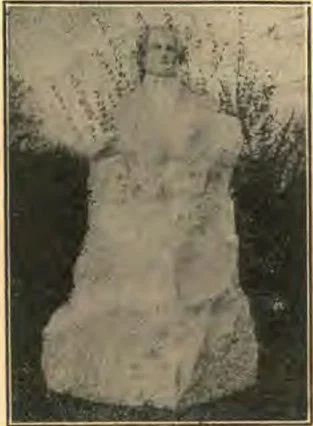
PARIS MONUMENT TO
HORACE WELLS
Nitrogen occurs free in the atmosphere, making about four fifths of the volume of air. Its chief office in the air is to dilute the oxygen, thereby lessening its activities. It is not chemically combined with the oxygen, only mixed; so the oxygen can easily be separated from the nitrogen for respiration and combustion.
Nitrogen, like hydrogen and oxygen, is colorless, odorless, and tasteless. It has been reduced to a liquid, and to a snow-like solid. It has no poisonous properties, neither will it burn or support combustion. The wisdom of having such an associate for oxygen in the atmosphere is evident. It is difficult enough to extinguish fires at the present time. If nitrogen aided ever so little in the work of combustion, it would, from its abundance, greatly increase the difficulty.
Nitrogen, meaning niter producer, was given its name because of its being an important constituent of saltpeter (KNO₂), often called niter. As nitrogen is so abundant in the air, the best method of obtaining it is to remove the oxygen from the air. Mr. Williams in his chemistry gives the following experiment for collecting nitrogen:—
“Cover a large, flat cork with a coating of plaster of Paris and float it upon a pan or basin of water. A small iron saucer serves well instead of the cork. Put upon it a small piece of phosphorus and ignite. Quickly place over the burning phosphorus a large, wide-mouthed jar. Notice that the water gradually rises in the jar to take the place of the consumed oxygen, and that in a few minutes the white fumes are absorbed by the water. Owing to the expansion caused by the heat, some bubbles of air almost always escape in the early part of the experiment.”
This experiment should be performed only under the supervision of an experienced teacher, as phosphorus is highly poisonous and inflammable.
Nitrogen is an important element in organic nature. All forms of life, animal or vegetable, contain a large proportion of it. The peculiar odor of burning hair and horn is due to the presence of nitrogen in those substances. Nitrogen, hydrogen, oxygen, and carbon are pre-eminently the organic elements. But neither plants nor animals ordinarily use the free nitrogen from the air. They get it from nitrogen compounds. We water plants sometimes with weak ammonia water. The plants break up the ammonia, which contains nitrogen, and use that element in their tissues. About one million five hundred thousand tons of sodium nitrate (NaNO₃) are exported yearly from the northern part of Chile, where immense deposits of it occur. Nearly all of this is used as a fertilizer, in order to furnish nitrogen to crops. Economists, recognizing that this supply is not inexhaustible, some claiming that in less than thirty years it will be exhausted, have partially solved the problem by discovering a way to utilize the nitrogen of the air. With the aid of the electric arc, some of the nitrogen and oxygen of the air are induced to unite, forming nitric oxide, which in its turn is readily converted into nitric acid or nitrates. A successful plant for carrying on this operation on a large scale has been set up in Norway, and is now turning out large quantities of nitrate of lime for fertilizing purposes, which is capable of replacing the natural nitrate of Chile.
“Recent investigations by Jamieson, in Scotland, and Zemplen and Roth, in Hungary, indicate that forest trees may, through the natural functions of their foliage, be able to perform the feat which science has only within the past few years placed within the reach of human accomplishment, of extracting free nitrogen from the atmosphere. Professor Henry, of Nancy, was the first to point out that forest soils are enriched in nitrogen by the decay of leaves. The later investigators have found nitrogen in the trichomes of many species of forest trees, and they believe that they have excluded every possible source of this nitrogen other than the atmosphere.”
Compounds of Nitrogen
While nitrogen is inert at ordinary temperatures, it can be made under certain conditions to combine with hydrogen, oxygen, chlorine, bromine, sodium, and some other elements. The principal explosives, as powder, dynamite, guncotton, and nitroglycerine, owe their activity to the presence of nitrogen in them, it making compounds unstable,—a necessary characteristic of explosives.8
Perhaps the most common or best-known compound of nitrogen is ammonium hydroxide (NH₄OH), or ammonia, as it is commonly called. That term more properly, however, belongs to the gas. Ammonium water consists of ammonia gas (NH₃) dissolved in water. It is thought the gas acts chemically upon the water, making the unstable compound NH₄OH, from which the gas readily escapes.
Ammonia was formerly prepared by the dry distillation of hair, hoofs, hides, and horns; for this reason it was called hartshorn, and its solution, spirits of hartshorn. At the present time ammonia is made in large quantities as a by-product during the manufacture of illuminating gas from coal. Since coal is of vegetable origin, it is natural to look to it for nitrogen compounds. The decomposition or decay of all vegetable or animal matter gives free ammonia to the air.
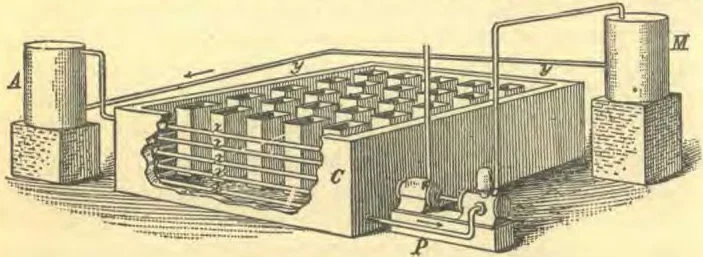
Ammonia gas is easily converted by cold or pressure, or by both together, into a colorless liquid. This liquid produces great cold when it evaporates, and is largely employed for cooling and for the production of artificial ice, for which purpose it has almost completely displaced other substances in practical work. The manufacture of ice, then, is a simple matter; if the liquid ammonia is allowed to evaporate near vessels of water, the heat required to cause the evaporation is drawn from the water, so the water is frozen.
MODERN ICE PLANT
“A is a tank filled with liquid ammonia. C is a rectangular vat, filled with strong salt water, through which are coiled a series of pipes, x x, that connect with A. Through the top of this vat are let down oblong galvanized iron boxes, containing the fresh water to be frozen. P is a steam-pump, which is continually exhausting the pipes and keeping up a rapid evaporation in A. This evaporation lowers the temperature of the salt water in C below the freezing-point of pure water, and in from thirty-six to sixty hours the ice is ready to be drawn from the boxes.”
Just as a drop of ether or benzine placed on the hand in evaporating draws heat from the hand, and causes it to feel cold.
Inorganic compounds are classed as bases, acids, and salts. Litmus paper, which may be obtained from a druggist, is used to test the nature of substances. In general, blue litmus is turned red by an acid, and is unaffected by either a base or a salt; red litmus paper is turned blue by a base, and is unaffected by an acid or a salt. A solution of cochineal, orange itself, will turn violet on the addition of a base, like ammonia. An acid will restore the orange color. Ammonia will turn red litmus paper blue, so it is a base, one of the strong bases called alkalies. It will, therefore, neutralize an acid. For this reason it is used in cases of accidents when acids are spilled upon the clothes or flesh. “But should the acid be received in the face, it is best to wash it off quickly with much water, then with a weak solution of ammonia, and finally, without rubbing, to cover the injured parts with sweet-oil.”
A friend of mine recently purchased a gray mohair skirt. Almost the first time it was worn she completely ruined the front width, as she thought, by getting lemon juice on it. Some one suggested to her that she put ammonia water on the spots from which the lemon juice had taken out the color. This she did, and then washed out the ammonium salt with clear, cold water, and found the skirt was restored to its original condition. If she had spilled nitric acid on the skirt, the ammonia would have deepened the spots instead of restoring them, though it might have kept the acid from decomposing the cloth.
Ammonia is much used for cleansing purposes and for softening, or “breaking,” water. In a medicinal way it is used as a restorative in cases of fainting, and overdoses of chloroform and other anesthetics. Smelling-salts reveal the presence of ammonia.
Nitrogen makes five compounds with oxygen. Perhaps the most interesting one is nitrous oxide (N₂O). This is a colorless gas, with a faint odor and sweetish taste. It will support combustion almost as well as oxygen. “When nitrous oxide is diluted with oxygen and inhaled, it produces a kind of intoxication, generally accompanied by a disposition to immoderate laughter, hence it is called laughing-gas. When the gas is breathed pure, it produces temporary unconsciousness and insensibility to pain. It has been used by dentists for the painless extraction of teeth. It should be used with caution; for if it is inhaled too long a time, it produces suffocation and death.”
“A monument was recently unveiled in Paris, in honor of the American surgeon and dentist, Horace Wells, the discoverer of nitrous oxide. Although its properties had been made known as early as the year 1800, Wells was the first to employ it in dentistry. He made a visit to Paris, where he communicated his discovery to the French medical societies.”
Nitric acid (HNO₃) is, as shown by the formula, a combination of hydrogen, oxygen, and nitrogen, and is one of three common acids so important in the arts and in commerce. It has been known for hundreds of years. Considerable quantities of it are employed in the manufacture of the explosives nitroglycerine and guncotton. Smokeless gunpowders, most of which are mixtures containing the foregoing explosives, have increased the demand for nitric acid. It is also used in etching copper and steel plate, also swords and razors, much as hydrofluoric acid is used in etching glass. It acts an important part in the making of the beautiful and varied coal-tar colors, or aniline dyes, which is one of the most fascinating of industries.
A simple test for nitric acid is that it turns the skin yellow. It has the same effect upon vegetable fibers.
Cutting and Cracking Glass
GLASS tubing and glass rod must generally be cut to the length required for any particular apparatus. A sharp triangular file is used for this purpose. The stick of tubing or rod to be cut is laid upon a table, and a deep scratch is made with the file at the place where the fracture is to be made. The stick is then grasped with the two hands, one on each side of the mark, while the thumbs are brought together just at the scratch. By pushing with the thumbs, and pulling in the opposite direction with the fingers, the stick is broken squarely at the scratch, just as a stick of candy or a dry twig may be broken. The sharp edges of the fracture should invariably be made smooth, either with a wet file, or by softening the end of the tube or rod in an alcohol-lamp. Tubes or rods of sizes four to eight inclusive may readily be cut in this manner.
An Ingenious Dish-Drainer
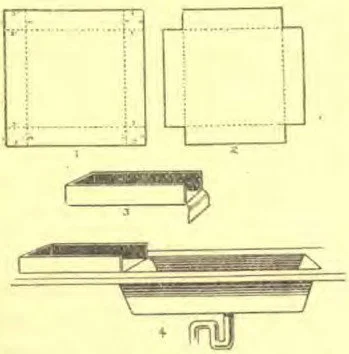
A VALUABLE accessory to the kitchen sink is made by taking a square of galvanized iron, one side of which is six inches longer than the width of the sink from front to back. Measure along each side three inches from each corner, and mark. Connect these points by lines drawn parallel to the side of the square. Cut out the three-inch squares thus made at the corners. Bend three of the sides upward at right angles along the lines drawn. At the corners solder the ends of the side pieces together. Bend the other side downward. Set the pan upon the sink-board with the side bent downward hanging over the edge of the board and into the sink. This makes a pan in which dishes, when washed, may be scalded and drained without the necessity of leaving them to stand in the water and without spilling the water upon the floor. Leave the pan on the sink-board all the time, and use it in which to place all hot or smutty cooking utensils. The sink and sink-boards are then easily kept white and clean. Your tinker will make the pan for about one dollar.—Woman’s Home Companion.
The Coldest City on Earth
THE coldest inhabited place in the world is undoubtedly Verkhoyansk, in northeastern Siberia, with a mean annual temperature of less than three degrees above zero, Fahrenheit, and a winter minimum of eighty-five below.
Verkhoyansk is in north latitude sixty-seven degrees, on the great arctic plain, scarcely more than one hundred fifty feet above the level of the sea. Probably there would be no town there if it were not necessary to Russian governmental purposes to have an administrative center for a region where many thrifty Yakuts, the fur-trading “Jews of Siberia,” carry on their operations.
All its inhabitants, save a few officials and other Russians, are Yakuts. This does not prevent its being a place of some importance, for the Yakuts are the most progressive people in northern Siberia, excelling the Russians themselves in enterprise and adaptability to Siberian conditions of existence.
The average temperature of the winter in Verkhoyansk is fifty-three degrees below zero, Fahrenheit. The rivers freeze to the bottom, and the small trees have been known to snap and split from the force of the frost.
Yet, with all this, Verkhoyansk is, it is claimed, not a disagreeable place of residence and is preferred by the Russian officials to many more southern and warmer posts. Its atmosphere in winter is always clear, and for the little time the sun is above the horizon its beams are unobstructed. The air is still, too; no blizzards or drifting snow-storms make life a burden to the inhabitants.
The Siberian dress completes the comfort of the citizens of this arctic city. It consists of two suits of fur, an outer and an inner suit. The inner suit is worn fur side inward, the outer fur outward. With his hood down, and just enough space left to see out of and to breathe through, the Verkhoyansker is vastly more comfortable in a temperature of eighty below than many an American, in his cloth overcoat in a temperature of five above zero.
The winter, indeed, is more enjoyable than the summer, which is hotter than might be expected. The average temperature of July in Verkhoyansk is fifty-nine above zero, and very hot days are not uncommon. The earth becomes green and vegetation thrives, though only the surface of the ground is thawed. At Yakutsk, which is farther south than Verkhoyansk, but not much warmer in winter, the mercury rises in July to one hundred degrees.—Harper’s Weekly.
French Thrift
THE French farmer rarely cultivates more than two or three acres of land, for which he pays from five hundred to one thousand dollars rent annually. The buildings must be of his own construction, and he must know the art of soil-making through and through. He can not fall back on commercial fertilizers to any extent, for that method of farming would soon swamp him. His family and those attached to it average eight persons, men and women. A little farm of this sort is made to yield over one hundred tons of produce in a year. In other words, there is not an acre of land in France or Belgium that can be cultivated at all that is not made to furnish not only food enough to sustain a family, but enough over to buy the necessaries of life.
The key-note to all this is that this sort of farmer knows how to make soil, not to stimulate it merely, but to make it. He does not waste a single weed or bunch of leaves, and he burns nothing that can be fermented into manure. Will America come to this sort of tillage? It looks now as if we were well on the road. We are learning to make great use of glass in our gardens. The Florida farmer, who is up to the times, gets four to five crops from his land, although that is not quite up to the French farmer with his seven crops. The old idea of resting soil is proved to be nonsense; for, rightly replacing the elements used up in our crops, the garden can be at work every day of the year. Our world is capable of taking good care of an enormous population, and it probably will have this to do. We shall learn to assign not more than five acres to a good-sized family, for liberal support and considerable contribution of produce to the support of those who do not own land at all.
Five crops from ten acres equals one crop from fifty acres, but they mean five times the crop from fifty acres. Better than that, intensive farming raises each crop to double the average per acre, or more. It is all based on the principle that right tillage makes richer land, while only wrong tillage wears out land. This is what the open-eyed land tiller sees ahead—doubled population, better fed than the present population, and crops brought up to such a maximum of production that the United States can take care of half the population now on the whole globe. Nobody till very recently had a dream of the possibilities of farming. So much for agricultural colleges and science.—The Independent.
The Danger of Gossip
By Marian B. Harding
ONE of the most harmful things in our daily life is the habit of gossip. Often, perhaps without being aware of it, it creeps into our conversation on the most general subjects. And for every word of gossip spoken, irreparable wrong is done to some one.
It is worse than slander; for slander can be traced to its source and punished; but gossip creeps along insidiously. It is never outspoken, but is always suggestive. Its influence is far-reaching; for words once spoken are never lost. They go on forever, helping or hurting some one. Years may pass, and we may forget that they were ever spoken; but in some life, at some time, may be found the effect of a thoughtless speech.
If one is severely burned, eventually the wound may heal; but there will always remain a scar. So is the perpetuity of gossip. Youth can suffer keenly and bitterly; and many young people have been rendered hopeless and discouraged by the gossip evil. We should ever remember that destinies are decided by little things.
Let us, then, be too strong and true to indulge in gossip. It weakens principle and destroys ideals. It leads to sophistry and cant, and to moral and spiritual looseness. We can never tolerate the sin of gossip and be “our brother’s keeper.” And if we are to stand for right principles and achieve some worthy end in life, we must work—
“For the cause that lacks assistance,
For the ills that need resistance.”
MARIAN B. HARDING.
Hardening Pharaoh’s Heart — an Illustration
By John N. Quinn
In a moment of carelessness, I place a razor within reach of my four-year-old child, who instantly seizes it, and having noticed how I used it, brings the sharp edge dangerously near the little throat. I ask the child to give me the razor, and meet with a refusal. His will now is antagonistic to mine. Again I make the request, only to be met with refusal. Knowing the danger which threatens the child, I seize his wrist. Instantly the fingers close tightly on the razor, and the muscles of the arm become hard. I continue my hold and in a kindly way make known to the child’s mind the danger of handling such an instrument. The danger slowly dawns upon him, the muscles are relaxed, and willingly the razor is surrendered. Both our wills are now a unit, and both of us are perfectly satisfied with the outcome. But who hardened the muscles of the little arm?—Both of us were involved in it; I, in my intense desire to save the child from injury and possible death attempted to secure the razor; he desired to retain it, and the tense muscles revealed the antagonism of his will to mine.
Pharaoh spurned God’s invitation to release Israel from a servitude both cruel and oppressive, a servitude unjust and tyrannical. God, being the author of liberty, insisted on Israel’s deliverance, and Pharaoh met with defeat and disaster. Had he yielded to the will of God, very different would have been his experience.
Sin is a dangerous thing; God pleads with us to surrender it to him, that he may eradicate it from our lives. We refuse his invitation, and each time we refuse our hearts become harder—hardened because of our opposition to the will of God; hardened, dreadful thought, until there is no remedy. On the other hand, when we heed God’s invitation, and surrender sin, how quickly the heart becomes soft and tender under the gentle pleadings of our Heavenly Father, and what a blessedness is experienced when we are thus reconciled to him! “To-day if ye will hear his voice, harden not your hearts.” JOHN N. QUINN.
We Are the Lord's
LUTHER and Melanchthon once wanted to cross the Elbe at Torgau during a terrific storm. Timid Melanchthon tried to dissuade Luther from making the dangerous crossing, and said, “Martin, do not cross over, the stars are against us!” Luther answered, “We are the Lord’s, consequently we are lords over the stars.” What a rich fulness of comfort and trust lie in the words, “We belong to the Lord”! There is no danger greater than he; no sin, not even death is greater. And what a call to us to be faithful, wakeful of our duty in these same words! They ennoble us and enrich our life. And that is the goal of salvation, to be his and to serve him.—Selected.
A New Pastime
DR. M. V. STRYKER, president of Hamilton College, has made out a list of two or three hundred words to be used as an educational pastime for the winter evenings. He says, “A general study of the list around the fireside with family or friends may not be conducive to harmony, but it can not fail to be instructive.”
A pronunciation exercise of this kind ought to result finally in greater harmony, it seems to me. While there will of course be conflicts in authority on some words, yet with a little study the preferred pronunciation can usually be determined. The “Speaker’s Manual,” published by the Review and Herald Association, will be of service in ascertaining the preferred pronunciation of Dr. Stryker’s list of words, which follows:—
I HOPE there are plenty more of these rusks, Ellen. You know to-morrow will be Tuesday, and we must have something to serve. I think these would be just the thing; they are even more delicious than usual.
A little smile of pleasure flitted across Ellen’s face. It was impossible to resist the praise of Miss Louise. But as the girl balanced, with practised skill, upon one hand the tray piled with empty supper dishes, she regarded her mistress with a speculative little frown.
“I thought it would be nicer to have scones to-morrow,” she ventured. “Served hot, you know, with butter. The weather’s so cold for the season that warm things kinder taste better. Don’t you think so?”
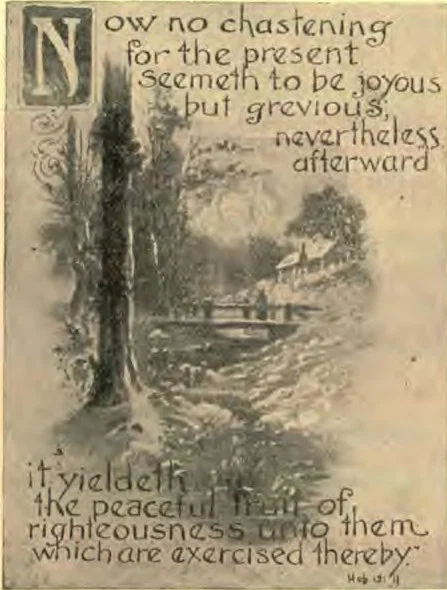
MEMORY TEXT
The invalid’s delicate face lighted with genuine pleasure. “Why, scones would be lovely to have!” she agreed. “That’s very thoughtful of you, Ellen. Mrs. Nelson is so fond of them, and she might come to-morrow.”
Ellen raised the west window-shade so Miss Louise might enjoy the full splendor of the sunset, then took up the tray again and walked down to the kitchen. Once in the realm where she was undisputed monarch, she set down her burden with an emphasis that caused the cup to dance almost out of its saucer.
“I wish Tuesdays had been left clear out of the week!” she declared. “I hate the sight of the day, with her sittin’ by the window, waitin’ and waitin’ for folks!” Suddenly she sank down in a chair near the table and buried her head in her arms. “O, how can she be so cheerful all the time?” she wailed. “It’ll kill her if things go on this way any longer!”
A sharp peal of the door-bell brought her to her feet, and she began dabbing frantically at her telltale eyes. A swift glance into the sideboard mirror showed her that her efforts had been unavailing. “O, I look awful to see anybody now!” she told herself. “Anybody’d think I’d been half-murdered. But I’ve got to do it. I don’t care how I look.”
In spite of her defiance, however, she drew a little sigh of relief as she caught sight of Dr. Gray’s portly figure through the hall window. It would not matter about him. She opened the door, and the boisterous wind hurled the doctor into the hall, and then romped away, laughing at its own impudence.
He followed her up-stairs to Miss Louise’s room, with the preoccupied air of the physician whose calls have ceased to be of vital importance to his patient.
But when, ten minutes later, he stopped at the kitchen on his way out, to leave some directions, there were worried lines about his eyes.
Ellen was busy with the dishes at the sink. She raised her head inquiringly. “Something you wanted, doctor?”
“A glass of water, please; the wind seems to have made me thirsty.”
When he had set down the tumbler, he looked at her with the same abstracted gaze. “I do not like the way Miss Louise is getting along,” he began, abruptly. He saw a shadow of pain steal into the girl’s eyes, and added kindly, “Of course I know it isn’t your fault, Ellen. You do the very best you can for her, and I wouldn’t want her to have anybody else; but I didn’t expect her to fail like this. I think, Ellen, that I will come out again in the morning and leave a tonic for you to give her.”
When he had gone away, Ellen vigorously apostrophized the door where he had stood. “Tonic!” she said, with fine scorn. “She doesn’t need a tonic any more than he does! What she needs is to have folks come and see her and pay some attention to her, like they did when she was first brought home from the hospital. They were sorry for her then, when they heard that she never could get well, and they was always offerin’ to make her things to eat, and all o’ that; but now, now they don’t even send their children in to ask about her any more. Mrs. Nelson, bein’ the minister’s wife, might have kep’ it up, I should ha’ thought; but I suppose gettin’ money for the new church is takin’ all her time.”
She set the last of the plates upon the draining-board, and wrung out the dish-cloth with a savage turn.
By eleven o’clock the next morning the house was in its usual scrupulous order, and Ellen was putting the last touches to the parlor. She paused for a moment in her dusting, and surveyed the table with critical approval. Over one of Miss Louise’s fine old India centerpieces the teacups, representing almost every country of the world, hobnobbed in delightful democratic fashion. A great bowl of purple violets occupied the center of the card-table, and filled the air with delicate fragrance.
“O dear!” the girl sighed, as she wiped the last bit of coral and set it back in its place upon the cabinet. “I believe there’s a hoodoo about bein’ always ready for company. Maybe if the house looked like a hurrah’s nest, and there wasn’t a scrap of anything to offer anybody, the folks would drop in on us by the dozens.”
Early in the afternoon Miss Louise, leaning heavily upon Ellen’s strong young arm, came slowly downstairs and sank into the big arm-chair by the window. From the doorway Ellen looked sorrowfully at her12before she left her to her lonely vigil. It seemed to her that the eager, expectant smile upon the patient face was more than she could bear. The sheer white wrapper, all embroidery and tiny tucks, trailed upon the floor in billowy folds, and the knot of lavender ribbon at Miss Louise’s throat heightened the flush upon her cheeks. She reached up and parted the curtains with one delicate, blue-veined hand.
“I am really afraid it’s going to rain, Ellen,” she said. “I seem to feel that it is. I do hope that we shall not have a shower before night.”
“I hope we shall!” the girl muttered, as she cut the thin slices of bread for sandwiches. “I hope it’ll pour; then she can’t really look for anybody to come.”
Less than half an hour later, as if in answer to her wish, fine, misty drops began to patter upon the roof. Ellen tiptoed to the parlor door to see if Miss Louise wanted anything. She was leaning far back in her chair with closed eyes, but she was not asleep, for at the sound of the footstep she roused herself.
“I was just picturing to myself how this room would look if it were full of bright young faces,” she said. “I love to have any one come, of course, but if young folks come I feel so flattered. You will understand when you get to be an old lady yourself, Ellen.”
“I guess if we lived right in town they’d come fast enough,” the faithful little maid assured her. “Bein’ right on the edge this way, it kind o’ seems like the country to ’em.”
The fine mist had changed now to full-grown drops, and little rivulets were chasing each other down the window-pane.
“I guess I’d better make your cocoa,” Ellen suggested. “It’s just about time, isn’t it?”
She started away on her errand, but a shrill peal of the door-bell brought her to a sudden stop; then the certainty that it was a pedler mustered her forces for action. Miss Louise had straightened suddenly in her chair, the pink flush deepening in her cheeks. With one despairing glance at her eager face, Ellen went to answer the summons, carefully closing the parlor door behind her.
At the sight that met her eyes a moment later, she stood struck dumb with amazement. There were all sizes and types of girls crowding upon the porch and swarming half-way down the steps. Some one in front was speaking, but for a full moment Ellen could not distinguish a syllable. Then the words began to take definite meaning.
“We’re the senior class from the high school,” the little blond lady was saying, and Ellen suddenly recognized her as the Latin teacher, Miss Marvin, who in Miss Louise’s happier days had been one of her most frequent callers. “You see, we were out on our annual spring picnic to-day, and it was so lovely when we started that we never dreamed we should be caught in the rain. I thought that Miss Louise might not mind if we stayed out in her big barn just until—”
Her voice was hesitating and apologetic, but Ellen, with one swift gesture that was almost savage in its eagerness, reached out and drew her into the hall. The girls silently trailed after her, sixteen of them.
“Don’t dare to say a word about the rain, or—or the barn!” she commanded. “You’ve come out to see her, remember!”
With a flutter of triumph she threw open the parlor door.
(Concluded on page fifteen)
Quotation on the Evil of Suppressing a Free Press
By George William Curtis
No abuse of a free press can be so great as the evil of its suppression.—George William Curtis.