"HE hath remembered His covenant forever, the word which He commanded to a thousand generations. Which covenant he made with Abraham, and His oath unto Isaac; and confirmed the same unto Jacob for a law, and to Israel for an everlasting covenant; saying, Unto thee will I give the land of Canaan, the lot of your inheritance." Ps. 105:8-11. "For Thou hast confirmed to Thyself Thy people Israel to be a people unto Thee forever; and Thou, Lord, art become their God." 2 Sam. 7:24. "Thus saith the Lord which giveth the sun for a light by day, and the ordinances of the moon and of the stars for a light by night, which divideth the sea when the waves thereof roar; the Lord of hosts is His name; if these ordinances depart from before Me, saith the Lord, then the seed of Israel shall also cease from being a nation before Me forever." Jer. 31:35, 36.
We have here an everlasting covenant and an everlasting nation. The everlasting covenant is with Israel. The name Israel (the prince that prevails with God) was given to Jacob after His wrestling with the angel. Gen. 32:28. This name is applied to the descendants of Jacob (Ex. 3:16), and was ever afterward the national name of the twelve tribes collectively.
The covenant that God made with Abram, and confirmed to Isaac and Jacob, He also confirmed to Israel for an everlasting covenant. In this covenant God promised Abram and his seed all the land of Canaan for an everlasting possession. Gen. 17:8. By consulting Heb. 11:13, we find that Abram, Isaac, and Jacob, and certain of their descendants, all died in faith, not having received the promise. From verse 10 we learn that Abram did not expect the fulfilment of the promise in this life; "for he looked for a city which hath foundations whose builder and maker is God."
Included the Earth.
Rom. 4:13 informs us that the land of Canaan promised to Abram and his seed included the world; and from the fact that the city which hath foundations (the new Jerusalem), whose builder and maker is God, is to be the capital of the earth made new (Revelation 21), it is plain that Abram so understood it. Then what God promised Israel was the new earth; not part of it, but all of it; and this is the inheritance promised to God's children of all ages. Ps. 37:9-11, 22, 29, 34; Matt. 5:5; Rom. 4:13; Heb. 11:39, 40.
Israel must therefore be the family name of God's children of all ages; for the inheritance is all promised to Israel, and if God has any children who are not Israelites, they can have no inheritance in the new earth. In Eph. 3:15 we read that God's children both in heaven and on earth are one family; and also that they have a family name. When a child is adopted into a family it takes the family name. When a Gentile is adopted into the family of God does he remain a Gentile still? This is impossible, for the word "Gentile" is applied to those outside of God's people, worshipers of false gods.
Eph. 2:1-3 tells us of some persons who "in time past were dead in trespasses and sins." Verse 11 informs us that when they were dead in trespasses and sins they were Gentiles; and verse 12 says that "at that time [when they were Gentiles] they were without Christ, being aliens from the commonwealth of Israel, and strangers from the covenants of promise, having no hope, and without God in the world." Then both the commonwealth and the covenants of promise belong to Israel.
Verse 13 tells us that "now in Christ Jesus ye who were sometimes afar off are made nigh by the blood of Christ," and verses 19 and 20 say, "Now therefore ye are no more strangers and foreigners, but fellow-citizens with the saints, and of the household of God; and are built upon the foundation of the apostles and prophets, Jesus Christ Himself being the chief cornerstone." But this foundation is Israel (Micah 5:2), and as the earthly family name of God's children is Israel, then when a Gentile accepts Christ and is adopted into the family of God, he takes the family name, Israel; he ceases to be a Gentile, and becomes an Israelite.
In proof of this we will consult a few more passages of Scripture. "For he is not a Jew, which is one outwardly; neither is that circumcision, which is outward in the flesh. But he is a Jew, which is one inwardly; and circumcision is that of the heart, in the spirit, and not in the letter; whose praise is not of men, but of God." Rom. 2:28, 29. Here we are told that the Gentile and the Jew may change places, the Gentile after the flesh becoming a Jew, and the Jew after the flesh ceasing to be a Jew: that this change is accomplished by a change of heart in the former, and the absence of that change in the latter.
We find the same statement in Rom. 9:6-8: "For they are not all Israel, which are of Israel; neither because they are the seed of Abraham, are they all children; but, In Isaac shall thy seed be called. That is, they which are the children of the flesh, these are not the children of God." Plainly those who through faith in Christ have been born again are Israel, and those who have not accepted Christ, and been born again, tho they may be of the seed of Abraham after the flesh, are not Israel.
We will give one more passage of Scripture, which is so clear on this point that if it stood alone it would prove all we claim. "If ye be Christ's, then are ye Abraham's seed, and heirs according to the promise." Gal. 3:29. We have seen that the new earth is promised to Israel, so he who is Christ's must be of Israel or he could not be heir to the promise made to Israel. Before passing on to Israel in the earth made new, we would just call attention once more to Rom. 4:13. "For his promise that he should be heir of the world was not to Abraham, or to his seed, through the law, but through the righteousness of faith."
The Fulfilment of the Promise.
"And he made of one every nation of men for to dwell on all the face of the earth, having determined their appointed seasons and the bounds of their habitation." Acts 17:26. R. V. In G. R. Berry's literal translation of the Greek New Testament the last clause reads, "Having fore-arranged times and the boundaries of their dwelling." From this verse we are referred to Deut. 32:8, where we read as follows: "When the Most High divided to the nations their inheritance, when He separated the sons of Adam, He set the bounds of the people according to the number of the children of Israel." Jacob was called Israel, and the number of his sons was twelve. Dr. Adam Clarke in commenting on this passage renders it, "according to the number of the sons of Jacob."
The next verse is proof that this is the meaning of the passage, "For the Lord's portion is His people, Jacob is the lot of His inheritance." That this verse does not refer to the division of the land of Canaan between the twelve tribes, is evident from the preceding verse: "Remember the days of old, consider the years of many generations; ask thy father and he will show thee; thy elders and they will tell thee."
The plain meaning of these passages is that God made of one (Adam) all the nations of the earth, and fore-arranged to divide the sons of Adam into twelve nations after the number of the sons of Jacob, and give them the earth, having beforehand not only determined their appointed season but the bounds of their habitation. This is only another expression of the statement in Rom. 4:13, that God has promised Israel the earth, with the additional information that Israel will then be twelve nations, elsewhere called tribes.
This promise has never been fulfilled, and never can be till Isa. 13:9 is fulfilled, and sinners are destroyed out of the earth; for we have seen that Israel is the family name of all God's earthly children. Under present conditions they are "strangers and sojourners here, as all their fathers were." 1 Chron. 29:15; Ps. 39:12; Heb. 11:9, 13. But when they inherit the earth there can be no other nations or peoples in it. The fulfilment of this promise lies beyond the millennium, when the whole land will be desolate. Isa. 13:9; 24:1-3; Jer. 4:23-27.
At the beginning of this period Israel, both those who have fallen asleep and those who are alive, will be taken to be with Christ (1 Thess. 4:15-17); and, assisting in the judgment of the wicked (1 Cor. 6:2, 3), they will reign with Christ a thousand years (Rev. 20:4). At the close of the thousand years they will come again to the earth, when the wicked dead who lived not again till the thousand years were ended will be raised (verse 5), and, urged on by Satan, they will try to take the camp of the saints and the beloved city, and fire will come down from God out of Heaven and devour them. Verse 9. In verse 15 we find that all whose names were not written in the Lamb's Book of Life were cast into the lake of fire.
New Heaven and Earth.
The next verse, chapter 21:1, tells us that a new heaven and a new earth had taken the place of the old heaven and the old earth which had passed away. From 2 Peter 3:7-13 we learn that just prior to the appearance of the new earth, "the [old] heavens shall pass away with a great noise, and the elements shall melt with fervent heat, the earth also, and the works that are therein shall be burned up"; also that this fire is the "perdition of ungodly men." In the new earth we find the holy city, the New Jerusalem. Rev. 21:2.10
Now we have on the earth the city that Abraham looked forward to, "which hath foundations, whose builder and maker is God," and we may expect the fulfilment of the promise made to Israel. This city is the capital of the new earth, for in verse 24 we read that the nations of them which are saved shall walk in the light of it, and the kings of the earth do bring their glory and honor into it.
So there will be nations and kings in the earth made new. From the number of gates in the city (verse 12), through which they are to bring their glory and honor into it, we would expect just twelve nations in the new earth, and this is the exact number of nations among whom God fore-arranged to divide the earth. From the names on the gates (verse 12), we find that these nations are the twelve tribes of Israel, and this is an exact fulfilment of God's covenant with Abraham, and His oath to Isaac, confirmed to Jacob and to Israel for an everlasting covenant.
In Matt. 19:28 we find further proofs of this. "Jesus said unto them [His disciples], Verily I say unto you, That ye which have followed Me, in the regeneration when the Son of Man shall sit in the throne of His glory, ye also shall sit upon twelve thrones, judging the twelve tribes of Israel." If the twelve tribes of Israel are the twelve nations in the new earth, we would expect to find the twelve apostles the twelve kings; and these are the very names we find on the walls of the city (verse 14), while within the city, the capital of the universe, is the throne of God and of the Lamb.
When the earth is divided between the twelve tribes of Israel their inheritance will be forever. Ps. 37:18; Isa. 60:21. In this we see the antitype of the division of the land of Canaan. In the type, when Israel was to cross over into the land of Canaan, twelve men were appointed, one of every tribe, each to take a stone from the midst of Jordan with which to erect a memorial of their miraculous passage. Joshua 3:11 to 4:7. In the antitype a number of people pass over without seeing death. 2 Thess. 4:17. In Rev. 7:4-8 and 14:1 we have mention of twelve thousand from each tribe of the children of Israel. In chapter 14:4 we learn that the hundred and forty-four thousand will constitute an everlasting memorial of the miraculous passage from the wilderness of this world to the Canaan of the earth made new. As the hundred and forty-four thousand are to "follow the Lamb whithersoever He goeth," they will be the representatives of the twelve tribes of Israel in the new earth. As the twelve tribes were always twelve parts of one nation, so the twelve nations in the new earth will be twelve divisions of the one everlasting nation, Israel, whose capital will be the New Jerusalem. They will have access to the tree of life, and there will be no more curse, neither shall there be any more death, neither sorrow nor crying; neither shall there be any more pain, for former things have passed away.
We know by the budding of the fig tree (Matt. 24:32-35) that the Lord is coming in this generation to gather His children home. This being the case, the twelve tribes of Israel must be on the earth to-day; for all who are to cross over are Israel, twelve thousand of each tribe. Rev. 7:4-8; 14:3. They are not Israel after the flesh, except as they have been grafted in again, for God is able to graft them in again if they abide not in unbelief. But the wild branches are also grafted in, and with them partake of the root and fatness of the olive tree. Rom. 11:17-23. "If ye be Christ's then are ye Abraham's seed, and heirs according to the promise." Gal. 3:29.
"Deep in unfathomable mines
Of never failing skill,
God treasures up His vast designs
And works His sovereign will."
THE LAW IN THE GOSPEL PLAN.
By F. M. Burg
BY F. M. BURG.
II. Justification by Faith.
THE subject of discussion in Romans 3 and Galatians 3, and like chapters from which men get their supposed proofs that the law is abolished, is justification by faith, and not in any sense an argument as to whether Christians should keep the law.
The question of justification by faith concerns people who are sinners and under condemnation. Whether people who have been justified and freed from past guilt through the blood of Christ should keep the law, is wholly another question; it is not the subject of the chapters named above.
"By the law is the knowledge of sin." Rom. 3:20, also 7:7. When the sinner stands face to face with the law which he has broken, and because of which transgression the Son of God had to suffer that the debt might be paid and the sinner be free, he sees his guilt under the movings of the Spirit of God as he could not in any other way. This is the object of the law to the transgressor, that by it sin may become "exceeding sinful." Rom. 7:13. "And where sin abounded, grace did much more abound." Rom. 5:20.
With the thought so clearly before us, that to the sinner the law is designed to make his guilt appear, that to him by this means sin becomes "exceeding sinful," it follows necessarily that his justification, or freedom from his guilt, can not be by means of the law. In Rom. 3:19, 20, Paul states this conclusion very plainly. And in writing to the Galatians he says, "That no man is justified by the law in the sight of God, it is evident; for, The just shall live by faith." Gal. 3:11.
Justification, forgiveness, freedom from guilt of past transgression, can be found only through faith in the blood of Christ. Speaking of Jesus, Paul says: "Whom God hath set forth to be a propitiation through faith in His blood, to declare His righteousness for the remission of sins that are past [literally, removing them], through the forbearance of God; to declare, I say, at this time His righteousness; that He might be just, and the justifier of him which believeth in Jesus." Rom. 3:25, 26.
This is clear, and needs no comment. We are justified from past guilt by faith in the blood of Christ. "Therefore being justified by faith, we have peace with God through our Lord Jesus Christ." Rom. 5:1.
To recapitulate: Justification is for men who need it; and this embraces all, for "all have sinned;" all have broken the law and stand condemned. The object of the law in such a case is to bring conviction of sin to the transgressor, through the work of the Holy Spirit. And when the man reaches this point, when he sees his wretched and lost condition, he cries out in sorrow and in a sense of his need, and pleads with God to be merciful to him a sinner. And through his bitter tears he sees the suffering Saviour on the cruel cross. That scene is enough to assure him that God is willing to abundantly pardon his transgressions. While confessing with mingled sorrow and gratitude the sins of his life, he believes, and finds Him faithful that promised. Now that the past is covered, the assurance possesses his soul that his sins, tho as scarlet, are taken away; condemnation is lifted from him, and he is free. He is at peace with God through Jesus Christ.
III. Third Chapter of Galatians.
Verse 8: "And the scripture, foreseeing that God would justify the heathen [actually, justify sinners] through faith, preached before the Gospel unto Abraham, saying, In thee shall all nations be blessed."
The subject of the chapter before us is justification by faith. God promised Abraham, covenanted with him, that sinners should be justified by faith. If the reader will keep this in mind, he will be safeguarded against any wrong conclusion, or wrong application of any expression found in the chapter.
Verse 10: "As many as are of the works of the law are under the curse." Now bear in mind that the writer here does not say that Christian people who keep the law are under the curse. He is not talking of Christian people. He is speaking of people who need to be justified, that is, sinners. If such people seek justification by the works of the law, they are "under the curse;" they have in this denied or rejected the death of Jesus for their redemption. The apostle follows the above statement with this: "That no man is justified by the law in the sight of God, it is evident." Verse 11. And it surely is evident, and it is hoped that it has been made to appear evident to the reader thus far. "The law is not of faith;" it is simply the expression of a Christian's legitimate duty. Verse 12.
In verses 13, 14, the statement is clearly made that Christ has paid the debt for the transgressor by His death on the tree, so that the blessing promised to Abraham, of justification from past guilt, might come to him who would believe.
In verse 15 the writer uses an illustration to make clear the thought he is about to express. He says that when men make a covenant or an agreement and it is sealed, it can not be changed by any one. That is clear to all. Hence the application which he makes: God made promise to Abraham that men, or sinners, should be justified by faith; and the promise was confirmed in Christ. That promise, or covenant, can not be changed. He says that the law which came in four hundred and thirty years after the promise to Abraham was made, could not disannul or make it of none effect. The promise stands just the same since the law was spoken at Sinai as before. The law was not given to justify sinners. That the law can not justify the offender, has been clearly shown in these studies; and up to this point in Galatians 3, this fact is still urged.12
Why Was The Law Given?
Then the question in verse 19 is a logical one, just such a question as we would ask, since it appears, as it does, that the law can not justify man, and was not given for that purpose: "Wherefore then serveth the law?" What is its purpose? Why was it given? Why do we have it in its written form? The answer is given: "It was added because of transgression." Men had sinned; and that the offense might abound, that sin by the commandment might become exceeding sinful (Rom. 5:20; 7:13), the law was set forth. In this it becomes a schoolmaster to bring us to Christ, that we may be justified by faith. Verse 24.
"Is the law, then, against the promise of God? God forbid." Verse 21. And as long as sin is here and men need a Saviour, until He come to whom the promise of the kingdom was made (Ps. 2:7–9), the law will serve this glorious purpose. Then, the new covenant fully consummated with the Israel of God, the law will be in the heart of every one, from the least to the greatest. All will know the Lord, and righteousness will fill the earth.
(To be continued.)
"BEHOLD, I MAKE ALL THINGS NEW."
By Frederick Langbridge
Could we this dawning year
But live to Him—
Love simple and sincere,
Faith never dim—
New green should overspread
The meadows brown;
New depths of blue o'erhead
Look smiling down;
Our dull life kindled to a strange new worth
Each should behold new heavens and a new earth.
—Rev. F. Langbridge.
THE BABY'S SMILE.
Experience of a Bachelor.
ONE afternoon I came into a Korean village, and while waiting the arrival of the horse with my books, provisions, cot-bed, and bedding, I amused a crowd of children with a little free-hand drawing. Among the group there was a little girl with a baby about two years old on her back.
It was a plump, pretty baby, with wonderfully regular features and large black eyes, and it was surprising to me how good-natured it was, considering the fact that its head was literally covered with matter a quarter of an inch thick, under which the diseased, itching scalp must have been exceedingly tormenting. His little hands went up constantly to his head and his small finger nails tore his scalp until it bled.
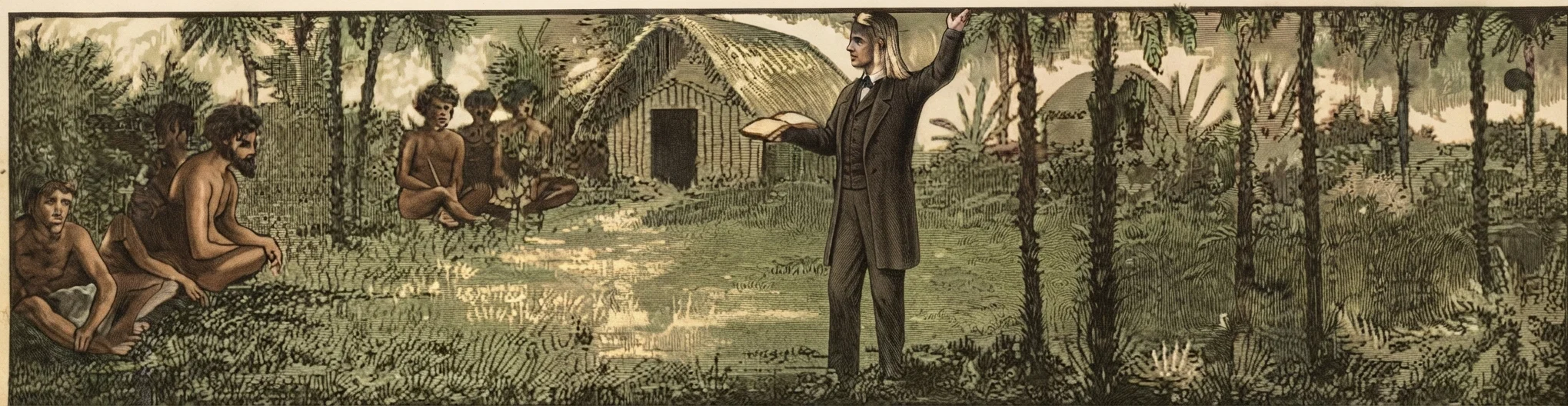
Native House in Huahine.
I stood it as long as I could and then sent for the child's mother. I had her bring a vessel and some warm water, and I took some good soap, made a lather, and washed and rubbed and scratched the baby's head for half an hour. While the experience was new and in this case rather disagreeable to me, it seemed quite pleasing to the baby, which moved its head about under my hands, as if the sensation of relief was very grateful to it. I worked until I noticed the baby getting pale, and then, being inexperienced in such matters, I was afraid to continue, not knowing what might happen to a two-year-old baby having its head washed for the first time in its life and under such circumstances.
I carefully dried its head and wrapped it up in a towel. The next morning the mother told me that it slept better that night than it had for a good many weeks. I brought my soap and rubbed and dug for another half hour, and this time got the little head comparatively clean, and drying it, wrapped it as before in a dry towel.
After I had finished and stepped aside to view the11result, the baby turned its head, looked at me, and gave me the sweetest smile I ever had.—Korean Methodist.
OUR WORK IN HUAHINE.
By Mrs. B. J. Cady
WE are spending a few weeks on the island of Huahine, one of the leeward islands of the Society group. This island is in plain sight of Raiatea and Tahaa, and small boats are often traveling back and forth between here and there.
Since we believe that the Third Angel's Message is the most important thing in the world at this time, and that the truth must be given to all people as a witness to prepare them for the end, we feel anxious to enlighten the minds of these people, and are trying to improve every opportunity for doing so.
We have a meeting appointed for each evening at our home, and always have a good congregation of children and a few adults. Sometimes there are many grown people in attendance. We do a good deal of singing both before and after the service, teaching the children to sing our hymns. This is a part of the service of which they never tire. All appear very friendly, and many acknowledge that we have the truth on the Sabbath question. What they need now is to see the importance of obeying the Lord.
As the grown people are so irregular in their attendance at our meetings, we concluded that we must do all we could to teach them in their homes. From the first, Mr. Cady has been spending much of his time visiting the people here in town and in the country round about, but I have been busy with other work, and have done but little visiting. Sister Lydia Parker, who is with us, started out with me the first day. At the first house we visited, I held a reading with a woman and her two married daughters. At the next house, we left a printed Bible-reading of the Family Bible Teacher for a white man to read. At another place the woman was busy sewing, but I made an appointment for a reading the next day with her. Then we came home, and I went to our nearest neighbor and held a reading with a woman there. The next day, I held three readings. At one place there were two men who asked if they could come in and listen. They both gave the best of attention, and when we had finished, the older one asked some questions on the subject which we had taken up. In the native church the women are not allowed to teach in meetings of the men, and some men are very much afraid that it will be said that they are being taught by a woman. But I am glad to say that it is not usually so with the most intelligent, or with those who have a real thirst for knowledge.
I now have appointments at four different houses for two and three readings a week, and at some places the neighbors also attend. It seems that this is the best way for us to work here, and the living Word of God can speak to the people as we cannot. I find that those who have been willing to have readings have manifested much interest in the truths presented, and I am enjoying the work very much.
Our work has had a slight interruption for the past few days in what is called a mourning feast. A younger brother of the king died five weeks ago, and as he was one of the leading members of the royal family and a prominent man in the government and the church, the whole island is mourning for him after their custom. This division of Huahine appointed this last Sunday as a mourning occasion, and invited all of the people from little Huahine to come over and have services with them. These people have been very busy preparing food for the visitors, and had tables and seats arranged on the grounds by the king's house, where they celebrate on holiday occasions. An awning of gaily colored bed quilts was tied above the tables. The first meal was given to the visitors Sunday morning, and they were fed again in the evening.
It was required that all should be clothed in black at their church that day, and so for several weeks past the people have been making black clothes and painting over their white hats. Some of the men's black calico coats were made much like the robes that priests wear, and looked very odd to us. There was a very large crowd at the church, and even the little children were dressed in black to honor the occasion. But the somber appearance did not appear to dampen their feelings any, and their songs which were prepared for the occasion often caused considerable merriment. After the services many went and shook hands with the wife and other relatives of the deceased man, and the women sat down around the wife as if to weep with her.
A meeting was appointed to be held last night, and texts given out, one for the young people, one for the women, and one for the men. These texts formed a foundation for remarks, and the people were requested to each find a Scripture verse that would help to explain the first one given, and present it in the meeting. We had no meeting that evening, but went to this gathering, which was on the grounds by the king's house. They had four groups of singers, and one group would sing at a time. After considerable singing, some one would get up and talk a while and repeat a verse of Scripture, and then there would be singing again. In the singing, some who wished to have the reputation of furnishing the most amusement, would try to do or say something odd to make the people laugh. Some even kept time to the music with the gestures which they use in their heathen dancing. In their talks, they would also banter one another, and tho they were discussing the Word of God, they would say funny things and use vulgar expressions simply to provoke laughter. Tho this was called a religious service and a mourning occasion, it seemed consistent with neither.
We stayed until ten o'clock, but they did not close their meeting until one o'clock; then they began again very early this morning, and kept it up till about noon, when they stopped for breakfast. Some who know not what it means to worship God in spirit and in truth, call this zeal, but it is apparent that love for God and true worship is not in it at all. It is only a desire for carnal pleasures that prompts it. Because Babylon has fallen and the church has lost its first love, it can indulge in such foolish and unprofitable amusements and mistake them for true worship.
We are hoping that some of these people may see the beauty and consistency of God's truth, and may learn to love it for the good there is in it.
HEAVEN'S THREE VOICES.
THERE are three voices born of heaven's blue:
The first to all men sounds at Morning's break;
It rings a trumpet-blast the whole world through,
When God says "Wake!"
The second comes when Noonday's sun is high:
A voice commanding and imperative,
Bidding men strive and pray unceasingly,
When God says "Live!"
The third when Evening follows in the shade
Of manhood's dying day, sounds last and best
To those who woke, and lived, and worked, and
prayed,
When God says "Rest!"
—Anon.
“LEAD US NOT INTO TEMPTATION.”
By C. F. Wilcox
BY C. F. WILCOX.
AT the beginning of Christ’s ministry He was baptized. On coming up out of the water, He heard the Father’s voice from heaven saying, “This is My beloved Son, in whom I am well pleased.” His life work was before Him. Here was His Father’s word announcing Him as His own Son, and declaring that He was well pleased with His mission. Wonderful and marvelous was the blessing granted Him there upon the banks of Jordan. But what followed? Was the lost world waiting for Him to save it in His way? Did He at once begin His mighty miracles? Could He at once set the captives of Satan free?
Listen, “And straightway the Spirit driveth Him forth into the wilderness.” Mark 1: 12. Was His mission there? Would He find the souls He came to save in the solitude of the wilderness? Would the spiritually blind and deaf seek for Him when far away from all human habitation? Why should the Spirit of God drive Him into the wilderness?
Matthew tells us the reason. He was “led up of the Spirit into the wilderness to be tempted of the devil.” Matt. 4: 1. God had given the world and all in it into the hands of man. Gen. 1: 26. But man sold out to the devil for a thing of naught; and thus Satan became the prince of this world. He possessed the souls and bodies of men, for they had given themselves to him. Christ came to set them free, to break the bands that held them slaves to Satan.
Christ came to save man. He must take legal methods. He must be straightforward and open. He came to redeem, to buy back. He brought the purchase price with Him, and it must be paid over to the present owner. The fact that Satan secured the world from man through fraud, did not affect the fact that he had possession.
Christ came to purchase the world. In His earthly mission He entered upon the real work of buying it back at the time of His baptism. He was then fully authorized to meet the claimant and make terms with him. One of the conditions was that He must stand single-handed in Adam’s place, meet the devil, and secure possession of the kingdom, paying all costs, satisfying all just claims, and reinstating man in his own dominion. And since “God was in Christ reconciling the world unto Himself” (2 Cor. 5: 19), the Spirit of God directed Him in all His ways on earth. Having come to purchase the kingdom, the very first one for Him to meet must be the usurper, the devil. Therefore, “the Spirit driveth Him forth into the wilderness” “to be tempted of the devil.”
Alone with the devil, and surrounded with savage beasts of prey, He must withstand every suggestion of doubt as to His mission, His father’s love for Him and His work, and not give place to the devil for one instant. Under the terrible physical strain of forty days without food or water, by day and by night, He must resist all that Satan and his host of evil could force upon His soul. He endured more than any mortal could ever know. Wealth and ease were offered Him, for all the kingdoms of the whole world and all their glory were laid at His feet. Even from this vantage point of glory, down through all that tempts mankind, even unto death itself, Christ drank the cup to its bitterest dregs. Had not angels ministered unto Him (Matt. 4: 11), He would have died right there under the terrible pressure brought to bear upon Him by the devil. Had He perished there, it would have been because the devil took His life—the price He brought with Him with which to redeem the world. But the unmasking of sin was not complete, the Sufferer must be revived that He might go forward and wholly show the hideousness of evil. He finished the work and came off a victorious conqueror in every detail.
Now the connection between all this and the prayer He taught us to pray. Having endured all the temptations that could possibly come to mortal man, and knowing the terribleness of the same, He desires that man shall be saved even from temptation. Since He had stood the test, and paid the full price for liberty, He would give liberty to all who would accept it. He would therefore lead men to look for escape from temptation. He had won for them, in their place.
His temptation had not come in the ordinary course of human events. His was not the common every-day temptations that come to man when surrounded by circumstances to relieve and help; but in the solitary wilderness He had met the devil face to face. And the Lord, “Our Father,” through His Holy Spirit, directly led Him there for the express purpose of having Him tempted of the devil. Christ, after this experience, knew what it was to be tempted of the devil. He knew, too, what it was to be led by His Father out into the lonely wilds, there to meet Satan single-handed. With midnight darkness around Him, with the wild beasts of the forest ready to devour, with all the hosts of evil crushing out His very soul, He realized what it meant to be led of the Spirit into the wilderness to be tempted of the devil.
And so He taught His followers to pray, “Lead us not into temptation, but deliver us from the evil one.” Matt. 6: 13, R. V. He would have them pray that they might escape from the fearful ordeal through which God had driven Him. While God tempteth no man, yet He did directly lead Christ away as a gentle lamb, to be tempted of the devil. His victory was for the world, and man might be spared the fierceness of the open conflict. He might and should hide behind the victory of the mighty Conqueror; and he should pray that he might be spared the face to face encounter with the devil. Therefore, he is to pray to the Father, “Lead us not into temptation, but deliver us from the evil one.”