Your ShelfYour Projects

Review and Herald, Vol. 80, No. 31.

Special Rates on the
Earlier text: Note and Comment

The Bible on Flesh Eating

JUST before the flood, it was declared that the wickedness of man was great in those days, and “every imagination of the thoughts of his heart was only evil continually.” Gen. 6:5. Besides this, “there were giants . . . in those days” (Gen. 6:4), so that with giant bodies and long life there was almost no limit to their power for evil.
The world was destroyed by water, and another trial made. Noah was set down in the earth after the waters dried up, and was commanded to eat of both clean and unclean beasts. Before this, the clean animals were used for sacrifice, but not for food; but now both were to be eaten: “Every moving thing that liveth shall be meat for you; even as the green herb have I given you all things.” Gen. 9:3.
It may be questioned that the purpose was merely to reduce the average years of man’s life, but the very fact of seeing the average severed in the middle in the first generation proves it to be true. The original span ranged from the 930 years of Adam’s life to the 969 of Methuselah’s, who was the oldest of all. Noah died at the advanced age of 950 years, while his oldest son reached only 602; and the next generation is recorded at less than 450; and after that it recedes quickly to 239 years. Genesis 11.
At the time of Moses it was said that man’s life was rated at “threescore and ten” (Ps. 90:10), which is considerably less than men lived during the centuries of a vegetable dietary. According to sacred chronology, about fourteen centuries elapsed from the creation to the deluge, with no decrease in the years of the lives of men, as against eight centuries from the flood to the time of Moses, with a decrease of something like eight hundred years in the longevity of men.
The cause of the rapid falling off of the allotted time of man’s existence on earth is no doubt traceable directly to meat eating. When extinction of the species was threatened because of the brevity of life, God called his chosen people out of bondage, away from the “flesh-pots of Egypt,” and fed them forty years on “corn from heaven,” and gave them divers laws and regulations respecting hygiene and diet.
The law upon which is placed greatest stress is that forbidding the use of certain animals and fowls as food, but it is unnecessary to mention these unclean beasts here, as the whole record may be had in Leviticus 11 and Deuteronomy 14. It may be interesting to note that certain restrictions were placed even upon the use of clean meats; as, for instance, the forbidding of the use of fat and blood. The animal was to be used only on the first and second day after it was killed, “and if it be eaten at all on the third day, it is abominable” (Lev. 19:7), which is very different from the modern custom of allowing meat to “ripen” before being used. It is said that some customers complain of meat if it is too fresh, as it is not so tender then as when it has had time to “ripen,” or decay. Too much can not be said against the inhuman practice of eating half-decayed flesh. It is “ripe” with germs, and pregnant with disease.
The modern practice of eating animal fat is not consistent with Bible teachings at all, for do we not read that “ye shall eat neither fat nor blood” (Lev. 3:17)? and again is it not written: “Ye shall eat no manner of fat, of ox, or of sheep, or of goat”? Lev. 7:23. How, then, can any one claim that the Bible supports the modern practice of flesh eating? Meat eating as permitted by the Bible is about as follows: no pork nor other unclean flesh, no fat, no blood, and no “ripe” flesh, only such things as do the least harm. Therefore, for the champion of a meat diet to affirm that the Bible sanctions the modern way of eating flesh is, to say the least, rather far-fetched. And were these same individuals restricted to the Bible plan of using flesh, they would become vegetarians in a very short time; for the blood and fat contain all the flavor of the meat.—James Montgomery, in Health.

Where to Economize

A MOTHER who was particularly successful in keeping her children at home evenings—so much so that it was with difficulty they could be induced to accept an invitation to spend an evening away from home—was asked if she had any particular secret for making home attractive. She replied that she could think of none except that she always kept her sitting-room and parlors very light. “In the evenings,” she said, “we always have all the light we want; we put on the gas till both back and front parlors are brilliantly lighted, and then we keep the house comfortably warm all over. This is the only secret, if it is a secret.” When the objection was made that this must be expensive, she replied, “O, well, we will economize in something else, if necessary; but a cheerful light in the evening we will have.”
Her remark was very suggestive, not only of the great difference between the cheerfulness of a well-lighted house and the gloom of one where the light is poor and stinted, but also of the choice there is in matters of economy. In these times nearly every one has to study economy in some directions, but in family life it ought to be directed and exercised in anything rather than the curtailing of family comforts. This is especially true of food, warmth, and comfortable clothing. Better to wear the plainest outside garments, better to have no extra suit, better to put up with old and patched furniture, than to deprive any of real comforts,—especially the children. Warmth and light are among the most essential of these. They are the attractions used by saloons and other places of temptation to draw our sons from our homes. We must counteract these by providing better attractions of the same kind. We can not afford to economize too much in these comforts.
This principle holds especially true in regard to children's food and clothing. . . . We have learned a great deal of late years of the possibilities of economy of food, even while having better and more palatable food on our tables than ever before. . . . Plenty of good, warm underclothing, good stockings, and stout, well-fitting shoes will make comfortable the plainest dress. If economy must be studied in children's clothing, let it be in the direction of reducing ruffles and trimmings and articles of outside show, and not in those things which give warmth and comfort.—The Interior.

Household Hints

MRS. ANNA L. COLCORD
COOKING UTENSILS.— Galvanized or tin saucepans should not be used for cooking articles containing acids, such as sour fruits, tomatoes, rhubarb, etc. Much of the cheap tinware of to-day contains more or less lead in its composition, besides that which is used in soldering the parts together. The action of acids upon this metal makes it dangerous to use for cooking certain foods. Copper or brass can not be recommended for use in cooking, from a health standpoint. Brass is a mixture of copper and zinc, and both of these metals are acted upon by certain foods to produce harmful results. In these days granite and enamel ware are comparatively cheap, are durable if used with care, are easily kept clean, and should be used for nearly all cooking purposes.
TO BRIGHTEN CARPETS.— Carpets may be brightened by dusting with a damp flannel. If the cloth is wrung out of water to which a spoonful of ammonia has been added, the effect will be still more noticeable.
TO WASH LACE CURTAINS.— Lace curtains should be put through coffee-water when laundered, or a little golden starch used with the white starch to give them a creamy appearance. A blue-white curtain is not considered artistic.
TO SWEEP WITHOUT DUST.— To prevent dust when sweeping, tear paper into small pieces, and soak for a few minutes in water. Squeeze the water out, and more sprinkle the damp paper on the carpet before sweeping.
TO TAKE OUT MILDEW.— Mix soft soap with powdered starch, half as much salt, and the juice of one lemon; spread the mixture on the part on both sides, with a brush; let the goods lie on the grass day and night till the stain comes out.
TO BE SANITARILY CLEAN.— “To keep a house in a perfect sanitary condition does not mean that you must be sweeping, dusting, and scrubbing all the time. Let the air and sunshine into every part of the house; do not allow any decaying matter to accumulate about the place; wash and dry all cleaning cloths, tubs, pails, etc., as soon as you have finished using them. It is not so much the dust that is in full sight, as the dampness and decay in dark places that makes a dwelling unsanitary. Brooms, brushes, dusters, etc., need frequent washing and thorough drying.”

Patent Medicines and the Liquor Habit

AMONG the many objections urged against patent medicines, none is more serious than the latest one advanced; namely, that it panders to the vice of alcoholism.
It From an analysis made by the Massachusetts State Board of Health we learn that Peruna was found to contain 23.46 per cent, by weight, of alcohol; Vinol, 15.33 per cent; Lydia Pinkham’s Vegetable ‘Compound, 16.77 per cent, and Swamp Root, 5.87 per cent. These analyses were made upon the request of Mrs. Martha W. Allen, an energetic worker in the W. C. T. U., and the community owes her its thanks for having taken this action.
Strange to say, the proprietors of Peruna claim that among its friends Peruna can count many of the leading temperance workers in the country, who give it unstinted praise, which may account for the case that is cited of a young lady who has been taking large doses of this compound, and found it so, exhilarating that she has become a sort of walking advertisement for it. Many of the advocates of Peruna would no doubt shrink in horror if asked to indulge in a cocktail; yet it is a positive fact that the majority of cocktails do not contain so large a percentage of alcohol as this much-lauded remedy, indorsed by temperance workers.
It has been frequently asserted that the drinking habit is on the increase among the women of this country. Is it to be wondered at, when their taste is vitiated and their will power undermined by having alcohol surreptitiously administered in excessive quantities, under the guise of a beneficial medicine? It is the meanest kind of hypocrisy to practice liquor selling, and to evade the license fee by calling it a remedy; and although it is necessary in many of these preparations to employ alcohol to preserve it, it should be the duty of the legislature to limit the percentage that should be used, so that this snare and temptation should be removed from the path of the young and unsuspecting.—Health.

An Object Lesson

A FATHER told his son to set up some bricks on their ends, in a line a short distance apart. “Now,” said the father, “knock down the first brick.” The boy obeyed. The fall of that brick made all the others fall too. The father then said, “Raise the last brick, and see if the others will rise with it.” They would not. Once down they must be raised singly. The father now said, “I have given you this object lesson to teach you how easy it is for one to lead others astray, but how difficult for him to restore them, however sincere his repentance may be.”
A dying man, whose life had been badly spent, exclaimed in agony of mind and heart, “O that my influence could be gathered up and buried with me!” It could not be. He was not able to put forth his dying hand to stop the evil he had done. His body could be buried, but not his influence.—Selected.

An Athlete's Testimony

Eustace Miles, the world's champion tennis-player of Cambridge, England, speaking of his own experience, states that the question of brain freshness and brain fatigue are matters of the greatest importance to the athlete, and that the thing that affects this the most is food. There is no other influence a quarter so powerful as the diet. The waste product from animal's flesh is probably waste product when it reaches the human brain; the effect will be almost the same as if it had been formed there by hours and hours of hard work by the individual. It is the waste products that bring on the feeling of fatigue. In eating the flesh of animals we introduce a large quantity of this, and that is one reason why one becomes worn out sooner on a flesh diet than on a non-flesh dietary. Mr. Miles says, “Once I obtained proteids chiefly from flesh foods, and I began to suffer from depression, headache, constipation, albuminuria, and increased weariness after hard exercise, all of which made it necessary for me to give up alcohol; but I felt a strong liking for it, and the struggle was a hard one. I was fond of what was called ‘good living,’ but I tried the fleshless foods, and before long away went my depression, my headache, constipation, the symptoms of albuminuria, and weariness after hard exercise, and my desire for alcohol, too. For years I have lived almost without flesh. When I have returned to it, back would come all my old symptoms, and also the desire for alcohol. On my side stand many of the old Greeks, the Spartans, the Athenians, also the sturdy Romans and the English Commons when at their best.”—Australasian Good Health.

Hygiene of the Eye

WHEN the eyes ache, close them for five minutes. When they burn, bathe them in water as hot as can be borne, with a dash of witch-hazel in it. After weeping, bathe them in rose-water, and lay a towel wet in rose-water over them for five minutes. When they are blood-shot, sleep more. When the whites are yellow and the pupils dull, look after your diet.—Selected.

Little Words

“YES, you did, too !” “I did not !” Thus the little quarrel started, Thus, by unkind little words, Two fond friends were parted.
“I am sorry.” “So am I.” Thus the little quarrel ended, Thus, by loving little words, Two fond hearts were mended.
— H. B. Keech, in Youth’s Companion.

Through East Africa

JOSEPH BOOTH
For twelve years I have had a longing to see Ugandaland, where less than twenty years ago the natives were sacrificed to the extent of two thousand in a single day, as the result of heathen superstition. To-day, from the coast to Lake Victoria Nyanza and forward to the Lake Albert Nyanza, and thence down the Nile to Khartum, the way is open for the advent message. From Mombasa every stage of the way is intensely full of interest, until this inland sea, Lake Victoria Nyanza, with its two thousand miles of coast line, is reached. Tribe after tribe is waiting for the message, which comes so slowly.
HARBOR VIEW, DAR-ES-SALAAM, BRITISH EAST AFRICA
Their habits, customs, and costumes vary strangely, as also the speech. It is by far the most wonderful picture I have been permitted to see in heathendom. Some are clothed in calico, some in grass, some in tree bark, some with iron and brass ornaments and rings, some with skins, some of the men are naked, and some of the women very scantily clothed, and in some tribes both men and women are absolutely naked, and without any disfigurement on their bodies or faces or ears.
There is one large tribe of the latter,—the Kavirondo people,—numbering, the authorities say, about one million. I am greatly interested in these people; for they bear the universal reputation of being the most moral of any tribe—not meat eaters, and not polygamists. Immorality is rare, and punished with death. I believe these people will welcome the advent message. Let us make haste to give it to them, and thus protect them from harsh contact with the incoming flood of modern life; for the railway cuts through the midst of their country.
As I look upon the enormous task yet to be completed,—“to every nation, and kindred, and tongue, and people.”—I feel sure that we must enlist the productive and evangelistic powers, and the possibilities of the people themselves, as well as double and treble our own efforts and offerings. Let me ask the readers of the REVIEW to consider what it means to convey in its most summarized form the advent message to the following tribes and kindreds, of whom I knew scarcely anything when I left Nyassaland in February last; namely, the Swahili, Somali, Abyssinians, Kikuyu, Massai, Wanandi, Walumbwa, Kavirondo, Waganda, Wataveta, Busoga, Bunyoro, Bukidi, Bukiki, Budu, Buduma, Baziba, Toro, Ankoli, Acese, Sudanese, and Nubians, the last two from Khartum. I have either seen personally or been in the country of the people that have just been mentioned, and besides have obtained information from reliable authority about certain tribes inhabiting the country beyond Ugandaland and bounded by Lakes Albert and Rudolph, the Upper Nile to Gondokoro, Wadelhi, and Namiule, and reaching from this Belgian Nile lake boundary to within two hundred miles of the Abyssinian escarpment, rising abruptly to eight hundred feet altitude.
In these tribes just mentioned four different languages are spoken. In Belgian territory there are twenty-three tribes, of which two are cannibals. In the German territory above Lake Victoria there are three tribes. Among these twenty-six tribes, three languages are spoken. The tribes and subtribes around Lake Victoria Nyanza accessible to Seventh-day Adventists number sixteen, among which three languages are spoken, and all within reach by either a small steamship or sailing vessels. These are all in the British possessions. The German lake coast line is far larger, but the tribes there are mostly unknown, as they have no steamer on their lakes, nor railroad through their territory.
Of some of the people named I can give scanty particulars. Of most, I know nothing but their names and localities. The Swahili and Waganda tribes are the most civilized. The former are mostly Mohammedans. The latter, although so far in the interior, are very intelligent, and largely Christians, either of the Church of England or of the Roman Catholic. The former have over sixty white missionaries in Uganda, Ankoli, and Busoga country, while the French Roman Catholics have nearly the same number.
Both the Uganda people (called Waganda) and the Swahili wear round caps and white gowns—red caps if journeying, and white at home. The Kikuyu are a pleasant, tractable people, with an elevated, healthful, fertile country. They wear a sort of bark-cloth mantle, and terrible ear ornaments. The Massai, Wanandi, and Walumbwa are warlike; the men wear no clothing. They have large herds of cattle and sheep, and carry huge, heavy iron spears, from five to six feet long. A single man will attack a lion or a leopard. In wet or cold weather, which is frequent, their country lying at an altitude of from five to eight thousand feet, they hang an ox skin around the neck, letting it fall over the back, and leaving the front of the body unprotected. Their women wear the most marvelous circles of iron and brass rings, ever widening until they reach the shoulder-blades, and projecting in front and behind the body. The arms above and below the elbow are encased in curiously wrought corrugated sheet-iron armlets of their own making.
The two last-named tribes are even now fighting the British, and they take thousands of their nut bolts from the railway line, and also the rails, for spears, etc.
I agreed with a Massai woman to buy her huge neck rings, brass ear pendants, and shining steel armlets for four rupees, expecting that they could be broken off. But as she left it to me and my Swahili interpreter to get them off, we succeeded in getting only the earrings, and so paid accordingly.
The Massai, Walumbwa, and Wanandi form a keen contrast to the Kavirondo. The latter live upon plantains, bananas, cassava, sweet potatoes, beans, and nuts, and are chaste, sober, and peaceful; while the three former, who live upon the hills and mountain plateaus from three to four thousand feet above the Kavirondo plains, cultivate nothing, wandering wherever there is food for their cattle, living on a flesh diet, drinking blood,—frequently by opening the veins of their cattle, and closing them afterward,—are immoral, and of a fierce and bloodthirsty character, yet of a somewhat haughty and handsome presence. They are very similar to my Yao friends, who until recently ate the hearts of their conquered foes, in order to possess their strength. Even in Plainfield station we have converts who have done this thing. So I am quite satisfied that these highland people are thoroughly redeemable by the Word of God.
Among the Nubian-speaking tribes the men are naked, the women somewhat clothed. The Shilowk, Dinkas, and Baris are highly moral. The Baris are very tall, courageous, and fine people, mostly over six feet six inches in height. They learn to write quickly, my informant having taught them. The Madi are timid and retiring. They wear long skewers of white glass, pendant from their lower lips, also treasure the hair of their ancestors, and make helmets of their own hair, covered with white beads. The Lutuka wear hanging, fringe-like grass around the loins. The Sudanese and Nubians wear their hair in little ringlets. The women are clothed with gay calicoes, and are noted for their immorality. The only Abyssinian I have met was a subject of King Menelek, and he seemed to be serving in the British army, learning all he could, especially the English language. He was a very intelligent and superior African. He knew the way by land to Abyssinia, and said it was three weeks' journey from Mount Kenia, the snow-crowned. Both Kenia and Kilimanjaro are massively visible in their glistening majesty from Nairobi, Kikuku country, where I stayed three days.
In the Kavirondo country there is one high mountain, Mt. Elgon, with an altitude of fourteen thousand feet; but it is not visible from Lake Victoria, surprising to say. The lake itself is a glorious, Paradise-like sheet of fresh water, beautifully studded with islands, large and small, of every contour and rugged outline, yet with abundance of fertile land. The water is pleasantly cool,—about seventy degrees Fahrenheit,—and the air, or wind, is of an agreeable temperature when in motion. Altogether, this has been a most enjoyable trip. I feel rather ashamed to be doing pioneer missionary work in such a holiday, excursion-like fashion, no kind of comparison with the trying, roundabout early days in Nyassaland. Then, we traveled in a canoe, slowly if not wearily; now, by rail, and enjoy comfortable arrangements for food and sleeping. The astonishing herds of game seen from a train are a great surprise. There are zebra, guzza, ostrich, wildebeest, antelope, and water buck of varieties known to the hunter, but not to such as I, who never hunt game.
Strange to say, the Massai and their related tribes do not touch game, only of their own food flocks. So from the train, which they have now ceased to fear, one often sees a herd of gazelle browsing unconcernedly near a herd of Massai cattle, with the headman and his prodigious spear plainly visible; for, strange to say, only one man is usually with a herd of two or three thousand cattle.
This country, from five to eight thousand feet in altitude, is simply charming, and makes one's heart sing with praise to God; while an undercurrent of sorrow and compassion surges up for the beings in God's image who are still sitting in gross darkness, waiting for the light, which is withheld through the slothfulness of the messengers to whom it is entrusted. As I look upon the range and problem of these waiting tribes, with the resources of the country, I experience a glow of conviction that within the next few years there is nothing to hinder every one of these tribes from having the third angel's message made known to them, but what the stay-at-home class of Seventh-day Adventists can with modest extra effort supply.

In the European Field

L. R. CONRADI
After the General Conference in Oakland, the brethren thought it advisable that I accompany them direct to Battle Creek. I had greatly desired to spend a little time among some of our German churches in the West, and this the more as I knew there were many young people who ought to be encouraged to enter our schools and prepare themselves for gospel work; but under the circumstances, I had to forego this privilege.
I remained in Battle Creek until May 3. I am glad that the good Spirit of the Lord came in, and that existing difficulties were removed. From Battle Creek I went to New York, stopping over night in Reading, Pa., where I spoke to the friends. I also had meetings with our German brethren and in Elder Haskell's mission, in Greater New York.
May 6 I took the steamer “Deutschland,” direct for Hamburg, and was happy that we had nice weather; this enabled me to do considerable correspondence on the way over. We sailed more than five hundred miles a day, and reached Hamburg on Friday, the 15th.
I was glad, indeed, to learn from Brother H. F. Schuberth, the vice-president of the German Union Conference, as well as from the quarterly reports, that God's prospering care had been over the field while I was absent. During the first quarter of 1903, one hundred and sixty-one persons were baptized, and twenty-three received by vote, making our present membership 4,357. This quarter's tithe was about $7,911, and the offerings amounted to $1,250, of which the First-day offerings (about $200) are set apart to the establishment of the mission in German East Africa. The greatest growth in membership was in the West German Conference, which added seventy-five. I was also glad to learn that this year our publishing house in Hamburg had sold over five thousand dollars' worth more books than during the preceding year. In spite of the hard times and many difficulties, our canvassing work is constantly moving ahead. May 22-24 I spent with our sanitarium and school in Friedensau. I found the work here in a prosperous condition. The new addition to the sanitarium was finished the morning I arrived, and before evening, three rooms were occupied. At present there are twenty-five patients in the sanitarium. The school is also well patronized, and the food factory sales are increasing constantly, averaging from fifteen hundred to two thousand dollars a month. We have made arrangements to hold our coming German Union meeting on the same grounds as heretofore.
En route to England, I spent two days in Holland, holding meetings in Amsterdam and Rotterdam, and meeting our four workers in that field, whom I found of good courage. I also visited Brother Klingbeil. The party that claimed to have “new light” have nearly all ceased to observe the Sabbath, and some have returned to the use of tobacco. Some who wrote pamphlets against us, strongly attacking the spirit of prophecy, have not simply left us with their indebtedness unpaid, but have also made bad debts in some other places; so we need not wonder that they were so willing to fight the Testimonies, on borrowed capital. We trust that, with proper care, the work in Holland will soon gain all that has been lost.
I was glad to meet Elder Irwin and Dr. Paulson when I reached London, May 27. The following day our Caterham Sanitarium was dedicated, and this was a very happy occasion, leaving the best impression upon those who were present. Good reports of the proceedings were published in several of the leading papers.
May 29 to June 7 was the time appointed for the British Union and South England Conferences, which were held in that part of Portsmouth known as Southsea. One of the best halls in the city was secured for the occasion, and there was quite a fair attendance from London and other sections of southern England; but owing to its extreme southern location, there were not many delegates to the conference from North England and the mission fields of Ireland, Scotland, and Wales; still we were pleased to meet the conference presidents and the directors of the missions in the British Union. This was really the first British Union Conference we have ever held, and several steps were still necessary more fully to perfect the organization of the union, and bind its parts more closely together. As no constitution was provided last year, there was not any definite arrangement as to the size of the various committees, and this question was taken up at this meeting, and after it had been clearly explained to the people, a constitution was adopted. The fact is, even at the present time church property is being held in Great Britain in the name of three trustees, and one of these has apostatized; surely there should be a better arrangement for holding such valuable property, so that it may not simply be left to a few private individuals or to isolated churches, but may be in the possession of the general body of believers.
Again: the passing of the constitution for the health association was up for consideration; and as the proposed constitution referred to the various local and union committees of the British field, it really seemed imperative that there be some written statement as to the number of persons composing these committees. After the British Union constitution was adopted, the articles of the health association carried in a short time. This association holds the sanitarium property, but its doings are subject to the approval of the British Union Conference. There was chosen a board of fifteen directors representing the various parts of the field, and Brother W. C. Sisley was elected chairman. Dr. A. B. Olsen was chosen superintendent of the Caterham Sanitarium.
We had an interesting educational day, in which Professor Salisbury and others set forth the advantages of a proper education. Two hundred dollars was donated toward the educational fund, and about six hundred and twenty-five dollars was placed at the disposal of that fund, without interest. This now opens the way for promising young people to receive an education, even if they do not have all the means necessary; but it is expected that as soon as those who are thus assisted begin to earn wages, they will return the money that they have been using, and thus this fund may be replenished.
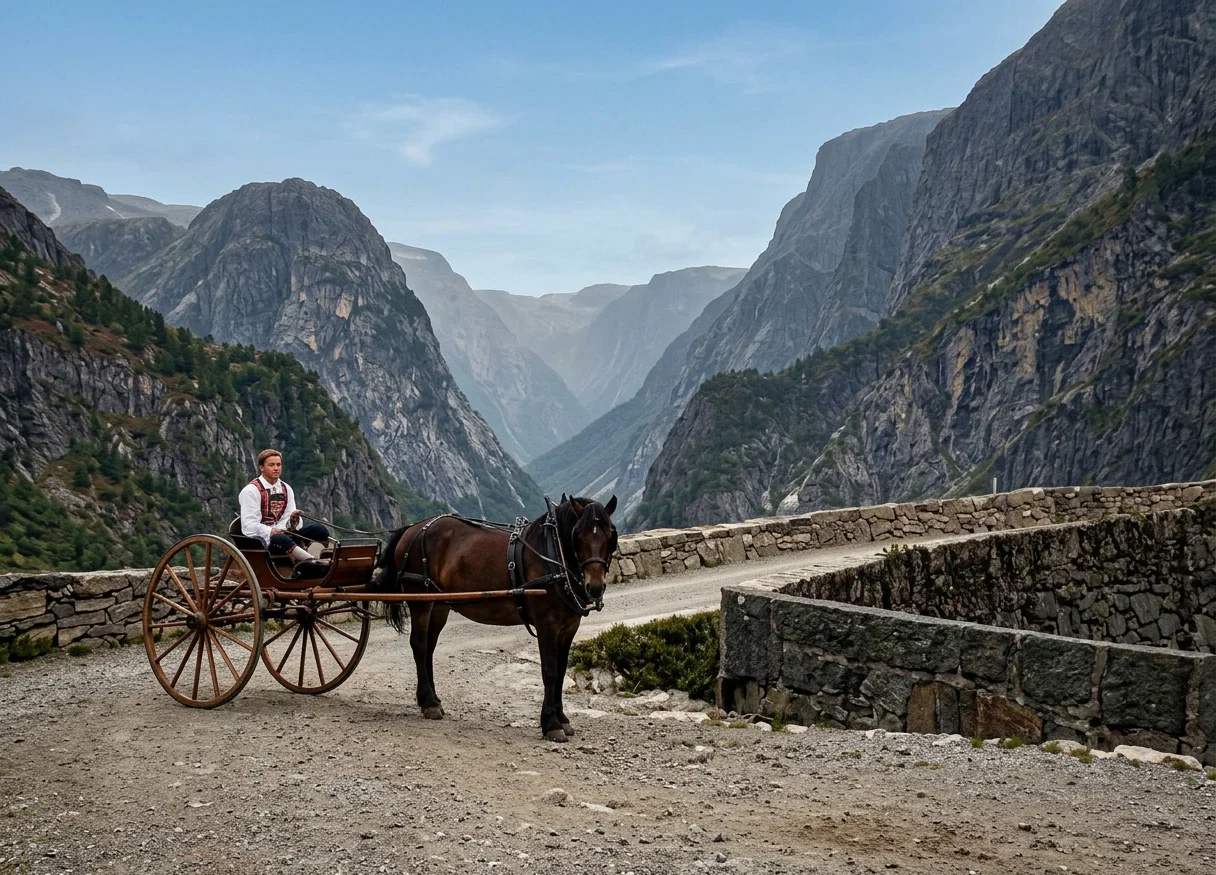
AMONG THE MOUNTAINS OF SWEDEN
Elder Irwin and the writer clearly set before the brethren what our people in America are doing for the work in Great Britain, and in all other parts of the world, and the efforts of the American churches seemed to be appreciated. The delegates passed a vote of thanks for this help, and pledged that they would do their utmost to co-operate with their brethren in other lands.
Elder O. A. Olsen was unanimously chosen president of the British Union Conference, and he enjoys the confidence of our brethren there. As Dr. Waggoner resigned the presidency of the South England Conference, Elder Olsen was unanimously asked to accept the presidency of that field until some one else be supplied.
The British Union Committee is composed of the presidents of the North England and South England Conferences, the directors of the Irish, Scotch, and Welsh mission fields, and the heads of the publishing house, the Caterham Sanitarium, and the school.
The British brethren have lifted nobly during the year in raising five thousand dollars for the Caterham Sanitarium, and there has been a noticeable increase in the tithe, especially of the North England Conference. The increase in membership is not so apparent, as statistics have not been given so accurately in the past; but it is now possible for the membership to be definitely stated, and we believe that the future will show a decided growth. Aggressive work has been planned for various other places.
Dr. Paulson spoke to the people each day, and his work was appreciated. All were pleased indeed to have the benefit of Elder Irwin's presence and counsel. The last Sabbath of the meeting was a good day, and the power of the Spirit of God was felt. The outlook for the work in Great Britain is very hopeful.
From this place, Brethren Irwin and Paulson and the writer went, via Hamburg, to the Danish Conference in Copenhagen, which was held June 9-14. There was a good attendance from the field, and a hopeful spirit prevailed. Elder P. A. Hansen was again elected president, and in view of his duties as chairman of the Scandinavian Union, calling him more or less into the general work, Elder J. C. Raft was asked to act as vice-president. Sabbath here was also a good day, and all the brethren enjoyed the good Spirit of God. We spent some time in considering the educational and the book work. The conference is entirely out of debt, and the tract society has paid half of its indebtedness to the Basel House. It was agreed that Brother L. H. Christian conduct a five months' institute in Copenhagen the coming winter, in connection with a course of lectures in that city. The Danish brethren realize the necessity of educating their young people for the cause of God.
At present we are attending the Norway Conference, and from here we intend to go to Nyhyttan, Sweden, where the Swedish Conference will be held June 22-28, and in connection with it, we shall have a council of the Scandinavian Union Committee. From June 29 to July 8 is the French-Latin Union Conference, in connection with the French-Swiss Conference, in Lausanne, Switzerland; and from July 9-19 is the German Union meeting at Friedensau. This will give Elder Irwin and Dr. Paulson an opportunity to get acquainted with the large union fields in Europe, and in turn, these fields will have the benefit of their assistance. While we would have been glad to have Elder Daniells with us during these meetings, yet we are thankful that the Lord has provided us with such efficient help and counsel, and above all, that we have had the presence of his good Spirit.
The outlook for the work in the European field is bright; but difficulties are not lacking. We daily remember our brethren in their general meetings in America, and hope that the Lord will give our people willing hearts, so that means may freely flow in for the support of the work in the regions beyond.

A Burning Shame

THE church of Christ, with forty millions of members in her Christian and Protestant communions, and with eight or ten millions of pounds sterling in the treasuries of British and American Christians alone, at the opening of the twentieth century of the Christian era, with all the couriers that God has put at her disposal, has not once yet carried the proclamation of her King to the ends of the earth; and there has not been one generation since Christ ascended, in which every human soul could be said to have had even one hearing of the gospel message. I solemnly affirm before God that this is a burning shame to the Christian church—that we have no right to talk about having done our duty, that we have no ground for indulging in the language of self-gratulation, that we have no right to speak of our fidelities, to dwell on our successes, or to think of the generosity of our gifts. This is all a most contemptible and contemptuous treating of the Lord our God. There is not the slightest practical difficulty in reaching the whole world—the race that now exists on this globe, the very generation of which we are forming a part—with the gospel, if the church would but awake to her duty.—A. T. Pierson, D. D.

Souls Perishing Without Christ

At every breath we draw four souls perish, having never heard of Christ.

Missionary Hymn

L. D. SANTEE
“For the Son of man is come to seek and to save that which was lost.” Luke 19:10.
“Go ye into all the world, and preach the gospel to every creature.” Mark 16:15.
O the lands that in shadow are lying, Where no gospel has ever been given, Where the heathen in darkness are dying, With groping hands reached up to heaven!
All the joys that may come on the morrow, By an echo of sadness are crossed; For my heart hears with infinite sorrow The pitiful cry of the lost.
I would go where strange islands are lying, In seas where the sands are of gold, I would tell them of Christ and his dying, And point to the Good Shepherd’s fold; I would tell them how sins are forgiven, Of redemption at infinite cost; I would tell them that Christ came from heaven To seek and to succor the lost.
I think, with a tender emotion, Of those that leave children and wife For the lonely lands over the ocean, That love the truth more than their life. ’Tis for this, they on wild seas are sailing, ’Tis for this, that the deserts are crossed. Ah, they hear in far lands the sad wailing, The pitiful cry of the lost!
They have gone to those lands in the distance, Their love casting out every fear, And they know there’s an endless existence To be theirs when the Lord shall appear. ’Twill be theirs to ascend into glory, With no more stormy billows to cross; For they’ve told to the world the glad story, And the gospel has gone to the lost.
Continue reading: Holland