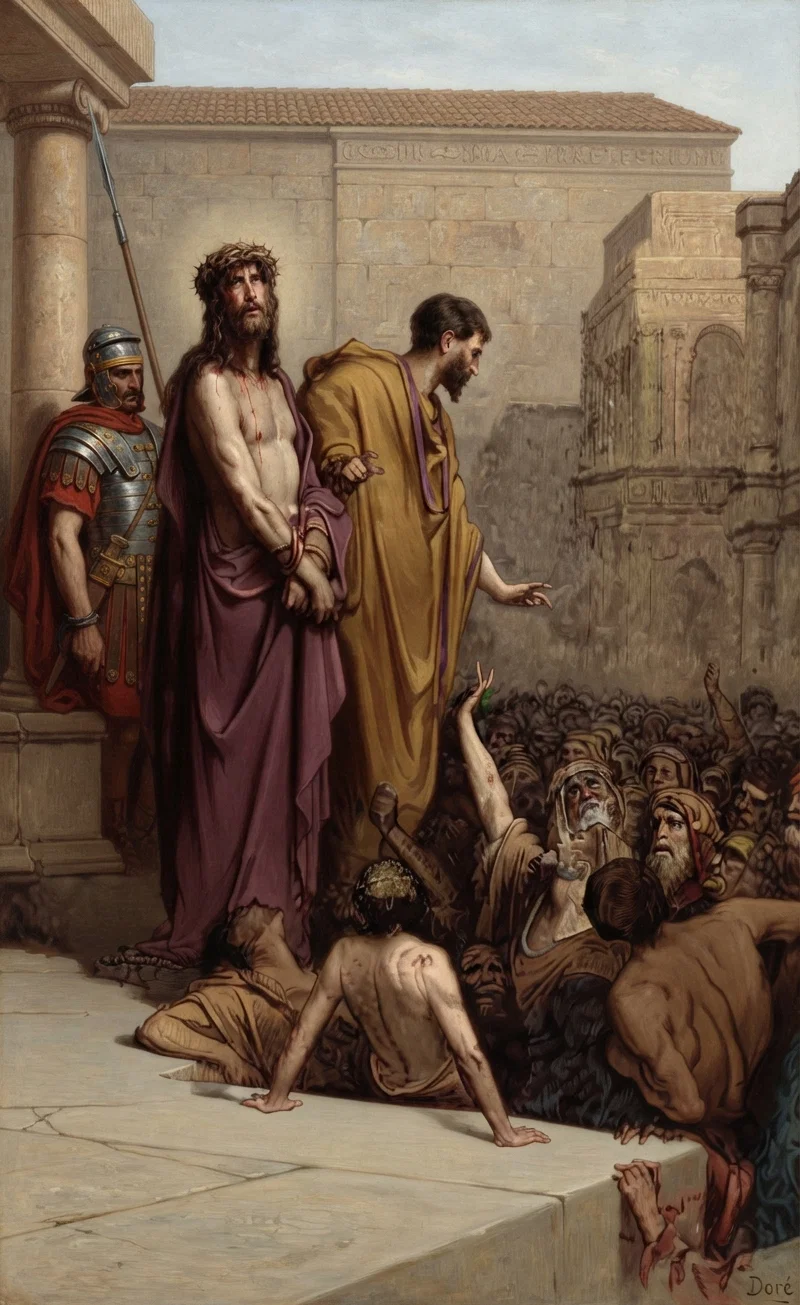
PILATE little knew the significance of these words as he spoke them to the angry mob that clamored for the Saviour's life. He had been warned not to have anything to do with that just man; and he believed him to be more than ordinary man; but all this did him no good. Pilate's confession is made by many at the present time—"I find in him no fault at all." We are too apt to see Jesus as the Son of God only, and to think of his spotless character during his earthly life as incapable of being marred by sin, and his being kept from the power of sin as something entirely independent of his own will. Thus, to many, Christ becomes a pattern after which we are to cut and fit; and since by all their cutting and fitting they do not succeed in making a perfect fit, they conclude that we are to do only the best we can. To such our Lord becomes an example which it is impossible to imitate, a model after which we can not fashion ourselves.
"Then came Jesus forth, wearing the crown of thorns, and the purple robe. And Pilate saith unto them, BEHOLD THE MAN!" John 19:5.
The latter statement is true. The cutting and fitting and the fashioning are not ours to do. The important part we must act is to "behold the man;" for "we all with open face beholding . . . are changed into the same image." 2 Cor. 3:18.
He was "declared to be the Son of David," "the Son of man," "the Man Christ Jesus." "For verily he took not on him the nature of angels; but he took on him the seed of Abraham;" being made like his brethren in all things, he suffered like them, and was tempted like them. See Hebrews 2. This and the preceding chapter present the mystery of the incarnation. The Son of God, who was above angel, seraph, and cherub, yea, equal with the Father, humbled himself to the estate of sinful man; and the angels, whose work it is to minister to man, were found ministering to him. "What is man that thou art mindful of him?" Being "the Son of man," he became heir to all the temptations and trials common to man, yet "with strong crying and tears" he looked unto Him that was able to save him from death, "and was heard in that he feared." Heb. 5:7.
Now we do not see the Son of God as the Creator, unacquainted with human wo and suffering, "but we see Jesus, who was made a little lower than the angels for the suffering of death, . . . that he by the grace of God should taste death for every man." He is one with us, and therefore he is not ashamed to call us brethren. He was made like us in all points, insomuch that he is touched with the feelings of our infirmities. The word "feelings" conveys much to the human mind. When we consider it in the light of our own experience, we are better prepared to comprehend its significance in the earthly life of the Son of man.
Perhaps we are unjustly treated in some way, and when thus wronged feel inclined to demand justice, but when we heed the instruction of Heb. 12:3,—"Consider Him,"—we are led to see that any and all such feelings are not in harmony with the Master's life and teachings. His persecutors envied him, and plotted to take his life, but he did not fear. They hated his followers, yet he sought the good of his enemies. He was insulted by the professed people of God, still he bore it patiently. And in their hatred they placed the cruel crown of thorns upon his innocent brow, and when they had smitten him upon the head with a reed, and spit in his face, they derided him, bowing the scoffer's knee. All this was done to him "who did no sin," yet he offered no resistance.
If the human mind, inflamed by meditating upon some real or imaginary injustice, could gaze upon the sublime scenes of Calvary, how often would our sorrows disappear behind the wo of the Son of man! Therefore "consider him that endured such contradiction of sinners against himself, lest ye be wearied and faint in your minds." "There's life in a look." This is how our hearts and minds are kept through Christ Jesus. Phil. 4:7. Thus he says to us, "Peace, be still," and there is a great calm. Trivial annoyances no longer provoke; but "looking unto Jesus" we shall endure "as seeing him who is invisible." May our prayer ever be, "We have no might against this great company that cometh against us; neither know we what to do; but our eyes are upon Thee." 2 Chron. 20:12. J. E. EVANS.
New Orleans, La.
DID CHRIST GIVE A NEW LAW?
By W. L. Iles
THE law of God, or the Ten Commandments, was once acknowledged by nearly all denominations as the eternal law of God for all time, the present dispensation as well as the past. The Decalog has been taught to the children in Sunday-school. These holy commandments have been the theme of many a gospel sermon. Churches have been decorated with a copy of the law of God. They have been pronounced "holy" by prophet, apostle, reformer, bishop, preacher, and the people. What a change has taken place! By ministers and laymen the law of God is called "the old law," "the law of Moses," "the Jewish law," and a "yoke of bondage." What is the cause of this change in the minds of the people? The law has not changed, but the people have. They see that the law very emphatically teaches that the seventh day is the Sabbath of the Lord, and they are prohibited from working on that day by the law. Rather than turn from their old way and keep the commandment, they prefer to cast reflection upon God's law, claim it was abolished by Christ, and a new law given to take its place.
Christ being a "prophet," and God speaking through him, all that he said had the authority of law. His life and teaching are an exposition of the moral law. If we follow him and obey his commands, we will keep the Ten Commandments. Suppose Christ did give a new law, where is the commandment in the new law that tells us to rest upon the first day of the week? It does not help the Sunday-sabbath cause in the least to claim Christ gave a new law, unless those who claim it can find a command enjoining upon us Sunday as a rest day.
Proposition.
All the new commandments given by Christ lead to the keeping of God's moral law.
1. "Think not that I am come to destroy the law." Matt. 5:17.
2. "Whatsoever ye would that men should do to you, do ye even so to them; for this is the law and the prophets." Matt. 7:12.
3. "A new commandment I give unto you, That ye love one another; as I have loved you, that ye also love one another." John 13:34.
4. "Go ye into all the world, and preach the gospel to every creature." Mark 16:15.
5. "And this is his commandment, that we should believe on the name of his Son Jesus Christ, and love one another, as he gave us commandment." 1 John 3:23.
If we will obey the first commandment given above we will have no trouble with those that follow. All the "new commandments" will not conflict with the law that Jesus says he came not to destroy. If we do not think that the law was destroyed by Christ, then we must think or believe the fourth commandment is still binding.
The second commandment given above is what is called "The Golden Rule." It is a rule which, if obeyed, would lead to the keeping of the last six commandments of the Decalog. It will not be obeying the commandment for me to do unto others as I would like to have them to do unto me. I must do to them as they should do (ought to do) to me. We should treat others, not as we would like to have them treat us, but as God would like to have them treat us. We must go to God's law to find out how God would have us conduct ourselves in relation to our fellow-men. No wonder Christ should have added "for this is the law." He that obeys The Golden Rule obeys that part of the law relating to man. He does his duty to his fellow-men.
Christ says, "A new commandment I give unto you." Does the new commandment lessen our obligation to keep the Ten Commandments? The children of Israel were commanded to love one another before they left Mount Sinai. Lev. 19:18. Christ's life upon earth was an example of love. The commandment was new because it was "love as I have loved you." In this new commandment Christ sets forth his life as our pattern, and what should be the measure of our love.
"Owe no man anything but to love one another; for he that loveth another hath fulfilled the law. For this, Thou shalt not commit adultery, Thou shalt not kill, Thou shalt not steal, Thou shalt not bear false witness, Thou shalt not covet; and if there be any other commandment [showing our relation to each other], it is briefly comprehended in this saying, namely, Thou shalt love thy neighbor as thyself. Love worketh no ill to his neighbor; therefore love is the fulfilling of the law." Rom. 12:8-10.
In the new commandment of Christ he simply commands us to love as he had loved, and as love is the fulfilling of the law of Ten Commandments, he commanded us to keep the law as he had kept it.
"Thou shalt love the Lord thy God with all thy heart, and with all thy soul, and with all thy mind. This is the first and great commandment. And the second is like unto it, Thou shalt love thy neighbor as thyself. On these two commandments hang all the law and the prophets." Matt. 22:37-40.
If all the law hangs on the two commandments, love to God and love to man, so long as we are required to love God and man, just so long will the law be binding. The first four commandments of the Decalog make requirements of us which will be obeyed, if understood, when we love God with all our hearts. The last six make requirements which will be obeyed when we love our neighbor as ourselves. Love to God and love to man is the fulfilling of the whole law.
In the command, "Go ye into all the world, and preach the Gospel," Christ recognized the law. The Gospel is "glad tidings" of salvation. Its purpose is to save people from their sins. "And she shall bring forth a son, and thou shalt call his name Jesus; for he shall save his people from their sins." Matt. 1:21. "Sin is the transgression of the law." 1 John 3:4. It is the transgression of the Ten Commandments. Rom. 7:7. If the law is abolished we have no need of the Gospel. If there is a Gospel to be preached, then there must be sinners, and if there is sin, there must be a law. The theory that the Jews had the law, and we have the Gospel without the law, is a false theory. The people of the old dispensation had the same law as a standard of righteousness, and the same Gospel that we have. "For unto us was the Gospel preached, as well as unto them." Heb. 4:2. "And the Scripture, foreseeing that God would justify the heathen through faith, preached before the Gospel unto Abraham, saying, In thee shall all nations be blessed." Gal. 3:8. Wherever you find the Gospel of Christ needed, there you will find sin; and where you find sin, there you find the law. "Go ye into all the world, and preach the Gospel," for the whole world, has transgressed the law and have need of the Gospel. The law points out the sin, the Gospel removes it.
We can enjoy the full benefits of the Gospel only as we believe in Christ. God is so much interested in our salvation from sin that he gave us the commandment, "Believe on the Lord Jesus Christ." Faith in Christ, or believing on Christ, establishes the law. Rom. 3:31. It is evident that all the new commandments of Christ, if obeyed, would lead to the keeping of the ten commandments.
W. L. ILES.
Phœnix, A. T.
"THE MOST HIGH RULETH." NO. 1.
THE Scriptures do not say that the Most High once ruled, or ought to rule, or will rule, or that men should use political power in order to set him up as ruler. The emphatic Word is that he "ruleth in the kingdom of men, and giveth it to whomsoever he will." Dan. 4 : 17, 25, 32. This always has been true since there was a kingdom of men, it is still true, and always will be true. "The Lord hath prepared his throne in the heavens; and his kingdom ruleth over all." Ps. 103 : 19. "He removeth kings, and setteth up kings." Dan. 2 : 21. These expressions show that the phrase "kingdom of men" does not confine God's rule in the earth to any one of the many earthly kingdoms recognized by men. It stands for all of them, for civil government as a whole, throughout fallen man's probationary state, for which time alone such government was instituted.7
That class of men who think the Almighty needs the help of human law to establish his authority in the earth would do well to remember these facts. There are a number of "reform" associations laboring under the delusion that men must in some way be compelled to observe "Christian usages" in order that the Most High may be able to rule in the kingdom of men. This delusion causes them much unnecessary trouble, and other people much unnecessary annoyance. It also causes many to be blinded to the real truth and work of the Gospel. Truly the Lord might ask these well-meaning but overzealous people the questions propounded to Job: "Where wast thou when I laid the foundations of the earth?" "Knowest thou the ordinances of heaven? Canst thou set the dominion thereof in the earth?" Job 38 : 4, 33.
God has, in various ways and at divers times, shown his ability to rule by might and power in a physical way, if that were his choice and ultimate design. The deluge in Noah's day, the confusion of tongues at Babel, the destruction of Sodom by fire, the plagues upon Egypt, the defeat of armies and the deliverance of his people by means peculiar to himself, are all in evidence as to his unlimited ability in this respect. But he has given incontrovertible evidence that his great object is a clean universe, including even the earth, ruled by means of his Spirit of love. His "long-suffering to us-ward" is not evidence of his lack of power or resources. "The longsuffering of our Lord is salvation." 2 Peter 3 : 15. The Most High has abundantly shown his power to rule in the kingdom of men in his own way, and at the same time carry on his wonderful work of grace, taking out a people for his everlasting kingdom who will choose to be governed by love. But he has not left man to devise the ways and means. "As the heavens are higher than the earth, so are my ways higher than your ways, and my thoughts than your thoughts." Isa. 55 : 8, 9.
It is a lesson that the professed followers of Christ should hasten to learn, that "all things work together for good to them that love God" (Rom. 8 : 28), and that what he has promised he is "able also to perform" (chapter 4 : 21). If this lesson were heeded by the professed disciples of the Lord, they would better understand the prerogative of God and the duty of following the example of Christ. Then would the world see a different manifestation of Christianity. They would see it in the fruit of the Spirit (Gal. 5 : 22, 23), rather than in efforts to secure compulsory laws. Then would the people of the world be more readily persuaded to become reconciled to God (2 Cor. 5 : 11, 20), rather than to be compelled to make an outward show of religion through the enforcement of human law.
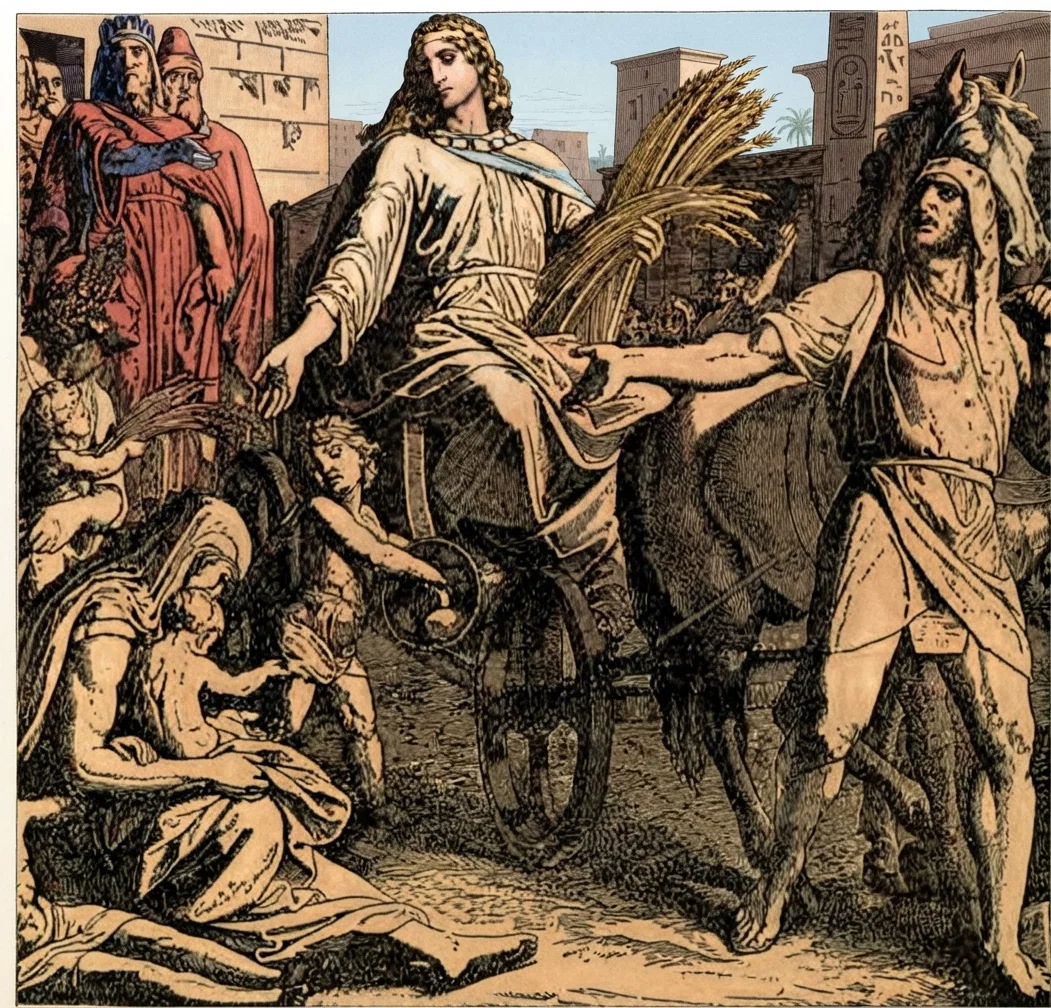
For the purpose of impressing this lesson, and calling to mind the one leading purpose of God in his dealings with the kingdom of men, let us refer to the inspired history, which was "written for our learning." Going back to the family of Jacob, we have the peculiar history of Joseph. Sold by his brethren in his youth, he became first a slave, then a prisoner, in Egypt, which was then the foremost government in the earth. From the prison Joseph was exalted to a position in which he was practically the ruler of the country. An extensive famine, the foretelling of which had been the means of Joseph's promotion, brought his brethren from Canaan to Egypt to buy corn. When they learned that the man with whom they had to deal was the brother they had sold into slavery, they naturally feared the punishment which they no doubt deserved. But Joseph was of a different spirit. He recognized that it was because the Most High ruled even in idolatrous Egypt that he was brought to stand next to the throne. So he comforted his brethren with these words: "Now therefore be not grieved, nor angry with yourselves, that ye sold me hither; for God did send me before you to preserve life. . . . Haste ye, and go up to my father, and say unto him, Thus saith thy son Joseph, God hath made me lord of all Egypt; come down unto me, tarry not." Gen. 45 : 5-9.
JOSEPH RULES IN EGYPT.
In after years, when there arose a king that knew nothing of Joseph, and cruelly oppressed the children of Israel, the Lord again showed that he "ruleth in the kingdom of men." He took Moses, who had been reared for the throne, and made of him a leader to deliver Israel from the bondage of Egypt. And God said to the king, who refused to let Israel go, "In very deed for this cause have I raised thee up, for to show in thee my power." Ex. 9 : 16. Heathen as he was, God had raised him to the throne. The Lord's power might have been shown forth to the king's honor, had he appreciated his privilege and been obedient to the One in whose providence he had been exalted. But as it was, the Lord's power was shown in his judgments, and in the overthrow of the king and his army in the Red Sea. "The Most High ruleth," whether men obey him or not.
When the Israelites had been safely delivered from Egyptian bondage, the Lord showed them further manifestations of his power and glory, notably at Sinai, where he appeared in awful majesty and rehearsed to them his law. Here they were organized into a government, of which God himself dictated the ordinances and regulations. His Angel accompanied them in person (Ex. 23 : 20; 1 Cor. 10 : 1-4), as they went forth to further demonstrate that "the Most High ruleth."
The only condition upon which his continual blessing was vouchsafed was obedience. By them he would have ruled all nations with whom they came in contact, had they been obedient to his Word. See Ex. 23 : 20-33. He gave them victory to the extent of their faithfulness. Not once did they win a victory of themselves; for when they were against God, he was against them in battle. His providence decided every conflict. As long as they were obedient he ruled in their favor; and when they turned after other gods, he gave them into the hands of the nations whose gods they chose to serve.
Never did he compel their service, but he allowed the consequences of their defections to come upon them until they would repent and turn to him for relief. Then he would again overrule in their behalf. He used faithful Israel as a means of executing his judgments upon those nations with whom he had long borne, but whose cup of iniquity at last became full (Gen. 15 : 13-16; Deut. 20 : 16-18), and of showing mercy to all others with whom they should have any dealings (Lev. 19 : 33, 34). On the other hand, he used the heathen nations as a means of chastening his own people when they proved rebellious against his authority. He chastens not to compel obedience, but as a loving reminder that the recreant one is going astray to his own hurt. See Heb. 12 : 6-11.
"God is love," and he doeth all things well. W. N. G.
A TRUE STORY OF ANSWER TO PRAYER.
By Mrs. S. L. Stout
HOPING it will inspire faith among us in God's promises, I write a remarkable answer to prayer as it was told me by a friend who heard it related by an aged minister at Wayne Chapel, near Dayton, Ohio. The minister still lives to vouch for its truthfulness.
In an early day Father Miller and his worthy wife were converted to primitive Methodism, and were known far and wide for their pious manner of living.
Owning large springs and prosperous milling interests for those simple times, it occurred to the man, then in his early prime, to erect a still-house as a means of faster increasing his worldly wealth, such things not being looked upon with the disfavor in those days that they are now. His devoted wife, in her closer communion with God, was strongly impressed with the evil of such a course, and set her heart to change her husband's mind by her arguments and entreaties. But all in vain. He remained firm to his resolve, and the lumber was sawed, and the work of preparation went on.
But, relying upon the promise of Him she had learned to trust, Grandmother Miller, the busiest of housewives of those very busy days, has since said that she "passed almost the fourth of every day in prayer-wrestling with God that in some way her husband's eyes might be opened to the magnitude of this terrible evil."
And just a few days before the building proper was begun, Father Miller dreamed that he died, and made admission for entrance at heaven's beautiful gate. The angel in charge looked on the book for his name, and he saw it registered there all right; but just then with one brush of his great white wing the angel erased his name forever from the record.
With a feeling of horror he awoke, and his mind was so impressed with his dream that his proposed still-house was abandoned and the lumber laid long upon the pile as a reminder of his great temptation. MRS. S. L. STOUT.
ONLY A LITTLE CRACK.
At first there was only a little crack in the marble coping of the temple roof. Into this the rain fell, and the frost, heaving, widened the crack. Dust gathered in it, and then a tiny seed, dropped by a flying bird. The tiny sprout swelled and swelled, making the crack still wider. Years passed, and the little plant became a shrub, its strong roots crowding wide the crevice, until the massive stone parted and fell from its place.
It was only a little thought at first, passing through the mind,—a little envy, lust of power, appetite, sensual pleasure. It came again, and found a tiny crevice in which to lodge. Silently, and unobserved, it drew to itself nourishment, and became more firmly fixed in the heart that cherished it. Gradually it sunk its roots deep into the heart, until, at last, it held the soul with a strong clasp, while its spreading branches overshadowed the whole life. In vain the victim struggled; what he could have so easily rooted out at first was now beyond his control. The noxious growth had mastered him, body and soul.
There is a line of the nearly-forgotten poet, Young, that deserves to be remembered:—
“Guard well thy thoughts,
Our thoughts are heard in heaven.”
He who habitually dwells in the region of noble and pure thoughts is removed from many temptations which beset the path of him who lives on a lower level. Miasmas do not infest mountaintops, and dwellers upon the highlands of obedience and purity are not endangered by a thousand ills that plague those who are yet lingering in the valleys of self-will and gratification. Come up higher into the pure air and sunshine of Christ’s presence. The life-giving breezes from heaven will give new vigor to your lagging steps, until service will be a joy, and the healing that is in his wings will leave no open wound for the lodgment of forbidden seed.—Evangel and Sabbath Outlook.
Love Because He First Loved Us
“We love, because He first loved us.”
Question Corner
By Editor
"Enquire, and make search, and ask diligently."
NOTE.—We wish those who ask questions to take particular notice: (1) Only such questions will be answered here as we believe to be of general interest and information. (2) We can not undertake to explain from four to a dozen scriptures, as in one sentence we are often requested to do. (3) Do not ask to "explain" a certain text or passage. State clearly the point in question. (4) Give full name and address, not for publication unless desired, but as evidence of good faith, and to give us the privilege of replying by letter if deemed best. (5) Unsigned communications of any kind find the quickest way to the waste-basket. (6) It is always well to inclose stamp. (7) "Foolish and unlearned questions avoid," also those that minister to mere curiosity. (8) Study the Scriptures yourselves.
No. 648. Three Days and Three Nights.
How SHOULD Christ's words be understood in Matt. 12:39, 40—"Three days and three nights"?
To answer briefly, they should be understood as the Lord would have them. "Consider what I say, and the Lord give thee understanding in all things," is a good Bible rule. 2 Tim. 2:7. Compare Matt. 12:40 with other texts referring to the same event, and which use the terms day and night. You will find, we are sure, that the expression "day and night" simply meant a day; that parts of days were counted as whole days, and that a part of the first and last of the days might not be included. Compare Luke 9:22; Mark 9:31; 10:32-34; Luke 24:20, 21. The words "heart of the earth" occur nowhere else in the Scriptures. Do they not mean the powers of earth, those of the earth, earthly? Our Lord was given into the power of the empire of earth when he was betrayed and arrested. See John 12:27 and Luke 22:53. Is it not reasonable to believe that here began the period of time designated as "three days and nights"?
No. 649. What Was in the Ark.
Was there anything put into the ark besides the Ten Commandments?
At one time there may have been. Heb. 9:4 seems to indicate that the rod of Aaron and the pot of manna were in the ark; but Ex. 16:34 tells us that the manna was laid "up before the testimony." See also Num. 17:10. The testimony was the witness of God's character against sin in the tables of stone. Ex. 25:16; 31:18; Deut. 10:2, 5. The book of the law, containing doubtless all the books of Moses, was placed "in the side of the ark of the covenant." Deut. 31:26. This could be spoken of as being in the ark. It is very reasonable to suppose that in the apostasies and reformations, in the backslidings and blindnesses of Israel, various changes took place in this respect.
No. 650. Forgotten Feasts and Sabbaths.
In Lam. 2:6 we find this expression, "The Lord hath caused the solemn feasts and Sabbaths to be forgotten in Zion." Please explain the above quotation, in fact, the whole verse referred to.
The whole passage is but a description of the Lord's wrath upon Jerusalem. When Judah would not serve God, God gave her up to her own delusions, the same as he will every one. Prov. 1:29-32; Isa. 66:4. Ezekiel says (20:24, 25): "Because they had not executed my judgments, but had despised my statutes, and had polluted my Sabbaths, and their eyes were after their fathers' idols. Wherefore I gave them also statutes that were not good," etc. Jeremiah told the Jews that if they would not keep the Sabbath and obey the Lord, Jerusalem would be destroyed, and the holy land would be desolate. Jer. 17:27; 25:11. The record in Lam. 2:6 is but a record of the fulfilment of this. Judah had "mocked the messengers of God, and despised his words, and misused his prophets, until the wrath of the Lord arose against his people, till there was no remedy." 2 Chron. 36:16. In other words, God took from them the blessings they despised. He suffered his "hedge" (Lam. 2:6, margin) to be taken away; the temple and its courts to be destroyed; the land was made desolate, and the solemn feasts and Sabbaths which it knew in its prosperity, were no more. The whole chapter is a picture of the desolation of Jerusalem and Judea because of her sins.
2 SAM. 13:39 reads: "He [David] was comforted concerning Ammon, seeing he was dead." How could David feel comforted when his son was killed?
While Ammon was alive, he was a source of anxiety to his father; but now that he was dead, David could do no more than to leave it with God, and be comforted in him. So he did with the child mentioned in chapter 12:15-23. As long as the child lived, he fasted and prayed, but when he could do no more, he left the matter with God, and was comforted in knowing that God doeth all well.
No. 652. Discoveries of Geology.
Do the discoveries of geology really conflict with the statement in God's Word that the world was created in six literal days, as scientists claim that they do?
All the true discoveries of geology do not really conflict with God's Word. The chief difficulties with geologists are that they discover many things that are not so, and make wrong calculations on what they do discover. All will admit that at some period or other the earth has been submerged; but geologists deny the universal flood in the time of Noah. The Word of God indicates that the changes at that time were both tremendous and universal. "The world [the cosmos, the arrangement] that then was, being overflowed with water, perished." 2 Peter 3:6. Not only were the flood-gates of heaven opened, but "the fountains of the great deep" were broken up. Gen. 7:11. The tremendous cataclysm changed the whole face of nature, heaved up mountain chains, buried forests, and melted the rocks. Sea became land, and land became water. Earthquake, fire, and deluge held high carnival; and changes took place in a day that geologists ascribe to millenniums. In simple reason when geologists differ from 350,000,000 years to 17,000,000 on the age of the earth, we still prefer to trust in the Word of God, of which "they willingly are ignorant." 2 Peter 3:5-7.
No. 653. Creation of Light.
WHAT was the light which God created before the sun and moon were made?
All light is from God. In what way it was manifest to the earth we know not. Doubtless the sun, moon, and stars were called into existence when the earth was, before the six days' work. But the light from these bodies did not pierce the dense clouds till the fourth day.
A TEMPORAL MILLENNIUM.
By G. W. Rogers
Will the World Be Converted?
1. MATT. 24:37: "But as the days of Noah were, so shall also the coming of the Son of man be."
2. Gen. 6:5: "And God saw [in the days of Noah] that the wickedness of man was great in the earth, and that every imagination of the thoughts of his heart was only evil continually."
3. 2 Tim. 3:1-5: "This know also, that in the last days perilous times shall come. For men shall be lovers of their own selves, covetous, boasters, proud, blasphemers, . . . unholy, . . . despisers of those that are good, traitors, . . . lovers of pleasures more than lovers of God; having a form of godliness but denying the power thereof."
4. 2 Tim. 3:13: "But evil men and seducers shall wax worse and worse, deceiving, and being deceived."
5. Matt. 13:30, 39: "Let both [wheat and tares] grow together until the harvest." "The harvest is the end of the world."
6. 2 Thess. 1:7, 8: "The Lord Jesus shall be revealed from heaven with his mighty angels, in flaming fire; taking vengeance on them that know not God, and that obey not the Gospel of our Lord Jesus Christ."
G. W. ROGERS.
Sioux Falls, S. D.
EVANGELIST MILLS' DEFECTION.
By Editor
DR. R. F. COYLE, of this city, recently preached a sermon on the "Lapse of B. Fay Mills," as he styles that once noted evangelist's change to Unitarianism. Of this action of Mr. Mills, Dr. Coyle said:—
"For some weeks past a good deal has been said and written about the new departure of the Rev. B. Fay Mills. Five years ago he held meetings in this city, which were attended by thousands. As a partial result of that special effort this church alone received an addition of 200 members on profession of their faith in Christ. We all remember with what warmth and fervor and positiveness, and with what a ring of conviction, Mr. Mills preached the Gospel at that time. But five years slip away, and, behold, we find this same man, this enthusiastic evangelist of former years, standing up in a Unitarian pulpit in Boston and saying, 'We leave the cross behind us.' He certainly has taken upon himself a fearful responsibility."
But the analysis of the step, as given by Dr. Coyle, is the point to which we would call attention, as it is probably the true one, and denotes the dangerous ground upon which many other ministers are standing to-day:—
"I feel quite sure that the lapse of the once famous evangelist was caused largely by a shifting of emphasis. How much the influence of Professor Herron and his school had to do with the unmooring of Mr. Mills we can not tell, perhaps a good deal; but we know that there came a day when he began to preach social salvation to the exclusion of individual salvation. He saw the corruptions of society everywhere, its evils, its injustices, its pitiless competitions, its utter disregard for the weak, its absolute need of purity and fraternity and righteousness if it
The Outlook
By Editor
"I will stand upon my watch, and set me upon the tower, and will look forth to see what He will speak with me."
AN ACKNOWLEDGED TRUTH.
In the prophetic word the Lord has very faithfully set before us the condition of the great professed Christian church in the last days. Apart from the fact that her backsliding and departure from God are foretold (Matt. 24:12-14; 2 Tim. 3:1-5), her divided state is expressed in various ways. Among the strongest terms used, indicative of her character in this respect, is "Babylon," the meaning of which is "confusion;" and confusion always comes from division. And the professed Christian church is certainly divided. We have the Greek Orthodox, the Roman Catholic, and the Protestant, hopelessly divided into many branches; and confusion worse confounded reigns in the chaos of religious beliefs, theories, creeds, politics, purposes, etc. Of one of the great threefold branches—Protestantism in America—the Independent recently thus spoke:—
"The division of our American Christendom is its sad reproach. Our Roman Catholic brethren never tire of declaring that they are Catholic, and that we who have inherited the unfortunate name Protestant are split into a hundred competing and conflicting sects. It is true that we are. Some of these sects recognize and fellowship each other in a limited way and others do not. Yet most of them are ready to admit that others beside themselves are true and regular Christian churches, and are willing to receive from them courteous messages at their national meetings. Yet these hundred and more denominations have no public, visible, formal bond of union; the Evangelical Alliance is hardly such. For all the world can see they are rivals, and such they very often are. They do not come together in towns, or cities, or counties, or States, or in the nature of affectionate fellowship and consultation. Their more Christian young people's societies may do so, but the churches do not. Now this attitude of scarce more than armed truce is simply wrong. It is a sin before God. It ought to be corrected."
If Roman Catholic prelates and priests studied the Bible and felt perfectly free to express their individual opinion of their studies, we presume they would differ as widely. They are kept together by a central power exerted through creed and anathema. But Protestants, having no central authority (for the Bible is such save with few, tradition and "science" being often preferred), divide and subdivide. There is a remedy for this division, but it will never come through the great churches. God would bring unity in his church by the everlasting Gospel, which bids us give glory to him instead of men. In the message of Rev. 14:6-12 is God's remedy for division. It unifies all who accept it.
Social Salvation Versus the Gospel
By William N. Glenn
is to hold together, and so entered upon a crusade to save society in the lump. Instead of continuing to preach the Gospel of a new life through faith in Christ Jesus he began to preach the gospel of a social law of righteousness. He came to the point where he seemed to ignore the fact that no high social law can be made operative without a life to back it up.
'From the Gospel Mr. Mills began to turn aside. He ceased to put the emphasis on the Fountain and devoted his energies to cleansing the stream. He gave himself to the fruitless task of painting the pump to purify the well. He slipped away from the necessity of the supernatural and divine, and became wholly absorbed in the human. From preaching Christianity he took to preaching morality, and as a consequence he has lapsed from the historic faith of the church of the living God.'
This "gospel of a social law of righteousness," this "social salvation," this "crusade to save society in a lump," has become almost a mania in modern religious zeal. From this source come many efforts to "cleanse the stream" by virtue of civil law and other human schemes. Mr. Mills is not by any means alone in the erroneous idea of wholesale social salvation, if he has, in advance of some of his former collaborators, arrived at the point of logical consistency where he could openly declare that he had left the cross behind him. W. N. G.