For three weeks we have had before us the study of the first chapter of Daniel. What is its lesson to us? for in behalf of us it is WRITTEN. "For whatsoever things were written aforetime were written for our learning, that we through patience and comfort of the Scriptures might have hope." Rom. 15: 4. The facts of the lesson were LIVED in the days of Daniel; they were RECORDED for the benefit of those who should come after — for those who live in "the time of the end." Dan. 2: 28, 29; 12: 4, 9, 10.
But what is the lesson? It was not written as a mere matter of history, to satisfy the curious regarding Daniel's early life; of the early life of the great Elijah we know nothing. It is not recorded for the mere temperance lesson and a record of a noble purpose. These are instructive. They are, in fact, about all the instruction which the chapter has yet furnished, and the lesson in this respect is precious.
But the lesson is larger than these. IT IS THE CONTRAST BETWEEN THE RESULTS OF TWO GREAT SYSTEMS OF EDUCATION, — the one system, the worldly, the Babylonian, showing at its best in the very height of Babylon's prosperity, with the learning, the opulence, the resources of a mighty empire at its back; the other, God's plan of education, a life rather than a system, manifested in seemingly one of the most discouraging times of earth's history. The people who had upheld that system were apostate, and in captivity to an imperious, haughty nation; the system (if so we may call it) was handicapped by its perversions in backslidden Israel, and hindered by the limitations and barriers of apostate, rebellious, and ubiquitously idolatrous Babylon.
The Babylonian education was manifested under the best conditions. The Biblical education was manifested in what to all human judgment were as low and mean conditions as it would be possible to exist in at all.
But behold the results: Four youths, whose early years were spent in war-ravaged and famine-stricken and utterly defeated Judah, surrounded on every hand by corruption and forbidden idolatry, yet doubtless having godly mothers and hearing the prophet Jeremiah, are placed in competition, so to speak, with the brightest and best young men from Babylon and surrounding countries. The Babylonian youths, many in number, were fed at the king's table, cared for by the king's most trusted servants. The young Hebrews lived in a strange land, were environed by the most untoward circumstances, cared for themselves, subsisted on a simple vegetarian fare of pulse and water ("starvation diet," it would be called by many), yet they surpassed all other students in knowledge and learning, and excelled all the king's counselors in wisdom and understanding. Is there not in this a lesson for the present?
Education To-Day
For what is the worldly educational system of to-day but Babylonian in principle? Let us note some of its most striking defects, recognized by many of the world's best and most earnest educators.
1. It is a one-sided education, in that it aims largely to develop the mental at the expense (not purposely or objectively) of the physical and spiritual. The "cramming" process is in vogue everywhere. Said Mr. Edward Bok, editor of the "Ladies' Home Journal," after careful investigation:
Do American men and women realize that in five cities of our country alone, there were, during the last school term, over sixteen thousand children between the ages of eight and fourteen taken out of the public schools because their nervous systems were wrecked, and their minds were incapable of going any further in the infernal cramming system which exists to-day in our schools? And these sixteen thousand helpless little wrecks are simply the children we know about. Conservative medical men who have given their lives to the study of children, place the number whose health is shattered by overstudy at more than fifty thousand each year. It is putting the truth mildly to state that of all American institutions, that which deals with the public education of our children is at once the most faulty, the most unintelligent, and the most cruel. — "Ladies' Home Journal," January, 1900.
Many others — physicians, teachers, and parents — could be quoted to the same effect. The system has not changed during the last decade.
2. It is, to a great extent, an unwise education from a purely worldly point of view. Of what earthly use, to mention but one item, is the effort to fill a child's mind with the tales of myths? Children labor for years to obtain a knowledge of that which is of no benefit in youth, and which at a later date, if it were ever needed, could be learned in a short time from a cyclopedia or a dictionary.
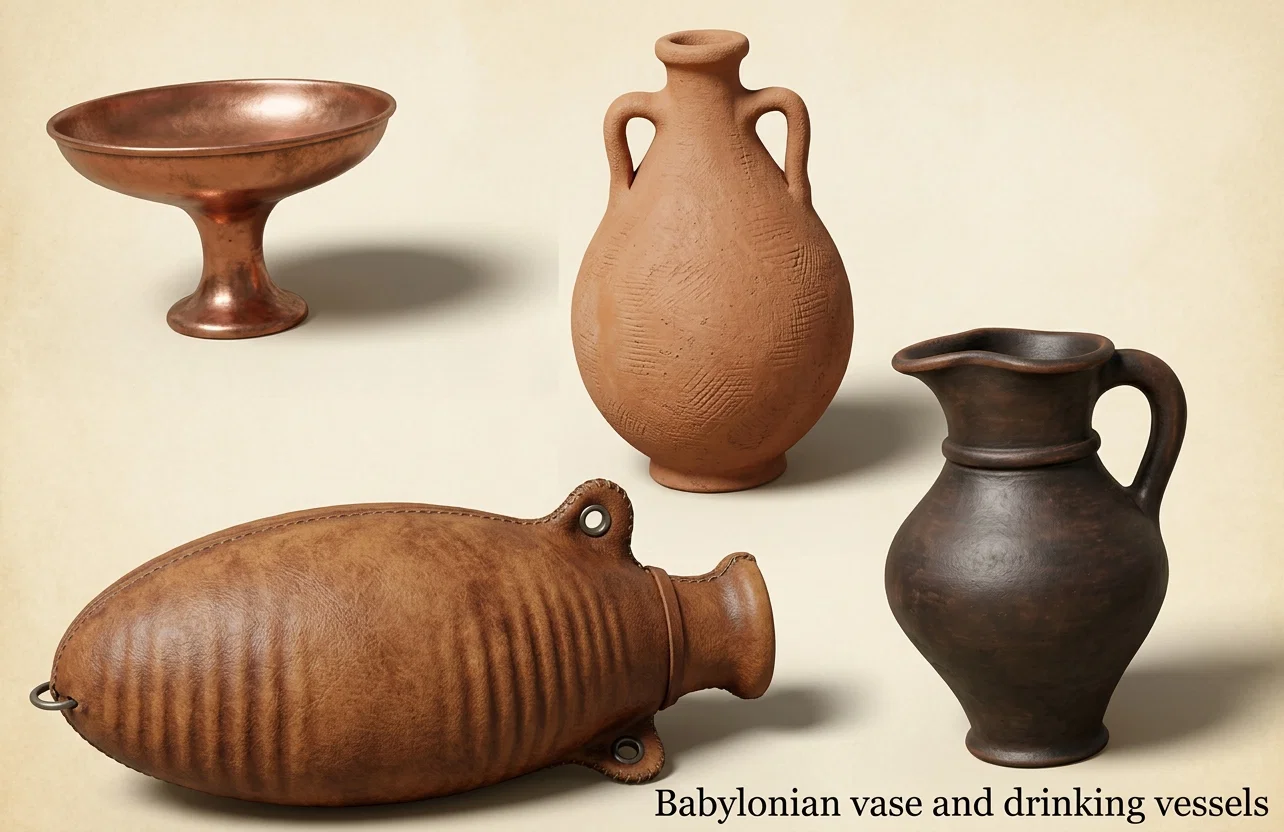
Babylonian vase and drinking vessels
Frequently the myths themselves are greatly perverted in adapting them to the child-mind and in omitting the salaciousness and obscenity of their characters; and even then the little one gets very deformed ideas of what is left. Fiction falls in the same category, perverting the judgment of the child with distorted and false views of life, unfitting him to discriminate between the false and the true, and fitting him to be one of those who make up the army of the worthless, or to fall among life's pitiful tragedies.
It is conceded that there are many who think that the study of fiction with other things of use will assist in developing imagination and discriminating judgment on the part of the child, but the conception is false. The same ones would not, in educating their children in art, continually keep before them a mixture or blending of the beautiful and ugly. They would not, in their musical education, continually have sounded into their ears a jargon of concord and discord. Eye and ear in such an education would lose the power to discriminate. Even so the child-mind, with its fertile imagination (which needs no feeder), needs to be educated in absolute truthfulness, as far as its parents or guardians can conceive. Let the standards of judgment, of taste, and of morals, be of the highest. The man who knows the ring and the features of the genuine, can discern the counterfeit.
3. The education of the day is wrong in that it does not develop the INDIVIDUAL. As Harold E. Gorst expresses it in the "Nineteenth Century and After":
Thousands of young men and women are turned out every year by our schools and universities upon an exact pattern, like sausages from a Chicago factory. Each is provided with precisely the same stock of knowledge, and consequently the market becomes overcrowded with an enormous number of workers all trained to perform the same set of functions.
Mr. Gorst speaks truly; and the effects of the education are seen in the multitude of graduates from one school or another who are utter failures. But in God's method of education there will be developed in the individual all the possibilities of his received talents and ability. The boy will not be considered as a fraction of a class, but an individual soul, having before himself alone in this sphere the complex problem of life to solve — not alone for the present, but for eternity. And the educational effort will be, not to pass "courses," not to obtain certain meaningless letters to attach to one's name, but to develop men and women, sons and daughters of the Most High, here and hereafter.
4. The worldly system of education leaves the moral and religious side of the child's nature untrained. We presume that the great majority of the readers of this article believe in a hereafter. This life is temporal. Beyond it lies eternity. What that eternity is to be to us depends on the characters we form here. The majority of those who will read this are doubtless believers in the Bible as containing the revealed will of God, the Guide-book to the better world. And yet the sad fact is that almost no attention is given in present-day education to the training for that life that measures with the life of God; and ignorance of the Bible is well-nigh universal. The child's body is fed and clothed. His mind is crammed with every dish of the mental menu of our wonderful school system; but the spiritual faculties, which equally need and demand instruction, are left to starve and die; and the result is the present conscienceless immorality of commercialism and the wide-spread skepticism of the day.
Defects in Education
The remedy for these deplorable results is a properly balanced education — a religious education which shall take into account the self-evident fact that a religion, to be of worth, must possess the whole man and be a motive power in every act of his life.
All this, in a dim sort of way, is recognized by many. In an editorial on the "Sources of Corruption," the "Independent" of January 17, 1901, declares that "the wickedness and bribery and wholesale stealing from taxpayers for the benefit of the few lies almost wholly at the doors of men who move in what are called the 'well-to-do' or 'exclusive' circles. It lies at their doors to-day, and it has lain there from the beginning of human government."
These men are those who have received education in the schools of their country — an education lacking in what the "Independent" calls "the training of the satisfactions." It further says:7Who will show us how to make children learn from actual experience that duty, truth, and honor yield the only satisfactions that stay with us? His will be an educational philosophy worth talking about. When its clear, dry light arises in the moral firmament, the paths of wisdom will be easier to follow than they are at present, under the dancing will-o'-the-wisps of "free election," and the moonshine of "pedagogy," both of which too often make worldly success look like the only thing worth living for.
In its issue of May 30, 1901, the same journal, under the heading of "Gospel of Wealth," refers to the address of Mr. Charles M. Schwab, president of the United States Steel Corporation, before two hundred boys in a trade school in New York City, and who sets forth himself as "an example of the rewards of right living;" to the address of John D. Rockefeller, the Standard Oil magnate, to a Bible class of young men, in which he lauded his pleasure of doing good in employing seventy thousand men; to Mr. Andrew Carnegie's book, "The Gospel of Wealth," and asks:
What is the effect on the public of this "Gospel of Wealth"? What is the influence of these men of vast fortunes, who, on several occasions, have stood forth as examples of right living?
Apart from the means of getting this wealth, assuming them to be entirely legitimate, the "Independent" answers:
This influence tends strongly to degrade the common morals. Let them amass their wealth; let them enjoy all the material good this earth permits; let them exert their power for weal or for woe in the markets of the world; but in the name of all that is good and precious to the human heart and imagination, let them not be set up before our young men as the great models of conduct to be imitated. . . . There has been wealth in the land before now; but the riches of these men is so colossal as to obtain an entirely new force. It acts with hypnotic influence on the imagination; it benumbs the senses; and in its vast glitter the eyes are blinded to all the simpler and purer attainments of life. . . . We are stricken down by these men with a delirium of material drunkenness, and they allow us no escape from its fascination.
It is all true, and its spirit dominates popular education everywhere. The education of the world has not protected us from wealth's engulfing tide; and now that it has assumed the throne, it will not save us from slavery to its imperial demands.
A Sense of Need
The remedy, the only remedy, is right education and training in religious lines from infancy. As one has expressed it, "The whole man must be educated; the whole man must be trained." This training must be from the Bible. And men feel this. Professor Huxley, skeptic tho he was, felt it. This is what he says:
I have always been strongly in favor of secular education, in the sense of education without theology, but I must confess I have been no less seriously perplexed to know by what practical measures the religious feeling, which is the essential basis of conduct, was to be kept up, in the present utterly chaotic state of opinion on these matters, without the use of the Bible. The pagan moralists lack life and color, and even the noble stoic Marcus Antonius is too high and refined for an ordinary child. . . . By the study of what other book could the children be so much humanized and made to feel that each figure in that vast historical procession fills, like themselves, but a momentary space in the interval between two eternities, and earns the blessings or the curses of all time, according to its effort to do good and hate evil, even as they also are earning their payment for their work?
Dr. Lyman Abbott has voiced the same thing in the "Outlook," and declares that the State should teach the Bible as the history of a people and a religion. But this will not do. It must be taught as it was taught to Daniel and his fellows — as the eternal living truth. Taught in this way, souls will see its glorious beauty. They will see God's hand in history, molding and shaping the nations of earth, despite sin. They will see God working in nature despite the curse. They will long for His creative and regenerative power in them. They will learn how to obtain it. They will see true worth to be more than wealth, faithfulness more than fame, ingenuousness more than ingenuity, purity more than mere power,
character more than coin, the service of God and to mankind more than to be served of Him and to rule His creatures. And O, how minds wide open on the Godward side will expand! In every branch of true science, in every useful occupation, they will excel; and this world will see again, in modern Babylon, as in Babylon of old, that those taught of God in "every matter of wisdom and understanding," are "ten times better" than mere secular teaching can produce. Men are needed. This is the education which will make men. It made one man THEN that served grandly as prime minister under Babylon's greatest monarch, and was called to the same post and as effectually served under the succeeding Medo-Persia dynasty, because he served his God; and if parents will return to God's method of education, trusting in that alone, unwarped, unpermeated by heathen or medieval tradition, or by an infidel science, it will again make men more precious than the golden wedge of Ophir, or the combined wealth of the world.
The first chapter of Daniel is God's object-lesson in education, with the world's education at its best and His education at the worst, with the comparative results. Who will heed the instruction and be taught of God?
Christian Patriotism
PATRIOTISM, according to the common use of the word, is a species of selfishness. If I should hold myself or my possessions up to be lauded above any other person or any other person's possessions, no one would doubt that I had a selfish motive in view. So when I hold my country up as the one to be always sustained, right or wrong, there is in such action the element of selfishness.
According to the common idea of patriotism, it was just as much the duty of the Spaniard to uphold Spain in the war with the United States as it was the duty of the American to uphold the cause of this Government. But there were Christians, professedly at least, on both sides, and this common idea of patriotism made them enemies, seeking to kill each other.
Therefore the theory of patriotism as taught in our public schools, and even in Sunday-schools, would teach Christians of different nationalities to take one another's lives, if their governments should go to war. This may be patriotism; but any one who has the most rudimentary knowledge of Christianity, knows that such patriotism is not Christian. Sowing discord among brethren is one of the things the Lord hates. Prov. 6: 16-19.
Christian patriotism acknowledges allegiance to the kingdom of Christ. Christians are debtors to men of all nations. They are subject to "the powers that be" in all nations, with the exception that they are "to obey God rather than men." They are not to set governments against governments, nor to take sides in the conflicts of the world.
The Spirit enjoins us: "Thou therefore endure hardness, as a good soldier of Jesus Christ. No man that warreth entangleth himself with the affairs of this life; that he may please Him who hath chosen him to be a soldier." This is Christian patriotism. "And if a man also strive for masteries, yet is he not crowned, except he strive lawfully" — according to the law of God: "Thou shalt love the Lord thy God with all thy heart, and with all thy soul, and with all thy mind," and "thou shalt love thy neighbor as thyself." The Christian is a warrior for God, against the common enemy of God and man; but, like his Master, he is to labor to save men. This is Christian patriotism. — William Newton Glenn.
Our Bible Reading
His Coming Literal, Personal, Visible
1. How literal was Christ's going away from this earth after His first advent?
And when He had spoken these things, while they beheld, He was taken up; and a cloud received Him out of their sight. Acts 1: 9.
2. How closely did the disciples watch Him while He was going away?
And while they looked steadfastly toward heaven as He went up, behold, two men stood by them in white apparel; which also said, Ye men of Galilee, why stand ye gazing up into heaven? Verses 10, 11.
3. What promise was given to the disciples as they were thus gazing so intently at their ascending Lord?
This same Jesus, which is taken up from you into heaven, shall so come in like manner as ye have seen Him go into heaven. Verse 11.
4. What other text shows that "this same Jesus" will come literally and personally?
For this we say unto you by the word of the Lord, that we that are alive, that are left unto the coming of the Lord, shall in no wise precede them that are fallen asleep. For the Lord Himself shall descend from heaven, with a shout, with the voice of the Archangel, and with the trump of God: and the dead in Christ shall rise first; then we that are alive, that are left, shall together with them be caught up in the clouds, to meet the Lord in the air: and so shall we ever be with the Lord. Wherefore comfort one another with these words. 1 Thess. 4: 15-18.
5. How bright will the glory of the coming of Christ be?
For the Son of Man shall come in the glory of His Father with His angels; and then He shall reward every man according to his works. Matt. 16: 27.
When the Son of Man shall come in His glory, and all the holy angels with Him, then shall He sit upon the throne of His glory. Matt. 25: 31.
Wherefore if they shall say unto you, Behold, He is in the desert; go not forth: behold, He is in the secret chambers; believe it not. For as the lightning cometh out of the east, and shineth even unto the west; so shall also the coming of the Son of Man be. Matt. 24: 26, 27.
6. What are some of the texts that speak definitely of the people seeing the Lord when He comes?
And then shall appear the sign of the Son of Man in heaven: and then shall all the tribes of the earth mourn, and they shall see the Son of Man coming in the clouds of heaven with power and great glory. Matt. 24: 30.
Behold, He cometh with clouds; and every eye shall see Him, and they also which pierced Him: and all kindreds of the earth shall wail because of Him. Even so, Amen. Rev. 1: 7.
Bibles for the Heathen
"As YE have done it unto heathen men and women who would walk five, fifteen, and thirty miles to secure a copy of the Bible but can not get it, so have ye done it unto Me, shall the Master say."
What Christ's Coming Means to the Earth
By C. P. Bollman
For thus saith the Lord that created the heavens; God Himself that formed the earth and made it; He hath established it, He created it not in vain, He formed it to be inhabited: I am the Lord; and there is none else. Isa. 45:18.
THAT God's original purpose concerning this earth will be carried out, and that it will finally become the home of the redeemed race, holy in character and loyal to their Creator, none can doubt who believes the testimony of divine inspiration. But this side of the time when the earth shall be filled with the glory of the Lord, it must pass through the purging fires of the day of God.
The curse of sin rests heavily not only upon man, the actual sinner, but upon the earth itself, the home of man. To Adam the Lord said, "Because thou hast . . . eaten of the tree, of which I commanded thee, saying, 'Thou shalt not eat of it: cursed is the ground for thy sake; in sorrow shalt thou eat of it all the days of thy life; thorns also and thistles shall it bring forth to thee; and thou shalt eat the herb of the field.'" Gen. 3:17, 18.
The apostle tells us that not only man but "the whole creation groaneth and travaileth in pain together until now," awaiting "the redemption of the purchased possession." Rom. 8:22; Eph. 1:14.
As our characters must be transformed, and our vile bodies be changed and fashioned after His glorious body (see Phil. 3:21), so must this earth be renovated and made new before it can be "filled with the knowledge of the glory of the Lord, as the waters cover the sea." Hab. 2:14.
Two Burning Days
There are two burning days, or times, spoken of in the Scriptures, each of which contributes something toward the cleansing of the earth from the human guilt which now rests so heavily upon it; one of these is at the beginning of the day of the Lord, and the other at its close. In the first of these times of burning, the surface of the earth is broken up, and the world is depopulated, leaving it a dreary waste without human inhabitant. The second burning day visits with the second death all the wicked, they having been raised from the dead, and melts the earth with "fervent heat," thus purifying it alike from the last trace of sin and from the presence of sinners.
We learn from Rev. 20:4-6 that the day of the Lord covers approximately a thousand years, for there is an interval of one thousand years between the resurrection of the righteous and the resurrection of the wicked. (See Rev. 20:5.) There is the same interval approximately between the first and the second burning day. Of that which befalls the earth at the beginning of the thousand years that separates the two resurrections, the prophet Isaiah says: "It is the day of the Lord's vengeance, and the year of recompences for the controversy of Zion. And the streams thereof shall be turned into pitch, and the dust thereof into brimstone, and the land thereof shall become burning pitch." Isa. 34:8-10.
The Earth Depopulated
Of the same time another prophet says: "I beheld the earth, and, lo, it was without form, and void; and the heavens, and they had no light. I beheld the mountains, and, lo, they trembled, and all the hills moved lightly. I beheld, and, lo, there was no man, and all the birds of the heavens were fled. I beheld, and, lo, the fruitful place was a wilderness, and all the cities thereof were broken down at the presence of the Lord, and by His fierce anger. For thus hath the Lord said, The whole land shall be desolate; yet will I not make a full end." Jer. 4:23-27.
In Dan. 2:34, 35 we are told that in the end of this world all earthly kingdoms become "like the chaff of the summer threshing-floors," and the wind carries them away, that no place is found for them. This probably refers more to the governments and people than to the territory which these kingdoms occupy. We know, however, from other texts, that at this time the earth itself will be more or less broken and burned.
The prophet Joel tells us that "the earth shall quake; . . . the heavens shall tremble: the sun and the moon shall be dark, and the stars shall withdraw their shining." Joel 2:10.
The Heavens Pass Away
The apostle Peter says that "the day of the Lord will come as a thief in the night; in the which the heavens shall pass away with a great noise, and the elements shall melt with fervent heat, the earth also and the works that are therein shall be burned up." 2 Peter 3:10. But the same apostle adds, "Nevertheless we, according to His promise, look for new heavens and a new earth, wherein dwelleth righteousness." Verse 13.
These texts reveal the fact that the coming of the Lord, or in other words, the day of the Lord, not only brings utter destruction to the earth, but at its close it likewise brings complete restoration to its Eden glory and perfection. When the earth came fresh from the hand of the Creator, He "saw everything that He had made, and, behold, it was very good." Gen. 1:31. "Whatsoever God doeth, it shall be forever," says the preacher; "nothing can be put to it, nor anything taken from it." Eccl. 3:14.
The Earth Not to Be Destroyed
God formed the earth not for destruction, but that it might be the abode of a race of beings loyal to Him and to the principles of His government. Satan attempted to defeat the divine plan by compassing the fall of man. But Christ redeemed not only man but the earth also, and will finally restore it to its original purity and beauty, and make it the eternal home of the redeemed race. As it was once given to the first Adam, so it will again be given to the second Adam. "And Thou, O Tower of the flock, the stronghold of the daughter of Zion, unto Thee shall it come, even the first dominion; the kingdom shall come to the daughter of Jerusalem." Micah 4:8.
We have read the assurance given us through the apostle Peter that "according to His promise" this will certainly be even so. Our Saviour, quoting from the 37th Psalm, said, "Blessed are the meek: for they shall inherit the earth." The psalmist adds this assurance,—that they shall "dwell therein forever."
A Vision of the New Earth
In the vision given him upon the isle of Patmos, the beloved John saw the earth as it will appear when purged from sin and sinners, and given again to man redeemed from the curse. Relating his vision, the seer of Patmos says:
I saw a new heaven and a new earth: for the first heaven and the first earth were passed away; and there was no more sea. And I John saw the holy city, New Jerusalem, coming down from God out of heaven, prepared as a bride adorned for her husband. And I heard a great voice out of heaven saying, Behold, the tabernacle of God is with men, and He will dwell with them, and they shall be His people, and God Himself shall be with them, and be their God. . . . And there came unto me one of the seven angels which had the seven vials full of the seven last plagues, and talked with me, saying, Come hither, I will show thee the bride, the Lamb's wife. And he carried me away in the spirit to a great and high mountain, and showed me that great city, the holy Jerusalem, descending out of heaven from God, having the glory of God: and her light was like unto a stone most precious, even like a jasper stone, clear as crystal. . . . And the city had no need of the sun, neither of the moon, to shine in it: for the glory of God did lighten it, and the Lamb is the light thereof. And the nations of them which are saved shall walk in the light of it: and the kings of the earth do bring their glory and honor into it. . . . And there shall in no wise enter into it anything that defileth, neither whatsoever worketh abomination, or maketh a lie: but they which are written in the Lamb's Book of Life.
Human language is impotent to add to this God-given description of the glory and beauty of the renewed earth and of its capital city. "Eye hath not seen, nor ear heard, neither have entered into the heart of man, the things which God hath prepared for them that love Him."
We speak of the realms of the blest,
That city so bright and so fair,
And oft are its glories confessed;
But what must it be to be there!
But let it be borne in mind that it is prepared only "for them that love Him;" all others perish in the purging fires of the great day.
The Kingdom of Heaven Within
By H. A. St. John
By H. A. St. John
The kingdom of heaven within me lies
If Jesus in me has His abode;
And He will bring in the grace I prize,
And reign in this mortal kingdom of God.
And then I'll willingly open my hand
And share with my fellows the gifts I prize;
With love and delight will my heart ex-
pand
When the kingdom of heaven within me
lies.
It is in my heart, by Christ made fair,
That I first crown Jesus the Lord of all;
And if I do not thus crown Him there,
I never will crown Him Lord at all.
If the kingdom of heaven in me abide,
In the law of the Lord will I delight;
And then nevermore will my footsteps
slide,
For Jehovah will order them all aright.
Sanitarium, California.
The Wonders of God's Word
By James Hamilton
THE Word of God is solid; it will stand a thousand readings; and the man who has gone over it the most frequently and the most carefully is the surest of finding new wonders there.—James Hamilton.
The Hunger and Thirst for World Empire
By A. O. Tait
By A. O. Tait
BABYLON reached the height of her glory and strength in world dominion and grandeur in the days of her greatest king, Nebuchadnezzar. This king believed that the gods of his empire had rendered him invincible, and he would not rest content till every petty kingdom on earth had acknowledged him as the great king over all.
When the king of Babylon had laid all the world in tribute at his feet, he strolled forth amid the costly and glittering palaces of his great capital to meditate upon his own majesty and power. On all sides of him were the massive works of his empire. His capital city was one of the greatest that earth had ever seen. Her walls, her gates of brass, her world-famed hanging gardens, were the pride of his heart. He had built, in honor of his favorite god, one of the most majestic buildings that had ever enshrined the breathless image of any heathen deity. And while surveying all these imposing works, and feeling secure in his overweening power, he found a vent for his high-tension feelings in the words, "Is not this great Babylon, that I have built for the house of the kingdom by the might of my power, and for the honor of my majesty?"
Babylon gave to the world a mighty and brilliant example of universal dominion. She left her impress upon the world so strongly that each of the three nations that immediately succeeded her would not rest content until they like Babylon of old had obtained world dominion. The most celebrated of the Grecian kings is said to have even wept, when he had conquered the world, because there were not more worlds to conquer.
The influence of Babylon has been permanent, otherwise the vision given to John would not have shown her as a symbol of the power that would reign in the very closing moments of time. Over and over again in the book of Revelation is Babylon mentioned as a symbol of the great active power of the very last days. The old nation of Babylon as such had long passed away when John wrote the Apocalypse, and he knew that it was so. But there had been implanted in the minds of men principles that would endure till the end of time. And hence, as his language clearly shows, John used her as a symbol of the proud-hearted, ambitious powers that would struggle for world dominion among the last generation of men.
Babylon fittingly represented the splendors, the pride, the vanity, and the despotism of the nations of this earth. Satan had said in his heart, "I will ascend into heaven, I will exalt my throne above the stars of God: I will sit also upon the mount of the congregation, in the sides of the north: I will ascend above the heights of the clouds; I will be like the Most High." Isa. 14:13, 14. And in the hearts of Babylon's kings he had implanted his doctrines and principles as he had not, perhaps, been able to implant them anywhere else. He had determined to be "like the Most High," and this meant to usurp the prerogatives of the Deity and enshrine himself in the minds of men instead of Jehovah.
Babylon, then, had an invisible tutor to inspire her with a determination to rule every individual in all the world. The arch-enemy who had said in his own heart, "I will be like the Most High," was seeking to spread the principles of his kingdom among men by leading them to impersonate his ambitions. When Satan said, "I will be like the Most High," that was equivalent to saying, I will be the object of worship, and will set the God of the universe to one side. The idea seems preposterous, but there is no avoiding the conclusion that to be "like the Most High" is to become an object of worship.
Hence we find the idea of worship, of domination in religious matters, a basic principle in the despotic sway of Babylon. Throwing the three Hebrew children into the fiery furnace, and Daniel into the den of lions, was done to test the relative power of the gods of Babylon and the great Creator that the Hebrews worshiped. World dominion in matters of religion was at the very foundation of spreading the dominion of the State into every part of the world. Many of the bloodiest battles that were fought were for the purpose of showing that the gods that had been adopted by Babylon were more powerful than any gods that could be brought against them.
This idea of the supremacy of the national gods was perpetuated among the nations that arose on the ruins of the old Babylon. In fact the succeeding nations borrowed or inherited their ideas from the Babylon which had gone before and marked out the way. Not that this idea originated with Babylon; but the person who had said, "I will be like the Most High"—I will be an object of worship myself—had brought his ideas of counterfeit worship to a higher degree of endorsement and acceptance than ever before. Time and experience had enabled the great adversary of all true worship to advance toward his demonic perfection as the days advanced.
Medo-Persia succeeded Babylon, and she in turn was succeeded by Greece. And in each of these great kingdoms were these same ideas of world dominion in worship carried out. But it remained for the empire of Rome to succeed Greece and bring the system to its height of perfection. Rome built herself into empire strongly. She remained at the height of power for several centuries, and it took her several other centuries to decay and crumble into ruins.
Rome permitted the peoples in different parts of her great domain to worship the gods that seemed most to their liking, but these must first be placed in the catalog of gods that it was permissible for a Roman citizen to worship. To worship a god that was not endorsed by the Roman State, was one of the most reprehensible crimes.
Coming down the centuries, the idea had been gaining in strength that men who had done mighty deeds, particularly in battle, were gods upon earth. And hence these men would be apotheosized, or placed in the calendar of the gods. This system of making gods out of human beings was brought to a zenith in the noontime splendors of the power of the empire of Rome. A blazing comet (supposed by modern astronomers to have been Halley's) appeared in the heavens at the time of the death of Julius Caesar, and it was seriously believed to have been a heavenly chariot sent to take the soul of the departed emperor to the abode of the gods.
It was the Roman emperor who stood at the head of the religion of the empire. He was the pontifex maximus, the supreme head of religion as well as the supreme head of the State. In his person both of these high offices were blended. And thus do we see that a religious despotism has been the foundation of all the great despotisms of history. Sometimes kings went to war to test the strength of their adopted gods. If they succeeded, their gods were with them, and were very powerful; if they failed, it was because their gods were too weak or too indifferent to save them.
Real tyranny, despotism, has false ideas of religion at the bottom of it. Men to-day will curse the czar of Russia for his tyrannies; but it is not the czar as a civil ruler that is a tyrant. It is the tyranny of the church Russia is under that is the cause of all her sufferings of despotism. And regardless of all the object-lessons of the past and present, men seem to be determined to try over and over again the experiment of compelling uniformity in matters of worship, and to make this a fundamental principle in the State.
Last week a number of prophetic scriptures were given, showing that this idea of a world-wide religious despotism is to be a great feature of the last generation of men. Satan will make his supreme effort to delude men in this respect as one of his last great strokes.
We have seen in the foregoing paragraphs how the nations of antiquity have tried to dominate the minds of men in matters of religion, and that the empire of Rome borrowed the system from Babylon, and perfected it. In a succeeding article or two we will follow this system as it developed into the "Holy Roman Empire," and see how, in harmony with the prophetic texts given in this department of the paper last week, the foundation is already strongly laid for the great religious despotism that will mark the close of time, and call for the second coming of Christ to put an end to it.
"I Have Never Refused God Anything"
By Florence Nightingale
If I could give you information of my life, it would be to show how a woman of very ordinary ability has been led to God in strange and unaccustomed paths to do in His service what He has done in her.
And if I could tell you all, you would see how God has done all, and I nothing. I have worked hard, very hard, that is all; and I have never refused God anything.—Florence Nightingale.
Human Imperfection
"A VEIN of imperfection runs through all human achievement."