The Danube Union Conference has not yet completed the first quarter of its history. Although the field was organized in July, 1912, up to December 31 it composed a part of the East German Union.
The Danube Union embraces the Transylvania and Middle Hungarian Conferences, and the West Hungarian, North Hungarian, Theiss-Save, Adriatic, Roumanian, and Bulgarian Missions. In all these fields we have a fair beginning. Our force of workers is almost sixty.
The canvassing work has also developed well, especially in the Middle and North Hungarian fields. A beginning has also been made in Roumania. Our Budapest branch house of the International Tract Society of Hamburg has closed its first year with a net gain of several hundred crowns. We are very thankful for this. In 1911 our colporteurs sold about 7,000 crowns' worth of tracts and books. In 1912 we reached almost 30,000 crowns.
It was my privilege to visit Roumania the beginning of this year. I first visited our company of believers in the city of Ploeshti, where we were disturbed by the priests last November while holding our yearly conference. Since then we have secured a new and very convenient hall, and are happy to say that our enemies have quieted down. On one occasion, several weeks ago, a priest came to one of our public meetings and denounced the Word of God, but his own people led him out, with an apology, asking us not to be angry, as the priest had probably been drinking a little too much and in consequence did not know exactly what he was about.
The experience we had here last fall resulted in benefiting the work of God. After the priests had routed our meetings, a number of the leading journals took our side and defended us. This brought the truth before the people, and many became acquainted with our work. In the city of Bukharest we now have two churches and a company, almost 200 members in all.
In a village near the city of Braila, a young man accepted the truth. The priest of the place, on hearing of it, caused the brother to be led out into the street in the middle of the village, where, before a great crowd of people, he strongly accused him. Finally the brother was commanded never to read the Bible again, but instead to come to the priest's house, where he would receive better and more useful books from the priest's private library. The young man, however, defended his position bravely, and declared that he would read no other book than the Bible, as that alone had brought peace to his soul. He was finally released, and went his way rejoicing. Our brethren in this country, although a great many times pressed by the enemy, are steadfast in the truth and meet their conflicts bravely.
I am sorry that the new outbreak of hostilities between Turkey and the Balkan States has made it impossible, at least for the present, for me to visit Bulgaria and Servia. However, Brother C. Motzer, the superintendent of the Bulgarian Mission, writes that they are slowly but surely gaining a foothold in different important parts of that field. All our workers have received permission from the government to canvass, even those who are not natives of Bulgaria.
In general, our work is making progress in our great field. The workers are all of good courage, and are pressing forward. Next quarter we hope to be able to give some figures showing our progress. We ask the people of God to remember us before the throne of grace.
Budapest, Hungary.
Hastings, Barbados, West Indies
By E. C. Widgery
E. C. WIDGERY
AFTER a four weeks’ trip, I have just returned home to Barbados, having visited St. Lucia, St. Vincent, and Trinidad.
In St. Lucia we have three small companies, who are of good courage and moving onward. Here we have to do some mountain climbing, and our sleeping accommodations are sometimes hard, at times being a plank. Still we are repaid in seeing the eager faces and in knowing there are honest hearts even on mountain peaks. The three companies are spreading the message even in this priest-ridden island.
Then we visited St. Vincent, where we have a small church building, and about twenty-five honest persons scattered over the island. They need a worker, as there are opportunities for a good work.
We then went on to Trinidad to the conference. The meetings were good. The Spirit of God was manifestly present.
The Lord has been blessing and is continuing to bless the work here in Barbados. Our tithe last year was over $700, our annual offering was about $50, and our Sabbath-school offerings were over $120. This is encouraging when we remember that we have so many poor members who find it difficult to obtain employment.
We have devoted much time during the past year to the general uplift of the work. There has been a systematic house-to-house work done, with good results. We have now a number of interested persons preparing for baptism, nine of whom will go forward the coming Sabbath.
You will be glad to know the medical work has made rapid advancement also. Dr. Cave has had a busy season, and has been able to build a treatment-room and equip it with all up-to-date appliances, electric-light bath included. The whole is a credit to the cause, and he has a good patronage.
We have been appointed to take charge of the East Caribbean Mission field and shall leave here about February 13 to take up our new work. Our address will be St. Thomas, Danish West Indies. We are of good courage and pressing on.
German Victoria Nyanza Mission
By L. R. Conradi
L. R. CONRADI
While our British Mission occupies the northeastern half of the lake, the German covers all the southeastern, and of late has extended its field seventy miles southeast of it into the Wasakuma country. Four years ago the work was started in this field, and though we had some adversities at first, yet the work has recently developed well.
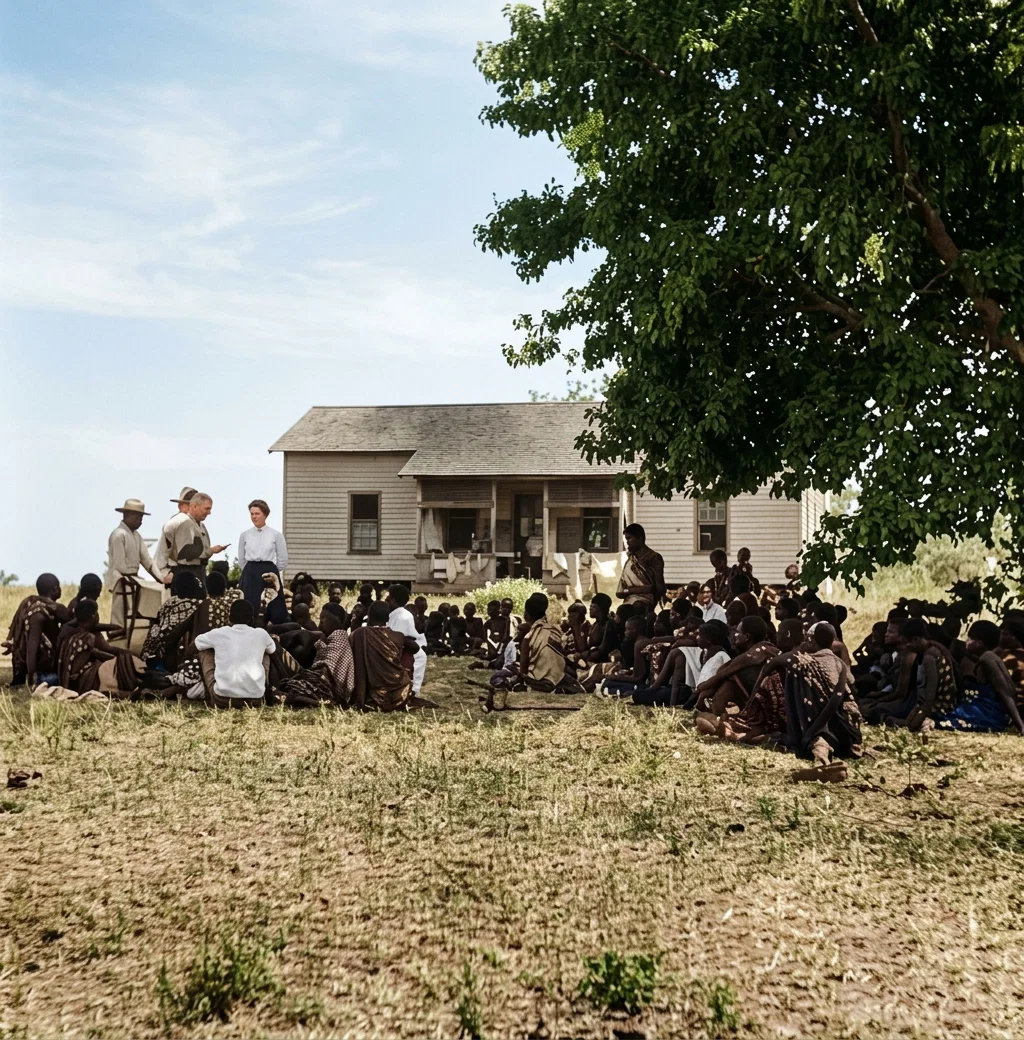
Leaving Karungu on the night of December 9, we reached Schirati, the German government station and port, by noon of the next day. Here we had a good visit with the secretary of the district, and then left in the afternoon, but did not reach Nyabangi, on the Mara Bay, until the next afternoon. As the Mara Bay goes many miles inland, and the main part of the district lies to the south of the Mara River, the German government has decided to put its district headquarters south of the Mara Bay. We saw a number of the new buildings on our way in; our station lies about three miles to the east of the headquarters, as the Catholics have an old mission site on the other side of the new government station. Brethren V. Toppenberg and E. Dominick are located here, and they were just about finishing the new dwelling-house at the station. The school is conducted under a large tree near by, about one hundred fifty pupils being enrolled. We remained here all day, December 12, preparing for our overland trip. During the day we visited the school and talked to the natives through an interpreter.
Early next morning we started out for the Busegwe station, which we reached after six hours' march. The people of this country, the Wasenaki, fearing the inroads of the Masai, have put their huts almost entirely out of sight. Nature rather favors them in this, as all over13the country we found the hills covered with large rocks, forming natural fortresses. We could see the station from afar, and the bell located on the tower of the adjoining hill was ringing in welcome of our approach. As we came close to the station itself, we found about two hundred boys all lined up, and the sultan and his whole staff; the drums were beating, and we were greeted with a rousing Nyambo, or the native “How do you do?”
KIDZU STATION AND PREACHING SERVICE
One of the first things we saw at the station was the grave of our faithful Brother Raessler, who laid down his life, and whose good wife later had to leave on account of the blackwater fever. Elder J. Persson, of Sweden, and his good German wife, have since taken charge of the station, and have made excellent headway. Several of the brethren addressed the natives. Brother E. Kotz could talk to them in the Swahili, which is the government language throughout the country. In the afternoon service I had the privilege of speaking to about three hundred, the schoolhouse being packed with people. We were especially pleased that six bright young men of this people were ready for baptism, and came to the general meeting at Majita. Early the next morning the young sultan accompanied us quite a way on our journey. He is deeply interested in the gospel.
Another eight hours’ march brought us to Kidzu, on December 15. This station is located on a high hill which can be seen from the lake. Dr. F. W. Vasenius and Brother O. Wallath are the workers here. They have a good dwelling-house finished, and the school is also under roof. They have about one hundred fifty students, of whom one fourth are girls.
On the sixteenth, the sultan came with his retinue, and listened attentively while I preached the gospel to them. As we had a three days’ trip from here into the Wasakuma country, it was necessary to secure about thirty native porters, while Brother A. A. Carscallen took his eight Kavirondos with him, so that we were, all together, nearly fifty. Dr. Vasenius thus far finds that the natives are rather shy in securing medical aid, especially if they have to pay something in return.
But gradually they are learning the advantage of a Christian doctor over the heathen medicine-men. On account of heavy rains we were unable to start before three in the afternoon of the seventeenth. Our path descended into a great plain, traversed by several rivers. In the distance we could see the range of hills—the aim of our next day’s trip. As the sun was setting, we pitched our two tents, the natives lighted the camp-fires, and after a hearty meal, we retired for the night. Traversing the plain the next day, we saw game of all sorts. After a good day’s march on the eighteenth, we camped for night near some government huts at important crossroads. The cheapest way of feeding such a large number of porters is to purchase a bullock of the natives, which costs us about two dollars and a half, while the hide will bring us nearly half of that when it is sold. There is but little to be had, besides the native flour, and the bananas and sugar-cane which may be found near the lake. The cane is generally rather expensive as compared with the meat.
On the nineteenth we marched another seven hours, and then reached the well-settled Wasakuma country. We pitched our camp in among the many villages. The rocks near by were covered with conies. The Wasakuma people are chiefly herdsmen and agriculturists. They number about one hundred seventy thousand. Ours is the chief Protestant mission among them now. The Catholics have occupied about one half of the territory. Next morning, before we started, a German ex-captain, who is in charge of mining interests, came up with his caravan. He was making the trip overland from the Cape to Alexandria. On Friday, the twentieth, about noon we reached Ntussu, where we met Brethren Kallenhauser, Palm, and Schurich. They had put up a good workshop, and were just finishing a good hut, where we were located during our stay. As there is no timber in the Wasakuma country, we have to bring the heavy timber from Nairobi. We hope that by the end of 1913 not only will Ntussu be finished, but also Kanage and Magala and Itilima. Soon after our arrival, Brethren Seiler and Munzig came up from Itilima, where they are erecting the first huts.
On Friday evening and Sabbath Brethren Dail and Kotz and I spoke to the natives. Brother Abrahamu, our native teacher of the Pare Mission, who accompanied Brother Kotz, also addressed all the natives at the different stations. They listened with great interest to his story of how he was converted from heathenism to Christianity, which he told them in fluent Swahili.
As the Wasakumas are busy on their farms, it will not be so easy to get a good start among them, but some boys are already preparing for school, and they proudly brought their slates and pencils with them, even some of the sultan’s children being present. The gospel does not yet exist in this tongue, nor does any other literature; but our workers are putting in hard strokes to get a good knowledge of the language. In view of the extent of this district and its distance from Majita, the headquarters, it was decided that one of our best missionaries in the Pare District, who is to be ordained soon, should come here and take charge of it.
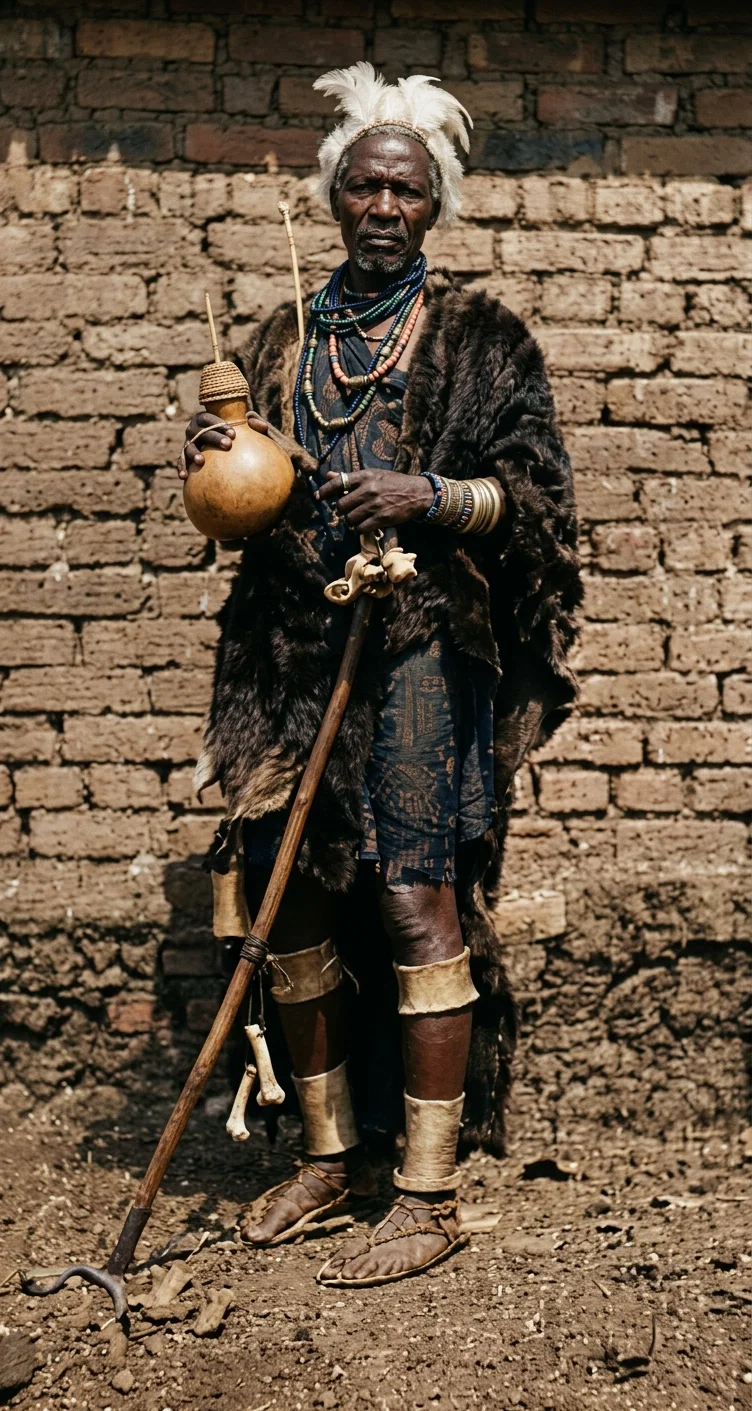
A HEATHEN MEDICINE-MAN AT WIRE HILL
It is a wonderful sight as one travels for days over vast tracts of land in the very heart of Africa to see nothing but native huts, no European building of any sort, except here and there, as light towers in the midst of heathen darkness, well-put-up Seventh-day Adventist mission stations. Let us remember the work among the Wasakuma people as well as among the Kidzu and Wasenaki.
Meet Trials with Smiles
“THANK God for the man who is cheerful
In spite of life's troubles, I say;
Who sings of a brighter to-morrow
Because of the clouds of to-day.
His life is a beautiful sermon,
And this is the lesson to me—
Meet trials with smiles, and they vanish;
Face cares with a song, and they flee.”
The Dumb Can Sing!
By Helen Adair
HELEN ADAIR
The dumb, sad spirit of the year has been cast out!
A joyful sprite now fills the earth with his glad shout.
Not satisfied with songs that he himself can sing,
He seizes children, birds, and fowls, and everything,
And teaches them to join him in his glad refrain.
He clothes him in his glorious, shimmering robes again,
And decks himself with diamonds, emeralds, and pearls;
Like conquering hero, silken banners he unfurls,
And scatters gifts among the crowds that throng his way;
His strength is so renewed he works both night and day;
His transformation is so great and so complete,
Like Jacob’s name, his name is changed to one more meet:
It rhymes with happy sounds—like wing, and sing, and ring—
We call him now, instead of Winter, gladsome Spring!
A Sabbath on a Sheep-Ranch
By Augusta C. Bainbridge
AUGUSTA C. BAINBRIDGE
“Are your chores all done, Ella?”
“Yes, mother, everything done but turning out the cows,” said a cheerful voice from the back porch.
“Where is Katie?”
“Here I am, and such a race as those colts gave me. If I had not been riding Dolly, I could not have corralled them. But they are safe now. Guess how many eggs I got to-day!”
“Fifteen?”
“No, seventeen, and three missionary eggs besides.”
“Well, girls, supper is all ready, and if father and George were here we could easily have it all over before sundown.”
“Let’s sing until they come. O, how nice it is to have the house so spick-and-span clean,” said Ella.
“All right, girls, you begin. I shall go to the lookout, and if they have not turned the hill, we shall have time for prayers before they get here,” said mother as she walked out to the end of the porch and mounted the platform that led to the roof of the wood-shed.
“I never like prayers while the sun is shining, and mother is in such a hurry on Sabbath evenings.”
“Yes, I know, Katie, but if we have prayers before they get here, we are sure to have them, but if we wait for the men to come, sometimes we have them and sometimes we can not. You remember the crowd that came in last Sabbath evening.”
“Not a hoof in sight, girls,” said mother. “We shall read and pray first, and then we can sing until they get here.”
“What blessedness! and it is sundown now,” said Ella, as they sang the dear familiar hymns that so often had marked the opening hours of the blessed day.
“By the way Topsy is barking somebody is coming.”
“Sure enough, here are father and George, and three men with them, and their dogs and a band of sheep. What does it all mean?” said Katie. “Well, I’m glad we had prayers after all, for it helps me to be patient when these cross-grained things come. More plates, more bread, more supper all around, more dirty dishes, more beds—no, they have their blankets, so they will sleep in the barn. Now I must not say nor think a cross word when mother is so patient over it, and I must not let Ella do it all,” soliloquized Katie.
Morning came all too soon to the tired family after the hard work of the evening. Breakfast for all hands must be served early, and the sheep be started by daylight, so they can cross the river and get their breakfast on the green flat beyond before they coil for their noon-time rest.
“Never mind, Katie,” said Ella, as they gathered up the breakfast dishes, “we shall have that much more time to ourselves after they are all gone.”
The bleating of the sheep, the barking of the dogs, the shouting of the men, the galloping of the horses, and all the various noises incident to releasing a band of sheep and getting them started on their way, were dying away in the distance. Quiet was settling down on the home, and Bibles were out ready for morning worship.
A horseman was heard riding back toward the house. Supposing it was a herder coming back for a few home-loving sheep who objected to being taken away from familiar surroundings, no one looked up. The clanking of spurs on the porch said plainly that some one was wanted.
“Mother, Hillis says he will ride over with George and me to Heron’s place, and we can see about the roan heifer and those other strays. Can you put us up a bit of lunch?” said father.
Willing hands cut the bread, wrapped the sandwiches, wiped the apples, hunted the drinking-cups, and soon the saddle-bags were filled, and rider and horse were off on their way again.351
From “All that dwell below the skies” to “Dear old Duke Street” was, with organ and voices, filling the room with its rich melody and soul-uplifting thoughts, so that no one heard the “Yo-ho! yo-ho!” that would have called one to the door, and saved all from the start when father burst into the room, saying:—
“What’s the matter with you folks? Are you all deaf? Hand me my red pocketbook. I’ll come back through town and get those things. My list is in there.”
Mother always knows where everything is, and nobody can resist her smile, so “Too bad to bother you again” was the gentle apology that prefaced another good-by, and away he went, crossing the river at the upper ford so that he could overtake the others on the flat.
Duke Street was out of the question now. Nothing seemed to fit this case but “What various hindrances we meet.”
“How can mother be so calm, when I should like to kick something?” whispered Katie.
“Sh!” said Ella. “You’ll feel all right by the time we reach the last stanza.” And so she did, and she rejoiced that—
“Satan trembles when he sees
The weakest saint upon his knees,” for she said in her heart, “O Lord, that weakest saint is I.”
It did not take long to tidy up the house and dress for the Sabbath service. Sabbath-school lessons were recited in the dining-room, all seated around the table where concordance and Bibles lay ready for reference if texts other than those given in the lesson were needed for fuller explanation.
It was Katie’s turn to review, and mother taught the lesson. Angels drew near, and the Holy Spirit sealed the words on open hearts as the passages were read or recited. To study the good Book is to appreciate it.
“May we read out under the big tree to-day?” asked Ella. “We will carry the chairs and papers out.”
“Yes, dear, I know of nothing to hinder,” said mother.
“What about Lambert and Mike?” asked Katie.
“Their supplies are in their sacks on the back porch, where they always find them when we are away. They are both marked, so there will be no trouble about that.”
“How I do wish they did not come on the Sabbath,” said Ella.
“I do not think it will be so much longer. I was talking to father about it the other day. He says it is an old ranch custom here, and the shepherds from the far-off camps expect to come in for their mail and supplies on Saturday. I told him that we should like to give the poor fellows a hot home dinner when they come in. It must be very monotonous to eat their own cooking every day, and that cooked over a camp-fire.”
“That will be a nice change for them and for us, too,” said Ella. “It takes mothers to solve problems, doesn’t it?”
The Signs, REVIEW, and “Christ’s Object Lessons” constituted the reading for the morning, each one reading a longer or shorter article as seemed appropriate. “Christ in Song” furnished words and tunes for the songs their hearts sang, and the noon hour came all too soon.
The Sabbath meals were light in this home, easily served, and quickly cleared away.
Then came the missionary meeting. Letters received during the week were read. All joined in prayer and council, seeking wisdom and light, that God’s plan might be followed in answering these and in deciding what literature to send next. The little tract case in the corner was searched for the best that would fit each letter. Twenty copies of the Signs were prayerfully wrapped, addressed, and laid in their place to await the stamping on the first day of the week. Some time remained before sundown, and it was spent in various ways in harmony with the day, ending in a short walk to a favorite spot where nature’s God had “made his glories known.”
Father, George, and Hillis came back just as they were preparing for Sabbath closing, bringing the roan heifer and other stray stock with them. This meant supper for them all as soon as it could be prepared. George started off for the cows, while father and Hillis did the other chores.
“When we leave our burdens with God, he always does something to make it easier,” said Ella, trying not to be disappointed because she had missed the quiet sunset service she loved so well.
“Would you mind, father, if I should ask George and Hillis to stay a little while,” said mother, “we have not had prayers yet?”
“No, no, go ahead, it will do the boys good,” cheerfully answered father.
“And will you read?” added Ella.
“Yes, daughter,” said father, “you find the place for me.”
“That wonderful one hundred seventh psalm never sounded so grand to me before,” said Katie, as they later prepared for bed. “It seems as if father is really coming to the Saviour when he reads the Bible. He reads so well, and he brings out the sense so clearly. One can tell just what the meaning is by the tones of his voice.”
“Yes, indeed, but best of all, I love to hear him say ‘Our Father’ with us after mother prays,” answered Ella. “He surely can not be far from the kingdom, in spite of his queer ways. Let us keep on praying for him.” “Good night.”
Chatsworth, Cal.
Training the Tongue
By Mary H. Williams
MRS. MARY H. WILLIAMS
“Out of the abundance of the heart the mouth speaketh,” and, conversely, of its poverty remaineth silent. James speaks of the tongue as an unruly member; and while it requires much training with bit and bridle, may we not forget there is sometimes need of ‘whip and spur’? What of the laggard tongue, so slow with its word of appreciation or merited praise that when it arrives it falls cold and lifeless; the mulish, obstinate tongue that balks till the opportune time for presenting a truth has slipped by; or the cowardly tongue that remains discreetly silent when it should declare boldly for justice and truth?
We should apply both lash and spur when the tongue is backward in acknowledging a mistake or confessing a wrong. While it is most praiseworthy to refrain from mentioning another’s faults, who is able to go to the offender privately and seek “in the spirit of meekness” to restore such a one? The wise man commends him who bridles his spirit. To maintain dignified silence under a taunt may even provoke the tormentor to greater efforts, while the tongue trained to return the “soft answer” not only turns away wrath, but wins a friend. The first is peaceable, the second a peace-maker.
If we picture the unbridled tongue as scattering firebrands of speech, we see the need of training the tongue to act quickly to stay the conflagration. If we possess a well-stored mind, it is not so difficult to stay the gossiping tongue, and turn the conversation into safer channels. Happy is he whose kind heart and ready tongue come quickly to the relief of embarrassment. Open-hearted friendliness can seldom go amiss; for it completely disarms diplomacy and deceit. The honest heart with no ulterior motives to conceal, vanquishes craftiness and cunning with its sincerity and truth.
We may dread the inquisitive tongue, yet what seems to us mere prying may often spring from a truly sympathetic heart. A little training in tactfulness and the possessor has that rare gift which draws the wounded heart to him in the sure confidence of ready sympathy and help. On the other hand, a little halting, a little delay while we select the proper vehicles of speech, and we have missed the one chance to say a word of kindness, sympathy, or love; and these are the words, which, like the gentle rain and dew, flow back to the fountain of the heart, supplying the abundance,—an abundance that overflows continually with brotherly kindness. Then while we cultivate the graces of the heart and mind, let us not fail to train the tongue; for “a word fitly spoken is like apples of gold in pictures of silver.”
Charles City, Iowa.
The Noon-Hour Prayer
“Evening, and morning, and at noon, will I pray, and cry aloud: and he shall hear my voice.” “And the Lord turned the captivity of Job, when he prayed for his friends.”
D. L. Moody once said, “Promise—prayer—performance—these are the three links in the chain of blessing.” If the middle link is missing, we have no right to expect the fulfilment of the promise or the privilege of enjoying the blessing.
Requests for Prayer
170. An afflicted brother who has been under treatment for eight months desires prayer for healing.
171. A Florida sister requests us to pray for the restoration of her hearing, and that she may be healed from neuralgia; also that her sister may regain her health.
172. A sister in Maine asks prayer for restoration to health.
173. An isolated sister in California desires us to unite in prayer for her healing.
174. “Please pray that I may be healed,” writes a friend from the District of Columbia.
The Sabbath Seal
By Arthur W. Spaulding
ARTHUR W. SPAULDING
The Sabbath hour draws on apace,
And I, a wanderer,
My journey backward swiftly trace,
To loved and lone afar,
Where, in the kingdom of my heart,
My little children sing:
“Safely through another week
God has brought us on our way;
Let us now a blessing seek,
Waiting in his courts to-day.”
Unseen, but glad, I take my part,
A king beneath a King.
Around me surge a graceless crowd,
Intent on mirth and gain;
To them the earth-tones cry aloud,
The heavenly voice in vain.
But far, far, my heart will hail
The voices now that sing:
“Sweet hour of prayer, sweet hour
of prayer,
That calls me from a world of care,
And bids me at my Father’s throne
Make all my wants and wishes
known!”
And all the tumults round me fail.
To shut me from my King.
The brooding shadows forward thrust
Their lengthening wings abroad,
And plain and mountain hide their dust
In an empurpled sod;
And, blending all the world in one,
A myriad voices sing:
“Softly now the light of day
Fades upon our sight away;
Free from care, from labor free,
Lord, we would commune with
thee.”
The week is past, the day is done;
We stand before our King.
Blest Sabbath day, thy precious hand
Hath drawn me closer home;
And, deeper thought! thy soft command
Shall teach me not to roam.
Speed thee, speed us, that glorious way,
Till all the saints shall sing:
“Holy, holy, holy! angels adore
Thee,
Casting down their bright crowns
around the glassy sea;
Thousands and ten thousands wor-
ship low before thee,
Which wert and art and evermore
shalt be.”
Then on that deathless Sabbath day
We join our heavenly King.
Tucson, Ariz.
Colporteur Work in the Levant
IN view of the terrible war that has been raging between Turkey and the Balkan States during a portion of the past year, we are glad to be able to present such a cheering report as the one that follows, recently received from the secretary of the Levant Union Mission, Brother C. Voigt. He writes:—
“We are very glad of the success of our canvassers during the past year. It was the most successful year that we ever have had in our canvassing work, but we think also that it was the most difficult year our canvassers have had. Wars, revolutions, epidemics, famine, earthquakes, and difficulties in communication do not serve to make canvassing an easy work. It took all the faith and courage of our canvassers to continue their work. There were about twelve who devoted their whole time to this work. They sold 27,350 piasters’ worth of books and tracts, about 2,000 piasters more than in 1911. They worked 8,046 hours. On an average each canvasser sold every hour 3½ piasters’ worth. This is much better than in 1911, when each canvasser sold 2 piasters’ worth an hour.
“Since 1909 our canvassers have sold in the Levant 70,835 piasters’ worth of our books and tracts. Praise the Lord for this, and never cease to pray for our canvassing brethren and sisters.”
During 1910 our brethren in the Levant published literature in four languages. In 1911 they added one language, while during 1912 they published in seven languages. The number of pages published during 1912 amounted to 4,415,500, more than double the number of pages printed in 1911. Let us not forget Brother Voigt’s request to pray for the canvassers in that difficult field.