The very essence of sin is this: “We have turned every one to his own way.” Man has rejected the authority of the will of God, and so set up in opposition thereto his own will and his own way. The act is an accident—an accident of temperament and of circumstance. The thing lies deeper down than the accidental manifestation of his rebellious will. That explains how it is that men take to various forms of transgression.
Have you ever thought why one man is a drunkard, another a thief, another an adulterer, and another a Pharisee? You do not often find that a man is the whole lot. I never find a man very bad in one direction, but he is a hypocrite in another. I believe there are far more hypocrites outside the church than in it. There is self-righteousness among the vicious as well as among those who pretend to virtue. Go to a man who is given to getting drunk. He says, “Yes, I know my little infirmity; I do not keep very steady, but at any rate I thank God I never robbed anybody. There is So-and-so, who goes to your chapel; I could tell you a tale about him.” And he regards himself as a very righteous man because he does not rob, though he does get drunk. The thief admits his offense. “Yes,” he says, “I have not been very honest; there are lots of things that have not come straight down by the line; but at any rate I thank God I never made a beast of myself.” One man will tell you unblushingly that he is guilty of some flagrant transgression of the law; but he will boast with great unctuousness that he has kept the seventh commandment. One man drinks, another steals, another yields to lust.
Why does one man give way to drink, another to dishonesty, another to adultery? There is some explanation behind it, and the explanation is to be found in this: the particular manifestation of a man’s sin is determined by the accident of his temperament and his circumstances.11If a man gets drunk, given other temperamental conditions and circumstances, he will do anything. A man who will steal, under other conditions would commit murder. A man who would lie, under other conditions would commit adultery. The particular commandment that he breaks is settled by the peculiarities of his temperament and the peculiar circumstances in which he is found. The explanation of his sin is found not in the accidents of temperament and circumstances, but in the revolt of his will. And that is how it is that the apostle claims that he who transgresses in one point is guilty in all. “No, no,” he says, “I am not; I may break one, but I keep the other nine.” If you break one, says the apostle, you are guilty of the lot. How?—Because the law is one, and the sin is not in the particular transgression, but in the revolt of the will against the authority of the eternal God.
Another thing the Bible emphasizes is, the result of sin is always the same: that it brings into human life three things,—guilt, disorder, death. . . . God’s Word rings out with no uncertainty in its sound, that sin means guilt, that sin involves man in terrible and eternal ruin. “The soul that sinneth, it shall die.” And the result of sin is not only that it brings guilt, it also brings disorder. That which is uppermost becomes degraded; that which ought to be the controlling element becomes a slave; that which ought to be the slave becomes the master; man’s nature becomes dislocated, and the elements being deranged brings the whole life into disorder, and the shadow of misery into the world.
The Most Terrible Thing in the World
Sin is the most terrible thing in God’s universe. Sin is the blackest word of human speech. Sin dug the bottomless pit. Sin kindled the unquenchable fires of hell. Sin cast a shadow over heaven itself. Sin broke the very heart of God. And, brethren, respectable or disreputable, chapel-goer or public-house loafer, in this there is no difference. We “all have sinned,” we have all brought upon ourselves the wrath and indignation of heaven; and there is only one prayer that is appropriate upon our lips, “God, be merciful to me a sinner.”
But over against this dark and terrible word, thank God, there is another and a greater: “Where sin abounded, grace did much more abound.” Grace is a greater and stronger word than sin. We “are saved by grace.” Sin not only brought ruin, but it so degraded and enfeebled man that he has no power of restoration. If ever he is to be saved, he must be saved, not by any effort of his own, but by the grace of God. Grace means—
“Free, Unmerited Favor”
without regard to merit on the one hand or obligation on the other. We have no claim. God was under no obligation, but of his mercy he saved us; and the salvation he wrought was “not of works, lest any man should boast,” but of grace through faith. Grace triumphed over sin in the person and death of Jesus Christ. God sent his own Son into the world to deliver us from the curse of sin. Jesus Christ laid aside the glories of the Godhead; and took upon him the form of a servant, and became subject unto death, even the death of the cross. To save us from sin he bowed his head on the cross, was made a curse for us, and so took away the curse which hung over our race. The Bible leaves no doubt that man is saved solely by the sacrifice of the Son of God; that it was necessary that he should die, if man should live. Sin’s penalty had to be paid, and Jesus Christ has paid it all. That is our gospel, the gospel of the cross as we have it in Isaiah 53. “The Lord hath laid on him the iniquity of us all,” and “with his stripes we are healed.”
The operation of grace in the world is explained again and again in the epistles. You find that by the grace of God as manifested in the death of Jesus Christ and in virtue of his atoning blood, the whole race of sinners is pardoned without condition. Says the apostle Paul, “We thus judge [or we reason], that if one died for all, then were all dead.” “God was in Christ, reconciling the world unto himself.”
Complete and Full Pardon
The gospel we have to preach is a gospel of immediate and full and complete forgiveness for every man that stands a sinner before God. This is the message that the evangelist brings, and the preacher proclaims in and out among all sorts and conditions of men, YOU ARE PARDONED, . . . not, You may be pardoned, but you are pardoned. Not on certain conditions you can have the pardon; it is here, and now by the grace of God every sinner stands forgiven. You say you are not conscious of pardon, but, on the contrary, are conscious of guilt. You are pardoned, if there is any truth in the Word of God. You are a pardoned man as you sit in that seat.
But you say you have not repented. Who said anything about repentance? You say, “I am a sinner.” Of course you are, and that is why I bring you forgiveness. You say, “But my heart is not broken.” It has nothing to do with the breaking of your heart. I am here simply to tell you that all the penalty of your sin, all the curse of your transgression, all the accumulated penalty of the world’s sin, have been borne upon the broken heart of Jesus Christ, and he has taken it away, and it is gone.
Universal Pardon Proclaimed
“Well,” but you say, “I am not forgiven; at any rate, I do not feel as if I were, and I have an uneasy sense in my conscience that I am not; I am wrong somewhere. What is wrong I have tried to put right.” In 1887 I was in Edinburgh, my first circuit. I was going over George the Fourth Bridge when I met a most picturesque procession. All the people looked as if they had come out from a picture-book. They were clad in all sorts of out-of-date costumes. The band was playing, and there were no end of folks. I wondered what was the matter, and I turned and followed. They went to the Market Cross, and when they got there, four men stood one at each of the four corners of the cross and blew a tremendous blast on the trumpets; and then the high sheriff, representing her majesty the queen, stepped forward, and unrolling a document, read a royal proclamation to this effect—that her majesty, in recognition of the mercies that had attended her reign for fifty years, hereby proclaimed a full and unconditional pardon to all deserters from her army and navy throughout the United Kingdom. The instructions to these forgiven deserters was that they should go, and sign their names at some military or naval depot within twenty-one days, and every man so signing would receive his pardon; for the queen had forgiven him. It was only necessary for him to go out and put his name to it, to indorse it, and to claim it.
Accepting the Pardon
I stood beside two fellows, and I heard their conversation. One of them was a deserter, and he was concerned in the proclamation. He said, “I think I will go right away and put my name down.” That is exactly the position in which you stand with regard to God’s proclamation. There is the proclamation; you are pardoned for the sake of Jesus Christ and his death on the cross; you are forgiven. There is no condition except that you shall accept it right on the spot. If you believe it and will take it, you may rejoice in God’s own forgiveness of your sins. Coming to God and accepting forgiveness means a return to allegiance. And all the gospel and the only condition we have to proclaim is this: If any man, however great a sinner, and however bad his record, will only return, our God will abundantly pardon him. I preach to you this gospel of forgiveness through the blood of the everlasting covenant. If ever you are damned, it will not be because you are not forgiven. If ever you are a lost man, you will be damned because you thrust away God’s offer, and because you have taken his pardon, and flung it in his face. Every man who goes down to hell tramples God’s pardon under his feet. Where sin abounded, grace, GRACE, GRACE doth much more abound. “As by one man sin entered into the world, and death by sin; and so death passed upon all men, for that all have sinned: . . . even so by the righteousness of one the free gift came upon all men unto justification of life.”—Rev. Samuel Chadwick.
God Is Good
“ALMIGHTY God, thy works around
In beauteous order speak thy praise,
And years with smiling mercy crowned,
To thee successive honors raise.
“Each changing season on our souls
Its sweetest, kindest influence sheds;
And every period, as it rolls,
Showers countless blessings on our heads.
“Yes; God is good: in earth and sky,
From ocean depths and spreading wood,
Ten thousand voices seem to cry,
God made us all, and God is good!”
Good News From Sumatra
By Marcelia A. Walker
MARCELIA A. WALKER
The Lord has given me plenty of work and excellent success since my arrival here. The people were waiting for relief from sickness. I never knew the treatments to help the sick so quickly as here. Patients with temperatures varying from one hundred and five to one hundred and six and one-half degrees were entirely relieved with one thorough treatment. I know this success comes only through the power of the Great Physician, under whose direction I am working. Whenever a disease peculiar to this climate, and of which I know nothing, is brought to my notice for treatment, all I have to do is to go to the Physician, and he directs me what to do. In this way I have had success where a cure was never before heard of.
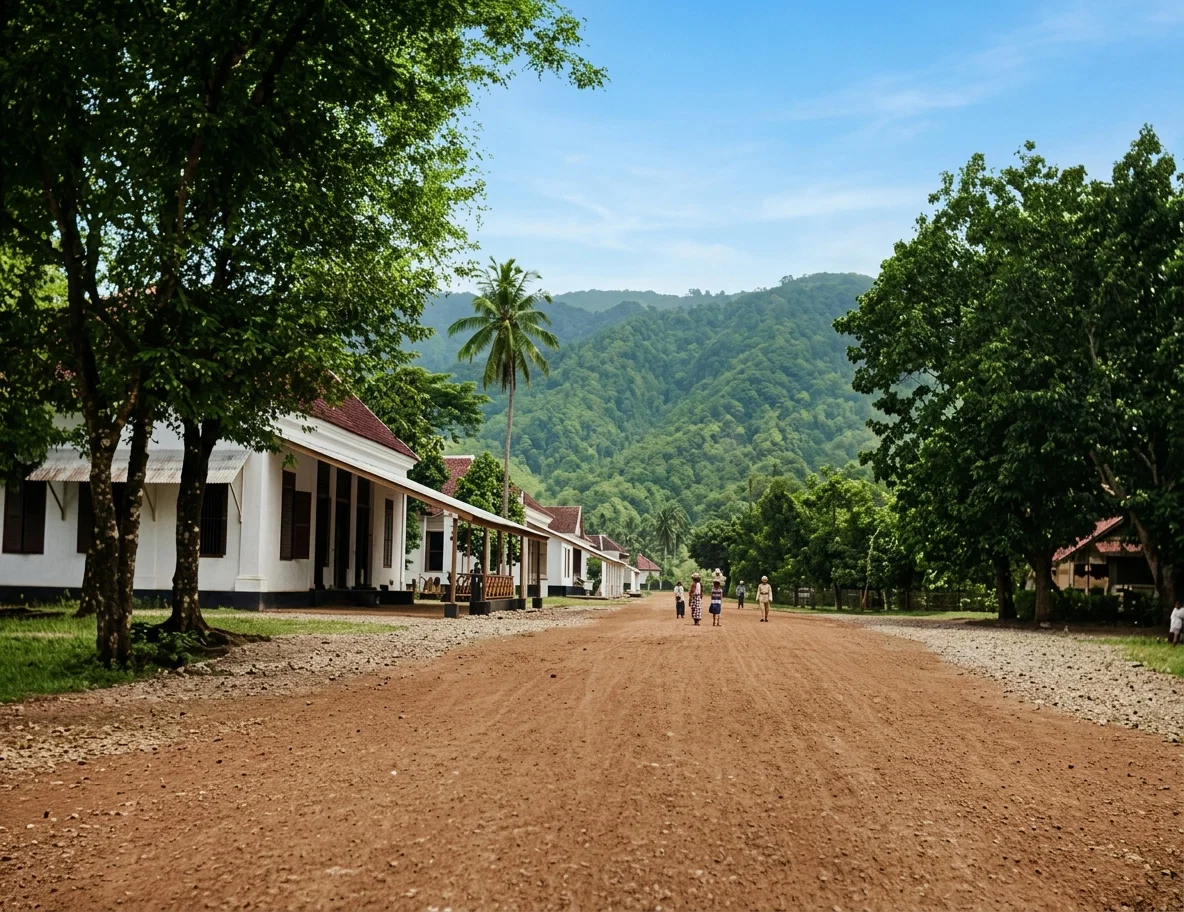
GOVERNMENT HOUSES, WEST COAST, SUMATRA
I enjoy the climate here, and have not suffered the least from the heat, although I am often out during the hottest part of the day. The nights are always cool. I sleep under a double woolen blanket every night, and am none too warm.
The water is pure, though not very cool. The vegetation is luxuriant. I never saw a prettier place than Padang. Each side of the street is lined with beautiful trees. The dwelling houses are usually set back a little from the street, with pleasant drives leading to the verandas. The houses are low, and rather open, with large roofs reaching out several feet beyond the walls. This keeps the rooms cool. The principal parts of the houses are the verandas and bedrooms, the front veranda being used for a reception and sitting room, and the back veranda for a dining room.
The beds are hard, consisting of a cotton mattress, without springs, and covered with a sheet. The blankets used for covering are folded during the day, and laid across the foot of the bed. Each person has a separate blanket. Between each two persons is a long, round bolster. This is much better, and more healthful, than our beds at home, as it is nearly the same as each person having a single bed, as many do have.
The native dress is also healthful. The outer garment consists of a short kimono and a large, straight piece of stamped cloth, folded for a skirt, and held in place by a girdle usually, though pins may be used instead. The women hardly ever wear anything on their heads when going out, as it is much cooler to carry a parasol.
Many friends have asked what we have to eat. We have excellent opportunities to live healthfully. Bananas and rice are two of the staple articles of diet, although we have many kinds of fruits and vegetables not known in a temperate latitude. We also have beans, peas, corn, white bread, squash, and both Irish and sweet potatoes. In nearly every yard can be seen cocoanut trees. Peanuts grow here, so we make our own nut butter. The dammer nut is excellent for cooking purposes. Cocoanut oil is cheap, and when fresh has a very pleasant flavor. From the stores we can buy all kinds of crackers, rolled oats, barley, etc., but nothing can take the place of rice. There are many excellent ways of cooking it, of which we know nothing in America. The best way, I think, is to let the rice come to a boil, then place it over a slow fire until quite soft, then add cream made by pouring a cup of water over fresh shredded cocoanut; press and strain, add another cup of water, press and strain again, pour over the rice, and let it come to a boil.
Meat is used in small quantities by the natives, but they spoil their food by pouring hot curry sauce over everything. They also eat many cakes and sweetmeats, made from a gelatinous rice rich in albumen, and from sweet potatoes, sago, cocoanut, sugar, flour, bananas, fruits of different kinds, etc.; so these are much more healthful than our home sweetmeats.
The Dutch people, as well as the natives, wonder when we tell them we use no meat, fried foods, tea, coffee, peppers, and very little sugar. But they can say nothing when they compare Brother Munson's children, fat and rosy cheeked, with their own thin, puny, pale-faced families. One of the greatest trials we have to deal with in treating the children is their having no constitutional strength. One day they may have a little cough, or may vomit once, and the next day they may be beyond help; so often no help is called. This is especially true of the Chinese families. Out of twelve children the mother will frequently have only one or two left. I am convinced that a proper and regular diet would remove the difficulty. We must first win the confidence of the people. This can be done only by kindness, sympathy, and help in bringing their sick back to health. Then we can teach them how to live healthfully, and of the Saviour's love.
As I can not speak the language well yet, Sister Munson goes with me as interpreter, and carries a Malay Testament, and reads or talks to the people while I treat them. Often we have prayer before we leave. Thus a double work is carried on. In this way a home has been opened where Elder Munson can hold meetings in the Chinese quarters. We had been asking the Lord to show us a place in which to hold meetings, and he used the health work as the opening wedge.
When giving treatments, a crowd will often gather around us. Many disparaging remarks are sure to be made, which sometimes frighten the family. But the good effects of the treatments, if we are allowed to continue them, soon remove all fear.
One mother begged us not to put water on her child, as Chinese children were different from white children. But she still wished me to take the case, as it was her only hope. The child's temperature was one hundred and six and one-half degrees when we arrived. After a thorough enema and bath, with ice to its heart and head, we had the temperature down to normal, and the child slept immediately afterward as it had not slept for four days.
The doctors here are not in sympathy with this work, but can do nothing, as the work speaks for itself, and we charge no fees. The people often give us presents to help support the work. One successful case will be talked about for13miles around,—at dinner parties, receptions, on the train, and everywhere. Our work at Fort de Kock, seventy-five miles away, had preceded us to Padang long before we arrived.
Satan tries to put hindrances in the way of the work here as elsewhere. But these, by faith and perseverance, can be used as stepping-stones to a greater work. The result of our work soon shows the people that health reform and hydriatic treatments can do more for them than all the drugs in the apothecary shop, their devil medicines, charms, and prayers to Satan, all combined.
Sometimes we make quite an effort to get the people to discontinue their devil medicines, etc., while I have the case in charge. They often promise Satan to serve him better in the future if he will only give them their child again; and he does restore some to health in a marvelous manner. I have several charms which have been taken from the bodies of the sick and given me before I began treating them.
Ofttimes we can strongly feel the powers of darkness about us. But we know that angels are standing ready to help us at the first cry of faith. I am so glad that Christ has met and overcome Satan, and all we have to do is to take shelter under his protecting arm.
In one of the first cases we had, we felt that Satan was working for hours to keep us from winning success. Sister Munson and I had prayer at the bedside of the sick woman, and immediately the treatments had the desired effect. Afterward I learned that Elder Munson was awake at the same hour, and was praying the Lord to strengthen us and bless our labors. The Lord has said, 'If two of you shall agree on earth as touching anything that they shall ask, it shall be done for them of my Father which is in heaven.' His promise has been proved true by us more than once during the past few months.
Every missionary, either home or foreign, needs a knowledge of these life-giving principles of health reform and hydropathic treatments, in order to reach the people. I for one am thankful that I had the privilege of gaining this knowledge. With it we can reach hundreds of homes which would otherwise be closed to us. We need more help—doctors, as well as nurses. Only those who enter the foreign or city mission work know the blessings of laboring in a needy field. This little station is the only one in this whole island world of fifty million inhabitants. Who will come and help us? If you can not come yourself, you can help send one who can come, and you can ask the Lord to strengthen us and bless our labors. We also need means to send out the native helpers as soon as they are ready. I am thankful that the Lord allowed me the privilege of coming, and thank the brethren and sisters who helped to provide the means.
Elder Munson has a little home school, to help pay the expenses of the mission, and to keep our Chinese helper in the field, and I have the privilege of conducting the class in physiology. It is interesting to see how quickly our Chinese boy catches all thoughts on healthful living, and how he puts them into practise. His father is a doctor. I try to make everything as practical as possible, by illustrating with the native articles of healthful and unhealthful diet and hurtful practises.
We have many interesting experiences each time we go out to visit. I only wish there were more workers to share in them. Jesus says, 'Lo, I am with you all the days, even unto the end of the world.' I know this is true; for we feel his presence and enjoy his blessings. Come and join us in the work, and share the joys with us.
Padang.
_A Dory Trip in British Honduras_
By H. C. Goodrich
H. C. GOODRICH
THINKING that the readers of the REVIEW would like to know how to work and travel in this part of the world, I will give an account of our trip up the Belize River, from which we have just returned.
Our dory, a canoe dug out of a large log, was well filled with provisions, cooking utensils, our paltikee (a large basket with telescope cover, which, covered with painted canvas, is water tight) well filled with bedding, and clothing, and two large boxes of books. Over all was a large water-tight canvas, to keep everything dry; for this is the beginning of the rainy season. The Belize River, which in the dry season is a very slow and quiet stream, in the rainy season rises from six to ten feet, and becomes a great flood. But these floods, which are used to bring down the mahogany and logwood from the far interior, and from all the little creeks, are the harvest time of the wood cutters. The mahogany is floated down in rafts, but the logwood, which is too heavy to float, is brought down in dories.
THATCHED HUTS
As there are but few roads in British Honduras, and these very poor, most of the people live along the rivers and the seacoast; and the only way to reach them is by water. There were three of us,—Brother Bennett, who had charge of the boat and the cooking; Brother Brauster, who is our pioneer canvasser and colporteur; and the writer. We left Belize at 3 P. M., June 15, and found no place to stop for the night till nine o'clock. As the house where we made our first stop was a good sample of a majority of those along the rivers and coast of this country, I will give you a description of it. Posts are set firmly in the ground; and to these are lashed with a strong, tough vine called tietie the framework of the walls and roof. The walls are usually composed of small poles fastened to the frame with the tietie vine. The roof is of thatch fastened in the same way, the doors and windows of boards with iron hinges, the floor of clay. The houses are usually divided into two rooms, a living room and a bedroom. At a little distance is the kitchen, built of the same material, but smaller, where the cooking is done over an open fire, sometimes on the clay floor, but more often on a raised platform covered with clay. The baking is done in a large, shallow kettle by building a fire on the heavy iron cover. The living room of this particular house was set apart for our use. So, quickly unloading cots and bedding, we put up our mosquito bars, covered our boat with the large water-proof canvas, and were soon sleeping soundly, not even a heavy rain being sufficient to awaken the writer.
At daylight we were astir. The dory was loaded, and we were soon paddling up the stream. At seven we stopped for breakfast. In this way we journeyed on, stopping at every house. At noon we came to the house of a man named Gordon, who years ago had purchased a copy of “Patriarchs and Prophets,” but having lost it, wanted another. He14was keeping the Sabbath, but did not seem to have any knowledge of our work, and I had never known of him. This man subscribed for the REVIEW, bought books to the amount of ten dollars, and seemed anxious to learn. We expect soon to see him walking in the light of the third angel's message.
That night we came to a good-sized village that used to be of some importance in the mahogany trade. We stayed here one day; and at night I spoke, by invitation, in the Wesleyan chapel and school, taught by Brother Green, whom I have mentioned before as interested in our work. The people earnestly asked us to stay a few days; to this we gladly consented, and stayed three days, holding a meeting each evening. This is a good opening for work, and ought to be improved without delay. I was sorry to leave this place; many heartily shook our hands, and asked us when we would come again, and why they had never heard these things before. Of this people only five or six adults could read, so they must depend more on hearing than reading. The next day at sunset we came to Lime Walk, after a hard day's work.
The river had risen about two feet, and most of the way the current was very strong, so we made slow progress with poles and paddles. At one place there is a rapids of eighty rods or more, where the river is filled with rocks. Here the brethren had to get out in the water, and draw the boat by hand along the bank, carefully avoiding the rocks. At Lime Walk we found Brother Hemsley. He has a daughter living in Belize, who accepted the Sabbath and was baptized soon after I went there. Her father spent a few weeks in town with his daughter, but declared he would go to none of her meetings, believing she was all wrong. But this prejudice was finally overcome. He came to meeting, and not long after began to observe the Sabbath; and the opposition of his neighbors and of his own family has not been able to move him. Some said that if we came there, we should not be allowed to land. It did not prove to be quite so bad as that, but we could hold no meetings with them, and sold only two books. However, we had some good Bible studies with Brother Hemsley and his family, which seemed to break down a great deal of prejudice, and we hope yet to see them all one in Christ.
The next day we came down the river to the mouth of Black Creek on our way to Crooked Tree, which is a good day's journey up this creek. We arrived just at night, very tired from the heat and the long pull up the stream. Brother Brauster went up into the village to find us a place to stay. He soon returned, saying that he was cordially received, and that a place was provided for us. As we were unloading our things, another man came down to the boat, and offered us a place in his house, which we accepted, as it was near by. At Crooked Tree is a strong Baptist society, with a nice church and schoolhouse combined in one building. Their mission worker, Mr. Cleghorn, also from Belize, was here to make them a visit. He met us very kindly, offering us a place to sleep in the schoolroom, which we accepted, as it had a board floor.
Friday was devoted to letter writing and helping Brother Brauster with his canvassing. Sabbath three of the Baptist brethren came in and asked why we kept the seventh day instead of the first day as the Sabbath. So we had a Bible study on the subject. They said it seemed very plain; but they wished to hear their own minister tell his side. Of course I told them that was right; and if he could produce any Scripture for Sunday sacredness, we would all keep it together. But much to their surprise, he refused to come. The next morning the same three men came the second time for another study on the same question. Sunday at 4 P. M. we had an open-air service, our subject being the Signs of Christ's Second Coming. This service was attended by the minister and all the people. We also attended the evening service. Monday evening we had a Bible study on Eden Restored; and as we had had some study on the Sabbath question, it was easy here to bring in that subject with great force. I asked them if in view of such precious promises, we could not give up all for Christ? and all answered in the affirmative. Three promised to give up their tobacco, and one man and his wife said they would keep the Sabbath. We sold a good quantity of books.
Tuesday we started on our way home, the water not being high enough for us to go farther. We reached Belize on Thursday, weary, but very thankful for a Father's care, and still more thankful that we could meet so many people who expressed a desire to know the truth. And they must know it. This trip has brought one thing forcibly to my mind; and that is that I can not stay in Belize. I told the little company here, while speaking from the words, “Go ye into all the world,” that they must no longer lean on the human arm for help, but take the work on their own shoulders, and carry the message to all this people; so that I might be free to go to those who had not yet heard the gospel. Yet the interest in Belize was never better; my correspondence is larger than ever before; the canvassing work must have more attention than hitherto; and yet the vision of those men and women saying, “Why have we never heard these things before?” comes up before me, and I must go. May God lay a burden on some hearts to come and work in the open fields of Central America.
Belize.
Scotland
By WM. A. WESTWORTH
WM. A. WESTWORTH
SINCE coming to this field last December, we have had many reasons to praise the Lord for the way that he has led us, and the many manifestations of his leadings have given us courage to press the battle as never before. Though there are many things that are strange to us, and we find it necessary to vary our methods of work, yet gradually we are being brought to see that God has a people here, and that they are waiting for the truth.
The past history of Scotland is an inspiration as we consider the men that have gone from here to give their lives for the Master's service, and the attitude of the nation for what they held as very truth is a witness of their sterling worth. Naturally very reserved and stolid, they hold with no small suspicion any effort made to lead them from the old landmarks that they have so long revered. Especially do they look askance at any 'new' religion from the States. Their national pride is great. The memory of such men as KNOX as a reformer, or Chalmers as a missionary, gives them the idea that they have all that is worth having in religion. Hence we find great difficulty in approaching them, and yet, when once their confidence is won, they are a noble people, and we feel that the Lord will not desert these who have stood so nobly for him in ages past.
“Sabbath” observance, as they universally style their First-day reverence, is stricter here than in any place we have ever seen. The masses generally go to the churches, to their own, but to no others.
It has been thought that we were too far north, and that the weather was too damp for tent efforts, but we are glad to report that this is not the case. We have been pleased to see the crowds that have come. During the week the attendance has been good, and on Sundays our fifty-foot tent has been filled, and on one occasion when Brother Ritchie spoke on the sanctuary question, illustrating his subject with a model twenty-four feet in length, many were unable to find entrance. Several have already accepted the truth, and the interest is better than ever before. This is in Kirkcaldy, a place of about sixty thousand inhabitants, just across the Firth of Forth from Edinburgh. The tent was given to us by the New York Conference, and the seats by the New England Conference; and I can safely say that I have never seen an effort more appreciated than is this one. So that our thanks are doubly due to those that have thus helped us, under the hand of God.
In Edinburgh, the capital, which is the social, religious, and educational center of the country, prejudice against any such movement as ours is high. But after some hard work, we begin to see light, and now we have a Sabbath-school of nineteen, and others are deeply interested. Only lack of means prevents us from getting suitable quarters and pushing the work here. The long evenings of the winter, for the sun sets at 3:30, give opportunity for good effort, and had we the means, we could carry on public services among many who are interested. There may be some who could aid us in this work; if so, we should be pleased to hear from them at 7 Maxwell St., Edinburgh.
At Glasgow, where for some time15there have been a few believers, the work is being pressed also. This company was raised up largely through the efforts of a few brethren who quietly worked and lived the truth. The judgment alone will reveal the efforts made by them, and the good accomplished for their fellow men. A good church building has been hired for the year, and we expect to carry on aggressive work in a short time. A good force will be there, and nightly services will be conducted. Satan has been at work with this company, and some have withdrawn, but the faith is dear to the remainder, and they are enlisted, for all they are or can be. In this city, which, with its suburbs, has about a million and a quarter of souls, an aggressive paper work is being carried on, from ten hundred to twelve hundred copies each week being sold. Sister Lamie is also doing a good work, and a number have become interested in the truth through the treatments she has given the sick.
We are pleased to see the work prosper; but as we contemplate the millions who have never heard the truth; as we see city-after city, scores of them in all parts of the country, which have never heard the sound of our message, and still the enemy is pressing into these places with all sorts of hellish devices,—Spiritualism, theosophy, Christian Science, false healings, and many others,—our hearts are burdened. While there has been some awakening in the ranks of our people, still we are far, far behind our possibilities. Even now there are those who as native workers could do far more than can any foreigners, who should be at work. But we can not use them. Think of it, brethren!—men ready to go, but no means to send them. We can not say, “Depart in peace, be ye warmed and filled;” that will not do. May the Lord burden every heart with a feeling of its responsibilities. Pray for us that the word may have free course, and that the Master may be glorified by an abundant harvest from 'bonnie' Scotland.”