FEBRUARY 4-22 I spent with the workers of our mission in Central China, located at Sin Iang Cheo, about one hundred and twenty-five miles north of Hankow, the commercial center of this section of China.
Although this work has been recently opened, yet a considerable footing has been gained. Brother Pilquist has secured a large Chinese house with ample room for living-rooms for his family, for the native gospel helpers, and for school rooms and chapel. The seed sown in the daily Bible studies has begun to take root. On Sabbath, February 14, six men who have responded to the gospel were baptized in the little stream which flows just outside the city wall. One of these is acting as an evangelist, affording Brother Pilquist an able native helper.
On Sunday these six, with Brother and Sister Pilquist, were organized into a church—the first Seventh-day Adventist church in the vast empire of China. Two other men who were not present on the occasion of baptism have fully identified themselves as believers, as far as possible without this ordinance. One of these lives about forty miles from here, but has made several trips to the mission on foot, spending a few days each time to receive instruction. Some years ago he with four others in his place accepted the Christian religion through the teaching of the English Church, but, being isolated, they have not enjoyed church associations. The third angel's message found a joyous response in his heart, and through him has reached the other four. At his earnest solicitation, a mission chapel has been opened in his native village as an outstation of the mission at Sin Iang Cheo.
Another man who has been attending the studies for the past few weeks has renounced his idols and turned to God. He is advanced beyond the age when it is usual for these people so bound by tradition, to forsake the religion of their fathers; but before the workers at the mission were aware that he was really interested, he had rented a piece of ground to till for the support of himself and his youngest son, who is the only dependent member of his family, and had taken up his abode near the mission; because, as he said, he desired to be taught in the Word, and to unite with this people, and to have his son attend the mission school. Another person always in attendance at the Bible studies is a well-educated man whom the Lord has released from the opium habit. He felt very sad on the day of baptism because his name was not enrolled among the candidates, but it was thought best to ask him to wait awhile.
The wife of Ho, who was one of the six men baptized, desires publicly to acknowledge her faith in Christ; but in common with the great majority of Chinese women, she has not been taught to read, a very great hindrance to her acquirement of an intelligent faith.
In response to an urgent request of another who has been to the mission on several occasions, Brother Pilquist, the evangelist, and myself accompanied him to his own city. We reached the place unannounced at about 4 P. M., but by seven o'clock a meeting place had been prepared, and about two hundred men gathered to hear the Word of God, among them some of the city officials. In the morning we were invited to visit the chief mandarin, who received us with true oriental hospitality. Later news reports a real interest to hear the message in that place, and brings the request for a chapel to be opened there.
In addition to preaching and teaching, Gospels and other portions of the Scripture are being distributed, and thus the message is radiating over a considerable area. A boy's school has just been opened with fourteen boys in attendance. This number will be increased as the school becomes known. One of the six baptized is well qualified to act as teacher of the school. Thus it would seem that a good work is already well begun, with two men ready to render assistance. A piece of ground to be tilled by the boys of the school, some of whom are not able to support themselves while in school, is needed. This may be rented at a reasonable price, and will produce two crops a year. A good, tried man is needed to connect with this mission station at once. The work is advancing, but it needs your earnest prayers and liberal support.
Mission Notes
Miss Helen Gladstone, daughter of England's great statesman, has given herself to settlement work in one of the crowded quarters of London.
The American Bible Society has accepted the manuscript for the Sheetswa New Testament, prepared by a missionary from East Africa. An edition in this dialect will be published at once, for the use of the Inhambane East Africa Mission.
Russia's great Trans-Siberian railway is now practically completed. In labor alone it cost over ninety million days' work. Nearly twenty miles of bridges have been constructed across rivers. Over ninety thousand immigrants have been attracted to Siberia, as this railway brings them in touch with the world.
On the borders of Tibet lives W. A. Hyde, of the Moravian Missionary Society. He has learned the Tibetan language, and has translated the whole Bible into it. Though not allowed to enter the land, he converses with travelers passing to and fro across the border. He has lived there nearly fifty years, hoping and waiting for the opportunity to preach in Tibet.
In Italy the British and Foreign Bible Society's circulation of the Scriptures last year amounted to 106,000 copies, as compared with 102,000 in 1901, and 96,000 in 1900. The increase in the circulation of the Bible in Central America is 8,353 copies; in France it is more than 80,000 in advance of 1901, while in South Africa the circulation was 26,000 above the average of the year preceding the war.
A Chinese woman convert, when staying in a Christian home in Edinburgh recently, expressed the missionary motive from her point of view in these words: “When I see what a difference the gospel of Christ has made in the homes of the people, when I hear what people say about their personal devotion to Jesus, O, I am amazed to think that you do not see it to be more your duty to send the gospel to the women of China, that they may have your Jesus, and that they may have your God.”
It is not easy to keep pace with the reports of new railways, either in construction or definitely planned for, within the Dark Continent. A railway line is now opened so that one can go from Cape Town, by way of Buluwayo and Fort Salisbury, to the port of Beira on the east coast. A train de luxe is now run for fifteen hundred miles north of Cape Town to Buluwayo. The main line of the Cape and Cairo Railroad will cross the Zambesi at Victoria Falls, three hundred miles north of Buluwayo, and that point will be reached, it is expected, the coming autumn.
The Island of Nevis
By STERRIE A. WELLMAN
STERRIE A. WELLMAN
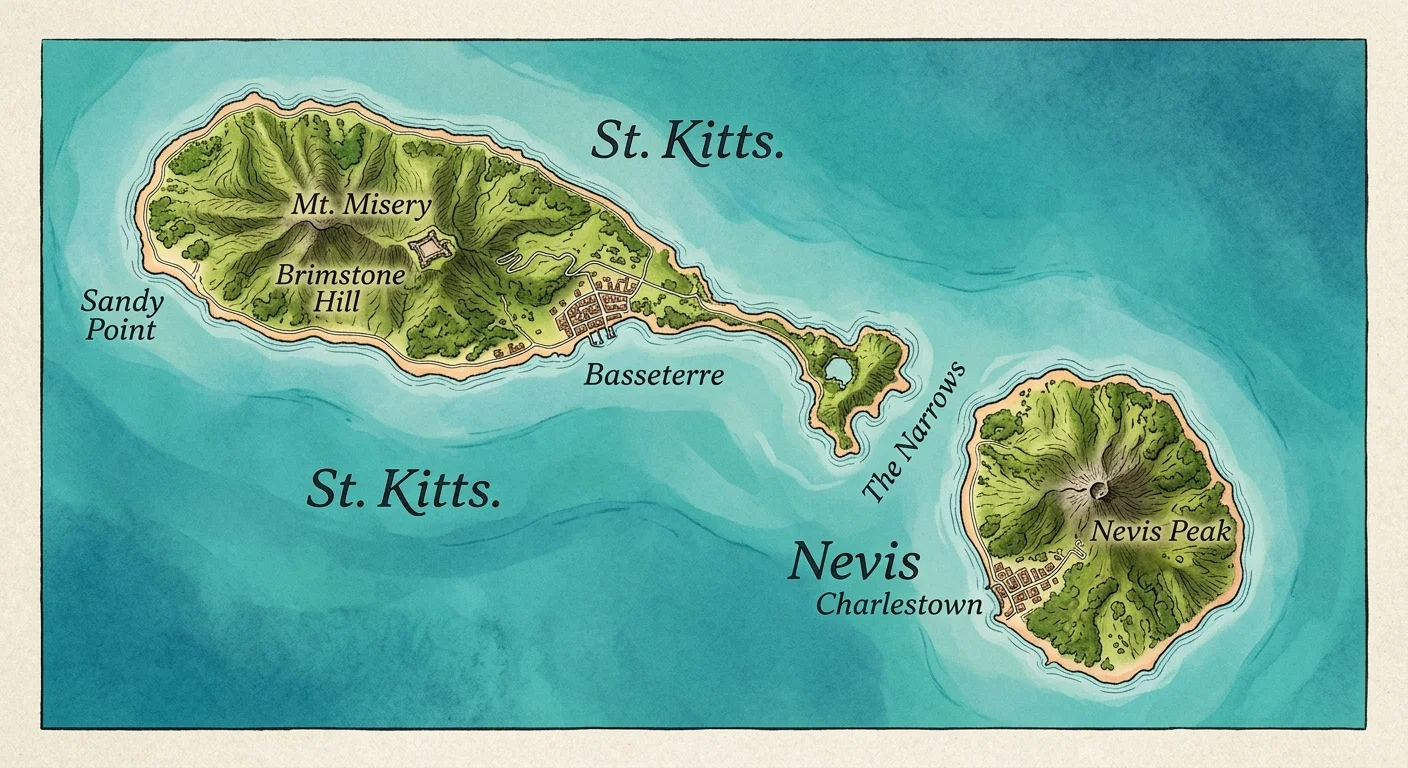
Starting from Basseterre, we take a little yawl lying at the wharf for Nevis. The wind is brisk, and the deep-blue waters of the bay are whipped into motion by it, the sail stiffens as it is run aloft, and ere we hardly realize the situation, we are away, crossing the twelve miles of briny waters which separated us from Charlestown, Nevis, entertained in the meanwhile by the lively chatter of our native captain and crew.
St. Kitts and Nevis.
After an hour and a half of swift flight, we arrive at the Charlestown wharf, greeted by that usual West Indian salute, “Here I am, massa.” We will start out on our travels at once; and turning southeastward from Charlestown, we will go directly into the country parts. We are hardly out of the town, when to our right we behold an old stone building, which fifty years ago was one of the most prosperous pleasure resorts and boarding hotels in the West Indies. To-day, like its island home, it lies a desolate wall, fast falling in decay. Here years ago flocked the élite of the West Indies. Its mineral springs were the attraction to the sufferers of the Carib Islands, from St. Thomas to Demerara. To-day all that remains is its history.
As we pass on, we do not follow the coast closely, but instead, trudging up, up, up, over the hills, close to the base of Nevis Peak, we follow the mountain road, until to the southeast we once more meet the seashore, along which the road runs till we reach the town of Charlestown.
About half-way up the hill we come upon an old English church, in which lie the records of the marriage of Lord Nelson, the great English admiral, who here united with one of the daughters of Nevis. And it was on this island, too, that Alexander Hamilton, the son of a Scotch planter, and the one who, next to Washington himself, did more than any other person to bring about the present stability of American institutions,—an able statesman, lawyer, soldier, and political teacher,—was born. So Nevis is a place of historical interest to both British and American.
As we come toward the east side of the island, it becomes very stony, and on every side are found those reminders of America, the old stone fences, grown black by the beatings of the wind and rain, and covered with the climbing and creeping vines in which these islands abound.
The remaining portion of our way lies along the shore road, to the north. As we travel on, we behold the northern coast of St. Kitts, its hills and mountains, and afar the peaks of St. Martins and St. Barts, to the south Antigua just revealing its low hills, and westward from it the beautiful but unfortunate island of Montserrat and the rock Redonda. We follow the coast by the channel, now at the base of the mountains and again far away from them, over rough roads strewn with stones washed down from the hills by the heavy tropical rains, through wild bush in which the monkey tribe finds a ready retreat, and after passing through several small villages, we arrive at our starting point, Charlestown.
In encircling the islands of St. Kitts and Nevis, it has been our pleasure to view, at varying distances of from twelve to sixty miles, nine of the Caribbean islands which are inhabited. Among these were St. Kitts, Nevis, Saba, Statia, St. Martins, St. Bartholomew, and Anguila, with a population aggregating seventy-three thousand. Such are these little islands of the Caribbean, washed by its warm waters and brightened by the tropic sun—a few of the minor creations of an all-wise and loving God; and they are among those of which it is said, “The isles shall wait for his law.”
Twenty-third Meeting
By W. T. Knox; H. E. Osborne
SATURDAY, APRIL 11, 7 P. M.
The special order of business for the hour was the report of the Publication Committee, which had been printed on slips for the delegates. The report was considered, the groups of recommendations being spoken to and fully discussed. The report of the committee was but slightly amended, and when its discussion was completed, it stood as follows:—
Report of Publication Committee
AS AMENDED AND PASSED
The Publishing Committee respectfully present the following report for your consideration:—
Whereas, It has been clearly demonstrated that systematic house-to-house canvassing with our literature is a powerful factor in extending the gospel of the kingdom to the world; therefore we recommend,—
1. That our people put forth a vigorous effort in behalf of the circulation of our periodicals.
2. That conference and other laborers unite in a systematic effort to engage and instruct members of our churches in this work.
3. That the large cities be entered and thoroughly canvassed as soon as possible.
4. That the periodical work be conducted under the direction of the conference committee.
5. That our ministers, church officers, and the heads of families be asked to unite in an earnest effort to encourage persons of varied age and ability to take up the work of circulating our periodicals and books as resident canvassers.
6. That conferences give more attention to the character of the work done by each canvasser, and render him the counsel, encouragement, and help that seem necessary, in order that a high standard may be maintained.
7. That we recognize the church-school teacher as an important factor in the training of our children to become colporteurs and canvassers.
8. That the General Conference Committee make liberal provision for the publication of gospel literature in all its mission fields.
9. That provision be made for one of its secretaries to give special study to the most effective and economical methods of producing this literature in the field.
10. That greater effort be made to send to the mission fields persons who will engage in the circulation of gospel literature.
11. That we endeavor to strengthen the Scandinavian and German work in America by an earnest and systematic effort to revive the canvassing and colporteur work among these nationalities.
12. That the printing of our German, Swedish, and Danish-Norwegian periodicals for circulation in America be done by the Union College printing department, provided it has the necessary facilities, and can do the work at reasonable prices.
13. That a committee of five be appointed from each nationality to manage, under the supervision of the Central Union Conference, the publication of the papers in their language, three members of each committee to be chosen by the Central Union Conference Committee, and two members by the General Conference Committee.
14. That these publication committees be authorized to publish tracts and pamphlets in their respective languages, as far as they may be able to procure the means to do so.
15. That the Central Union Conference Committee assist Union College in raising about four thousand dollars, for furnishing the Union College printing department with a good-sized printing-press and other necessary facilities.
[Voted to refer Recommendation 15 to the Central Union Conference.]
16. That we secure from the Christiania Publishing House the large Scandinavian books required both in Europe and in America.
17. That we secure from the Hamburg Publishing House the large German books required in America and Europe.
18. That we encourage our brethren engaged in the issue of gospel literature in the French field by making our Canadian Publishing Association a depository for the distribution of their literature in America.
19. That the General Conference Committee make provisions for the publication of large books in the Spanish language, in Barcelona or some other favorable seaport town of Spain; and for the publication of the necessary periodicals, tracts, and pamphlets in Mexico and our South American missions, according to the necessities of the several fields.
20. That we recognize the right of union conferences and union mission fields to establish and maintain book depositories wherever in their judgment it appears best to do so, and that when such depositories are established, they take control of the publishing work in their territory, and that they have the privilege of securing their books from such sources as they may deem best.
21. That wherever depositories are established which will affect in any way existing publishing houses or their branches, satisfactory arrangements be made so that the interests of all parties concerned may be protected.
22. That it be distinctly understood that in establishing these depositories it is not contemplated that printing offices be started for printing and binding books, but that these be purchased from our established publishing houses.
23. That in case the Review and Herald accepts the invitation of the Atlantic Union Conference to establish a plant in its territory, they be requested to arrange with the Pacific Press Publishing Company for the transfer of its New York branch at a fair valuation, and that in lieu of the territory of the Atlantic Union Conference, now under control of the Pacific Press Publishing Company, they turn over to said company their territory in the Central Union Conference.
24. That our publishing houses furnish publications to the depositories in union conferences and mission fields at publishers' rates.
25. That a General Advisory Committee for North America be selected for the purpose of unifying and upbuilding the publishing work, and to assist in strengthening and systematizing the efforts of our State tract and missionary societies. This committee to consist of the following: One person from each publishing house, one from each branch office, one from each union conference, and one from the General Conference. The selection of these persons to be made by the publishing houses and conferences.
The report of the Nominating Committee was taken up. The Southern delegates had considered the matter of representation on the Conference Committee. It was moved by them that, inasmuch as their field had but one representative on the committee as reported, while the educational work had several men, the report be amended by substituting the name of R. M. Kilgore for that of M. E. Cady, who was named in the report.
The motion to substitute was carried. The report was further amended by adding the names of C. M. Everest, W. O. Palmer, C. N. Woodward, A. Moon, to the list of transportation agents. The amended report stood as follows:—
Report on Nominations
President, A. G. Daniells; First Vice-President, L. R. Conradi; Second Vice-President, W. W. Prescott; Secretary, W. A. Spicer; Treasurer, I. H. Evans; Auditor, D. B. Parmelee.
Executive Committee: The presidents of union conferences and union mission fields, the persons named being the present incumbents: Atlantic Union Conference, H. W. Cottrell; Lake Union Conference, A. G. Daniells; Southern Union Conference, G. I. Butler; Southwestern Union Conference, G. G. Rupert; Central Union Conference, E. T. Russell; Northern Union Conference, C. W. Flaiz; Pacific Union Conference, W. T. Knox; Canadian Union Conference, W. H. Thurston; British Union Conference, O. A. Olsen; German Union Conference, L. R. Conradi; Scandinavian Union Conference, P. A. Hansen; South African Union Conference, W. S. Hyatt; Australasian Union Conference, G. A. Irwin; French-Latin Union Mission, B. G. Wilkinson; South American Union Mission, J. W. Westphal; and the following-named persons: W. A. Spicer, L. A. Hoopes, A. T. Jones, W. C. White, C. H. Jones, David Paulson, J. C. Ottosen, A. J. Read, Frederick Griggs, W. C. Sisley, S. N. Haskell, R. M. Kilgore.
For Members of the General Conference Association: S. H. Lane, W. H. Edwards, H. M. Mitchell, W. A. Spicer, A. G. Daniells, I. H. Evans, W. W. Prescott, P. T. Magan, Allen Moon, J. D. Gowell, Wm. Covert, C. D. Rhodes, A. G. Haughey, R. A. Underwood, J. E. Jayne, H. W. Cottrell, S. N. Curtiss, J. S. Comins, A. E. Place, D. B. Parmelee, J. Sutherland.
Transportation Agents: W. A. Spicer, Battle Creek, Mich.; S. N. Curtiss, New York City; C. L. Kilgore, Graysville, Tenn.; W. O. Palmer, Nashville, Tenn.; J. Sutherland, College View, Neb.; C. M. Everest, Minneapolis, Minn.; B. R. Nordyke, Kansas City, Mo.; C. N. Woodward, Keene, Tex.; C. H. Jones, Oakland, Cal.; A. Moon, Chicago, Ill.; A. Bacon, London, England; J. A. Burden, Wahroonga, New South Wales, Australia; H. W. Decker, Portland, Ore.; A. Pages, Hamburg, Germany.
Legal Trustees of the Foreign Mission Board: A. G. Daniells, W. A. Spicer, S. N. Curtiss, H. W. Cottrell, I. H. Evans, A. J. Breed, Frederick Griggs, W. W. Prescott, J. E. Jayne.
The Conference considered the report by calling question on each name, and on motion the entire report was adopted.
Meeting adjourned to 8 o'clock, April 12. W. T. Knox, Chairman.
H. E. OSBORNE,
Secretary.
General Conference Proceedings
By W. T. Knox; H. E. Osborne
Twenty-second Meeting
FRIDAY, APRIL 10, 2 P. M.
THE first part of the meeting was occupied with the discussion of resolutions relating to the work in the Southern field, which were adopted. These resolutions were printed in the REVIEW of April 21.
The sixteenth recommendation of the Committee on Plans was then taken up.
16. We recommend, That all conferences and mission fields recognize the tithe as the inheritance of God's ministers, and that an allowance be granted from the tithe to properly support sick or aged laborers, also the dependent widows and orphans of those removed by death.
R. A. Underwood: I know of some cases — I could mention them — of our brethren who have died, fallen at their post, leaving widows and children. These widows and orphans have struggled for years, some of them under most trying circumstances, with sickness and death in their families; and they have received no help. Sometimes ministers have been moved about over the world until they break down in a field where they have labored but a little while, perhaps in some poor conference that does not see why it should assume support for the little time it has received service. It seems to me that the General Conference itself has some responsibility under this resolution.
A. G. Haughey: I do not want to be understood as not favoring the support of the ministry, but I must confess that I believe that, if a minister is no longer able to do ministerial work, he should be supported, but not from the tithe. I believe a special fund should be created for that purpose. I believe this according to the last chapter of Volume VII of the Testimonies.
D. E. Lindsey: I am heartily in favor of this recommendation. Some provision of this kind should have been made years ago. I can not see why a man should cease to be a priest when he gets old, or why he should cease to be a minister of the gospel when he gets old. I believe the tithe is the proper fund to care for the Lord's ministry.
A. G. Daniels: I have felt very keenly that as a denomination we ought to take a stand on this question, and have a general understanding, so that there will be no question anywhere in the world regarding what shall be done in such cases. We started in two years ago, with a committee, to study out some plan. I was on that committee, and I tried to study out a plan for a fund. I studied and studied what kind of a tax we could put on the preachers, or on the people, or on institutions, to create a fund. I finally fell back on the tithe as the inheritance of God's ambassadors. [Voices: “Amen.”] So I abandoned the idea of creating a fund. I am quite aware of what Brother Haughey has referred to. But that does not preclude this idea of the tithe being that fund. Before this Conference opened, I presented the matter to the General Conference Committee when Sister White was present; and I said that, after studying the subject the best I knew how during the two years, this was the only plan that I could see that would be workable, and Sister White gave her unqualified approval and assent to that idea. Now I feel anxious that we shall take this up in our union conferences all over the world, and have it well understood by all the Seventh-day Adventists in the world that the tithe is the inheritance of the ambassadors of God, and that they can throw their lives into this work, and can devote their donations to this work, and can wear themselves out, and have an inheritance laid up with God's people. I do not want to lay up money in a bank or possess a foot of land until I get a share of Abraham's inheritance. And there are many who share that feeling. I am looking to see God's work finished before I get too old to labor. But I want to see this understanding prevail as to broken workers who have thrown their all into service.
And further: when a minister dies, what about his widow and his children who have not a competency left? I say that the conference to whose service his life has been devoted should see that that dependent widow and those children are cared for just as though that ambassador of God was living and working. He has put all his means and his life into that work, and he has an inheritance laid up there for his wife and children. Just as far as consistent, we should assist the widow and the children to earn a living; and if this is made possible in a reasonable and proper way, let the assistance drop.
And when we do it, our brethren and sisters will be pleased. They love our ministers; they are loyal; they will do it. I believe, brethren, that when our people hear that we take this action to care for our ministers, and that we plan to send our tithes as far as possible into new fields, leaving them to carry on the work in their immediate vicinities, we shall appeal to them to pay a full tithe in stronger language than we can in any other way.
Another thought: I believe it should be taught all the time that every minister should be an earnest, zealous, wide-awake minister, to receive the tithe; that a minister must throw his life into the work; he must aspire to something; he must study; he must be a strenuous worker in this cause. And if he is careless, if he does not take hold and work, and devote himself, he is not worthy to receive the tithe; but the true minister who is deserving of the tithe while he is well, is the man who is deserving of it when he is sick, and whose wife and children deserve it when he is dead.
H. Shultz: The priest's wife and children ate of the same things that he did, and obtained it from the tithe. The families of our ministers should live of that which the ministers live of. That is God's plan. We see many of them falling around us, and at our General Conferences we pass resolutions expressing our sympathy for those who remain. I have heard it said time and again, Sympathy does not amount to anything without something in your hands to help. That is the way to sympathize with those who are in need.
The series of recommendations was then voted upon, as amended, and carried.
Meeting adjourned to 7 P. M., April 11.
W. T. KNOX,
Chairman.
H. E. OSBORNE,
Secretary.
Twenty-fourth Meeting
SUNDAY, APRIL 12, 8 A. M.
The further partial report of the Committee on Plans was taken up. The following is the report:—
Report of Committee on Plans
17. We recommend, That the General Conference Sabbath-school Department be directed to lay plans that shall foster, improve, and build up the young people's work.
18. That the ministers and other workers throughout the field be urged to give this work their hearty support and co-operation.
19. That we approve of the plan that Sabbath-school officers be elected by the church.
20. That great care be taken in arranging for the work of the State conference Sabbath-school departments.
(a) In the appointing of capable secretaries, and avoiding frequent changes whenever possible.
(b) In not placing so many other burdens upon those secretaries that the interests of the Sabbath-school and young people's work must be neglected.
Whereas, The East Indian Archipelago is within easy reach of Australia, and by geographical position naturally belongs within the jurisdiction of the Australasian Union Conference; therefore,—
21. We recommend, That this island group be made a mission field of the said union conference, and that an appropriation be made for starting a mission in Singapore as soon as possible; further,—
22. We recommend, That the missions in the Society Islands and in the Samoan Islands be advised to connect with the West-Australasian Union Conference, and that the workers in those fields receive their credentials or licenses from the said union conference.
Whereas, The Southern States have been presented to us repeatedly as a very needy and much neglected field, a field in which we should take a great interest, and with which we should become better acquainted; therefore,—
23. Resolved, That suitable men be chosen from the field to lay before our people in the older and more prosperous conferences the needs of the various struggling institutions and missionary enterprises in the South.
24. Resolved, That persons sent forth to engage in this work should bear special credentials from the managers of the enterprises which they represent, indorsed by the officers of the union conference or mission field in which said enterprise is located.
Whereas, The Southern Missionary
Resolutions on Southern Missionary Work
By G. A. Irwin; H. E. Osborne
Society is doing a good work in the organization and maintenance of colored mission schools; therefore,—
25. Resolved, That the Executive Committee of this Conference be advised to appropriate from the general mission fund six hundred dollars per quarter for the work in progress, and that there may be some expansion in this line of work.
26. Resolved, That we approve of the following plans adopted by the Southern Union Conference Committee at its January meeting in Nashville:—
(a) That the Southern Union Conference Committee unite with the officers of the Southern Missionary Society in the formation of plans for raising means, and in presenting them to the people.
(b) That we approve the plans of the society for raising means by interesting individuals in the sale of books and other useful articles, and donating their commission to the society.
27. That we recommend the use of the little book, “Story of Joseph,” for this purpose, recommending this enterprise especially to women and children throughout the land. That we invite Christian workers of all denominations to take part in this effort.
Whereas, In the Southern States there is special need of medical missionary effort through many small sanitariums, treatment rooms, health food stores, and restaurants, and specially the need of institutes and schools for the training of persons to engage in Christian Help work and nursing; and,—
Whereas, A Southern Medical Missionary Association has recently been organized, having great responsibilities and promising opportunities, but having no present resources; therefore,—
28. Resolved, That we endeavor to assist this association in its noble work, by advising the Executive Committee to appropriate one thousand dollars a year for the support of its general work, and by our co-operation with the officers and representatives of the association in an effort to raise eight thousand dollars for the aid of its struggling institutions and enterprises, among which are the Graysville Sanitarium, the Atlanta Sanitarium, the Hildebran Sanitarium, and the Colored Sanitarium at Nashville.
Whereas, The Lord has prepared the way for a mission in German East Africa, and efficient workers are ready to be sent, and the German Union Conference is desirous of having this work begun, and is ready to assist it; therefore,—
29. Resolved, That we grant the raising of five thousand dollars for this purpose, as was proposed at the Friedensau meeting, in July, 1902.
30. Resolved, That we make an earnest and continuous effort to impress upon our people everywhere the importance of our quickly carrying this message to the people of the large cities, giving special attention to the neglected cities in the East and South.
These resolutions were adopted.
Twenty-fifth Meeting
SUNDAY, APRIL 12, 3 P. M.
The special order of the meeting was the report of the field secretary of the educational health campaign, Dr. S. P. S. Edwards. The following recommendation was then adopted:—
That the General Conference Committee make provision, as soon as possible, for the publication of books in the Portuguese language in Lisbon, Portugal.
The Committee on Credentials and Licenses then presented the following recommendations:—
1. That all persons laboring in union or local conferences, and not in the employ of the General Conference, receive their credentials or licenses from the conferences employing them.
2. That the following-named persons be granted ministerial credentials: J. N. Anderson, D. T. Bourdeau, A. C. Bourdeau, A. G. Bodwell, T. H. Branch, George M. Brown, B. E. Connerly, G. W. Caviness, A. G. Daniells, I. H. Evans, F. W. Field, H. C. Goodrich, D. U. Hale, A. A. John, I. G. Knight, J. A. Leland, D. D. Lake, P. T. Magan, H. M. Mitchell, J. A. Morrow, R. W. Munson, A. R. Ogden, G. K. Owen, W. W. Prescott, J. L. Shaw, W. A. Spicer, Mrs. E. G. White, J. W. Westphal.
3. That E. Pilquist, of China, be ordained and receive credentials.
4. That ministerial license be granted to the following-named persons: T. H. Okahira, H. E. Osborne, E. R. Palmer, J. M. Hyatt.
5. That missionary license be given to the persons hereafter named: A. N. Allen, Mrs. Emma Anderson, Theida Black, Mabel Branch, W. D. Burden, L. J. Burgess, Mrs. Georgia B. Burgess, Mrs. G. W. Caviness, Mrs. B. E. Connerly, Della Coates, C. C. Crisler, T. H. Davis, J. W. Erkenbeck, Phebe Ellwanger, W. J. Erkenbeck, Mrs. T. W. Field, Mrs. A. M. Fischer, Mrs. A. S. Fleming, L. F. Hansen, Mrs. L. F. Hansen, Maggie Hare, S. Hasegawa, R. S. Ingersoll, Mrs. Olive P. Ingersoll, F. C. Kelley, Mrs. I. G. Knight, Grace Kellogg, Annie Knight, H. Kuniya, A. La Rue, S. A. Lockwood, Mrs. Myrtle Lockwood, Sara MacEnterfer, H. B. Meyers, Mrs. R. W. Munson, Mrs. J. A. Morrow, Mrs. A. R. Ogden, Mrs. S. J. Olney, Anna Orr, H. A. Owen, Mrs. H. A. Owen, Miguel Placencia, Winifred Peebles, Mrs. L. Flora Plummer, W. W. Quantock, Mrs. May Quantock, Anna Robinson, H. E. Rogers, Ida R. Reagan, S. P. Smith, Mrs. S. P. Smith, D. Ella Smith, Mrs. J. L. Shaw, Ida Thompson, Samantha E. Whites, E. H. Wilbur, Mrs. E. H. Wilbur, Marcelia Walker, Helen A. Wilcox.
6. That any other candidate for credentials and licenses be referred to the General Conference Executive Committee.
The report was adopted as a whole.
Voted to adjourn.
G. A. IRWIN, Chairman.
H. E. OSBORNE, Secretary.
Twenty-sixth Meeting
SUNDAY, APRIL 12, 5:30 P. M.
A final report of the Committee on Institutions was presented, as follows:—
Report of Committee on Institutions
We recommend,—
9. That the International Medical Missionary Training-school Association be requested to deed the old Battle Creek College property to the General Conference Association, to be by them held for the denomination.
10. That any financial obligations contracted by the International Medical Missionary Training-school Association in securing title to said property shall be taken over by the General Conference Association.
11. That diligence shall be exercised to meet these obligations, by securing donations, through the sale of “Christ’s Object Lessons,” the Missionary Acre Fund, and all other methods that may seem expedient.
12. That a committee of seven be appointed to investigate the relationship existing between our institutions and the denomination.
The report was discussed, and, on motion, adopted without amendment.