ROBERT DALLAS was five years old. His father and mother were gay, worldly people, and not at all zealous in temperance. They did not see the harm of drinking a glass of wine now and then, and as for cider, they often had that on the dinner-table. They used brandy and other liquors when they were ill, and sherry and port wines for sauce and jelly. They never signed the pledge. O, no! that was quite unnecessary and unwise. They would not promise never to touch or taste liquors, for a time might come when they would wish to use a little, or when it might be really necessary.
But Grandma Dallas was a right-up-and-down, out-and-out temperance woman. She always felt sorry when she saw grandpa getting “a drop for medicine,” as he sometimes did, and afraid when Robbie’s father and mother went to a party, lest they should be tempted to take what the word of God forbids.
And grandma talked to Robbie a great deal about this, for he was a bright little fellow, and she wanted him to stand on the right side of every question.
The minister, too, was a very decided and out-spoken preacher of righteousness. He saw the promise of good in Mr. Dallas’s little boy, and took a great deal of pains to explain to him things which such children do not often understand. And Robbie loved Mr. West very much, believed every word he spoke, and always acted as he thought his minister would approve.
In the course of the winter, whooping-cough came into the family. Baby was first taken, and the doctor came and gave him medicine.
“Jamaica rum and glycerine,” he said, “is the very best thing he can take. You can’t cure whooping-cough; it must run its course. But you can relieve it, and this is a sure relief.”
By and by Robbie began to cough too.
“O dear!” groaned mamma, “two children sick now.”
“Give him some of baby’s medicine,” said papa; “he’ll weather the storm.”
“None of the baby’s medicine for me,” promptly exclaimed Robbie. “It’s rum; the doctor said so. I know Mr. West wouldn’t give me that.”
“And you rather cough than take the medicine, foolish child?” asked grandpa.
“Yes, sir,” answered Robbie, with a strong emphasis.
“The doctor knows more than you do.”
“No rum for me, though, sick or well,” persisted the little boy. Robbie was in earnest, and grandma was pleased.
One day his mother made some jelly for the table. She usually put lemon-juice in her jelly; but not having lemons in the house, she flavored it with sherry wine. When they came to lunch, Robbie noticed that the jelly was not the usual color.
“What’s in that jelly?” he asked.
His mother didn’t like to tell him, so she evaded the answer. “Oh, something good,” she said, “something you’ll like.”
“It looks red like wine; is there wine in it, mamma? Tell me true.”
“Yes, dear, a little,” said mamma, who would on no account deceive her boy.
“No jelly for me, then,” spoke up Robbie.
His mother knew it was a self-denial for her little boy to give up the jelly, of which he was very fond. She tried to persuade him to take some; told him it was silly for him to feel so about it; that there wasn’t wine enough in it to hurt a baby, and that it was really naughty for him to behave so. “You should eat what is set before you, asking no questions,” she said.
But none of these things moved the child. “Mr. West says we must always do right when we know what is right, and never do wrong when we know what is wrong,” said he. “I am going to do right. No jelly for me!”
His mother was surprised that such a little boy should have so clear an understanding of right and wrong, and such a determined spirit. She thought about his words and his brave conduct, and that night she said to him: “Robbie, you have taught me a lesson. I will never again tempt you, or any one, to take wine in any shape.”
And she never did. She put it away from her pantry, from her table, from her medicine-closet, and learned to say “No” when in company. Papa followed in the same good way, and Robbie soon had the satisfaction of saying to his beloved pastor, “No wine or rum in our house now, Mr. West.” He and grandma were very happy together in the great change that had come to his home.
“’Twas Mr. West and grandma,” said Robbie; “if they hadn’t talked and preached to us, we shouldn’t be so.”
But grandma thought the change was owing very much to Robbie.—Youth’s Temperance Banner.
THE HONEY BEE'S SONG.
I AM a honey bee, buzzing away;
Over the blossoms the long summer day;
Now in the lily cup, drinking my fill,
Now where the roses bloom under the hill;
Gaily we fly, my fellow and I,
Seeking for honey our hive to supply.
Up in the morning, no laggards are we,
Skimming the clover tops ripe for the bee;
Waking the flowers at dawning of day,
Ere the sun kisses the dewdrops away.
Gaily we sing, as onward we wing
Back to the hive with the treasure we bring.
No idle moments have we through the day,
No time to squander in sleep or in play;
Summer is flying, and we must be sure
Food for the winter at once to secure.
Bees in a hive are up and alive,
Lazy folks never can prosper and thrive.
—Selected.
Glory in Overcoming Difficulty
The greater the difficulty, the more glory in surmounting it. Skillful pilots gain their reputation from storms and tempests.
Letter Budget.
LYNNIE M. BAKER, of Anderson Co., Kan., writes: “I am a little girl nearly eight years old. We do not live near any church, but we have Sabbath-school at home. Last summer we went to meeting six miles from here, at a school-house. One Sabbath while we were at meeting, it rained very hard; and Deer Creek, which we had to ford on our way home, was so high that both our horses were drowned. We had hard work to get ashore ourselves. Pa went under twice. I think the Lord was very good to save all our lives. I want to be a good girl, that I may meet you all in heaven.”
Yes, Linnie, you had a narrow escape; and the Lord was very good to preserve all your lives. You met with a loss in the drowning of your horses, but they have no preparation to make for death. No doubt you all feel glad that there is still opportunity given you to make sure of eternal life. The Lord preserves our lives from harm a great many times when we do not know that we are exposed to any special danger. We owe him our lives, and our best service. Let us walk carefully and faithfully before him.
MYRTLE BURGESS, a little girl nine years old, writes from Turner Co., Dakota. She says: “I live on a farm. We have two lambs,—one black one, and one white one. They are both cute. Our school is out now. When I go, I walk a mile and a half. I go to Sabbath-school every Sabbath. There are ten in my class. I keep the Sabbath with my father and mother. I have been to every camp-meeting held in Dakota. I like the children’s meetings best of all the meetings. I like the INSTRUCTOR real well.”
Myrtle has the benefit of so many meetings; she has great light. She must try to walk in the light, because the Lord will expect more of children who have many privileges, than he will of those who have but few. All must do the best they know how with what light they have.
LYDIA MUNN, of Emmet Co., Mich., writes: “We live in sight of Lake Michigan. We are almost alone, away up in the northern part of the State. My papa and mamma keep the Sabbath, but we don’t have the privilege of going to Sabbath-school or meeting. Two good Sabbath-keepers have visited us, and their visits cheered us, and did us much good. One sent us the INSTRUCTOR, and now we have family Sabbath-school and prayer-meeting. We like the INSTRUCTOR real well. After we read the papers, we give them to some other little girls to read. I am eleven years old, and I have a sister thirteen years of age. We hope to meet the INSTRUCTOR family in the new earth.”
Perhaps the little girls who read your paper, Lydia, would like to attend your family Sabbath-school; and so your school might grow into something more than a family-school.
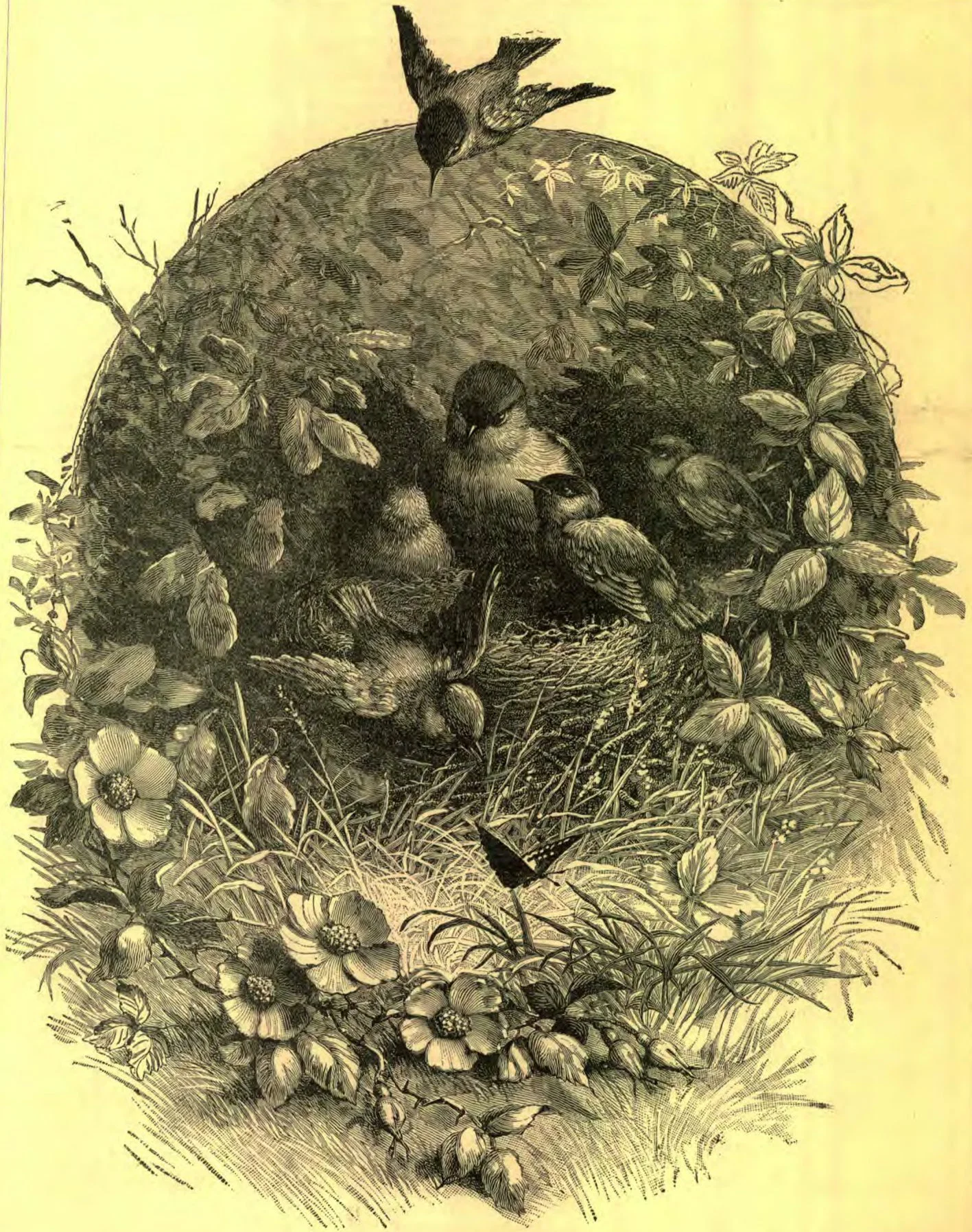
R. L. WILDMAN, of Moultrie Co., Ill., wishes to tell the little folks about some birds that visited their home. He says: “I had a little box setting on the cupboard, and one day two little wrens came into the house, and began building a nest in it. They carried a great many sticks and other bits of things, until they had nearly filled the box. They left a place in one end for a nest, which they afterward lined; then they laid five speckled eggs in it. After setting on the eggs a proper length of time, four little birds made their appearance. These the old birds fed nearly all the time until they could fly. At last the young birds flew away, and the old birds went right to repairing the nest; and when I write, they have already laid two eggs more. “We love our little birds, and hope all the readers of the INSTRUCTOR love the birds too.”