Your ShelfYour Projects

Signs of the Times, Vol. 37, No. 12.

Christ Is Risen
Earlier text: Christ Is Risen

Christ Is Risen

By Abdiel
ALL over Christendom March 27 will be observed as "Easter Sunday" in honor of the resurrection of Christ. The very term "Easter Sunday" should arouse investigation on the part of every lover of God's Word, of every true Protestant, of every disciple of the Lord Jesus Christ; for neither one of the terms is Christian or Scriptural. The word "Easter" occurs once in the Bible (Acts 12:4); of which the original is "Passover," and is so rendered in the Revised Version. The origin of the word is "Eostre," the name of a heathen goddess worshiped in the springtime by our pagan Saxon ancestors, whose votive offerings consisted of vernal plants and flowers, for Eostre was the goddess of spring, and the worship rendered her was nature worship, the character of which is well known to those versed in mythological lore. The spring or Easter festival is wholly of pagan origin.
The term "Sunday" has a similar origin. It is the name given by our pagan ancestors to the first day of the week, dedicated by them to the worship of the sun. Losing sight of God, the Source of all light, who is light, they turned to worship the creature made by God as a light-bearer. The first day of the week became the sun's day. The worship of the sun is also nature worship, and can be traced back into remote pagan times farther than any other form of idolatry. Sunday has no place in Scripture. It is neither taught as a duty nor revealed as a privilege. It is never presented as a holy day, either by express declaration or by inference.
So much for the term "Easter Sunday." The words are both of pagan origin, pointing us back to the dead heathen worship rather than to a living Saviour.

Not a Matter of a Day

True, the feast of the Passover came in the spring; but the object of the Passover ceased when "Christ our Passover" was "sacrificed for us." 1 Cor. 5:7. True it is that Jesus rose from the dead in the spring of the year, just after the time of the Passover; but what is there in that event which calls for the celebration of a day? He was not a day in coming forth from the tomb. In fact, the Scriptures place no emphasis upon the day of His resurrection, thus showing that the particular time is not in anywise important. The resurrection of Christ has in it nothing which would connect it with a particular day of the week; for the types of which our Lord was the antitype fell on various days of the week.
But apart from any positive declaration of Scripture to that effect, is it not well [[FIGURE]] to set apart a day in honor of the resurrection? Is it not well to draw the minds of the church and the world to that great event of Christendom at least once a year? To this last query I would reply most emphatically that it is well; but how shall it be done? by human devices, or in the way revealed of God in His Word? In devising and carrying into effect human plans and institutions, these evils arise: (1) Not having the Word of God, much more human energy is expended, and always unsatisfactorily, in securing their adoption and observance by the people. (2) This extra energy placed upon a purely human ordinance tends to exalt it above the divine, about which less is done and said. And if the human is designed to be a memorial of any work of God for which God has given a memorial, the acceptance of the human makes void the ordinance of God, and so the one error leads to many others.
Other evils which need not be named follow in the wake of Easter Sunday as a memorial in honor of the resurrection. A large amount of human energy, which should be devoted to God, is expended in the introduction and observation of the day. It exalts the yearly day, by the very manner of its observance, above the simple faith of the Gospel, by appealing to the sordid motive of pleasing God by works which He has not commanded. And finally it blinds the church and the world to the importance of the very thing which Infinite Wisdom set apart as an abiding evidence of a risen Christ.

A Memorial of Christ's Resurrection

All that God asks that we may be received into His family, is willingness on our part. This implies submission and faith; but Biblical faith comprehends it all. "Believe on the Lord Jesus Christ, and thou shalt be saved." Acts 16:31. "He that believeth and is baptized shall be saved," are the words of Christ in Mark 16:16. But baptism is not a work of the man which saves or helps to save him; it is an act of faith. The properly instructed soul will count it a privilege. When a true woman has won the love of a noble husband, her next desire is to show the union of their hearts, the trueness of their love, before the world. She has espoused him, given herself to be his alone, and she desires the world to know it. Therefore the marriage ceremony; therefore the privilege of the bride to name the day. So it is that when we have accepted Christ, when we have yielded all to Him, we wish the world to know it. We desire the truth of the union to be made known. We have become dead to the world, we have renounced its sin, that we might "be married to another, even to Him who is raised from the dead." Rom. 7:4. See also Acts 8:35-38. "For as many of you as have been baptized into Christ have put on Christ." Gal. 3:27. Baptism is therefore the marriage ceremony between the believer and Christ.
But the marriage is "to Him who is raised from the dead, that we should bring forth fruit [by the power of that risen life] unto God." Rom. 7:4. Baptism has direct reference, therefore, to the risen Christ. Here is another testimony: "We are buried with Him by baptism into death: that like as Christ was raised up from the dead by the glory of the Father, even so we also should walk in newness of life. For if we have been planted together in the likeness of His death, we shall be also in the likeness of His resurrection." Rom. 6:4, 5.
The great facts of the Gospel, Christ's death, burial, and resurrection (see 1 Cor. 15:1-4), are the very facts set forth in the ordinance of baptism; and in going forward in that ordinance we declare to the world that we accept of Christ's death and life for us. He died for our sins; His burial was proof of His death; He lives for our justification and victory. Our baptism shows that we should henceforth "walk in newness of life;" and we are married to Him, that "we should bring forth fruit unto God."

An Abiding, Daily Evidence

Now as death came by sin (James 1:15; Rom. 5:12), the triumph over death is the triumph over sin (see Rom. 8:1, 2; Rev. 1:18). The reason why the grave could not hold Christ, was because He was righteous. Acts 2:24. He triumphed over sin in the flesh, and His resurrection was a proof of His power. This is the power for which Paul relinquished all else,—"the power of His resurrection,"—and this power, this "newness of life," this "fruit unto God," is the proof to the world that there is a risen Christ, who has triumphed over sin and death, and who by His grace gives in answer to the faith of His people the same power to them. It is this very righteousness which He longs to put upon them in answer to faith. See Rom. 3:22. It is this very power which He desires them to have in answer to faith. See Eph. 1:15-23. It is this manifestation of the righteousness and power of God which reveals to all men that "Christ is risen indeed." And because the celebration of a day either weekly or yearly, hides this great and all-important fact, we are opposed to it and protest against it as a part of that mystery of iniquity which would make void the mystery of God.
Christ is risen! Proclaim that Christ is risen, but not once a year alone, not once a week alone, but every day and every hour of the day, in the manifestation to the world of "the power of an endless life"—His life who died for us, and who lives to intercede in our behalf, who lives in all those who trust Him. Reader, when, how, where, are you proclaiming that Christ is risen? He is our Passover; let Him be manifest to the world every day.
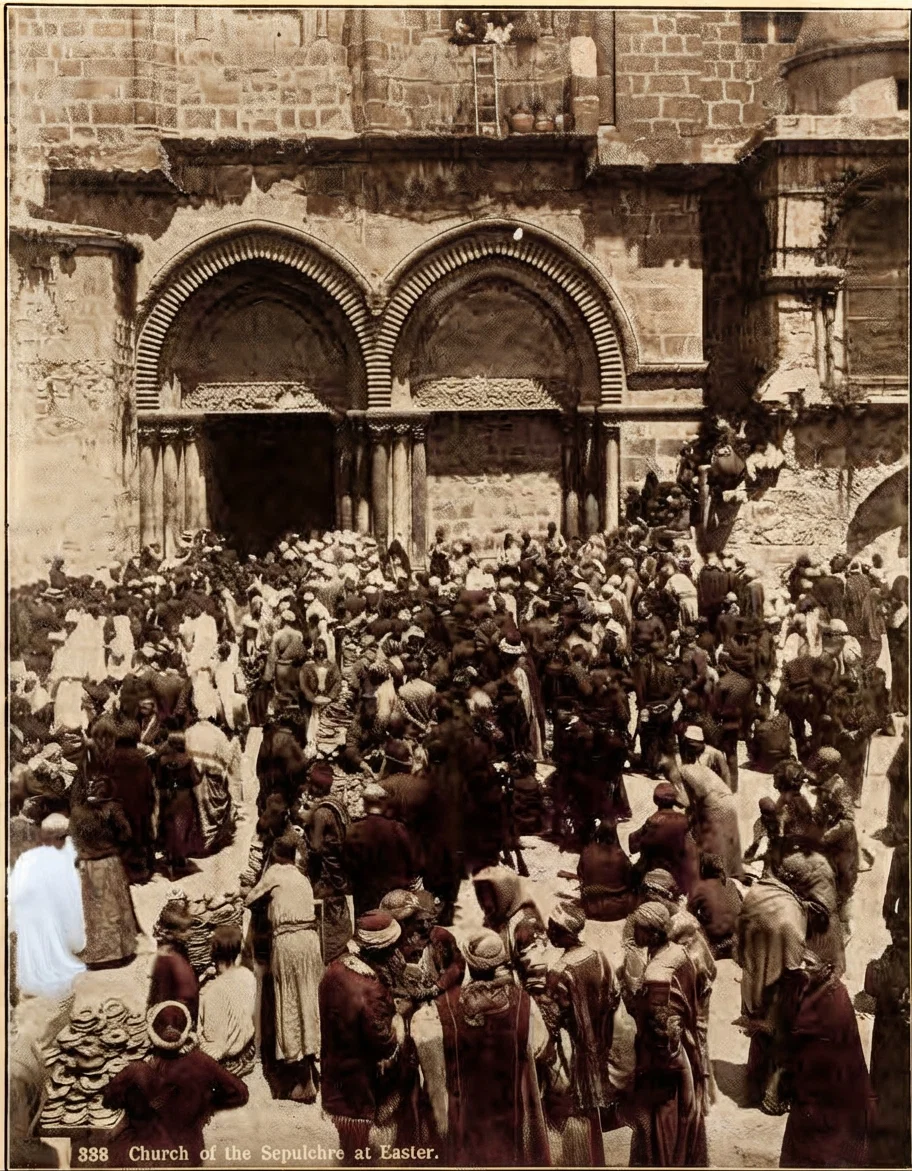
Scene in Jerusalem on "Easter Sunday" at the "Church of the Holy Sepulcher." No one can prove that our Lord was here buried.

The Miracle of Galilee

WE stand at the northern end of the lake and witness a strange phenomenon. The waters of the upper Jordan have journeyed down mountainside and through morass and past modern village and ancient ruin to gather to themselves the impurities and muddiness of a fast-running, unattractive stream. Now the miracle is on. Those yellow waters plunge into this pure water of Galilee, which reflects in its bosom the sapphire glory of the upper world, and immediately the stream is lost, and becomes at once purified. Where it pours itself into the lake, you can look down twenty feet and see the bright pebbles and shining fish. In no other place in the world does this seem to be paralleled. The great streams like the Ganges push their colored waters eighty miles and more into the sea, a distinct current. Smaller rivers sometimes make their yellow track across the entire lake; but the marvelous purity of Galilee makes every other drop of water instantly clear and clean.
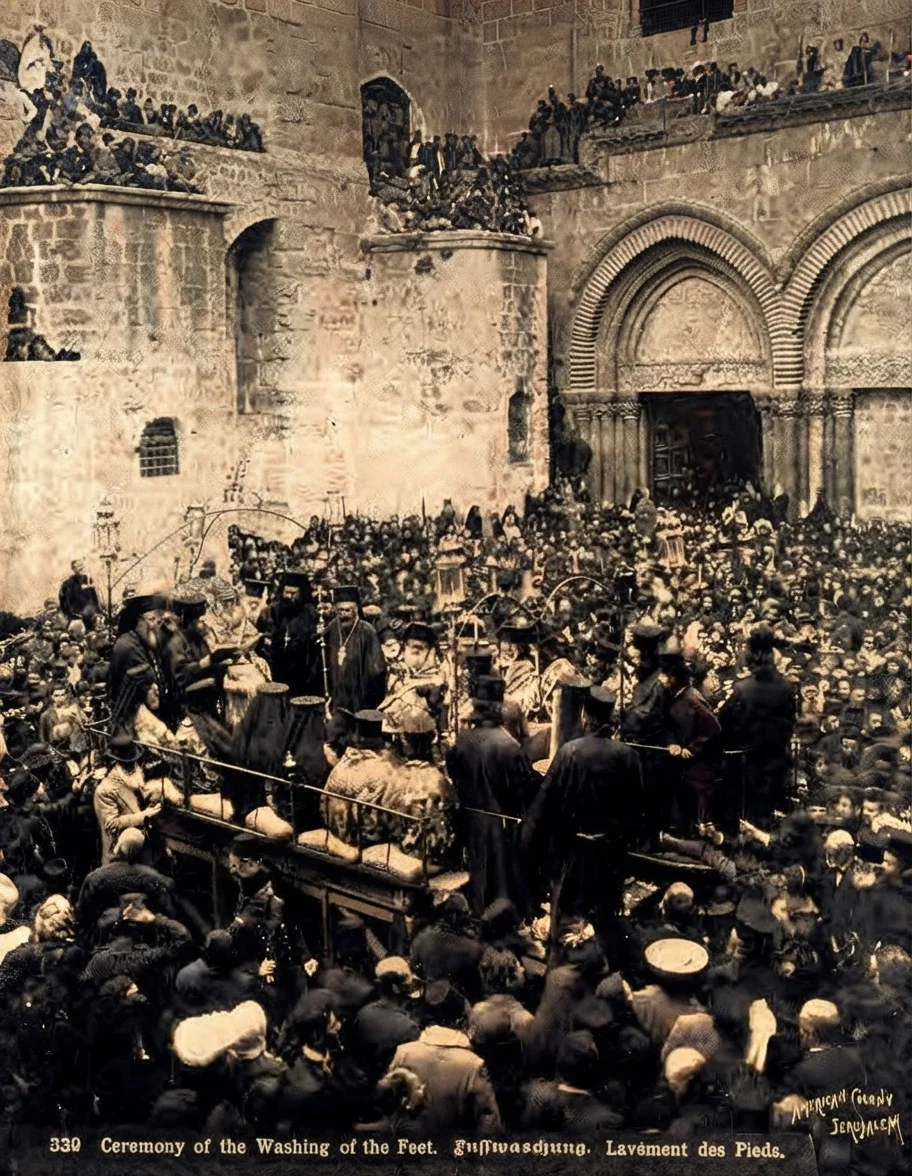
The ordinance of feet-washing was instituted by our Lord as recorded in John 13. It was celebrated in the early church in connection with the Lord's Supper. See note on last page.
This is the striking parable of the heart of Christ. The moment another life touches His life, the result is inevitable and miraculous. Nature has no phenomena to surprise us and no reality to change us like this. To come into contact with the purity of Christ, is to become pure. We have named it something else and harder to be understood, but this is the great change. This is the supreme wonder. This is the glorious possibility in human life—the muddy stream made pure enough to reflect heaven, by touching Christ. This is the power of Christianity and the demand upon every Christian life. The Christian life is the Christ life, and that is the purity of the upper world. Character, and nothing less than His character, is the result in any life which pours itself into the divine life. —Cortland Myers.

To-Day's Test

THERE is no hardship ahead of us in life that may not be made easier by our doing the hard thing of to-day with unflinching faithfulness. And every hardship that lies ahead will be the harder to meet by any failure of ours in to-day's test. This day's testing and trial is sure to be severe. It probably seems unfairly so. It may be the hardest we have ever yet known. It is sure to seem dull, and unattractive, and utterly lacking in those elements of picturesqueness or heroism or adventure that seem to mark the achievements of the world's great victors. But that is what makes it hard to the point of being worth while. And here is another reason for taking up its challenge manfully: "For this commandment which I command thee this day, it is not too hard for thee, neither is it afar off." How we ought to rejoice that there is something close at hand that is big enough to test us but not big enough to break us! —Great Thoughts.

Our Safety Is in Dwelling Apart

“The Lord brought Abraham up from Ur of the Chaldees, but he stopped half way. He had no blessing till, having set out to go to the land of Canaan, to the land of Canaan he came. He was safe and alone, even in the midst of foes. Lot was not safe in Sodom, tho in a circle of friends. Our safety is in dwelling apart with God.”

A Purpose for the Ministry

WHAT if every preacher could realize the truth of the assertion made by the young minister's aunt in regard to the audience he would address the first Sabbath after assuming his pastorate? "Ye maun mind, laddie, that they're no clever and learned like what ye are, but just plain country fouk, ilka ane wi' his ain temptation, an' a' sair trachled wi' mony cares o' this world. They 'ill need a clear word tae comfort their herts and show them the way everlasting." What makes this passage so striking is the fact that it is descriptive of the needs, not alone of that little kirk in Drumtochty, but of every church in the world.
Would that every pastor might be impressed as was John when his devoted aunt concluded: "But, O, laddie, be sure ye say a gude word for Jesus Christ." Under the influence of this counsel, John burned the learned discourse he had prepared; and on that memorable Sunday, his congregation quietly left the house of worship feeling a nearness to God and love to their fellow men, instead of awe and admiration for the young preacher's learning and studied eloquence. You remember that Donald remarked, as he went thoughtfully homeward:
"There was a man sent from God, and his name was John."
It is a fact greatly to be deplored, that many pastors forget that the Gospel alone can satisfy the hearts of men. Thousands of their flocks are starved on lectures fed to them. If discourses upon such topics as "When Silence Is a Virtue," "Long Beds and Short Bedclothes," "Where Shall We Live?" were occasional ones; if they were interspersed with sermons that warm one's heart to the Saviour, that inspire greater faithfulness to Him and His cause, the reason for regret would not be so great. But these topics are illustrative of the constant diet provided by many ministers for their Sunday morning congregation; and in some such lectures to which I have listened, not once even was the name of Christ mentioned.
Now, we are not intolerant of all except the oldest of thought and method, but rather, are inclined to be as liberal as the rest of the college-bred young people of to-day. In our opinion, a certain amount of such discussion is all right, provided it does not exclude the preaching that centers around Christ. It is the exclusion of the Gospel sermon that is growing so prevalent in some localities, to which I wish to call our pastors' attention. It seems as if a large part of the Sabbath desecration of to-day were due to this fault. It has been shown from investigation during the last fifteen years that on account of this lack of something worth going for, thousands of young men do not attend church; and that the preachers who prepare sermons with the single purpose of winning souls to Christ, have the largest congregations and the best results in their general church work. The man who lifts up Christ, will never fail to draw hearers; the man who has a real message, will never lack an audience.
The efficiency of the Gospel sermon is attested by the foreign mission reports. The true missionary realizes that there is at least one in his congregation who has never heard of Christ and may never again do so. To him he preaches. That one may go from that service to his home in some hamlet never reached by a Christian; but the missionary for Christ has tried to tell him enough in that sermon so that he will want to learn more and can lead others to Christ.
In point of conversions, the method of preaching employed by the missionaries pays about fourteen per cent. Here in the home land, pastors almost without exception (and these exceptions are so noticeable that we call them "evangelists," a name we ought to be able to apply to all ministers) take it for granted that all in the audience have been brought up in Christian homes, know the Gospel story by heart, pray and read the Bible every day, and have such a knowledge of and love for Christ that on Sunday they need a change of thought, something "liberal," something "broad." And many prayers seem to be offered for oratorical effect, many "sermons" preached to pander to the supposed tastes of the whole congregation, because, perhaps, one or two of the least spiritual have expressed a desire for lectures. And these methods, in point of conversions, pay us one and three tenths per cent.
Do not these facts, added to other observations we can make for ourselves, give us a hint as to how we are to accomplish the purpose of the church—the evangelization of the whole world? In every other business there is an aim, to the accomplishment of which every part of the organization is contributory; but, strange to say, some very important parts of our organization seem to have forgotten the purpose for which they have been called to our pulpits—to lift up Christ, and Him alone.
Now, we do not have to think that this is something that we, as laymen, can not help. If you feel a deep need of the Gospel, tell your pastor so. There is not a man in our pulpits to-day who does not desire to please his people. And if these same people ask for the talks that will bring them closer to Christ, just that kind of sermons will they get. But it is Gospel sermons that the pastor ought to preach anyway, "not as pleasing men, but God, which trieth our hearts."

The Call of the Night

THERE'S a cry in the wind to-night From the lands where the Lord is unknown, While the Shepherd above, in His pitiful love, Intercedes at His Father's throne.
There's a call from the dark to-night, That haunts the lighted room, From His "other sheep" on the broken steep At the edge of eternal doom.
There's a pain at my heart to-night — From the heart of God it came — For I can not forget that He loves them yet, And they've never heard of His name.
There's a sob in my prayer to-night, When I think of the million homes Where never a word for the Lord is heard, Nor a message from Jesus comes. — Author Unknown.

"In the End of the Sabbath"

"In the end of the Sabbath, as it began to dawn toward the first day of the week, came Mary Magdalene and the other Mary to see the sepulcher." Matt. 28:1. See also Mark 16:1, 2. One writer says of this text, "The right translation of Matt. 28:1, and kindred scriptures, gives us the Christian Sabbath, and leaves Saturday-worshippers without a foundation to stand upon."
Then he proceeds to give us what he calls a "right translation of Matt. 28:1," as follows:
"Now, in the end of the sabbaths at the dawning toward the first day of sabbaths, came Mary Magdalene and the other Mary to see the sepulcher."
Now we can not agree with this so-called "right translation," for all scholarship is against it, as will appear by reading a few other translations of the phrase in question.
"Now late on the Sabbath day, as it began to dawn toward the first day of the week."—American Revised Version.
"Now after the Sabbath, as it was dawning to the first day of the week."—Emphatic Diaglott.
"And after the Sabbath, when it began to dawn on the first day of the week."—Sawyer's Translation.
"Now after the Sabbath, as it began to dawn toward the first day of the week."—Wesley's Translation.
"Sabbath being over, and the first day of the week beginning to dawn."—Campbell, Macknight, and Doddridge's Translation.
"After the Sabbath, in the early dawn of the first day of the week."—Weymouth's Translation.
"After the Sabbath, as the first day of the week began to dawn."—Twentieth Century New Testament.
"And the Sabbath being over, in the dawn of the first day of the week."—Norton's Translation.
"And the Sabbath being over, as it began to dawn toward the first day of the week."—Noyes's Translation.
From the above we judge the so-called "right translation" to be in error, and the assertion a mistake. ARTHUR L. MANOUS.

The Divine Order

First made pure, then sacrificial. This is the normal life. It is not something to be feared. It is to be experienced with delight. This is life at its best and its happiest. Without it Galilee becomes a Dead Sea,—no beauty, no music, no life; death everywhere. We live by dying. We save by giving. We find by losing. The man who keeps his religion has not a religion worth keeping. It is a strange statement but true, that Christianity must be given away in order to be kept.—Cortland Myres.

How Do You Work?

MAN must work. That is certain as the sun. But he may work grudgingly, or he may work gratefully; he may work as a man, or he may work as a machine. He can not always choose his work, but he can do it in a generous temper, and with an uplooking heart. There is no work so rude that he may not exalt it; there is no work so impassive that he may not breathe a soul into it; there is no work so dull that he may not enliven it.—Henry Giles.

OUR BIBLE BAND

Schedule for Week Ending April 2 Sunday March 27 Joshua 5-8 Monday " 28 " 9-11 Tuesday " 29 " 12-14 Wednesday " 30 " 15-17 Thursday " 31 " 18, 19 Friday April 1 " 20-22 Sabbath " 2 " 23, 24
OUR week's reading begins with Joshua 5 and closes with the book. It will be noted that the first thing that Israel did after crossing the Jordan was to carry out the ceremony of circumcision, which was the indication that they had cut themselves off from all unholy intercourse with the world, and had dedicated themselves to God. We have the record after this of the Captain of the Lord's host appearing to Joshua, showing that He was cooperating with him in the work that God gave him to do.
THEN follows the encompassing of the wicked city of Jericho. God is no respecter of persons; and every time that Israel marched around that city, there was opportunity for the inhabitants of Jericho to open the gates of that city and welcome them in. But every time, their hearts grew harder, until the time came that God's host threw down the walls of the city, and only Rahab and her household were saved.
THAT city God devoted to destruction, and Achan committed the awful trespass of taking what belonged to God. He showed how one traitor to God in a church or an assembly can turn away the blessing of God from all connected with him; a great and awful fact, which has been repeated many times since.
THE remainder of the book tells of the wars of Israel, the division of the land, Joshua's solemn charge before he lays down his burdens. Very touching and forcible is his plea to halting, unbelieving Israel. He had served when others had failed; and at the very last he declares, "If it seem evil unto you to serve Jehovah, choose ye this day whom ye will serve; . . . but as for me and my house, we will serve Jehovah."
ONE can but reflect, as he reads the experience of Israel during the days of Joshua, that had they been faithful to God, He would as truly have driven out or destroyed their foes from before them, as He did the city and inhabitants of Jericho. They would not have needed to imbrue their hands with blood; God, who saw all hearts and knew all conditions, would have fought for them.

Vindicative and Vindictive

THE judgment of God in the punishment of the finally impenitent will not be vindictive in its nature, but rather vindicative. God will not punish a man because He has a grudge against him, from petty spite, or through feelings of revenge. This would be vindictive, the same spirit that prompts man to revenge on his fellow some real or fancied wrong. In the destruction of the wicked will be manifested the highest exhibition of God's love. "God is love," and every act and attribute of His character is one of supreme love for all His creatures. Sin produces sorrow, misery, and wo. To prolong the lives of the impenitent would be but to prolong their misery and suffering. God in love takes from them that life which of itself has become a burden. In all this He vindicates His own honor, and contributes to His own glory and the happiness of His people.
—★—

The Unchangeable God

THE following excerpt is from a sermon by the Rev. D. S. Phelan, D.D., editor of the Roman Catholic Western Watchman, and is published in that paper in its issue of February 10 last:
"Men tell us that everything is changing; that development is the universal law; that the world is changing; that men are changing; that the moral system is changing; that everything is undergoing a process of change. Therefore, religion must change, the Gospel of Jesus Christ must change, the world needs now another Redeemer. Men demand a new Gospel. Now what has changed? Has anything changed? Has the sun changed? Does he not rise and set as he always did? Have the stars changed in their courses? Have the rivers changed? Have the mountain ranges changed? Have the seasons changed? Do they not follow each other in regular course, and have they not been doing it from the beginning? Have the animals changed? Are not the bears what bears always were? Are not lions what lions always were? Are not the oxen, and the sheep, and the domestic animals, what they always were? There is nothing changed there; nothing changed in the heavens above, nothing changed in the earth beneath. Then what has changed? Has God changed? God is the same yesterday, to-day, and forever; He knows no change; upon Him never falls a shadow of alteration. God is essentially immutable. Has truth changed? Has the multiplication table changed? Have men's minds changed? Have men's hearts changed? No, men are the same as they always were; men are the same inconstant and inconsistent beings they always were. Men to-day love what is good and run after what is bad. Men to-day approve the right and do the wrong. Men to-day are false to themselves and false to each other, as men always were. If we read the history of the world aright, we will find that men are the same in every age, and there is no change in humanity."
All of which is generally true, and as regards God's immutability emphatically true. "I am Jehovah; I change not;" "with whom is no variableness, neither shadow of turning," are the words of Holy Writ. How is it, then, that the Roman Catholic Church would presume to change the holy law of God in the substitution of Sunday, the first day of the week, for the Sabbath, the seventh day of the week? She claims authority to do that. Does not that very claim, prove, demonstrate that she is not the true church of the unchangeable God?

Men versus God

MUCH is made nowadays as to what learned men may have to say concerning a doctrine or belief. The majority of Christian scholarship, it is said, is against the "Higher Criticism." What of it? Suppose they were for it? Would that affect the truth? It may be that one man knows a fact, and one thousand others do not believe it; does that change the fact? So far as the Gospel of Jesus Christ is concerned, the men of worldly wisdom have always been found against its work for their day. The children of the Exodus doubtless believed in God's work through Abraham and Joseph, but not through Moses. The Pharisees and scribes and learned doctors of the law in the time of our Lord's sojourn on earth, believed in God's work through Moses, or thought they did; but they rejected Him whose coming Moses predicted. Many learned men will tell us to-day that they believe in the work of Jesus and the apostles for their day, but they do not believe the things which Christ and His apostles taught for our day.
The only true faith is a present, living faith, which lays hold of a present Saviour, a present truth, a present Gospel. "All flesh is grass, and all the goodliness thereof is as the flower of the field; . . . the grass withereth, the flower fadeth; but the Word of our God shall stand forever." "Ye have plowed wickedness, ye have reaped iniquity; ye have eaten the fruit of lies: because thou didst trust in thy way, in the multitude of thy mighty men." "For ye see your calling, brethren, how that not many wise men after the flesh, not many mighty, not many noble, are called: but God hath chosen the foolish things of the world to confound the wise; and God hath chosen the weak things of the world to confound the things which are mighty; and base things of the world, and things which are despised, hath God chosen, yea, and things which are not, to bring to naught things that are; that no flesh should glory in His presence." But those who trust in God will find Him in Jesus Christ "wisdom, and righteousness, and sanctification, and redemption." "He that doeth the will of God [not of men] abideth forever."

The Unfathomable Fulness

THE eternal ages of the future will fail to reveal to our minds the fulness of one single attribute of the character of our blessed Lord. So long as God shall be higher than man, which will be so long as He maintains His character of God, there will be in Him unexplored and unfathomable depth and greatness. One of the joys of the eternal state will be the study of God and of His matchless love as manifested in the gift of His Son. And every time the arches of heaven resound with the praise of the redeemed, there will be revealed to their minds some new phase of heavenly beauty and loveliness, which will call forth from them fresh expressions of delight and holy, enraptured joy. Thus it is that those whom John saw round about the throne cry day and night, "Holy, holy, holy, Lord God Almighty."

Excavations at Jericho

One of the German societies conducting investigations in the Holy Land, are making excavations in Jericho, the city whose walls fell down before the marching of Israel. They claim that the evidences which they have unearthed show that the city was a strong city before the day of Israel, as the Bible intimates. The most remarkable result of the excavations was the finding of a double wall embracing the whole city of Jericho. This double wall may have been erected by the Jews at a later date.

Mexico

THERE has been running for some time in a popular magazine a series of articles entitled "Barbarous Mexico," charging that country with thousands of cases of chattel slavery, with peonage, with inhuman treatment of Yaqui Indians, etc., etc. Not long ago we inquired of a gentleman who had been for some time in Mexico, and who was conversant with conditions in all parts of the republic, regarding the truthfulness of these articles. His reply was in substance that some of these things were in a measure true, and that many things occurred which would not be done in America, but conditions were vastly different in the republic of Mexico than they were in America, and the government found that some things were absolutely necessary that would not be tolerated in the older republic of the North. This gentleman considered, however, that on the whole Mexico was getting as good a government as could be expected, and he doubted very seriously indeed whether a course opposite to that pursued by the present government would get better results.
The government meets constant and persistent opposition from the Roman church and also from the lawless classes; and many of the reports of cruelty and unjustifiable severity are greatly exaggerated. The above is confirmed by an article in the Literary Digest of February 26 which has just come to hand, and which quotes from Mr. Elisha H. Talbot in a series of articles in Moody’s Magazine. It declares that the articles referred to above are a libel upon a "much maligned and sadly misrepresented country." Some of the details mentioned by the above series of articles are pronounced "wicked fabrications" by General Torres.
"No peaceable Yaqui was ever deported to Yucatan or elsewhere; only such are deported as have been guilty of criminal acts; and no Mexican families have ever been deported—only Yaquis, and these after many appeals have been made to them to obey the laws of the land, and after repeated warnings to cease pillaging and murdering."
David E. Thompson, former United States minister to Mexico, is quoted as saying, "The Mexican government has dealt more kindly with these blood-thirsty Indians than justice demanded."
An American lawyer, Robert J. Kerr, says:
"During the period of nine years covered by my personal experience there have been in that district two or three instances of improper treatment of laborers by their employers; but these were investigated as soon as reported, and the offenders were severely punished."
Mr. Talbot has this to say regarding the charge that President Diaz is a despot:
"I doubt if there is a country on earth that can point to a cleaner record in this regard [that is, in the matter of amassing great wealth at the expense of the country] than can Mexico."

The Decadence of France

We have received advance sheets of the North American Review for February containing a striking article on "The Decadence of France," by Mrs. Bellamy Storer, in which Mrs. Storer goes on to show that France is rapidly degenerating into absolute infidelity; that the secular schools, instead of being purely secular, are not only non-religious, but really anti-religious; more than this, are making a religion of infidelity. She gives samples of how in books expressions which refer in any wise to God or providence have been cut out, and nature or the state has been substituted.
For instance, she tells us that in the events of Robinson Crusoe, when he came to a time of great need, he prayed, "Lord, help me, for my need is great." Then he remembered that he had tobacco in a trunk, and in searching for tobacco he found a Bible, in the Bible a promise, and he pleads the promise, and his fever leaves him; but the revised edition of the book in the schools of France omits all mention of the Bible and everything connected with it, and the idea is left that the tobacco cured him.
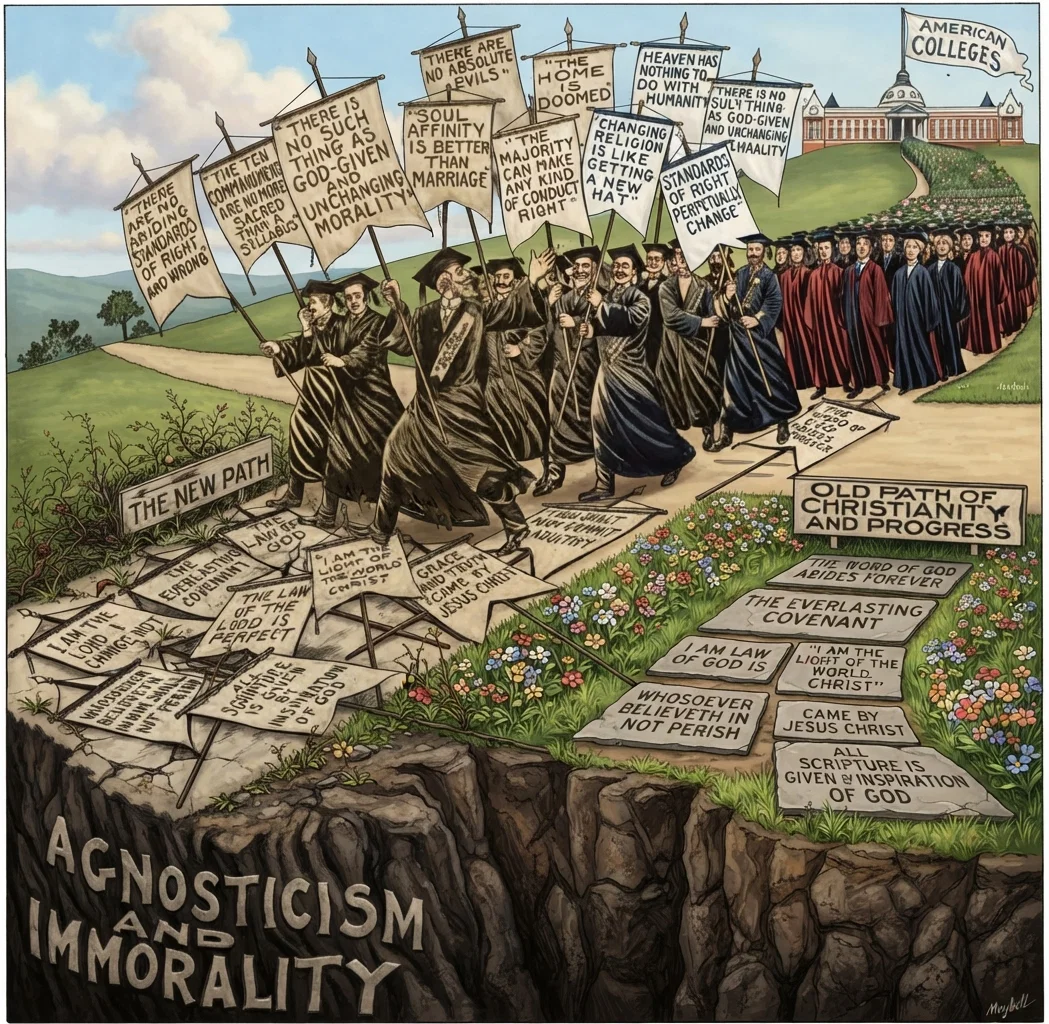
This cartoon is not meant to include all colleges; for there are honorable exceptions, especially among the smaller schools. The expressions on the banners, however, are actual quotations from the teaching of various educators in great universities and colleges. This teaching tramples under foot the very essentials of Christianity. Religious anarchy breeds political and social anarchy and fosters crime.
Of course Mrs. Storer, a devout Roman Catholic, feels that the condition of France is awful beyond description; and it is. It is a sad, sad thing when infidelity is openly and aggressively taught; and yet there is one thing, it seems to us, which Mrs. Storer and other good Catholics ought to think about in the study of the question.
What drove France to infidelity was the recoil from the conditions brought about by the church of Rome, which had ruled it for years. If Protestantism stood where it ought to stand, it would save many of the French from infidelity; there was a time when God desired to save France from her infidelity;
namely, during the Reformation period. But the Protestants were driven out, France was held to Roman Catholicism, and the Revolution followed. Now that Revolution is being repeated. The reaction has swept back again, perhaps not as aggressively as in the eighteenth century, but nevertheless as truly. Infidelity is but the reaction of extreme traditionalism. One puts a man and history in the place of God, and the other puts the living, carnal human in the same place, and both tend to degeneracy.
Continue reading: The Star of Bethlehem