Almost Unbelievable Atrocities — Fire upon Their Own Dead — Impelled by Demons
A DEMONIACAL fury that goes beyond the powers of description has characterized the war in Europe. Both sides in the controversy have been studying, as never before, how they might improve their weapons of destruction, and how they might invent new ones. To use the language of one who has been on the battle field during some of these severe struggles: "As the war has progressed, science has been adding element after element to the arsenal of frightfulness." Poisonous gases and liquid fire have been brought into the field of action. It is said that two of the new automatic rifles are equivalent to one machine gun. The hand grenade has been constantly developed into greater convenience and power, while the "torpedo bomb" is perhaps the most terrible of the improvements that have been made in the destructive elements since the war started. This torpedo bomb has an "explosive force that is appalling. They split up into long splinters, sharp as a knife, that cut men about in atrocious fashion."
All these new elements and improvements have been brought into action to be used at Verdun, in the battle that has been raging there since February 20. The descriptions of that conflict, given by men who have been on the ground, show something of its awful character.
Seemed Like an Earthquake
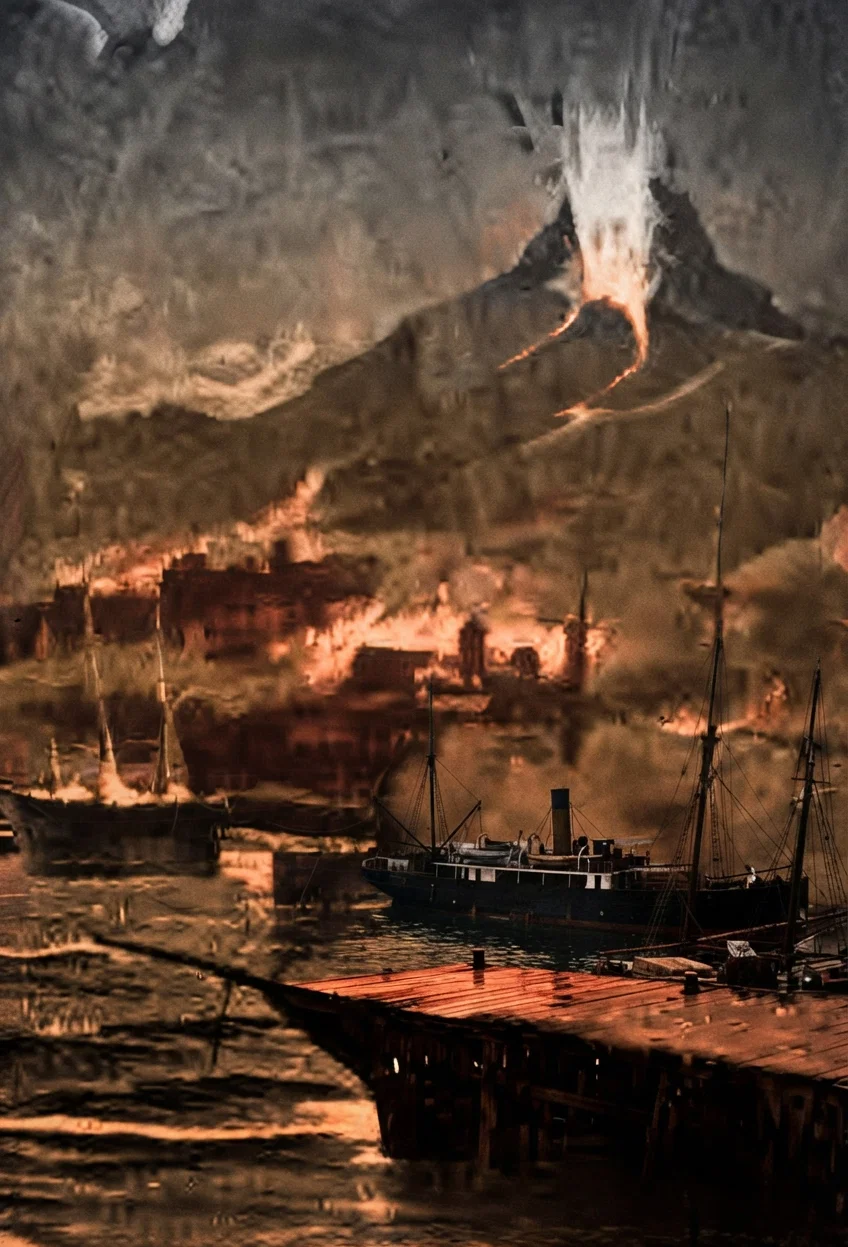
BUT as these men say, words are powerless to tell the story. Every inch of ground is "searched by an incessant hail of shells of all descriptions." One of the participants said: "I saw two shells, I don't know of what caliber, meet in the air. The double explosion was appalling; but it was high up, and did no damage." This same individual said: "It made one dizzy to watch it. I once was in an earthquake in Martinique, and it seemed like that."
“I was once in an earthquake in Martinique, and it seemed like that.”
The earthquake in Martinique was one of the most destructive disasters in modern times; and the man who found the battle at Verdun like such an appalling earthquake as the one at Martinique, continues his description as follows:
"The ground appeared to rock and change its shape like the sea; and no wonder, for the shells were falling so thick that the craters formed by their explosions were promptly filled in and deformed by the craters made by fresh explosions. I have been in holes, during this fight, that were ten or twelve feet deep, and must have been made by several shells bursting in the same spot."
For more than four months, the mighty opposing armies have been in the midst of these demon furies of war in that battle of Verdun. Think of what it means for men to stand under such a strain for such a length of time. Before the war broke out, we were assured on every side, by the warriors and the pacifists alike, that men would never face the modern weapons of destruction, and therefore war on any large scale was at an end.
All these theories have been completely shattered. Four months of continuous war tempest like that at Verdun is sufficient to show that men will stand for day after day and week after week, in the face of the worst forms of destruction that demons can invent.
When this Verdun battle had been in continuous progress for three months and five days, a dispatch stated: "The fighting at Verdun continues with implacable fury. There is not even time given to bury the dead or succor the wounded."
The soldier is trained to face death, and he does it. It will take something besides appalling instruments of death to pave the highway to peace.
Speaking of a counter attack that had been ordered, this soldier, who was in the thick of it, said, "Our men arose as one man, . . . their faces transfigured by the desperate passion that shook us all."
In reference to the preparations for these fearful charges, it is stated that the men are "usually doped into madness by potent drugs." And in this condition, "they come on like fiends, and appear entirely unconscious of what they are doing."
Concerning the artillery fire that was playing upon the charging columns of men, this participant said, "It was mowing down the close ranks of the enemy, literally like standing corn before a reaper."
The Wall Street Journal is not given to publishing sensational news. It usually confines itself to the cold figures of finance. In one of their recent issues, they give a short description of what one of the eyewitnesses saw enacted on the battle field around Verdun. Viewing the scene through his field glasses, this writer tells of the masses of men that were charging forward. And then the "guns opened, and mangled humanity was piled in windrows. I thought the battle ended; but in a short time, another line in solid formation was sent steadily forward, and as they started to pass over the piled-up heaps of their dead and dying comrades, the cannon again blazed, and the pile of dead and wounded looked a solid wall."
"I had never dreamed of such slaughter; but the sight that followed, I think no man ever before saw. High explosive shells began blowing to pieces the masses of dead and dying."
Blew Up Their Own Dead
THE writer speaks of his horror at such a sight, and then explains that the action was "blasting the walls of the dead and dying, that another line of troops might pass through and execute the order, 'Forward!'"
All past wars have been bad enough; but never before have there been wars that the Bible has described as being especially impelled by the spirits of demons. John, in apocalyptic vision, describes the spirits of devils working miracles as they go to the kings of the earth and of the whole world to gather them to the battle of that great day.
Is it any marvel that the prophet Jeremiah, while viewing the scenes that are passing before us in the world to-day, should9have said, as anguish took hold of his heart, that his heart made "a noise" in him? The scene was so tense, so indescribably awful, that as the prophet viewed it two thousand five hundred years before it should occur, he found his heart pounding within him, making "a noise."
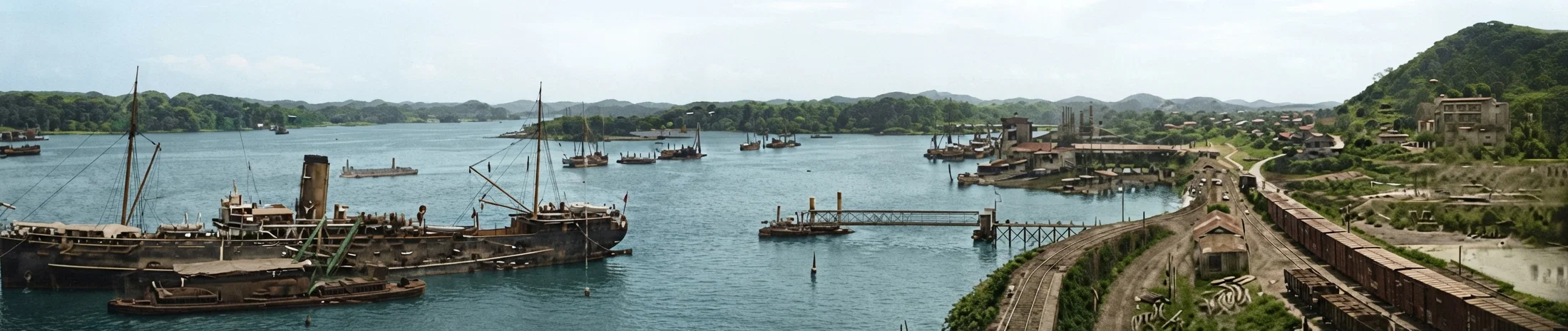
BIRD'S EYE VIEW OF BALBOA AND PACIFIC COAST ENTRANCE TO PANAMA CANAL.
The prophet hears the sound of a trumpet and "the alarm of war," and says that "destruction upon destruction is cried," for "the whole land is spoiled."
It is apparent that our civilization is no barrier against the demons of war. And it is quite as clear that nominal Christianity, which has only the form, and knows nothing of the saving power of Jesus Christ, cannot keep men from fighting. The only hope for the individual in this time is the real experience in the salvation of the real Christ, which will prepare us to stand in His presence at His coming.
His coming cannot be long delayed, for the conditions in the world at the present time are too filled with destruction to last. To get ready for that great day should be the absorbing passion of every heart.
TO OUR READERS
By Editor
All reasonable effort will be made to preserve accuracy of statement, and to verify all authorities quoted.
Scripture quotations, when not from the Authorized Version, are taken from the American Standard Revised, unless otherwise stated.
Persons receiving copies of this paper without ordering them are not indebted to this office. Such papers are paid for by others.
Manuscripts should be addressed to the editor. Address all business and make all money orders, etc., payable to the SIGNS OF THE TIMES, Mountain View, California.
SUBSCRIPTION RATES
By Editor
Three months ................................... $0.50
Six months ........................................ .90
One year (50 numbers) ..................... 1.75
With "Questions and Answers" ............ 2.00
Two or more copies to one person, six months, each $0.60.
Two or more copies to separate addresses, six months, each $0.65.
Weekly and monthly SIGNS one year, $2.25.
Expiration: The wrapper bears date of the last issue due on your subscription. Unless renewed in advance, paper stops with the expiration date.
Change of address: Kindly give both old and new address.
JAMES COCHRAN, Circulation Manager.
ON THE CANAL ZONE
By W. A. S.
Encouraging Words from the Regions Around the Caribbean
OUR West Indian Union Conference Committee who gathered in council on the Canal Zone represented 4,000 members of every country and about every island around the Caribbean Sea.
A Spanish Bible Class at Panama
Small though our numbers are, comparatively, it is really remarkable how these Sabbath reform and advent truths find their way into every corner of the earth where men dwell. The message that we bear is marked in the prophecy, “To every nation, and kindred, and tongue, and people,” and surely it is hastening on toward the goal.
The place of our missionary council was the Seventh-day Adventist church in Cristobal, on the Canal Zone. The roar and rumble of the rushing traffic of the Panama railway was in our ears as we discussed mission problems; but alongside the great canal seemed a fitting place for a missionary council. Every highway of world travel and traffic is a missionary highway, in this generation of world evangelization. It was so in the apostolic days. The book of Acts and the earliest ecclesiastical histories show how the gospel message followed the paths of commerce and colonization in the Roman Empire.
So in the Panama Canal we see not only one of the greatest works of human skill, but we recognize the hand of Providence as well, which in our day has been shortening distances, and providing new ways and means for the enlightening of the world. As the great pathway opens at last, from sea to sea, we may well recall Mackaye’s hymn of thanks:
“Lord of the sundering land and deep,
For whom of old, to surge
Thy wrath,
The floods stood upright as a
heap,
To shape Thy host a dry-
shod path, “Lo, now, from tide to sundered tide,
Thy hand, outstretched in glad release,
Hath torn the eternal hills aside,
To blaze a liquid path for peace.”
S. D. A. representatives at Latin American Missionary Congress
It is the day of the yet wider opening of the Latin countries north and south of the isthmus. Already, notwithstanding the confusion the great war makes in shipping, the awakening and stir of a new time is to be seen and felt in these regions.
A New Impetus to Protestant Effort
SHORTLY before our own missionary council gathered on the Colon side, the great Latin American Missionary Congress had been meeting in Panama City, on the Pacific side. It was an enthusiastic and seriously businesslike congress, planning ways and means for the missionary enterprise in Central and South America. A number of representatives of our own mission
fields were present in the meeting. As the New York Christian Herald report put it:
“Representatives of more than fifty denominational organizations were present. The Protestant Episcopal bishop sat down beside the Seventh-day Adventist.”
Whatever makes for the spreading of the word of God and the giving of the gospel invitation to sinners, rejoices our hearts; and we who watched the proceedings, felt that a new impetus was to be given to Protestant effort in the Latin countries. The authorities of the Catholic Church recognized it also. The
archbishop of Panama formally warned all Roman Catholics to keep away from the congress, and denounced it as a new peril to the people of Latin America.
Because of the pronounced aversion of the great societies to the Bible Sabbath, we Seventh-day Adventists have a message for the Roman Catholic which others have not. And everywhere our workers rejoice to see how the power of God attends the delivery of that message among truth-seeking Roman Catholics.
Every year, in normal times, in Europe and the Americas, hundreds of Roman Catholics become Seventh-day Adventists, and join us in proclaiming this message of preparation for the coming of the Lord.
A Back-to-the-Land Movement
IN our Cristobal committee council, it was planned to establish work in Colombia, the only Central or South American country that had not been put permanently on our missionary map. Now workers are in the field — Elder B. E. Connerly and his active family, with headquarters a week’s journey in the interior.
Our work on the Canal Zone has been largely among the West Indians working or living within the Zone while the construction work was in progress. Now all this community is moved away, and members have spread everywhere. Several companies have taken land on the isth-10mus, outside the Zone. I visited one of these churches. I saw a back-to-the-land movement working out very satisfactorily. Most of these happy members had seen their funds disappearing after canal construction stopped, and they were left to pick up work as they might in Panama City. Then the idea took root, 'Why not take up 'cultivations' beyond the Zone?' Allotments were secured in the savannas, or the unbroken country; and as a little money was earned, houses began to go up in the wilds; first the merest shelters, then boarded-up cottages. On my visit, I saw a cheerful company, meeting for worship in a neatly built church, with every sign of an industrious community of home makers.
We have a good church building in Cristobal, and a mission hall in Panama City.
Elder W. G. Kneeland, president of the West Caribbean Conference, whose headquarters are on the Zone, leads a field stretching a thousand miles, from Nicaragua to the bounds of Colombia. He reports an interesting work started among the Mosquito Indians of the Nicaragua coast.
The South Caribbean Conference was represented by Elders N. H. Pool and E. C. Widgery, headquarters in Trinidad, off the Venezuelan coast. This field reported 378 baptisms during the year.
The Jamaica Conference, E. C. Boger, president, reported 221 baptisms.
All together, as the representatives of our work around the Caribbean made up their lists, the baptism of adult converts totaled 711.
Watching for Some One to Come
THUS in regions to the southward, where the laborers are few and the needs great, the blessing of God is attending the preaching of the Word. It is a difficult field to cover. When the council had planned for Elder A. J. Haysmer, president of the West Indian Union, to visit a portion only of the field, it was found he would require seven months to make the visits.
Up both the Berbice and the Essequibo River, in the Guianas, Indian settlements continue to call for Seventh-day Adventist missionaries to come to them. A small work has already begun on the lower reaches of these rivers, but the conference has been unable to provide funds for the opening of the far interior. In the days of 1844, the Indians of these regions were stirred up somehow to think of Christ's second coming. Into their tribal traditions has grown the idea that some day teachers will bring them news of the coming of the Messiah. Having heard of our work and message, they have sent word that they are waiting for us. 'We are watching for some one to come,' they say.
Truly the harvest is great, and the laborers are few. We felt it anew meeting with the West Indian committee on the Canal Zone, and seeing these brethren trying to stretch their resources to answer new calls. W. A. S.
AN INDUSTRIAL CRISIS APPROACHING
What Will Happen When Wages Tumble After the War? — Will There Be Riot and Bloodshed?
SOBER thoughts fill the minds of many of the world's best thinkers as they look into the future. Tremendous changes have occurred during the past two years. The times have been vibrant with intensity. The wheels of industry have, in this nation, whipped up their speed.
America is enjoying the "most abounding prosperity in her history of a century and a half." Never have such high wages been paid to the workers — two dollars a day for the cheapest form of labor, and up to forty-five dollars a day for workers in some of the munition factories. Yet grave apprehensions are felt over the industrial complications that will inevitably follow the present war.
Strikes from Shore to Shore
ACCORDING to the Current Opinion for July, "there is a cloud on the horizon. It is no bigger than a man's hand, and yet it is a cloud that may wreck American prosperity."
Illustrating the statement by concrete facts, the magazine quoted continues:
"In spite of high wages, we never before had as many impending strikes as we now have. In spite of the rapid advance of the eight-hour day, we never before had as many impending strikes. At the time of writing this, strikes are impending among all telegraph operators from Chicago to New York, among all train men, among all garment workers, among the anthracite coal miners.
"Munition workers are receiving all the way from forty-five dollars a day down to three dollars a day, and there is not a munition plant in the country, from Bridgeport to Calgary, where strikes have not taken place and are not impending. Longshoremen and dock men netting six dollars to four dollars a day are on strike in one harbor. Longshoremen and munition workers, the latter receiving four times as much as a foreman who has spent ten years preparing for his job, four times as much as a banker who has spent ten years preparing for his job, nine times as much as a teacher or college professor who has spent seven years preparing for his job, are on strike for one of two things — higher wages or shorter hours; in some cases both.
"As long as our abounding prosperity lasts, we can pay the higher wages for the shorter hours, raise the cost of living to meet the higher wages for the shorter hours, and raise the wages to pay the higher cost of living for the higher wages and shorter hours — what the late James J. Hill described as 'a fatal spiral' to a peak, from which we might all tumble over a precipice. That is, as long as the war lasts and we are wallowing in prosperity from the misfortunes of others. But when the war stops, what? Wages shoot up, but they cannot come down without causing a riot or a strike.
"The extremists say that wages are bound to go up and up, and hours to come down and down, until labor has expropriated capital. Capital says, the minute higher wages and shorter hours destroy returns, industry will be wrecked and ruined. Between these two is a chasm. He who bridges the chasm will avert catastrophe."
Forebodings Foretold
WILL there be a tumble in wages when the war is over? And will the multitudes of workers accustomed to big wages stand idly submissive under the very shadow of the fabulous war fortunes heaped together by the financial reapers from the war's harvest?
There is an undeniable feeling of suppressed anxiety over the outlook. There is a strong presentiment that somehow human history is approaching a crisis. But who can throw light on this difficult problem? Who can read the future? Surely it is beyond the ken of the human mind. Yet there is One who knows the end from the beginning — the living God.
And "we have also a more sure word of prophecy; whereunto ye do well that ye take heed, as unto a light that shineth in a dark place." 2 Peter 1: 19.
In this sure word, even the forebodings that now fill men's hearts are foretold. After delineating those "signs" which were to serve as precursors of the second coming of King Jesus — the "distress of nations, with perplexity," and so forth — the inspired description continues, "men's hearts failing them for fear, and for looking after those things which are coming on the earth."
We have reached the time foretold. We have reached the time of the "distress of nations" pictured in advance, and now men's hearts are filled with forebodings over "those things which are coming on the earth."
We are approaching a crisis — the world's crisis. It will be felt in every sphere of human activity. It will belt the globe.
A Time of Howling
WE are swiftly approaching the time foretold by the apostle James in these significant words:
"Go to now, ye rich men, weep and howl for your miseries that shall come upon you. Your riches are corrupted, and your garments are moth-eaten. Your gold and silver is cankered; and the rust of them shall be a witness against you, and shall443eat your flesh as it were fire. Ye have heaped treasure together for the last days. Behold, the hire of the laborers who have reaped down your fields, which is of you kept back by fraud, crieth: and the cries of them which have reaped are entered into the ears of the Lord of sabaoth. Ye have lived in pleasure on the earth, and been wanton; ye have nourished your hearts, as in a day of slaughter. Ye have condemned and killed the just; and he doth not resist you. Be patient therefore, brethren, unto the coming of the Lord. Behold, the husbandman waiteth for the precious fruit of the earth, and hath long patience for it, until he receive the early and latter rain. Be ye also patient; stablish your hearts: for the coming of the Lord draweth nigh. Grudge not one against another, brethren, lest ye be condemned: behold, the Judge standeth before the door." James 5: 1-9.
The Coming Storm
BUT above this dark international industrial storm, with all its rumblings and mutterings of hate, with its lurid flashes of violence, is seen the rainbow of promise. "The coming of the Lord draweth nigh." The world's industrial strife will end at the second coming of Christ. It can never be settled by human wisdom. Socialism can never bring about a settlement.
This is not pessimism. Earnest, thoughtful men everywhere see the dangers that threaten. It is well to face facts squarely. The student of God's word looks above these dark, distressing scenes, beyond these clashes of might against might, and fixes his hope on the return of Jesus. This will be the Christian's anchor in the coming industrial storm. L. E. F.
“IN PERILS OF ROBBERS”
By J. E. F.
The Providential Escape of Missionaries in China
A THRILLING story comes fresh from Shensi province, China, where revolution is rife, and where bands of marauders with murderous weapons are looting. Three of our missionaries — Dr. A. C. Selmon, and Pastors Frederick Lee and Liu Djeng Bang — had gone into that province to look after a new interest that had recently sprung up, where lately we have organized four Sabbath schools and prepared to start church schools, and where about fifty persons have requested baptism.
These workers returned by the old dusty highway, said to be a thousand years old. That length of time is believed to have passed since the caravans first took their loads of silk over the plains and mountains to western Asia and Europe. At places, the road is worn down in the loose soil till it is sunken away into the earth, and the walls stand on either side like great precipices.
While on their way, our missionaries met a squad of bandits, who told them to halt and deliver over all arms and ammunition. When assured that they had met missionaries, they searched the baggage, and then drove on, leaving our workers thankful to have escaped so easily. But soon there came up another band of robbers, more fierce and insolent, with pistols and great knives. They accused our workers of being foreigners connected with the government artillery, and were not inclined to accept their word that they were only missionaries.
They commanded them to alight from the cart, at the muzzles of rifles. They robbed them of their money and their watches, and plundered their baggage and threw it about. Again and again a leading bandit raised a rifle to shoot the missionaries, and once, when Dr. Selmon was too slow in giving an answer, one of these highwaymen jumped at him, striking him twice with a club. The robbers consulted whether they should shoot our missionaries or not. They decided to take them to the robber chief, who was coming on in a mule cart. So our workers marched ahead, in front of the pointed rifle, under violent threats and invectives.
Befriended by the Robber Chief
DR. SELMON says that when they came to this prince of bandits, a rough, one-eyed fellow, with his two great pistols and strings of cartridges, they used their most polite Chinese, and tried to ingratiate themselves into his favor. They were successful; for the old chief, with pistol in hand, caused the other outlaws to give back the watches and the money — all but $20. The missionaries were told they could depart. They were then nearing a large walled city; and soon they were within, and the gates were closed. But in a short time, the city was taken, and a thousand bandits, headed by this old chieftain, entered, and shot promiscuously at the terrified people, and soon the city was in their hands.
As night came on, every one was fearing what might happen at the hands of these ruffians, for they would undoubtedly choose the dark hours as the favorable time for looting. Our missionaries were praying and planning, knowing that their robber friend was as powerless to control his bands as he was to control the wind. The missionaries had secured a rope, and were intending, if only they could evade the watch on the wall, to let themselves down over the city wall and make good their escape; but just as they were expecting to hear the crack of the musket and the cries of terror, they heard instead the sound of heavy thunder and the fall of heavy rain. This continued till morning broke.
Twice in the morning — once at their lodgings, and again at the city gate — they were held up by these fierce outlaws; but getting the attention of the old robber chief who had befriended them the day before, they at last escaped the “perils of robbers.” They met in the road many natives who like themselves were fleeing with what valuables they were so fortunate as to save. The doctor cites Psalms 24 and 91, and referring to the thunder-storm at the hour of greatest peril, remarks that the day of miracles has not passed. J. E. F.
THE INFLUENCE OF RUM
By Editor
THE liquor dealers of the nation are endeavoring to make much out of the recent action of Vermont in her vote on the prohibition question. They would try to have us believe that the action of Vermont shows the tendency toward a sentiment of individual liberty that will not permit prohibition to be forced upon people.
Arguments of that kind may serve to quiet the consciences of some individuals; but why do not the liquor men come forward with facts to show the great benefits that have come to the world through the drink habit? Why do they not have pictures of college and university presidents who have been elevated to their exalted and useful positions through the power of rum? Why do they not show mountains tunneled and railroads built by men who got their inspiration and their power from the use of rum? Why do they not show widows and orphans that have been rescued from misery and hopeless poverty through the influence of rum? Why do they not show insane asylums that have been emptied by the liberality and the power and the influence of rum?
The trouble is that they have nothing of this kind to show. The showing is all on the other side, no matter how much they may try to cover it up. They all know that this world is full of women and children who are suffering because of the liquor business. They all know that our almshouses and insane asylums are crowded because the liquor traffic has driven men to ruin and despair, without hope either in this world or in the world to come. They all know that the liquor traffic makes efficient men inefficient; it makes happy homes unhappy and miserable. The facts are clearly all on one side.
Is not this a time when each man and woman should earnestly ask the question, Is not the individual blind and on the road to everlasting ruin who insists upon drinking intoxicating drinks? God’s word holds out no hope for the drunkard; and if there is no hope for the drunkard, what will be the condition of the individual who insists upon selling him the liquor that debases his soul?
Liquor men may succeed in deceiving themselves; they may succeed in deceiving many of their fellow men; but they must all understand that there is a great tribunal before which every individual must soon appear, where the Judge cannot be deceived nor bribed.
It will be well if we bear this important fact in mind.