The Youth’s Instructor, Vol. L, No. 10

WINTER
Earlier text: WINTER

MY PET SKUNKS

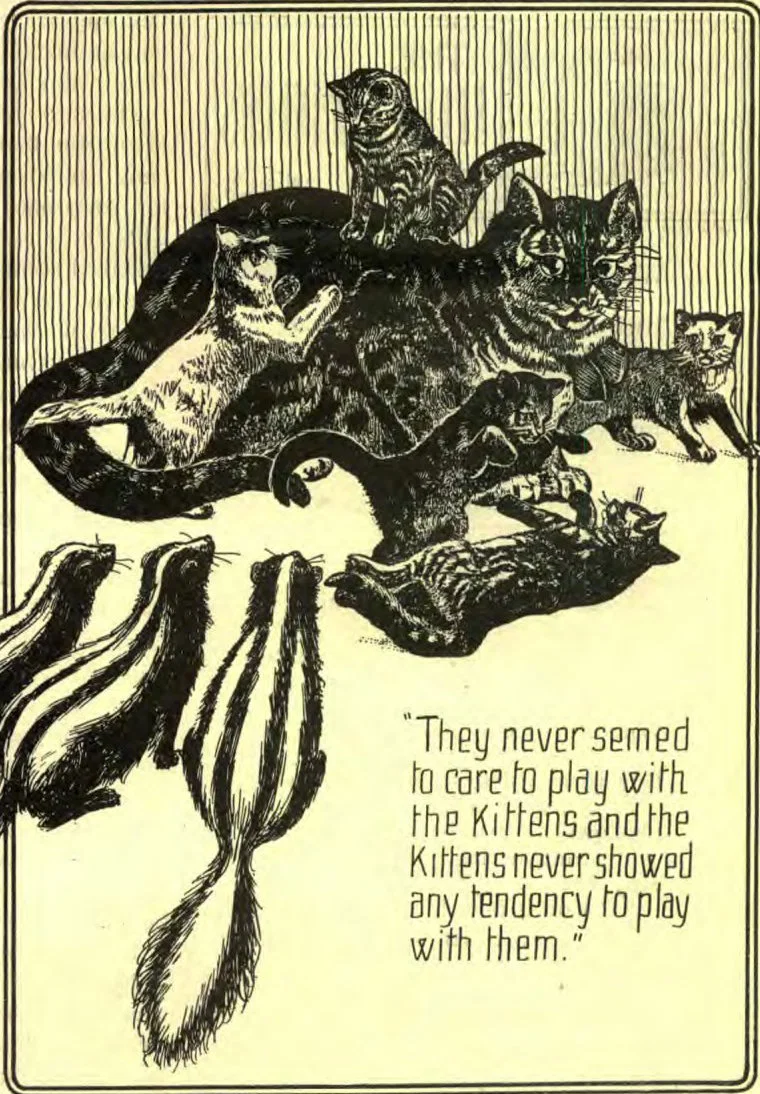
Yes, pet skunks — and they were beauties, too! One day we found the den, and killed their mother and father and four brothers and sisters. Three were so beautiful that we took them to the house, and gave them to my old spotted cat to bring up with her own kittens. At first she objected strongly; but as I insisted, she finally decided to adopt the little strangers, and cared for them as for her own babies, except that she never caressed nor played with them. They were very beautiful little fellows, with three white stripes on their back. The tail was long and bushy, and had a broad white stripe down the middle. Otherwise they were as black as a coal.
They were very playful, and would roll over and over each other by the hour. In one way they were different from kittens in their play,—they never crouched, and waited to spring on each other. They never seemed to care to play with the kittens, and the kittens never showed any disposition to play with them. They showed no strategy in their play, and, in fact, they have none. There is no animal that is more easily trapped; for if there is a bait of anything they like, they never think of a trap, and no amount of experience seems to teach them. They have little fear; for no wild animal will molest them, and nothing but Indians will eat them.
Skunks are very cleanly animals, and make much better mousers than any cats we ever had. The pets I raised came to an untimely end before they were quite grown, but my mother once had two that she kept for several years. They never made themselves obnoxious, and always kept out of the way of strange dogs. Skunks will start out on a hunt about dark, and stay till daylight. They will snoop into every hole and nook they can find, and will catch any sort of worm or bug, as well as mice and birds. They can climb trees, but seldom do so. I have seen them climb to a bird’s nest, and have known them to climb to escape a dog. They eat anything that a cat will eat, but do not care for bread if they can get anything else. They like to slay, and will often kill in one night more than they could eat in a month. For the most part they are a benefit to man, though he must take care to keep them out of his chicken-coop.
These skunks of mine were very great pets, and liked to get on one’s shoulder, rub their back over one’s face, and curl their long, bushy tail about one’s neck, though they never purr. They loved to lie behind the stove in the house, and sleep till about the middle of the afternoon, when they were ready for a romp. As pretty a sight as I have ever seen was a number of young, wild skunks rolling and tumbling about on the green grass. These animals are very easily tamed if taken when but a few days old, and there is almost no danger of their making themselves offensive. They will lie down and take a whipping as meekly as a kitten. The only drawback to them is that they never get over their appetite for chicken.
The home of these animals is usually in a hole in the ground, or in some crevice in the rocks. In this latitude they have a warm nest of grass and hair. Two old skunks and seven or eight kittens often live in the same home all winter. They get so fat at times that they can scarcely waddle. This fat makes an oil that is regarded by some as an excellent remedy for croup, and often sells for a high price.
FLOYD BRALLIAR.

“FOLLOW DIRECTIONS”

ROLLA’S examination grades were never up to the average. Generally his test work barely passed him, though it was no uncommon occurrence for him to fail entirely. His class grades were usually fairly good, hence neither teachers nor parents could account for the poor quality of his work in the general review. Roland himself could not explain why his brain was always so befogged when he tried to commit his “know-how” to paper, but was inclined to charge all the slips and blunders to his treacherous memory.
On the first day of the year Roland was invited to spend the afternoon at the home of one of his young friends. When he came downstairs, ready to go, he stopped in the library, where his big brother, Ben, was at work, and asked: “Do I look all right?”
“Y-e-s,” said Ben, slowly, eying him from head to foot. “All but your shoes. Blacked them with stove-polish, didn’t you?” he added, with a laugh.
“No, I didn’t,” retorted Roland, looking down at the dauby boots he was purposely trying to keep out of sight.
“I used Kate’s polish,— because she said it was so much better than the blacking in the box. I believe she just wanted to play a trick on me, for my shoes are horrid.”
“Perhaps you did not use it right,” suggested Ben.
“Better go back, and read the directions on the bottle,” said Kate, quietly. “It worked all right for me.”
Roland ran back to his room; and after shaking the polish bottle as if it were accountable for his humiliation, turned it round and round until his eyes rested on the words, in big letters: “Follow Directions.” Then he read what was said about brushing until dry—and polishing until the shoes should shine like a mirror.
Kate was right, and the fault was not in the polish but in his own blunder of not reading directions, and afterward following them. To be sure he had made no mistake, he read the whole thing over again, and then proceeded to carry out the instructions by brushing and polishing until he could almost see his face in the shoes.
While he rubbed and polished, his thoughts turned backward, over the many failures that he had encountered in the past year,—failures that had not been repaired, like the shining of his shoes. Pausing suddenly in his work, he looked up, exclaiming: “I have found the key to my failures! I have never followed directions right. I’m almost sure I haven’t.”
Presently there was a call from below. “Hurry up, Roland; it’s time to go.”
“Coming!” answered the polisher, with a final flourish, and the next moment he was racing down the stairs, two steps at a leap.
“Hello! that looks more like the proper thing,” said Ben, glancing critically at the boy’s shining shoes. “‘Follow Directions’ has given you quite a new understanding surely.”
“And upperstanding, too, perhaps,” said Roland, significantly.
“What do you mean?” asked Ben, with a puzzled look. “Found a new brain polisher?”
“Maybe so,” returned Roland, “but I’m not sure. I’ve been thinking that ‘Follow Directions,’ if rubbed in and thoroughly polished, might help me over the hard places in my examination tests. Don’t you think there is a chance for me yet?”
“Why—yes—certainly,” admitted Ben. “The experiment is worth trying at any rate.”
“I mean to put it to test before I sleep tonight,” answered Roland. “I hope I’ll not be disappointed,” he added, running off to overtake the other boys.
That night Roland gathered up his books, and began his search for the “Follow Directions,” which, though not in such large letters as on the polish-bottle, were plain enough to convince him that he had missed the vital part out of his studies when he failed thoroughly to understand the principles involved in the dull rules and notes, for the lack of which he had smirched his examination papers as hopelessly as he had blotched his shoes.
Having found out that his bad work was the result of not “following directions,” he applied himself diligently thereafter to the musty rules and explanatory notes, the consequence being that there were no more humiliating failures. It required months of hard study, however, to go back over all the “directions” that he had either skipped entirely, or simply glanced at with an eye to getting through to-morrow’s lessons.
“It’s hard work studying backward,” he said to Ben one morning, after tripping over some of the hard rules he had been rehearsing.
“It’s just like beginning at the roof to build a house,” answered Ben. “With all the heavy timbers above to support, what a time the masons would have laying the foundation!”
“And what a poor foundation it would be,” said Roland.
“Yes,” agreed Ben. “It is better to ‘follow directions’ as they are given than to go backward with the weight of a score of lessons pressing upon them. However, it is better to have a foundation, even if it has to be built in the hardest way.”—Belle V. Chisholm.

PUSSY'S LETTER

Pussy thought she'd write a letter To her friend, the Irish setter.
Little Ruth made all things ready, Held the little soft paw steady.
It was very nicely written For a simple Maltese kitten.
But — Ruth, do you mind my telling? — Pussy isn't good at spelling!
— Fullerton L. Waldo.

Kittens Who Never Played Together

“They never seemed to care to play with the Kittens and the Kittens never showed any tendency to play with them.”
They never seemed to care to play with the Kittens and the Kittens never showed any tendency to play with them.

OVERLAND IN WINTER

Those whose childhood was spent on the Western frontier, where they were largely deprived of modern conveniences in their homes, and were so far away from railroads that to see a train of cars was considered a rare treat, can best appreciate what the ingenuity of man has done toward lessening the inconveniences of traveling long distances. Many are living to-day who can remember when the only means of reaching the Pacific Coast overland was by mule-team or the ox-cart. The wagon trail to California used to be marked with the skeletons of animals, and the nameless graves of pioneers who had perished from privation or disease, or perhaps at the cruel hand of robbers or the no less merciless hand of the red man.
A few short years have passed; and now one may enter a Pullman coach supplied with all modern conveniences, work to advantage during the day, pass the night in comfortable sleep, and in sixty-nine hours after leaving Chicago, step into the depot at San Francisco.
When the season has not been too dry, a summer journey presents many advantages over a winter trip, particularly if the traveler has sufficient time at his disposal to take some of the attractive side trips that are permitted without extra expense if the proper arrangements are made beforehand.
Nothing, however, can compare with the magnificence of mountain scenery in winter time, especially if the sun shines bright by day, and there is a full moon at night. It seems a pity that some of these soul-inspiring sights could not be in the immediate vicinity of so densely populated a city as Chicago, where the thousands of children whose souls are starving for a glimpse of God as revealed in his works, could feast their eyes upon such wonderful revelations of him as some of this mountain scenery presents.
I shall never forget one scene in the Sierra Nevada Mountains. Clouds were hovering over the highest peaks, and all the mountain shrubbery was weighted down with snow. The sun shining through the rare air of this altitude upon this pure-white snow, made a picture of such dazzling splendor that one's thoughts instinctively turned to the scenes of that better world, which even inspired pens have been unable to describe, and compared with which all the grandest scenes of this earth are but a shadow. How strange that any are willing to miss all the splendor of that beautiful beyond for a few empty pleasures here in this sin-cursed world!
The snow-fall is so great in the Sierra Nevada Mountains that the Union Pacific Railroad Company has found it necessary to enclose its track for forty-one miles in a continuous snowshed. This shuts away from the traveler's view much beautiful scenery; but if it were not for this precaution, undoubtedly the trains would be frequently blockaded.
The warm, moisture-laden winds from the Pacific Ocean striking these mountains are cooled, and the moisture is precipitated either as rain or snow. This immense snow-fall thaws nearly all summer. Man has taken advantage of this fact, and, by irrigation, has spread these mountain streams over millions of acres of what used to be arid land, but which now blossoms as the rose. Salt Lake Valley is a good illustration of this. Here scarcely a drop of rain ever falls, yet I think I never saw more luxuriant vegetation. A beautiful, clear mountain stream flows on each side of all the principal streets of Salt Lake City, furnishing abundant moisture for the graceful trees that are likewise on each side of all the best residence streets and many of the business streets. When the Mormons took possession of this valley, it was, with small exceptions, a portion of the Great American Desert.
The western slope of the Sierras, in the days of hydraulic mining, was a great gold-mining district. The resulting débris was washed into the rivers, particularly the Sacramento, gradually filling it up so that it began to overflow the agricultural districts below. This caused the farmers of this country to secure a law prohibiting this form of mining where it would tend to fill up those rivers that afterward ran through farming districts.
On a recent trip, six inches of snow had fallen in the heart of the Sierra Nevadas during the previous day and night, but in less than two hours of downward journey the ground was covered with green grass, and here and there could be seen a wild flower. Ripe oranges hung on the trees, and palms were growing in the gardens. The air was as mild as in northern Illinois in the middle of May. When the trip is taken in the warm season, one misses this sudden change from winter to summer. DAVID PAULSON, M. D.

MRS. DURAND'S BACKROBE

My wife's brother, seven years old, was surely in France with his mother (said Mr. Leroy Durand), for we had received a cablegram on their arrival; but his voice seemed to be screaming on the shore of Lake Pazhegouki, in the St. Maurice Wilderness of Quebec. That scream first reached our ears as we paddled around a bluff, and lost hearing of the cascades. My wife, kneeling in the bow of our small canoe, stopped her paddle midway in the act of dipping it, and turned her eyes about to me. They are always big, as you know, but they were twice as big then. That was the first time I had seen her look scared, and we had hunted together, east and west, north and south, for five years past. When we left New York two weeks earlier, the voice of her little brother in a delirium of pain seemed still sounding in her ears, she told me, although he was so far convalescent as to have sailed on the “Etruria” a fortnight before we left for Quebec.
“Did you hear anything?” she asked me now. “It was some tree creaking.” I was trying to reassure her.
“Nonsense! There’s no wind.”
In fact, the lake was so calm that the up-side-down shores were as distinct as the right-side-up ones, except where trout wallowed in the mirror, or a darting kingfisher touched it with spreading circles. White clouds were as fleecy in the lake as in the blue above us, and a perfect silence seemed to hold all the void between the counterparts, while our canoe ran on with a lessening gurgle as we listened for more than twenty seconds. Then the childlike, the almost infantile, screams came again, seeming to reach from the far opposite shore by force of some poignant emotional quality of agonized weakness. They ended with a short note like a wail, choked off by faintness or despair.
My wife knows the woods, and now she said, “It must be a young bear—a yearling—in a trap.”
“Exactly. Chief Josef.”
She took to paddling without a reply. She herself had given Chief Josef the order for a backrobe.
On we went at a faster stroke than she usually sets, straight for the bluff of the screams. For intervals of about a minute they lingered in our ears, and then spread through the blue.
“Come right along up, and set him free,” said my wife, as she landed.
“And what will his teeth and claws be doing while I’m springing the trap open?” I asked, when I had made the canoe secure.
“Then come and put him out of his pain.”
“Certainly, my dear, I’ll go. But you’ll stay here in the canoe. It won’t do you any good to see that bear.”
“It might,” she said, with self-reproach. “But, anyway, I’ll never let a trap be set on my account again. Come!”
“But the old she-bear may be up there, and you didn’t bring your gun.”
“Go up at once!” said my wife, who had never imagined that a man with a magazine rifle could get into serious trouble with bears.
So up I went; and my wife got back into the canoe and pushed off a few yards, to be ready, as I told her, in case I might “find bears too plenty on the hill.”
But there was only the one, a young bear, as my wife had guessed—not a cub, not an infant, but a child,—one of about seventeen or eighteen months. I wish I could quite forget that picture of despondency.
He was caught by the right forepaw; he had dragged the trap till the clog caught between two small trees; then he had pulled the trap back and forth and round and round till the earth was worn bare of grass, and the twigs and the little bushes within his reach were stripped of bark. His mouth was down, biting gingerly at the twisted leg, and muttering most piteously, as if that way of getting free were too unendurable. Then, as the crescendo of wailing screams began once more, his head was raised toward the sky, as if the creature were veritably appealing to the Eternal Judge between man and beast.
At that instant I fired, and he sank down in death with a sense of relief, I do believe. He did not struggle in the least, so much had his strength been exhausted by the long ordeal. His trapped leg I found to be broken and twisted as a towel is twisted in wringing it; the edges of the bone had torn the muscles and tendons to a fibrous pulp.
I went back to the canoe, and told my wife, “The bear was a yearling,” and had no questions from her.
On the way to camp we passed the Montagnais wigwams, and I stopped to tell Chief Josef of shooting his bear.
“Dass good t’ing,” said Josef. “I glad you keel heem. He’s not hol’ ’nough for mek good robe for de lady sleigh, but he’s good maybe two dollar. Me, I hain’ had no lucky wis bear since de lady is tol’ me for trap some good skin. Tudder day, what you t’ink? I’ll find in one udder trap great big paw what de sacre bear he’s twist off, or bite off, maybe—anyhow, he’s get away. Here’s dat paw, lady,” and he took the hideous relic from behind one of his wigwam poles, and offered it to my wife.
She turned away, hit hard, and so pale that I put my arm around her, to help her down to the canoe. Without a word we started—there seemed nothing to say. But when we had paddled a mile, she stopped the stroke, and turned her head over her shoulder with, “Leroy, did you understand about trapping before?”
“I didn’t realize what it meant to the animals.”
“I’m glad you didn’t—or I shouldn’t like to think I’d married you,” she said, in a conclusive tone.
Since that day she has never worn fur.—E. W. Thompson, in Youth’s Companion.

SYMPHONIES

WHERE the winding river flows, Murmuring, sighing, Past the reeds and rushes growing On the shore, Thrushes sing; and autumn’s winds, Whispering, crying, Join your voice,—come, let us listen Evermore!
Where the autumn sunset glows, Glimmering, fading, See, a rosy cloud is floating In the blue! Woodlands veiled in purple mists, Brilliance shading,— Sight, enthralled, might linger ever On the view!
Where the mossy footpath goes, Wandering, straying, Down the aisles, so dim and dusky, Of the wood, Shadows, touched by sunny gleams, Shimmering, playing,— Sing, O listening heart! forever, “God is good!”
MINNIE ROSILLA STEVENS.

THE GOOD SAMARITAN

(March 15)
MEMORY VERSE: “Thou shalt love . . . thy neighbor as thyself.”
LESSON SCRIPTURE: Luke 10:25–37.
LESSON HELP: “Christ’s Object Lessons,” pages 376–389.

Synopsis

All through Christ’s ministry the Pharisees continually tracked his footsteps, in order to catch some word by which they might condemn him. At this time a lawyer came forward to entrap the Saviour with a question. The Pharisees had set him on, but Christ would not enter into controversy. With great skill he gets the lawyer to answer his own question, and then convicts him of sin with the searching words, “Thou hast answered right: this do, and thou shalt live.” But the lawyer is unwilling to confess that he does not keep the law, and tries to excuse himself by professing not to know who his neighbor is. Again Christ refuses to be drawn into an argument. He answers the lawyer’s question by relating an incident, the memory of which is fresh in the minds of his hearers.

Questions

1. To tempt Jesus, what question did a certain lawyer ask? NOTE.—The lawyers and scribes were those who explained the law.
2. How did Jesus reply to this question?
3. What two commandments did the lawyer quote in answer to his own question?
4. What did the Saviour then say to him? What effect did this have upon the lawyer? See Synopsis.
5. To justify himself, what second question did the lawyer ask? NOTE.—The lawyer was trying to get Christ into an argument, and the Pharisees were standing by ready to condemn him.
6. What incident did the Saviour then relate to show who one’s neighbor is?
7. Where did this cruel occurrence take place?
8. How badly was the poor traveler treated?
9. Who came along and saw him? What did the priest do? What ought he to have done?
10. Who followed the priest’s example? Why did these men act this way? Read Quotation 4.
11. Finally what kind-hearted man came along?
12. How did this Samaritan feel as he saw the wounded and helpless man? NOTE.—The priest had his heart hardened against one of his own people, but the Samaritan had his heart open toward one of another people.
13. With his own hands, what did he do for the stranger?
14. What commandment did he thus fulfill?
15. To what place did he take the wounded man? What did the Samaritan do for him there?
16. Before leaving the inn, how did he still further show his kindness? Whom does this Samaritan represent? Read Quotation 5.
17. After giving all the particulars of the incident, what question did Jesus ask the lawyer?
18. What answer did he make? Why would he not call the Samaritan by name? Read Quotation 3.
19. What did Jesus then tell the lawyer to do?

Quotations from the Lesson Help

1. “Among the Jews the question, ‘Who is my neighbor?’ caused endless dispute. They had no doubt as to the heathen and the Samaritans. These were strangers and enemies. But where should the distinction be made among the people of their own nation, and among the different classes of society? Whom should the priest, the rabbi, the elder, regard as neighbor? . . . Were they to regard the ‘unclean’ as neighbors? This question Christ answered in the parable of the good Samaritan. He showed that our neighbor does not mean merely one of the church or faith to which we belong. It has no reference to race, color, or class distinction. Our neighbor is every person who needs our help. Our neighbor is every soul who is wounded and bruised by the adversary. Our neighbor is every one who is the property of God.”—“Christ’s Object Lessons,” page 376.
2. “The great difference between the Jews and the Samaritans was a difference in religious belief, a question as to what constitutes true worship. The Pharisees would say nothing good of the Samaritans, but poured their bitterest curses upon them. So strong was the antipathy between the Jews and the Samaritans that to the Samaritan woman it seemed a strange thing for Christ to ask her for a drink. ‘How is it,’ she said, ‘that thou, being a Jew, askest drink of me, which am a woman of Samaria?’ ‘For,’ adds the evangelist, ‘the Jews have no dealings with the Samaritans.’ And when the Jews were so filled with murderous hatred against Christ that they rose up in the temple to stone him, they could find no better words by which to express their hatred than, ‘Say we not well that thou art a Samaritan, and hast a devil?’ Yet the priest and Levite neglected the very work the Lord had enjoined on them, leaving a hated and despised Samaritan to minister to one of their own countrymen.”—Id., pages 380, 381.
3. “The lawyer found in the lesson nothing that he could criticize. His prejudice in regard to Christ was removed. But he had not overcome his national dislike sufficiently to give credit to the Samaritan by name. When Christ asked, ‘Which now of these three, thinkest thou, was neighbor unto him that fell among the thieves?’ he answered, ‘He that showed mercy on him.’”—Id., page 382.
4. “The priest and the Levite had been for worship to the temple whose service was appointed by God himself. To participate in that service was a great and exalted privilege, and the priest and Levite felt that having been thus honored, it was beneath them to minister to an unknown sufferer by the wayside. Many to-day are making a similar mistake. They feel that they are doing a great work, and they can not stop to notice the wants of the needy and distressed.”—Id., pages 382, 383.
5. “The Samaritan had fulfilled the command, ‘Thou shalt love thy neighbor as thyself,’ thus showing that he was more righteous than those by whom he was denounced. Risking his own life, he had treated the wounded man as his brother. This Samaritan represents Christ. Our Saviour manifested for us a love that the love of man can never equal. When we were bruised and dying, he had pity upon us. He did not pass us by on the other side, and leave us helpless and hopeless to perish.”—Id., page 382.

PEACEFUL REST

THE mind needs remedying and setting right many times a day. It resembles a compass placed on a rickety table; the least stir of the table makes the needle swing round, and point untrue. Let it settle, then, till it points aright. Be perfectly silent for a few moments, thinking of Jesus; there is an almost divine force in silence. Drop the thing that worries, that excites, that interests, that thwarts you; let it fall like a sediment to the bottom, until the soul is no longer turbid; and say, secretly, “Grant, I beseech thee, merciful Lord, to thy faithful servant pardon and peace; that I may be cleansed from all my sins, and serve thee with a quiet mind.” — Bishop Huntington.

SHORTHAND BY MAIL

YOUR spare time can be well improved by studying shorthand, and this can be done at small expense to you by taking a mail course at your home. We are using “The Rogers Compendium of the Graham System of Shorthand,” a method arranged especially for home study, and giving an epitome of a system of shorthand acknowledged to be the best, the briefest, and the most complete. The only presentation of Standard Phonography in which all shorthand outlines are written as first learned, thus greatly abbreviating the work on the part of the student. A complete course in thirty lessons, illustrated by facsimile notes, with key. The correction of all students’ papers given special attention by experts. Reasonable tuition rates. If interested, write for full particulars. Practicing stenographers wishing to prepare for rapid reporting work should secure the last twenty lessons.
Fireside Correspondence School, Battle Creek, Mich.

SOLID THROUGH TRAINS OF

GRAND TRUNK RAILWAY SYSTEM

WIDE VESTIBULE COACHES and PULLMAN SLEEPING CARS BETWEEN

Battle Creek and Chicago, Buffalo, New York, Philadelphia, Toronto, Montreal, Boston
For time-tables, descriptive matter, and information, apply to any representative of the company.

THE SANITARIUM FIRE

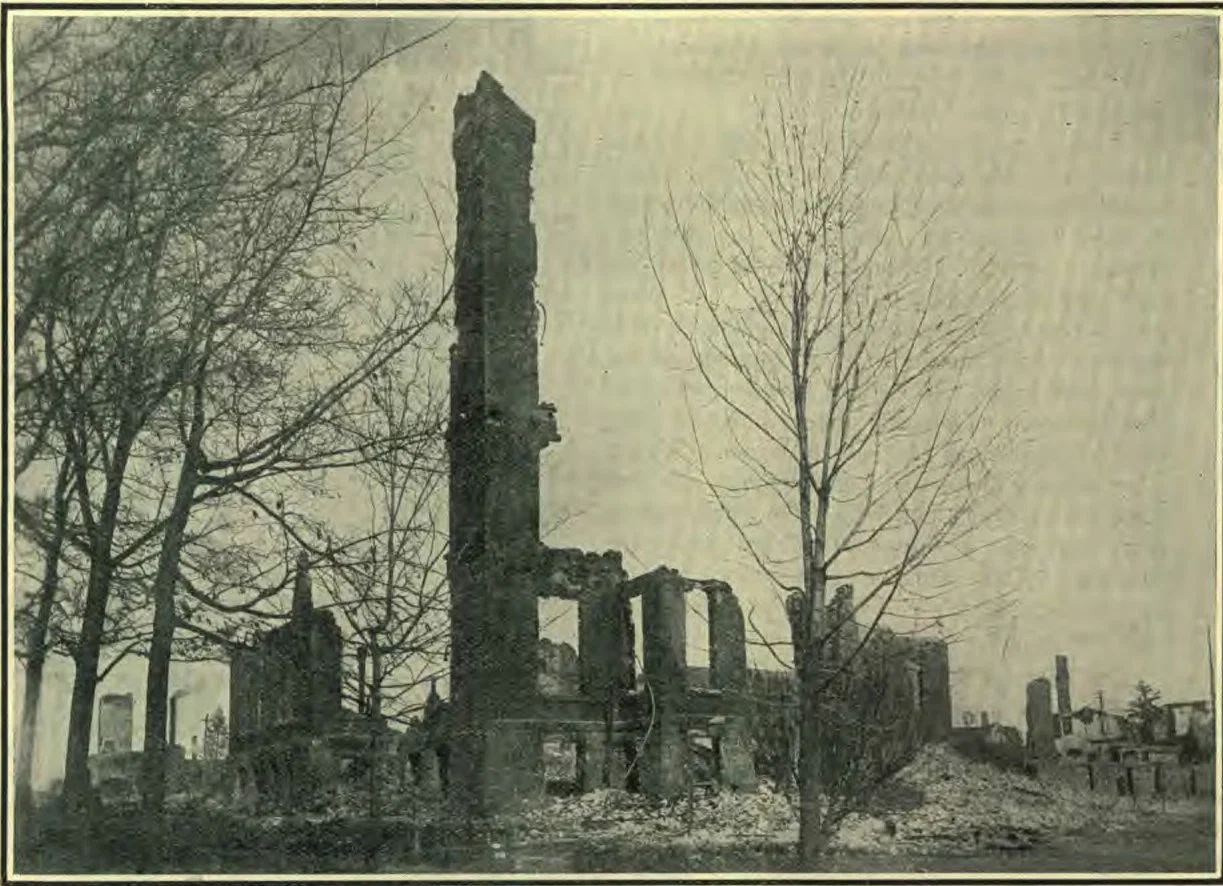
As the burning of the Sanitarium and Hospital has been fully written up in our papers, it is thought best not to repeat the facts in the INSTRUCTOR. We have, however, secured permission to print, by courtesy of B. C. Peterson, two pictures, one showing the center of the main building as it appeared about five o’clock on the morning of the fire (which will be given next week), and the accompanying view of the ruins, from the southwest corner of the Sanitarium. Other views will be given from time to time.
As was expressed again and again during the morning of the fire, the principles which, under the blessing of Heaven, made the institution what it was, can not be burned. Correct health principles; the advancement in rational methods of treating disease; the skill and experience of physicians and nurses; and, above all, the unselfishness, loyalty, and self-sacrifice of the employees,— all these are of far more value than any facilities; for without these any equipment, however splendid, would be useless in the specific work for which the Sanitarium was founded, for which it has always stood, and for which it still stands.
As soon as the workers of the institution could be gathered together after the fire, a short meeting was held, in which only words of courage and hope and trust in God were expressed. At this, and at later meetings, the employees have offered to give their services to the institution, receiving only board and room, until such time as the new building is finished. This will mean a gift from the helpers of about four hundred dollars a day to the new building.
During the days following the fire, one standing in the crowded hallway of the old College Dormitory, where the patients and guests were temporarily cared for, could not but be impressed with the spirit of cheerfulness, courage, and “making the best of it” pervading the very atmosphere. Patients who had lost everything, even their clothing, and others (like Ira D. Sankey and Colonel Hadley, who lost valuable book manuscripts) whose losses are of a nature to be beyond money value, seem to forget their personal loss in gratitude for their escape with life. And, indeed, those who are familiar with the buildings, the rapidity with which the fire spread, and the loss of life under similar circumstances in other places, can not but feel the sense of wonder and gratitude expressed by the words: “This is the Lord’s doing: and it is marvelous in our eyes.”
VIEW OF RUINS FROM SOUTHWEST CORNER
Shortly after the fire, an “Extra” containing a brief report was being sold on the streets of a large Western city. An old friend of the institution, seeing the headlines, asked to look at the paper; and it was handed to her with the remark: “I am sorry. I was there nine months, and they did me good.” That sentiment is echoed by thousands upon thousands of men and women in all parts of the world. Hundreds of telegrams and other messages expressing sympathy and offering financial aid, have been received from former patients who were benefited while at the Sanitarium, and who have become its friends.
While we deplore the loss of these buildings to which many, through long association had become personally attached, let us not fail to learn the lesson God would teach us by their removal. Would he not have us learn that buildings are nothing in his sight, but that he honors the principles which these buildings represented—that the things which are seen, in which men so often put their trust and confidence, are at the best only temporal, but that the things which are not seen are eternal? And if again he allows us to hold in trust another great Sanitarium, shall it not be with humble, thankful hearts, in which there shall be no trace of faultfinding or criticism, but only gratitude for the opportunities of education it affords to us as young people, and a determination to carry its life-saving message to the world?
THOSE wishing to secure copies of this photograph can do so by sending twenty-five cents to B. C. Peterson, Review and Herald, Battle Creek, Mich.
Continue reading: WHAT IS GOING ON IN THE WORLD