The Youth’s Instructor, Vol. L, No. 10

WINTER

The Youth’s Instructor

March 6, 1902

Review and Herald Publishing Company · Battle Creek, Mich. · March 6, 1902

WINTER

The Spring is crowned with buds and blooms; Warm Summer wears her sheaves; And Autumn has a chaplet gay, Of red and yellow leaves; But Winter hangs his jeweled crown Along the burdened eaves.
Spring fills her brooks with piping frogs; Summer has reapers’ song; Autumn has shrilling katydids; But, hark! ding-dong, ding-dong! Old Winter shakes his music out The streets and lanes along.
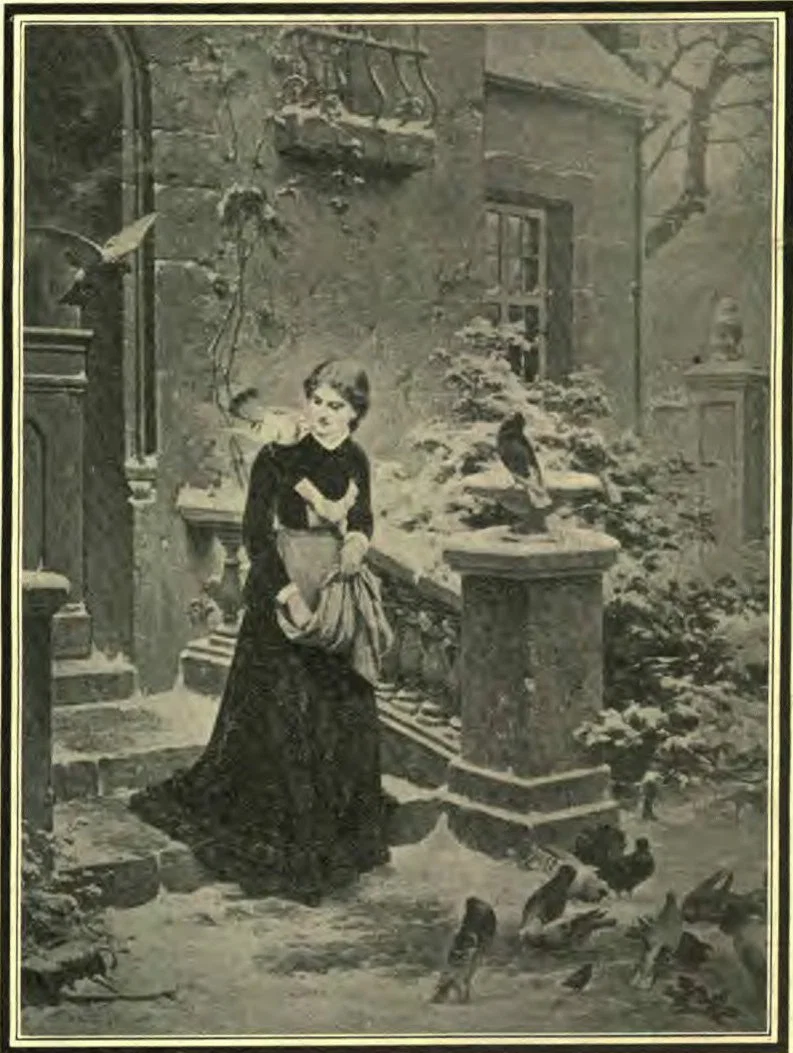
And not the birds of warmer climes Spring scatters o’er the land, Are dear as Winter’s chickadees And doves, a friendly band About my feet, that, trustful, take Their portion from my hand.
ELIZABETH ROSSER.

HOW THE LORD SEES

“The Lord seeth not as man seeth; for man looketh on the outward appearance, but the Lord looketh on the heart.” When Samuel, the prophet and messenger of God, went to the house of Jesse to choose a king for Israel, he was impressed with the noble bearing of the eldest sons. But one by one they were set aside by the unerring Spirit of God. Samuel was perplexed. The Lord had sent him to this house, and yet refused to accept any of the sons whom he proposed to anoint. Yet there remained one more, a lad keeping the sheep. What the rest were doing no one knows. They were doubtless “young gentlemen” according to the modern sense of the phrase. They lived on their father, rode fine horses, wore good clothes, played games, and lived to please and amuse themselves. Perhaps they carried canes, and parted their hair in the middle. They were perfumed, and combed, and cultured. Fine kings they would make, no doubt; but the Lord said, No. What had they ever done for humanity? The only thing recorded of them is their abuse of David.
But who was David? What had he done?—Well, he was useful. To be useful is one of the highest objects in life. To be ornamental is all right, if usefulness precedes it. David “was ruddy, and withal of a beautiful countenance, and goodly to look to;” but before and far above this he was of some use. He minded the sheep. His training as a shepherd prepared him to lead and care for the people. While tending sheep, he learned music and poetry, and in every way improved his mind. He was gentle and loving as the lambs of his flock. When one was sought to soothe the troubled spirit of Saul, David was chosen. At the sound of his harp the evil spirit fled.
David was not an effeminate, flabby youth, who could do nothing but play a banjo or guitar. He was said to be “a mighty valiant man, and a man of war, and prudent in speech, and a comely person, and the Lord is with him.” A lion and a bear came to destroy his flock. David did not climb a tree, or run shrieking for help; he defended his flock. He says, “I went out after him, and smote him, and delivered it out of his mouth: and when he arose against me, I caught him by his beard, and smote him, and slew him.”
CHICKADEES AND DOVES, A FRIENDLY BAND
His three eldest brothers enlisted, and went to war. They wore fine uniforms, and carried furbished arms. But, like their comrades, they cowered before the gigantic Philistine who, morning and evening, defied the armies of Israel. What good were they? Face to face with real difficulty, they amounted to nothing. But when David came upon the scene, his spirit was aroused. The zeal of God inspired his heart and nerved his arm. Saul’s armor was only an impediment to such a spirit. In the strength of God, whose armies were being defied, whose name was being reproached, whose honor was trailing in the dust, he went forth in his simple preparation, a sling and five smooth stones.
God saw in the heart of the youth all these possibilities and more, because David was bound to be of some use. He was content to work while others loitered. He was willing to watch the sheep while others frequented places of amusement. He was a boy who could help his mother, or comfort a sick child. He employed his time to the best advantage by improving his mind and developing his body. He did not run away from danger, or shirk duty. And when his engagement at the palace of Saul was over, he did not play the part of a heroic dude, but went back to the sheep till God called him to other duties. These are some of the things that made him a man after God’s heart.
G. C. TENNEY.

THE MEASURE OF OUR ABILITY

It is natural for men to look on great armies as the embodiment of strength, and on men whom nature has richly endowed as men of ability. Even Christians go through life thus, deaf and blind to the great truth that “the Lord seeth not as man seeth.” I suppose there is no one cause of discouragement equal to this spiritual blindness. They look on themselves as the world looks on them, and say, when the call comes to work for God, “O, I can’t do that; I haven’t the ability.” Then comes into effect that great law concerning man, “As he thinketh in his heart, so is he;” and constantly its force works to weaken.
In view of this evil thing, so common with his people, God has given us lesson after lesson, all designed to teach that our strength lies not in any outward show of might or power, but in his Spirit. One of these lessons is found in the life of David.
It was in those days when Saul had departed from the Lord, that a great darkness and unbelief rested on the people, and God in loving-kindness sent the Philistines up to waken them. Israel sent out the best army they could gather together to repel the invaders; but fear arose in their hearts, and day after day they shrank from the contest.
But one morning a shepherd boy hastened into the ranks to speak with his brothers. As he stood talking with them, there came out of the army of the enemy a giant, who shouted in a loud voice, “I defy the armies of Israel this day; give me a man, that we may fight together.” But the men of Israel were terrified before this great man, and the shepherd lad saw with astonishment that they fell back before the enemy. O, what a black chapter in the sad history of God’s chosen people, that in all that army there should not be one man with faith enough to go out and conquer in the name of his God!
So the Lord must send out into the wilderness, and call an untrained shepherd boy from tending the sheep, to show the world that there was still a God in Israel! Was it because David had greater strength, or more skill in war, that God called him?—No, indeed; for Saul said to him, “Thou art not able to go against this Philistine to fight with him: for thou art but a youth.” But David, knowing wherein his strength lay, answered, “The Lord that delivered me out of the paw of the lion, and out of the paw of the bear, he will deliver me out of the hand of this Philistine.” You know the story.
And now let us ask ourselves how it shall be with us? When men say, and our trembling hearts declare, “Thou art not able to go,” shall we listen to them? or shall we act on the words of Christ, when he said, “All power is given unto me in heaven and in earth. Go ye therefore”? EDISON DRIVER.

WHAT SHALL IT PROFIT?

CARES, riches, pleasures, all are used by Satan in playing the game of life for the human soul. The warning is given: “Love not the world, neither the things that are in the world. If any man love the world, the love of the Father is not in him. For all that is in the world, the lust of the flesh, the lust of the eyes, and the pride of life, is not of the Father, but is of the world.” He who reads the hearts of men as an open book says: “Take heed to yourselves, lest at any time your hearts be overcharged with surfeiting, and drunkenness, and cares of this life.” And the apostle Paul, writing by the Holy Spirit, says: “They that will be rich fall into temptation and a snare, and into many foolish and hurtful lusts, which drown men in destruction and perdition. For the love of money is the root of all evil: which while some coveted after, they have erred from the faith, and pierced themselves through with many sorrows.”
“And when he was gone forth into the way, there came one running, and kneeled to him, and asked him, Good Master, what shall I do that I may inherit eternal life?”
Christ pointed him to the commandments, and the young man answered, “All these things have I kept from my youth up: what lack I yet?”
“Then Jesus beholding him, loved him, and said unto him, One thing thou lackest: go thy way, sell whatsoever thou hast, and give to the poor, and thou shalt have treasure in heaven; and come, take up the cross, and follow me.”
“But when the young man heard that saying, he went away sorrowful: for he had great possessions.” He chose his riches instead of Jesus. He wanted eternal life, but he would not receive into the soul that unselfish love which alone is life. With a sorrowful heart he turned away from Christ.
As the young man turned away, Jesus said to his disciples, “How hardly shall they that have riches enter into the kingdom of God!” These words astonished the disciples. They had been taught to look upon the rich as the favorites of heaven: worldly power and riches they themselves hoped to receive in the Messiah’s kingdom; and now if the rich were to fail of entering the kingdom, what hope could there be for them?
“Jesus answereth again, and saith unto them, Children, how hard is it for them that trust in riches to enter into the kingdom of God! It is easier for a camel to go through the eye of a needle, than for a rich man to enter into the kingdom of God. And they were astonished out of measure, saying among themselves, Who then can be saved? And Jesus looking upon them saith, With men it is impossible, but not with God: for with God all things are possible.”
My dear young friends, God knows what your besetting sin is just as surely as he knew the ruler’s. His word to him is a message to you. You must decide between Christ and the world. If you choose Christ, you must deny self, take up the cross, and follow him. The Saviour says to you: Withdraw your love from earthly treasure. Follow me, and you shall have treasure in heaven,—a “far more exceeding and eternal weight of glory.”
Christ does not ask his children to follow where he has not led the way. He was rich, but for our sake he became poor. He left the heavenly courts, and came to this earth to share the poverty of the poor and the toil of the laborer. He said of himself, “Foxes have holes, and the birds of the air have nests; but the Son of man hath not where to lay his head.”
God is testing and proving his children to see if he can trust them with eternal riches. Are you living for him? Have you placed all you have at his disposal? Are you day by day revealing the unselfishness of the Redeemer? Life is uncertain. One may count on years of worldly pleasure, but accident or disease may suddenly cut him off. Are you ready for death?
God asks you: “What shall it profit a man, if he shall gain the whole world, and lose his own soul? Or what shall a man give in exchange for his soul?” “Behold, I come quickly, and my reward is with me, to give every man according as his work shall be.”
MRS. E. G. WHITE.

GIVING AND RECEIVING

“Fred likes you very much, doesn’t he, Charlie?” said Aunt Fannie to her four-year-old nephew, whose playmate had just bidden him a smiling good-by at the door.
“He’d better like me!” answered the little fellow, squaring his small, sturdy shoulders. “I gave him two doughnuts this morning!”
We all laughed at the frank avowal; but, sitting with my work, I began to wonder how much Charlie’s childish philosophy differed from that of many older and wiser people.
To count self entirely out of the sum of kindnesses done to others is one of the hardest tests of human nature. And yet, as Balzac puts the question, “What heart that has sown good to reap gratitude, can think itself great?” Gratitude must be a voluntary offering, not an exacted tribute. Its perfume should be like that of the blossoming rose-garden, not of the flower crushed and dying in a too eager hand.
“I will give to him who will serve me,” is the voice of selfishness. “I will minister to him who has need of me,” answers the spirit of true generosity. Love must know no measure but that of necessity. The children of the Highest, like him, are kind even to the unthankful and the evil.
Yet, so benignant are the divine compensations, that the rewards which elude conscious pursuit are gained by those who never sought them. Their bread returns from the waters; their full measure is rendered into their own bosoms. Their very names “smell sweet, and blossom in the dust.”
And for the world beyond—there is no good deed accomplished here so quietly that the left hand knew not the secret of the right, but is stored up in the infinite treasure-house. Eternity will hold many surprises, but none more marvelous than that which awaits the “poor in spirit,” who shall find themselves heirs of the “kingdom of heaven.”—Young Peoples’ Weekly.

THE SURE PATH

Of all the paths, what path is best However long the way may be? What path is sure, or east or west, For you or me?
Is it the one ’mid flowers begun And ended so, we find the best? Or that whereon a cloudless sun Shines oftenest?
No; ’tis the path whereon we find The hard-won battles every day; Where busy duties are assigned To show the way;
Whose skies, perhaps, are overcast; Whose waysides wither in a night; But through whose driving mists at last Shines out the light.
FRANK WALCOTT HUTT.

AFTER HOURS

It was almost five o’clock in the afternoon. The office typewriters were clicking away under the rapid fingers of the operators. Only a few minutes more, and business would cease for the day. Five o’clock sounded, and all through the building one could hear the noise of hurrying feet, as men and women hastened homeward.
Down the brass-covered stairs from another department came one of the chief officials of the company, taking two steps at a time, and hurrying into the correspondence room with a rush.
“Is there a stenographer here who will help me a few minutes?” he asked, in a low tone, as he leaned nervously over the manager’s desk. “I have some letters of importance to get off to-night, and my own secretary is rushed with work.”
“Yes,” answered the manager; “I think Miss Davis will be willing to stay.” The manager stepped quietly over to where Miss Davis was arranging her machine and table for closing, and in a minute returned. “She will be glad to stay,” said he.
Miss Davis laid aside her hat and gloves, took out her notebook and waited. You would have said that she seemed to prefer to wait, as she watched the busy official run up-stairs to secure the needed facts for his letters.
The office clock ticked steadily on. Miss Davis made no sign of haste. She sat quietly near her desk, arranging a bit of work for the next day. It would have been easy to show impatience in one slight way or another, but she showed nothing of the sort.
After some fifteen minutes had passed, the official for whom Miss Davis waited, came into the room with apologies. “I’m sorry to have kept you,” said he, “but I find you need wait no longer. I am obliged to you, but my secretary can take care of these matters for me.”
“Oh, don’t mention it,” said Miss Davis, brightly, and at last she, too, went out of the now silent building, a half-hour late, on her way home.
It is, of course, just a little every-day incident. But if you think that is all, you shall see that this, like so many other seemingly small sacrifices, had something fine about it.
Indirectly the manager learned next day that Miss Davis had been in an extraordinary hurry to go home on the previous evening. That day her mother had suffered a stroke of paralysis. Miss Davis left her unconscious, with other members of the family at her bedside, and went to work as usual, but all day long said never a word to the manager about her anxieties, and did what seemed her duty to the company. Hourly she expected to be called home, and hourly longed to go. She knew her mother might recover, and might not. The danger of sudden death was not such as to demand her presence continually. She could be reached quickly. But there was in Miss Davis the same fidelity to her ideal of duty, and the same self-control in not betraying her anxieties in the midst of her duties, that might under some circumstances write one down a heroine in the world’s history.—Well Spring.

WOODPECKERS AND SHRIKES

WHILE we are on the subject of woodpeckers, it may be well to mention one or two others, so you will not get them confused.
The Hairy Woodpecker looks much like the Downy, but is nearly a third larger, and has no black bars on the white of his tail. He is a shy bird, and you are not so apt to see him about houses as the Downy. In the nesting season the male spends his spare time drumming on the resonant dead limb of a tree; and the louder the noise he makes, the more satisfaction it seems to give him. It is his way of telling his mate that he loves her; if she likes his ability as a drummer, that settles it; they set up housekeeping. It takes them about a week to build a home. The opening into their nest is as round as if made with an auger. It is supposed that two birds, once mated, remain so through life.
The Hairy Woodpecker is a very useful bird, destroying many injurious insects. It never attacks a sound tree.
Description.— Male: upper parts black, spotted and striped with white; red band on back of head; under parts white. The female is similar, but has no red on neck. Length, nine to ten inches.

The Flicker

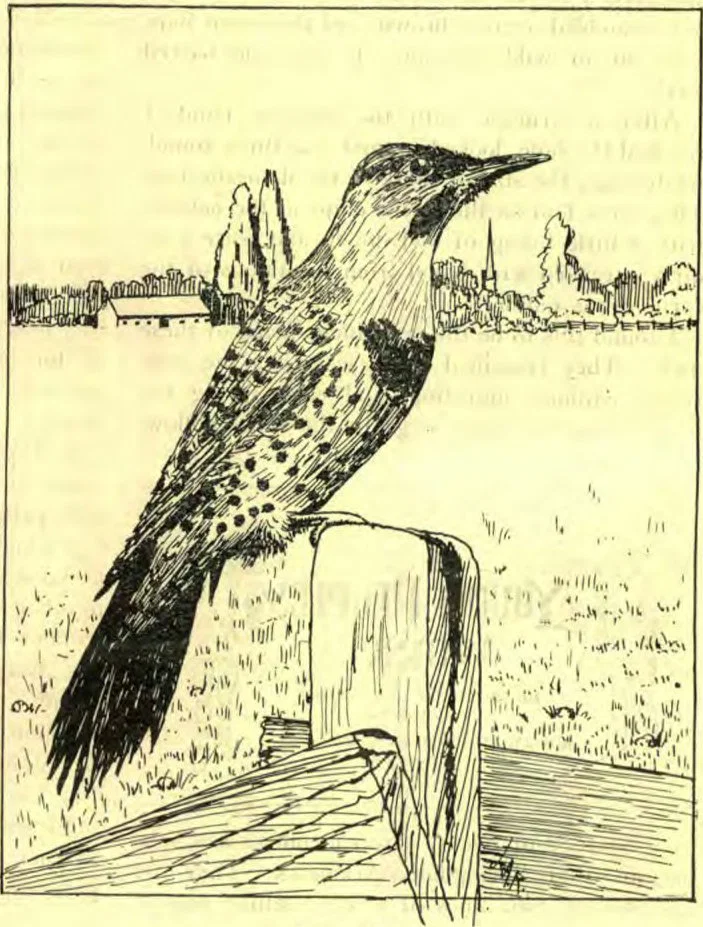
Among the woodpecker family, I must not forget to mention the Flicker. He has a number of other names; as, Highhole, Yellowhammer, Clape, Yucker, Yellow-flicker, Golden-winged Woodpecker, and some twenty-five or thirty more, including Woodchuck, and Piquebois Jaune.
The Flicker is the most interesting of all our woodpeckers. When he utters his cries, he is bound to be heard. His most common note is a signal, or salute, not unlike Kee-yer! In the spring he utters his If-if-if-if-if, many times repeated; or, as some give it, Cuh-cuh-cuh-cuh, etc.
The Flicker is not so much a carpenter as the other woodpeckers, and nearly half his food is made up of ants, which he digs out of decaying logs, stumps, and fence-posts. When, in the spring, he makes love to the lady Flicker of his choice, you should watch him; his antics are most ludicrous and amusing.
Description.— Adult: back brownish, marked with black bars; throat pinkish; under parts lighter, spotted with black; red band on back of neck; rump white; black stripes on side of throat (the female does not have this stripe); black crescent on breast; under sides of wings and tail yellow. Length, twelve inches.

The Shrike

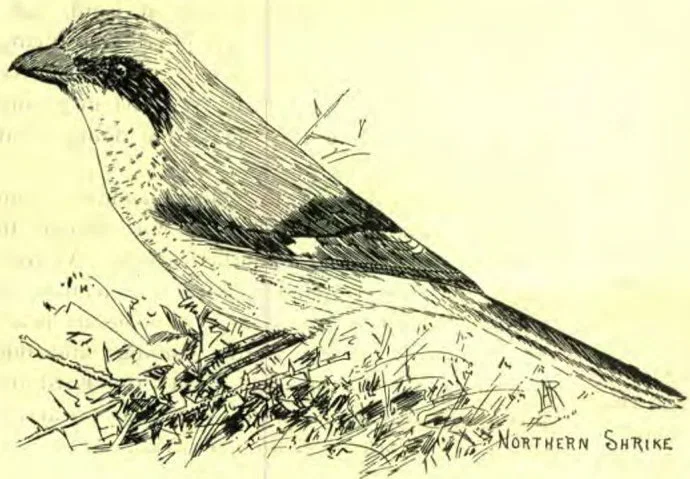
Another bird you may meet with in winter is the Northern Shrike, or Butcher-bird. In summer he lives and nests within the arctic circle, but in October moves down into the United States, though rarely farther south than Virginia, Kansas, and California.
There is a Southern Shrike also, and the two birds are very much alike. This other bird is called the Loggerhead Shrike. The Northern Shrike may be known from the Southern, or Loggerhead, by its larger size, lack of black on the forehead, and gray rather than black in front of the eye. The time of year will help you to some extent in determining which bird you see, because you will meet with the Northern Shrike only from October 20 until about the first of April, and in the neighborhood of St. Louis it is rare at any time of the winter. The Loggerhead comes from the south about the middle of March, and nests as far north as Virginia, and west of the Alleghanies, northward to the Great Lakes, through central New York to Vermont and Maine.
When the Northern Shrike visits us in the winter, it does good work in making away with mice and English sparrows.
Description.— Upper parts gray; wings, tail, and line back of the eye, black; under parts white, barred with black; forehead whitish, without black line. Length, ten and one-fourth inches.
The Loggerhead Shrike is a very quiet bird. I have often, when driving in the country of central Illinois, seen six or eight of these birds in company along the fence, or on some wayside tree. They are always to be found in the open country, where they have an opportunity to see all that is going on; for they are always on the watch for any small creatures that will serve as food, such as crickets, grasshoppers, meadow-mice, small snakes, besides cutworms, cankerworms, and the like. On this account the Loggerhead Shrike is a very useful bird. Sometimes when food is scarce, he will eat small birds, but this is not usual. I think you will watch them many months before you will discover a Shrike harming other birds. The Agricultural Department of the government, after making a careful study of this bird and its habits, tells us that it should be protected, as its food all over the country consists mainly of grasshoppers.
The Shrike impales its victims on thorns or any other sharp projection. It doubtless does this to assist it in tearing the thing into pieces to be eaten. A Shrike was observed to catch a meadow-mouse, and carry it up into a tree, where, after it had killed it, it tried to wedge it into a crotch, so that it could eat. Finally it found the sharp end of a snag, on which it fastened its prey.
Olive Thorne Miller says she has seen a Shrike throw a dead meadow-mouse over a fence wire that had sagged to the ground, in order to get bits off to eat. She also says that a lady in New Hampshire had a Shrike in captivity. The bird could not eat a piece of meat until he had a place to fasten it. He hopped about, looking for something, until she guessed what the little creature wanted. She brought it a kitchen fork, which had two tines, and the moment the bird saw it, he ran to her, hopped up on her hand, jerked the meat onto the tines, and immediately began to eat.
THE FLICKER
THE FLICKER
Let us never forget, as we see these manifestations of wisdom and intelligence on the part of the lower creatures, that their knowledge, or lack of knowledge, as the case may be, is the direct will and gift of God. Job 39: 13-18. And he who gives the Shrike its bright intelligence for its work, will do far more for us; for “he teacheth us more than the beasts of the earth, and maketh us wiser than the fowls of heaven.” And “if any of you lack wisdom, let him ask of God, that giveth to all men liberally, and upbraideth not; and it shall be given him.” Therefore, “Who maketh thee to differ from another? and what hast thou that thou didst not receive? Now if thou didst receive it, why dost thou glory, as if thou hadst not received it?” So, “Let not the wise man glory in his wisdom. . . . But let him that glorieth glory in this, that he understandeth and knoweth me, that I am the Lord which exercise loving-kindness, judgment, and righteousness in the earth: for in these things do I delight, saith the Lord.” L. A. REED.

A BARRED OWL’S NEST

One March night at dusk, as a wood-chopper was quitting work in a clearing just out from a Massachusetts village, two great owls approached him, chasing each other from tree to tree with noisy hootings. Hearing of this, and knowing that it was nesting-time, I determined to find their home.
For miles around it was a wild country, with groves of tall pines here and there, and tangled swamps. In woods of this sort there are many old nests, built originally by crows, squirrels, or hawks, any one of which the owls may appropriate; for owls are the very laziest of housekeepers.
But which of all these is the right one? Sometimes the secret is betrayed by the owner’s gliding off when the intruder approaches, or when the tree is struck with a club. Another very good sign is when fluffy down from the body of the bird clings to the nest or to twigs near it.
I spent many days in the search that spring, but all were fruitless, although I scoured the woods for miles.
The next spring, as people often heard the owls hooting, I tried to find the nest again, as before, without success.
At length one warm day I started out with a boy friend, beginning where the wood-chopper saw the owls.
Within ten minutes, although it was still early afternoon and the sun was bright, I heard a long-drawn-out cry—the hooting of the barred owl. We started for the pine grove whence the sound seemed to come; but before reaching it, the boy called my attention to a good-sized hole in an oak stub a dozen feet from the ground. I told him it was hardly large enough or high enough for the big owl, but a little screech-owl might use it.
Reaching the base of the stub, I gave it a careless kick. Instantly a great whirring, thundering sound proceeded from within. At the entrance appeared a most comical, monkey-like face, and out scrambled a great brown bird that went flapping off in wild affright. It was the barred owl!
After a struggle with the slippery trunk I reached the hole, looked in, and saw three round, white eggs, the size of those of the domestic hen. They were laid on the rotten chips at the bottom, with a little lining of owl down, and were very dirty, streaked with blood from the talons of the carnivorous mother.
I found this to be the permanent home of these owls. They remained in these woods the year round without migrating, and each spring the mother laid her three eggs in the same hollow.—Selected.

SEATTLE, WASHINGTON,

Has a newly organized Young People’s Society of eight members. From a letter from one of these, Miss Anna Myberg, we glean the following:—
“Though our numbers, so far, are few, the weekly meetings are well attended; for both young and old come, and all seem interested. We hold our meetings on Friday evening, as there is no other time when all can come together. So far we have not taken up the studies in the INSTRUCTOR, for all did not have the paper, but we expect to take a special club for this purpose before long.
“We have the usual opening exercises, followed by a short talk by the leader, and a twenty-minute reading from the Testimonies, different persons being asked to read each evening. In the social meeting all are invited to take part; and the result is a bright, interesting testimony meeting.
“As most of us work in the treatment rooms or the health restaurant, our time is well filled; still we know that God can use our lives to his glory as we go about our daily work if we will but let him. We ask your prayers, that we may each be a shining light for the Master.”

EMMA L. RUNCK

FROM ALMA, NEBRASKA

The young people’s work at Alma is moving forward. We organized with six active members, and have now almost double that number, besides several associate members. The interest deepens as we move onward. Our meetings have proved a great help to the church.
The superintendent of our Sabbath-school testifies that had it not been for the strength received from the young people’s meetings, she would not stand where she does to-day. Others bear a similar testimony.
We hold our meetings on Sunday afternoons. The last report of work consisted of twelve missionary letters written, and sixty-three papers and 1,707 pages of books and tracts distributed. The report previously to this was sixteen papers and 5,018 pages of books and tracts given away.
There seems to be a good outside interest, and we have been promised help soon. We are of good courage, and hope to see souls saved in the kingdom as the result of our efforts.

EMMA L. RUNCK

Springdale Society Organized for Four Lines of Work

A Society of twenty-seven members has been organized at Springdale, Arkansas. They are undertaking four lines of work,— selling papers, distributing free literature, helping the poor and needy, and caring for the sick.

Young People's Society Organized at Montavilla, Oregon

From Montavilla, Oregon

Realizing that the Lord has a great work for us as young people to do, and in order that we might more effectively work for him, we have organized a Young People’s Society here. As yet our numbers are few; but we know that it is not in numbers that strength lies so much as in the consecration and devotion of the individual members. Our courage is good, our confidence is in God, and we are determined to press forward in the Master’s service.
We hope soon to send a report of something actually accomplished by our Society.
Chas. Nelson.

TALENTS—LESSON IV

Influence — A Testimony Study

(March 9-15)
We would suggest that this lesson be presented by five members of the Society, each taking, for special study and presentation, one of the five divisions under which the subject has been arranged. The subject is large, and the references should not be confined to those given here. If the smaller companies do not have all the volumes referred to, they can find much more than is given in any single volume.
The lesson is based upon “Christ’s Object Lessons.” The matter given under subject of Influence (pages 339–342) should be carefully read to begin the study.
1. Every one, no matter what his position in life, exerts a powerful influence, either for good or for evil, upon all with whom he comes in contact. See Volume III, page 363, last paragraph.
2. This influence is unconscious, and usually much greater than we imagine. See page 542, first paragraph.
3. One’s influence never stops with those whom he knows personally, but passes on through them to others. Its limits can never be measured. See Volume IV, page 59.
4. Every act of our lives is significant. “Our words, our acts, our deportment, even the expression of the countenance, has an influence.” See Volume III, page 363, second paragraph.
5. God holds us personally responsible for our influence. See Volume III, page 363, first clause of last paragraph; Volume II, page 132, last paragraph.
E. T. R.

ANOKA, MINNESOTA

The students of the Conference School at Anoka have organized a Young People’s Society of thirty-six members. Our avowed purpose is to become efficient workers for the Lord. We have a leader, an assistant, a secretary, a treasurer, and three department officers. The interest is really good, and encourages us to press forward. Our meeting held February 5 was one of special encouragement to all. Several interesting experiences were related, and many expressed a renewed determination to consecrate time and talent to the service of the Master.
We have done some work, although our studies and domestic duties limit us as to time. Nineteen Bible readings and cottage meetings have been held, two missionary visits made, 1,379 pages of tracts and 226 papers distributed, and two of the young men have spent some time sawing wood. As a result of the work, several families are interested in the truth, and we believe that some will accept it. We have all we can do besides our school work. CARRIE MACK.

EXTRACTS FROM LETTERS

“Our Young People’s Society at Chitwood, Oregon, is increasing in numbers and interest. The present membership is fifteen, and the attendance from the outside is good. We are glad to say that some from the outside are taking an active part, and making a careful study of the lessons. We use the outline lessons in the INSTRUCTOR as the basis of our study, and hold our meetings on Sunday evening. We hope the interest will continue during the summer.”
“The meetings of our Williamsport (Pa.) Society have been well attended, and the interest is a deep spiritual one. The Spirit has been moving on the hearts of all. The meetings this winter have been held in our church on Sabbath afternoon. Some of the little children have loved to come. Two weeks ago one little boy only six years old was sitting on the front seat by himself. After the lesson a testimony meeting is usually held, all who wish taking part. There is no urging, but an invitation is given to all. This dear little fellow stood up with his hand over his eyes, and said, between sobs, “I want to be a good boy, and won’t you pray for me?” After sitting down it was some time before he ceased sobbing. Some hearts that had seemed hard were touched. We praise the dear Lord for the influence of his Spirit on many hearts. I think I make no mistake when I say that whatever success we have had is largely due to the burden the parents have for the salvation of their children. Oh, that every parent could realize the precious possibilities in the home work!”

The Young People's Work at Enid

It was the privilege of the writer to attend the meeting of the young people at Enid, Sabbath forenoon, January 25. It is truly inspiring to see our young people taking such an active part in preparing for a stronger effort in giving the message, and at the same time doing what they can where they are.
A large number of the older members join with the young people, but do not attempt to do more than aid them in their work. At roll-call every one responded with a selection of scripture, and I was glad to hear so many bearing especially on the Lord’s coming, and our part in giving the message. May the Lord inspire our youth in many places to take an active part in this work.—Oklahoma Gleaner.

A GOOD WORD

ELDER I. J. HANKINS, president of the Indiana Conference, thus encourages the young people's work in that State, through the State paper:—
“We are glad to know that our young people in Indiana are organizing for study and for work. Good reports are coming in from the newly organized societies. Let the good work go on, and let the meetings be conducted by and for the youth and children; but let the church and Sabbath-school officers advise and counsel the youth, encouraging them in every good work.”
Continue reading: MY PET SKUNKS