REFERRING to the Lord’s work in the earth, Luther said: “It is not by the sword that he will have his gospel propagated.” Such were the words of the great reformer of the sixteenth century, and such is still the language of true Protestantism.
The sword is a carnal weapon; but the language of the true followers of Christ is, “The weapons of our warfare are not carnal:” the sword of the Spirit is our sword, and this, as Paul in Ephesians 6 says, is “the Word of God.” Upon one occasion, it will be remembered, one of the disciples of Christ attempted to defend him with the sword. The Master’s command was, “Put up again thy sword into his place: for all they that take the sword shall perish with the sword.”
D’Aubigne, in the “History of the Reformation,” speaking of the fallen condition into which the Church had lapsed by resorting to worldly power, says: “She had, from false policy, had recourse to earthly instruments and vulgar weapons. When once the Church had begun to handle these weapons, her spiritual essence was lost. Her arm could not become carnal without her heart becoming the same.” This is a solemn truth, and the principle herein involved is as true to-day as it ever was. The Church can no sooner call upon the State for aid and assistance than she loses her spiritual power. In this act she denies the gospel, which is the power of God unto salvation, rejects her lawful husband, the Lord, and unites herself, in adulterous connection77is the “wine of her fornication” referred to in the Scriptures, with which Babylon, the Romish Church, has made all nations drunk. And, sad to say, the harlot daughters, the apostate Protestant churches, are now seeking the same illicit union, as is manifest in their appeal to the State to enforce Sunday observance.
God constrains no one by means of force. He never forces nor attempts to force any one to believe. His moral government is not one in which he exercises force. To the creatures he has made he says, “Come, let us reason together.” He invites them all to come and take of the water of life freely, to come and be saved; but he compels no one. Neither will those who are godlike seek thus to constrain any one. Said Luther, “I am ready to preach, argue, write; but I will not constrain any one, for faith is a voluntary act.” But in all ages those who have assumed to take the place of God, and by law prescribe to men their religious duties, have acted very ungodlike. Because men would not believe and act in religious matters as they dictated, they have threatened them with the infliction of civil penalties, thrown them into dungeons, placed them upon the rack, and kindled around them the fires of persecution. Thus blindly and without reason have they sought to force their opinions and practices upon their fellow-men. But the men who do such things are not Christians, whatever their profession; neither is the church which upholds such actions and pursues such a course the Christian church, however much it may claim to be.
W. A. COLCORD.
Rome Claims Supremacy Over the State.
[Everybody ought to know the real position of Rome touching the relations of Church and State. A standard Catholic work, “Familiar Explanations of Christian Doctrine No. IV.,” published by Benziger Brothers, “Publishers to the Holy Apostolic See,” New York, Cincinnati, and Chicago (pages 195–198), gives this information definitely and explicitly:—]
ST. THOMAS AQUINAS asks the question: “Can the pope deprive a sovereign of his temporal power if he become an apostate from the faith?” and he replies to this question as follows: When a sentence of excommunication is juridically pronounced against a sovereign for apostasy, his subjects are by the very fact free from all allegiance. Charged to preserve in all their integrity the fundamental truths of faith, and to watch over the spiritual welfare of the members of the Catholic Church, the pope as her head can take all necessary measures to secure her children from the danger of perversion. “With a wicked heart the apostate deviseth evil and at all times he soweth discord.” Prov. 6:14. It is clear that the faith of a nation is in imminent danger under the power of an apostate ruler. As the church has a right to punish one of her members for willful murder or adultery, so has she also a right to punish a Catholic sovereign for abandoning the faith; she can dispossess him of his States if she judges this punishment useful for the spiritual good of her children.
It may be said that Julian, the apostate, had Christian soldiers in his army and commanded them to march for the defense of the empire and that they were not disengaged from their allegiance, as they obeyed his orders. We must never confound right with fact. For certain reasons it may not be advisable for you to use your rights; but for that your right is not less certain. In the time of that apostate it was not advisable nor possible for the church to use all her rights. She therefore allowed her children to obey that apostate emperor in all that was not contrary to faith, in order to avoid a greater evil, but her moderation and prudence did not destroy or lessen in the least any of her imprescriptible rights.
When States were wholly Catholic, as they were for a good many centuries, when all men believed, with the saints and martyrs, that it was to the pope that the Almighty said, “Whatsoever thou shalt bind on earth, shall be bound in heaven;” when the supreme authority of the Holy See was at once the bulwark of thrones, and part of the public law of Europe; when Cæsar said to the council, presided over by the papal legates, as Constantine, the master of the world, said to the Fathers at Nice, “Nos a vobis recte judicamur,”—nobody disputed that, as members of the Christian commonwealth, kings and princes were subject, by the law of God, to the authority of the Roman pontiff. It was his office to restrain, by all the means which the decree of God and the faith of Christians gave him, any abuse of their power by which either the interests of religion or the just rights of Christian people were prejudiced. He was at once the guardian of the faith, and the only invincible enemy of tyrants. The most eminent non-Catholic writers have confessed that Christianity was preserved from what Guizot calls “the tyranny of brute force,” mainly by that vigilant and fearless intervention of the Holy See, for which, as some of them sorrowfully admit, no substitute can now be found. But it is evident that the extreme penalty of deposition, the application of which is now transferred from the pope to the mob, could only be enforced in a state of society which has long since passed away, and is never likely to return.
But, if popes no longer depose bad princes, “by the authority of Peter,” there are others who depose good ones without any authority at all. In order to depose them more effectually, they have taken to cutting off their heads. Cromwell and his fellows did it in England; Mirabeau and his friends in France. These energetic anti-popes did not object at all to deposition, provided it was inflicted by themselves. They object to it still less now; it has become a habit. Englishmen deposed James II. after murdering his father, and put a Dutchman in his place. In other lands they are always deposing somebody. The earth is strewn with deposed sovereigns. Sometimes they depose one another, in order to steal what does not belong to them. One of them has deposed the pope himself, at least for a time, and all the rest clap their hands. They do not see that by this last felony they have undermined every throne in Europe. Perhaps in a few years there will not be a king left to be deposed. Since the secular was substituted everywhere for the spiritual authority, kings have fared badly. The popes only rebuked them when they did evil; the mob is less discriminating. And the difference between the deposing power of the popes and that of a mob is this: that the first used it like fathers, for the benefit of religion and society; the second, like wild beasts, for the destruction of both.
There is, therefore, among all true Catholics, but one unanimous voice as to the supreme authority of the head of the Roman Church, viz.: that Jesus, the Son of God, and of man, gave to Peter and his successors that fullness of jurisdiction and power which will keep the church in safety till he comes back in the day of Judgment; and to deny that supreme authority is to be at sea, drifting about with the currents of opinion, and tossed on the troubled waves of Protestantism, Calvinism, Quakerism, Mormonism, Spiritualism, Socialism, and all the other isms and sophisms.
Shame on Maryland.
The State of Maryland does not mean to be beaten by Tennessee. The latter commonwealth punished an otherwise inoffensive citizen for ploughing in his fields on Sunday, and Maryland has now inflicted the statutory pains and penalties on another farmer for husking corn on Sunday. We congratulate both of these Christian commonwealths on this signal vindication of the majesty of the law. To be sure, in both States thousands of saloons and brothels and gambling-houses are open every Sunday, making every one who enters them tenfold more a child of hell than he was before, but the courts have punished two Christian men for the much worse offenses of quietly ploughing in the fields or husking corn in a barn. Fiat justitia, ruat cœlum.
We wonder that the very stones do not cry out against such travesties of justice; that Christian men do not lift up their voices in protest against this wicked perversion of religion, this insult to the name of Christ. And, in particular, why do not Baptists, whose fathers stood against the world for soul liberty, make themselves heard when these relics of mediæval bigotry and persecuting intolerance are found in our free country? Sunday laws like those in Tennessee and Maryland are a disgrace to a Christian commonwealth in this nineteenth century, and should be repealed at the earliest possible moment.
The farmer who has been so sternly dealt with by the State of Maryland belongs to that denomination known as “Seventh-day Adventists.” He observes Saturday as a day of worship, and consequently is absolved by his conscience from the observance of Sunday. To him the first day of the week has no more sacredness than the third, and we are exhorted by the Apostle Paul to have due regard for such scruples on the part of our brethren. (Rom. 4:4–6.) He disturbed nobody by his labor, and he should not have been molested. We have known cases in which Seventh-day Christians deserved the penalties of the civil law. In one case, a Seventh-day Baptist kept a blacksmith shop just across the village street from a Baptist Church, and he always managed to have a job of hard pounding on his anvil at the hour of divine service in the Baptist Church. He deserved to be punished, not for working on Sunday, but for malicious disturbance of the worship of other Christians. He was persecuting those who differed from him in faith and practice. Had he been inoffensive about his work, and had the Baptists procured his prosecution for Sunday labor, they would have been persecuting him for a difference of faith and practice.
Baptists ought always to keep their minds clear on this one point: no laws relating to the observance of Sunday are valid that are founded on any belief as to78the sanctity of the day, or that seek to punish men for the offense of “Sabbath-breaking.” Such laws, where they exist, are a relic of the union of Church and State against which Baptists should set their faces as a flint. Sunday laws designed and adapted to secure for every man a day of rest, and to protect him from molestation if he choose to make it also a day of worship, are all that can be justified by the principles that Baptists maintain. We are bound by our centuries of protest against religious persecution to oppose everything else.
In this, and many other States, it is a bar against prosecution for Sunday labor, if the accused plead that he keeps any other day as “holy time.” This is the least recognition that the civil law can give to the rights of conscience. Maryland, Tennessee, and other States that still have persecuting Sunday laws on their statute books, cannot too soon follow the just and liberal example of New York. The Empire State has many defects, but we are proud to be citizens of a commonwealth where legal persecution of one denomination of Christians by others long ago ceased to be a possibility.—New York Examiner.
The “Non-Sectarian” Delusion.
By L. D. Burdick
“NON-SECTARIAN” is a much used term. It catches the ear. It is attractive and seductive. It seems to soften down the bitterness of old-time bigotry. It seems to give expression to the idea of religious freedom that many have who are inclined to be liberal-minded. It is also the watchword of religious partisans suspicious of their rivals. It is used in manifold combinations. In short, it is a word to conjure with. But what does it mean? Are the applications of it legitimate, or do they convey more often an impression contrary to the truth?
According to the “International” the word “sect” comes from the Latin secta, from sequa, to follow. It is often confused, says the same authority, with the Latin secare, to cut. A sect is defined as “those following a particular leader, or authority, or attached to a certain opinion.” This definition is illustrated by a reference to the followers of Mahomet as a sect, and by a quotation from the Book of Acts, in which the Christians are spoken of as a sect.
Now in the common use of the word one of the sub-divisions of the people who accept Christ as their leader in religious matters, is called a sect. Two or more of these sub-divisions combined become non-sectarian. It is in this sense the term is used almost exclusively in discussing the schools, public appropriations, and matters pertaining to the government. It matters not how small a percentage of the whole people are represented in the combinations of sectional divisions, if they agree to work together for certain ends, it becomes a non-sectarian movement. What would be wrong for one faction alone to do, becomes right if several factions are united! To use the public schools to teach the particular belief of one part of a sect, is condemned. To use the public schools to teach the particular beliefs that several parts of the same sect can agree upon, is approved. To take a part of the funds of the people to promote the interests of one denomination can not be allowed; to use it for the advancement of several denominations who can agree to work together, is another thing.
What an absurd position! Yet is not this practically the aim of the non-sectarian cry? Do not most of the religious papers stand on this platform? Does the National League seek to go beyond this? They propose a reformation that will cut off appropriations for a Catholic, a Baptist, or a Presbyterian, specifically; but supposing the Catholic, the Baptist, and the Presbyterian agree to use the public institutions to propagate some dogmas on which they unite, what then? That will fill the non-sectarian idea, yet, all of them together are only a part of one of the great sects.
The fallacy of this non-sectarian position is well illustrated in the recent use of the university at Ann Arbor for the revival meetings conducted by Rev. B. Fay Mills, in defiance of the constitution of Michigan, which says the property of the State shall not be used for the benefit of any religious sect. The churches of nine denominations and the Students’ Christian Association united in the meetings. They were largely advertised for weeks beforehand. The use of the university for part of them was clearly to bring to bear the influence and power of a State institution in promoting their success. Not even all the divisions of the Christian sect in the city took part in them. Not all of them were invited to join with them. Four denominations who hold Christ as their leader, the Episcopalian, the Unitarian, the Zion, and the Catholic, were left out, or refused to join with them. The four denominations out of the combination represent more people of the Christian sect in the nation than the nine denominations who were represented in the so-called non-sectarian combine. The Students’ Christian Association, on whose invitation the meetings were taken to the university, is a sectarian institution so strong that no one is admitted to membership unless he belongs to the Christian sect; and no student is allowed to have a share in its government unless he holds to the divinity of the founder of the sect. What a cry would have gone out from the nine denominations if the Catholics had gotten possession of the State university hall and used it to propagate their religious doctrines? What would Rev. Dr. MacArthur say if they should take the bones of Saint Anne, or the relic of Saint Paul into the hall of a State university, instead of a “reformed drunkard and gambler,” as Mr. Mills was advertised, and use the property of the people to make proselytes to their faith?
Too much praise can not be given to the timely, able and unanswerable sermon in condemnation of this use of State property, preached and since published by the pastor of the Unitarian Church, Rev. J. T. Sunderland.
What is wrong in principle can not be made right by a multitude participating in it. Some of the “non-sectarian” movements do not commend themselves. Closely examined they reveal the same limitations to intellectual and spiritual liberty.
The public schools can only be made truly non-sectarian by ceasing to use them for teaching any religious creeds.
L. D. BURDICK.
The New “Standard Dictionary.”
WE remarked some months since, after examining sample pages of Funk & Wagnalls’ new dictionary, that when the “Century Dictionary” was published, and immediately thereafter the “International,” we thought that little or nothing more was to be expected, or even desired, in the way of dictionaries, for years to come; but that the “Standard” promised to be superior in several respects to all others. This promise has been realized. The first volume of the “Standard” is now completed, and is even better than the sample pages led us to expect.
In point of material and workmanship the “Standard” is far superior to all other works of its kind. The book is one that any publishing house may well be proud of; and while for purposes of orthography and pronunciation but little fault can be found with any dictionary in common use in this country, the “Standard” has several new features which will certainly commend it to the general public.
It is impossible, in the space at our command, to mention all the good points in this dictionary. One very commendable feature is that it gives not only synonyms but antonyms, and also the proper prepositions. For instance:—
Antidote, n. 1. Anything that will counteract or remove the effects of poison, or disease, or the like.
2. Anything that will correct or counteract evil of any kind, physical or mental, or its effects.
Synonyms: Corrective, cure, remedy, specific.—Antonyms: Bane, poison, venom, virus.—Prepositions: To, for, or against.
Another very satisfactory feature of the “Standard” is that the definitions are given first and the derivation of the word last. It is strange that lexicographers have not thought of this order before. Probably a dictionary is consulted a hundred times for spelling, pronunciation, and definition to one time for derivation.
We note with satisfaction also that the literary quotations made to illustrate the use of words are not the stock quotations given in other dictionaries, but are almost entirely new. This does not, of course, add to the “Standard” where it is used alone, for its literary illustrations are not superior to those used in other dictionaries, but it does add to its value for comparison.
The “Standard” has reduced the compounding of words to something approaching a logical system. This fact alone ought to endear it to printers and proof-readers, especially.79
The illustrations in the “Standard” are both numerous and exceedingly good. Besides small illustrations on almost every page, Vol. I. is embellished with eight beautifully colored full-page lithographic plates. These are (1) Examples of Architecture, (2) Birds, (3) Coins, (4 and 5) Decorations of Honor, (6) Flags of America, Hawaii and Samoa, (7) Flags of Europe, Asia and Africa, (8) Gems and Precious Stones. Besides the lithographic plates there are full-page plates showing dogs, cattle, fowls, and horses. These illustrations add both to the beauty and utility of the “Standard.” In addition to the colored plate of ancient coins, there is a very full table of modern coins giving the value of each in English and American money.
The more conservative will find many things to criticise in the new dictionary. Preference is given to the so-called reformed spelling in many cases; and as with the “Century” authority can be found in the “Standard” for very many things not recognized by such authors as Webster and Worcester. But language is the result of growth, and usage makes law. Lexicographers do not make languages; they simply record them as they find them. The more refined and expressive slang of to-day will continue to become the perfect English of to-morrow, until time ends or progress ceases.
Full particulars and sample pages of the “Standard” can be secured by addressing the publishers, Funk & Wagnalls’ Company, New York City.
The Church Union on Sunday Observance.
“THERE was a singularly interesting debate last night,” says the Westminster (Eng.) Gazette, of February 10, “at a meeting of various guilds at the rooms of the English Church Union on the question of the observance of Sunday. Mr. Stewart Headlam, who came late from the School Board meeting with Mr. Ridgeway, more suo expressed his conviction that every one was in favor of any amount of recreation after attendance at the Holy Communion, an assertion which was loudly challenged; but there was a general consensus of opinion that, while the Sunday was a day of rest, worship, and recreation, it was very wrong for the leisure classes to make so many other people work to minister to their pleasure. In fact, the majority of those present recognized that the sons of toil had a right to an amount of liberty on Sundays which would have shocked a former generation. An extremely interesting and effective speech was made by a laborer in the building trade, who advocated the opening of museums on Sundays, as did Mr. Ridgeway very strongly.”
“The Sovereign Pontiff.”
AN article in the February number of the North American Review on “Territorial Sovereignty and the Papacy,” by Mgr. O’Reilly should set American readers to doing some very earnest thinking. The purpose of it is to try to show that the pope ought to have a territory of his own, in which he should be absolutely independent of all civil authority. The idea appears to be that the pope should be situated so as to be a sort of father and arbiter for all mankind, and that he will not be looked up to as such by all the nations if he is in any manner subject to the government of any one nation. After referring to the complications with Italy growing out of the killing of Italians at New Orleans two years ago, Mgr. O’Reilly makes this startling proposition:—
The day may come when to avoid war between this country and Italy, a worse thing might be done than to invoke the peaceful mediation or arbitration of the sovereign pontiff.
It is difficult to imagine what “worse thing might be done” than to relinquish our own sovereignty as an independent nation, and give to the pope or to any other hierarch the power to meddle with our affairs, a power which once acquired would not be given up. The very term “sovereign pontiff,” used by Mgr. O’Reilly, a man who is very near the pope, is a pretty clear indication of the disposition to get and hold authority and power which has lodgment in the papal breast. It is a very human ambition, but it is one that develops vigorously in ecclesiastical circles and the American people cannot afford to subordinate the civil authority of the whole people as vested in their regularly chosen official representatives, to any ecclesiastical domination from any source, even to the extent of an “arbitration.” This is true if the ecclesiastical authority were part of ourselves; it is overwhelmingly true when such authority is outside of ourselves. The total separation of the State and the Church, any Church, in any form, or under any guise, is absolutely essential, and it is right along this line at the present time that “Eternal vigilance is the price of liberty.” Even now efforts are being made in the United States to enforce religious observances by national law and constitutional amendments, and persecution of non-conformists has already begun in some quarters under State laws now in existence.—Midland (Mich.) Republican, Feb. 23, 1894.
What the National Reformers Propose to Do.
SECRETARY WYLIE of the National Reform Association thus outlines the work to be accomplished by the association to secure the adoption of the proposed “Christian” amendment to the Constitution of the United States:—
1. At least two agents must be kept at Washington to watch the progress of events, to arrange for hearing, and to form the connecting link between the people and the Congress.
2. When the time comes for hearing arguments by the judiciary committee we must send to Washington the best talent in the land to present the strongest pleas possible for the submission of the proposed amendment.
3. When the bill is reported to the two houses we must flood Congress with petitions urging the passage of the bill. Letters and telegrams by the ten thousand should also be sent to individuals, Congressmen and Senators, urging them to vote for the measure.
4. When it is submitted to the conventions in the States for ratification Christian citizens without regard to sect or party should labor to secure the election of good men, who are sure to vote for ratification, as members of the ratifying conventions.
5. Meetings must be held in every city, town, village, hamlet, and country district, to quicken and concentrate the Christian sentiment of our country in favor of this amendment. Petitions must be circulated and signers obtained by the hundred thousand. Every one who can devote a little time, if only a few days or hours, should circulate the petitions for signatures.
6. Literature treating of this measure must be scattered all over the land, East, West, North, and South, so that the whole people may be awakened and enlightened on this the most important measure ever brought before this nation.
It matters little what the National Reformers do. The Supreme Court and Congress have already practically amended (?) the Constitution; but it is of the utmost importance that the people shall be made acquainted everywhere with the real nature of the National Reform movement and the National Reform combination, so that they may refuse to worship the papal beast and his image.
DO YOU USE A FOUNTAIN PEN?
THEN YOU NEED THE
COMBINED INK-BOTTLE AND PEN FILLER,
Consisting of a bottle holding ink sufficient to fill a pen eight or ten times, with a patent rubber cork and filler, all enclosed in a neat wooden case with a screw top, making the safest, most complete, compact, and convenient article for the use of traveling men and others now extant. When filled with ink it weighs less than three ounces.
Imitation Rosewood case, 25 cents; real Box wood case, 50 cents. Sent post-paid on receipt of price. Pacific Press, 43 Bond St., New York.
Waterman's Ideal Fountain Pen
“I find the most satisfactory pen of its kind,” says Chauncey M. Depew, President of the New York Central R.R., and thousands of others are ready to bear a similar testimony. This pen is simple and yet highly philosophical in its construction. It rarely gets out of order and seldom needs repairs.
The pen-points are fine, medium or coarse, and of all grades of flexibility from soft to very stiff. Any hand can be suited. A full guarantee goes with each and every pen. The cut shows a No. 4 pen (gentleman's size) reduced about one half in size.
History repeats itself, because human nature is the same in all ages of the world. Hence, he who would know
HOW TO AVOID ERROR IN THE FUTURE
must know how errors have developed in the past. The "Fathers of the Catholic Church" shows the condition of the heathen world at the time of Christ, briefly states the principles of ancient heathen philosophy, and shows how the adoption of these principles by prominent men in the church, and the incautious lowering of the standard of pure Christianity, developed the Papacy, which was simply a new phase of paganism. The chapter on
SUN-WORSHIP AND SUNDAY
is alone worth the price of the book. Fine English cloth, substantially bound, contains about 400 pages, and will be sent post-paid for $1.00.
THE PHILOSOPHY OF THE PLAN OF SALVATION
By an American Citizen
By “an American Citizen”
Is something that every Christian ought to read. It is a valuable book, though not entirely free from remarks which indicate wrong ideas. But as these occur only incidentally, and are in no sense essential to the author's course of reasoning, they are unimportant. The book can be safely put into the hands of any one, and would be especially valuable in dealing with the candid skeptic.
Nearly 200 pages, Bound in Cloth.
—Price 25 cents.—
ROBERT MORRISON, the Pioneer of Chinese Missions—By Wm. J. Townsend, Sec. Methodist New Connexion Missionary Society. 12mo, 160 pages, fully illustrated, cloth extra, 75 cents.
JOHN WILLIAMS, the Martyr of Erromanga—By Rev. J. J. Ellis. 12mo, 160 pages, fully illustrated, cloth extra, 75 cents.
Order of PACIFIC PRESS,
43 Bond Street, New York City
Or Oakland, Cal.
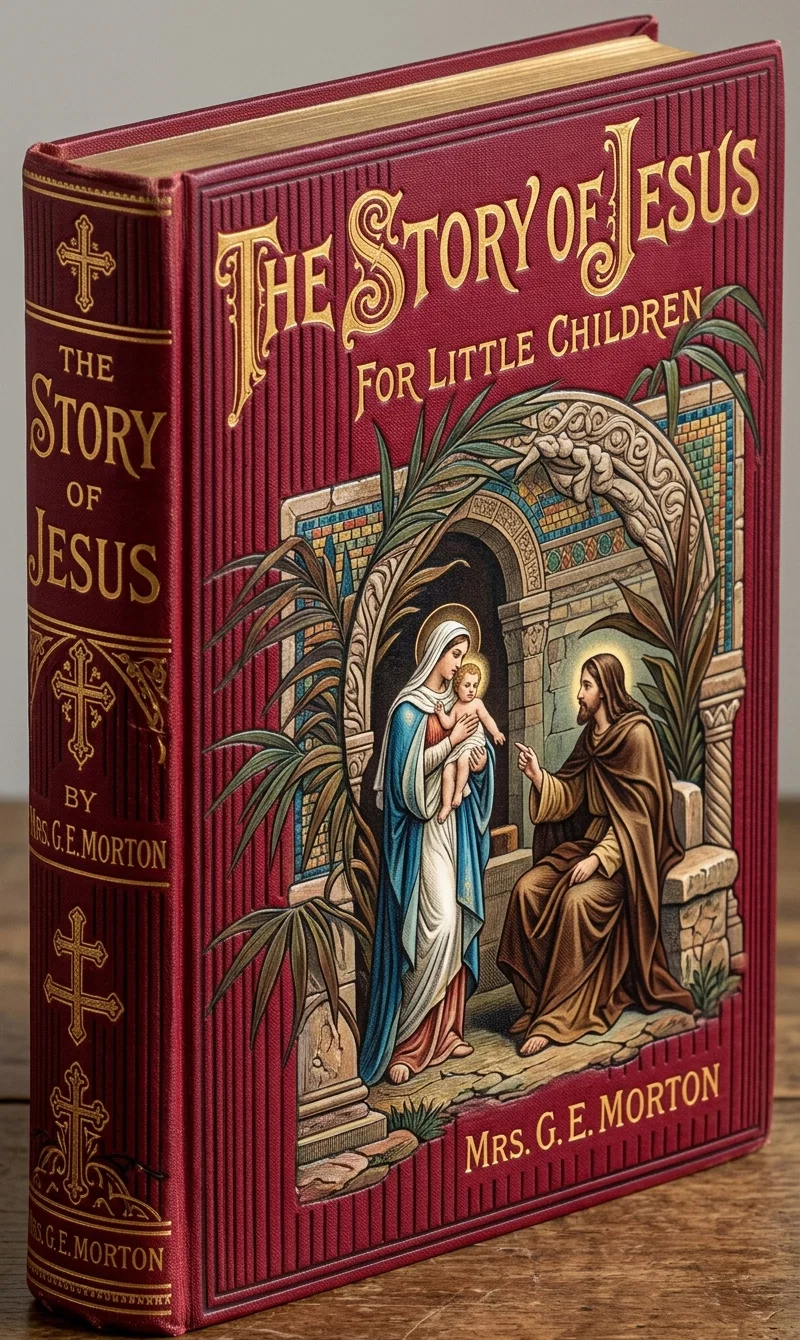
THE STORY OF JESUS.
By Mrs. G. E. Morton
BY
MRS. G. E. MORTON.
A successful attempt to adapt the life of Christ to the comprehension of children of four years old and under. The charm of the story and the simplicity of the telling make this one of the very best books that can be given to a child.—New York Observer.
12mo, 316 pages, cloth, printed in colors, $1.00
“The garb of the Sisters of Charity was conspicuous in the Thirty-fourth Ward public school to-day,” says a Pittsburg dispatch of the 26th ult. The reason given is that four nuns who had been previously employed in the parochial school of the ward begun teaching in the public school. The priest in charge of the parish states that this was necessary because of lack of accommodations for the parochial school children in his building. Instead of erecting an edition to the parochial school he installed nuns as teachers in the public school. “The nuns passed the school- teachers’ examinations with high percentages.” The school board is composed of Catholics, and they readily agreed to the proposition. It is said that there will be no religious instruction given in the school hours, and that the nuns will not wear their rosaries, but will wear their religious garb. Commenting on the facts stated, the Independent, of this city, says: “Of course a nun should not be excluded from qualifying as a teacher if she can. But we should draw the line at her wearing any specially religious garb: and if we are not mistaken, General Draper, who was superintendent of schools for this State, decided that such a dress could not be allowed in public schools.” If General Draper ever made such a ruling he was clearly right. Distinctively religious garbs must be excluded from the public school rooms unless the schools are to be completely Romanized.
TOPEKA, Kansas, is moving in the matter of Sunday closing. The Ways and Means Committee met recently, says the Topeka Capital, to discuss the Sunday closing ordinance. A delegation from the Ministerial Union, consisting of Revs. Alderson, Dill, and Owens, was present to discuss the matter with the members of the committee.
“The points of discussion took a very wide course, which involved Sunday labor in nearly all its phases. This dealt with the butcher, milkman, Sunday paper question, and even the street railway company, and ran so far into the ridiculous that the ministers were compelled to draw the line and confine the discussion to a representative case, that of the butcher.
“The ordinance relating to Sunday closing states that it shall be unlawful to expose to sale fermented liquors, any goods, wares or merchandise excepting drugs, provisions and articles of immediate necessity on Sunday. It was over the expression ‘immediate necessity’ that the widest opinion existed among the committeemen. Messrs. Holman and Fulton thought it unnecessary to get meat on Sunday, as it could easily be kept if bought on Saturday. Colonel Burgess thought it no worse to buy meat on Sunday than to have his wife wring a chicken’s neck and clean it before going to church, while General Bradford thought the butcher shop ought to be kept open for several hours, but not later than 9 o’clock. The latter opinion met with favor and it was finally left to Mr. Bradford to draw up an amendment to ordinance 68, which should specify that butcher shops be kept open for three hours, until 9 o’clock on Sundays, and also naming a $5 minimum fine, which is not contained in the present ordinance.”
LEGISLATION seems to be running mad. The latest freak is a bill at Albany “to prohibit the tolling of any bell in any cemetery in Brooklyn.” The Sun pertinently enquires: “Will the meddlers with everything, and every custom, and every right of the living and of the dead, even with funerals, burial ceremonies, and immemorial usages, never cease their meddling?”
THE Catholic Review does not like the idea of taxing church property, but thinks that in the event of such a policy being adopted, "it is not the Catholics but the Protestants who will have the most reason to wince." And that is just the reason church property will not be taxed. "Protestants" there are in abundance who would like to tax Romish Church property, but the Protestants who are willing to pay taxes on their own church property are few.
A DISPATCH from Toledo, under date of February 21, published in the Sun of this city, on the 22nd, states that a judgment was rendered against one W. J. Ostrander, on a suit brought to recover a balance of $138.40 on a contract for a lot of rifles sent to Council No. 2 of the American Protective Association. Ostrander was, it seems, the agent of the council in the purchase of the rifles. With the American Protective Association and the Roman Catholics both arming, the results are scarcely a matter of doubt. Open conflict must ensue.
The American Protective Association is opposed to the papacy, and this is right. But this way of opposing the papacy is not right. Rome and her methods are all wrong. And opposition to Rome or her methods cannot be made in the right way, nor can it ever succeed, by doing as she does. That only helps her along, instead of being any real opposition to her,
A CORRESPONDENT wants to know our objections to the proposed 16th Amendment. We have no objection to it except that it does not go far enough. It prohibits simply appropriations for “sectarian” purposes. In the proper sense of the word that is all right, but in the sense in which it is intended by the promoters of the amendment it would still leave the Government or any State free to make appropriations for that colorless thing known as “unsectarian religious instruction.” The amendment does not touch the root of the evil and is not designed to.
A FRIEND in Missouri writes us as follows:—
By Editor
Publishers AMERICAN SENTINEL:
Not being very busy to-day I canvassed a little for the SENTINEL, and the first five men I showed the paper to subscribed; and I herewith send you $4.50, for which you will please send the paper to the following names: [Here are given five names and addresses.]
Our friend need have sent us only four dollars on five new subscriptions, and is therefore entitled to fifty cents credit on his own subscription under our special offer recently made. Other readers of the SENTINEL have been doing the same kind of work, and there is opportunity for still others. Let the good work go on.