In the early part of 1902 our sanitarium and hospital buildings in Battle Creek, Mich., were destroyed by fire. A year later the main building of the Review and Herald publishing plant was laid in ashes.
The destruction of these large and important buildings seemed like a great calamity to our cause. It made us all think seriously, and when messages came through the Spirit of prophecy telling us that these great fires were judgments from the Lord, we sought the Lord earnestly to know what was wrong, and what should be done to correct the wrong and meet the mind and purpose of God.
In our perplexity and our search for the right way the definite message came, telling us that instead of rebuilding the publishing house in Battle Creek, we should remove the headquarters of our work to some suitable place in the Eastern States, on the Atlantic coast. This message was a surprise to the majority of our people. To some it brought a sense of relief and encouragement; to others it brought great perplexity and regret.
In our study of the problem, our attention was called to the message given in 1856, stating that when the cause had become strong in the West, the movement would turn eastward, and that power would attend our labors in the East. As we put these two messages together, the way became clear, and with assurance and courage we took up the task of removing our headquarters from Battle Creek, where they had been established for nearly fifty years, back to the Atlantic coast. We moved to Washington, D. C., in August, 1903.
In connection with this removal to the East, earnest messages began coming to us through the Spirit of prophecy in behalf of the cities in the Eastern States. These messages directed our attention to these populous cities, and gave well-defined reasons why immediate, strong, efficient efforts should be made to give our message to the masses in these cities.
One of these messages was entitled “A Present-Day Work,” and from the following may be seen, in part, the deep solicitude it expresses for the millions in these cities who know not that the day of their visitation is at hand:—
“More and more, as the days go by, it is becoming apparent that God’s judgments are in the world. In fire and flood and earthquake, he is warning the inhabitants of this earth of his near approach. The time is nearing when the great crisis in the history of the world will have come, when every movement in the government of God will be watched with intense interest and inexpressible apprehension. In quick succession the judgments of God will follow one another,—fire and flood and earthquake, with war and bloodshed.
“O that the people might know the time of their visitation! There are many who have not yet heard the testing truth for this time. There are many with whom the Spirit of God is striving. The time of God’s destructive judgments is the time of mercy for those who have had no opportunity to learn what is truth. Tenderly will the Lord look upon them. His heart of mercy is touched; his hand is still stretched out to save, while the door is closed to those who would not enter. . . .
“Behold the cities, and their need of the gospel! The need of earnest laborers among the multitudes of the cities has been kept before me for more than twenty years. Who are carrying a burden for the large cities? A few have felt the burden, but in comparison with the great need and the many opportunities, but little attention has been given to this work. . . . ‘Repeat the message, repeat the message,’ were the words spoken to me over and over again. ‘Tell my people to repeat the message in the places where it was first preached, and where church after church took their position for the truth, the power of God witnessing to the message in a remarkable manner.’
“For years the pioneers of our work struggled against poverty and manifold hardships, in order to place the cause of present truth on vantage ground. With meager facilities, they labored untiringly, and the Lord blessed their humble efforts. The message went with power in the East, and extended westward until centers of influence had been established in many places.
“The laborers of today may not have to endure all the hardships of those early days. The changed conditions, however, should not lead to any slackening of effort. Now, when the Lord bids us proclaim the message once more with power in the East, when he bids us enter the cities of the East, and of the South, and of the West, and of the North, shall we not respond as one man and do his bidding? Shall we not plan to send our messengers all through these fields, and support them liberally? Shall not the ministers of God go into these crowded centers, and there lift up their voices in warning the multitudes? What are our conferences for, if not for the carrying forward of this very work?”—Testimonies for the Church, Vol. IX, pp. 97-99.7
It will be noticed that this message given in 1909 calls our attention to conditions and experiences back in the pioneer days. It almost repeats some of the things said in the message given in 1856, which contained the promise that an active movement would at some future time return to the East. It connects that return movement to the East with most serious conditions prevailing in the land.
This recent message not only directs attention to the Eastern cities, but it names some of them, and gives specific instruction regarding the efforts that should be made for them:—
“In Portland, Maine; in Boston, and the towns round about; in New York, and the populous cities close by; in Philadelphia and Baltimore and Washington, the Lord desires us to proclaim the third angel’s message with power. We cannot exercise this power ourselves; but we can choose men of capability, and urge them to go into these avenues of opportunity, and there proclaim the message in the power of the Holy Spirit. We must plan to place in these cities capable men who can present the third angel’s message in a manner so forcible that it will strike home to the heart.”
A year later another communication came, addressed to the leaders in the Maine Conference. This message contains the following instruction:—
“DEAR BRETHREN: The importance of the work in Portland, Maine, is kept before me. I am glad that a house of worship is being erected in that city. The Lord will be pleased if all our brethren in the Maine Conference will make a solemn covenant with him and work unitedly to complete this building. . . . The Lord does not require means of those who have it not to give. Poverty is not so great a difficulty in the advancement of the Lord’s work as is the manifestation of self by men. The living Christ alone can deal with the selfish dispositions of men who are determined to have their own way. The Lord is waiting to see self-esteem and self-confidence broken down. I beseech of our brethren to fast and pray, if necessary, till every difference be removed, till self is subdued, and there results a sweet spirit of harmony. . . . A new era is to begin for the Maine Conference. . . . It is for the glory of God that the work in Maine shall go forward with increased strength.”
These messages and others of a similar character led to earnest, conscientious efforts in behalf of the cause in Maine. Elder and Sister Haskell were especially moved upon to carry out this instruction. They went to Portland and labored untiringly for the church, and also for the people of that city. They met with many perplexities and discouragements, but they held on. Others united with them in faithful, persistent effort. They endeavored to comply with every detail of the counsel given. The church appointed seasons of fasting and prayer. The members put away differences that separated them, and prevented the fullest Christian union.
The Lord kept his promise to work in their behalf. The year 1915 was a most encouraging one for the workers and the believers in Maine. Nearly one hundred members were added to the Portland church. The eight thousand dollars of indebtedness on the church building was paid. Having no conference office and needing a baptistery and more room for Sabbath school purposes, a neat addition was made to the church building, at a cost of $1,700, all of which was paid by the time the work was completed.
Further than this, an encouraging change came over the cause of present truth throughout Maine. The brethren all over the State began to seek the Lord earnestly and to do more active work. Their tithes increased, and they came to the front in all their offerings. They took first place in the Harvest Ingathering work. From one of the most backward conferences in the whole United States, the Maine Conference has stepped into the front ranks. The brethren do not boast of this progress; they give thanks and praise to God for it all.
We heard about these things, and some of us could hardly believe all we heard, knowing quite well the former conditions. On invitation I visited Portland, and found everything there as reported,—a greatly increased membership, a nice new church building, new conference offices, and not a cent of indebtedness. The spirit of the people was warm, joyous, courageous. A new life had taken hold of all.
While at South Lancaster during the last week of prayer, Elder A. E. Sanderson, who has acted as pastor of the Portland church during the past year, expressed to me his belief that there was yet much more to be done for the city of Portland and the State of Maine. He quoted the instruction that had been given us with reference to holding large meetings to arouse the people. He suggested, further, that I assist by giving three addresses in Portland, and I reluctantly agreed to do so, feeling, however, a large degree of uncertainty as to the part I could fill.
The Portland city hall is one of the finest civic auditoriums in the United States, the one thing of which the people of the city are especially proud. This hall was secured for three nights. Thorough work was done in advertising the meetings, utilizing neat show-window cards, large, nicely painted signs in prominent places, and a liberal amount of newspaper space. All the advertising was of a creditable, high-class character. The Sabbath preceding the first meeting was appointed a day of fasting and
prayer. The brethren were expecting an audience that would fill the hall, and were praying and working for it. Personally I felt that if five hundred persons came to hear us, I should feel encouraged. My burden was not so much for a large attendance, as that God would speak to the hearts of the people and cause them to think very seriously.
The church from which Sister White’s parents were excluded still stands, and is on the same street as the city hall. The building where Sister White attended school when she was a child is still there. The little hall, about eighteen by thirty feet, where Brother and Sister James White and Brethren J. N. Andrews and J. N. Loughborough used to meet with a little handful of people, is there now, being used as a paint shop. As I thought of the dear old pioneers, standing loyally and courageously for the truth when it had no standing of its own, amid prejudice and ridicule, I was made to feel very serious indeed, and was led to pray earnestly for that loyalty and courage that filled the hearts of the pioneers in those dark days. A. G. DANIELLS.
Young People's Missionary Volunteer Day
By Irwin H. Evans
THE General and Division Conferences have set apart the first Sabbath in May as Young People's Missionary Volunteer Day. Not a few leaders, church elders, and even ministers will probably ask, Shall we observe this day? and if so, what shall we do to make the day both profitable and interesting?
The latter part of this question will be answered by a program which the Missionary Volunteer Department will furnish all church officers and young people's leaders for this occasion.
Let me suggest a few reasons why this day should be observed by every church in the Division Conference:—
1. The General and Division Conferences have set this day apart to be observed by our churches throughout the world. It adds much to the interest of the occasion to know that every fellow believer in the denomination is following the same program that we are trying to carry out. This makes us a united people, and invariably brings strength and comfort to the church.
2. Our young people need the inspiration and help to be obtained from the observance of this day. They are isolated from the world and its pleasures. We do not wish them to join other young people's societies nor to attend public amusements, nor the places generally visited by the young. We must offer them something more interesting and helpful. This day's service is designed to meet a need in the lives of young people, and to encourage them to8remain loyal and faithful to the church and the third angel's message.
3. Not a few young people of Seventh-day Adventist parentage are out of Christ. It is the endeavor of the Young People's Missionary Volunteer Department to lead the unconverted and those who are not especially interested in the truth, to give their lives to God, and to take an active part in the work of the church. The efforts for the day will be to interest these young people, and all should unite in prayer that the Holy Spirit may speak to many hearts, and that those out of Christ may find the joy of the Christian in believing.
4. To accomplish this purpose, there must precede this day a heart preparation of much prayer and wrestling with God. Parents should tarry long in secret communion with the Most High for their wayward sons and daughters out of Christ. The church officers should counsel together, lay their plans with the young people's leaders in a very definite way, and spend much time in prayer in behalf of those young people who need help.
5. The Young People's Missionary Volunteer Department has prepared a program for the day, which will appear in the REVIEW of April 20. These workers have spent much time and prayer and study trying to set forth those points that will be most helpful. No other program should be substituted for this, but each one should study well the part he is to take in the day's service, and make it as helpful as possible.
This day should be made a day that will never be forgotten. It should be a day when the Holy Spirit shall manifest its convicting and converting power. Our young people must be brought to Christ, if labor and prayer on our part will bring them. They are needed in the homeland, they are needed in the foreign fields, and we must remember our duty toward the “beautiful flock,” that the Lord has intrusted to our love and care. Nor should we forget the purpose of this day. It is not a holiday, but a holy day, the proper observance of which will bring rejoicing and thanksgiving to many hearts.
We therefore trust that our church elders and leaders everywhere in the Division Conference will plan long beforehand to make this day one of the best in the whole year. Let us work for great things, pray for great things, and believe that God will give us the desires of our hearts.
I. H. EVANS,
President N. Am. Div. Conference.
Secret Societies
By Ellen G. White
(Continued)
MRS. E. G. WHITE
I ASK you who take pleasure in these associations, who love the gathering for indulgence in wit and merriment and feasting, Do you take Jesus with you? Are you seeking to save the souls of your companions? Is that the object of your association with them? Do they see and feel that there is in you a living embodiment of the Spirit of Christ? Is it manifest that you are witnessing for Christ, that you belong to a peculiar people, zealous of good works? Is it manifest that your life is governed by the divine precepts, “Thou shalt love the Lord thy God with all thy heart, and with all thy soul, and with all thy mind,” and “Thou shalt love thy neighbor as thyself”? To speak to the hearts and consciences of those that are ready to perish, is beyond the power of one who does not himself surrender all for Christ. But where do your fluency and warmth of speech show that your interest is centered?
In these societies what are the favorite subjects of conversation? What are the themes that excite interest and give pleasure? Are they not the gratification of the senses,—eating and drinking and pleasure seeking? The presence of Christ is unknown in these gatherings. No reference is made to him. His companionship is not desired. Where and when is God honored by such associations? Wherein is the soul in the least benefited? If you do not influence your companions for good, are they not influencing you for evil? Will it do to lay aside the lamp of life, God’s Word, and mingle freely with this class of associates, and come to their level? Do you think you can find something to satisfy the hunger of the soul apart from truth and the favor of God? Shall those who profess to believe the truth for this time be at home in such scenes, when God is not in all their thoughts?
In the same room where these societies have had their gatherings, the congregations have met to worship God. Can you, during the sacred hour of divine service, forget the scenes of merriment and feasting, and indulgence in the wine cup? All this God writes in his book as intemperance. How does it blend with eternal realities? Do you forget that at all these pleasure gatherings there is a Witness present, as at the feast of Belshazzar? Could the curtain that separates us from the invisible world be rolled back, you would behold the Saviour grieved to see men absorbed in the pleasures of the table, in hilarity and witticism, that put Christ, the center of the world’s hope, out of their thoughts.
Those who cannot discern between him that serveth God and him that serveth him not, may be charmed with these societies that have no connection with God, but no earnest Christian can prosper in such an atmosphere. The vital air of heaven is not there. His soul is barren, and he feels as destitute of the refreshing of the Holy Spirit as were the hills of Gilboa of dew and rain.
At times the follower of Christ may by circumstances be compelled to witness scenes of unholy pleasure, but it is with a sorrowful heart. The language is not the language of Canaan, and the child of God will never choose such associations. When he is necessarily brought into society that he does not choose, let him lean upon God, and the Lord will preserve him. But he is not to sacrifice his principles in any case, whatever the temptation.
Not of Christ
Christ will never lead his followers to take upon themselves vows that will unite them with men who have no connection with God, who are not under the controlling influence of his Holy Spirit. The only correct standard of character is the holy law of God, and it is impossible for those who make that law the9rule of life to unite in confidence and cordial brotherhood with those who turn the truth of God into a lie, and regard the authority of God as a thing of naught.
Between the worldly man and the one who is faithfully serving God, there is a great gulf fixed. Upon the most momentous subjects,—God and truth and eternity,—their thoughts and sympathies and feelings are not in harmony. One class is ripening as wheat for the garner of God, the other as tares for the fires of destruction. How can there be unity of purpose or action between them? “Know ye not that the friendship of the world is enmity with God? whosoever therefore will be a friend of the world is the enemy of God.” “No man can serve two masters: for either he will hate the one, and love the other; or else he will hold to the one, and despise the other. Ye cannot serve God and mammon.”
But we are to beware of indulging a spirit of bigotry and intolerance. We are not to stand aside from others in a spirit that seems to say, “Come not near to me; for I am holier than thou.” Do not shut yourselves away from your fellow men, but seek to impart to them the precious truth that has blessed your own heart. Let it be manifest that yours is the religion of love. “Let your light so shine before men, that they may see your good works, and glorify your Father which is in heaven.” But if we are Christians, having the Spirit of him who died to save men from their sins, we shall love the souls of our fellow men too well to countenance their sinful pleasures by our presence or our influence. We cannot sanction their course by associating with them, partaking in their feasts and their councils, where God does not preside. Such a course, so far from benefiting them, would only cause them to doubt the reality of our religion. We should be false lights, by our example leading souls to ruin.
Responsible for Other Souls
I lately read of a noble ship that was plowing its way across the sea, when at midnight, with a terrific crash, it struck upon a rock; the passengers were awakened only to see with horror their hopeless condition, and with the ship they sank to rise no more. The man at the helm had mistaken the beacon light, and hundreds of souls were at a moment’s warning launched into eternity. If we present a phase of character that misrepresents Christ, we present a false light, and souls will surely be misled by our example.
And Christians who connect themselves with worldly associations are injuring themselves as well as misleading others. Those who fear God cannot choose the ungodly for companions, and be themselves unharmed. In these societies they are brought under the influence of worldly principles and customs, and through the power of association and habit the mind becomes more and more conformed to the worldling’s standard. Their love for God grows cold, and they have no desire for communion with him. They become spiritually blind. They can see no particular difference between the transgressors of God’s law and those who fear God and keep his commandments. They call evil good, and good evil. The brightness of eternal realities fades away. The truth may be presented to them in ever so forcible a manner, but they do not hunger for the bread of life, or thirst for the waters of salvation. They are drinking at broken cisterns that can hold no water. Oh, it is an easy thing, by association with the world, to catch their spirit, to be molded by their views of things, so that we do not discern the preciousness of Jesus and the truth. And just to the degree that the spirit of the world dwells in our heart, it will control our life.
When men are not under the control of the Word and the Spirit of God, they are captives of Satan, and we know not to what lengths he may lead them in sin. The patriarch Jacob beheld those who take pleasure in wickedness. He saw what would be the result of association with them, and in the Spirit he exclaimed, “O my soul, come not thou into their secret; unto their assembly, mine honor, be not thou united.” He lifts up the danger signal, to warn every soul against such associations. The apostle Paul echoes the warning: “Have no fellowship with the unfruitful works of darkness.” Eph. 5:11. “Be not deceived: evil company doth corrupt good manners.” 1 Cor. 15:33, R. V.
(To be continued)
Contentment
“CONTENTMENT is a pearl of great price; and whoso purchaseth her at the expense of ten thousand desires, maketh a wise and happy choice.”
'Tis Jesus Saves
By Mrs. M. C. Hunn
MRS. M. C. HUNN
I ONCE was lost, but now I'm found;
'Twas Jesus took me in.
I'm dwelling now within his love,
The love that frees from sin.
I'd wandered far out in the cold,
But Jesus brought me to the fold,
And oh, what rapture to be told,
“‘Tis Jesus saves from sin”!
I'm drinking at the fountain pure
That doth so freely flow;
I've found a spring of glorious joy
The worldly cannot know.
I care naught for this world so gay,
Its pleasures soon will pass away;
'Tis sweeter far to know today
That Jesus saves me now.
He fully cleanses me from sin,
He fills my heart with love;
And oh, what rapture to my heart
To tell of him above!
To tell of him who died for me,
Who gave his life upon the tree,
Who gave his life to set me free;
Now saves and fills with love!
Come, sinner, taste of Jesus' love,
'Tis sweet as honeydew;
Come to the fountain, drink and live,
It freely flows for you.
O sinner, ere it be too late,
Come, seek and find the narrow gate;
Come to the Saviour, do not wait,
'Tis he will save you now.
Boulder, Colo.
The Sixth Commandment
By Milton C. Wilcox
The Law of God — No. 11
The Sixth Commandment
MILTON C. WILCOX
It was Jehovah, the great covenant God of his people, who thundered from Mt. Sinai the sixth word of the law.
“Thou Shalt Not Kill”
With the common application of the commandment, mankind are generally agreed. But what about killing by God’s command, so often referred to in the early part of the Bible? Was not this a violation of God’s law?
Look upon it in this light: All life is from God. He gave life to man as a trust to be used to his glory and always for man’s eternal good. If man misuses the gift, God does no injustice to remove it in whatsoever way he will. If by swift and superhuman judgment or by human agent, we can leave it with him.
Sometimes a nation or a people become so corrupt, so debased, so depraved, so reprobate, that it is mercy to them and their present and probable posterity to destroy them utterly, as the Canaanites were destroyed. Think of the fearful harvest of crime and vice which would have been perpetuated if these nations had been permitted to live and continue to propagate. God’s mercy was manifest in their destruction.
Sometimes the work which God did through Israel was limited and perverted by the human instrument. But the life of man we may safely leave with God the Creator, the Life-giver, the Judge of all the earth. It is his to give; it is his to take away. But we should not hold him responsible for the sins of his people.
“Thou shalt not kill.” The law strikes at the highest transgression, and includes all under it, every motive that leads to the taking of life. Therefore the divine comment, “Whosoever hateth his brother is a murderer.” 1 John 3:15. For hatred, full-grown, free, and without restraint, results in murder. He who hates is a transgressor of this law. There are many sins which would place one in this category. He may not be free to admit it, but his words and acts reveal the hatred, and God tells us what it means.
There is one remedy—the love of God in the heart. That love will come when we, seeing the enormity of our own sins and the great mercy of God in giving his Son to die for such sinners, yield those sins to God, and open our hearts to receive the Holy Spirit. See the climax of this experience in Rom. 5:1-5.
But these are not all the transgressions covered by the commandment. Great corporations are killing men and women by their demands in service, by the unsanitary conditions under which the hands are obliged to work, and by the pitifully small wages paid. Sweatshop factories are killing men. For these conditions individual men are in some way responsible, and the judgment of God will find out how and why and where.
The husband, by leading a life of lust or selfishness, by penuriousness and brutality and bestiality, may be killing his wife. The wife, by the selfish course she is pursuing, by self-centered fault-finding, extravagance, and neglect, may be undermining the life of the husband. The careless, indifferent, wayward son, or the selfish, wanton daughter may be breaking the heart and sapping the life of father and mother.
All murder is not by bludgeon, choking, poison, shooting, or stabbing. These are sometimes the more merciful. It is sometimes the slow, long-drawn-out cruelty, the wilful, selfish neglect, the adding of weights and burdens to an already overburdened life. Husband, father, wife, mother, son, daughter, these are things for us to consider. We shall meet the consequences of our acts in the great judgment day, unless we have, by God’s grace, gained the victory over our thoughtlessness and neglect.
Suicide is murder. We have no right to kill ourselves in any way, by violence, hanging, poison, or by the slower process of a bad habit or any wrong course of life.
Regard the life of all, even your own, as sacred to Him who redeemed you with his own precious blood. Let the love of God into your heart, and it will drive out hatred, and implant therein a love for every person in the world.
Mountain View, Cal.
Minas Geraes, Brazil
By F. W. Spies
F. W. SPIES
NOVEMBER 12 I started on a visit to some of the places in Minas where the truth has found friends. I first visited Caxambie, where I met Brother Rhode, and where some of our newly baptized brethren had created an interest among their relatives. In this place I found six persons who had begun keeping the Sabbath. Others were studying the truth. We spent several days with them, holding meetings and teaching, and then went to Juiz de Fora. Here also several families had recently begun keeping the Sabbath. Our meetings were well attended, and I was pleased that on the Sabbath I could baptize four.
From Juiz de Fora my trip took me to Bello Horizonte, the capital of Minas, where I went to visit Brother and Sister Kroeker. Sister Kroeker had for some time been canvassing there with good success, and Brother Kroeker had been teaching the English language to quite a number of young people, even normal school professors and students of the place. This city impressed me as being a very promising place for a series of tent meetings; but like so many other openings, it must wait until some future time.
From Bello Horizonte I went to Barbacena. Here Brother Rhode and I spent several days. During our stay Brother Bettoni's family, four in all, were baptized.
We went to Guarany, where the truth had found an entrance, and where we had another baptism, six being here buried with their Lord in the watery grave. - I was especially impressed with the fervor of these new brethren.
Having finished our work in Guarany, we went several stations farther, to a place called Serra dos Maccacos. In and about this latter place there resided a number of native Christians. Some, having learned that our colporteurs were working in that section, became alarmed and warned them against the work. The effect of this warning, however, was the opposite from what was expected. One of the leading men, thinking it strange that they should be warned against people who try to follow the Bible, became curious to know more about us, and sent Brother Rhode an invitation to visit him. As Brother Rhode could at that time spend only a few days with these people, he left them a copy of Portuguese “Bible Readings.” When we arrived, we found fifty persons keeping the Sabbath. Brother Rhode has since spent a few weeks in that place, and found as many others anxious to study the precious message for this time.
Surely the field is ripe for the harvest; but how great a lack of reapers in this large and needy field! May the Master send more reapers to gather the ripe grain is our earnest prayer.
South Caribbean Conference
By N. H. POOL
N. H. POOL
In closing our work for the year 1915, we see many evidences that the arm of the Lord is not shortened, and have many reasons for praise and thanksgiving. The final statement shows that two new churches were organized, and 378 converts added to the membership, as compared with 132 in 1914. One church building was dedicated. While war conditions have prevailed and times in general have been hard, yet our tithes and offerings have not fallen off.
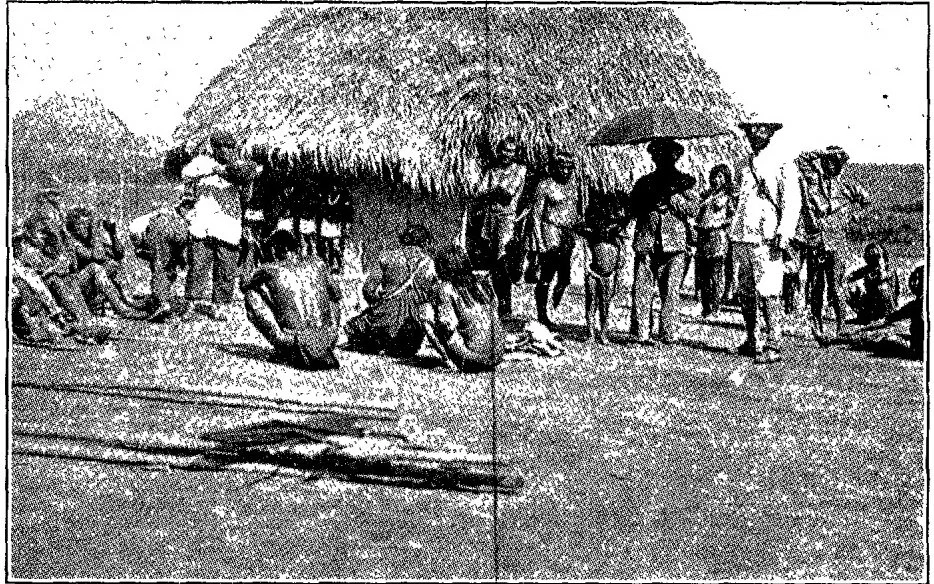
CHIEF JEREMIAH'S HUT WHERE ELDER O. E. DAVIS DIED
There were sold during the year $4,700 worth of books, $3,000 worth being Spanish books placed in Venezuela. We have had no regular bookman, so feel that we have made a very small showing in the sale of publications as compared with the great opportunities that lie before us. With a man to devote his time to that work, we are hoping for better results this year.
The school work is struggling against many difficulties, yet we have held our own, and the prospects are brighter for the future, as we started one new school in January.
Our medical work took an advance step during the year. Dr. Charles Cave, of Barbados, who had been laboring under difficulties because of lack of room, was enabled to make a change for the better. He has secured a fine property . It was the surgeon's quarters when the army was stationed there, a very substantial building facing the Atlantic Ocean, with fine beach and sea bathing. With the renown that Barbados has as a health resort, there is good reason to believe it will be an excellent place for our work.
When we compare what has been accomplished with the great needs of the field, it seems insignificant. With a territory larger than three union conferences, or equal to three fourths of the territory east of the Mississippi River, with six distinct races and languages (at present we are carrying on work with three, the English, French, and Spanish), and two missions among the American Indians of British Guiana, it would seem this is quite a large mission field.
There was a call for Brother H. Beck to visit a company of Indians on the Berbice River, in British Guiana. A little later it was my privilege to visit them in company with him. We were agreeably surprised to find that some were obeying the truth and desired baptism. They had a church building partly erected , and promised that they would build a mission house if we would send them a missionary. The church is now completed and waiting for dedication. They still wish to build a house for the missionary.
In the Guianas and Venezuela there are great numbers of these children of the forest, who for some reason have a very strong impression that the Lord is coming soon. They are desirous of having some one teach them the truth as we know it. At present we have some young people at our Tapagruma mission who are studying and making the needed preparation, so that when we have a missionary to send to the interior, they may assist as guides and interpreters. They are acquainted with the people and country where Elder Davis died. The accompanying picture of Jeremiah's hut, and beside it Brother Davis's grave, was obtained on this visit into the interior of British Guiana.11
Besides these Indians, we have the Dutch and East Indians, for whom we are doing practically nothing. But we cannot turn aside from the duty that faces us at every turn.
We are glad to welcome new workers as they come to the field, and trust that with a united effort many may yet be gathered as trophies of redeeming love. We are praying that the Lord of the harvest will send forth many more laborers into these dark places.