THESE are “barefoot days” for the country boy, and likewise days for “first aid” to his wounds, stings, bites, and bruises. A good first-aid outfit should be in a safe place in every mother’s closet, ready for immediate use. Moments gained at the beginning of an injury may save hours of suffering later. Such an outfit may contain:—
A roll of absorbent cotton; a spool of adhesive plaster; a package of sterile gauze; half a dozen rolls of bandages from one to four inches wide; a bottle each of liquid soap, of peroxide of hydrogen, of iodine, and of 7½-grain bichloride of mercury tablets; a pair of sharp, small scissors; a pair of tweezers; a brush; and a small basin. A light, well-made box, with handle and lock, is the ideal container for this outfit, insuring its cleanliness and readiness for use when needed. (Special warning should be given in regard to the bichloride of mercury tablets. The bottle should be plainly labeled, and in some way so marked that the contents will always be recognized as poison. Many serious accidents have resulted from neglecting these precautions.)
The first essential in treating a wound is the absolute cleanliness of the hands that are to do the work. To insure this they should be thoroughly scrubbed in very hot, soapy water, rinsed in boiled water if it is to be had, and then immersed in a 1-1,000 bichloride of mercury solution. This is made by dissolving one 7½-grain tablet of bichloride of mercury in one pint of warm, boiled water.
Next, the skin in the region of the wound should be cleansed, first with warm water and soap, and then with the antiseptic solution.
Punctured Wounds
When Tom catches his arm on a long, sharp thorn, pushing the thorn well into the tender flesh, or when Henry jumps from the loft to the pile of hay on the barn floor, and encounters the sharp tine of a pitchfork on the way, or little Joe steps on a nail,—their wounds are classified under the heading given above.
These wounds may become very dangerous if infected; and it should not be forgotten that common garden soil is often a fertile source of infection for the deadly tetanus, or lockjaw.
The punctured wounds should be carefully cleaned, as already outlined; bleeding should be encouraged; the foreign body should be removed, and the puncture swabbed out with iodine, applied with a bit of absorbent cotton wrapped on the end of a small, sharpened stick. The wound should then be packed with a narrow strip of sterile gauze.
In all severe wounds it is advisable to call a physician, but this first-aid treatment may be given before he comes.
Patriotic Wounds
Toy pistols, firecrackers, “torpedoes,” and other noise makers are still with us, and the resulting injuries are unfortunately common. In the event of such an accident, a physician should be sent for at once; for these wounds are usually dirty, and often followed by lockjaw.
The wound should be thoroughly cleaned, using hot water and soap, and the 1-1,000 bichloride of mercury solution. If a physician cannot be secured, the wound must be carefully examined for the presence of foreign bodies, and these removed. This sometimes necessitates cutting the skin. A pair of small tweezers, which have been made sterile by boiling in the disinfecting solution, should be used to grip and remove the foreign matter. The wound should then be carefully washed out with peroxide of hydrogen or with iodine, and an aseptic dressing applied.
Fishhook Wounds
These are painful wounds, but not serious. The chief difficulty is in removing the hook. “The best way to accomplish this is to press the hook out through the tissue until the barbed end is in view, when it may be cut or broken off, and the hook withdrawn.” Peroxide of hydrogen or iodine should then be used to wash the wound, and an aseptic dressing applied.
Bee Stings
The sting of bees, wasps, hornets, etc., rarely has a serious result, but it is often extremely painful. The sting is sometimes broken, and part of it left in the flesh. It should be removed, and some alkaline solution applied to the swelling. A solution of washing soda or ammonia water often gives relief. Baking soda, wet earth, or a fresh slice of onion may be used. When a child has been stung inside the mouth, as sometimes happens, a solution of salt and water, as hot as can be borne, may be held in the mouth, but should not be swallowed.
Bruises.
These are of frequent occurrence. The skin of the bruised surface should be thoroughly but gently washed with hot soapy water and then with an antiseptic solution, such as the 1-1,000 bichloride of mercury solution. Discoloration may be greatly reduced or prevented by alternate hot and cold applications. Hot fomentations also serve to relieve the pain. With both hot and cold, moderate pressure is recommended to the injured part, to prevent the further escape of blood and help to absorb that already present. Diluted vinegar, diluted alcohol, arnica, and other lotions are often used, but authorities agree that the application of hot and cold water is the best remedy.
MRS. I. H. E.
MRS. C. L. STONE
By MRS. C. L. STONE
Training in Habits of Order and Helpfulness — No. 5
MRS. C. L. STONE
My observation in teaching hundreds of children convinces me that children are interested most in doing the thing they know how to do well. No person, either adult or child, enjoys doing a thing which he does not know how to do, and which, though he do his best, must still be done in a bungling fashion.
Dexterity of hand is not acquired in a day. Just as the student of music must practice for hours day after day and year after year before he acquires the desired suppleness of touch, so the little child must be trained to a dexterity of touch in performing work.
Long ago in the schoolroom the discovery came to me that the healthy child, the child who could be set at a task and accomplish it, the child who could be depended upon to do his work neatly and well, was the one who had had careful instruction in manual training.
It may seem an indirect route, but I believe it is one of the surest ways of developing, in the end, helpfulness in our children. The desired dexterity of touch follows only much constructive work. Let them begin in earliest childhood with clay modeling and paper folding, tearing and cutting. A little later, introduce mat weaving and raffia winding, which are17preparatory steps for the later basket weaving. Not only do we teach dexterity of hand in these things, but in them we find opportunity for teaching artistic form and color arrangement. In this way an educated taste is acquired, which later will be very helpful in the arrangement of rooms, the selection of rugs, wall paper, etc.
As the children grow older, systematically teach them sewing, pasteboard sloyd, gardening, wood sloyd, cooking, and laundry work. In short, give them a complete course in housekeeping. The same course is not adapted to both boys and girls. Their natural tastes should influence to a certain extent.
It is of the utmost importance that, if we are to expect neatness and order in our children's work, they be trained carefully and systematically in the manner of doing it.
“To children active and restless,
Employment is most of all;
For useless pleasures, if often
Repeated, are apt to pall.
“But work, of a kind congenial,
Whatever they most enjoy,
Will be to their minds a guidance,
And their hearts and hands employ.
“‘Tis an inborn, primal impulse;
What two years’ boy would fail
To reach, if he could, the hammer,
And try to drive a nail?”
Takoma Park, D. C.
A Mother’s Prayer
So many cares to burden all the day,
So many wounds to bind, and hurts to
heal,
So many steps to guide along the way,
So much for hands to do and hearts
to feel,
Thou knowest, Lord, how weary mothers
grow;
How, at the close of day, we come with
lagging feet
And ofttimes aching head, to ask thy help
Just to keep sweet.
The cup of little things that worry so,
Comes often to a mother’s lips to drink.
The griefs and joys that only mothers
know
Make up her chain of days, forged
link by link.
Dear Lord, a mother draws her strength
from thee,
Her wisdom, too, to guide the childish
feet;
But always, Lord, our daily need will be
Just to keep sweet.
— Selected.
Making a Friend of Daughter
By Virginia Dale
When I was a little girl, my mother once sent me with a note to our washerwoman, who lived, with her five daughters, in a small, unpainted house on the outskirts of the little town.
That shanty, with its yard inclosed by a ramshackle fence, was the most interesting place I had ever visited. Over the dilapidated front door an old-fashioned gourd vine flourished. At the side of the house was a well, with gourds of fascinating shapes and sizes suspended in the shade of the arbor for the convenience of those who were thirsty. In the front yard, beds of rank dog fennel were outlined with whitewashed stones. Hanging in the sun beside the kitchen door was a wide-mouthed, greasy-looking bottle in which the family cure-all, dog fennel salve, was brewing. Back of the house was a curious mound of earth, which I was told contained turnips for the winter. One of the girls dug out an enormous white and purple one. Another ran into the house, and brought out an ornate glass saltcellar filled with the coarsest—and the sweetest—salt a human being ever tasted. With that turnip and the salt, we were going to have a party!
The five girls led the way to the extreme end of the lot, and we wedged ourselves into a narrow passage between a chicken coop and a board fence that kept the alley out of the back yard. This space was the playhouse. It was furnished with broken stools, a wooden horse, and the most fascinating collection of broken dishes and bottles that ever ravished childish eyes. On the ledge of the fence was a fragment of vase containing the ubiquitous dog fennel blossoms. That ledge was the table from which we were to eat the turnip and salt, and drink cool water from dripping gourds. Just as we had begun our feast, the mother appeared with a bag of crackers. That was the most delicious repast I had ever tasted. It was so good that I could hardly wait to get home to tell my mother all about it.
I shall never forget her look of horror as I recounted my adventure, nor the chill of fear and rebuff that settled like a wet blanket over my bubbling enthusiasm. It was a humiliating and tearful time; and when it was all over, I had one distinct impression—that hereafter I would spare my mother the details of all thrilling or dangerous experiences. By this plan, I argued, she would be saved much anxiety. It worked beautifully; and from that day to this I have never told my mother the things I should have told her, the things I would gladly have told her had I been less afraid of the consequences.
Now I am a mother myself. I have a spirited daughter ten years old. She has an adventurous disposition that is forever seeking the “why” of everything. Girls with temperaments like hers need extremely careful guidance. She is not like a reed, to be bent at will, but like a brittle twig that too sudden bending breaks. It has always been my greatest concern to bend her gently in the right direction, a process that is slower than breaking, but to my mind infinitely better. To guide her intelligently, it is first necessary to keep her confidence, which is easier said than done; because confidences are as easily frightened away as birds—a too sudden move, and, whir-r-r-r! away they fly!
When my daughter first began to prattle, I determined never, never to be visibly shocked at anything she said or did or thought, no matter how shocking or alarming it might be. You see I have never forgotten the lesson of the raw turnip. Sometimes my very soul has quaked within me because of something she has said or done and told me about afterward; but, to my knowledge, I have never frightened away a confidence by allowing this fear to show in my face or manner. When it has been something that needed serious thought, I have waited an hour, a day, a week, as the case demanded, and then laid siege to the fault in a roundabout way. I never give her a chance to think, “I wouldn’t have been given that scolding if I had not told her; after this I won’t tell her.”
One of the best ways to get and keep a girl’s confidence is to keep in touch with her viewpoint. Children live in a different world from the one inhabited by grown-ups; and it doesn’t seem quite fair to expect them to come and live in ours—which is a very strange place, indeed—unless we sometimes return their visits and become acquainted with theirs.
There have been times in my life when it was almost martyrdom to be dragged away from some important work and led out into the yard where half a dozen youngsters had prepared a tea party on the lawn, and placed one of my rugs on the grass for me to sit upon while I presided at the teapot—filled with tepid catnip tea! But after the first plunge into their world of make-believe, I always have a perfectly delightful time, and I get the children’s viewpoint.
The other afternoon my little girl went to a party. It was just around the corner, so I was not worried when dusk came and she had not returned. When she did come, something in her face telegraphed to me the knowledge that either she had not had a good time or she had something on her mind that she disliked to tell me. I waited—smiling—until she was ready. Suddenly, and with an audible gasp, she exclaimed, “A boy walked home with me!”
This was her first experience with an escort, and she evidently feared the consequences. I said, “Why, what a nice, gentlemanly thing for that boy to do! Did the hostess ask him to walk around with you because it was getting dark?” Her look of relief was actually pitiful. “No,” she said, shyly, “I don’t think she did, because he asked me if he might.” There was a little silence. I knew there was more to come. “And we played kissing games,” she faltered. “I didn’t like to be disagreeable and spoil everything, so I played, too.”
She knows I do not approve of kissing games. “Well,” I said, “of course, one has to be polite, but there are so many more interesting things to do at parties that I am a little surprised that Mrs. Blank did not think of them. When we have your birthday party, we’ll think up a lot of new games.”
“A boy walked home with Mary, too, but she isn’t going to tell her mother, because she’ll scold,” she commented.
Mary’s mother is a charming woman, but she is so afraid about Mary’s behavior that she makes the child’s life miserable. She is a model of dignity; always lovingly stern and reproving. I suspect that in her heart she regards me as a foolish, weak-minded, frivolous person who should never have been intrusted with the bringing up of a woman-child! Just the same, she is always glad when I take Mary with us on our rambles through the woods or for a picnic beside a particularly happy brook we know.
How the secrets do pop out of the little hearts out there in the woods! They are not afraid when they are on their own ground, so to speak. Things they would hesitate to say in my drawing-room come as naturally as spring flowers when I join them on excursions into their world. They sit on tree trunks and tell each other’s fortunes with daisy petals. They talk about the boys they like; about what they did when they were little(!), and what they are going to do when they are big. They open their18hearts as frankly as if I were a bowler that neither heard nor saw. And all the time I am drinking in every syllable—indexing every new emotion, listening for the first tone of self-consciousness, ready to sweeten the first poisoned thought, waiting to guide to a safe arbor the groping tendrils of these expanding minds.
The things my daughter tells me are not always beautiful things. Upon one occasion she told me frankly things that I feared would sear the freshness of her lips. The story was about a boy at school, a boy now recognized and cared for as a degenerate. Think of the evil that would have festered in my daughter’s mind if she had kept this story from me and deprived me of the power of drenching it with an antiseptic solution of common sense, and purifying it with the sunlight of love and sympathy and understanding!
Sometimes the piano is dusty; occasionally the meals are a little late; and very often while I am reading aloud, I have a feeling that I should be darning the stockings. But I persuade myself that I have a long future in which to darn and dust and serve meals right on the minute, and just a few precious years in which to make a lifelong friend of my daughter.—Virginia Dale, in McCall’s Magazine.
The Hebrew-Christian Convention
By F. C. GILBERT
THE first convention of Jewish-Christian brethren ever held among us was recently convened at South Lancaster, Mass. It was certainly an interesting meeting. A few years ago such a meeting would have seemed to many almost impossible. We who have faith in the third angel’s message know that with God all things are possible, and whatever the Lord has declared in his Word and through his prophets must surely come to pass.
One by one the Jews are coming in. On account of their bitter and deep-seated prejudices it seems impossible to hold exclusive meetings for them. But the Spirit of the Lord has been blessing the efforts which have been put forth during the past few years in their behalf, so that today there are about thirty in the Atlantic Union Conference, several in the Columbia Union Conference, a few in the Columbia Union Conference, a few in the Lake Union Conference, and we believe a few in one or two other union conferences in this country. For some time we have tried to secure a faithful census of the Jewish believers, but have not yet met with the fullest success.
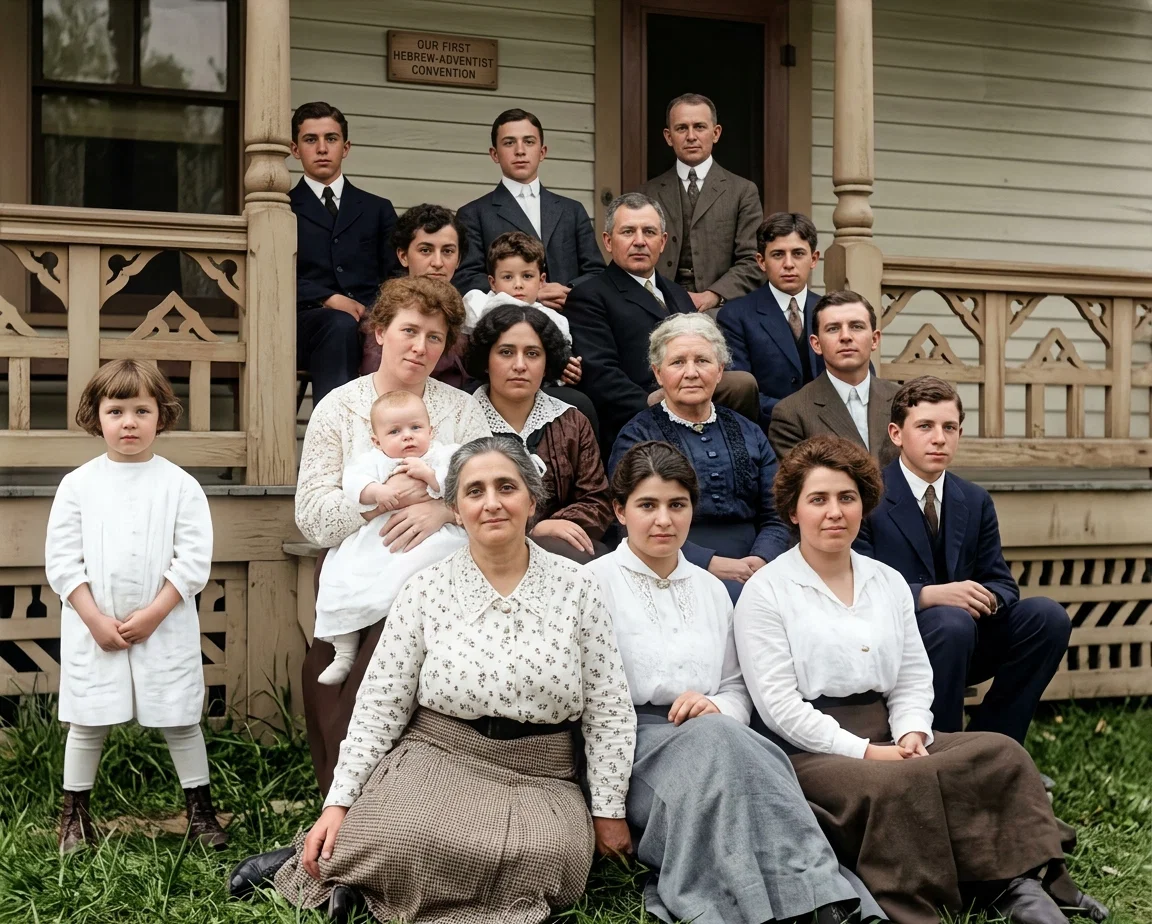
OUR FIRST HEBREW-ADVENTIST CONVENTION
As we have come in contact with our Jewish brethren and sisters, it has seemed clear that there was need of instruction concerning the definiteness of our work and message. Several have for some time been calling for a gathering of their brethren and sisters in a general meeting, and they have felt that such a meeting would be very profitable. The matter was presented to the Jewish Advisory Committee, and it was thought best to have the meeting this spring.
There were fourteen adults in attendance, and one of our brethren brought his wife and three children with him. This brother has been passing through some bitter experiences with his family on account of his faith in Christ and in this truth, but we are glad that the Lord has answered his prayers, so that his wife is not only favorable to the message, but took steps at this meeting which we believe indicated that her heart was with us altogether. The accompanying picture of the brethren and sisters was taken during the convention.
We had a daily program, and several of the ministering brethren rendered helpful assistance. The meetings were held in the South Lancaster church, and the Jewish brethren were very grateful for the opportunity afforded them of attending the convention. Every one received help and spiritual blessing, and surely the Holy Spirit was present in the meetings.
The first meeting was held on Wednesday evening, May 26, at 7:30. After an opening hymn, the eleventh chapter of Romans was read for a Scripture lesson, and Elders P. F. Bicknell and B. F. Machlan offered prayer. After a few remarks by the chairman, F. C. Gilbert, words of welcome were spoken by Elder Bicknell, in behalf of the South Lancaster church; by Elder E. E. Miles, in behalf of the entertaining committee; by Elder A. Moon, in behalf of the Massachusetts Conference; and by Elder K. C. Russell, in behalf of the Atlantic Union Conference.
There was a daily Bible study at 6 A. M. The need of preparation for service, and the necessity of being deeply rooted in the truth, were emphasized. At 9 A. M. there was a devotional hour, and at 10:30 the convention work was carried on. A number of papers were read by different ones upon themes which vitally affect the work among the Jews. Such topics as, “Can the Jew Be Reached With This Message?” “What the Third Angel’s Message Means to the Jews;” “Orthodox and Reform Judaism;” “How Shall We Reach the Jews?” “How Shall We Deal With Jewish Prejudices?” “Some Ways of Getting the Message to the Jews;” “What Part Can Seventh-day Adventists Act in Bringing the Truth to the Jews?” and other subjects which are closely associated with our work of bringing the message for this time to the Jewish people, were considered.
It was agreed by all present that to carry on our work among the Jews not only is there need of power and the presence of the Holy Spirit, but great19tact must be used that in our efforts we shall draw them rather than repel them. The words mission, missionary, and missionary work should not be named among them, as these terms to the Jews are signals of enmity and animosity. Many experiences were related showing how Jews will come to Seventh-day Adventist churches when they become acquainted with our people, and all those present were unanimous in their belief that for the present time most of our work must consist in circulating our literature, in efforts in connection with our churches and halls in the cities, and especially by our own people doing all they can to make themselves known to the Jews as Christian Sabbath keepers.
Some of the Jewish brethren and sisters were in need of instruction that would enable them to meet many of the Jewish questions and objections, especially from the Old Testament; for we must remember that the Jews do not accept the New Testament as the inspired testimony of God. The Lord helped in meeting these questions from the Bible, and all felt that they had been helped and benefited by the meetings.
During the convention an effort was made to interest the Jews in the neighboring town of Clinton, and on Friday evening quite a number of them came to the service.
A thousand copies of the forthcoming Yiddish magazine were taken by the brethren and sisters, to be distributed or sold among the Jewish people. One Jewish brother was baptized.
On Sabbath afternoon an interesting service was held, and we wish that many of our brethren and sisters might have been present, to hear the testimonies of the young men and women as they told how they accepted Jesus. The Gentile knows but little of what it means to give his heart to the Lord or to accept the Sabbath truth, as compared with what it means to the Jew. All our ministers and lay members who were present at that meeting Sabbath afternoon will better appreciate what it means for a Jew to accept Christ and his truth; and we are sure that they will have more sympathy for the lost sheep of Israel.
The brethren and sisters pledged their loyalty to this most blessed truth, and their hearts are grateful to God for the spirit of prophecy connected with this message. To the Jews, who for two thousand years have been praying to the Lord to send them another prophet, that they may hear the voice of God through his servant as in days of old, it is a wonderful thing to know that from the rise of this message the Lord has connected with it the spirit of prophecy, and it seems to them much like the real religion of Israel when the Lord led their ancestors. The following resolution was passed during the convention:—
“Whereas, The spirit of prophecy has repeatedly stated that many of the Jewish people will yet accept this truth, and,—
“Whereas, We see that some have already taken their stand; therefore,—
“Resolved, That we Jewish Christians in convention assembled, recognize that in our accepting the third angel’s message we see the beginning of the fulfillment of this prediction; and, further,—
“Resolved, That we give thanks to the Lord for his goodness in bringing the light of this truth to us, and we pledge ourselves that with the help of God we will be loyal to this blessed third angel’s message, and do all we can to bring the light of this truth to as many of our Jewish people as we possibly can, and to all others.”
The brethren and sisters were loath to leave when the meeting closed on Sunday afternoon, May 30, but all felt that it had been a blessed and profitable gathering, and went away with the determination to work for the advancement of the third angel’s message as never before, and with the belief that the Lord will yet bring many more of the Jewish brethren into the light of present truth.
F. C. GILBERT.
Scientific Dish Wiping
By Flora Huntley
RECENTLY I watched two men in a cafeteria wiping trays, and I discovered some points that are worth observing by those who do their own work. One man wiped the top of a tray at the top of a pile, then turned it over, at the same time passing it on to a second man, who wiped the bottom of the same tray and set it right side up on a second pile, which was then carried to the dining room by a waiter. Each man used two towels, one in each hand, so that every motion counted. Even the work of wiping one tray was thus highly specialized.
This gave me an idea. By experimenting and watching my own motions when wiping dishes, I found that I made many useless passes through the air. I discovered that I could gain time by using two drying towels instead of one, and several motions, such as picking up the end of the towel, were eliminated.
Now, when a woman spends, on an average, two hours a day washing dishes, it will pay her to save even a minute or two at each process. If a business man finds it profitable to study to eliminate every useless motion, it certainly should profit the housewife. One of the reasons why there has not been more progress in housework is because women have not reckoned their time as worth much.
In estimating the cost of a product made in the home, a common expression is, “I didn’t count my time anything.” With this idea it is not strange that there is no leisure for recreation or reading or music. Save the minutes, and eliminate the useless processes, and there will be time for spiritual things.—Flora Huntley, in Christian Endeavor World.
A Study of the Pattern for Our Medical Missionary Work in Reference to the Training of Nurses
By Julia A. White, M. D.
There are many high-class nurses’ training schools in the world today which have unbounded medical facilities, and annually put hundreds of noble nurses into service. These nurses are working hard to lessen the sickness and suffering of mankind. They have had a most excellent head and hand training.
We have set for our training schools the high standard of head, hand, and heart training. We recognize that the20dominant spirit of the age, the spirit of commercialism, has invaded the sick room, and is crushing out the nobler spirit of unselfish service to the sick. We stand for reforms in the treatment of disease, abandoning the use of poisonous drugs, and instituting in their place simple rational remedies, hygienic measures, and above all, we acknowledge the proffered assistance of the Great Physician in the relief of physical as well as spiritual maladies.
For more than forty years we as a denomination have been training nurses, and in that time thousands have been graduated. Many of them are in home and foreign fields. Some are in private work, and are doing all they can to spread the truth. Many are working from a commercial standpoint, and many have given up the faith. What might this army of workers have meant to the work if they had consecrated their lives to the ministry of healing as instituted by the great Medical Missionary!
We must recognize the fact that we have not reached the ideal for this branch of our work. We have been told that “the nurses who are trained in our institutions are to be fitted to go out as medical missionary evangelists, uniting the ministry of the word with that of physical healing.” “There should be companies organized and educated most thoroughly to work as nurses, as evangelists, as ministers, as canvassers, as gospel students, to perfect a character after the divine similitude.”
“From the instruction that the Lord has given me from time to time, I know that there should be workers who make medical evangelistic tours among the towns and villages.”
“Workers, gospel medical missionaries, are needed now.” “Let little companies go forth to do the work to which Christ appointed his disciples. Let them labor as evangelists, scattering our publications, and talking of the truth to those they meet. Let them pray for the sick, ministering to their necessities, not with drugs, but with nature’s remedies, and teaching them how to regain health and avoid disease.”
This instruction is definite and to the point, yet we are not meeting God’s ideal; for we are told that “there should be hundreds in training where there is now one.” “The meaning of genuine medical missionary work is yet known by but few.” “Medical missionary work is still in its infancy.” “Because the Saviour’s plan of work has not been followed, the work has not proved a success.” “Christ, the great medical missionary, is our example. Of him it is written, ‘Jesus went about all Galilee, teaching in their synagogues, and preaching the gospel of the kingdom, and healing all manner of sickness and all manner of disease among the people.’ He healed the sick, and preached the gospel. In his service, healing and teaching were linked closely together. Today they are not to be separated.”
To carry out our course of study and to give the proper mold to our sanitarium training schools, one of the first requisites must be that every instructor in these training schools be a medical missionary evangelist if he is to be a true leader.
These questions might be asked: Is it an advanced step to eliminate largely the domestic work of the first-year nurses and put them into the field as canvassers and medical missionary field workers under proper leadership, and thus, early in their course, inspire them with the missionary spirit? In selecting students for our training schools is there enough careful attention given to the correspondence? Are the Christian principles that form the foundation of the school impressed upon the applicant? Is she given a definite idea of what it means to be a nurse, and especially to be a medical missionary nurse? Is our age limit proper? Would more mature students make more satisfactory workers? Do we make it difficult enough for our young people to gain entrance to our training schools? Are we always careful to have satisfactory recommendations for applicants?
Surely none should be admitted but consecrated young people, those who can unreservedly give their lives to medical missionary work. As a denomination, it is truly high time for us to cease to train the professional nurse, as such, and thus cease to commercialize this branch of the Lord’s work.
When these young people enter our institutions, they should be surrounded by those who will throw about their young lives the protection they need. This responsibility should not fall on one or two. It is the duty of the whole faculty.
Our three months’ probation period should mean more than it many times does. It should separate from the school the undesirable, the frivolous, and those unfitted for medical missionary work. The school discipline should be definite and strict.
We are told that “great care should be taken in regard to the spirit pervading the Lord’s institutions. These institutions were founded in self-sacrifice, and have been built up by the self-denying gifts of God’s people and the unselfish labor of his servants. Everything connected with institutional service should bear the signature of Heaven. A sense of the sacredness of God’s institutions should be encouraged and cultivated. The workers are to humble their hearts before the Lord, acknowledging his sovereignty. All are to live in accordance with principles of self-denial.”
Our training schools should put forth special effort to make the Bible study thorough. Few of our young people have an adequate knowledge of the Bible. They have accepted present truth as a legacy from their parents. So there is the greatest need of their becoming thoroughly conversant with the principles of our faith. Their training should be considered incomplete until they are prepared to give a Bible reading at any time on any point of faith.
During their course they should become so thoroughly conversant with our denominational books that they can intelligently present them at any time. Must they learn to canvass?—Most assuredly, and their education is incomplete until they are prepared to do this work; for they must never overlook the golden opportunity of getting truth before the people. They must sow the seeds of truth beside all waters. The faithful medical missionary will find opportunities to place the printed page in the hands of the patient.
Students should be so thoroughly trained in the science of healthful living that they can go into the homes and do healthful cooking in a way to meet the demands of the people. They should also be able to teach the principles of healthful dress. In fact, they should be able to demonstrate health school work in any of its phases.
To prepare them for this work, a part of their time each year must be spent in the field, with leaders who are medical missionary evangelists.
While in training they must learn to be strong in the Sabbath school work so that when they get out in the little companies with whom they will meet, they will be a real help and inspiration to these lonely ones.
In fact, the great object of our sanitarium training schools is to train leaders in every branch of the work which is to carry the gospel to the world in this generation. Leaders are needed everywhere, in every department of our work. Our institutions suffer because of a lack in this line. The best superintendent of a sanitarium is a man who has worked in every department of a sanitarium. The best matron is the one who has proved her ability as a nurse. The great need is a thorough fitting, and then God will place these young people where they can be used to the best advantage.
When our sanitarium training schools place themselves on vantage ground, these principles will be so prominent that they will permeate our churches in such a way that every Seventh-day Adventist home will be a miniature sanitarium, influencing the neighborhood around.
Then our conference brethren will see that we truly intend to cooperate with them in the work of carrying the message to the world in this generation, and they will gladly use us, “their right hand,” in the propagation of the gospel. Then the influence of our training schools will be world-wide. This training for public work that will reach the homes of the people and teach health reform in all prophylactic as well as therapeutic measures, with the one great object of winning souls to this truth, will reach farther than any other public work that we as a people can do.
It must be very evident to those who have given the matter careful thought that we need fewer training schools, and should give opportunity for better work in larger schools. This would provide work for a larger number of graduate nurses in the institutions that do not carry training schools, and would give a better chance to develop leaders. In this way workers could be transferred from one institution to another, and all could get an all-round experience in institutional and field work.
We should plan more carefully for the work of our graduate nurses. Right here there seems to be a failure. Unless we can bind these workers to the organized work after they have finished their training course, many of them will take up professional work and drift out of the truth.
Might not two nurses be placed in each church of any size, whose duties would be to educate the members along health lines, nurse their sick, and hold health schools with the church members and their neighbors? As a means of support, they could give treatments whenever opportunity afforded, and canvass for our periodicals and books. They could be a connecting link between our people and our institutions; and21when they found cases needing medical attention which they could not manage, they could call our own physicians, where oftentimes outside doctors are called. This would build up our work.
These workers should give Bible readings, help with Sabbath school and Sabbath services. Their work should be supervised by the pastor or elder, and thus they become the helping hand to the gospel work.
Surely there would be no question about the results. If this plan were carried out, our work would be bound together into one harmonious whole, and we should be following the instruction given in “Counsels to Teachers,” page 468, which says:—
“The Lord has ordained that with those who preach the word shall be associated his medical missionary workers, — Christian physicians and nurses, who have received special training in the healing of disease and in soul winning. Medical missionaries and workers in the gospel ministry are to be bound together by indissoluble ties. Their work is to be done with freshness and power. By their combined efforts the world is to be prepared for the second advent of Christ. Through their united labors the Sun of Righteousness is to rise, with healing in his wings, to lighten the benighted regions of the earth, . . . and many will open their hearts to receive the healing beams.”
When this or some better plan is followed, and our medical missionary workers join their efforts with the evangelists, we shall not need to be told that the medical missionary work is yet in its infancy. JULIA A. WHITE, M. D.