The Youth’s Instructor, Vol. XLIX, No. 37

A TRUE STORY
Earlier text: A TRUE STORY

CONQUERED BY KINDNESS

ELISHA was a prophet of the God of Israel. The king of Syria fought against Israel, but God showed his servant Elisha all the plans of the king of Syria, and he told them to the king of Israel. So the king was able to escape from his enemy, and did not fall into the traps that were laid for him.
When this had happened many times, the king of Syria thought there must surely be a traitor among his servants, who told the king of Israel his plans, and he asked them to show him who it was. Then one of the servants said: “None, my lord, O king: but Elisha, the prophet that is in Israel, telleth the king of Israel the words that thou speakest in thy bedchamber.”
Then the king said, “Go and spy where he is, that I may send and fetch him.” And it was told him that he was in Dothan. So he sent a great host, with horses and chariots, to take Elisha captive.
When Elisha’s servant saw the hosts of Syria, he was very much afraid; but Elisha was not, for he knew that God was with him. He prayed that God would open his servant’s eyes, and then the young man saw that there were horses and chariots of fire all round about Elisha.
Then Elisha prayed that God would smite the army of the king of Syria with blindness. So God smote them with blindness.
Then Elisha said to them, “Follow me, and I will bring you to the man whom ye seek.” But he led them to Samaria, where the king of Israel’s army was. Then the Lord opened their eyes, and they saw that they were in the midst of their enemies.
Now it was their turn to be frightened, and no doubt they were; for they thought that they were caught in a trap, and would surely all be slain. The king of Israel thought so too, and he said to Elisha, “My father, shall I smite them? shall I smite them?” as if he were eager to begin.
But Elisha knew a better way of conquering his enemies than by killing them. He knew God’s way, and he had read the words of the wise king, Solomon: “If thine enemy be hungry, give him bread to eat; and if he be thirsty, give him water to drink: for thou shalt heap coals of fire upon his head.” When he prayed that God would smite them with blindness, it was only that he might have the opportunity to do them good.
So Elisha said to the king of Israel, “Thou shalt not smite them: . . . set bread and water before them, that they may eat and drink, and go to their master.” And he prepared great provision for them, and when they had eaten and drank, he sent them away, and they went to their master.
We may be sure that the king of Syria was surprised to hear that they had been so mildly and kindly treated. Elisha’s kindness quite conquered the enemies of Israel, and there was no more trouble with them; for we are told that “the bands of Syria came no more into the land of Israel.” EDITH E. ADAMS.

THE OLDEST DOLLY IN THE WORLD

"She's so old!" Comfort said, a little crossly; "an' so 'lapidated all over!" "Well, why not? She's been lap'ed so much," remarked the big boy, who made jokes, and laughed at them himself. The big boy was Comfort's brother. "I don't believe there ever was such an old doll as Diana is," lamented the little mother voice, ruefully. She was holding the poor dolly up for the aunties to see, and the aunties both laughed,
The curly haired auntie held out her hand for the doll. "Poor Diana Smith!" she said, gently; "she does look old, and as if she had met perils by land and by sea—"
"Yes'm, she has—both of them," said Comfort, briskly. "She's been earthquaked and drowned, and once she caught a sunstroke. An' I guess she's 'most a hundred years old!"
"A doll I saw last summer was twenty-two hundred years old," the smooth-haired auntie quietly remarked.
"Twenty-two hundred years old!" Comfort's shrill, astonished little voice chimed in.
"Twenty-two centuries!" cried the big boy in big-boy language. The curly haired auntie looked just a little bit amazed too. Certainly that was a remarkably old doll.
"I s'pose she b'longed to Mr. Methuselah's little girls, but I shouldn't s'pose you'd have seen her," murmured Comfort.
The "smooth auntie" (that was Comfort's name for the aunt who had smooth, shiny brown hair) smiled. She took dilapidated little Diana Smith into her arms, and rocked her as if she had been a real baby.
"Yes, as old as that—possibly a little older. She wasn't very handsome, of course. You couldn't expect such an old, old dolly as that to be handsome. They told me (the people who take care of her) that she is the oldest doll in the world."
"Why, auntie! why!"
"Dearie me!" murmured the curly auntie.
The big boy whistled.
"Has she—is her little girl mama 'live to see her?" Comfort queried, in rather an awed tone. She always felt awed before very old people—and twenty-two hundred years old!
"No," auntie said, gravely. "Her little girl mama died three hundred years before Jesus was born, Comfort. She was a little princess, and lived in Egypt. When she died, they wrapped her little body in soft, strange wrappings, that kept it all these twenty-two centuries just the same."
"Little girl mummy," muttered the big boy to himself.
"Yes, a baby mummy. And when the people of this century opened her tomb, they found the old, old dolly held tight in the little princess's hand. She had held it there twenty-two hundred years."
"O!" breathed Comfort, very softly. She reached out for Diana, and clasped her in her arms. Her face was very tender and loving. Diana seemed suddenly very young indeed, and very dear.
The big boy was swinging his feet noisily, and he had turned away so nobody could see his face at all. Something about his eyes bothered him.
"The princess's dolly is made of wood, rudely cut out. It is little and homely, but the little princess loved it."
"Oh, yes, she loved it," Comfort whispered.
"It is in the British Museum now," the smooth-haired auntie went on. "They keep it among the relics; and there it lies under the glass, looking up at this queer, unfamiliar world of to-day. If it could feel, how it would wonder where its little dark-faced mother is!"
"An' how lonesome it would feel!" finished Comfort, softly. "Poor little dolly!"—Annie Hamilton Donnell, in Primary Education.

SCHOOL BEGINS TO-DAY

Hark! I hear a patter, patter, As of dancing feet, And a gentle, merry chatter, As of voices sweet! Here they come — a troop of posies, Pink and blue and white; Little maids with cheeks like roses, Earnest, blithe, and bright.
Now I hear a clatter, clatter, Like an army coming. Dear me! what can be the matter? Such a buzz and humming! Here they are — oh, what a noise! — Shouting, screaming, howling! — Such a throng of happy boys! Never one is scowling.
“Ding — dong — dong!” the bell is calling, “School begins to-day!” — Clearly on the laughter falling,— “Do not stop to play! Ding — dong! — come!” the tones seem pleading, “Summer has been long! Now’s the time for spelling, reading! Ding — dong — dong! Ding — dong!”
— Selected.

BIRD CAROLINGS

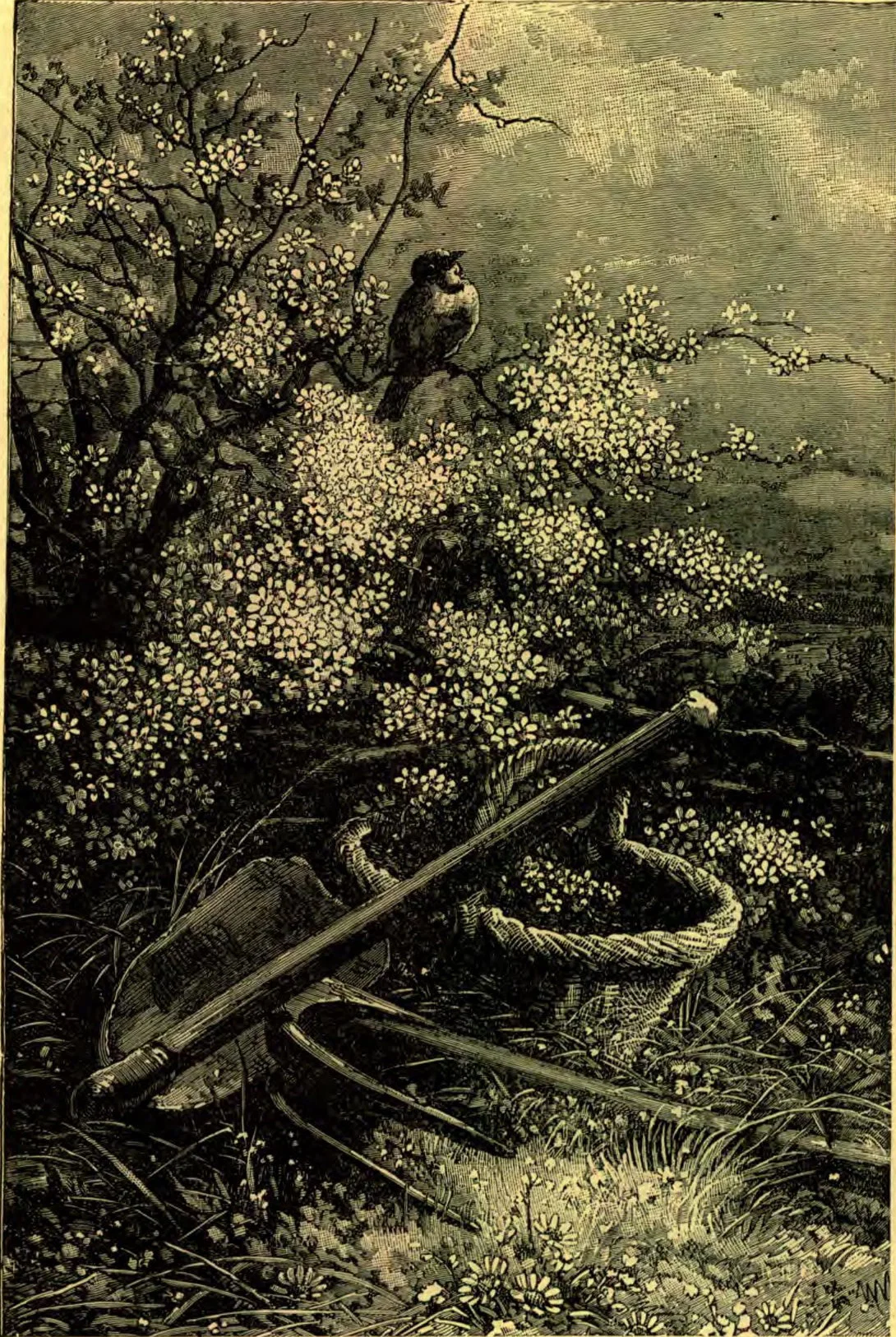
CAROL, little birdie, sing,— O how glad you are!— As the joyous sun of day Drowns the silvering star!
Joyous, bursting with your song, As of swelling love, So you warble to your mates And to heaven above.
As this morning I have heard Your glad song of praise, So you greet, dear little bird, Bright and cloudy days.
Carol! carol! let your song Waft its melody Over all the hills and vales, Morning’s jubilee!
Hark! how resonant with praise Over vales and hills, How the morning’s choral song Every spirit thrills!
O my heart! and shall the voice Of a little bird Shame your silence? Wake your song! Let your voice be heard!
B. F. M. Sours.
CAROL, LITTLE BIRDIE, SING

AS LITTLE CHILDREN

Jesus says that “except ye be converted, and become as little children, ye shall not enter into the kingdom of heaven.” The little child has the utmost confidence in its father’s word. Man fell by doubting God, and can not be restored while he doubts. “In quietness and in confidence shall be your strength.” We must ask for what we need, and believe that God does hear. He tells us that “what things soever ye desire, when ye pray, believe that ye receive them, and ye shall have them.”
I once knew two little boys, aged nine and eleven years, who went out to pick wild berries. After they had filled their bucket, they set it down among the bushes, and went off to play for a while. When they were ready to return home, they could not find it. At first they cried, but the younger said, “God knows where our bucket is; let us ask him to help us find it.” They knelt in prayer, and, as they said, “When we had prayed, we went straight to our bucket.” They glorified God for helping them. Let us exercise the same childlike confidence in God. F. L. MOODY.

HEALING OF PETER'S WIFE'S MOTHER

(Concluded)
Simon's Wife's Mother Lay Sick.—Even the household of the apostle Peter was invaded by sickness. In this we are reminded of the message Martha and Mary sent to Jesus: “Him whom thou lovest is sick.” Ofttimes must the message be carried to the divine ear that some loved one down here below is sick. Being the recipient of divine love does not in itself insure immunity from suffering and sickness. This is one of the most remarkable miracles that Jesus wrought. It is the one miracle which stands out clearly to show Christ as our sickness-bearer.
Peter's mother-in-law was probably a Christian. We may learn from this that the people of God are not exempt from sickness. Job was a man who feared God with all his heart, and eschewed evil, and yet he was afflicted in a most sudden and serious manner. Dorcas, with all her good works, did not secure immunity from sickness. And even Paul, in speaking of the troubles that came upon him in Asia, said that he despaired even of life. As a rule, in all our afflictions, the disposition to obey or disobey determines the rapidity with which we may receive and experience the blessing of divine healing.
They Tell Him of Her.—“Anon they tell him of her,” says Mark. This is an example of what we should do in all cases of sickness,—simply tell Jesus about it; lay the case before him. They made no specific request; they simply told Jesus about the case. Luke says, “They besought him for her.” After telling Jesus about the fever-stricken woman, they brought Jesus into the chamber. As the Christian worker visits the sick and stands by the bedside of the afflicted, he should feel his responsibility of bringing Jesus with him into the sick chamber, there to heal, comfort, and cheer. This he can best do by bringing in principles that will make clear the cause and object of sickness and suffering. It is the privilege of every Christian to be an interpreter of the language of disease; or, as Job says, “one among a thousand, to show unto man his uprightness [“what is right for him,” R. V.].”
He Took Her by the Hand, and Immediately the Fever Left Her.—Many are stricken with spiritual fever,—afflicted with moral emaciation, suffering from mental disquietude. To heal these it requires the same all-powerful touch that it took to heal Peter's mother-in-law of the fever that had stricken her down. This was a great miracle,—the instantaneous healing of fever,—but there are even greater miracles. As one has said: “The greatest miracle of Providence is that no miracles are needed to accomplish its purposes.” Notice the use this woman made of her strength when it was regained. It was instantaneously restored, and she immediately began to minister to others. God restores strength, and heals, for service and ministry,—not to save us the trouble of taking treatment.
She Ministered unto Them.—True-hearted service is the great evidence of conversion or healing. The woman, when healed, did nothing unusual or demonstrative. She went at once about the necessary work of preparing food to satisfy the hunger of the Master and his co-laborers, who had been engaged all day in taxing work. She did not seek a large audience before whom publicly to announce her recovery. She did not go in excitement to her neighbors, and proclaim the wonder that had been wrought in her case. She restricted her serving to works of necessity, and manifested her gratitude by ministering to the One who had ministered to her. Christ could have miraculously provided food with which to satisfy the hunger of himself and his disciples with the same ease with which he raised the afflicted woman from her bed of suffering, but this he did not do. Here we learn that Heaven expects man to do his best, and that which man can not do, God will perform. The healing of the woman was beyond human power, and the work of restoration Christ willingly performed; but the preparation of food was a task in every way suited for human hands to perform, so it was reserved for the woman, so recently healed, to manifest her gratitude by this labor of loving service. It is not possible for those who have been healed to-day to minister to Jesus as did this woman; but it is possible to feed the hungry, clothe the naked, and otherwise minister to needy and suffering human beings, in every one of whom Christ dwells.
W. S. SADLER.

WHY DO WE NEED THESE OBJECT-LESSONS?

“I HAVE made up my mind to do one thing,” said a woman just recovered from a contagious illness of several weeks; “when any of my friends are ‘shut in’ hereafter, I am going to write to them. You can’t think what the mails meant to me when I was ill. The most simple little message from even a casual friend or acquaintance I read and reread. One dear friend just returned from the seashore sent me a Japanese pincushion in the form of a wee kitten made of silk—a souvenir of the trip—accompanied with a facetious little note: ‘A kitty for you to play with till I can come to see you myself.’ Illness brings us back to a second childhood, I suppose; for that little cushion gave me as much pleasure through those sick days as if I had been only five years old. Then another friend sent me a spray of climbing roses from the terrace of a neighbor who was traveling in Europe at the time, and of course knew nothing of my illness. ‘I thought that, coming from her own bush, it would seem like a direct word from her,’ was the message that came with it; ‘you know she would be so sure to send it herself if she were here.’ Those roses seemed to me to have a double fragrance.”
“I know just how you felt,” chimed in a listener. “A year ago, during that smallpox epidemic, I was unfortunate enough to be quarantined for some weeks, though I was perfectly well myself. Of course I could not send out letters or see my friends; and if it had not been for the messages that came to me, I don’t know what I should have done. Sometimes they came from people I knew so slightly that it was especially touching and sweet. Some of the friends I expected most confidently to hear from never wrote me a line. Since then I have made a point of writing to my shut-in friends; before, I hardly thought of such a thing. I wonder why so many of us need these object-lessons to make us thoughtful?”—Young People’s Weekly.

Giving Freely and Expecting Little from Friends

The less you exact of your friends, the more they will give you. For yourself, give as richly and as nobly as you want to—of your love and your confidence and your loyalty. Live up to your highest ideal of what a friend should be (and the higher you make that ideal, the finer woman you will be, and the more friends will flock to you); but never exact of your friends that they shall give you more than they choose easily to give. If some one you love disappoints you,—as many, many more will do in days to come,—do not hold up your ideal of what she should be and do as a mirror in which to count her imperfections. Let it pass, if you can, with a little smile that may be sad, but need not be at all satirical. And never be jealous of a friend, if you want to keep one. If anybody you are fond of forms other friendships, or seems to be engrossed with other friends, do not let it make you unhappy, and above all, never offer comment upon her all-too-evident neglect of her old friends for new ones.—Ladies’ Home Journal.

THE EXECUTION OF THE JUDGMENT

(September 28)
MEMORY VERSES.—Ps. 149: 5-9.
1. Who will be joined with Jesus in executing the judgment? John 5: 27; Ps. 149: 5-9.
2. At what time do the people of God begin this work? Dan. 7: 22; Rev. 20: 4; note 1.
3. What are some of the cases which they will be called to judge? 1 Cor. 6: 2, 3; note 2.
4. How long time will be spent in determining the punishment of the wicked? Rev. 20: 4.
5. When the cases have all been acted upon, what will take place? Jude 14, 15; Rev. 21: 2; note 3.
6. To what part of the earth will Jesus and the saints and the city descend? Zech. 14: 4, 5.
7. What will the Lord do for the sleeping wicked when he then comes to earth? Rev. 20: 5; note 4.
8. What change will thus be made in Satan’s condition? What will he do? Rev. 20: 7, 8.
9. What do the wicked then do? What is the result? Rev. 20: 9.
10. What is the fire which consumes the wicked? Heb. 12: 29; note 5.
11. How completely will the wicked be destroyed? Obadiah 16; Mal. 4: 3.
12. What effect will the fire of God’s presence have upon the earth? 2 Peter 3: 12, 13; note 6.
13. What wonderful honor will be shown this world which has been redeemed? Rev. 22: 3, 4.
14. How many will then join in praise to God? What will be their song? Rev. 5: 13.

NOTES

1. By reading Dan. 7: 22 carefully we may learn the time when judgment is given to God’s people. The prophet says that the wicked made war against the saints until certain things took place, and then he gives them in their order. First, the Ancient of Days came; second, judgment was given to the saints of the Most High; third, the time came that the saints possessed the kingdom. The work of judgment lies between the coming of the Lord and the taking possession of the new earth, and is therefore the work of the thousand years; for it is a thousand years from the time that God’s people are taken to heaven until they return to the earth. They live and reign with Christ a thousand years. The work of judgment upon the wicked begins when the righteous are first taken to heaven.
2. The angels that fell into sin and were cast out of heaven, and who, with Satan, have been warring against Jesus and his people, will all be brought into judgment. They have been “reserved unto judgment.” 2 Peter 2: 4. The people of God, who have been tempted and persecuted by them, will know how to deal justly with them, and give them a merited reward. Satan himself will be tried by those who have overcome. The cases of all who have fought against God, of both angels and men, will be brought before the Lord Jesus and his people, and all the dark, hidden, crooked ways of sin will then be understood. 1 Cor. 4: 5.
3. At the close of the one thousand years of examination, after it has been determined what the “wages” of the wicked shall be, Jesus and the saints will leave heaven, and come to earth, where the wicked are still sleeping, “to execute upon them the judgment written.” Ps. 149: 9. A careful record has been made, and the punishment will be dealt out just as it is written. The “book of death” will be carefully followed, and no mistakes will be made.
4. While Jesus and the saints are descending from heaven, Jesus “bids the wicked dead arise to receive their doom. They come forth a mighty host, numberless as the sands of the sea. What a contrast to those who were raised at the first resurrection! The righteous were clothed with immortal youth and beauty. The wicked bear the traces of disease and death.”
5. The glory of God is a “consuming fire” to all sin. And it is just as truly a consuming fire to sin now as it will be in that day when the wicked are destroyed. “In all who submit to his power, the Spirit of God will consume sin.” When we confess our sins, turn from them and seek God for power to overcome all our wrong traits of character, the Spirit of Jesus Christ comes in and actually burns out and destroys all the results that sin has left behind. “But if men cling to sin, they become identified with it. Then the glory of God, which destroys it, must destroy them.” The reason the wicked will be destroyed, is because they have become so full of sin, so sinful, that they can not live in God’s presence. His presence, his glory, which devours sin, devours them also; for they are all sin.
6. The earth has been terribly defiled by sin and death. Isa. 24: 5. In the flood the Lord buried sinners and their miserable, wretched works. Mountains were rolled upon their cities, so filled with crime and wickedness that God could bear the sight of them no longer, and monstrosities of all kinds were forever buried from sight. Therefore, when God begins to purify the earth, the fires will go down deep into it, and consume all the works of sin that lie hidden there. Deut. 32: 22. There will not be one trace of sin left, and it will never rise again. God will “make all things new.” And “the meek shall inherit the earth; and shall delight themselves in the abundance of peace.” Ps. 37: 11.

THE MAKING OF CHARACTER

Do not let us suppose that character requires great circumstances for the making. Character can be made in poor circumstances. There are huge manufactories in this country, with magnificent machinery, with chimneys belching forth clouds of black smoke to pollute the air, where they turn out carpets of the most wonderful aspects, which would almost make you ill to look at, and which perish quickly in the using.
Far away in the East, in some poor little hut, an Eastern workman is working with threads of many colors beside him. He has been toiling for years; and when he has finished, he will have turned out a single square of such beautiful coloring and such perfect workmanship that when it comes to this country, it will be bought at a great price, and the owner's great-grandchildren will see it fresh and beautiful. So much for the great manufactory and the whirling wheels and the noise and the smoke; so much for the quietness and obscurity of a single workman! —John Watson, D. D.

SENT FREE

Read Special Offer Below.

THE CO-RO-NA MEDICATOR.

A natural evolution from E. J. Worst's famous Catarrh Inhaler that has won a world-wide reputation. It is made of Nickel, and will last a lifetime; is so compact it may easily be carried in a vest pocket or reticule.

CATARRH

Don't take medicine into the stomach to kill germs of Catarrh in the head. If you will only stop and think for a moment, you will certainly realize that the germs of disease were carried into your head by air, and that air is the only agency that will carry a medication to the diseased passages capable of destroying such germs. Catarrh, Colds, Pains and Roaring in the Head, Bronchitis, Sore Throat, Headache, Partial Deafness, La Grippe, and all diseases of the air passages yield as if by magic to treatment with the Co-ro-na Medicator. Science and common sense can offer no improvement upon this little pocket physician. It is simple in construction, and may be used anywhere and at any time. It is the only positive cure for the diseases named. I make it easy to prove this beyond all question by the following remarkable

SPECIAL OFFER.

For a short time, I will mail free to any reader naming this paper one of my new Scientific Co-ro-na Med-icators, complete, with medicine for one year. If it gives satisfaction, send me $1.00; if not, return it after three days' trial. Could any proposition be fairer?
E. J. WORST, 112 Elmore Block, Ashland, O.
NOT SOLD BY DRUGGISTS. AGENTS WANTED.

GRAND TRUNK R'Y. SYSTEM.

Taking Effect June 2, 1901.

Trains leave Battle Creek.

WEST-BOUND.

No. 2, Mail and Express, to Chicago ................................ 12.15 P. M. No. 7, Limited Express, to Chicago .................................... 7.00 A. M. No. 1, Chicago Express, to Chicago ................................... 9.23 A. M. No. 3, Lehigh Valley Express, to Chicago ............................. 3.50 P. M. No. 5, International Express ........................................ 2.17 A. M. No. 75, Mixed, to South Bend ......................................... 7.30 A. M. Nos. 9 and 75, daily, except Sunday. Nos. 1, 3, 5, and 7, daily.

EAST-BOUND.

No. 10, Mail and Express, East and Detroit .......................... 3.45 P. M. No. 8, Limited Express, East and Detroit ............................. 4.50 P. M. No. 4, Lehigh Express, East and Canada ................................ 8.22 P. M. No. 6, Atlantic Express, East and Detroit ............................ 2.10 A. M. No. 2, Express, East and Detroit ..................................... 7.00 A. M. No. 74, Mixed (starts from Nichols yard) .............................. 7.15 A. M. Nos. 10 and 74, daily, except Sunday. Nos. 4, 6, 8, and 2, daily.
W. C. CUNLIFFE, Agent, BATTLE CREEK.

ADVERTISEMENTS

SELF-PRONOUNCING S.S. Teachers' Reference Bible

Contains the Celebrated Teachers' Helps,
Comprising nearly 400 pages. Also a complete series of fifteen new maps.

DESCRIPTION

IMPERIAL SEAL BINDING, TUCK EDGES, known as “DIVINITY CIRCUIT,” ROUNDED CORNERS, FULL RED UNDER GILT EDGES.
We offer this Bible, postpaid, for only six new yearly subscriptions at 75 cents; or twelve new six months' subscriptions at 40 cents.
We will also send it, postpaid, with the INSTRUCTOR one year for $2.25. For 20 cents extra we will stamp your name in gold upon the cover. Address—
THE YOUTH'S INSTRUCTOR, Battle Creek, Mich.

FOR EVERY DAY OF THE WEEK

SUNDAY:
“What God wants is men great enough to be small enough to be used.”
MONDAY:
Those who look for troubles will not be long without finding trouble to look at.—F. B. Meyer.
TUESDAY:
Seek to love nothing out of God. God remakes a broken heart, and fills it with love. He can not fill a divided heart.—Dr. Pusey.
WEDNESDAY:
“O blessed life! the heart at rest, When all without tumultuous seems; That trusts a higher Will, and deems That higher will, not mine, is blest.”
THURSDAY:
As snow is itself cold, yet warms and refreshes the earth, so afflictions, though in themselves grievous, keep the soul of the Christian warm, and make it fruitful.—John Mason.
FRIDAY:
“There is a picture in the Louvre representing the interior of a convent kitchen. But instead of grave-faced monks preparing the mid-day meal, angels are putting on the kettle, and doing the other humble tasks, all looking as if they found the joy of heaven in the menial service. So it seems to me if we get the joy of heaven—unselfishness—into every common duty of life, we shall feel it is heavenly work.”
SABBATH:
“Being confident of this very thing, that he which hath begun a good work in you will perform it until the day of Jesus Christ.”

SPECIAL ATTENTION

Is called to the note on page 292 concerning the study for the Young People's meeting to be held on Sabbath, October 12. Notice that the program for that Sabbath will be a missionary program, material for which will be drawn from the October number of the Missionary Magazine.
In a recent meeting of the Sabbath-school Department Committee it was planned to devote one study each month to missionary topics, material being drawn from the current issues of the Missionary Magazine.
Every young person who does not have access to this journal should subscribe at once. The periodical not only gives the subject-matter for the study, but treats every phase of our missionary work as a denomination, being a combination of the old Missionary Magazine and the Medical Missionary. The price is only fifty cents a year. Order of your tract society, or direct of the Mission Board, 267 Main Street, West, Battle Creek, Mich.

THEY STILL COME

THE contributions for the India Mission Fund still continue to come in. This week two further additions are made. Mrs. M. E. Ronald, of Williamson, Iowa, sends two dollars; and Brice Morrow, of Lead Hill, Neb., adds another dollar to his former gifts. Let us not forget to pray that the blessing of Heaven may water the seed thus sown, and make the papers a real blessing to those who read.

BE NATURAL

“We once knew a girl,” says the editor of the Young People’s Weekly, “who prepared for having a picture taken by making herself look as unnatural as possible.” Others have doubtless known girls who were guilty of doing the same thing; and it sometimes seems as if the further the picture is from showing the every-day home face of the sitter, the better she is suited.
This habit of “putting on” is not confined alone to the occasions when she prepares to go to the studio. When making a visit, or receiving guests, or in the presence of her elders, how many a girl affects a wisdom she does not possess, wreathes her face in smiles that would excite wonder among her brothers and sisters, and even changes the very inflection and tones of her voice; in fact, makes herself into something entirely different from what she is,—thereby perhaps deceiving herself, but certainly no one else.
There is nothing, dear girls, more beautiful in this worn-out world, than a sweet, unaffected, perfectly natural girl. Your elders do not expect to hear from your lips the wisdom that comes only with years; they will be quite contented and pleased if you will be to them only what you should be in your own home every day,—a natural, sunshiny, happy-hearted, ladylike girl, who thinks of others before herself, and who does not affect anything, because she already has the greatest gifts this life has to offer,—youth, health, hope, and the happiness that dwells in a loving, unselfish heart.

THE LAST SIGN

That Jesus gave in the long line of prophecies in Matthew 24, by which we are to know that the end is near, “even at the door,” is the sign of the falling stars, fulfilled Nov. 13, 1833.
A beautiful art luxotype picture, 22 x 29 inches, has been made, representing this last sign, as seen at Niagara Falls, where history states the display was grand beyond all description. The most wonderful thing that the Lord placed on earth is here united with the most marvelous thing he ever put in the heavens, and it is done so artistically that the world must stop and look; if the picture is hung up in our homes and in the waiting-rooms all over the land; and, looking, they will become as familiar with the last sign of Christ’s coming as they are with the sight of the great Falls of Niagara.
To show conclusively the place of this sign in the chain of fulfilled prophecies of Matthew 24, a sixteen-page booklet is also being prepared, containing over thirty half-tone engravings, and on the face of each the very words of our Saviour predicting what the picture shows fulfilled. This booklet in a rack beside the picture, in the public waiting-rooms of the world, and in our homes, will convince thousands of the truth for this time on this point.
The price was advertised in the REVIEW at sixty-five cents, postpaid, in strong mailing-tube, with ten copies of the illustrated booklet; but the orders are coming in so that the price has been dropped to only thirty-nine cents, including the ten booklets. This is done in order to encourage the widest possible circulation. Those who have sent sixty-five cents will receive a second picture, mailed free.
Address the designer and publisher, F. E. Belden, Battle Creek, Mich.

California Citrus Shipments, 1900-01 Season

THIRTEEN thousand car-loads of oranges and nine hundred car-loads of lemons were shipped from California during the period from November 1 to April 1, 1900-01.

Naphthalene Recommended as Remedy for Mosquito Bites

A SOUTH American physician recommends naphthalene as an antidote to the poison of mosquito bites. He declares that if a fresh bite is rubbed with the remedy, no swelling will follow; and even when the swelling is painful, it will neutralize the poison, and afford relief.

Speed of Blood Circulation Through the Body

It has been estimated that, assuming the heart to beat sixty-nine times a minute, at ordinary heart-pressure, the blood travels at the rate of two hundred and seven yards in the minute, or seven miles an hour, one hundred and sixty-eight miles a day, and over sixty-one thousand miles a year. If a man eighty-four years of age could have one single blood corpuscle floating in his blood all his life, it would have traveled in that same time more than five million miles.

Sultan's Edicts Against Christian Schools and Typewriters

Not long ago the sultan of Turkey issued an edict forbidding the importation or use of typewriters in his realm; and following this comes another decree, forbidding Turkish girls to attend Christian schools, or the employment of Christian teachers and governesses in private Moslem families. If this order is strictly carried out, it will mean the suffering and perhaps the death of many noble missionaries, who will not forget the example of Peter “and the other apostles” when called to answer for their faith, nor to choose, with them, “to obey God rather than men.”
Continue reading: Teak: The Most Prized Ship Timber