Be quick in obeying, be loving, be true;
Be mindful of manners in all that you do;
Be cheerful, be helpful, be gentle, be kind;
Before in all right ways; in wrong ways behind;
Be earnest, be honest, be useful, be pure;
Be good, and your happiness then will be sure.
Be Definite in Your Appeals to God
Be definite in your appeals to God. See clearly what you do want, and ask for it.—Baptist Union.
Foods in Brazil
By W. H. Thurston
W. H. THURSTON
In almost every country one finds a national dish. In Brazil it is rice, beans, and farina. Rice grows there with but little cultivation, as do beans also, but large quantities of rice are also imported. The rice is cooked with fat—generally lard—in such a way that every kernel is whole, dry, and mealy, and the beans are thoroughly boiled, and served with plenty of broth. These two are mixed together on the plate, and then sprinkled with farina, and eaten with gusto. Every variety and color of beans can be found in the cities, as well as different varieties of lentils and peas. Black beans, however, are the general favorites, though in some states a small brown bean supersedes them.
Farina is made from the mandioca root, which is extensively grown. This root grows to quite a length, being sometimes as long as one's arm and eight or ten inches in circumference. The flesh is pure white, and when boiled, much resembles the Irish potato. The natives grate the uncooked root, or grind it, and then subject it to heat, until it is thoroughly dried, and this is their much-loved farina, which one finds on the tables of rich and poor, high and low, alike. Of course it is only a raw starch, and plays much mischief with the digestive organs. However, it is not as dreadful as the dry salted beef which they use to a great extent, even eating it raw or steeped in vinegar. Its appearance is very repulsive to a foreigner as it hangs in great slices in all the grocery shops; but the native feels that he is an object of charity when he cannot get money to buy his carne secca, as he calls it. From its use and the constant drinking of their fiery paraty, a whisky made from sugar cane, one sees very many most pitiable cases of the terrible elephantiasis.
But one can live in Brazil and fare sumptuously. A great many vegetables are grown the year round, almost all, in fact, except cabbage, which is abundant in the cool season. Sweet potatoes are plentiful, large, and well flavored.
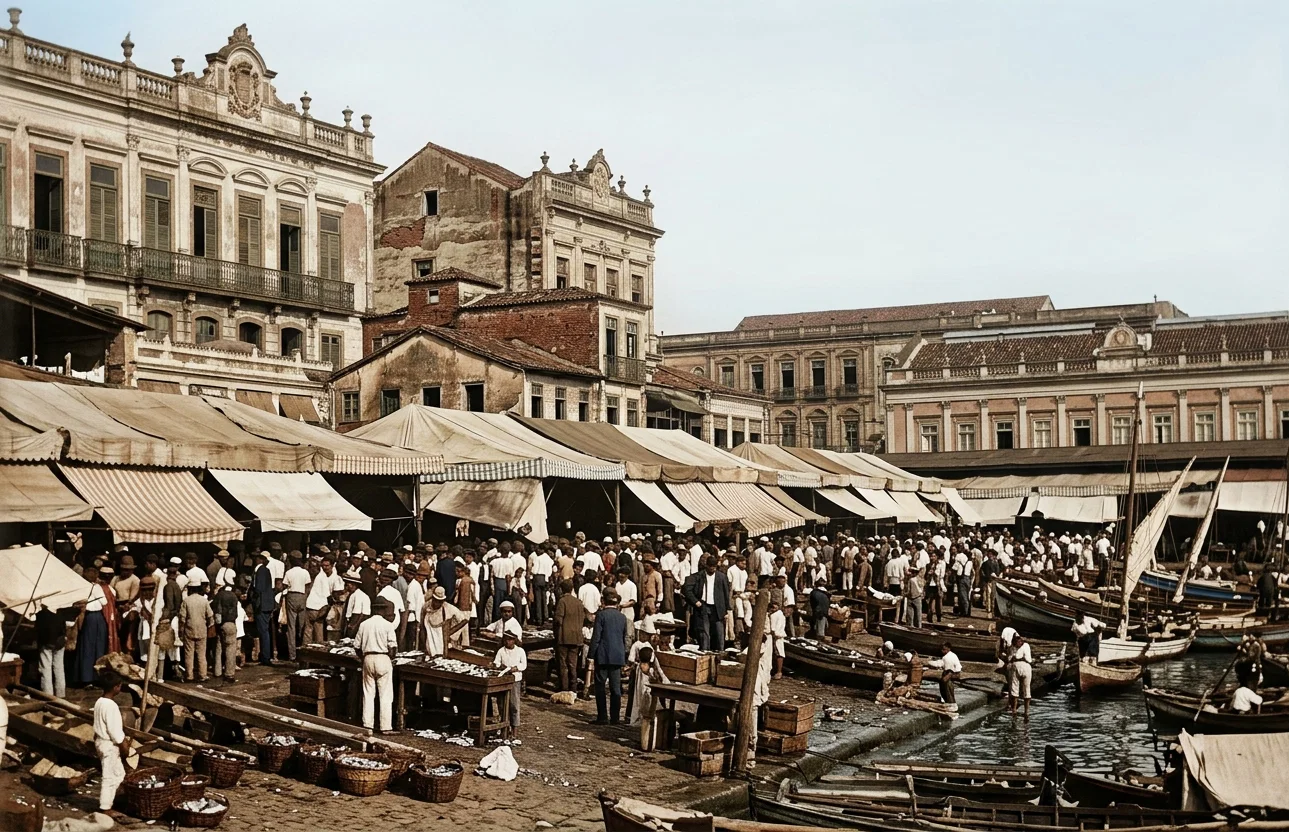
FISH MARKET IN RIO DE JANEIRO
A great deal of macaroni is made, and it is cheap. Fruits are abundant, and their name is legion. Some varieties are on the market the year round, while others come in their season; but as soon as one or more varieties are gone, others take their places. Pineapples are large, juicy, and abundant from November until February. Watermelons and muskmelons grow to enormous size, and in some parts are very plentiful. Bananas can be had all the year very cheap, while the greater part of the year one can buy one hundred large, juicy oranges for even less than the price of a dozen in this country. Nuts are no dearer than in the United States, while walnuts and peanuts are even cheaper.
Corn is the only grain which can be successfully raised in that warm country; but one does not need such a variety of grains when fruits, legumes, and nuts, as well as vegetables, are so plentiful all the year. But, as is the case in all this sad old world, the natives have perverted the bounties of nature, until the diet is far from being pure, simple, and natural, as our loving Father designed it should be; and the great need of that great land is for patient, loving hearts to go among the people, live with them, and show them how to live. As they leave the stimulants and coarse, fiery diets, their warm, impulsive natures can be directed to the Desire of nations, for whom they also long, though they know it not. O that we for whom the truth has done so much would so love and so appreciate it that our whole desire and effort would go out to the suffering ones of earth who know it not!
Religion in the Philippine Islands
By Curtin G. Roop
Rev. Curtin G. Roop, in The Missionary Review of the World
The history and state of religion in the Philippines is so identified with the history and state of the races there found that an account of the former involves an account of the latter. And in order to be at all definite in this required ethnographical treatment of the islands, we must also point out the general geographical features. The archipelago stretches northwest and southeast, from twenty-one degrees to four degrees forty-five seconds north latitude; that is, from the latitude of the southernmost point of Cuba, one thousand one hundred miles southward. In extent the archipelago is a little more than equal to our own country from Maine to the Potomac, excluding Pennsylvania. The actual land area is estimated at fifty-two thousand five hundred square miles—not far from that of Florida or Arkansas. The islands are hundreds in number. I shall speak of but two by name. The first is Luzon, most important and northernmost, practically the only part of the group with which the Americans have had to do thus far. From Luzon, islands of greater or less size stretch southward to Mindanao, the second largest in the group. From Mindanao southward extends the subordinate group of the Sulu, belonging to the Philippines and reaching to Borneo. The relation between the history and state of the religions and the ethnography and geography of the archipelago will appear throughout our treatment.
Scanty burial relics are found, indicating a prehistoric pre-Malay race. These relics bear Chinese and Japanese resemblances, and, as compared with the most original surviving tribes of to-day, indicate a more advanced race. Such a race is supposed by some to have occupied a Malay continent of prehistoric times, now submerged, and to have been a considerably developed people. No traces, however, indicating the religion of these pre-Malays in the Philippines are found, except that the burial relics are such as show a belief in continuance of a life subject to want of food after death, and indicate such reverence as to suggest worship of the dead; especially is this seen in the fact that these relics seem to have been very sacredly—that is, superstitiously—guarded from disturbance.
Aboriginal Religion
Of the people now surviving, the Aetas, or Negritos, are considered to have been the aborigines of the archipelago. They are a small, black race, in height about four feet ten inches. They are spiritless and cowardly, and of a very low mentality. They climb trees like monkeys, swiftly chase the deer afoot, have voices similar to the voices14of monkeys, herd together in fifties and sixties, and, in order to protect themselves from the scourge of fleas, sleep scattered about in ashes. One writer says of them: “Their religion seems to be a kind of cosmolatry and spirit worship. Anything which for the time being, in their imagination, has a supernatural appearance is deified. They have profound respect for their dead.” Another writer says of these aboriginal Negritos: “They neither worship sun nor stars, nor bow before permanent idols, but adore for the day any rock or tree trunk in which they trace a resemblance to an animal. They have great respect for the aged and the dead. For years after the decease of one of them they place betel-nuts upon the grave, above which the deceased’s bows and arrows are hung.” Every night, so they believe, he quits his grave to go hunting. They have no funeral ceremony, but simply lay the corpse at full length in the grave, and cover it with earth. When one is afflicted with a malady deemed incurable, or has been smitten with a poisoned arrow, they bury him alive. In view of their high regard for the dead, and their reverence for old age, which borders toward that state, it is reasonable to suppose that they consider the fatally wounded to be candidates for the awe-inspiring after-state, and therefore to be dismissed from the midst of the living at once by immediate consignment to the grave. One writer says of their religion, that it seems to be, indeed, a kind of ancestor worship. Summing up, it would seem that these aboriginal Negritos, under the influence of a sort of animism, deified natural objects (trees, stones, etc.), and worshiped them, and that they also accorded their dead such awe and regard as with them was equivalent to worship.
These aborigines are now found only in the interior of the islands among the mountains, whither they were driven by the incoming Malays. They number about twenty thousand (some say only ten thousand), and are destined to disappear entirely.
The Malay Period
The Malays, at a time unknown, came to these islands, probably from Malaysia. Long before Spain’s arrival they had driven the Negritos back, and were themselves occupants of the coasts and of considerable territory inland—perhaps most of the territory. What the religion of these people was we of course can only partially gather, as we find it spoken of by the first and later visitors to the islands, and as we find it illustrated in the more or less undomesticated tribes of to-day. Let us go to the north and proceed southward.
The Gaddanes are a fierce tribe in the north of Luzon, whose conquest has never been attempted, of whose habits something is written, but of whose religion I found nothing, save at the season of the year when the tree popularly known to the Spanish as the “fire tree” bears its fire-red blossoms—these people celebrate their religious feasts, and gather scalps and trophies of war.
Proceeding southward, we next mention the Igorrotes. They are scattered over a considerable part of Luzon. As to their religion, the most noticeable thing distinguishing them seems to be that they are utterly impervious to Christianity—at least, to Spanish Catholic Christianity. The answer one of them made to a priest who was trying to teach him Christianity, and to explain to him the marvelous life of St. Augustine, was characteristic of the tribe when he said, “No colored man ever became a white man’s saint.” In the religion that never canonized the colored man the Igorrotes desired no “part nor lot.”
The Tinguianes are next in approximately geographical order southward. It is concluded from physical resemblances that this tribe is descended from the shipwrecked Japanese who sought refuge in the mountains. One writer says: “They are pagans, but have no temples. Their gods are hidden in the mountain cavities. They believe in the efficiency of prayer for the supply of their material wants. Hence if there be too great an abundance of rain, or too little of it, or an epidemic disease raging, or any calamity affecting the community in general, the anitos (images) are exhorted.” They highly regard their dead. According to one writer, they roast them into a dry state, and bury them (generally beneath their dwelling, in a sort of well) in niches, each person in a niche, above his father. They believe in the existence of a soul, and that it detaches itself at death, and remains with the family. They worship neither sun, moon, nor stars. When a chief sees a stone, tree, or any natural object of peculiar shape (as, for instance, the shape of a cow or buffalo), he tells the people of his village, and they go forth to worship it. They may, for instance, make a straw shelter over the object worshiped, and sacrifice a pig. After worshiping and feasting, they burn down the straw roof from over the fetish, and go their way, and the object is forgotten. From all that has been said, I conclude that the Tinguianes had originally a sort of fetishism and, perhaps, ancestor worship.
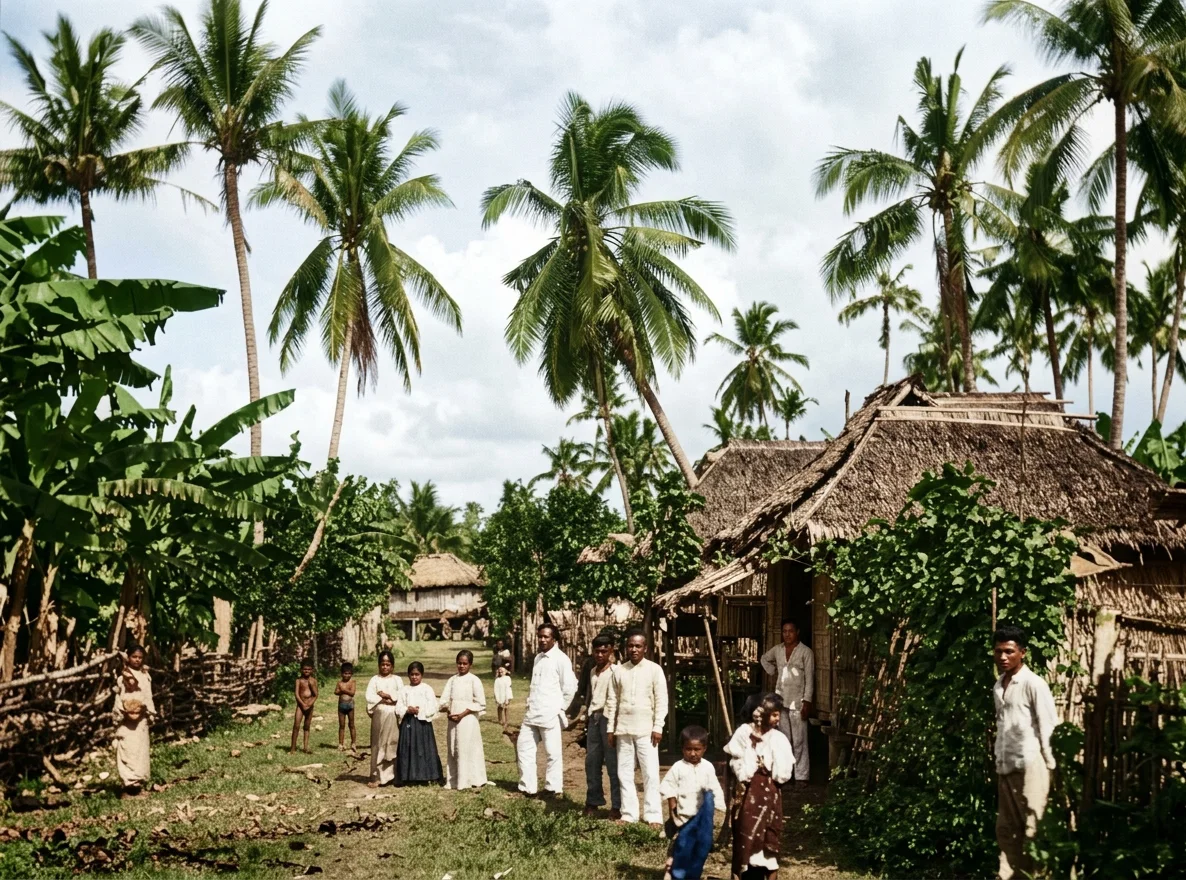
A VILLAGE IN THE PHILIPPINES.
Coming on farther south in the island of Luzon, we arrive among the Tagalogs (Tagalas, Tagals). They are at present inhabitants of Manila and the adjacent territory. They are Malays with a considerable blending of Chinese and Japanese—for it is to be borne in mind that the Chinese and Japanese have been on the islands from time immemorial. The Tagalogs are at present the most advanced people of the islands, and have been Christian for about five hundred years. Consequently their originally religion can be learned only from the very earliest accounts we have of the islands, and from surmises on their close similarity to surrounding tribes, which stretch back into the interior, and still retain, to some extent, their primeval customs.
Such a tribe are the adjoining Bicols, closely related to the Tagalogs in race and language. Such also are the Bisayans (Visayans), stretching still farther south, who, with the Tagalogs (and Bicols), will probably, on account of superior intelligence, ultimately absorb all the other tribes in the northern half of the archipelago. One writer says of the Bicols that they believed in good and evil spirits, witches, circumcision, divination by the stars. Of the Bisayans we have gathered much more. It is evident that they never had temples, but each man performed his religious ceremony in his hut. Some huts may possibly have been used as clan meeting-places—as it were, temples. They prayed to particular gods called “devatas” (anitos among the Tagalogs), and had one devata to govern the sea, and another to watch over the children and house. One writer says that they sacrificed to devata15as one who appeared to be in rebellion against the deity. A true interpretation would probably be that they sacrificed to devata as if to deity in hostile stage or anger. Hell was called “solad,” heaven “ologan.” Souls of the departed go to a mountain in the Province of Otou, called “medias,” where they are entertained and served. Alongside of the devatas, to which they sacrificed and prayed, they placed their deceased grandfathers and great-grandfathers. Also they reckoned among the gods all who came to death by the sword, lightning, or crocodile, believing that such went to heaven on a bow. They buried their dead in coffins hewed out, fitting closely, so that there should be no unoccupied space requiring to be filled by the death of additional members of the family. Trinkets were buried along, and a jar of rice and one of water were placed by. If distinguished slaves were killed and buried for attendance in the land of spirits, the coffins were placed in a grotto, or beneath the house where the treasures are kept, or on a high rock. The caves where they were buried were not disturbed; they were regarded as the dwelling places of spirits, which especially manifested themselves by precipitating storms upon sailors who passed by and did not reverence them. Sailors feared to pass by a burial cave, lest they also should be drawn after the dead. The aged chose to be buried on some promontory, where sailors passing by should worship them. Especially were those who had been distinguished by bravery worshiped. Such were called “humalagar,” which corresponds to the Latin “manes”—namely, deified ghosts of one departed. When a man died, all of the village were compelled to keep silence for a time, varying according to the rank of the deceased, sometimes until the relatives had killed a sufficient number of victims to appease the spirit of the dead. Such a practice would seem to be nothing more nor less than human sacrifice made to appease a worshiped spirit, the statement of some writers that human sacrifice was never practiced in the islands to the contrary notwithstanding. Some say that these Bisayans had idols, others doubt whether they had anything corresponding to a permanent image recognized by the whole community. The alleged idols are described as painted, with large teeth (boars’ tusks), large faces, concave or flat back, feet turned up. One writer gives this people’s account of the creation as follows: “A vulture, soaring between heaven and earth, was unable to alight (the sea mercilessly rose higher and higher), whereat Heaven in anger came to the vulture’s rescue by creating islands. The vulture then alighted, and split a bamboo, out of which sprang man and woman, who then begat children, and drove them forth from home.”
De Morga, a Spanish writer and traveler of the last part of the sixteenth century, says of the Bisayans: “In their religion they seem to have no notion of the true God. The devil appeared to them in various horrible and fearful forms and forms of savage animals, so that they feared and trembled at him, and adored him, usually by making figures of those forms, which they sometimes kept in caverns and special houses, where they offered perfumes and sweet smells and food and drink.” The “devil” of which De Morga thus speaks of being worshiped was evidently a god or gods, since he speaks of their representations of him by the anitos, which is the Tagalog name for images of their gods. “Others,” he says, “worshiped the sun and moon, making feasts and getting drunk. Some adored a mountain bird marked with yellow, which they called ‘batala’ (bathala being the Tagal name for God the Creator in contradiction to idols, which are called anitos and lic-has, or statues). In general they reverenced and adored the cayman, a mammoth crocodile of the rivers, falling upon their knees wherever they saw it, and raising their hands to it, under the notion that by this it would be appeased and withdraw.” They had no temples; each person made, and for the most part kept, his images, without solemnity or ceremony, in his dwelling. There were no priests, if we except a few old men and women (witches and sorcerers); these performed prayers and ceremonies to their idols for the sick, and believed in omens. “To those consulting them they answered a thousand absurdities and lies,” says De Morga. He says that they were never cannibals, nor did they offer human sacrifice. We have learned from other writers, however, that at least some families of these people killed human victims to appease their dead relatives. “They had little ceremony or outward religious institutions, which fact made them the more susceptible to Christian missionaries. They believed in another life, with rewards for those who had been valiant and done great deeds, and with punishments for those who had done evil; but they did not know how nor where this would be.” Their dead they buried in their own houses, and kept the bones, especially venerating the skull.
We have now traced the islands from the north southward, past their middle, to the borders of the Mohammedan rule, in Mindanao and the adjacent islands. Mutual hostility has always existed between the Moslem southern part and the Christian northern part of the archipelago. Hence Christian travelers have not been able to go through the southern islands so freely, and have not given to the Western world very complete accounts of the peoples in the south. We can only assume, therefore, that the primeval religion of the south did not differ materially from the more northern islands already described.
To sum up concerning the pre-Christian, pre-Moslem religion of the Philippines, then, we should say that in general it consisted in an amorphous mixture of fetish nature worship, spirit worship, and ancestor worship, and perhaps arose in some instances to the plane of the worship of spirits of more general cosmic control. Here were no temples, and the only approach to priests was a species of sorcerers and witches. Belief in the immortality of the soul seems to have been universal.
(To be concluded)
Scripture Reaching Moslems in the Turkish Empire
ALTHOUGH there are but few missionaries who have direct access to the Moslems in the Turkish empire, the Word of God reaches many of them. A colporteur in Albania came one day upon a party of seven Moslems sitting together reading the Bible. Last year forty-four thousand Bibles were circulated in Egypt, where ninety-two per cent of the population is Moslem. Besides that, from one Bible depot there were sold last year nearly thirteen hundred copies of the Bible to the Sudanese.
A Chinese Mandarin's Admiration for the New Testament
An English official from Peking was once asked by a gentleman if he had ever witnessed any effects of Christianity upon the high officials of the Chinese empire. In reply he said that he had once asked a high mandarin if he had ever read the Bible. The mandarin went back into an inner room, and brought out a notebook full of extracts from the New Testament. He said that he had read the New Testament through, and had copied from it the things that he admired most. Then, laying the book upon the table, he put his hand upon it, and said, “If only the people who profess this religion were to live in accordance with its precepts, this religion would spread all over the world.”
Missionary Object Lesson: King Levankia of Barotseland
A MISSIONARY object lesson is found in the presence of King Levankia in London. He is from Barotseland, Africa, and a decade ago was the cruel leader of a degraded people. He is now a professed Christian, and is laboring to advance civilization in his tribe. He went to London to attend the coronation of the king and gain some ideas for governing his people on Christian principles.
Presbyterian Board Gathers Missionaries Under Appointment in New York
The Presbyterian Board has made it the custom for a number of years to gather at their headquarters in New York the missionaries under appointment. Here they may meet one another and the different members of the board. A few weeks ago sixty-two were thus assembled, seven bound for Africa, fourteen for China, nine for India, eleven for Japan and Korea, nine for Persia, and four for the Philippines.
Mission Notes
A MISSIONARY in West Central Africa reports that six native women, after hearing of the woman's work in other lands, came voluntarily to offer their services and be instructed. They began in a very simple way — reading the Bible to their visitors, taking it when they went to other villages and when visiting the sick. Once a month the missionary holds a meeting with them, to hear reports and for prayer and council.
Help Each Other
If any little word of mine
May make a life the brighter,
If any little song of mine
May make a heart the lighter,
God help me speak the little word,
And take my bit of singing,
And drop it in some lovely vale
To set the echoes ringing.
If any little love of mine
May make a life the sweeter,
If any little care of mine
May make a friend's the fleeter,
If any lift of mine may ease
The burden of another,
God give me love and care and strength
To help my toiling brother.
— Selected.
W. W. QUANTOCK
By W. W. Quantock
India
DACCA, MYMENSINGH, AND NARAINGANJ.—These places are situated in eastern Bengal. Dacca used to be the capital of this district, and is consequently a noted place. It has only a small European population, but its native population is about one hundred thousand. It is quite an educational center, and has several colleges. It is said to be next to Calcutta as far as educational facilities are concerned. It is one of the many places in India that are waiting for some one to come and hold up the light of truth in all its glory. Being an educational place, there are a great many students there. If some one could start the work in a place like this and follow it up, there is no doubt that much good could be accomplished among the students.
Mymensingh and Narainganj are not so large as Dacca. The Baptists have quite a work started in this district. About forty miles north of Mymensingh they have been working among an aboriginal tribe, in which the caste system does not prevail, and as a result over thirty companies have been raised up during the last few years. As I go from place to place and see what is being done, and what there is to do, I often wonder how long it will be before we can have work started among the different peoples of India.
Narainganj is the center of the jute market of the world. The merchants are Greeks, Armenians, and Englishmen. Among them I was able to sell quite a number of our large books, such as “Patriarchs and Prophets,” “Great Controversy,” and “Christ’s Object Lessons.”
I called on one man at Dacca who did a great deal of reading. He was also a business man. When I told him my business and what I had to show him, he at once spoke of two books that he had bought from some one in Calcutta who was selling off his books just before leaving for England. The two books were “Patriarchs and Prophets” and “Daniel and the Revelation.” He was much pleased with the style in which the books were written, and with the thoughts presented. He also bought “Great Controversy” and “Christ’s Object Lessons,” and subscribed for our paper. So the seeds of truth are scattered, and will find nourishment in some hearts. In due time they will spring up and bear fruit to the glory of God. I am thankful for the privilege of having a part.
There is a great work to be done, but it will soon be done if we get our hearts right before God, and work with all our might.
W. W. QUANTOCK
Church Work and Health Meetings in St. Gallen
By Albertina B. Voth
Switzerland
St. Gallen.—Since coming to this place, we have held meetings in a public hall four or five times a week, and have visited from house to house. This work, together with our labor for those who call on us, keeps us very busy. We had quite a hard time to get a place in which to hold meetings, hall rent being high, and there being great prejudice against our people.
We are not nursing at present, but the Lord is with us, and is blessing our feeble efforts. Thursday nights my husband gives talks on anatomy, physiology, and hygiene. We have Dr. Kellogg’s large chart, and it is indeed a great help in bringing the truth before the people. It is most surprising how ignorant people are of the laws of health. Even those who profess to be Christians, when we visit them, offer us beer and wines, believing that these are very nourishing. Recently we have held a temperance talk each week, and since beginning these meetings we have not been annoyed in this way.
Several have begun keeping the Sabbath since we came here. Six precious souls have joined our small company, and many others are interested, among whom are six Catholics and one Mormon, also a whole family of eight persons. One member of this family has already kept two Sabbaths. I never before realized as I do now, what it means to give up a good position and look for other work, to lose friends, and be regarded as a fanatic. It is quite a step to take in this country. Children are almost compelled to go to public schools on the Sabbath unless they attend a church school. I hope that the Lord will find a teacher for St. Gallen, as we shall soon need one. It is indeed a pleasure to be in this work. I enjoy it more and more.
We are now having most beautiful weather, and the mountain scenery here is grand. St. Gallen lies very much higher than Basel. People say that they often have a snow shower here in the middle of summer.
Albertina B. Voth.
Quebec Conference
By J. W. Collie
The twenty-third session of the Quebec Conference was held in Waterloo, Quebec, September 4–14. The season being an unfavorable one for crops, many were kept from the meeting who otherwise would have been present. The Lord came very near, and blessed his people as they sought for forgiveness of sins, and consecrated themselves to his service. The first Sabbath was characterized by a manifest outpouring of the Spirit of the Lord, and nearly all present were made to rejoice in God’s goodness. Prior to the Canadian Union Conference, which began the 10th, the local laborers and the writer worked in behalf of the spiritual interests of the meeting.
Elder Wm. Ostrander, formerly of Michigan, was present, and spoke in behalf of the work in Montreal. Here is a priest-ridden city of three hundred thousand inhabitants, and only a handful of laborers to accomplish the work necessary to be done; but Brother Ostrander was full of courage and hope, and expressed his conviction that much might be done the coming year. Brother E. P. Auger has also come to labor for the French people, and the conference will do all it can to advance the work in Montreal the coming year.
Elders Farnsworth, Rickard, and Ellis gave interesting reports of their work this past summer.
Although this is one of the old conferences, having been organized over twenty-five years ago, the membership is small, and the tithe sufficient to pay only a very small corps of laborers. With the Canadian Union Conference headquarters located in this conference, and the addition of laborers which have come in, we confidently expect to see Quebec take advanced steps. The brethren returned to their homes with courage and hope.
The following-named officers were elected: President, S. A. Farnsworth; Secretary and Treasurer, W. H. Libby;15Executive Committee, S. A. Farnsworth, H. E. Rickard, Wm. Ostrander, J. M. Ellis, and Wm. Blythe.
It was a pleasure to meet these brethren for the first time, and as we saw dear souls find liberty in Christ, we were made to rejoice. J. W. Collie.
British Honduras
By H. C. Goodrich
THE interest is still good here, and one more has begun to keep the Sabbath. We have a dark, hard field in Central America.
Brethren Allen and Branster have just started out on a canvassing tour through the northern part of the colony. Brother Branster has been over this territory before, and as a result one man is keeping the Sabbath and wishes baptism. Mr. and Mrs. Allen will probably go to Tegucigalpa, at the beginning of the new year, as canvassers; and then we must have another man and his wife to enter Guatemala, a city of sixty thousand inhabitants. From these two centers they can work out as opportunities occur, to enter other cities around them. Throughout Spanish Honduras and Guatemala there are several large cities that must soon be entered. There are thousands of souls in these cities who have never heard the message of truth.
H. C. GOODRICH.
W. G. KNEELAND
By W. G. Kneeland
Trinidad
SAN FERNANDO,—We have been able to secure a good lot for a church building at San Fernando, with funds raised outside of our regular offerings, and have thirty-five dollars pledged toward materials. We are doing all we can to keep our people here selling books, tracts, etc., and turning in all, or at least part, of the commission to the building fund, as that is the only way they can raise money. We do not intend to begin building till we can buy the frame and roof, which will cost about one hundred dollars.
A minister told me the other day that he had decided to cast in his lot with us soon, and was arranging to sever his connection here at the end of the month.
W. G. KNEELAND
Canvassers' Institute and Work in Barbados
By W. A. Sweaney
Barbados
BRIDGETOWN.—We have been holding a canvassers' institute the last week or two, as several of our canvassers are home from the work in other islands. We held one extra meeting each day, for one week, and still hold two extra meetings on Sabbath and Sunday, to study the Bible and the Testimonies concerning the canvassing work, and also to study the field, plans, methods, books, etc. God has greatly blessed us, although we were disappointed in having none of our laboring brethren with us. We considered the work with “Christ’s Object Lessons,” and the church is taking hold of it bravely. We had only fifty copies on hand, and in one week they are nearly gone. We have sent to St. Vincent for more. This forms the nucleus of a school fund. We hope to sell a goodly number of books even here, where times are so hard, money so scarce, and poverty so pinching. Myself and family sold fourteen last week, besides doing all our other work.
Barbados is again quarantined, on account of smallpox, which is assuming almost epidemic proportions. Scores have it, and several deaths have occurred. Prices of everything are extremely high, and starvation stares many in the face. Some plantations are closing down, owing to the low price of sugar, and hundreds of laborers are thus thrown out of employment, to starve, beg, or steal. I am glad that our God is so great that he can make use of even all these terrible experiences, to advance the interests of his kingdom. The interest in our work is more marked just now than at any former time. The church is filled, and crowds stand at each window on Sunday evenings. I am giving Sunday evening lectures on Revelation. A great many are deeply interested. Many are convinced of the truth, and some are halting between two opinions, almost persuaded. A few are obeying, some of whom give evidence of sound conversion to the truth.
The increase of attendance and interest is largely due to the unity, zeal, and earnestness of the church. Our missionary, prayer, young people’s, and Sabbath services are all seasons of refreshing, and are constantly increasing in attendance and interest. Nearly every member is doing something in personal, house-to-house work—selling, loaning, and giving away literature, inviting the people to church, praying for and ministering to the sick and needy, holding Bible readings, etc. W. A. SWEANEY.
Canvassing Work in Sweden
By M. T. Ahlkvist
The branch of the message that here seems to be the most prosperous, and the one receiving special attention, is the canvassing, or book, work. About forty are giving almost their whole time to this work in a country of about five million people. The colporteur work has for years been the leading feature in the work of giving the message in this country.
“Prophecies of Jesus” is the main, or large, book, which at present is being circulated, especially by the canvassers. We have recently obtained “Christ’s Object Lessons,” which is on sale by ministers, Bible workers, canvassers, and lay members. “Steps to Christ” is being sold in large numbers by the canvassers.
Since my arrival here from the States a year ago last July, I worked at my trade, blacksmithing, for a while, as I thought that this kind of work would be beneficial to my health. But very soon our earnest canvassing agent found out some particulars concerning my whereabouts, etc., and at once urged me to engage in the work of selling books. I considered this call as from the Lord, and from January of this year until June, I canvassed in the city of Malmo, when I attended the conference held at Nyhyttan.
At present I am associated in the work with Brother P. A. Ahlström, who has also spent a number of years in the United States. We are laboring on a small island, by the name of Öland, located in the Baltic Sea. The Lord is giving us good success in this precious work. In less than two months, from July 13 to the present, September 4, I have sold 148 copies of “Prophecies of Jesus,” 14 of “Christ’s Object Lessons,” and 206 of “Steps to Christ.”
Two years ago or more “The Great Controversy” was sold throughout the island, and many consider it a good book. In many homes both “Great Controversy” and “Prophecies of Jesus” are to be found.
“Blessed are ye that sow beside all waters, and send forth thither the feet of the ox and the ass.” Isa. 32:20. “In the Lord shall all the seed of Israel be justified, and shall glory.” Isa. 45:25.