THE heading to this article is a part of a scripture that tells of a time when certain ones will think that they offer service to God when they kill certain other ones of their fellow men. The scripture verses giving the text and context are the following:
"These things have I spoken unto you, that ye should not be caused to stumble. They shall put you out of the synagogues: yea, the hour cometh, that whosoever killeth you shall think that he offereth service unto God. And these things will they do, because they have not known the Father, nor Me. But these things have I spoken unto you, that when their hour is come, ye may remember them, how that I told you." John 16: 1-4.
The worst and the bitterest religious persecutions that the world has ever known are those of the "Christian era," and consequently after Christ had spoken the foregoing words. For when good things become perverted, the counterfeit is the worst that can be devised.
These words of the Teacher are both a warning and an encouragement. They warn us against being among those that will kill people, and still think that they are offering "service unto God." And on the other hand, if we find ourselves persecuted, and threatened with death, because of our faith in the God of the Bible, we may be assured that this is a part of the privilege that comes to the Christian.
It is generally considered that we have reached such an "advanced state of civilization" that we will never have any more religious persecution, and especially so in this country, "the land of the free and the home of the brave," "the land in which every man may worship God according to the dictates of his own conscience," or where he may refrain from any worship, just as he sees fit.
But the great civilization of the old Roman empire did not stop it from persecuting those who differed from it in matters of religion. And after the "civilization" of that empire had been nominally baptized into a profession of Christianity, it did not prevent it from plunging into the worst and the bloodiest persecutions of which history furnishes any records. Of course the worst of these persecutions occurred after the empire of Rome had been broken up into the kingdoms that succeeded it. But all the seeds for that persecution were sown during the time that Rome was a nation entire, and at the time when she was in the noonday of her civilization. Civilization alone is not enough to keep peoples from lapsing into the intolerance of persecution.
Trusting to the civilization of the time to protect us is the very thing that will prove the ruin of those who place their trust there, and who do not look continually to the principles that are the basis of all true civilization. The "fathers" of this republic laid down the foundation principle that "eternal vigilance is the price of safety." And while this phrase was uttered by Patrick Henry at the ushering in of the war of the Revolution, yet it was the foundation for the slogan that has been a principle with the nation, that "eternal vigilance is the price of freedom," as well as the price of safety.
This "eternal vigilance" must be exercised in keeping the real principles of freedom before the mind; because when these principles are lost sight of it is very easy to drift, amid all the glare of the light of civilization, into the worst forms of bigotry and persecution. Hence it is always proper to raise the question as to whether or not there are any tendencies in our time looking toward the drifting away from the old principles of liberty that allow us the freedom of worship. For freedom to worship, or not to worship, just as the individual may choose, is one of the dearest of our rights, and it is the one target at which all the artillery of intolerance is aimed.
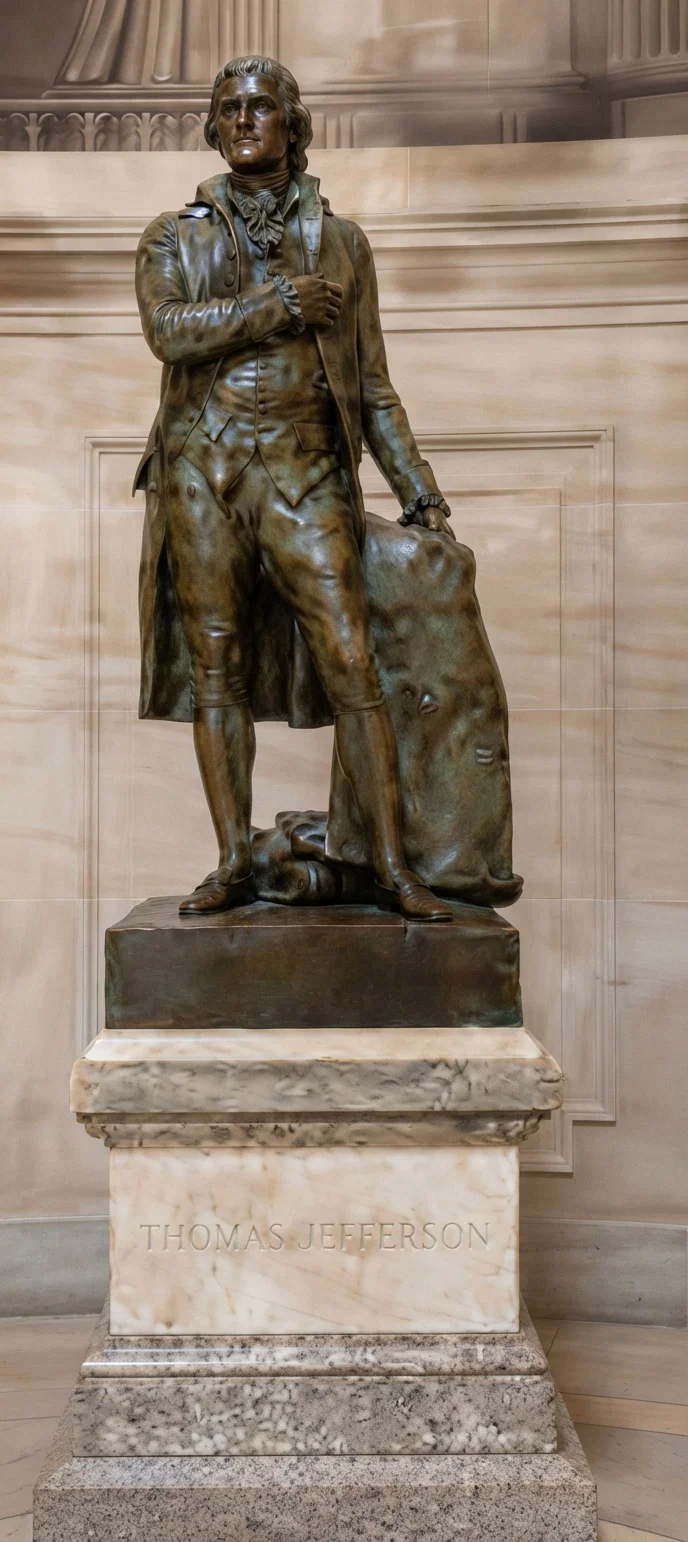
Statue of Jefferson at the Capital, Washington, D. C.
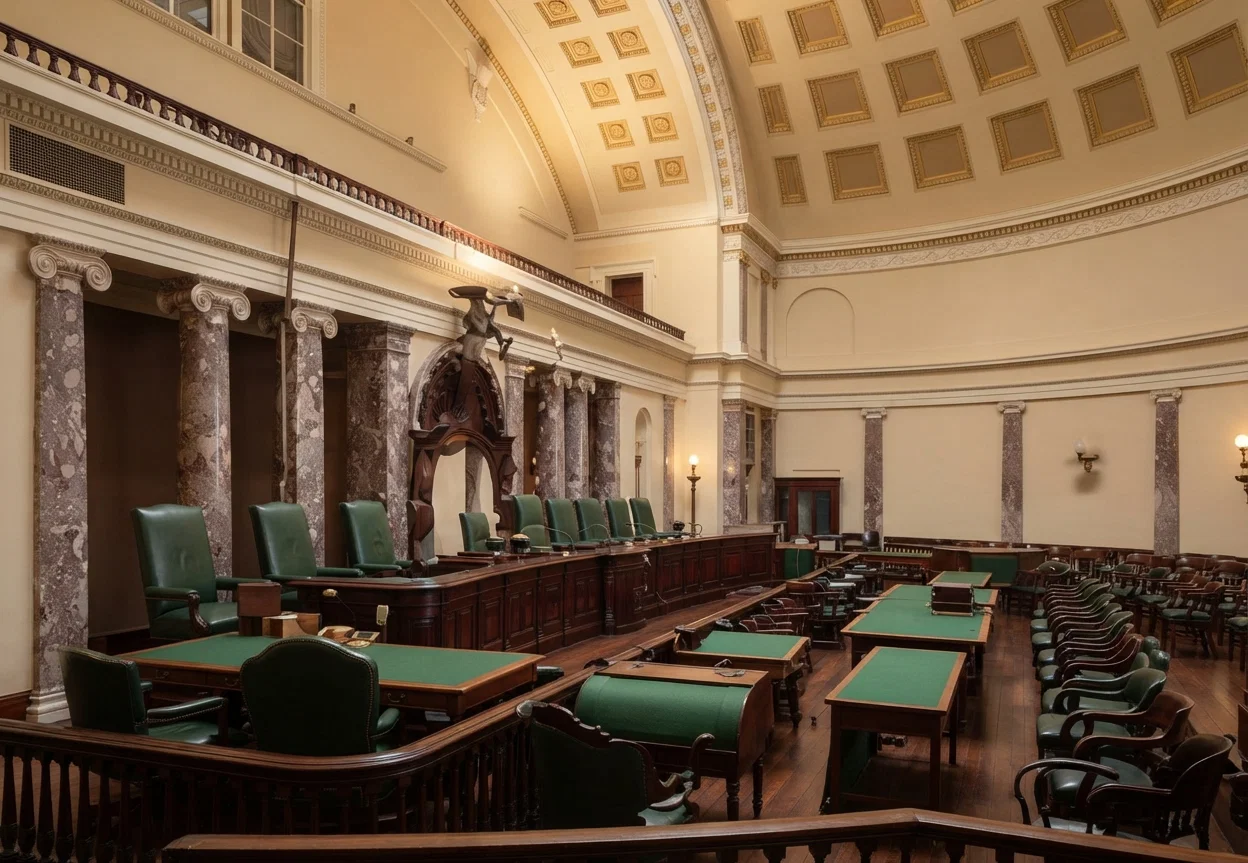
Interior View of Supreme Court Room, Washington, D. C.
It is recognized that this is an age of intensity, and mighty issues are surging in the minds of the populace. And in this time of intensity it is clear that when a wrong movement is set in motion it will rapidly develop mighty results. Hence all the greater necessity of looking well to the ground on which we are standing.
A Most Perplexing Issue.
One of the most perplexing issues of this time is the conflict that is being waged between capital and labor. There is constant agitation everywhere, and strikes and rioting are very common in numerous places. It has been frequently suggested, and particularly by the heads of the Catholic Church, that religionists will have to step in to act as arbiters and guides before the social malady can be healed. This may seem like a small straw, but in the intensity of these times there is no telling what may come out of it in a very few months when once the thing is well started.
Most closely allied with this notion that religionists will have to intervene to settle the labor and capital difficulties, is the further contention that we must have strict Sunday laws in order "to give the laboring man his right to rest one day in seven." On this latter contention there has been the most persistent propaganda kept up for the last half century. Notwithstanding the fact that every state in the union except California has a Sunday law, we find that at the meeting of every legislature there are always those on hand who want still further legislation in favor of the observance of the day.
The national legislature at Washington has not had a session for years during which there have not been numerous bills presented, asking for legislation to enforce the observance of Sunday. The present Congress had but just convened when there were introduced three separate bills asking for Sunday legislation.
Widely Extended Sunday Ordinances.
Very many of the cities and towns of the country have their ordinances prohibiting Sunday labor, and providing penalties of fine and imprisonment for their violation. During the last few months there has been a big agitation in New York City because of the enforcement of one of these ordinances there. The decision of a district judge made it obligatory for the police to close all places of amusement in the city on that day. The order of the judge was rigidly enforced for a few Sundays, when the general clamor for amusement on Sunday rose so high that a way has been found by which the theaters, concert halls, etc., are again opened. But the agitation has developed the fact that there is a strong sentiment in favor of making strict Sunday observance obligatory under the pains and penalties of the civil law.
In Kansas City there was a similar agitation to the one in New York, for here, too, the judge of one of the courts lent his influence to the Sunday cause. He gave discourses upon the subject to the church people and told them that he was with them to make Sunday rest a rigid reality.
Then there has been the agitation of the subject in Chicago, Los Angeles, and many other large cities, during the very recent months. Disciples of the movement are already lecturing in different places in California, preparing the public, as they suggest, for some definite action at the meeting of the next legislature a year from now. They say that it is a shame to have California stand out alone without any law to enforce the observance of Sunday.12
A Religious Question.
Superficial thought might not suggest anything significant in this Sunday-law agitation that is becoming stronger and stronger thruout the country. But closer thought should show any one that the whole history of Sunday is the history of a religious institution. It began its history as a pagan holiday dedicated to the worship of the sun. The first law in the Christian era proclaimed in its favor was the Sunday law of Constantine, who was called the first Christian emperor, but who was in fact never more than a nominal Christian, for many of the acts of his life show that he was not a follower of the Nazarene. It is said that he even postponed his baptism till he felt sure that he was on his death-bed, so that he might indulge freely in the excesses and ambitions that were his controlling power.
The whole history of the Sunday institution from that time to the present is associated with religion. And therefore when it is sought to secure Sunday legislation, the effort is wholly in behalf of religious legislation. The statement is frequently made by those in favor of it that they are not working for a religious Sunday; they say that they want a civil Sunday for the working man. But the mere calling of a religious institution by a civil name does not make it anything else but religious. It would be just as sensible for those who believe that sprinkling is the correct form of baptism to ask for a law that everybody should be sprinkled, and then say that they are not asking for a religious sprinkling; they only want a civil form of baptism. This may seem an absurd illustration, but if we yield to the Sunday law, then may not the next step be to get a law requiring everybody to be baptized? Nations have had such laws, and it is not out of the question to have them again. And as there is the same lack of agreement in regard to the correct mode of baptism that there is in regard to the day that should be observed as the Sabbath, it would be necessary for the state to make a law telling us how to be baptized. The same spirit that will make and enforce the Sunday law is the spirit that all thru the centuries has required whole multitudes of people to be baptized, or else suffer the penalties of the law of the state.
The Lord Jesus Christ, in the verses quoted at the beginning of this article, told us that the time would come when men would think that they were doing a service to God when they killed His followers. He did not say that His teaching would apply only in the middle ages; indeed He did not say when it would apply. He merely stated that the time would come when such persecutions would arise, and we know that all of it that does come will be brought into the world thru religious intolerance, and religious intolerance is usually based upon some form of religious legislation.
But There Is a Direct Prophecy
of the Lord that tells us specifically of religious persecution that will arise in this very generation in which we live. It would not be consistent with the length of this article to consider that prophecy in this connection, so we defer that part of the subject for next week. Let it be said in this connection, however, that there is an abundance of evidence to show, both in the prophecy and in the events of the time, that the work that was done by Madison and Jefferson and Washington and the rest of the founders of the republic is in great danger of being lost sight of thru the greed for gain and the lust for both civil and ecclesiastical power. And because of these things it is highly important that we give close heed to the portents of the time.
A Unique View of the Capitol.
As already suggested, the direct prophecy that bears upon the subject will be considered next week. T.
Peace on Earth and Goodwill
By George Hodges
'GLORY to God in the highest,' sings the celestial chorus, 'and on earth peace, good-will toward men.' You see how the carol met with its music the two kinds of fear under which men lay trembling. 'Peace on earth,' where men were sore afraid of men; and good-will from heaven that men may no longer be afraid of God.—George Hodges.
Do It Now.
THESE words are conspicuously posted over the office table of one of my successful friends, and in his workroom adjoining, one may see another sign reading, "Do it Now Avenue."14No wonder this friend is prosperous, and no wonder he is crowded with all the business he can attend to. He knows very well the worth of that little word, "now." There are hundreds who are robbing themselves of a prosperous future because they have not learned the value of "Do it now."
An idle present makes an empty future; and he who hopes for a prosperous future should understand that he can have it only by a proper use of all the "nows." It was Cervantes who said, "By the street called By-and-by you reach the house called Never," and it might be better for all our work if we could always remember his words.
There are too many who intend to do good sometime, but are doing nothing toward it now. And he who fills his to-day with nothing but good intentions is in a fair way to do nothing all his life.
—A. H. Lewis, D.D.
The Building of a Home
By Mrs. L. D. Avery-Stuttle
The Family Altar.
THE best medicine in all the world is prayer. I was reading the other day a prescription for insomnia by a famous physician. What was it?—Morphia, or opium, or patent medicine? Did he prescribe air, or sunshine, or electricity, or water?—No; something which he declared was better than all or any of these,—simple, earnest prayer. Prayer calms the nerves, rests the brain, invigorates the body, and elevates and strengthens the soul.
When everything else failed, prayer added fifteen years to the life of Hezekiah. There is nothing too hard for it to accomplish. Leprosy, that loathsome horror of the East, can not stand before it: “Lord, if Thou wilt, Thou canst make me clean.” “I will; be thou clean.”
Enough. No long, tedious convalescence after that. No feverish anxiety as to whether that prayer will avail. Prayer brings the almighty Spirit of the Eternal, the most tremendous agency in the universe. Before its all-prevailing power, empires and kingdoms submit themselves. Kings, lords, and potentates are as nothing, and even the very devils in their home of darkness tremble. Prayer has resisted the power of wild beasts; “chained the mouths of lions,” stilled the raging waters of the deep, and robbed the fiery furnace of its prey. Even the monster Death has been forced to open his insatiate maw at the pleadings of the simple prayer of faith.
But I have only mentioned a few of the wonders which have been accomplished by the agency of prayer. There are no heights too vast for its voice to reach; there are no depths so abysmal, so unfathomable, that they can not be penetrated. Neither the boiling deep nor the belly of the whale prevented the prayer of the despairing and repentant prophet from reaching the ear of the Eternal.
Well, since prayer is such a mighty factor, since in the mouth of the righteous it is all-prevailing, would it not be a good thing if at the beginning and at the close of every day we should assemble our sons and our daughters, our man servants and our maid servants around the family altar to thank our heavenly Father for past blessings and to ask help for the future?
The influence of family prayer is greater and more enduring than can be calculated. Nothing will take its place with the same results. Not even secret prayer should supersede it. How many noble sons have been saved by the memory of the earnest fireside prayer from the lips of a godly father or a tender mother; how many promising daughters have been brought to repentance by the sweet remembrance of the morning and evening prayers of a Christian home, eternity alone will reveal.
The other day I saw a workman clinging fast to a long ladder firmly attached to the ridge-board of the house he was repairing.
“Aren’t you afraid?” I asked.
“O no,” came the confident reply, “O no; you need not be afraid as long as you have a firm hold above.”
Tears came to my eyes as I replied: “That is right, my friend; if we only have a firm hold above, we have no need to fear.” O how sad that so little time is spent in securing a firm hold on the Arm of strength that never fails! More hours spent in prayer, mean fewer hours and days in nerve-racking worry and feverish anxiety. The firm assurance that our anchor “within the veil” holds firmly is worth more than anything else in the world; that amid the worry and moil of this feverish life may come the blessed assurance like a benediction of peace, that, altho the bottom rung of the ladder may rest amid the slime and the mud of earth, the top reaches even to the throne of the Eternal.
“But,” objects some busy, care-worn father or mother, “there are so many chores to do in the morning; the children must be washed and dressed and prepared for school as soon as breakfast is over; baby is peevish and takes extra care, and really it does seem as if the morning is the very busiest time of the whole day. If we attempt to have prayers before breakfast, the food becomes cold and not fit to eat, standing so long; while if we wait until after breakfast, it seems so hard to collect the family. So when our cares began to increase, we thought we would be entirely excusable to omit morning worship.”
Ah, my poor friend; you stopped praying just when you most needed the strength and help prayer would bring. The burden of care increased, and so you decided to bear the weary, crushing weight on your own weak shoulders. What worse than folly! Martin Luther used to say that whenever he had a hard day’s work before him, he gave extra time to prayer.
I suppose, my brother, that on account of this lapse in the morning, you give all the more time to evening worship? When the cares of the day are all over, how fitting and how restful to commit the soul to the keeping of that Eye which neither slumbers nor sleeps.
“Yes, that’s so. We used to have evening prayer always when we were first married, and we belong to the church now; but, you see, after supper, the children want to go to bed, wife is tired and nervous, and I feel actually too weary by the time I have finished the daily paper to lead in worship. I suppose we ought to, but we’ve excused ourselves, because—”
Ah, yes, I see. But I am afraid that some day the Master may excuse you, too,—excuse you from entering the city of gold; excuse the angel from writing your name in the Book of Life; excuse you from wearing a golden crown, and from joining in the song of Moses and the Lamb around the great white throne. Some day the Master, whom you have so neglected and whose proffered love and aid you have so scorned, may say to you, “Excused from heaven.”
Ah, think of it! too tired to spend a few moments in prayer, but not too tired to spend an hour reading the appalling, sickening, disgusting records of crimes and sensationalism and folly with which the pages of the daily newspapers are defaced!
O, the saddest words which were ever spoken to mortal man were spoken to the professed people of God:
“Ephraim is joined to idols; let him alone.”
Press the Battle.
By D. R. Lowell, D.D.
ON, my brother, press the battle,
Press it sternly to the end!
By His Spirit God will help you,
And a glorious victory send.
E'en tho forces strong and bitter
All your efforts may oppose,
They shall vanish like the shadows,
Ere the embattled day shall close.
See the fields all white to harvest!
Islands waiting at our door,
Nations pleading for our coming,
Pleading now as ne'er before;
Superstition's night is passing,
Barriers, weakened, now give way,
While the heathens' night of darkness
Breaks before the Gospel day.
—D. R. Lowell, D.D.
Story of Pitcairn Island
By Editor
“Story of Pitcairn Island.”—By Rosalind Amelia Young, a native daughter. Pitcairn Island, one of the volcanic gems of the Pacific, has been heard of wherever the English language has been spoken. The story of the working out of the problem of human life on its limited territory reads stranger and more thrilling in many respects than a romance. But most, if not all, of the tales told and the books printed have been too fragmentary, or incorrect and misleading. It will be interesting to the friends of that miniature world to know that an authentic history has been written, and that by a native of the island, one to the manor born.
Miss Rosa Young is one of the direct descendants of the mutineers of the Bounty. The book is a plain, unvarnished tale of Pitcairn and its inhabitants from its settlement to the year 1894. It is written with charming simplicity of style, which refreshes the reader and invites continued perusal. Illustrated with 26 engravings. Fourth edition, with appendix. Cloth, $1.00. Address this office.
Drunkenness and Crime.—What are the reasons for such an alarming increase in the nation’s drink bill? “The relation of crime to intemperance is well understood by men who have to deal with those who transgress the laws of the land. In the words of a Philadelphia judge, ‘Rum and blood, I mean the shedding of blood, go hand in hand.’”
“A district attorney in the city of Boston is reported as declaring that ‘Ninety-nine out of every hundred of the crimes in our commonwealth are produced by intoxicating liquors.’”
“Let those in positions of public trust take heed lest thru wine and strong drink they forget the law, and pervert judgment.”
“‘Wo unto him that buildeth his house by unrighteousness, and his chambers by wrong.’” “Behind the liquor-dealer stands the mighty destroyer of souls.”
“Often he is forbidden to sell intoxicants to one who is drunk, or who is known to be a confirmed drunkard; but the work of making drunkards of the youth goes steadily forward. Upon the creating of the liquor appetite in the youth the very life of the traffic depends.”
“Should not the liquor-saloons that have wrought so much evil, be entirely abolished?”
“Let the voices of the nation demand of its lawmakers that a stop be put to this infamous traffic.”
These startling sentences have been selected from a new sixteen-page tract just received from the press. They call attention in a marked way to the evils of the liquor traffic; and the responsibility for the continuance of this awful crime-producing agency is clearly indicated.
We believe that our readers will be well repaid for a careful perusal of this tract. And you have friends who should receive the light contained in its truth-filled pages. Bible Students’ Library, No. 196, price only $1.00 per 100.
Order from the Pacific Press Publishing Co., Mountain View, Cal.; 285 Salmon St., Portland, Ore.; 1109 E. 12th St., Kansas City, Mo.; or from your local tract society.
S. S. Supplies.—We still have a good supply of S. S. Record F at 35 cents, for schools of 20 to 90 members; class records at 10 cents; S. S. Quarterlies at five cents each. If you need a Bible, send for our “Select List of Bibles.” Address, Pacific Press, Mountain View, Cal.
The Shooting of the Young Idea.
By Annie Laurie
A LITTLE girl who lives near me took her brand new hat and tore it into a thousand pieces and threw it into the fire the other day, because her mother couldn't find time to take her out just at the moment that the little girl felt inclined to go.
The mother smiled and said, "Poor child, she hasn't learned the lesson of meeting evil with good yet."
I'm going to watch that little girl.
I'm afraid she'll make very interesting copy for the newspapers some day. She'll be just the sort of person who will shoot some man for refusing to keep his promise and divorce his real wife and marry her.
I wonder how much of all these brand new theories about subduing evil with good and meeting enemies with a smile, and the development of the "ego" have to do with the epidemic of murder and all sorts of unhallowed crime in this country!
A woman shot a man in Arizona the other day.
She says she is glad she did it.
She was a trained nurse and when the man's wife was dying he promised her that as soon as the funeral was well over he would marry her.
Instead of which he took the first train out of town when the funeral was over, and the nurse had to track him a thousand miles to get close enough to teach him what she calls "a lesson."
I wonder why she didn't learn her own lesson early in life—the lesson that a woman who lets another woman's husband make love to her is both a fool and a wicked woman, and that she will have some little bills of her own to pay before she gets thru with the wretched business. . . .
Whenever a merely finite mind begins to argue that it is stronger and bigger and wiser than any set rule or command, look out for trouble. Now, if that little girl who threw her hat into the fire had been mine, I should have given her a good, old-fashioned spanking first of all, and then I should have made her go without a new hat for the rest of the season. Then when she was grown she'd know what the phrase "cause and effect" means and how to deal with that meaning.
I wonder if I'm a hopeless barbarian?—
Annie Laurie.
Children at the Table.
By A. M. H.
It has been wisely said that children's conduct at the table reflects credit or condemnation upon their elders in an unmistakable manner. The child taking lunch with a neighbor shows just the degree of refinement to which he is accustomed. Children may early be taught that whatever refinement they possess is evident in the way they take their food. The correct way of eating may easily become a habit, and it is at the home table that dainty habits, or those quite the reverse, become settled.
Mothers should pay strict attention to this part of a child's education and start it in right habits. Above all, the little ones should not be snubbed for their attempts to add to the general conversation, neither should they be permitted to be so much in evidence that their friends and parents are forced to keep in the background.
If one takes pains to always have the table neat and clean, it teaches the children to be more particular at the table. A liberal use of small cloths not only adds to the appearance of the table but saves the table-cloth from such frequent washings. The napkins, tray cloths, and doilies can be kept soft and white by putting them to soak over night in a warm Pearline suds. When washed in this way they require very little rubbing, which is a genuine saving to the fabric.
Children have rights, and one of their rights is to be corrected in private. The wise mother never wounds her child by public reproof, nor embarrasses the rest of the family and sympathetic guests by nagging and fault-finding in their presence.
A. M. H.
The Zeal of Former Days.
By Max Hill
CALL to remembrance former days
When truth first reached thy sight,
How with a song of faith and praise
Ye bore affliction's fight.
While ye were made a gazing-stock,
Reproached, afflicted sore,
Still thou, tho men should jeer and mock,
Pressed on and praised the more.
A better, more enduring crown
For thee in heaven waits;
There ye may rest, the cross laid down,
Beyond the pearly gates.
So therefore cast not thou away
Thy ear'ly confidence;
The sure reward in God's great day
Will be thy recompense.
And we have need of patience still
The while we yet remain,
For having done the Master's will
The promise we shall gain.
For yet a little while and He
Whose love our hearts have known
Will come, and on the glassy sea
He will reward His own.
MAX HILL.
Christian Science!
By Editor
WE are preparing in pamphlet form the articles which are now appearing in the SIGNS OF THE TIMES on Christian Science, by Elder R. A. Underwood.
It will be issued as Bible Student's Library, No. 197, and the price will be 10 cents.
Please place orders with your Tract Society.
Pacific Press Publishing Co.
Mountain View, Cal.
DATE OF EXPIRATION.
By Editor
The Signs wrapper bears date of last issue due on your subscription. Unless renewed in advance, paper stops with expiration date.
If herewith is an order-blank, you will know you have overlooked sending renewal. You will not wish to miss a single issue. Back numbers often can not be furnished.
The LORD'S DAY
A Brief but Comprehensive Treatise covering the History and Doctrine of the Sabbath and Sunday
The LORD'S DAY
The Test of the Ages
Controversy from Creation to the Present. Truth supported by Scripture, Historical fact, and Argument. A Multum in Parvo on the Sabbath Question. Illustrated; 128 pp; price, 10 cents post-paid. PACIFIC PRESS Mountain View, Cal.
Ferry's 1908 Seed Annual
Ferry's Seeds are the best known and the most reliable seeds grown.
Ferry's Seeds are the best known and the most reliable seeds grown.
Every package has behind it the reputation of a house whose business standards are the highest in the trade.
Ferry's 1908 Seed Annual will be mailed FREE to all applicants. It contains colored plates, many engravings, and full descriptions, prices and directions for planting over 1200 varieties of Vegetable and Flower Seeds. Invaluable to all. Send for it.
D. M. FERRY & CO., Detroit, Mich.
A GREAT WINTER RESORT.
Do you know that Colorado, and especially the valley in which is situated the Boulder-Colorado Sanitarium, is a most delightful winter climate, equal in every respect to that of California or the sunny South?
The Boulder-Colorado Sanitarium is a well-equipped medical institution, employing the very best and most approved methods of treatment.
The medical staff comprises four physicians—two men and two women—graduates of leading medical schools, together with a large corps of nurses of both sexes.
No tubercular or consumptive patients received. Special reduced rates are afforded during the winter months. Write to-day for large illustrated catalog, with card of rates. Address, Boulder-Colorado Sanitarium, Boulder, Colorado.
Second Advent Movement, The Great
By Editor
Second Advent Movement, The Great. By J. N. Loughborough. A late revision of the old book "Rise and Progress of Seventh-day Adventists." Cloth, $1.50. Address this office.
This book forms a most interesting and instructive narrative on the subject indicated by its title. Commencing with the early experiences of the Advent movement of 1843 and 1844, the writer, who has been actively engaged in proclaiming the doctrine since 1849, here presents a graphic account of the struggles and difficulties thru which the pioneers were safely carried by their unwavering faith in God and their unfaltering loyalty to the cause they had espoused. Due attention has been given to those agencies which, in the providence of God, have aided in building up and preserving the work represented by this people. Illustrated, 480 pages. Cloth, $1.50.
GRANDMOTHER'S SERMON
By Editor
Church School Reader No. 5
THE new Church School Reader for the fifth grade is now ready. It contains 353 pages and is fully illustrated. Its reading selections are the best we have ever seen, while the method used for combining reading with language and spelling, makes the use of a separate grammar and speller unnecessary in the grade for which it has been prepared.
As an indication of how this is done, we refer you to a portion of a poem found on pages 214 and 216 and reproduce the page in which the lesson study, based on this poem, is given.
GRANDMOTHER'S SERMON
7. "Life is a stocking, grandma says,
"And yours is just begun;
But I am knitting the toe of mine,
And my work is almost done.
11. "But the saddest, happiest time is that
Which we court, and yet would shun,
When our heavenly Father breaks the thread,
And says that our work is done."
10. "There are long, plain spaces without a break,
That in youth are hard to bear;
And many a weary tear is dropped
As we fashion the heel with care.
12. The children come to say "Good night,"
With tears in their bright young eyes;
While in grandma's lap, with a broken thread,
The finished stocking lies.
—Selected.
217
must be ripped? the long, plain spaces? the fashioning of the heel?
Spelling
Why is the consonant doubled in these words: saddest, knitting, ribbing, ripped, dropped? Why is it not doubled in these words: sadly, golden, sweeter? Why is the y changed to i in "happiest"? Why is the e dropped in "wrinkled" and not in "scarcely"?
Word Study
Word Forms.—See, do, and go.
Give the four forms of see, do, and go. Insert saw, seen, did, done, went, or gone in each of these blanks:—
I know that he — it.
The day is —.
I have — no man wrong.
I — it.
Alice said that she had — it.
Do you know who has — away?
Have you — the picture?
Yes, I — it yesterday.
Mary thinks that I — it.
Do you know who — it?
Write three sentences using saw correctly; three using seen correctly; three using did correctly; three using done correctly; three using went correctly; three using gone correctly.
Homonyms.—Copy these sentences, using the right word:—
Be thou like a (roe, row) or a young hart.
Will you (row, roe) me across the water?
We set out a long (row, roe) of trees.
(Toe, tow) the disabled vessel into port.
This rope is made of (tow, toe).
Composition
Think of something else to which our lives might be compared; such as a tree, a day, the seasons, or a voyage, and write several paragraphs about it.
Please remember that this is one of the series of reading books recommended by the Educational Department for use in all our church schools. It is substantially bound in cloth. The price is $1.00 post-paid.
Prices of the other numbers in series are as follows: "No. 1" 75 cents. "No. 2" 75 cents. "No. 3" 90 cents.
ADDRESS YOUR TRACT SOCIETY OR
PACIFIC PRESS PUBLISHING CO.
Mountain View, Cal.
285 Salmon St., Portland, Ore.
1109 E. 12th St. Kansas City, Mo.
Smoking Women
By Editor
Smoking Women.—And now the smoking fad has struck San Francisco society women; and the report is that two wealthy leaders of society puffed their dainty cigarets in public in a prominent cafe in San Francisco. Following this will come the apes, the imitators, of the fashionable set. It is disgusting, unwomanly, degrading. Of course, it was to be expected that the private vices would sooner or later crop out in public, and following these things will be more shameless practises. No woman can pursue such a course and remain pure in mind and thought, and beyond that lies Sodom. These are among the curses of wealth; a curse to its possessors, and their follies a curse by example to those who would imitate, and to the heritage they leave to the future. "Behold, this was the iniquity of thy sister Sodom: pride, fulness of bread, and prosperous ease was in her and in her daughters; neither did she strengthen the hand of the poor and needy. And they were haughty, and committed abomination before Me; therefore I took them away." Let the past teach thee.