THE doors had been there so long and the baby such a little while! For “years and years,” Morry said, they’d been slamming the doors, and the baby had not been taking naps quite three months. You can see yourself how hard it would be to remember not to slam them—I mean the doors.
Little Mother sighed, and patiently rocked the baby off to sleep again. Something would really have to be done, though; this could not go on.
“They are such dear boys, if they were not quite such loud ones!” Little Mother smiled over the baby’s sickly little head. “If they could only remember, all of them,” she added, smiling a little more as she thought of the Gray Boy and the Big Boy. For it was a fact that the Gray Boy and the Big Boy took their turns at slamming the doors and stepping hard on the polished floors.
“They’re all of a piece. Boys will be boys,” smiled Little Mother, tenderly. “But something must be done to keep the baby from being awakened. I must wind my ‘thinking-clock,’ as Morry calls it, and set it at nap-time!”
The Gray Boy was grandpa; the Big Boy was papa. And there were three little boys. Morry was right in the middle between ten-year Jack and six-year-old Reg. I leave it to you what chance a little blue-eyed, silky, three-months girl could have to stay asleep!
At supper-time after Little Mother had rocked the baby to sleep eight times, she passed round the funniest dish. It was a ridiculously fat little yellow and brown crockery pig, with a slit in his pudgy back. Everybody looked astonished.
“Thank you, ma’am, but I don’t eat pork,” the Big Boy murmured, politely.
“Five cents, please, in the slit in his back,” Little Mother smiled, cheerfully, “you woke her up only once to-day.”
“I’m sorry,” passing the ridiculous pig along to the Gray Boy, “but you woke her twice; twelve cents, please!”
Understanding glimmered in grandpa’s laughing eyes, but he drew back resolutely. “Twice five is not twelve,” he objected.
Little Mother smiled. “You’re above the age limit for five-cent fines,” she said. “It’s six cents over sixty years old. I suppose I might as well explain the rules now. This is the baby’s ridiculous pig, and you are all to put your fines into him. I have decided to fine you for waking the baby. Rates as follows: Six cents fine for all over sixty; five cents, over forty; three, over ten; two, over eight; one, over six. All fines to be paid promptly. When the pig is full, we will bid off the privilege of smashing him to the highest bidder, who shall count the money and send it to the savings-bank for the baby, to be entered in a little blue bank-book. To-day is the beginning of the new arrangement. I have here the list of the times the baby has been waked up to-day.”
She spread a paper out on the table-cloth for them all to see. The items on it were quite distinct and startling, like this:—
TIMES
DUES
Grandpa
2
12 cents
Papa
1
5 "
Jack
1
3 "
Morry
3
6 "
Reggy
1
1 cent
Morry gasped softly. Six cents was a good deal! Besides, he was only going on “over eight,” not nine years old for—m-m—well, not for most a month, anyhow. And he hadn’t meant to slam the door any of those three times.
“Twenty-seven cents!” cried papa, adding up the “dues” column. “That baby will be rich before she’s a year old!”
“And we shall be poor,” groaned the Gray Boy, dropping twelve pennies, one at a time, into the pig. But his eyes were not groaning; they were twinkling behind his gray brows.
Little Mother’s new arrangement worked well. If at first the doors slammed just the same, at any rate the pig grew heavier and heavier to lift, and the baby grew richer and richer. Perhaps that was some compensation for being waked up, though the baby never said so.
Gradually, surely, the doors slammed more “seldomly,” as Morry expressed it. The Big Boy declared it came about through everybody’s pennies giving out; they had to shut the doors softly!
One day somebody—Morry, of course—discovered that the pig was full. Then there was great excitement, for Little Mother must “auction off” the right to smash him and get the money out. And everybody wanted to know just how rich the baby had grown.
“One cent!”
“Three!”
“Five!”
The bidding was lively. Morry counted over his remaining allowance money in wild anxiety. O how he wanted to do the smashing!
“Six! Six cents!” he bid, tremulously. It was his all.
“Going, going, gone, to Morry,” the auctioneer cried hurriedly, before any one had any chance to bid again. And, queerly enough, no one made any objection.
Smash! The money tumbled out splendidly. How rich the tiny Girl One must be! Ten cents, eleven cents, seventeen, twenty-seven! The count went up, and up, up, up! Up to a dollar,—to a dollar and a quarter.
“One dollar and eighty-three cents,” announced the Gray Boy, slowly. And what do you think? Little Mother clapped her hands so hard she woke the baby!
“Three cents, please, ma’am,” the Big Boy said gravely, presenting the largest piece of the pig to her. And then there was one dollar and eighty-six cents! Who wouldn’t be willing to be waked up for that?—Christian Endeavor World.
Aunt Betsy's Polly
By W. S. Chapman
True Stories from the South
AUNT BETSY is own cousin to Uncle Byrd. They live in a grand house down near Dresden, Tennessee, and have everything comfortable and pleasant in and about their home.
Both husband and wife are very fond of pets. They have a pet horse, cow, and calf, a pet dog, cat, besides chickens, ducks, and turkeys.
In addition Aunt Betsy had a pet parrot that she delighted in, and took great comfort with, because it was such a companion for her. She had been very careful in its training, and had taught it many things, particularly to talk plainly.
Many an hour Aunt Betsy spent with this bird, teaching it new words or sentences, and it was cheering to hear her merry laugh when the bird would finally master the new words.
Polly had such a wise way, seemingly, of considering new words when Aunt Betsy would speak them. She would not, at first, attempt to repeat what she heard, but would gravely scratch her head, and close her eyes, as if in deep thought, and then, suddenly opening them, wink at her mistress and make a first clumsy effort to pronounce the words. If Aunt Betsy laughed at her, as she sometimes was forced to do, Polly would pout and grumble, just as she had often heard Aunt Betsy's husband do when he could not readily find his slippers, evenings.
In pleasant weather, Polly's cage would be hung out on a limb of a giant oak tree which stood by the house, where she would remain for several hours “to air” as Aunt Betsy explained. The hook that held the cage was strong, and the cage hung high up beyond the reach of cats, and so no fear was ever felt for Polly's safety.
One day Aunt Betsy and her husband went away visiting, leaving the parrot hung up under the tree. While away, a severe thunder storm occurred, and they could not get back until late at night, and so they retired without a thought of the bird.
In the middle of the night they were awakened by Polly's crying, “Poor Polly! Poor Polly!” They sprang out of bed, Aunt Betsy crying, “O, my poor bird! O, my poor bird!” And the parrot answered in the most mournful tones, “Poor Polly! Poor Polly!”
Before either could get dressed and reach the tree, the sound of something falling came to their ears, and then a shriek from Polly, and again, in doleful tones, the cry, “Poor Polly! Poor Polly!”
When they reached the tree, they found the cage on the ground, the door open, and poor Polly gone.
“O, my poor Polly! My poor bird has been carried away,” cried Aunt Betsy, and from high above her head came an answering, wailing cry, “Poor Polly! Poor Polly!” Looking up, they saw in the dim light a large owl flying toward the forest with poor Polly in his claws.
As they watched the fast receding figures, powerless to help, they heard at intervals, growing fainter and fainter with the increasing distance, the pitiful, mournful, good-by cry of the captive bird, “Poor Polly! Poor Polly! P-o-o-r P-o-l-l-y! P-o-o-r P-o-l—” until it died away in the somber blackness of the woods.
Poor Aunt Betsy was overcome with the excitement and grief, and it was weeks before her hearty laugh was heard about the house again. She grieved for that bird, and its fate, almost as much as she would have done for a child. Her husband offered to purchase another bird, but she persistently refuses to have any other house bird around her.
W. S. CHAPMAN.
Giotto's Perfect Circle and the Pope's Commission
“WHEN the pope’s agent was traveling over Italy to get examples of the work of all great painters, Giotto simply took a piece of paper, and drew a circle with one turn of his wrist. The man was angry, but Giotto would give him nothing else. The pope at once picked this out from all the other work, and asked what it meant. When he heard the story, he smiled and examined the circle more attentively. Then he said, ‘Let this artist be sent for; he has done a simple thing so perfectly that I am sure he is the very man to paint the pictures I have in mind.’”
Tank Development and How to Do It
Something about Photography—No. 4
Tank Development and How to Do It
No class of development has been found to give better results with the general run of amateur negatives than what is known as Tank Development. It is a method that has been employed by those who do developing for amateurs, for many years, and the success of it has been a matter of wonder to many who did not know how the results were attained. Of its success with film photography the Eastman Kodak Company, who are the largest makers of film cameras and film in the world, say: “Tank development for film is introduced only after the most exhaustive experiments in our factory have conclusively proved that it is by far the best way of developing film ever devised.” This company has prepared a machine for carrying out the tank idea, so that no dark room is needed. The exposed film is developed in ordinary daylight. Such machines are of almost inestimable value to the tourist and traveling photographer.
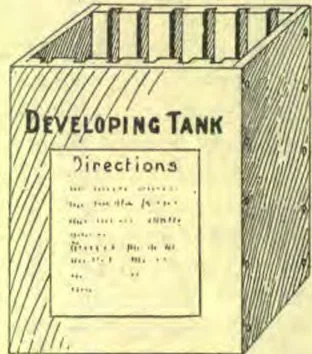
Fig. 1.
To “tank-develop” plates, the exposed plates are placed in a tank (Fig. 1) of very much diluted developer, each plate being slid down into grooves on the inside of the tank. The tank itself is generally made of hard rubber or imitation rubber, but may be of glass, aluminum, or even of wood that has been coated with some waterproofing material; for a home-made tank, bicycle or bath tub enamel of good quality, thoroughly dry, has been used successfully.
The developer may be any of the ordinary kinds, but preferably one that does not soon oxidize and discolor. The ordinary strength will be diluted five or ten times with water, or even more. Into this the plates are slid, a cover is put tightly on the tank, and the photographer can leave the dark room, and go about his other work for half an hour or more. Then he comes back, and one by one examines his exposures by the ruby light. If any are finished, he rinses and fixes them. But probably none are ready, and he waits another half hour, and another, and another, till every exposure has yielded a satisfactory plate or film. In some of the finishing houses dozens, and often hundreds, of negatives are undergoing tank development at all hours of the day.
I have no hesitation in recommending this method of negative making, because I know it will do good work. But if you do decide to practise it, don't be impatient for quick results. Allow plenty of time, or you will get thin, under-developed negatives. Give them plenty of time to gain contrast.
Developers for Tank-Development
By Edison Driver
The “developing-machine” powders for film, as sold by all dealers, are good for plates as well. But several workers recommend the following:—
Carbonate of soda 1 ¼ oz.
Sulphite of soda ¾ oz.
Glycin ¼ oz.
Water (hot) 16 oz.
When ready for use, add eight ounces of water to every ounce of this stock solution, or more or less, as may be desired. The more water, the longer will be the development; and the less water, the shorter.
FIG. 3
Photography by Moonlight
Moonlight is very dim compared with sunlight. I have learned by experiment that on a bright moonlight night it requires an exposure of from five to twenty minutes or more, with the full, open lens of a common hand camera to yield a picture on a fast plate. A fairly accurate rule is to first figure out the exposure you would give the same view in broad sunlight (a snap shot with a common camera would perhaps be 1-50 of a second or less), and then multiply this by one hundred thousand, and you will have something like the correct time for the night picture.
Do not try to include the moon itself, because it will move during the exposure. If the moon is really desired, it can be retouched in afterward.
FIG. 5
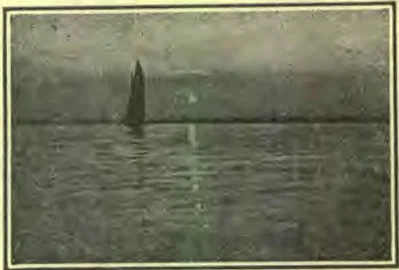
Nowadays many pictures appear in the papers and magazines, purporting to be “moonlights;” in them are rippling waters or dashing waves, which tell us plainly that the exposure could not have been more than the fiftieth of one second. These “moonlights” are not moonlights at all, and a truer, though less poetic name for them would be “sunlights.” One of these, with a moon retouched in, is shown in Fig. 2.
To make them, the camera is pointed across the water, toward the morning or evening sun, and a snap-shot exposure made. It is developed in a weak developer to make rather a thin negative. This makes “moonlight,” and, if we wish, a big round “moon” can be retouched in.
An Interesting Use of Flash-Light
FIG. 2
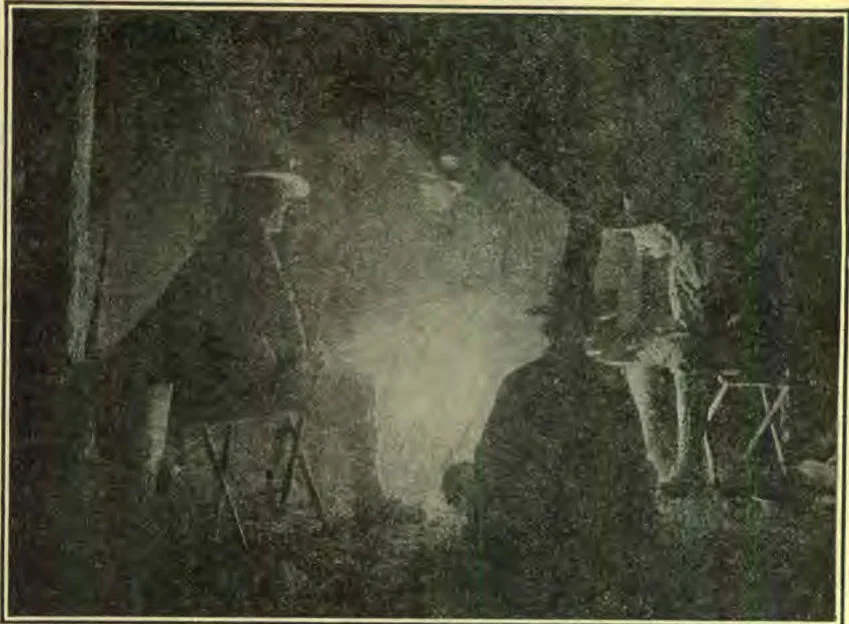
Every one is familiar with the common use of flash-light for making pictures in dark places; but I think the following way of using it will be new to most of my readers. For instance, there is a group of people seated around a camp-fire, and we wish a photograph of it. We know that firelight is red, and does not take well; it would require perhaps a quarter of an hour to make a good exposure. Now it is only necessary for some one to throw a bit of flash-light material on the fire, and the brilliant flash produced will give us our picture in an instant. It is understood, of course, that the camera shutter is to be opened before the flash, and left open until the exposure has taken place. Flash-light may thus be used in fireplaces, forges, stoves, and even lamps (if old chimneys are used) for securing quickly the effects of firelight.
Fun with Blue Print Paper
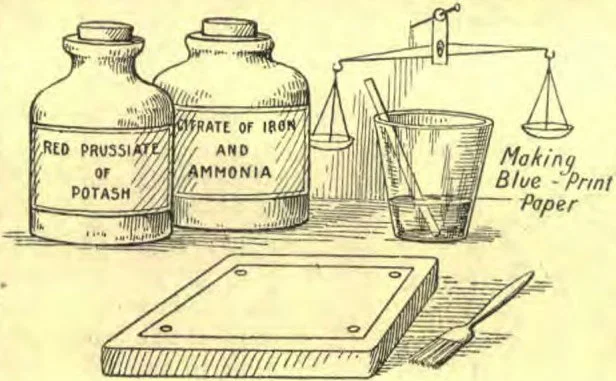
Blue print paper can be bought for fifteen cents per two dozen sheets, 4 x 5, in some places, and it can also be prepared by the user easily. To prepare it, dissolve 1⅞ ounces citrate of iron and ammonia in 8 ounces of water. Keep in a dark-colored or paper-covered bottle with a good stopper. It must not be kept in the light. In another bottle of 8 ounces of water dissolve 1¼ ounces ferricyanide (red prussiate) of potassium. Keep this tightly corked also. For use mix ½ ounce of each of these solutions, and spread the mixture thinly and evenly on white paper, cardboard, backs of postal cards, or other material on which it is desired to photograph. Dry the paper in a warm dark room.
It might be well to say right here that blue-print mixture does not keep well, and if one has a pair of scales, it is better to weigh out and mix a small amount of the chemicals at a time. An ounce of the mixture should cover a great deal of surface. It may be applied with a soft brush, a tuft of cotton, or a wad of thin white cloth.
This paper, when dry, can be printed on under a negative in sunlight. When the shadows have become slightly bronze-gray in color, wash the print, and it will immediately develop out into a beautiful blue picture. The washing makes it permanent, and when dry it is finished.
In the same way leaves and drawings can be copied, by laying them on glass in a printing frame, putting in the paper and exposing in the sunlight. Prints will, of course, be negatives of the leaves; but if one wishes, he can print from these negatives just as he would from any negatives, and thus secure positives.
FIG. 4
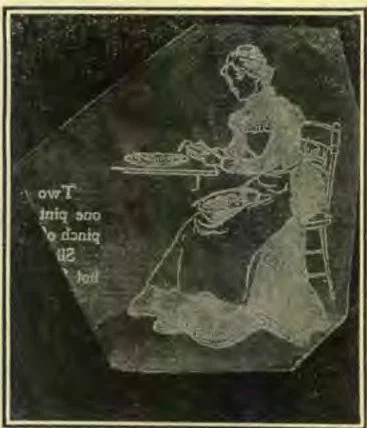
Many interesting uses for the paper will suggest themselves to the boy or girl who loves to experiment. They will find that it is only necessary to write in good black ink upon any thin paper, oil the paper to make it more transparent, and a print can be made of the writing or drawing in a few moments in the printing frame. Pictures cut from the papers and magazines are easily copied in this way. Fig. 5 shows how one will look.7
If there happens to be printing on both sides of the paper, it must be removed from one side in the following manner: Wet the picture in a pan of water, and lay it face down, that is, the side you wish to save, on a smooth hard surface, as on a piece of glass, tin, or a plate. Remove all the water you can by blotting with a piece of cloth or blotting-paper. Then with the finger tips carefully rub away the printing that is not desired. If care is used, it will take but a few moments to remove everything that is not wanted, and the remaining picture can be dried, oiled, and printed. Of course you can combine your own handwriting or drawing with what you find printed, and many interesting and amusing effects can be secured. You will have only to oil these blue-print negatives and print from them to make positives just like the original prints.
Another way to make a blue-print negative is to first expose a piece of blue-print paper in the sun till it is very blue, wash and dry, and then write and draw on it with a pen dipped in either a strong solution of sal-soda (carbonate of soda) or a solution of oxalic acid (poison). You will find that your pen will leave a white line behind it, just as if you had written with a fine white ink. When the drawing is made, it will be a negative, and you can print positives from it.
What Are “Magic” Photographs?
I have been asked many times what the so-called “magic” photographs really are. They come in a little envelope and appear to be squares of perfectly white paper. A little piece of blotting-paper accompanies them, and this is to be wet with water, and has the power of developing pictures on the blank papers, when they are laid upon it—much to the astonishment of the purchaser.
Any one can prepare them. First prepare a solution of bichlorid of mercury—½ ounce, water 4 ounces. Keep it in a bottle, and label it “poison.” In it bleach out any photograph you wish to convert into a “magic.” The bleached print can then be washed, dried, and kept for years. To cause the original picture to appear upon it, lay it on a piece of blotting-paper that has been once soaked in sulphite of soda solution, dried, and again moistened when wanted for use. There are other ways to make the print appear. I have not tried them, but am told that carbonate of soda, ammonia, hyposulphite of soda, or even tobacco smoke will do it.
EDISON DRIVER.
INTERMEDIATE LESSON.
VII — Result of Sin
(November 17)
MEMORY VERSE: “For the Son of man is come to seek and to save that which was lost.” Luke 19:10.
REVIEW.—In the beginning was —, and the — was with —, and —. All — were made by —. And thou —, in the — hast laid —, and — are the works of —. By — were —, and all — by the —. For — spake, and —. He —, and it —. In six — the Lord made —. Thou hast made —, and for — they are, and were —. Of old — hast laid —, and the — are the work of —. They shall —, but — remainest. All of them shall — like —. As a — shalt thou change —. When I consider —, what is — that thou art mindful of —? Thou madest him to — have — over —. Thou hast put — under —. All —.
Questions
What did Adam and Eve lose because of disobedience?
How did Satan seek to overcome Jesus? Luke 4:5-7. Why? What did he show the Saviour? What did he offer to give him? On what conditions? How did Jesus overcome the temptation?
What did God do to the earth because of Adam’s sin? Gen. 3:17-19. What sentence was pronounced on Adam?
What did God see on the earth soon after this? Gen. 6:5-7. How did this make him feel? What did he say he would do? With what was the earth filled?
How did he destroy the earth? Gen. 7:17-24. How many were saved alive?
What did Noah do to prepare for the flood? Gen. 6:14, 22. What would have been his fate if he had not done as God said?
When will the earth again be as it was in the days of Noah? Matt. 24:37-39. What will the people be doing? Will they know the Lord is coming? Why not?
What will some say at that time? 2 Peter 3:3, 4, 7, 10. How will the earth be again destroyed?
How will the day of the Lord come to some? 1 Thess. 5:2. To whom will it not come as a thief? Verse 4.
For what may we look after the earth has been destroyed by fire? 2 Peter 3:13, 14. Seeing we look for such things, what should we do?
Lesson Story
Because they disobeyed, Adam and Eve lost the dominion given them. Satan then became the “prince of this world.”
Jesus came to our world to seek and to save that which was lost.
Satan knew if he could cause Jesus to sin, he would then rule the world forever, so he used all his power in tempting him. He tried to make Jesus believe that he could gain the world in an easier way than to suffer and die. After showing him all the glory of its kingdoms, he said, “If thou therefore wilt worship me, all shall be thine.” But Jesus overcame all the temptations of the devil by depending on what God had written. We may overcome in the same way.
Because of sin, God cursed the earth, and told Adam he should die.
It was only a short time till the world became so sinful that God said he would destroy it. “And it repented the Lord that he had made man on the earth, and it grieved him at his heart.”
“But Noah found grace in the eyes of the Lord.” The Lord told him to make an ark, and that he and his sons and their wives should go into it, and thus be saved from the flood of water he was about to bring upon the earth. There were only eight persons saved alive of all that were then living on the earth. Had Noah not believed what God said, and done that which he told him to do, he would have been destroyed with the rest.
Jesus says, “But as the days of Noah were, so shall also the coming of the Son of man be. For as in the days that were before the flood they were eating and drinking, marrying and giving in marriage, until the day that Noah entered into the ark, and knew not until the flood came, and took them all away; so shall also the coming of the Son of man be.”
At that time there shall come scoffers who will say, “Where is the promise of his coming? for since the fathers fell asleep, all things continue as they were from the beginning of the creation.” The world as it was in the days of Noah, being overflowed with water, perished; “but the heavens and the earth, which are now, by the same word are kept in store, reserved unto fire against the day of judgment and perdition of ungodly men.”
But because men will not believe that the world is to be overflowed with a flood of fire as it was covered with a flood of water, the day of the Lord will come to them as a thief in the night. “But ye, brethren, are not in darkness, that that day should overtake you as a thief.” Some will believe God and get ready to meet the Lord, and they will be saved.
After the earth has been purified from sin by fire, then there will be created new heavens, and a new earth, in which the righteous shall dwell evermore. “Wherefore, beloved, seeing that ye look for such things, be diligent that ye may be found of him in peace, without spot, and blameless.”
VII — The Word in the Plan of Salvation
(November 17)
MEMORY VERSE: “Thy word is a lamp unto my feet, and a light unto my path.” Ps. 119:105.
Questions
What is one important agency in the new birth? 1 Peter 1:23.
What is the word of God called? What is accomplished by the presence of God’s truth in the heart? John 17:17.
What should we therefore do? For what purpose? Ps. 119:11.
What may we know if we keep his word? 1 John 2:4, 5.
Upon what does our Christian life depend? Matt. 4:4.
What example did the Saviour give us concerning the use of the Word? Luke 4:4, 8, 12; note 1.
What promise is made to those who keep the word? Rev. 3:10.
What assurance have we that God’s word will not fail? Isa. 55:10, 11; note 2.
Notes
Whenever one is encompassed with clouds, perplexed by circumstances, or afflicted by poverty or distress, Satan is at hand to tempt and annoy. He attacks our weak points of character. He seeks to shake our confidence in God, who suffers such a condition of things to exist. We are tempted to distrust God, to question his love. Often the tempter comes to us as he came to Christ, arraying before us our weakness and infirmities. He hopes to discourage the soul, and to break our hold on God. Then he is sure of his prey. If we would meet him as Jesus did, we should escape many a defeat. By parleying with the enemy, we give him an advantage.—“Desire of Ages,” pages 120, 121.
The Word of God is not simply so many leaves, chapters, and verses. It is a thing of life. If all copies of the Scriptures in existence were burned, the word of God would still stand fast. Heb. 4:12, R. V.; 1 Peter 1:23.
TAKE time to talk with God.
The Letter Box
WASHINGTON, D. C., Oct. 3, 1906.
DEAR EDITOR: The following books, “Great Controversy,” “Coming King,” “The Story of Daniel the Prophet,” “Christ’s Object Lessons,” and the Bible, are the ones I have chosen for my course of reading.
I will be glad for any instruction or help you may give me. I want to know how to give the truth to others, but can not express myself as clearly as I would like. What books would be a help to me in that line? I have been canvassing a little in my spare time, and like it very much. Pray for me. VIOLET WILLIS.
BRUNO, MINN., Sept. 5, 1906.
DEAR EDITOR: Please find enclosed answers to Scripture Enigma of YOUTH’S INSTRUCTOR, dated Aug. 28, 1906. I have read the fourteen chapters to which reference is made. I am reading the Bible through; have read nearly as far as the book of Ruth. My mother teaches the YOUTH’S INSTRUCTOR class in Sabbath-school. I am in her class. I am fifteen years old. I sold ten copies of the Life Boat and five copies of the Earthquake number of the Signs. A church-school is being built on one corner of our land. Love to all. MARGARET TURNER.
SALEM, ORE., Sept. 2, 1906.
DEAR EDITOR AND READERS: On the fifteenth of June a chimney-swift started to build a nest in our house, on a shelf up-stairs. The male and the female went together, but the female did all the building, the male sitting on the top of the house while she was building.
It took her nine days to get the nest built. Then she laid five long, slim, pointed pearly white eggs. When she had sat a week, she took a day off, and gathered more goose feathers, going about half a mile to get them. Then she sat another week. One chick hatched the twelfth of July, three the thirteenth. Then she left the nest to get them food. The little birds kept the other egg warm, and it hatched the next day.
Both male and female were kept busy bringing flies, all of which they caught on the wing. The father would come flying in, and as soon as he came near, he would say Chiet-chiet-chiet, and feed them and go right away, but the mother would creep in softly to the edge of the nest, and say Chir-r-r-r-r-r. After the little ones got their eyes open (which took nine days), the parents did not speak at all when they came.
The mother kept the nest clean, and often stayed to visit her babies, but the father never stayed.
The parents soon got tame, so we could put our hands on them when they were feeding their baby birds. The mother was tamer than the father, and one time when I wanted to see the shape of her wing, I took hold of it and drew it out the way it is when she flies.
If we put our hands in when it was dark, she would bite at us. When the little ones’ eyes were open, they would try to scare us by snapping their bills, and flipping their wings. When we tried to take them out of the nest, they would hang on with their sharp claws.
They left the nest when they were three weeks old. One left the second of August, one went the third, and three the fourth. As soon as the first one went away, those left in the nest did not get much attention from the old birds.
There is a bird I have seen, which I do not know the name of. It has a bright-black head, dull-black back, and the wings are of the same color, with a few white feathers. Its sides below its wings are red, and its breast is white. It is a little smaller than a robin. It has a long tail, straight at the end, with a white feather on each side. Its body is slim. It eats seeds. In the winter it is found with the juncoes. Please tell its name.
Another bird is a little larger than a yellow bird. Its wings are black with yellow spots; it has a black strip across its back between its shoulders; its head is bright-red; and the rest of its body is yellow. I have seen only one like it, so I can not tell much, but maybe some one can tell me its name.
We take the INSTRUCTOR, and like it very much. I will close now as my letter is long.
Your friend,
GLADYS ROSSER.
Miss Gladys has written an exceedingly interesting letter. We shall be glad to hear from her again. I am sure if she reads from some good bird book, the description of the towhee, or chewink, she will find that the first bird she asks about answers the description perfectly. Perhaps by this time, Miss Gladys, you have seen again the second bird you mentioned. If so, send me another description, noting carefully all details, and I may be able to identify it with certainty. Does the following description of the yellow-bellied sapsucker describe your bird? It is about two inches shorter than a robin; the back is black, white, and yellowish; below it is greenish yellow; tail black, white on middle feathers, white edge to wing coverts; crown, chin, and throat bright red; bill about as long as head.